Still have questions? Leave a comment
Checklist: Dissertation Proposal
Enter your email id to get the downloadable right in your inbox!
[contact-form-7 id="12425" title="Checklist: Dissertation Proposal"]
Examples: Edited Papers
Enter your email id to get the downloadable right in your inbox!
[contact-form-7 id="12426" title="Examples: Edited Papers"]Need
Editing and
Proofreading Services?

Your vs. You’re: Learn the Differences with Easy Examples
 Aug 10, 2026
 10
min read
10
min read
You’re and your are two of the most commonly confused words in the English language by students, professionals, and even native speakers. Though they sound exactly the same, their meanings couldn’t be more different. A big reason for this confusion is the common association of apostrophes with possession, which misleads people into mixing up the two terms. In this article, we’ll break down the difference between your vs. you’re with clear explanations and real-world examples.
We’ve included specific phrases to help you figure out whether to use your or you’re in context, plus some handy tips and a quick-reference guide. Let’s jump in!
Are You Facing Vocabulary Errors? Let Our Editors Help You Write Better. Get Started
What is the difference between your and you’re?
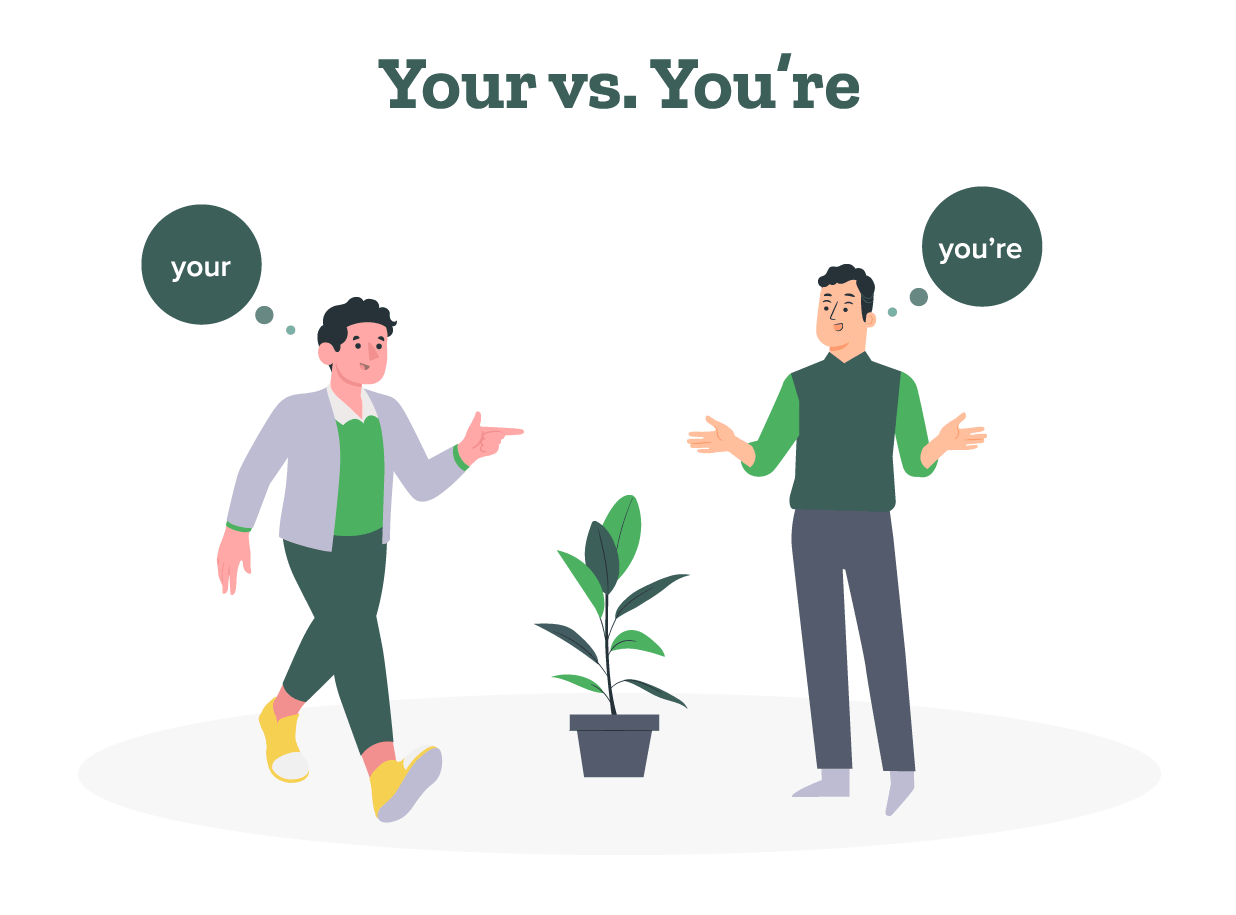
Here’s the difference between you’re vs. your: Your shows ownership. You’re is a contraction of “you are.”
Your is a possessive pronoun that shows belonging and ownership. It is derived from the personal pronoun you and is usually used before a noun. ‘Your’ is a possessive form. It indicates ownership, as in the phrase ‘your car’.
This is your book.
I took your book to read.
You’re is a contraction of the words you and are. For example:
You’re not the only one who has problems.
She knows that you’re a senior manager at Deloitte.
The above examples demonstrate the difference between these two homophones.
The golden test: Replace “you’re/your” with “you are.” If the sentence still makes sense → use you’re. If it breaks → use your. This one trick catches the mistake almost every time.
Your vs. you’re: quick-reference table
Before diving into the phrase-by-phrase examples, here’s a side-by-side comparison to anchor your understanding:
| Reference | Your | You're |
|---|---|---|
| Part of speech | Possessive pronoun | Contraction (you + are) |
| Function | Shows ownership or belonging | Describes a state of being |
| Used before | A noun or adjective | A verb, adjective, or noun phrase |
| Expand to | Cannot expand; it's one word | "You are" |
| Example | Your jacket is nice. | You're wearing a nice jacket. |
Your vs. you’re examples
1. Your welcome or you’re welcome
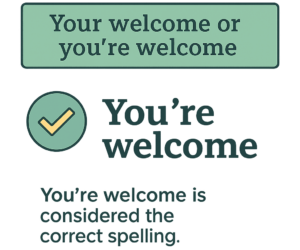
You’re welcome is considered the correct spelling if you’re responding to someone saying thank you, as it is used to express a state of being appreciated. However, if you are describing someone’s welcome, your welcome can be used. Here are some examples to clarify the meaning further:
You’re welcome! I’m happy to help.
Your welcome was grand and memorable.
2. Your right or you’re right
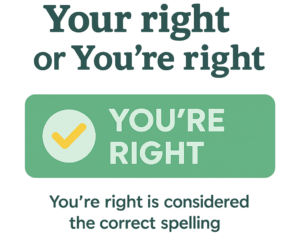
You’re right is regarded as the appropriate spelling if you wish to acknowledge that someone is correct about something. However, your right is the accurate spelling if you are talking about someone’s rights.
You’re right about finishing the foreign assignment first.
Know your rights and avoid getting duped by anyone.
3. Your or you’re beautiful

You’re beautiful is correct as a standalone phrase. However, if you are referring to someone’s beauty in a sentence, your beautiful is the right phrase. If you wish to use the contracted form of you and are, you’re beautiful is the right usage.
You’re beautiful!
You don’t know you’re beautiful!
Your beautiful eyes reminded me of a famous dancer.
4. Your good or you’re good
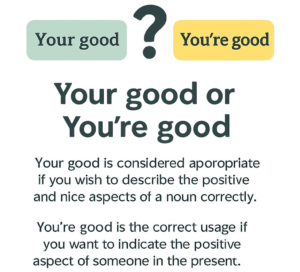
Your good is considered appropriate if you wish to describe the positive and nice aspects of a noun. You’re good is the correct usage if you want to indicate the positive aspect of someone in the present.
Your good jacket has been spoiled.
I know that you’re good people.
5. Your pretty or you’re pretty
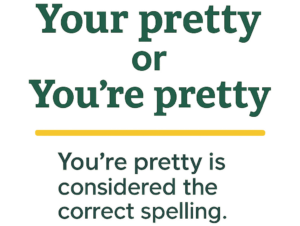
You’re pretty as a standalone phrase is the correct usage. However, if you wish to commend the beauty of a noun in a sentence, your pretty is the right usage. Here are some your and you’re examples of this phrase:
You’re pretty!
Raj said that you’re pretty.
I love your pretty bag.
6. Your the best or you’re the best
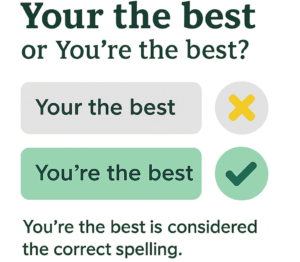
You’re the best is widely accepted as the right usage. Your the best is the incorrect phrase which should not be used.
You’re the best friend in the world.
He thinks that you’re the best artist in the class.
To determine if ‘you’re’ is correct, replace it with ‘you are’ and see if the sentence still makes sense.
7. Your honor or you’re honor
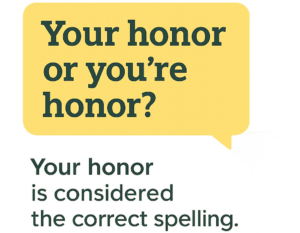
Your honor is considered the correct usage by dictionaries worldwide. When addressing someone, your honor means respect and high esteem. Your Honor is also used as a term to address the judge in judicial courts. You’re honor is regarded as the incorrect spelling.
I rest my case, Your Honor.
Don’t compromise on your honor.
8. Your not or you’re not
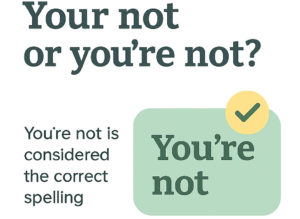
You’re not is the right phrase that must be used. Your not is the wrong usage. ‘You’re’ combines the pronoun ‘you’ with the verb ‘are’.
You’re not responsible for his mistakes.
She hopes that you’re not influenced by the wrong crowd.
Now that we’ve seen your vs. you’re examples, a question arises: When to use your and you’re? Let’s find out!
Why do people confuse your and you’re?
These two words are homophones: words that sound identical but have different meanings and spellings. When you say either word out loud, there’s no way to tell them apart, which is why the confusion runs rampant in texting, emails, and social media posts.
Another layer of confusion comes from the apostrophe itself. Most people learn early on that apostrophes signal possession, so you’re (with its apostrophe) can feel like it should mean “belonging to you.” But in this case, the apostrophe marks a contraction, not ownership.
It’s also worth noting that autocorrect tools on phones and computers don’t always fix this error, since both words are spelled correctly; they just mean different things.
Pro tip: If you’re writing something important, a cover letter, a client proposal, or a research paper, use a professional proofreading service rather than relying on autocorrect alone. AI spell-checkers still miss context-dependent errors like your vs. you’re more often than you’d expect.
Common sentences where writers go wrong
Here are some real-world situations where people consistently pick the wrong word and the corrections:
| Incorrect usage | Correct usage | Why? |
|---|---|---|
| Your going to love this. | You're going to love this. | "You are going" → needs contraction |
| I hope you're day is great. | I hope your day is great. | "Day" belongs to you → possessive |
| Your always so kind. | You're always so kind. | "You are always kind" → contraction |
| Tell me you're opinion. | Tell me your opinion. | "Opinion" belongs to you → possessive |
| You're car needs a wash. | Your car needs a wash. | "Car" belongs to you → possessive |
When to use your and you’re
Let’s make this crystal clear with a simple decision framework:
- Use your when you want to show that something belongs to or is associated with someone. It always comes before a noun or an adjective modifying a noun.
- Use you’re when you mean “you are.” If the expanded form sounds right in context, the contraction is correct.
There are no exceptions to these rules. If the expansion test (“you are”) works, go with you’re. If it doesn’t, go with your. It really is that simple once you make the habit.
How to remember the difference: mnemonics and tricks
Rules are easier to follow when they’re attached to something memorable. Here are a few tricks writers actually use:
- The expansion trick: Replace the word with “you are.” If it works → you’re. If not → your.
- Think of the apostrophe as a placeholder: The apostrophe in “you’re” replaces the missing letter “a” from “are.” No letter is missing in your — it’s already complete.
- Associate ownership words: “Your” shares letters with “our”; both signal belonging. “Our house” → “Your house.”
- Use a sentence mnemonic: “You’re not lending your name to this project.” Here you’re = you are, and your = belonging to you.
We hope this article has resolved all your doubts about your vs. you’re. There are also many other commonly confused homophones like their and there, to, two, and too. To remember the difference between such homophones, you can create mnemonics and jot down simple sentences with these homophones. This will help to remember the meanings of homophones.
As experts in providing editing and proofreading services, we’d love to make your job easier and help you understand concepts better. Go through our list of resources to avoid making common grammar and word choice errors!
- 10 Most Common Grammar Mistakes & How to Avoid Them
- Who vs. Whom: When to Use Which [& Why It’s Important]
- Its vs. It’s: When to Use Its and It’s in a Sentence
- Affect vs. Effect: Meaning, Difference, & Examples
- Em Dash vs. En Dash vs. Hyphen: When to Use Which
- Ms. vs. Mrs. vs. Miss vs. Mx. | Uses and Pronunciations

Tanvi

With a foundation in Life Sciences, Tanvi enjoys curating technical writing tips tailored for ESL students. When she's not translating complex concepts into bite-sized nuggets, she can be found playing with dogs or painting landscapes.
One comment on “Your vs. You’re: Learn the Differences with Easy Examples”
Comments are closed.











You’re kind to give us this proper information regarding your and you’re.