The most basic understanding of “fiction” in literature is that it is a written piece that depicts imaginary occurrences. There is this unspoken assumption that fiction, because it is of imagined events, has nothing to do with reality (and therefore researching for a novel is not important). This is far from the truth.
The history of fiction writing presents an inherent paradox: the most gripping of novels require you to write of imagined events in a realistic way. If we accept literature as a reflection of the world around us, then we must also acknowledge that the best of fiction stems from reality. It may be an account of imaginary events, but is still heavily rooted in the real.
For a writer, this means in-depth research about various aspects of novel writing, including cultural and social context, character behavior, and historical details.
Your task is (ever so slightly) easier if you are writing about situations contemporary to you. But the further you go back, through the annals of history, the harder it becomes to strive for such authenticity.
Grammar mistakes are jarring, but so are plot holes. An inconsistent story is off-putting to even the most immersed reader. So, here’s the bottom line: don’t assume, and get your research down.
Why is research important for fiction?
Because even William Shakespeare, one of the most iconic figures of literature, erred in making anachronisms. One of the most famous literary anachronisms is in his play Julius Caesar, in Cassius’ line:
“The clock has stricken three.” (Act II, Scene 1)
The error is that clocks that “struck” were invented almost 14 centuries after the play was set!
But Shakespeare was a giant. We have forgiven these misgivings because Shakespearean literature is rich even with such minuscule errors. As for us foolish mortals, it’s probably best to do our research thoroughly.
Having a detailed understanding of the landscape that you are writing about is one of the most effective ways to draw your reader into the story world. Your extensive knowledge of your chosen topic will also give you a stable and authoritative voice in your writing.
What should you be researching?
As you might have realized by now, there are various aspects of your novel you should be researching. To start with, we’ve split fiction writing research into two categories: content and form. By content, we mean the details and elements you should focus on within your story. By form, we mean the style and genre of writing you wish to eventually adopt.
Needless to say, these two categories will overlap with each other as you make your story more streamlined.
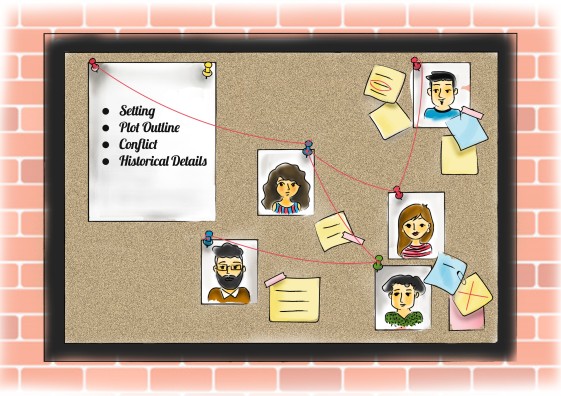
Setting
A story’s setting is one of the most important elements of fiction writing. It is essentially the time and space that your narrative is set in or the story’s backdrop. A story might have a gripping narrative and well-rounded characters, but it is incomplete if the reader doesn’t have a sense of where it’s all happening. As part of your setting, you can include geographical, cultural, social, and political details that you feel are relevant to the story.
In other words, you are essentially creating a “world” for your story. These may seem like tiny details to add to your otherwise imaginary story, but they provide depth and plausibility to your story.
One cool way to get a lowdown on these intricate spatial details like roads, mountains, hills, monuments, and other geographical landmarks is through tools like Google Maps and Street View. This is especially useful if you have to write about a place you can’t visit or you simply want to get geographical descriptions right.
Plot
The worst thing you could do as a writer is to assume things. This is a misstep that is quite unnecessary and can easily be avoided with some research. The information you have already gathered while researching your setting is a good enough start. What you now need to do with all these seemingly scattered pieces of information is to make sure they do not contradict each other.
Character details and human behavior
In plotting your story, you will also automatically gain an understanding of the intention and goals of your characters. In order to flesh them out and ensure that they are dynamic and interesting, research is required.
An understanding of human behavior and nature is a very important skill for a good writer. The stereotype of a perceptive and observant writer is, in fact, due to quite a practical need! Even if your characters do not exist in reality, they should seem real enough for your readers to be able to relate to them.
Historical and social background
Your story world is not just the time, place, and immediate surroundings of your characters. Irrespective of what setting your story has, it also has the larger context of the world that your characters reside in. This could be from a real point in history (like Victorian England, 1920s jazz era, etc.) or it could be completely made up (Oceania from 1984, or Panem).
But irrespective of whether you’re writing historical fiction or creating a new world altogether, it must be thorough and consistent in supporting your plot. As a writer, you must clearly understand the culture and systems that your characters are a part of. A well-rooted universe also gives readers an insight into a character’s identity.
Writing style and genre
If you are writing a novel in a particular genre, it’s important to be aware of writing conventions and tropes commonly used in that genre. The best, and most obvious, way to do this is to read novels and stories in your genre of choice. Look at the top-rated and critically acclaimed books and study them carefully. Be critical in your study, try to understand the author’s creative writing process, and look at the style and tone they try to evoke.
Aside from this, you could also take a look at books about novel writing in general. These will give you general, but useful information about novel writing, like when to write long descriptions and when to cut straight to the action.
How should you be researching?
- Read about what you are researching. Books, articles, and other forms of print media are great ways to gather information on culture, history, and society. Biographies and memoirs are great for character insight (especially if you’re basing your book on a real person). If you’re basing your novel in the real world, you know what to do next. If you’re creating your own world, this is still a good basis for whatever you cook up within your world.
- Films and TV are great sources for helping you develop your character as they help you understand character traits and motivation in your story. Additionally, they might also help you visualize your story.
- If you are writing about characters with a niche profession (for example), take interviews with people who are in that field. For instance, if you are writing a detective story, talk to people in your police precinct and observe their behavior.
- If you are writing about specific locations, read up about that. In the age of the internet, there are many resources and forums where you can interact with people around the world.
- Try to visit the locations you are writing about and spend some time there, to gain an insight into what life in that place is like.
Incorporating research into fiction
Be selective about your details. Whether or not you actually incorporate the details that you have researched, knowing your world well will make your writing infinitely better.
Because of all the information you have amassed, there is a certain bias you acquire as an “expert” on the subject of your story. So if you include a lot of information, there is a danger of your work sounding too technical.
Make sure that every detail you include is directly relevant to the plot. Keep it simple: and avoid unnecessary plot holes.
You can use these practical tips to research for your next story. Once you research and complete your story, the next step is to edit and publish your work. As a trusted brand offering editing and proofreading services, we’d love to help you refine your work.
Here are some other articles you might find interesting:
Book editor: How to train yourself to become one

Book editing is tough and costs you sleepless nights and chewed up nails. But it’s exciting all the same and can give you a window into the magnificent writing that talented authors are conjuring up every day. Many writers have dreamt about becoming a book editor. Maybe it is because of the insight that they would get into their own book or get to see what other authors are drumming up. Becoming a book editor is tough, and there is obviously a lot of competition in the industry. But it is an exciting profession and is definitely something that you should go ahead with if you have ruminated over it in the recent past.
Book editing can come through a variety of means. You can either become a book editor and work with a company independently without being their ’employee’, you can be a freelance book editor, which means you can edit and proofread books independently or you can be a book editor for a publishing house or editing and proofreading company.
We have some tips for you on how to start out on the path to become a book editor.
- Get some training: You do not have to have a bachelor’s degree in English to even dream of being a book editor. But it is necessary to know the technicalities of book editing. It is better if you look up online book editor modules or look up short term courses at least. It’s important to know the technicalities of book editing: the levels of book editing, jargon and the industry. Make sure that whatever course you choose has a sample for you to do at the end for you to understand whether you need more training or you are ready to get your hands ink-stained in the field.

- Read up everything you can get your hands on: It is without a doubt that a good book editor has to be an avid reader as well. Through extensive reading, you’ll be able to understand what is important in the art of writing, which ultimately will help you understand how to approach a book or document when you start editing it. Reading will also help you understand what approaches other book editors take.

- Improve your writing skills: Even if a bachelor’s degree is preferred, it is possible to break into the field without a degree. But for this, you need strong writing skills. Ensure that your grammar is impeccable and you understand the ins and outs of the English language well. Even if you then break into the field without an English degree, you will be able to edit books or documents in other domains than literature: fashion, technical, science and technology.
/writer2-172409300-58ae4fbb3df78c345b7c5b62.jpg)
- Practice everyday and get experience: A book editor usually needs to have some experience writing and proofreading. Apply for book editing internships or work as a writer, editorial assistant, or reporter. You can get internship opportunities through the many apps available or you can scour LinkedIn. Apart from this, it is very important that editors develop basic computer skills: electronic publishing and social media. These internships will inculcate other skills into your resume such as finding good and compelling stories and how to communicate with writers throughout their writing journey.

Book editing and becoming a book editor is a path that many want to take but are intimidated by. And you are right, it is intimidating. But with PaperTrue‘s guidance, proper understanding of the job and determination, you will book (pun intended) yourself a spot in the editing world!
How to Hire a Book Editor in 5 Practical Steps
Writers have many doubts about how to hire a book editor. Do you need to hire a professional editor in the first place? When should you look for one? Where can you find the best book editor to for hire, and are they worth the expense?
In this article, we’ve listed all the important things you need to know while hiring a book editor.
What is a book editor?
A book editor is a professional trained in the task of spotting errors in your manuscript and giving additional feedback on how it can be improved. Book editors can be employed by publishing firms, can be freelancers, or work with an author service company.
Working with a book editor is a tricky endeavor and it can go the wrong way very easily, if you’re not careful about hiring the right one. To be honest, the logistical part of the “how to hire a book editor” question is easier to handle. You read articles, you explore your options, and eventually, you find someone to work with.
But there’s more to working with an editor. As a writer, you’re attached to your book. Beyond the sheer effort you have poured into it, the book has immense sentimental value. So when a book editor starts knocking down the precious palace it took years for you to build, you’re bound to get angry!
And this is where the problem lies. In order to avoid hurt feelings, unnecessary irritation, and a failed writer-editor partnership, you need to account for these aspects of hiring a book editor as well.
For now, let’s address the logistical side of how to hire a book editor.
Is it worth hiring a professional editor?
It’s easy to imagine that while self-publishing your novel, self-editing is an acceptable option. However, this works out only in theory. You have neither the training nor the objectivity to edit your own manuscript effectively, so self-editing does not work. Here’s a quick guide to the book editing and proofreading process, in case you’d like to read more.
So if you’re writing a novel, you may imagine that you can ask friends and family to review it for you. They may catch a plot hole or two, comment about a character here and there, but that is about it. These people don’t have the expertise and experience that makes a professional novel editor invaluable.
A fiction editor knows the genre conventions of romance and mystery. They know the audience expectations and industry standards for fantasy, thriller, and children’s books. Based on this knowledge, a professional novel editor’s insights are far superior to any beta reader’s opinion on your manuscript.
Plus, editing is much more than just catching spelling mistakes and plot holes! As you’ll soon discover, you won’t be hiring an experienced professional editor for your book, you’ll be hiring a whole team of them.
How to hire a book editor
In the five steps below, we’ll tell you how to hire an editor for your book when you have nothing but a freshly written manuscript in hand. From selecting what kind of editor your novel requires to actually working with a fiction editor, we’re covering your entire journey.
1. Decide what kind of book editor you need to hire
Book editing and proofreading is a long process that consists of multiple checks for different issues in the manuscript. There are five essential editing tasks, and individual editors often specialize in one or a couple of these.
- Editorial assessment: An editor surveys your book and gives you their feedback in the form of a detailed letter, informing you about the kinds of editors you require.
- Developmental editing: This edit surveys the broad elements of your book, telling you which parts of your book work and which ones don’t.
- Copy editing: The copy editor scrutinizes your pages and paragraphs to remove all inconsistencies, grammar mistakes, and punctuation errors.
- Line editing: The line editor takes a look at your style and word choice, focusing on the tone and emotion in your writing. Editors often offer this along with copy editing.
- Proofreading: This is the final overview of your work, removing all remaining errors from your book. A round of proofreading is crucial before publishing your book. If you’d like to read more about how proofreading changed modern publishing, visit this page.
If you want to know when you should hire a book editor, you first need to find out the kind of editor you require. In case you’re still in the development stage and need a second opinion on your ideas (and the rudimentary stages of their execution), you will have to approach a developmental editor.
However, if you need someone to go through your paragraphs to remove mistakes and inconsistencies, then you need the help of a copy editor. The editorial assessment gives you some perspective on this decision, so it’s always recommended to have it done.
2. Hire a novel editor at the right time
The work of the developmental editor comes before that of the copy editor and the proofreader, so naturally, you need to hire a developmental editor much earlier. However, while hiring a developmental editor, you also need to make sure that your ideas aren’t half-baked.
The most common problem with new writers is that they hire a professional editor too soon, not comprehending what falls under the editor’s purview. It’s understandable to consult a developmental editor while finalizing the broader elements of your book, but you need to understand that in the end, the writer has to put in the work and actually write their book.
Many new writers also make the mistake of not reviewing their finished draft before sending it to the editor. This results in the editor having too many issues to sift through, affecting the nature of their work and their relationship with you. Make sure to review your draft multiple times before you hire a professional editor.
Reviewing your draft yourself also helps lower your costs. Remember: the denser your edits, the higher the cost! So, what is the right time to hire an editor?
While you need to ensure that your manuscript is ready for the editor’s eye, you also need to keep in mind that reputed, reliable editors are almost always booked. You need to book them a few months in advance to ensure that your manuscript gets reviewed and edited in due time.
So, your draft needs to go through a few rudimentary edits before you send it for editing, but you also need to book editors in advance. While hiring an editor, you have to aim for the fine balance between these two things.
3. Find book editors online
As a self-published author, it is unlikely that you can access (or afford) established editors in the genre of your book. The names that you read on popular titles are almost always associated with a publishing house, the very thing you’re trying to avoid by self-publishing.
Fortunately, you don’t have to restrict yourself to the established system under self-publishing. You can hire a team of freelance editors to edit and proofread your manuscript, or hire an editing firm to do the same.
Freelance editors
You can find a book editor for hire on platforms like ServiceScape. These sites feature a large number of freelance editors from which you can assemble your editing team. You’ll need to check recommendations and ask for sample edits while selecting each individual editor for your specific editing and proofreading requirements.
You should hire a novel editor that has worked in your particular niche. For example, the author J. Thorn specializes in dark fantasy. He works as a developmental editor and writing coach for other authors with similar interests, so if your novel is a work of horror or dark fantasy, he may be a potential editor for you to work with.
The problem here is that experienced editors are often booked for months, so it might be difficult to find a schedule that works for both parties. However, if an editor is busy or somehow isn’t the best choice for you, they might know which other editor can be the right fit. So, contacting even one professional novel editor can help you start your process of hiring an editor.
You can also get in touch with other writers whose genre and writing style is similar to your own. Make use of your network in the writing community, especially on social media sites like Reddit, Twitter, and Facebook, where it is much easier to find leads. Other than the sites mentioned above, Upwork and Fiverr are also great places to look for freelance editors.
Problems with hiring a team of freelance editors
Keep in mind that working with a number of different people might hike your editing costs. Moreover, experience and proven results come with an added cost, so finding a seasoned editor through this method will cost you more. If you can’t afford to spend a fortune on book editing, hiring an editing service might be the best option for you.
You need to know that it can be a whole task and a half to choose the right people out of the large (sometimes daunting) number of editors featured on various websites. You also need to look at sample edits to ensure that your working style and work ethic matches that of your editor. It takes time and effort to screen the available options and select the right team to edit your manuscript.
For writers who are new to self-publishing, this process brings a lot of anxiety and stress. There’s nothing worse than being stuck with the wrong people, or spending money on a botched editing job.
Editing companies
Editing firms help you avoid unnecessary complications, simplifying the book editing process. Author services not only handle all necessary editing tasks with skill and coordination, but also ensure a quick and timely completion of the edits.
These firms have years of experience working in the publishing industry, due to which they are well informed about the readership. They edit your document with your reader in mind, adding more value to your book.
More importantly, editing companies are also familiar with the trends and standards in the publishing industry. So, they can bring your book to the level at which it can compete with traditionally published books.
Plus, most of these companies offer lower prices on combined editing processes and discount offers from time to time, bringing down your editing costs by a significant margin. If you’re new to self-publishing, this might be the most pocket-friendly and stress-free option for you.
Here’s a comprehensive list of the best editing and proofreading services that you can refer to while making your decision.
Also read: Book Proofreading 101: The Beginner’s Guide
4. Ask for a sample edit
Most editors should be alright with offering a free sample edit before you hire them. However, if someone asks you to pay for a sample, don’t hesitate. Like all other professions, editing requires hard work, so you should pay the editor for their time and effort.
A sample edit tells you the editor’s working style, their degree of ruthlessness, and their expertise. This is a glimpse into what it looks like to work with this editor, so it helps you choose better.
If there are issues in this edit, clearly you’re not going to be happy with this editor. If there are glaring errors they failed to spot or unnecessary harshness in their feedback, these are clear indicators for you to keep looking for a better option.
The right book editor for you is the one who works according to your requests and respects your individual voice. They possess the skills to spot the words that aren’t working, and the tact of telling you why. If a novel editor cannot manage these basic tasks, they’re not the person to handle editing for your manuscript.
5. Give clear instructions
Learning about how to hire a book editor requires you to know yourself as a writer. If your cookbook contains a recipe you copied out from your grandma’s old diary, let your editor know. If you have a problem with someone rearranging your sentence structure randomly, tell your editor that.
In order to avoid irritation and disappointment, give clear instructions to the book editor you hire. Be direct in the brief, so the book editor can work accordingly. Trust us, this makes for a much healthier working relationship!
Things to remember when hiring a professional editor:
- Check what kinds of editing your manuscript requires.
- Review the manuscript a few times yourself before sending it to a book editor.
- Start early on booking an appointment with a reputed editor.
- Ask for sample edits and check recommendations.
- Give clear instructions to help the editor work better.
Tips to Self-Edit Your Dissertation

Is it possible to edit your dissertation yourself? Certainly, under the right circumstances and with the right practices. While it is usual practice to have your dissertation looked at by another person (your supervisor/colleague) or use professional editing services, it is definitely possible to significantly improve your dissertation yourself if you follow some tips and tricks of the trade that we will list, just for you!
Read one word at a time
The first mantra of self-editing, and indeed any kind of editing, is reading one word at a time. On a word processor like MS Word or Google Docs, what this translates to is reading with the cursor. While reading a document, place your cursor on the word you are reading, and move the cursor as you read on. Pressing “Ctrl” and the right arrow key makes the cursor go from one word to the next on Google Docs or MS Word. This is a great way to spot spelling errors as well as errors in sentence construction and phrasing, as you are really focusing on the document at the word and sentence level, instead of reading through your own writing, like you probably have several times.
This is especially important for editing your own writing. As you read what you have written over and over again, the eye becomes trained to skip over sections, filling in the blanks from memory. By disciplining and forcing yourself to go through each word, you can avoid making several of these errors.
Run a spell check
Almost all word processors have a default spelling and punctuation checker. In MS Word and Google Docs, this functionality can be accessed with the F7 key. The checker goes through the document and highlights any possible errors: red indicating spelling errors, green indicating grammatical errors, and blue indicating areas of improvement, such as the use of passive voice or concise alternatives to long phrases or sentences.
Regardless of how closely you have read your dissertation, even implementing the above advice of reading word after word, owing to human error, there may well be several issues that slip through the cracks. The spell checker is a helpful tool to patch these inadvertent errors.
Note that since the spell checker is often unaware of terminology from various subject areas, there may be several words and phrases it highlights that are not actually errors. Gene names, for example, are usually highlighted in red as they are not recognized words. Similarly, abbreviations may be highlighted. The spell checking functionality should just be used as a guide. The final decision to implement what the spell checker recommends rests on you, and you should exercise this choice carefully.
Run search checks
There are several commonly repeated errors in every manuscript that you can actually search for and resolve. Some of the common ones are listed below:
- Double spaces
- Double punctuations (../,./,,)
- Hyphen between numbers to indicate range (should be en dash instead)
- US and UK English inconsistencies (realize vs realise)
- Inconsistent use of abbreviations (check if the full term has been used multiple times)
Some of these issues will probably already be flagged by the spell checker, but it is worth it to run a check again just in case. Aside from this, if you detect any other issue in your writing that is repeated (for example, using a comma after “such as”), you can run a search for that issue alone throughout the dissertation and fix it.
Use Google Scholar
The Google Scholar tool lets you search through existing databases of published studies. Unlike a normal Google search, the Google Scholar only features hits from published academic papers. This tool can therefore be very useful to you when editing your own dissertation. If you are confused about the use of a specific term in a particular context, you can just run a search and see if the term has been used that way by other authors in published studies. A high number of hits means that a particular use is acceptable. On the flip side, getting less than three hits is a red flag. Google Scholar can get you out of some quite tricky situations, especially if you are not fully aware or updated about subject-specific conventions. Let’s examine this with a few examples:
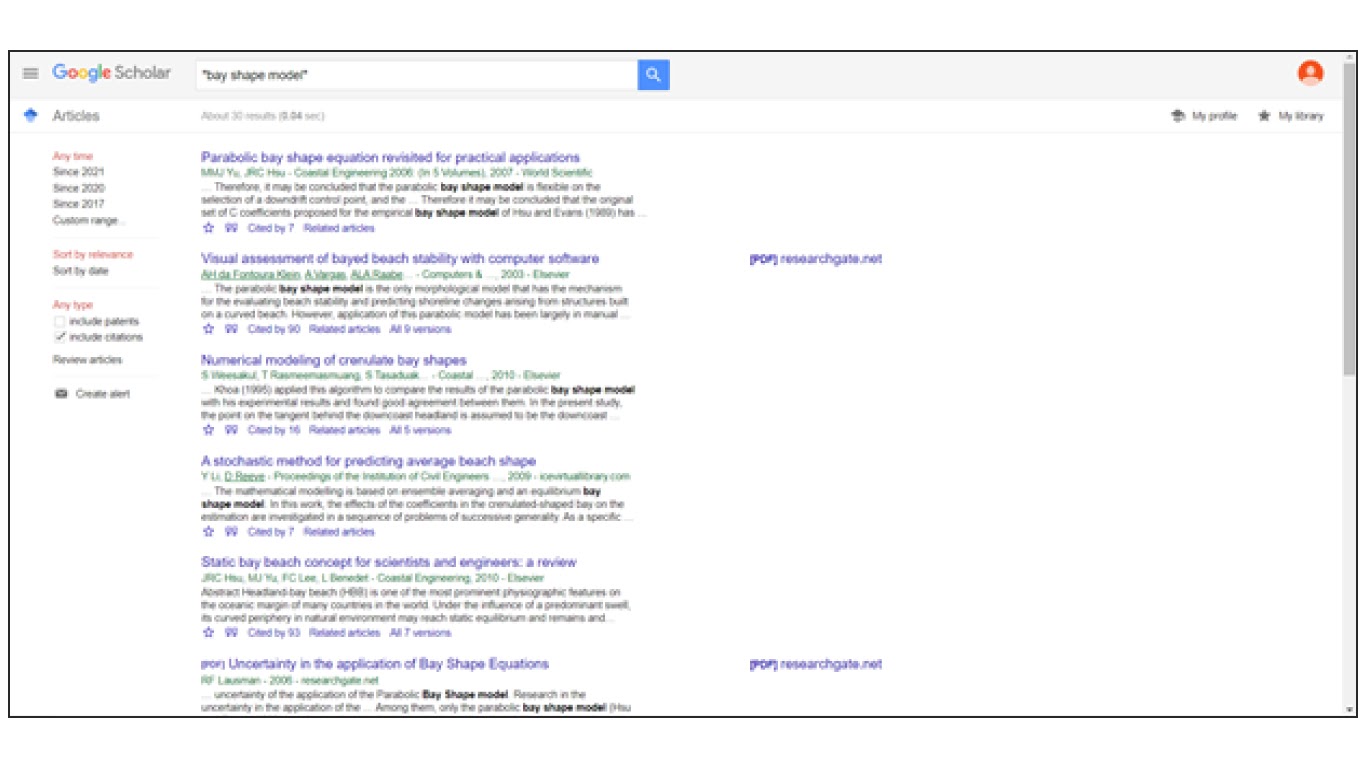
If we wish to verify a fairly common term such as “bay shape model”, we can run an exact search for it on Google search, and we come across several hits. It is this easy to verify that the term exists across published literature. We can also see that the term coexists commonly alongside some other adjectives such as “parabolic”. This gives us a good idea of the fact that the term in question is used as a noun.
However, if we erroneously change the order of words to “shape bay model” and run another search:
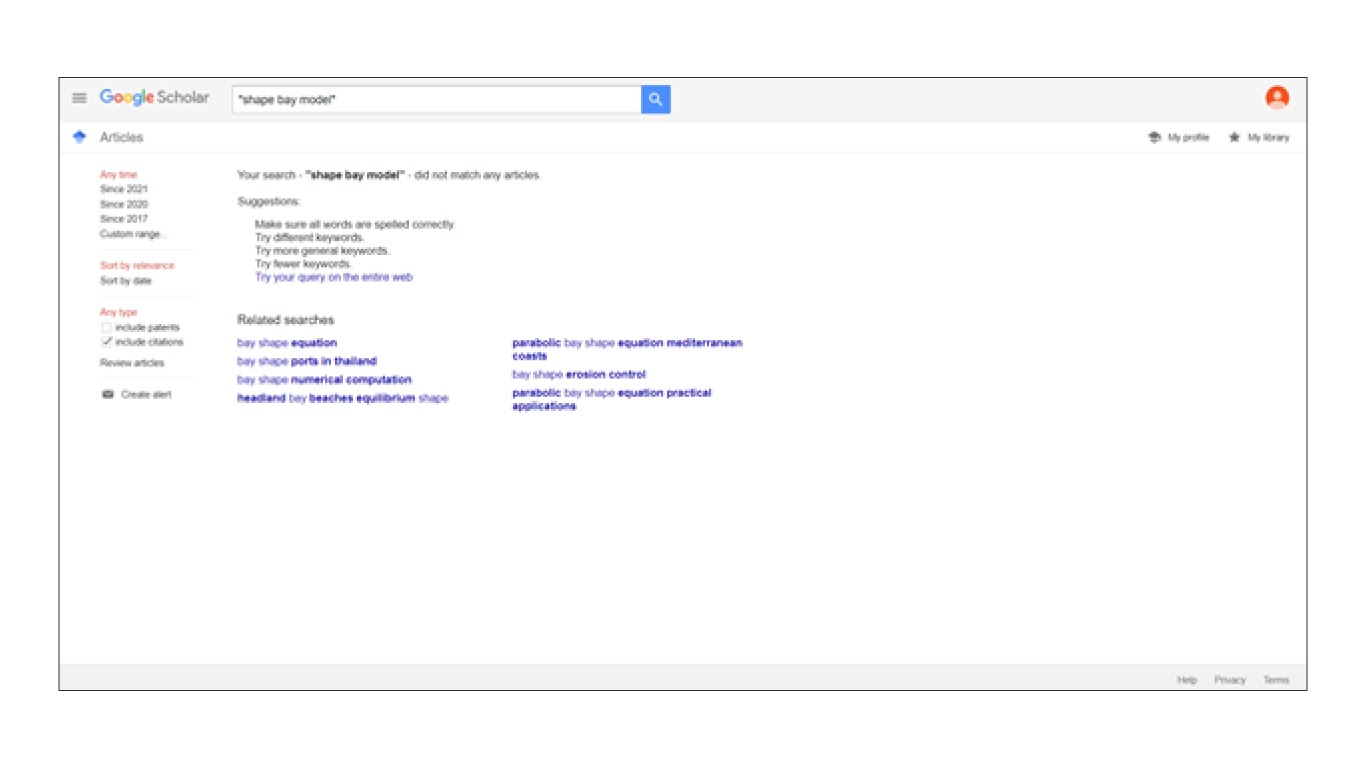
The lack of hits or the presence of no more than 3 or 4 indicates that the term may not be reliably used. The advantage of using Google Scholar over just Google is that it specifically looks at published academic literature instead of content from almost anywhere on the internet!
Read through your university’s dissertation guidelines and formatting requirements carefully
This is fairly self-evident, but it is surprising how many of us actually fail to do this and end up with last minute pre-submission hitches as a result! Universities typically either have a very detailed set of guidelines according to which a dissertation has to be framed to be considered acceptable for submission or direct you to follow a popular style guide (Chicago, MLA, APA). It is absolutely necessary that you read through the style guide in question very carefully. Keep it handy throughout the editing process.
This is especially important in case of referencing. When including a citation or a bibliography, every aspect of the reference list needs to be looked at in detail. Some common areas to carefully look at are the following:
- Author names: Full names, last name and initial, first name followed by last name or vice versa
- Journal title: in full or abbreviated, italicised/bold/normal text
- Volume, issue and page numbers
- Position of publication date
- Position of URL or doi
These are just some of the many tiny elements that you need to get right to ensure that the reference list is absolutely spick and span! There are also some reference management softwares that can help you in this, but make sure you still check the list carefully, as softwares can be notoriously inaccurate sometimes.
Apart from this, universities usually also have word count requirements for various sections of the dissertation, and make sure you know if you are going above those!
Check figure labels carefully
Often, we are so focused on the text side of things that we end up ignoring whether the text inside the figures is grammatically correct and free from spelling errors. Don’t skip over the figures! Make sure you examine each little label carefully.
Self-editing can prove difficult, and it is probably better to have a professional or a colleague look at your writing before you submit it, but following some of the previous steps will ensure that you eliminate as many errors as you can and shorten the overall editing process before you can submit your dissertation. It is probably better to self-edit after writing the draft of each chapter so you do not get overwhelmed with the Great Wall of Text when sitting down to edit in the final stages. Above all, have faith, and this too shall pass!
The Introduction Chapter of a Dissertation
As the name suggests, the introduction chapter acquaints a reader or evaluator with the contents, main argument(s), and scope of a dissertation. It is the first official chapter of your dissertation and is placed after the table of contents. Think of it as a preview of the whole dissertation, a glimpse into what the project is all about.
Simply put, an introduction chapter should
- Introduce and contextualize your research topic
- Clearly state the focus of your study
- Specify aims, objectives, and method of study
- Justify the value and relevance of this research on a broader level
- Provide an overview of upcoming chapters
When to write the introduction section
Although the introduction is the first chapter that will be read, conventionally, it is written towards the end of the writing process. This is because your research, as you progress, will change course—the methods you use may change, your hypothesis or original research question might become broader or narrower, or you might change its conceptual framework altogether.
Since the point of this chapter is to be introductory (of course), you’ll want to be accurate in letting the reader know exactly what your project entails. Writing the introduction chapter in the end along with the abstract and conclusion ensures that all three sections, and the dissertation itself, are consistent in their ideas and arguments.
Moreover, this saves time. Had you written an introduction beforehand, you’ll be forced to make modifications or rework it altogether.
If you choose to, you can draft an outline first, just to keep you on track, and keep revising it as you go along. (This is also an interesting way to track how your project has developed.)
Keep the original proposal you wrote as a reference because the components of the two will overlap.
The components of a dissertation introduction
The background and context
Your aim is to generate interest in your research topic and explain why it’s important or timely for this topic to be researched on. Start with a relevant or historically significant incident or news statement. Cite important literature along by way of introduction, so your reader can make a connection to established (possibly even seminal) work in the field.
By setting up a context with this, you’re easing a reader into your topic of study and gently leading the way to the core of your research.
Don’t go overboard with this, though; you have the rest of the dissertation to do that.
All you need to do at this stage is to give some basic information about your topic and field, just enough for the reader to know what’s coming up. Use keywords and terminology important to your field so they have more clarity.
The research problem
After setting the stage for the reader, write about how this context relates to your topic of study. In other words, spell out where the research problem lies in the context you’ve set.
This will lead you to write about the focus, topic, or questions that you have specifically chosen within this broader area of research. Once you have laid that out, clearly state the main argument or hypothesis that you have set out to test as a part of the study.
After this, write about the specific parameters you have set out to answer or analyze the question or problem. This will tell the reader what the scope of the project is, with regard to factors like time frames, geographical areas covered, specific themes, and disciplines your research falls under, and so on.
When you clarify the scope of your research, you should also be clear about what your dissertation will not cover. Address the limitations of your current research. This defines the scope further and helps future researchers continue what you’ve begun.
The relevance of your research
As you’ve already identified the context of your dissertation, this is the apt time to explain the rationale behind the dissertation as well.
The reason original research is given utmost importance in the academic world is that it is one of the most reliable ways of furthering knowledge in a particular field. That’s why it’s important for you to argue its relevance at the onset. What larger value does your research serve (other than finally getting that long-awaited degree, of course)?
Why should future researchers and the scholarly community pay attention to this work? What broader social, political, or scientific applications does your discovery have? Why does your research matter?
These are some questions you should aim to answer.
Draw a connection between the rationale and the context you’ve laid out until this point. A reader, based on this information, should be able to understand how your project has taken the direction it has so far.
An overview of the dissertation
Once you’ve introduced the context, the research area, the specific research question, your hypothesis for the study, and the rationale behind that choice, explain how you will go about the research. State what you aim to do and the objectives to be achieved.
State the methods you have used in the study and briefly summarize its results.
You will have noticed by now that this structure is simply a summary of the entire dissertation. If you’ve reached this point, well done! Anyone reading your dissertation will be clear about what they are going to encounter next.
The Table of Contents Page of a Dissertation
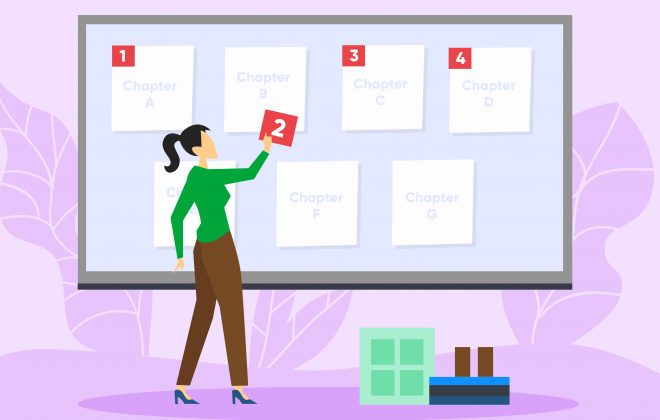
If you start your dissertation directly with an introduction, it’ll be like throwing your readers into a battlefield in which they have no idea who the enemy is or who they’re fighting. That’s where the table of contents comes into the picture. It is an organized listing of your document’s chapters, sections, and figures which are clearly labeled by page number. A good table of contents page should be accurate, easy to follow, and thoroughly formatted.
Where should the table of contents come?
The table of contents page ideally comes after the acknowledgments section and before the chapters.
How should you write a table of contents page?
You first write the title or chapter names of your research paper in chronological order. Secondly, you write the subheadings or subtitles. After that, you write the page numbers for the corresponding headings and subheadings.
What is included in the page?
A table of contents includes the title of the paper at the very top, followed by the chapter names and subtitles in chronological order. At the end of each line, is the page number of the corresponding headings.
Why is it important?
A table of contents is very important for two important reasons.
- Firstly, it helps the reader easily locate contents of particular topics itemized as chapters or subtitles.
- Secondly, it helps the writer arrange their work and organize their thoughts so that important sections of an academic project are not left out.
Tips to write a table of contents page:
- The table of contents is best completed after you have finished your thesis. But it’s a good idea to draw up a mock table of contents in the early stages of writing, which allows you to formulate a rough structure and think about how you are going to do your research.
- An unclear or sloppy table of contents may even have an adverse effect on your grade because the dissertation is difficult to follow.
- The formatting of your table of contents will depend on your academic field and thesis length. Whichever discipline you are working in, you need to create an organized list of all chapters in their order of appearance, with chapter subheadings clearly labelled.
- Don’t list subheadings for one chapter and forget them for another. They are not always required but they can be very helpful if you are dealing with a detailed topic.
- Chapter titles and subheading titles must match their corresponding pages. For example, if your first chapter is called “Chapter 1: An Introduction”, it must be written as such on both the table of contents and the first chapter page.
Where should you create a table of contents page?
You can produce a manually generated table of contents page in Microsoft Word, but it will be a lot easier if you use the automated feature.
So there you have it. Bookmark this article for when you would need to write a dissertation and it will make things a lot easier! For more dissertation-related articles, visit our Resource Center!
The Acknowledgments Section of a Dissertation
No dissertation can be completed solely by one person. Surely, you’ve had help along the way; whether it’s through moral support or people advising you on the actual thesis itself. The acknowledgments section is where you thank all these people for supporting you from day one, both in the research and writing process. It is not just an expression of gratitude, but also a way to honestly assert that you had help along the way.
This section is one of the few points in a dissertation where you have the liberty to add your personal touch.
Who can you thank?
Broadly speaking, there are two categories of people you can thank. Your professional acknowledgments comprise people who helped you in researching and writing the dissertation, and your personal acknowledgments are for people who provided non-academic support.
Let’s look at both categories one by one.
Professional acknowledgments
These are people who helped you in your dissertation in their professional or academic capacity. They may have provided resources, helped you formulate the focus and principal arguments of the dissertation, or played a key role in data collection processes. They may have also guided you through a large part of your study’s methods and methodology or allowed you to take part in their own research project for experience.
- Supervisors or advisors
- Professors
- Technicians
- Laboratory staff
- Peers and colleagues who may have helped you
- Organizations or institutions that lent you support
- Research participants
- Editors and/or proofreaders*
*Some universities will require you to acknowledge your editors and proofreaders. Check your university’s guidelines to see if this is required.
Personal acknowledgments
After expressing your gratitude to all the people who helped you compile the dissertation, you can thank people in your personal life who you feel inspired or supported you through the course of working on the project.
- Friends
- Family members
- Partner
- Pet(s)
Bear in mind that it’s better to acknowledge people who were there for you during the time you undertook the dissertation (as opposed to, say, a high school teacher who you generally feel inspired by.)
Include funding details in this section
In addition to acknowledging the intellectual labor and moral support that helped you finish the dissertation, thank your financial backers. These include any grants or scholarships you’ve won, funding bodies, or even private donors.
How to write the acknowledgments section
You don’t have to think too hard about an introduction or a conclusion, and you can simply begin with “I’d like to thank” and elaborate on how they contributed to the project. Similarly, you can end with your last thanks.
As far as the structure and organization of the acknowledgments is concerned, prioritize the order based on the type of support they lent you. Traditionally, your professional acknowledgments must precede your personal ones.
Your writing style can be a bit informal here, as the acknowledgments section is not a part of the dissertation body. But while you do have the freedom to deviate from formal academic writing conventions, it’s best to keep it crisp and professional.
When acknowledging your academic collaborators, write their full names and titles.
Professor Charles Wodehouse
Robert Sullivan, PhD
Dr Douglas Adams
If you received any support from public or private organizations or institutions, write out their complete names as well.
The New York Public Library
Child Rights and You, London Chapter
Where should the acknowledgments section go?
The acknowledgments section goes right after the title page, before the abstract.
While this is the general convention, check your university’s guidelines to check if they have specified a place for this page.
How long should it be?
Typically, this section should not be over a page in length. It can be as short as one paragraph or it can take up the whole page. How long this section depends on the number of people you’d want to thank.
Can I add humor here?
While it’s not particularly inappropriate to be witty or humorous in this section, ensure that it still maintains the professional tone that is required of a dissertation.
Here are some examples of researchers wielding their sense of humor onto paper:
Lastly, I’d like to thank Jacques Derrida, whose pedantic observations about language have furthered research in my field considerably.
My deepest gratitude goes to Rico, my parrot, who, perched on my shoulder daily, provided unwavering support and unexpected moments of wisdom.
What is a Book Copyright Page?
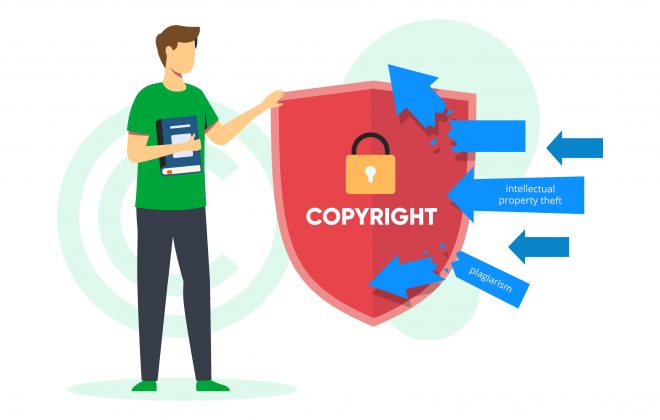
What is a book copyright page?
A book’s copyright page is very important, especially if you want to protect your writing from plagiarism.
The copyright page is most commonly found on the back of the book’s title page.
What does a book copyright page include?
It should include the following:
- Copyright notice
- ISBN
- Rights and permissions
- Disclaimer
- Edition information
- Design, production, editing, illustration credits
- Publisher’s address
- Ordering information
- Trademark notices
- Author website
- Country in which the book was printed
- Environmental notices
- A copyright notice and year
The copyright symbol (“©”) should go next to the copyright owner’s name. It should look like, “© 2021 by Iris Scott,” or can be spelled out “Copyright © 2021 Iris Scott.”
Important tips:
- The copyright owner is the author of the book, not the publisher nor the printer. If any publishing company requires that they be the copyright holder, don’t publish with them.
- If you use a pen name, you can put that on the copyright page instead of your real name.
iii. Your copyright will last for the duration of your lifetime plus an additional 70 years.
The copyright year is the year you receive your copyright. If the book is reprinted into new editions, the copyright will list all of the edition years, starting with the latest.
The copyright year is the year your book is published, not written.
- Rights reserved notice
This states that the copyright holder, who is the author, reserves all rights to reproduce the book or portions of the book.
It can be simply stated as, “All rights reserved,” or you can expand upon it.
- All rights reserved, including the right to reproduce this book or portions thereof in any form whatsoever.
- All rights reserved. This book or parts thereof may not be reproduced in any form, stored in any retrieval system, or transmitted in any form by any means—electronic, mechanical, photocopy, recording, or otherwise—without prior written permission of the publisher.
An ISBN is an International Standard Book Number, which is necessary if you plan to sell your book. The number always comprises 13 digits, and the numbers correspond with regional codes, particular publishers, editions, etc.
The ISBN is merely an identifier for your book; it has no legal weight. There is a different ISBN for each format of your book, for example, paperback and hardcover.
- Disclaimer
The disclaimer feature is normally used in fiction books and is included to protect you from potential lawsuits if your characters or plot lines resemble real people or events.
It acknowledges that some characters may resemble real people, yet it affirms that this is a work of your imagination.
- Permissions notice
If you include excerpts from any other work (another book, artwork, articles, etc.) you will need to give credit on the copyright page.
- Country of printer/printing edition
The page also includes where the book was printed and what edition it is (first or second or third, etc.).
- Publisher information
Publisher information (such as the name and address) should be included in the copyright page.
- Where does a book copyright page go in a book?
- How can I get a copyright for a self-published book?
- Do I need a copyright page in a KDP book
- Edition Information
Even if it’s on your title page, the edition information should appear on the book copyright page. This doesn’t need to be an elaborate paragraph, just a simple line of text that states which edition is this.
- Design, production, editing, and illustration details
The acknowledgements section usually has a list of people who helped your book be what it is, but it’s okay to list them here as well.
- Author website
Include the author website on the page, especially if you’re self-publishing.
- Ordering information
If your book is published by a big publisher, then the ordering information such as quantity sales, textbooks, orders by trade bookstores or wholesalers should be included on this page.
- Trademark and environmental notices
Trademark notice information should be on the book copyright page, which includes names and logos of the publishing company. The copyright page can also include statements which verify its environmental consciousness of the book.
Case Studies: How We Helped Our Authors Perfect Their Manuscripts

Writing starts off as a project or a hobby for a lot of us. Some might want to take this more seriously than a hobby and plan to get published! Editing and proofreading is the next step to take after writing your book and before deciding to publish it. But there are a bunch of questions that we need answered before we leap onto the editing and proofreading platform.
How do we know if our readers will enjoy our work? How can we be sure there are no errors? As experts, we can help you confidently take the leap with our editing and feedback.
Before you place an order with us, let’s find out more about what some of our valuable clients gained from consulting us.
Book: The Chronicle of Golgotha Days (Non-Fiction)
Author: Sujith Balakrishnan
Book Summary: Set in the backdrop of ’90s Kerala, Sujith Balakrishnan’s book is about the brutality of a young girl forcibly sold into the sex trade.
Objective: To structure the story properly and to retain the author’s voice and story.
Solution: Once we reviewed Balakrishnan’s draft extensively, we helped him rewrite and reconstruct parts of the book to effectively convey his story. Our focus in this project was to retain his voice and story, and he found more effective ways to present his work.
Book: The Eyes of Channel County (Fiction)
Author: Matt Brodie
Book Summary: The author Matt Brodie’s book The Eyes of Channel Country is an adventure novel set in Australia about the quests of Amber and Michael Hauksby.
Objective: The author needed help with strong characterization and plot consistency, considering this is the third of a series.
Solution: We improved his book by making it more contextual. We focused on helping him expand the setting and dialogues with the goal of instilling more realism. We also helped him improve his dialogues, tone, scene transition, and overall narrative consistency.
Book: The Blood of a Stone (Fiction)
Author: Richard Braine Jr.
Book Summary: Richard Braine Jr.’s book The Blood of a Stone is a fantasy novel.
Objective: The author wanted us to check for over-detailing, character development, and consistency in the story.
Solution: The book had a superb plot and a setting with depth. But the author saw room for improvement and asked us to review his writing. In essence, we did so with faith in his talent, guiding him where we sighted over-detailing and felt the characterization could be stronger. Ultimately, we helped this writer achieve the larger objective of enriching his work and making the interplay between the antagonist and protagonist compelling.
Book: The Invisible Hunt (Fiction)
Author: Harrison Baumgardner
Book Summary: This book is about a rescue operation of a high-profile doctor enlisted for classified research involving a bioweapon and its mutilated victims.
Objective: To make the book compelling with inputs on the tone, vocabulary, story and plot.
Solution: We helped him by eliminating wordiness and keeping the sentences crisp and action-oriented. Along with this, we also emphasised on the sparing use of devices such as the dialogue tag and the increased use of military-style language. At the final stages, we were effectively able to bring out the urgency and danger of the mission.

Get carefully curated resources about writing, editing, and publishing in the comfort of your inbox. [contact-form-7 id="12723" title="Subscribe Form"]
How to Copyright Your Book?
If you’ve thought about copyrighting your book, you’re on the right path.
Explore more