Newsletter Sign Up

To vs. Too vs. Two | Difference, Examples, When to Use

If you are confused about using to vs. too, you’re not the only one! Even native speakers struggle with using the right word. It’s time you learn the difference between to and too and find out how to use them in sentences!

To and too are homophones: Words that are pronounced the same but have different meanings. So if you want to find out whether to use to or too in a sentence, you need to first understand their meanings. Let’s begin!

What’s the difference between to and too?

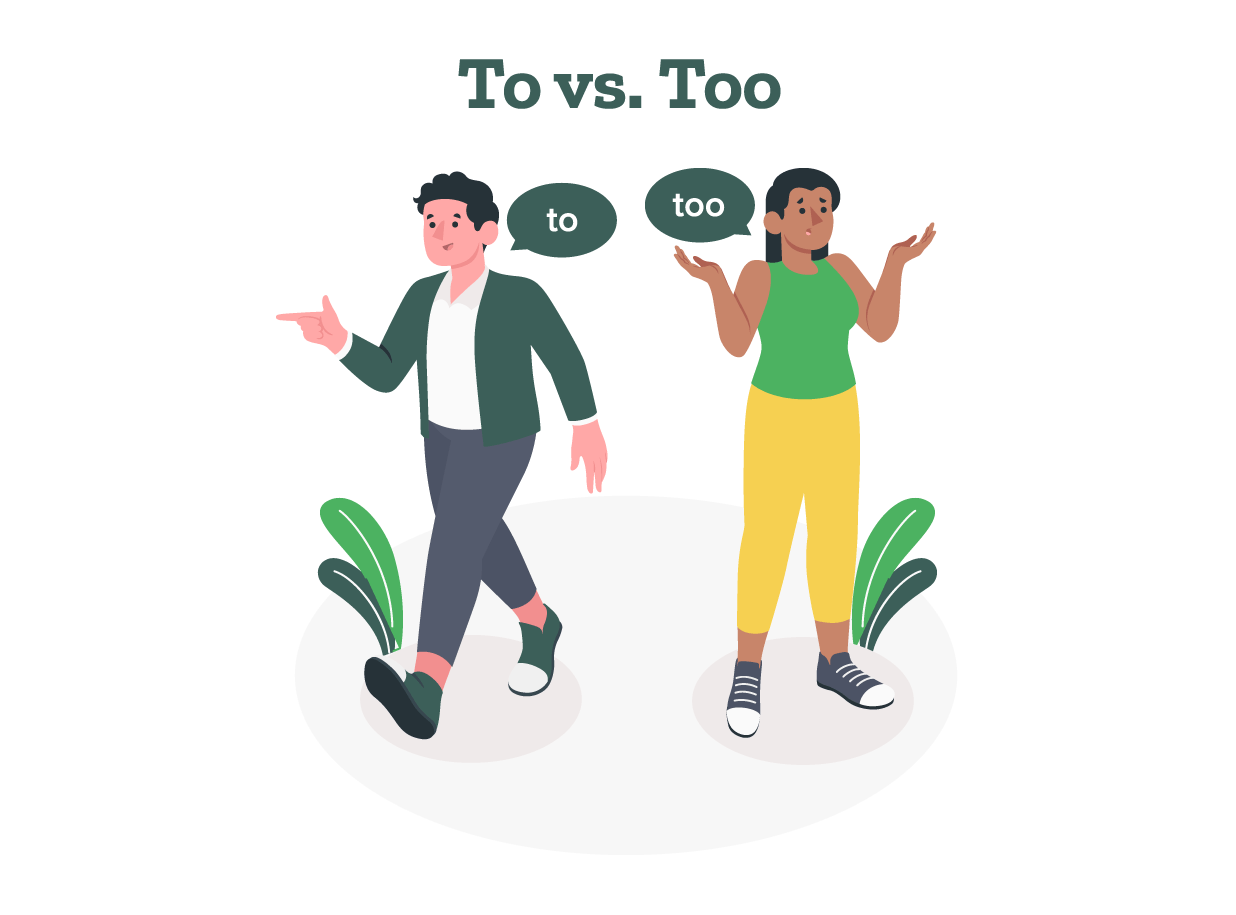
Here’s the difference between to and too:

Too is an adverb. It’s used to express excessive quantities or degrees. It often indicates that something is more than necessary.

The drink is too cold.

Let me come along too.

Lena went to the mall too.

To is a preposition. It expresses motion towards a specific destination or indicates an action or intention. Furthermore, it can denote a range of time, place, or quantity.

Destination: He is going to Australia.

Action: They were going to eat at the restaurant.

Range: The weather is cold from November to January.

When to use too vs. to

Use to when indicating direction, action, or range. 

Lena wants to go to the mall. 

The child needs to eat.

The city could be one to two miles away.

Use too to convey excess or agreement.

There were too many flies in the garden!

Lena likes the mall too.

The exam was too difficult for her.

Using to or too: examples

1. What are you up too or to?

The correct phrase is What are you up to? In this context, up to is an expression used to ask about someone’s current activities, plans, or what they are doing at the moment. 

Hey Irfan, what are you up to this weekend?

Nathan asked Irfan what he was up to that weekend.

They were talking about what they were up to this evening.

2. You to or you too?

The correct phrase is you too. It is a common way to respond to someone when you want to reciprocate their feeling or sentiments. 

Happy New Year to you too!

You should come to watch the game too.

Thank you, you too!

3. Too me or to me?

The correct phrase is to me. It is used when you want to express that something is directed toward you or shows your perspective. 

Could you please pass it on to me?

To me, it seemed good.

Can it ever happen to me?

4. Would love to or too?

The correct phrase is would love to. This phrase is used to express a strong desire or enthusiasm to do something.

I would love to go to the beach this weekend.

Lena would have loved to go to the mall.

They would love to join us for dinner tonight.

5. Too much vs. to much

The correct phrase is too much. It is used to indicate an excessive or overly large amount of something. It conveys the idea of more than what is considered necessary.

She ate too much cake at the party.

The noise was too much; it gave me a headache.

He spent too much money on clothes last month.

To vs. too vs. two

Another word that sounds like to and too but has a different meaning is two. Since two is a number, it rarely adds to the confusion of to vs. too! Let’s try to understand how two stands out from too and to.

Two (2) is a number. It comes after one (1) and before three (3). 

Use two when referring to the number 2.

There are two options to choose from.

Lena had two cups of coffee, and she was just getting started!

I have two cats at home.

Now that you understand the difference between these words, you can use to, too, and two correctly.

Using to, too, and two in a sentence

I like to paint.

The vessel was too heavy.

Two points were given to the red team.

We hope the above examples have settled any lingering doubts!

Tricky word choices such as to vs. too can result in a poorly written document for many English learners. As providers of expert editing services, it’s our job to help you out! Check out these resources for any further queries on grammar or punctuation:

How Do You Spell 40: Is It Forty or Fourty?

How do you spell 40? This can be a tricky and frustrating question. If you have ever been unsure about whether to use forty or fourty, your search ends here! We’ll tell you the difference between forty and fourty and explain how this spelling became common.

We’ll also provide you with some useful tips to help you remember the correct spelling of 40. So without wasting any time, let’s get started!

Forty or fourty: Which is correct?

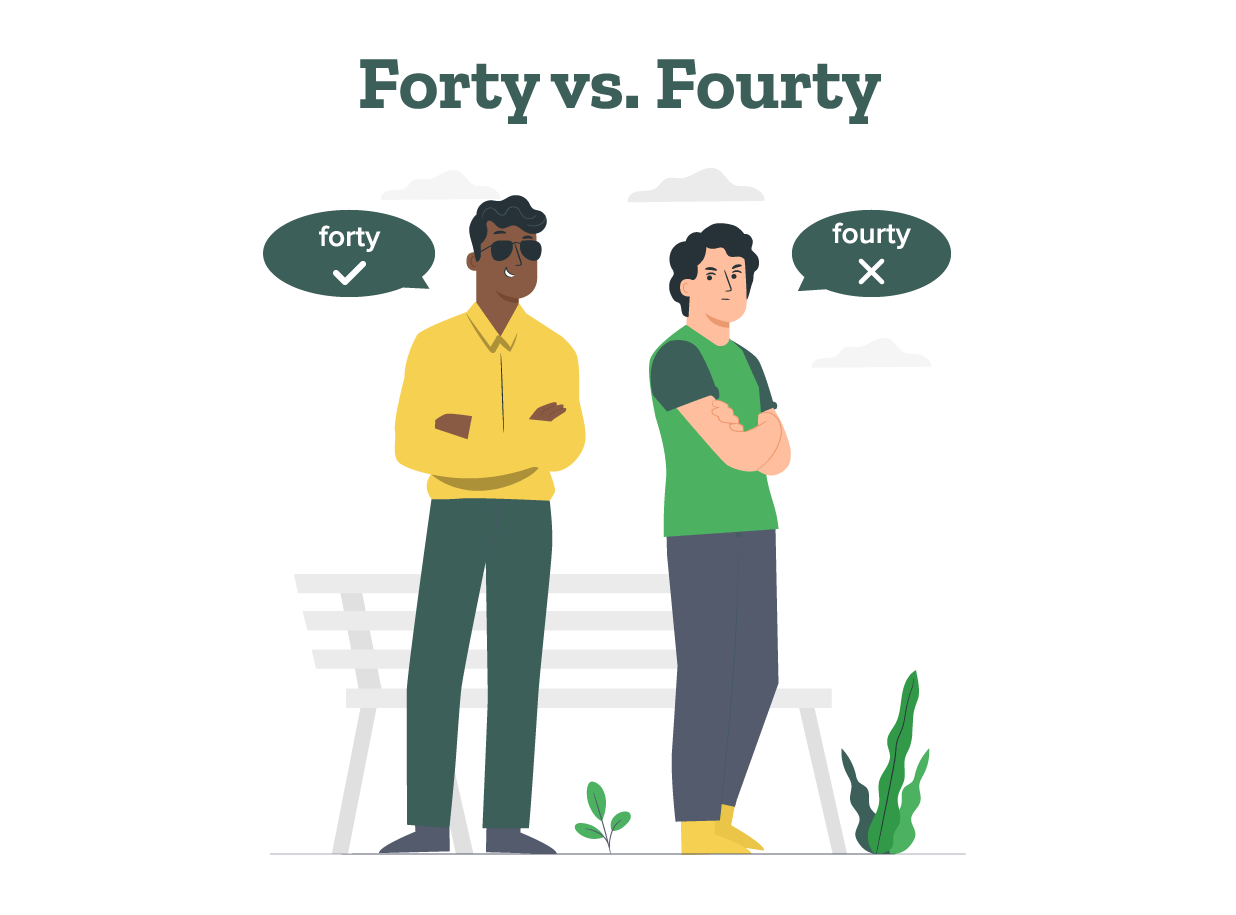
The correct spelling of 40 is forty. In British as well as American English, forty is considered the only appropriate word form. Even when it is part of a bigger number, 40 is still spelled as forty

For example: Forty-four, forty thousand, forty million

What’s a word form?

Word forms are different forms of a word created by altering their spellings, which leads to newer (but related) meanings. There are many ways to do this such as adding a prefix or a suffix to words. 

For example: un + happy = unhappy, happy + ness = happiness

Forty (40) is a whole number which refers to two times twenty. Though forty is derived from the word four, it is still considered worldwide as the correct spelling. All dictionaries consider the spelling of 40 as forty and provide no alternatives. Let’s see some examples for more clarity. 

“Life really does begin at forty. Up until then, you are just doing research.” — Carl Jung 

Forty is the old age of youth; fifty is the youth of old age.” — Victor Hugo. 

Forty is a most beautiful age for men and women…” — Elif Shafak

Want to know where all the fourty or forty confusion began? Let’s take a look. 

So how do you spell 40? 

The only accurate spelling of 40 is forty. The root of all the confusion is in the history of the word. Fourty was considered the appropriate spelling for 40 before the 15th century. However, many variants of forty emerged in Modern English such as fourtie, fourtye, and vorty, which were gradually replaced by forty.

What do we mean by Modern English?

English as it has been used since the 1500s is called Modern English.

Why did forty replace fourty?  

The word fourty was commonly used from the 12th to the 15th century. However, the use of the word fourty reduced in the initial decades of the 15th century. The reason for this was various shifts in the usage of vowels during this time. This led to the emergence of several variants of 40 in Middle English such as feortig, fuerti, feowerti, and feouwerti. 

In the 1800s, the word forty first appeared as part of the expression forty winks. The Online Etymology dictionary credits William Kitchiner for coining this term. 

“‘A Forty Winks Nap,’ in an horizontal posture, is the best preparative of any extraordinary exertion of either.” — William Kitchiner, The Art of Invigorating and Prolonging Life

Later, the word forty-niners appeared in 1849 in the US. The phrase Forty-niners referred to individuals who migrated to California to look for gold.

How to remember fourty vs. forty

Here are three tips to remember the correct spelling of 40 as forty.

1. Fortune comes at forty

An easy strategy would be to remember that the first four letters of fortune and forty are the same. Using these two words in the same sentence will help to keep in mind the correct spelling of 40. 

2. For for forty 

A good strategy is to associate the word for with forty and make your sentence using both words. Remembering this sentence and the fact that both for and forty do not contain the letter U will help you remember the correct spelling of forty

There were forty gifts for him.

He withdrew forty dollars for a payment. 

She purchased forty beads for making bracelets.

3. Fortieth, the ordinal number 

The word fortieth is the ordinal form of the number 40. This word indicates the 40th position of any person or object.  Remembering the fact that fortieth also doesn’t contain the letter U will help you memorize the spelling of 40.

Also read: To vs. Too vs. Two | Difference, Examples, When to Use

We hope this article provides you with clarity on the question, Is it forty or fourty? As experts who provide professional proofreading services, it’s our job to help you out with such difficulties! 

You can bookmark this article and take a look whenever you’re unsure about using forty or fourty. In case you have more doubts about word choice or grammar, here are some articles that can help:

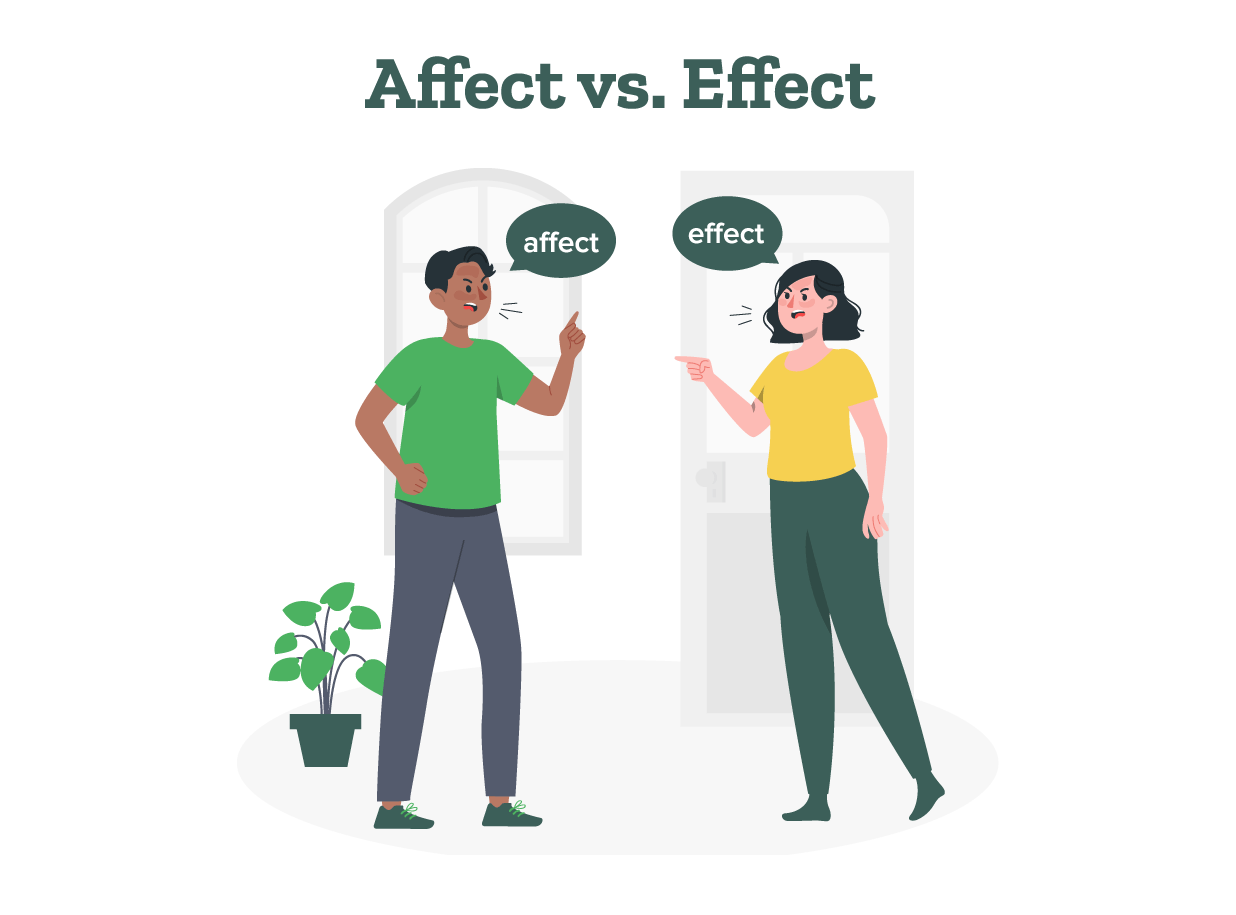
Affect vs. Effect: Key Differences Explained with Examples

The word pair affect vs. effect is easy to mix up. The words sound the same and their meanings are quite similar! So how do you tell the difference between affect and effect? When should you use which? We’ll help you settle the “affect or effect” debate once and for all.

In this article, we’ll start with the affect vs. effect definitions and help you easily remember the difference. We’ll also go through some commonly used phrases with the two words, so you know whether to use affect or effect in your sentences.

What is the difference between affect and effect?

Here’s the difference between affect and effect:

Affect is a verb. It means “to influence or change something”.

Climate change affects the rain cycles globally.

Synonyms: Change, influence, alter, impact, transform

Effect is a noun. It means “the result of an action or event”.

The global disruption of rain cycles is an effect of climate change.

Synonyms: Result, outcome, ramification, product

We’ll clarify this further:

Climate change influences rain cycles. In other words, it affects rain cycles. So, when used as a verb, affect means the action of creating a change. On the other hand, the noun effect represents the change itself: Disrupted rain cycles are a result of climate change. In other words, they’re an effect of climate change.

Still unsure when to use affect vs. effect? Let’s try this one more time, then!

Have an effect or affect

The correct usage is have an effect and not have an affect. Since affect is a verb, it can’t be used with the verb have to describe something. That’s the job of a noun!

After all, you wouldn’t say have an eat, would you? You’d say have an apple or have lunch. Apple and lunch are nouns, while eat is a verb. Similarly, effect is a noun, while affect is a verb.

This affect vs. effect example should clear it up:

The weather affects my mood.

The weather has an effect on my mood.

Retaining the same sentence structure, we can simplify this as:

A affects B.

A has an effect on B.

So, when (A) affects (B), (B) experiences the effect of (A)’s influence. This relationship between affect and effect can help you remember the difference between them.

Exceptions to the rule

Like everything else in grammar, there are a few exceptions to the common uses of affect and effect. Affect has two other meanings—one as a verb and one as a noun—while effect has one other meaning as a noun. Take a look:

Other meanings of affect

Affect as a verb (another meaning): To put on an act, to add an “affectation”

Sarah tried to affect a British accent to impress the judges and the audience.

Synonyms: Feign, simulate, act, assume, pose

Affect as a noun: An emotional response that can be observed (mostly used in psychology)

At receiving the award, the actor’s face showed a genuine affect of surprise and joy.

Synonyms: Disposition, impression

Another meaning of effect

Effect as a verb: To actively accomplish something

The management implemented strategies to effect an improvement in company performance.

Synonyms: Achieve, accomplish, generate, cause, create

Now that we’ve seen the definitions of affect and effect, it’s time to help you remember them. We don’t want you googling affect vs. effect right after closing this article!

Effect or affect: How to remember the difference?

An easy way to remember the difference between affect and effect is to think of the initials. A is for action (affect) while E is for end result (effect).

A = Action = Affect

E = End result = Effect

If the word describes an action, it’s affect. If it describes the end result, it’s effect. Easy as that!

Now, let’s go through some examples of common phrases where you can confuse the two. Just to solidify the information!

Affect vs. Effect examples

We promised to settle the debate between choosing affect or effect, and we’re doing just that. A large reason for the confusion about using effect vs. affect is that many common phrases include these words. So let’s go through them one by one and end all your doubts!

1. Take effect or take affect?

Take effect is the correct usage, meaning “to begin producing a result”. For example, “The law will take effect next month.” Take affect, on the other hand, is not a valid phrase in the English language.

The terms and conditions take effect as soon as a contract is signed!

The medicine will need some time to take effect.

The peace treaty took effect a month ago, after years of deliberations.

Synonyms: Be operational, become effective, have an impact

2. Go into effect or affect?

Go into effect is the right phrase, used to indicate that something is starting to be implemented. For example, “The new regulations will go into effect on 01 April 2023.” Go into affect is incorrect and is never used in English.

The new dress code policy will go into effect in a month.

The tax reform bill goes into effect tomorrow.

When the law prohibiting plastic bags went into effect, plastic waste reduced greatly.

Synonyms: Come into effect, become effective, go live

3. In effect or in affect?

As you may have guessed by now, the correct usage is in effect and not in affect. In effect means “in practice” or “operational” while in affect is never used in English. Here are some examples of how to use in effect in a sentence:

The peace treaty is now in effect, fortunately.

Starting next month, the price increase for certain products will be in effect.

The interim management team is in effect until a permanent replacement is found.

Synonyms: Operational, in force, in practice

4. Something to that effect or affect?

The correct phrase is to that effect and not to that affect. To that effect is used to convey that the general meaning of your wording is the same, even if the details may differ. So the description may not be precise, but captures the gist of what was said.

Pathik mentioned that he disliked BTS, or words to that effect. Can you imagine!

The witness wasn’t too sure but knew that it was something to the effect of a threat.

The CEO hinted at a possible partnership with a former rival, or something to that effect.

Synonyms: In essence, in a similar vein, in general terms

5. Affect change or effect change?

Like most such phrases, effect change is the right one and not affect change. To effect change is to actively initiate and implement measures to bring about a certain outcome. Affect change, on the other hand, is not a valid phrase in English.

A nonprofit organization aims to effect change in a community.

The manager has effected positive change in the team’s daily functioning.

Babil’s outreach programs are actively effecting change in the local community.

Synonyms: Bring about change, enact change, drive change

6. Negatively affect or effect?

The correct usage is negatively affect while negatively effect isn’t a valid phrase in English. Negatively affect describes the action of causing a negative impact on something. To negatively affect something is to have a negative impact on it.

Widespread xenophobia negatively affects the lives of migrants everywhere.

The prolonged drought is negatively affecting the agricultural sector.

Improper disposal of plastic waste has negatively affected marine life.

Synonyms: Impair, undermine, inhibit

7. Full effect or full affect?

Full effect is the correct phrase, meaning “the maximum impact of something”. Full affect is not a valid phrase in English and hence is never used. 

All Star rules are in full effect!

In full effect, the concert’s lighting created a mesmerizing experience.

The company’s environmental conservation efforts are now in full effect.

Synonyms: Full force, maximum impact, full extent

8. Adverse affect or effect

The correct usage is adverse effect, which means “a negative consequence of an action or situation”. This phrase is an extension of have an effect, like several others we’ve seen in this list. Adverse affect, on the other hand, is not a valid phrase and should never be used.

The medication could have an adverse effect on some patients.

Heavy pollution in the city had an adverse effect on air quality.

The new policy had unintended adverse effects on certain vulnerable populations.


We hope this clears up all your confusion about using effect or affect. As experts who provide excellent editing and proofreading services, it’s our duty to help you out! If you have more questions about word choice, grammar, or punctuation, here are some useful resources:
How to Write an Impactful Personal Statement (Examples Included)

A personal statement stands out from other educational documents in that it’s intended to be personal, as the name suggests. It offers the admissions committee a glimpse of your personality and not just your abilities and accomplishments. 

A personal statement requires just the right amount of vulnerability, accompanied by passion and enthusiasm. But first, you need to know what is a personal statement. Let’s take a look.

What is a personal statement?

A personal statement is a personal essay required by selection committees for jobs, scholarships, or universities. It is a summary of your accomplishments, interests, experiences, and goals. 

A personal statement is often confused with a statement of purpose, but these are completely different documents. 

A statement of purpose highlights your career path, academic and professional achievements, and motivations for choosing a particular field of study in a much more formal manner. 

A personal statement, on the other hand, emphasizes both academic achievements and personal aspects. 

An effective personal statement answers questions like:

Who am I?

What are my strengths and weaknesses?

What are my talents and accomplishments?

Why am I applying to the school of my choice?

What are the experiences that piqued my interest in my chosen field of study?

What are the special aspects of the school I’m applying to?

How to write a personal statement

Similar to most writing assignments, breaking down a personal statement into smaller parts can make the writing process much easier. A personal statement follows the standard format of the introduction, body, and conclusion, but you need not write them in that order. 

We recommend writing the introduction at the end, as it’s the most challenging part and requires a higher level of creativity. Let’s get into the nitty-gritty about how to write a personal statement for grad school or for college:

1. Craft an attractive hook or introduction.

Starting your introduction with your name is the biggest mistake you can make. The admissions committee already has access to your personal information and academic credentials and is looking to gain deeper insights into your personality, interests, and motivations. 

To make a strong impression, it’s better to begin with what motivated you to study your chosen field or why you’re interested in studying at a particular university. Let’s look at an example:

One summer while running around in my backyard, I fell down and scraped my knee. My grandfather, being an established doctor, carefully bandaged my wound. His calm, prompt, and comforting demeanor left a lasting impression on me. It sparked my interest in medicine.

2. Elaborate on your accomplishments, relevant skills, and experience.

A personal statement should be authentic to you and should help you stand out amongst your peers. You have to sell yourself to the admissions committee and let them know your skills, accomplishments, and talents without sounding conceited. 

A good way to do this is to avoid mentioning academic achievements which are already mentioned in your transcripts. Instead, mention qualities and insights you’ve gained over the years with the help of real-life experiences. For example:

Leading my school’s basketball team taught me the values of teamwork, coordination, agreeableness, and leadership.  

You can also mention insights gained from a job or internship, a paper or a journal that had an impact on you or a course or session you conducted that taught you something new. 

Working as a nurse in the children’s hospital was an eye-opening experience for me. It not only made me a kinder, more compassionate person but also taught me practical skills such as suturing a wound. 

3. Draft a logical conclusion.

Make sure to tie the conclusion with the body of the personal statement to create a story arc. The concluding statements should carry information about how your chosen field of study or the facilities provided by the universities will be useful to you in your professional career.

Make sure to use emphatic and expressive language to make your personal statement more impactful. For example:

Gaining hands-on experience with the state-of-the-art operating machine provided by your medical department will give me a head-start in my chosen field of neuroscience. 

4. Edit and proofread.

Just like it is with any other important document, proofreading your personal statement is crucial. It ensures that your statement is free of errors and presents you in the best possible light.

You have a few options for proofreading your personal statement. One option is to proofread it yourself, but it can be difficult to catch all of your own mistakes. Another option is to ask a friend or family member to proofread it for you. They can provide a fresh perspective and may catch errors that you missed.

If you want to take your proofreading to the next level, it’s a good idea to have your work proofread by a professional. A personal statement editing service has the critical eye and experience necessary to catch even the most subtle errors.

Note: Although its content and structure remain the same, the length and complexity of a personal statement depending on its purpose. Personal statements for universities and scholarships are typically longer and more detailed as compared to those required for jobs.

Tips for writing a personal statement

Let’s take a look at the tips and tricks to write a personal statement along with relevant examples:

1. Keep it personal.

Although there are certain rules to be followed when writing a personal statement, it is important not to lose your own voice. The admissions committee wants to get to know you as a person and not just as a student.

2. Avoid unnecessarily complicated language.

Using appropriate technical terms in your field can showcase your expertise and understanding of the subject matter to the admissions committee. But overusing or misusing jargon can confuse, or even put them off.

3. Avoid simply listing achievements and experiences.

While highlighting your achievements and experiences is essential, simply listing them is not enough. It’s important to provide insights into what you’ve learned from these experiences since the admissions committee already has access to your transcripts and wants to know more about your personality.

4. Keep a light, positive tone.

Even when writing about a serious topic such as “How I overcame homelessness”, the tone should be inspirational and insightful.

5. Use action words.

Make use of action words to make your text more conversational and engaging. For instance, instead of writing “I was the captain of the volleyball team and we won many tournaments” you can say “As the volleyball captain, I consistently lead my team to victory”. 

Personal statement example

Let’s better understand how to write an impactful personal statement with the help of an effective personal statement example:

As a child, I always found it difficult to relate to children my age. I was quiet, timid, and very vulnerable. I was 17 when I was first diagnosed with depression. With the help of professionals, I was not only able to function better but was also able to integrate into groups. 

The effects of therapy and medication amazed me. The underrated field of psychology had a powerful impact on me. It helped me understand myself as well as those around me better. This is why, when it came to choosing a field of study, I chose abnormal psychology.

In college, I not only topped my course but also conducted drives and free therapy sessions to help those in need. I also published a paper on the effects of appreciation and criticism on mental health. 

I believe that my experiences with mental illness will give me a unique perspective in the field of abnormal psychology. I believe I’ll be able to provide more effective and practical solutions to patients because of my own struggles. My goal is to make a difference in the lives of others by helping them overcome their struggles and find happiness.

Citations and References: What Are They and Why They Matter

It is a universal truth that citing and referencing your academic sources is the most tedious task for a student. After spending weeks on a paper (or if you’re daring, one night), how absurd is it to actually sit down, backtrack all your data, and sort them in a specific order that you should have probably remembered by now, but you don’t. There’s no need for distress, that’s 90% of us, and it’s totally normal. Citations suck, and that’s a scientific fact. 

Regardless of all the grumbling, though, citing and referencing your academic texts are incredibly important components of academic writing. There’s no way around this one, and there shouldn’t be either. If your university hasn’t already taught you how to do this on day 1 of college (or if you need a revision), look no further. Or if you’ve ever been confused about when to use what, read on! 

Ideally, the best way to go about this is to ask your professor or adviser. “When in doubt, go to your guide,” so says the old adage. But, well, life is life, and it often doesn’t pan out the way you want it to. So instead of poring over ache-inducing guides in a library, you might want to stick around for this one.

What does citing and referencing a paper mean?

When you are engaging in academic writing, irrespective of the length or intensity of your essay/paper, it is imperative to properly cite your sources. Simply put, this is a way to document all the sources that you have referred to while writing your research. It is an incredibly valuable process without which your findings will be incomplete. Proper citations are a vital part of academic proofreading. Believe it or not, they can make or break your paper. 

There are many reasons for this: other than, of course, the plagiarism charges that will grace your paper with the stamp of a sore F. Plagiarism is not just copying, it actually amounts to stealing someone else’s painstaking work—their intellectual property. Citing your sources is also the most standard way to increase your credibility in the academic world. It places your work in the context of the literature of your field and is therefore also a mark of good scientific research. It is the most reliable way of providing evidence and strengthening your arguments. 

The whole process itself consists of two main parts:

  1. Citing your source within the body of your text itself, also known as in-text citations, and 
  2. Compiling all your sources in the reference section or bibliography

There are a certain set of details about your references that you generally have to provide: your source’s name, where it is from (also called containers in the MLA format), page numbers (or time stamps, for audiovisual sources), issue or version or edition, and publication details. The information that you have to provide is largely the same in all formats, but what varies is the order in which they are provided.

Word processors usually have inbuilt features to help you document your sources, but it is infinitely better (I’m sorry, but c’est la vie!) for you to do it yourself. Sometimes MS Word isn’t updated to the latest trends in citation styles, or your college might have specific requirements.

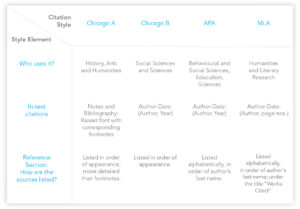
As you may already know, there are many types of citation styles, depending on discipline and university—hence the confusion of when to use what. But the following three are the most common and therefore the most likely that your professors will ask you to use. 

  • Chicago Manual of Style 
  • Modern Language Association
  • American Psychology Association 

Chicago Manual of Style (CMS):

One of the most famous styles of citations, the Chicago Manual of Style is a standard style devised by the University of Chicago Press. Chicago style citation is mostly used by published scholars and academics and has two systems of documenting sources within texts. Other than that minor difference, they are both largely similar. 

Here is a brief introduction to both of them:

  1. Notes and bibliography: This style is primarily used in the fields of literature, history, and the arts. Instead of most other systems that usually have the source listed within the text itself—so that you can see the source credentials while you’re reading the paper, rather than having to refer to the bibliography section each time you want to verify a source—this method uses footnotes and endnotes on every page. Whenever you directly quote, paraphrase, or reference an external source, it should be marked with a number that will appear in raised font which must correspond with a note at the bottom of the page. The sources of each page are usually quite brief, only containing the name of the text and page numbers. A more extensive version is found in the bibliography.
  2. Author-date: This method of citing texts is more common in the social sciences and sciences. In-text means that sources are cited briefly within the text (author, date within parentheses) and must correspond to a source in the reference list. The reader must be able to cross-check sources, where the source’s full details must be given.

As mentioned earlier, the reference or bibliography section is where you list out all your sources in order of their appearance in your paper. According to the Chicago Style, your references must ideally have the following information about your sources: their title, the author or authors’ names (also applicable to editors, compilers, and translators), and publication details. The author’s name is listed with the surname first (e.g.: Hawking, Stephen) and the title of the text is italicized. 

When you’re citing a journal article, for example, your entry will look something like this: 

Rosenhan, David. “On Being Sane in Insane Places.” Science 179, no. 4070 (1973): 250–258

American Psychological Association (APA):

The APA style citation is popular in the social sciences and sciences. It was devised by the American Psychological Association to standardize scientific writing within academic disciplines. It is also commonly used within empirical disciplines with practical applications such as medicine, business, criminology, law, etc. In this format, the date of publication is given priority so as to stay updated with ongoing research in the respective fields. 

For its in-text citation, APA uses the author-date system. When you are paraphrasing or simply referencing your source, the in-text citation has the last name of the author and the year of publication in brackets, separated by a comma. If you are directly quoting your source, it also includes page number(s). 

Unlike Chicago, your bibliography is only compiled once at the end of your paper under the reference section in. It contains the author’s name, year, name of the text, name of the larger source (in italics), edition or issue number, and publication details. The whole section is compiled alphabetically in order of the author’s last name. As you will see below, the author’s initials are mentioned instead of their first name. While citing a journal article, your citation will look like this: 

Rosenhan, D. L. (1973). On being sane in insane places. Science, 179(4070), 250-258.

Modern Language Association (MLA):

As the name suggests, MLA is a standard citation guide that is popular within literature and language studies. The 8th edition of MLA, published in 2016, is the most updated version of this format. Since MLA citations are used in literature and humanities, there is much more leniency to source a plethora (of types) of materials within the system—hence the need for constant updates. 

It also follows the author-date system for its in-text citations—the last name of the author, followed by the page number of the text you are referencing; both in parentheses. If the name of the author is already there in the body of your text, only page numbers are mentioned in parentheses. 

As for references, it follows the following general format, subject to modifications as per source: author, the title of the source, container (once again, in italics), version/number, publisher, publication date, and location. 

An entry to cite a journal article will look something like this: 

Rosenhan, David L. “On Being Sane in Insane Places.” Science, vol. 179, no. 4070, 1973, American Association for the Advancement of Science, Washington DC, USA.

a brief guide to citations


How to cite an online source

It’s the zenith of the internet age. There is no doubt about that. In the midst of the trend of all of human history being stored in digital formats, many sources sought out by academicians are being documented as well. Online journal databases like JSTOR and Elseiver have comprehensively compiled both current and past editions of academic texts across various fields. As part of the online cataloging process, each text is given a Digital Object Identifier or DOI. If you are accessing your source online or if you have done your research online, your citations must include the DOI of your source (or a link to it, if there isn’t one). So, if you’re citing your paper in APA, for example, your citation will look like this:

Rosenhan, D. L. (1973). On being sane in insane places. Science, 179(4070), 250-258. https://doi.org/10.1126/science.179.4070.250

Glossary

  • Bibliography: A list of all the sources you have referred to in your research of an article or paper. Unlike the reference list, this also includes sources that have not been directly cited in the text.
  • Cite (v.): The act of referencing a text to use it as supporting evidence in your own paper or article.
  • Citation (n.): A reference to a published work in your paper. Direct quotes and paraphrases can be cited in a paper, by including the name of the text, its author(s), date of publication, etc.
  • DOI: Abbreviation of Digital Object Identifier. A unique code of numbers, letters, and symbols that identify the referenced text on the web. A DOI is used to identify sources on the internet.
  • Endnote: A reference, comment, or note placed at the end of the article. It can be used to elaborate on points
  • Footnote: A reference, comment, or note placed at the end of each page.
  • In-text citation: Used when referring to, summarizing, paraphrasing, or directly quoting an existing source. The in-text citation is included in parentheses, immediately following the reference. Usually includes the year of publication and the author (and the page number, if it’s a direct quote), and must correspond with an entry in the reference list.
  • Reference list: A list of texts referenced in the paper. Each reference must have a corresponding in-text citation within the paper.

Purdue University’s Online Writing Lab has an immensely comprehensive table that you can refer to see how to cite any type of document (books to newspapers to pamphlets to even podcast episodes) in the three systems that you’ve just learned. 

Homophones, Homonyms, and Homographs: What’s the Difference?

  • Bare in mind that the differences between homophones and homonyms are a bear minimum. Or is it bear in mind? Maybe bair in mind?

We won’t confuse you further. If you’ve already figured out something’s off with that first sentence, then you’re on the right track. If you haven’t, don’t worry, it happens to the best of us. 

Even to native speakers of the English language, sometimes grammar and words seem elusive. So we can only imagine how confusing it must be for someone just grasping at the tails of this vast language. English has differently spelled words that sound the same, words with the same spelling that sound different, and differently spelled words that sound the same! 

Eliminate errors and enhance your writing!

It’s a lot to wrap your head around at first, but that’s why we’re here to help you out! Keep reading to learn about homophones, homonyms, and homographs. 

Homophones 

Homophones are words that sound alike but mean different things. These may be words that are spelled the same or have different spellings. A pair or group of words can be considered homophones as long as they sound the same. 

Examples: 

“No, I don’t have Maria’s book.”

“I don’t know where my cat is.”

“No” and “know” are homophones with different spellings. 

The height difference between them is minute

A minute has 60 seconds. 

The word “minute” has two different meanings: in the first sentence, the word means “small” and in the second instance, it denotes a unit of time. This is an example of homophones with the same spelling.  

Homographs 

Homographs are words that have the same spelling, but are different in meaning and may also be different in pronunciation. 

Let’s look at this with another example. 

Humans have been using bows and arrows for approximately 72,000 years. 

It is tradition for actors to bow three times before the curtain call. 

The first instance of the word “bow” is a noun, referring to the weapon used in archery. The second instance of the word is as a verb, referring to the action of bowing. 

Homonyms

Homonyms are words with the same spelling and pronunciation, but have different meanings. Put another way, you could say that a word needs to be both a homophone and a homograph to be a homonym. 

Let’s look at some examples. 

Helena played the lead role in the school’s production of Hamlet. 

The road will lead you to the yellow brick house. 

The word “lead” in the first sentence is a noun (denoting a primary/major role in the play), whereas the second sentence sees the verb form of the word (in this case, referring to direct or show the way to a location). 

Homophones vs. homonyms vs. homographs

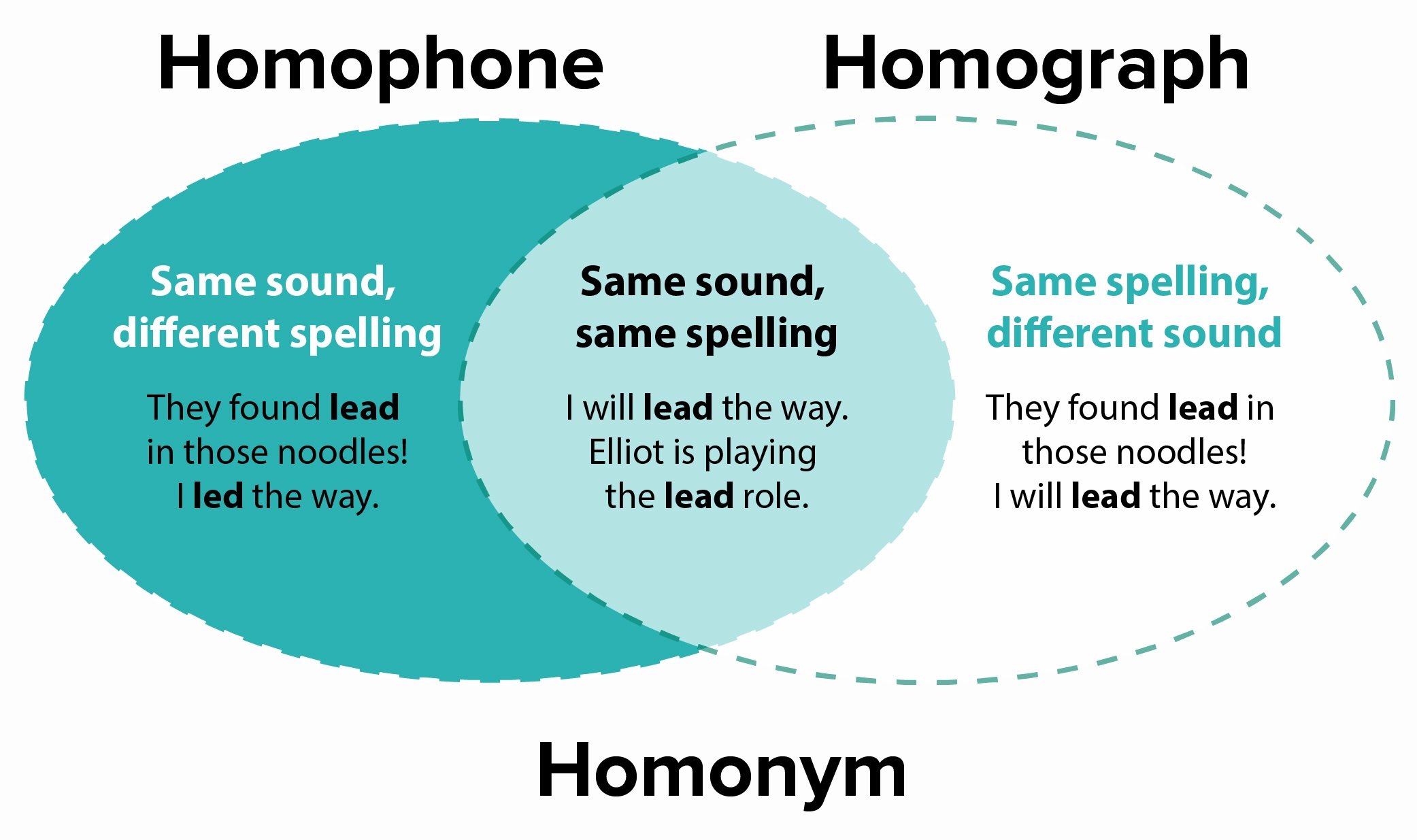
Here’s a quick infographic to help you remember the differences between homonyms, homophones, and homographs.

Homophones, Homographs, and Homonyms.


We hope this helps you effectively remember the differences between homonyms, homophones, and homographs.

We hope this helps you effectively remember the differences between homonyms, homophones, and homographs. As experts in editing and proofreading, we realize the importance of correct word choice and grammar. If you wish to eliminate your document’s grammar, word choice, and other errors, you can consider choosing our editing and proofreading services

Bookmark PaperTrue’s Resource Center for quick grammar and language tips!

How to Write a Conclusion for an Essay (Examples Included!)

Condensing a 1,000-plus-word essay into a neat little bundle may seem like a Herculean task. You must summarize all your findings and justify their importance within a single paragraph. 

But, when you discover the formula for writing a conclusion paragraph, things get much simpler! 

But, how to write a conclusion paragraph for an essay, and more importantly, how to make it impactful enough? Through this article, we will walk you through the process of constructing a powerful conclusion that leaves a lingering impression on readers’ minds. We will also acquaint you with essay conclusion examples for different types of essays. 

Score high with our expert essay editing services!

Let’s start from the beginning: How can you write a conclusion for an essay?

How to write a conclusion for an essay

In order to write an effective conclusion, you must first understand what is a conclusion in an essay. It is not just the summary of the main points of your essay. A well-written conclusion effectively ties together the main ideas of your essay and also pays heed to their broader implications. The objectives of your concluding paragraph are as follows:

  • Highlight the significance of your essay topic
  • Tie together the key points of your essay
  • Leave the reader with something to ponder about

A good essay conclusion begins with a modified thesis statement that is altered on the basis of the information stated throughout the essay. It then ties together all the main points of the essay and ends with a clincher that highlights the broader implications of your thesis statement. 

Now that we’ve understood the basics of how to conclude an essay, let’s understand the key aspects of a good conclusion paragraph. 

1. Restating your thesis statement

If you want to understand how to start a conclusion, you must realize that involves more than just restating the thesis statement word for word. Your thesis statement needs to be updated and expanded upon as per the information provided in your essay. 

There are many ways to start a conclusion. One such method could be to start with the revised version of your thesis statement that hints to the significance of your argument. After this, your conclusion paragraph can organically move on to your arguments in the essay. 

Let’s take a look at an effective way of writing a conclusion for an essay:

If the following claim is your thesis statement:

Virtual reality (VR) is undeniably altering the perception of reality by revolutionizing various industries, reshaping human experiences, and challenging traditional notions of what is real.

The restated thesis statement will be as follows: 

Our analysis has substantiated the claim that virtual reality (VR) is significantly transforming the way we perceive reality. It has revolutionized industries, reshaped human experiences, and challenged traditional notions of reality.

2. Tying together the main points

Tying together all the main points of your essay does not mean simply summarizing them in an arbitrary manner. The key is to link each of your main essay points in a coherent structure. One point should follow the other in a logical format.

The goal is to establish how each of these points connects to the message of your essay as a whole. You can also take the help of powerful quotes or impactful reviews to shed a unique light on your essay. 

Let’s take a look at an example:

VR presents a new paradigm where the distinction between the real and the virtual becomes increasingly blurred. As users dive into immersive virtual worlds, they are confronted with questions about the nature of reality, perception, and the boundaries of human consciousness. 

3. Constructing an impactful conclusion

Most of us are confused about how to end an essay with a bang. The answer is quite simple! The final line of your essay should be impactful enough to create a lasting impression on the reader. More importantly, it should also highlight the significance of your essay topic. This could mean the broader implications of your topic, either in your field of study or in general.

Optionally, you could also try to end your essay on an optimistic note that motivates or encourages the reader. If your essay is about eradicating a problem in society, highlight the positive effects achieved by the eradication of that problem. 

Here’s an example of how to end an essay:

In a world where virtual boundaries dissolve, VR is the catalyst that reshapes our perception of reality, forever altering the landscape of the human experience.

Here’s a combined version of all three aspects:

Our analysis has substantiated the claim that Virtual Reality (VR) is significantly transforming how we perceive reality. It has revolutionized industries, reshaped human experiences, and challenged traditional notions of reality. It presents a new paradigm where the distinction between the real and the virtual becomes increasingly blurred. As users dive into immersive virtual worlds, they are confronted with questions about the nature of reality, perception, and the boundaries of human consciousness. In a world where virtual boundaries dissolve, it is the catalyst that reshapes our perception of reality, forever altering the landscape of the human experience.

Now that we’ve understood the structure of a concluding paragraph, let’s look at what to avoid while writing a conclusion. 

What to avoid in your conclusion paragraph

When learning how to write a conclusion for an essay, you must also know what to avoid. You want to strengthen your argument with the help of a compelling conclusion paragraph, and not undermine it by confusing the reader. 

Let’s take a look at a few strategies to avoid in your essay conclusion:

1. Avoid including new evidence

The conclusion should not introduce new information but rather strengthen the arguments that are already made. If you come across any unique piece of information regarding your essay topic, accommodate it into your body paragraphs rather than stuffing it into your conclusion.

Including new, contradictory information in the concluding paragraph not only confuses the reader but also weakens your argument. You may include a powerful quote that strengthens the message of your essay, or an example that sheds light on the importance of your argument. However, this does not include introducing a completely new argument or making a unique point.

2. Avoid the use of concluding phrases

Your conclusion should hint towards your essay coming to an end, instead of blatantly stating the obvious. Blatant concluding statements undermine the quality of your essay, making it clumsy and amateurish. They also significantly diminish the quality of your arguments. 

It is a good idea to avoid the following statements while concluding your essay:

  • In conclusion,
  • In summary,
  • To sum up,

While using these statements may not be incorrect per se, hinting towards a conclusion creates a better impression on the reader rather than blatantly stating it. 

Here are more effective statements you could use:

  • Let this essay serve as a catalyst for…
  • As we navigate the intricacies of this multifaceted topic, remember…
  • As I bid farewell to this subject…

3. Don’t undermine your argument

Although there might be several points of view regarding your essay topic, it is crucial that you stick to your own. You may have stated and refuted other points of view in your body paragraphs. 

However, your conclusion is simply meant to strengthen your main argument. Mentioning other points of view in your essay conclusion, not only weakens your argument but also creates a poor impression of your essay.

Here are a few phrases you should avoid in your essay conclusion:

  • There are several methods to approach this topic.
  • There are plenty of good points for both sides of the argument.
  • There is no clear solution to this problem.

Examples of essay conclusions

Different types of essays make use of different forms of conclusions. The critical question of “how to start a conclusion paragraph” has many different answers. To help you further, we’ve provided a few good conclusions for essays that are based on the four main essay types.

1. Narrative essay conclusion

The following essay conclusion example elaborates on the narrator’s unique experience with homeschooling.

  1. Restated thesis statement
  2. Body paragraph summary
  3. Closing statement

My experience with homeschooling has been a journey that has shaped me in profound ways. Through the challenges and triumphs, I have come to appreciate the unique advantages and personal growth that homeschooling can offer. As I reflect on my journey, I am reminded of the transformative power of this alternative education approach. It has empowered me to take ownership of my education, nurture my passions, and develop skills that extend far beyond the confines of academic achievement. Whether in traditional classrooms or homeschooling environments, it is through embracing and nurturing the unique potential within each of us that we can truly thrive and make a lasting impact on the world.

2. Descriptive essay conclusion

The following essay conclusion example elaborates on the narrator’s bond with their cat.

  1. Restated thesis statement
  2. Body paragraph summary
  3. Closing statement

The enchanting presence that my cat has cannot be ignored, captivating my heart with her grace, charm, and unconditional love. Through the moments of playfulness, companionship, and affection, she has become an irreplaceable member of my family. As I continue to cherish the memories and lessons learned from her, I am reminded of the extraordinary power of the human-animal bond. In their company, we find solace, companionship, and a love that transcends words. In a world that can be challenging and tumultuous, never underestimate the profound impact that animals can have on our lives. In their presence, not only do we find love but also a profound sense of connection.

3. Argumentative essay conclusion

Here’s an essay conclusion example that elaborates on the marginalization of, and acute intolerance towards, LGBTQ+ individuals. 

  1. Restated thesis statement
  2. Body paragraph summary
  3. Closing statement

The journey toward equality for LGBTQ+ individuals is an ongoing battle that demands our unwavering commitment to justice and inclusion. It is evident that while progress has been made, the journey toward equality for these individuals is far from complete. It demands our continued advocacy, activism, and support for legislative change, societal acceptance, and the creation of inclusive environments. The struggle for LGBTQ+ equality is a fight for the very essence of human dignity and the recognition of our shared humanity. It is a battle that requires our collective efforts, determination, and an unyielding belief in the fundamental principles of equality and justice.

4. Expository essay conclusion

This example of an essay conclusion revolves around a psychological phenomenon named the bandwagon effect and examines its potential ill effects on society:

  1. Restated thesis statement
  2. Body paragraph summary
  3. Closing statement

The bandwagon effect in psychology is a fascinating phenomenon that sheds light on the powerful influence of social conformity on individual behavior and decision-making processes. This effect serves as a reminder of the inherently social nature of human beings and the power of social influence in shaping our thoughts, attitudes, and actions. It underscores the importance of critical thinking, individual autonomy, and the ability to resist the pressure of conformity. By understanding its mechanisms and implications, we can guard against its potential pitfalls and actively foster independent thought and decision-making, also contributing to a more enlightened and progressive society.

Now that you’ve taken a closer look at different conclusions for essays, it’s time to put this knowledge to good use. If you need to take your essay up a notch and score high, professional essay editing services are your best bet.

Happy writing!

How to Write a Short Story in 6 Simple Steps

Condensing all the elements of a story into a space of 1,000–10,000 words can be quite the feat. You may have several questions such as: How do I develop my protagonist? Should the backstory be detailed or will some flashbacks suffice? How many characters do I include? In order to understand how to write a short story, we must answer these questions one by one. 

In this article, we’ll guide you through everything there is to know about short story writing. With the help of essential writing tips for short stories and relevant examples, our step-by-step guide will reveal the secret of how to write a good short story. Without wasting any time, let’s start with the tips on writing a short story!

Captivate your readers with our expert story editing services!

1. Find a premise that works for you

Although we have several tips for writing short stories, the inspiration to write a short story can be drawn from anywhere. This may include your own life, neighborhood gossip, anecdotes from others, or even writing prompts. One key thing to note while you write short stories is, to begin with a premise that resonates with you. 

Wondering how to start writing a short story? Here are a few ideas you could rely on to get your creative juices flowing:

A. Draw inspiration from personal experience

Do you have an interesting anecdote you want to share? Perhaps a peculiar experience that gave you a unique perspective? Well, if you want to write short stories, these are precisely the experiences you should visit.

In case you need any help jogging your memory, you can also make use of the following prompts: 

  • Describe a bizarre experience.
  • Elaborate on the most precious gift you’ve received.
  • Explain your roadmap to overcoming a challenge that you faced.
  • Elaborate on an unforgettable encounter.
  • Explain the most heartbreaking situation you’ve witnessed.
  • Paint a picture of a surreal moment.

B. Draw inspiration from outside

Whether it may be the neighborhood gossip or a message from a book that really inspired you, you can always draw inspiration from the outside world. It’s a good idea to keep a note of anything that strikes you as interesting or unusual that can serve as inspiration for your story.

This can include anything from an exotic fruit being introduced to the market to a ghost story narrated by a friend. Collect a variety of such notes and you’re sure to find something that could germinate into a short story!

C. Make use of writing prompts

If you’re just delving into the art of short story writing, prompts are your best friend. You can refer to several books and online resources for writing prompts. Platforms such as Reddit have pages dedicated to unique writing prompts.

Stick to a prompt that generates a strong emotion in you. You need not even have a plot in mind, but just a rough idea of the main character or an event. 

Here’s a list of prompts you can refer to when looking for inspiration for a short story: 

  • What happens when all the electronic devices in your home start operating on their own?
  • The consequences that take place after you discover an omnipotent book of magical spells.
  • Imagine your life as a 14th-century peasant.
  • What if plants started growing from your body and no one else could see them?
  • Imagine that you have a rare psychological problem, that nobody else in the world suffers from.
  • You discovered the key to time travel, how would you use it?
  • What would you do if you were the only person on this planet?
  • Describe a time when space travel becomes standardized.

If needed, you could also make use of a mind map to link all your themes and ideas. 

2. Flesh out your characters

After choosing a suitable topic for your short story, flesh out your main characters. Unlike a novel, a short story generally sticks to one or two main characters with a couple of supporting characters mentioned in passing. This is because a large number of characters can significantly lengthen the story.

It consists of a protagonist, an individual who changes the most in the story. Some short stories may also include an antagonist that gets in the way of the protagonist achieving their goal. An antagonist may not always be a person, it could also be a force or circumstance that thwarts the protagonist’s progress.

If you’re confused about how to write a good short story with so few characters, we have the answer! Rather than a wealth of characters, the success of your short story relies on the development of your protagonist. Hence, it is a good idea to ask yourself the following questions in order to construct a well-rounded main character:  

  • What is the background of my protagonist?

For example: Having no friends at school made Little Joe lonely.

  • What does my protagonist desire the most? How do they plan to achieve it? 

For example: He just wanted someone to play ball with, and he did try to approach a couple of kids from school…

  • What is lacking in my protagonist? This can be anything from a vice to an idiosyncrasy.

For example: …but he was too timid to speak, let alone make friends. 

  • Make sure to establish a distinct pattern of speech and tone of voice for your protagonist.

For example: Then one day, Joe gathered up the courage to ask a little girl, “Will you p-p-play ball with me?” She responded with a smile, “Sure.”

3. Develop an outline that builds tension

Once you’ve substantially developed the character of your protagonist, it is time to build up the scenes. Since a short story is fairly concise, focus on showing not telling. You can also provide hints about the protagonist’s backstory for brief moments in the story, instead of dedicating entire paragraphs to it. This adds a sense of intrigue and mystery to your draft. 

Every short story should include a goal, an inciting incident, and a climax. Each scene should include tension as a result of the protagonist’s desire and a force that hinders the protagonist from achieving this desire. In a novel, you have plenty of leeway to build up your story but a short story is much more concise. 

You must be wondering how to start short stories. A good option is to start off your story in the middle of the action, building tension for every scene thereon. You can also start the story with smaller obstacles the protagonist needs to overcome, culminating in an event that tests their abilities. This final obstacle can also serve as an opportunity for the protagonist to rethink their goal. 

Short stories are fairly concise and compact. They allow for experimentation with several unique structures of writing in a relatively short amount of time. They are also less rigid in form as compared to novels, which makes them the perfect test subject for exploring different timelines and points of view. 

4. Just write it all down

After penning down all your scenes, link them together to create a rough draft. Your first draft, naturally, wouldn’t be publication-worthy. The goal is to simply get something down on paper that you can revise, re-revise, and edit later on.

Your first draft simply serves as a block of wood that you can later carve into a beautiful statue. The objective of this step is to jot down ideas, not to build a complete story.

5. Take a break and revise with a fresh eye

After developing the first draft of your short story, it’s time to rejoice, relax, and celebrate. It is essential to keep your work aside for a bit before getting back to it. Famous authors like Stephen King take a break from their first draft for a period of six weeks. However, we’re simply asking you to take a break for a day or two.

This break enables you to look at your first draft with a fresh, objective pair of eyes. It also allows you to glean any unique insights that you may have missed. After taking the necessary break, revise and restructure your story until you’re completely satisfied with it. 

It is vital to ask yourself the following questions while revising your story: 

  • Did I construct an intriguing opening that hooks the reader?
  • Have I practiced the art of showing, not telling?
  • Is each of the scenes relevant to my protagonist’s desire?
  • Have I provided subtle hints about the protagonist’s backstory instead of blatantly stating it?
  • Has my protagonist’s character substantially developed since the beginning of the story?
  • Have I written an impactful ending that ties together all the loose ends of my story?

6. Edit and without mercy

Editing is the last step before the publication of your story.  The editing process is highly extensive: It involves restructuring, rephrasing, and conducting basic quality checks of your novel. This process gets rid of all the errors and ambiguities in your writing, making your story clearer, concise, and readable. 

If you choose to perform this step by yourself, make sure to distance yourself from your story. The goal is to look at your work from an objective standpoint, which becomes difficult when you’re the author of the story. You can ask your writer friends or a learned family member to go over your novel and point out any errors or inconsistencies. 

The best option is to work with a professional editing service. These firms employ trained professionals for different subjects and pair you up with an editor best suited for your niche. The professionals are trained to look at your work with an unbiased, critical eye and make suggestions when it comes to grammar, formatting, or even word choice.

We hope this article provides you with valuable tips on how to write a short story. Happy writing!

Continue reading to perfect your short story! 

Novel Proofreading | Definition, Significance & Standard Rates

Effective novel proofreading separates an average book from a professionally written bestseller. Failure to proofread results in several grammatical, punctuation, as well as spelling errors. This may lead to several reputed publishing houses rejecting your manuscript no matter how interesting, or engaging the plot may be. 

When it comes to self-published novels, shabby formatting and careless mistakes put off any reader. They also make the novel amateurish and difficult to read. 

In this article, we will guide you through the process of proofreading your novel. This involves understanding different proofreading options and learning about the cost of consulting professional proofreading firms. 

But first, let’s understand: What exactly does proofreading a novel include?

What is novel proofreading?

The process of novel proofreading includes correcting minor errors that hinder the readability of your manuscript. The word proofreading can be traced back to the Latin word “probare”, which means to test or prove.

These errors include grammatical, spelling, syntax, typographical, and typesetting errors. The proofreading process is the first step towards the publication of a novel and takes place after the novel has been typeset.

Proofreading is often confused with copy editing, however, the two processes differ significantly. Copy editing involves making structural and stylistic changes to improve readability and flow. It also includes making subtle changes to the content of your manuscript to make it appealing to readers. 

Comparatively, proofreading is a much more straightforward process. It simply focuses on fixing mechanical errors and does not involve making changes to the content of the manuscript. The process of proofreading is conducted after your novel is typeset. Whereas, the process of copy editing is carried out before the typesetting process.

Why is novel proofreading important?

Even minor mechanical errors can stand out like a sore thumb and compromise the quality of your writing. How the omission of an Oxford comma completely changes the meaning of a sentence. Take a look at the following cases:

I would like to thank my parents, Tiffany and God.

I would like to thank my parents, Tiffany, and God. 

Unless Tifanny and God are your parents, the second sentence is the right way to go. Lack of proofreading not only detracts from all your hard work but also obscures your ideas and confuses readers. 

If you want to publish a high-quality novel that matches the industry standard, thorough proofreading is key. You can either do this on your own or consider consulting a professional. But what are the benefits of consulting a professional?

Benefits of professional proofreading

Professional proofreaders have the ability to catch the smallest of errors that often go unnoticed. They are also seasoned enough to notice discrepancies in the format of typeset documents. Hence, it is a good idea to trust them with the manuscript you’ve worked so hard on.

Constantly writing and revising your manuscript gets you intimately familiar with it, which makes you overlook the most obvious of errors. Professional proofreaders approach your manuscript with a more objective point of view. Their professional training, along with an objective viewpoint, makes them the perfect candidate for this task.  

Apart from language training, proofreaders also have extensive knowledge about the publishing requirements and the industry standards your novel should meet. So, if you simply want to focus on the creative writing process, consulting a professional is your best bet. 

Wondering how and where you can find a professional? We’ve got you covered!

How to find a professional proofreader for your novel

Finding a professional who understands your thought process and method of working is not an easy task. Although skill level is important, you should also consider the working pattern of the professional. For instance, if you find proofreading physical copies easier, you should consult a professional who uses that method! 

Different proofreaders employ different methods to refine and correct your novel. Depending on their skill set, experience, and the length of the novel, the charges may also differ. It is crucial to conduct the necessary research before consulting a professional. Let us see how this can be done.

1. Consider recommendations.

The best way to find a professional suitable for you is by word of mouth. There are several writer groups of various genres you can consider in order to get relevant information. You can refer to the personal experiences of fellow writers while making decisions. If working with an editor, you can also consider asking them for references. 

2. Look for online directories.

There are several directories that offer listings of highly qualified editors and proofreaders. These directories are reliable sources of information as they take into consideration the qualifications of the proofreader, along with the genre they specialize in. You can refer to websites like The Editorial Freelance Association to help you in your search.

3. Refer to online reviews. 

Although this may not come as much of a surprise, online reviews provide a wealth of information when looking for a novel proofreader. Online reviews provide helpful insights on not only the quality of work but also the level of professionalism and time taken. Websites such as Google My Business, Trustpilot, and Yelp are helpful in providing these insights. 

4. Ask for sample edits. 

Even though it is helpful to consider the experiences of other writers, forming your own opinion is crucial before making a decision. Many professionals provide free sample edits. You can refer to these edits before selecting one that works the best for you.

Why work with a proofreading firm?

Finding a proofreader is too much of a hassle for you, hiring a proofreading firm is your best bet. These firms have trained experts with significant knowledge and experience to make your job much easier. They also provide specialized services for self-published authors. Here’s a general overview of the proofreading process:

1. A proofreader is assigned to your novel, based on its subject matter. 

2. The proofreader begins working on your manuscript.

3. It is then reviewed by the senior editor. 

4. Last-minute quality checks are made, and the document is then returned to you. 

5. If you wish to make any revisions and changes to your manuscript, you can also avail yourself of a revision request. 

Although this is the general procedure, this process varies from one proofreading firm to another. For instance, some proofreading services offer a free revision of your edited novel and specialized proofreading services for self-published authors. To make things easier for you, they also provide free sample edits.

What is the cost of novel proofreading?

The average proofreading rate for a novel is $13–$15 dollars per 1,000 words. However, this rate greatly differs according to the length and genre of your novel. 

The following table provides an overview of the proofreading cost as per the genre of the novel.

Proofreading rates may also vary from one firm to another. Here are the average proofreading rates for prominent proofreading firms:

Even though these rates may seem pricey, getting your novel professionally proofread is a wise investment. Lack of proofreading may result in poor sales and negative reviews from readers. So, if you want to make things easier for yourself, it’s a good idea to consult a proofreading firm.

How to Copyright Your Book?

If you’ve thought about copyrighting your book, you’re on the right path.

Explore more