Newsletter Sign Up

MLA Citation Examples: Cite Essays, Websites, Movies & More

When you write an MLA Style paper, it is important to create a comprehensive record of all the sources you’ve used to compile your research. The official handbook provides citation guidelines for a plethora of sources—from journal articles and books to more modern sources such as websites, social media content, and other digital media. In this article, we’ll take a look at MLA citation examples for some of the most commonly used sources in arts and humanities research.

Included in this article are MLA citation examples for essays, websites, movies, book titles, and more.

For general information about the MLA citation style, visit our article on how to create in-text citations and the Works Cited page, as well as our post on formatting guidelines.

If you are looking for MLA work cited examples for journal articles, book chapters, and other commonly cited sources, read on.

1. Journal article

Research papers from journals and periodicals are frequently cited in academic literature. While the MLA Works Cited page attempts to be inclusive of various publication details, every element may not be available for all sources you wish to cite. For example, some journals may not have volumes or issue numbers. In these cases, you simply omit elements that are not applicable to a particular source.

The general format for an MLA journal citation is

Author(s). “Article title.” Journal name, volume, issue number, year of publication, (pages). DOI or URL. 2nd container name.

Follow these general guidelines to cite a journal article under MLA 9:

  • Follow the capitalization used in the title of the original article.
  • Enclose the title of the article within double quotation marks.
  • Italicize the title of the container (in this case, the journal or periodical).
  • Wherever applicable, include the volume and issue number, year of publication, and the article’s page range in the journal.
  • If you have accessed the paper online, include the article’s DOI.
  • If a DOI is unavailable, include the URL where you accessed the article.
  • If the article is hosted on a larger database (i.e., the journal has a container), add its name after the DOI or URL.
  • Add the date you accessed the article. (This element is optional, but advised.)

Here are some MLA journal citation examples:

Stango, Marco. “Dewey, Semiotics, and Substances.” The Pluralist, vol. 14, no. 3, 2019, p. 26, https://doi.org/10.5406/pluralist.14.3.0026. Scholarly Publishing Collective.

Earl, Jennifer, and Katrina Kimport. “Movement Societies and Digital Protest: Fan Activism and Other Nonpolitical Protest Online.” Sociological Theory, vol. 27, no. 3, Sept. 2009, pp. 220–43, https://doi.org/10.1111/j.1467-9558.2009.01346.x.

Nusta Carranza Ko, et al. “Landing of the Wave: Hallyu in Peru and Brazil.” Development and Society, vol. 43, no. 2, 2014, pp. 297–350. JSTOR, http://www.jstor.org/stable/deveandsoci.43.2.297. Accessed 19 Oct. 2022.

2. Book chapters

Students writing MLA Style papers are often confused about how to cite book chapters. The handbook lays out detailed guidelines about citing book chapters from a variety of containers, such as fiction texts, nonfiction books, or anthologies.

Here’s how you can cite a chapter in a book in MLA 9 format:

Authors. “Chapter title.” Book title: subtitle, edited by [editor’s name], Publisher, year of publication, page range.

Follow these guidelines while citing book chapters:

  • Maintain the capitalization conventions of the original title.
  • Enclose the chapter name in double quotation marks.
  • Italicize the name of the book (i.e., the container) it’s in.
  • If the book is an anthology that has been edited or compiled, add the editor’s name after the container title.
  • Add the publication year of the complete book, even if the chapter was published separately beforehand.
  • Add the page range of the chapter after publication details.
  • Precede the number range with “pp.”

MLA citation examples for book chapters:

Frye, Marilyn. “Some Reflections on Separatism and Power.” The Politics of Reality: Essays in Feminist Theory, Crossing Press, 1983, pp. 95–109.

Baudry, Jean-Louis. “Ideological Effects of the Basic Cinematographic Apparatus.” Narrative, Apparatus, Ideology: A Film Theory Reader, edited by Philip Rosen, Columbia University Press, 1986, pp. 316–24.

Huxley, Aldous. “Chapter III.” Brave New World, Vintage Classics, 2004, pp. 25–48.

Zusak, Markus. “The Gates of Thievery.” The Book Thief, Alfred A. Knopf, 2006.

Essays within books:

If you’re citing an essay contained in an anthology or collection, follow the same format used for book chapters. Anthologies and collections count as containers.

Barthes, Roland. “The Romans in Film.” Mythologies, translated by Annette Lavers, Vintage Classics, 2009, pp. 15–18.

Short stories in books:

The same conventions apply to short stories as well. See below for some MLA citation examples for short stories.

Coward, Matt. “The Hope of the World.” The Mammoth Book of Roaring Twenties Whodunnits, edited by Mike Ashley, Constable & Robinson Ltd., 2004, pp. 185–216.

Wilde, Oscar. “The Sphinx without a Secret.” The Happy Prince & Other Short Stories, Macmillan Popular Classics, 2016, pp. 89–95.

3. Standard book citation

Sometimes you may refer to books as a whole, rather than specific chapters or lines in them. This is common in literary analysis and criticism, where a researcher may analyze entire texts.

A standard MLA book citation is done in the following order:

Author(s). Book title. Edition no. (2nd onwards), Publication city, Publisher, Publication year.

Follow these guidelines in MLA book citations:

  • Maintain the capitalization convention used in the original title.
  • Italicize the title and subtitle (if there is one) of the book.
  • Skip edition details if the book is in its first edition.
  • For print editions, include the publication date and location.
  • For republished editions of a book, include its original year of publication.
  • For the 2nd or subsequent edition of a book, include the edition number and original year of publication.
  • If you’re citing a translated version of a book, include the translator’s name after the title.
  • If you’re citing a digital copy you accessed on a personal e-reader, add “e-book ed.” to the Works Cited entry.

MLA citation examples for books:

Louisa May Alcott. Little Women. 1868. Puffin Books, 2014.

Pinker, Steven. The Sense of Style: The Thinking Person’s Guide to Writing in the 21st Century. Penguin Books, 2014.

Here is an example of an MLA citation for an anthology:

Rosen, Philip. Narrative, Apparatus, Ideology: A Film Theory Reader. New York, Columbia University Press, 4 Nov. 1986.

The MLA handbook also has guidelines about citing translated books and digital versions of books. Below, we’ve included more examples of how to cite a book in MLA format.

Translated books:

Add the name of the translator after the book title:

Kang, Han. The Vegetarian. Translated by Deborah Smith, New York Hogarth, 2015.

Digital books:

If you have referred to digital versions of a book in your research, you can mention that in your complete citation. While this is generally not necessary, you can include such details if they are pertinent to your research.

When you cite an ebook that you’ve accessed on Amazon Kindle or any other e-reader, you should take care that the publication details are specific to the online edition.

Here’s an example of how to cite an ebook in an MLA paper:

Louisa May Alcott. Little Women. E-book ed., Amazonclassics, 2017.

Note: Amazon Classics is an online publication. This edition of Little Women is exclusive to Amazon Kindle.

When you cite an online version of a book (from open-access sites like Gutenberg), make sure you include the URL to the page hosting the book. Instead of a publisher, you can also add the name of the website hosting it.

Fitzgerald, F. Scott. The Great Gatsby. Gutenberg Project, 1921, www.gutenberg.org/cache/epub/64317/pg64317-images.html.

MLA textbook citations:

To cite a full textbook in the MLA format, use the following template:

Copi, Irving M., et al. Introduction to Logic. 14th ed., Pearson Higher Ed, 2012.

If you’re citing chapters or page numbers, adapt the book chapter format for the text:

M. Copi, Irving, et al. “Science and Hypothesis.” Introduction to Logic, Pearson Higher Ed., 2012, pp. 513–38.

4. Websites

With the advent of the internet, it’s not uncommon to use online sources to compile your paper or essay. The MLA citation format, as of the 9th edition, has been updated to include online sources. The handbook has detailed guidelines about how to cite websites, online news articles, blogs, and other web resources.

This is the general format for an MLA website citation:

Author name(s). “Title of the Individual Webpage.” Title of the Website, Name of the Publisher, date of publication (day-month-year), link to URL. Accessed on day-month-year.

Follow these guidelines to cite webpages and websites in an MLA paper:

  • Begin the entry with the webpage author, if there is one.
  • Enclose the title of the webpage in double quotation marks.
  • Follow the title with the name of the website in italics.
  • Include the name of the publisher or organization it’s affiliated with if it differs from the webpage author.
  • If there is a publication date, include it in the day-month-year format.
  • If the page has been updated or modified, include the latest date of publication.
  • Include the direct link to the webpage you accessed.

The guideline about including a site’s URL is a new addition to the MLA citation format and was not present before the 9th edition.

If you wish, you can also include the date you accessed the website. While this last step is optional, you should definitely include it if it gives your reader more context about the work.

See below for some examples of MLA citations for websites:

Online news article:

McIntosh, Steven. “Anna May Wong: Actress Becomes First Asian American on US Currency.” BBC News, 19 Oct. 2022, www.bbc.com/news/entertainment-arts-63316940.

Poniewozik, James. “How ‘The Good Place’ Became an Antihero Antidote.” The New York Times, 31 Jan. 2018, www.nytimes.com/2018/01/31/arts/the-good-place-kristen-bell-ted-danson.html.

Online magazine:

Max, D. T. “The Unfinished.” The New Yorker, 2018, www.newyorker.com/magazine/2009/03/09/the-unfinished.

Blogs and other websites:

Rosa, Erin La. “32 Plays You Need to Read before You Die.” BuzzFeed, 5 Aug. 2014, www.buzzfeed.com/erinlarosa/32-plays-that-will-change-the-way-you-see-the-world.

Nguyen, Hanh. “‘Atlanta’ Review: Season 1 Masterfully Subverts Everything, Including the Sweet and Somber Finale.” IndieWire, 2 Nov. 2016, www.indiewire.com/2016/11/atlanta-review-season-1-subversive-feelings-1201742565/ .

An example of a website citation with no author in MLA 9:

“Plato”. Stanford Encyclopedia of Philosophy, 12 Feb. 2022, https://plato.stanford.edu/entries/plato/.

5. Poetry

In the Works Cited list, you can cite poems from authors’ collections, compiled anthologies, and online sources. The MLA citation format for poetry depends on the container that the poem is in. If you’re using a book, you will include it as a book chapter. If you’ve referred to a web version, you may cite the website it’s hosted on.

Here are some examples of how to cite a poem in MLA:

Citing poetry from a book:

Kandasamy, Meena. “Lady Justice.” Ms Militancy, Navayana Books, 2010, pp. 28–29.

Citing poetry from an edited collection:

Lear, Edward. “There Was an Old Man with a Beard.” The Norton Anthology of Poetry, edited by Margaret Ferguson et al., 5th ed., W W Norton & Company, 2005, p. 1041.

Citing a poem from an online source:

Poetry Foundation. “Ozymandias.” Poetry Foundation, 2017, www.poetryfoundation.org/poems/46565/ozymandias. Accessed 25 Mar 2016.

6. Plays

Plays, just like poems, are cited depending on the source they were accessed through. In the Works Cited section, specify if you’ve referred to a print edition, an e-copy, or an online version by using the appropriate Works Cited entry format.

Here’s how you can cite a play in MLA:

1. Print editions

Wilde, Oscar. The Importance of Being Earnest. 1895. Oxford University Press, 2008.

Shakespeare, William. Hamlet. 1601. Signet Classics, 1998.

2. Online editions

Wilde, Oscar. The Importance of Being Earnest: A Trivial Comedy for Serious People. 1895. Project Gutenberg, 1997, www.gutenberg.org/ebooks/844.

Shakespeare, William. Hamlet. 1601. The Complete Works of Shakespeare, 1993. http://shakespeare.mit.edu/hamlet/full.html

7. Magazine articles

The MLA Handbook contains guidelines to cite both printed and online editions of magazine articles. See below for examples of both:

MLA print magazine citation:

Meaney, Thomas. “The Wages of Realism.” The New Yorker, 18 May 2020, pp. 58-62.

Asimov, Isaac. “Nightfall.” Astounding Science Fiction, Sept. 1941, vol. 28, no. 1, pp. 9–34.

MLA online article citation:

Meaney, Thomas. “The Myth of Henry Kissinger.” The New Yorker, 18 May 2020, www.newyorker.com/magazine/2020/05/18/the-myth-of-henry-kissinger.

8. Films

Students in humanities, especially those in disciplines such as media studies, cultural studies, literature, and film studies frequently cite movies in MLA Style papers. To cite a film in MLA 9, use the format below.

How to cite a movie in MLA:

Name of the movie. Contributor(s), Production house/Distributor, Year of release.

Who should you list as the “author” of a movie in an MLA citation?

Given films have many contributors—directors, actors, editors, screenwriters, and so on—you should list the contributors who are most relevant to your research. If you’re discussing the entire film, you can cite the director as the primary contributor. If you are discussing a specific aspect of the film, like its actors’ performances for instance, write “performance(s) by [name of the actors]”.

Follow these guidelines while creating MLA citations for a movie:

  • Italicize the name of the film.
  • Write the director’s name as they have been credited.
  • Include names of other contributors directly relevant to the research.
  • If you are including a re-released or alternate version of the film, add its details after the contributors’ names.
  • Include the names of the production house or distributor of the film.
  • If you are citing multiple production companies, separate their names with a forward slash (“/”).
  • Add the release year of the film.
  • If you’re citing a film you watched on an online streaming site, mention the application name in italics, after the year.
  • If the site is not affiliated with the official production company or distributor, add a link to the page’s URL.
  • If you are citing a foreign language film with an English title, start with the translated title immediately followed by the original title enclosed in brackets.
  • In in-text citations, include timestamps of the sequence(s) you are referring to.

Additional tip: If you are including a distributor, consider adding the country of the distributor if it is relevant to the research.

MLA citation examples for films:

Standard film citation:

Dune. Directed by David Lynch, Dino De Laurentiis Company, 1982.

Apocalypse Now. Directed by Francis Ford Coppola, Omni Zoetrope, 1979.

Citing different versions of a film:

Apocalypse Now. Directed by Francis Ford Coppola, Director’s Cut, Omni Zoetrope, 1979.

Citing films with multiple contributors:

Apocalypse Now. Directed by Francis Ford Coppola, performances by Martin Sheen, Robert Duvall, Marlon Brando, Frederic Forrest, and Albert Hall. Omni Zoetrope, 1979.

The Godfather. Directed by Francis Ford Coppola, performance by Marlon Brando. Paramount Pictures, 1972.

MLA citation for a non-English film:

If a foreign language has an English title, you may start with that followed by the original title enclosed in square brackets.

Breathless [À Bout de Souffle]. Directed by Jean-Luc Godard, Les Films Impéria, 1960.

You can also cite a foreign language film without the optional English title.

Kannathil Muthamittal. Directed by Mani Ratnam, Madras Talkies, 2002.

Citing films from streaming sites:

El Camino: A Breaking Bad Movie. Directed by Vince Gilligan, performed by Aaron Paul. Netflix / Sony Pictures Television, 2019. Netflix.

Man with a Movie Camera. Directed by Dziga Vertov. Vseukrainske Foto Kino Upravlinnia (VUFKU), 1929. YouTube, https://www.youtube.com/watch?v=cGYZ5847FiI.

MLA in-text citations for films

An MLA film in-text citation format has two elements: the title of the film in italics and the timestamps of the sequences being discussed. For example:

(Apocalypse Now 01:23:36-01:25:49)

(Man with a Movie Camera 00:03:25–00:07:45)

9. Television episodes

A standard MLA TV episode citation follows the same structure as a movie citation. The only addition is the season and episode number. Contributors you can add for this type of citation are directors, creators, screenwriters, and performers.

Here are some examples of how you can cite TV episodes under MLA 9:

“Two Cathedrals.” The West Wing, Created and written by Aaron Sorkin, directed by Thomas Schlamme, season 2, episode 22, John Wells Productions / Warner Bros. Television, NBC, 18 May 2001.

“Noël.” The West Wing, Performed by Bradley Whitford, created and written by Aaron Sorkin, season 2, episode 10, John Wells Productions / Warner Bros. Television, NBC, 20 Dec. 2000.

This is how you can cite TV episodes that don’t have titles:

The Thick of It. Created by Armando Iannucci, season 3, episode 1, BBC, 24 Oct. 2009.

MLA in-text citations for television programs and episodes

If you are referring to a specific episode in the in-text citation, include the episode title and relevant timestamps. If you are discussing a show ‌in general, italicize the show name in the in-text citation.

(“Two Cathedrals” 31:05-37:12)

(The West Wing)

10. The Bible

MLA citations for the Bible depend on the edition you’re referring to. The citation style for the Bible follows the format used for a book. Italicize “The Bible”, followed by the version you are using. Then continue including publication details of that edition.

How to cite the Bible in MLA:

Holy Bible. King James Version. American Bible Society, 2011.

The Holy Bible. New American Standard. American Bible Society, 2000.

Note that the Works Cited entry for the Bible does not include details about chapters and verses you have used in your paper. These go inside parenthetical citations, as shown here:

“Let all your things be done with charity.” (King James Version, 1 Corinthians 16:14)

Other religious texts

Use the same format to cite other religious texts in the MLA citation style.

Name of text. Version. Name of publisher, Publication year.

If the text you’re citing does not have alternate versions, you may skip that element. If the edition has an editor or translator, include those details after the version.

Here are some examples:

The Holy Qur’an. Islam International Publications Ltd, 2019.

The Bhagavad Gita. Translated by Juan Mascaró, Penguin, 2003.

11. Online videos

In addition to films and television shows, students can also cite online videos from platforms such as YouTube, social media sites like TikTok and Instagram, and other video hosting sites like Vimeo. Start with the format below to create an MLA citation for a video.

How to cite a video in MLA 9:

Username. “Title of the video.” Website name, Username, Date of publication, URL.

How to cite a YouTube video in MLA:

Thorn, Abigail. “Is Art Meaningless?” YouTube, Philosophy Tube, 22 Aug. 2022, www.youtube.com/watch?v=T6EOVCYx7mY.

In-text citation: (“Is Art Meaningless?” 00:14:17-00:16:28)

Citing a video on a social media platform:

Vice Media News (@vicemedianews), “I Miss The Smiles of the Afghan Girls Who Went to School.”, Instagram. 12 August 2022, https://www.instagram.com/p/ChKFZW5jNEQ/.
How to Write a MEAL Paragraph: Writing Plan Explained in Detail

What is the MEAL plan in writing? How many sentences should a MEAL paragraph have? Why should you be writing according to this plan in the first place? In this article, we’ll answer all your questions about the MEAL writing format and provide an example for better understanding.

The purpose of academic writing is to communicate your arguments with clarity and precision. As academic editors, we regularly come across essays and papers that don’t have a logical flow. For this to happen, you must break down your central argument into distinct parts in a way that each paragraph deals with a single part.

This helps the reader navigate your text easily and makes comprehension easier. After all, your job as a writer is to make things easier for the reader to understand!

The MEAL paragraph helps you achieve exactly that. It offers the reader a part of your larger claim, offers some explanation, and leads them on to the next part.

Thompson Writing Program at Duke University developed the MEAL writing plan to help students organize their material. But the MEAL paragraph is a convention, more than a strict rule. So once you understand the point of this writing plan, you’re free to adapt it however you want!

Without wasting any time, let’s see how to write an effective paragraph, every single time.

Make sure your paragraphs are well-structured.

What does MEAL stand for in writing?

The acronym MEAL stands for main idea, evidence, analysis, and link to the larger claim. In a MEAL paragraph, you arrange your sentences in this specific order. 

This gives your argument a logical flow throughout your paragraph. The MEAL paragraph starts with the central idea. Once you state it, you can provide evidence to support it. If the evidence needs to be analyzed for your reader’s understanding, you do that next. Once the idea has been presented and backed with evidence, you provide a link to your larger argument.

In this way, your essay or paper becomes a chain of interlinked paragraphs that all flow from each other. This helps you structure your paragraphs and improve the flow in your document.

M: Main Idea

A well-written thesis focuses on one main idea, called the thesis statement. Similarly, an effective essay paragraph focuses on one main idea, which can be found in the topic sentence. Conventionally, this should be the first sentence of your paragraph, but it’s not possible every time.

So even if the MEAL paragraph is designed with a specific order, it’s more of a guideline than a strict rule. Just make sure to develop your paragraph around a main idea and put that in your topic sentence, even if this is your second or third sentence. 

But if you can’t decide on the main idea, then you won’t know the starting sentence to your MEAL paragraph. How can you follow the MEAL writing plan if you don’t know where to begin?

When you break up your central claim into smaller chunks, form sentences out of them. Develop this argument from introduction to conclusion, and you’ll have a rough outline of topic sentences!

E: Evidence

Evidence validates your main idea. Here, evidence can be a direct quote from your source, paraphrased text, or a series of examples. Anything you use to support your topic sentence counts as evidence.

In academic writing, evidence is essential. The value of your writing is often determined by the sources you cite. Obviously, all your citations fall under the evidence section of the MEAL paragraph.

So anything you use in your paper to support your claims—research papers, journal articles, books, artwork, digital media, interviews, data samples—is your evidence. But evidence isn’t enough on its own, is it?

You need to state what you have made of the evidence in your document.

A: Analysis

Sometimes, the topic sentence and evidence may be so complementary that you won’t need to explain any further. But often, you need to analyze your evidence and explain how it supports your claim.

After all, this is what academic writing is all about! You analyze what others have written on a topic and use that to create new knowledge.

While the conventional order is analysis after evidence, it may not always work out that way. Especially in a research paper or journal article, you’re analyzing multiple sources, which makes it difficult to separate evidence and analysis.

As always, we recommend that you adapt the MEAL paragraph to suit your argument and ‌ writing conventions. As long as you prioritize clarity and present the necessary components in your paragraph, you should be fine!

L: Link to the larger claim

The last sentence of a MEAL paragraph is supposed to be a “link back to the central claim”. In other words, you state your main idea, explain it, and then elaborate on how it connects to your central argument.

But this is difficult to achieve and awkward to read. As you develop your argument, you don’t need to explicitly state how each chunk of your entire argument connects to the central idea. Your instructor and reader are smart enough to understand this based on your topic sentence and analysis!

So, we recommend that you end your MEAL paragraph with a link to the main idea of the next paragraph. This connects your paragraphs together and makes your entire document more cohesive.

Then again, in cases of complicated arguments in documents like journal articles, you may need to link back to the central claim for the reader’s comprehension. As you must have realized by now, the MEAL writing plan must be adapted to your particular discipline, topic, and writing style.

Just make sure to end your paragraph with a linking sentence that eases the reader’s transition between two paragraphs!

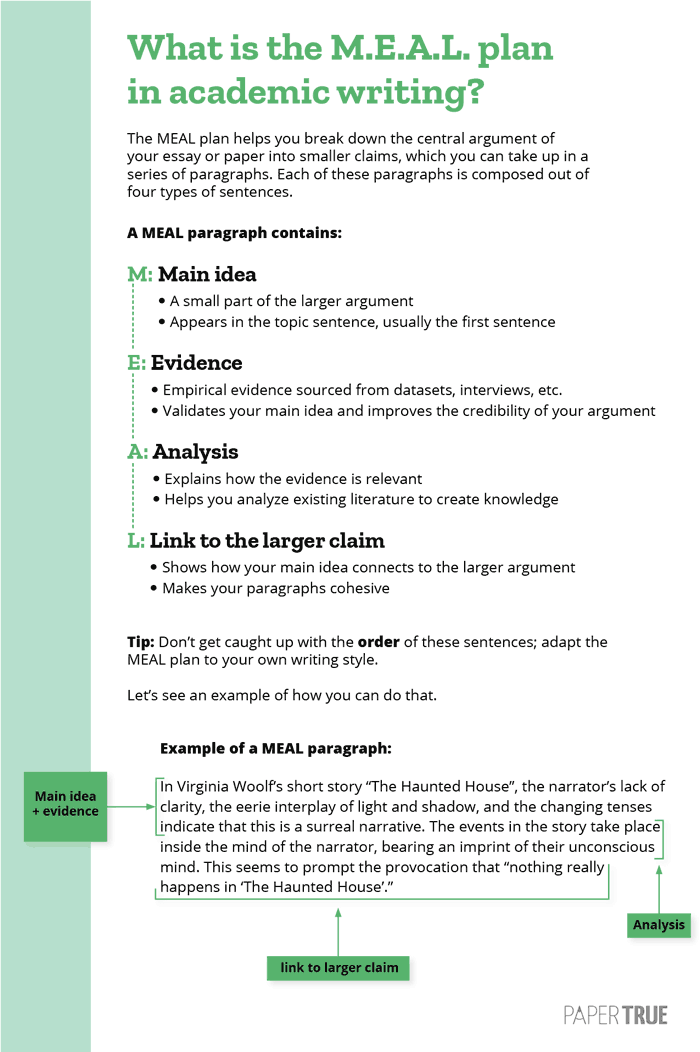
MEAL paragraph: An example

A quick guide to the MEAL writing plan along with an example of a MEAL paragraph.
As you can see in the example above, the four components of a MEAL paragraph are all present, but we’ve switched up how they appear. The evidence and main idea appear together, while the analysis is more of an elaboration of the topic sentence.

Notice how the paragraph only contains sentences that deal with the main idea. An effective paragraph under the MEAL writing plan contains no filler sentences: trim all the dead weight and only retain the essential words. As experts in editing and proofreading services, we can help you enhance your document’s paragraphs.

Want to keep reading? Here are the newest articles we’ve worked on:

The 5 Things to Look for in a Dissertation Editing Service

The thing about most writer victories are that they’re short-lived. It’s always another draft, another opinion, another revision, and so on. So if you’re just done writing your MLA style dissertation – congratulations! But editing still remains. 

What I’d suggest right off the bat is to hire a professional thesis editing service, no questions asked. They can perfect your work quicker and better than you can, while helping you deliver the intended impact.

But hiring a professional editor for your dissertation also means entrusting someone with roughly twenty thousand precious words of your hard work for a price. So ensure that they check off all the boxes in the following list and are worth your investment!

1) Cost

Cost got your tongue? Puns aside, it’s important to find that sweet spot between fair pricing and maximum quality. Pay attention the complexity of work being offered to you and base the rationality of the price off it. A lot of online proofreading services offer discounts, free samples or revisions and more. Lower costs can also mean botched editing, so better safe than sorry!

2) Time Taken

It’s taken you half your life to complete writing the dissertation (I’m kidding!), but that doesn’t mean editing should take up the remaining half. Editing services may sometimes vary on time taken in case of a dissertation (and this could work either way). So it’s best to get that sorted before the payment stage.

3) Safety and Security

As far as your dissertation is concerned, you cannot be safe enough. Plagiarism could occur in the blink of an eye, and your document’s security compromised in a click. Ensure that you’re trusting your work to a reputed service and check for established payment portals on the website. You can never be too sure.

4) Type of service being offered

Editing in general tends to focus more on grammar and syntax correction. For a dissertation however, look for services that offer academic editing and have qualified editors who are knowledgeable enough to proofread your work.

5) Customer support

Last, but not the least by any means. Having constant interaction with the editors might not always be feasible, and can even cause delays at times. Therefore, it’s important to work with an editing service that is constantly approachable – in order to facilitate better communication.

customer support - editing and proofreading thesis and dissertation

There’s no way to pick a best, but there’s no reason you shouldn’t be able to pick what works for you. Take a look at unbiased reviews, be absolutely clear in your specifications to the editor, and most importantly – relax with all your newfound free time! To give you a head start on the hunting, why not give PaperTrue’s sample edit a chance?

Here are some related articles that you might find interesting:

On Being Tense About Tense: What Verb Tense To Write Your Novel In

Time in a story is something we all, readers and writers alike, take for granted. Until we have to deal with it. How often do you actually sit down and think about what verb tense an author writes in? 

We don’t, right? Not usually. We instinctively know that a story is written in the past, or at least about the past: we are reading a story after it has happened. This has remained the general trend in literary history. 

To believably draw a reader into fictional events is a difficult task as it is. Therefore, the importance of maintaining tense is much more than maintaining consistency in language. The tense you write in also determines how you tackle time in your narrative. Is your story definitely set before it was written? Is your story ‘happening’ as the reader is reading it? All this can be established through the tense you write in. 

We’ve already told you that there are two ways you could go about this: historical present tense vs. past tense. But, if the understanding is that stories, regardless of variation in narrative tense, has been written after they have occurred (that is, the story is in the past), then what is the difference? 

This is an ongoing debate between writers, linguists and literary critics. Each perspective has its pros and cons, which are what we will be examining in this article. 

Past Tense Narratives: 

Pro: It’s Easier To Manipulate Time

Since this is a story told in the past tense, you can easily stretch or condense the time frame of the story. This allows you a lot of advantages – you control the pace of the novel, and you can jump back and forth in your timeline easily.  

Pro: It’s Easier to Read, Generally Speaking

Since past tense narratives are more common, as readers, we are more used to reading in the past tense. It can be jarring, and almost unbelievable at times, to read a story in the present tense. So, if you’re a novice writer who’s not quite confident about what to do, perhaps it’s best to stick to tried and tested methods.

Con: Everyone Knows There’s an End, So What’s the Suspense? 

So if you write a novel in the past tense, there are at least two things your readers are likely to know: the story has an end, and the narrator is alive by the end of the book. Convention says that this might make your book predictable (especially if you’re in genre fiction), making it difficult for you to use suspense.

(On the other hand, you could take advantage of it. Since everyone knows that there is an end to a story allows a writer to use foreshadowing and dramatic irony effectively. Moreover, you can always choose to subvert conventional storytelling.)

Present Tense Narrative 

Pro: It’s Considered Easier to Write 

In a novel anchored in the present tense. you’re most likely to use the simple present and the simple continuous tense, and a bit of simple past and future if you want to jump back and forth in time. Whereas, in a narrative anchored in the past tense, you would probably have to use most of the 12 tenses in the English language.

We’re only laying down the facts, but it’s clear which sounds like less of a hassle, right?

Con: It’s Harder to Pull Off 

Since writing stories in the present tense is a fairly recent trend and is often considered an ‘unnatural’ way of storytelling, there is a risk involved. Chances are, your story could sound awry really quickly. So, it’s best to stick to conventional wisdom and write in the past tense. 

Con: It’s Harder to Read, Maybe Even Unbelievable 

Like we said, it’s not that your story is happening in the present, it’s just that the reader has to believe it is. But if it’s not done well, your story will sound artificial and unbelievable, not to mention hard to read.

Pro: It Brings and Urgency and Suspense to Your Writing 

A present-tense narrative, when done right, gives your reader the feeling of experiencing the narrative at the same time your characters do. This allows for a kind urgency and immediacy in your novel, which can make it powerful. Since your reader and your characters are also on the sam page (pun intended) about time, it’s easier to create an air of suspense about what’s going to happen next.


Historic Present: Legit, or Just a Passing Trend? 

Now, that’s some food for thought. As we mentioned before, the verb tense debate is quite vibrant. And many (established) writers have really strong feelings about this. For instance, Philip Pullman and Philip Hensher point out that a change in verb tense doesn’t necessarily guarantee powerful prose. Honestly, they have a point there. As Hensher points out, “vivid writing is vivid, regardless of tense.”


But, then again, like we’ve said before, there is no right answer. The choice is for you to make. The choice is what makes your story better. You can write your novel in any verb tense or multiple verb tenses, but that’s for you to try and test now.


A List of Writing Contests in 2022 | Exciting Prizes!

Writing competitions are vital for any poets and writers who want to be successful. But it’s important to know which poetry competitions, short story contests, and nonfiction contests are worth the effort. So we took a deep dive into the web, looking for the writing contests in 2022 that are both exciting and dependable.

Suffice it to say, you won’t find any sham contests in this list!

Writing Contests in 2022

We love bringing you useful information that can help you along in your writing career. In fact, as your editors and proofreaders, we consider it our duty! So, we have brought you only the best poetry competitions and the most exciting nonfiction contests.

Whether you’re a poet or a writer, the themes and challenges you’ll find here are sure to make your writing juices flow!

Along with the usual poetry competitions, short story contests, and nonfiction contests, we have a mixed contest category. These contests are open to both poets and writers, accepting entries in multiple genres.

If you can’t find entries for December, don’t worry! We’ll add those as new competitions are declared and more writing contests in 2022 go live. So, make sure to keep an eye out on this page!

Without further ado, let’s begin our list of writing contests in 2022. 

September 2022

The month of September has a good mix of short story competitions, poetry contests, book writing competitions, and nonfiction contests. While we couldn’t find an essay contest for you this month, there are several mixed competitions that feature the nonfiction category.

Short story contests 2022

1.The Face Project 

Each day, the organizer uploads an oil portrait. You have to write a story on this image and send it as your submission. This unique contest allows you to submit up to 28 stories!

Word limit: 1,000

Prize: Feature in a unique art publication

Entry: Free!

Closing date: 04 September 2022

2. Women’s Fiction Competition 2022 – Short Story 

The short story contest is organized by Mslexia. All shortlisted stories will appear in an ebook anthology while the four finalists will be published in the December 2022 edition of Mslexia.

Word limit: 3,000

Prizes: £3,000, three prizes of £100

Entry fee: £12

Closing date: 19 September 2022

3. The Booksie 2022 Short Story Competition

This short story contest is organized by Booksie, an online writing platform. The organizers are looking for stories to make them “laugh, cry and see the world in a slightly different way.”

Word limit: 5,000

Prizes: $500, two prizes of $100

Entry fee: $5.99

Closing date: 24 September 2022

4. Henshaw Short Story Competitions

The short story contest is organized by the Henshaw Press. For a fee of £14, you can get critiques from the competition judges after the results have been announced.

Word limit: 2,000

Prizes: £200, £100, £50

Entry fee: £6

Closing date: 30 September 2022

5. Writer Contest – Writers of the Future 

This is the most influential story contest in the genres of science fiction and fantasy. It has three quarterly winners and one yearly winner, who receives a grand prize of an additional $5,000.

Word limit: 17,000

Prizes: $1,000, $750, $500

Entry: Free!

Closing date: 30 September 2022

Poetry contests 2022

6. 20 Syllable Poem Contest

This poetry contest invites you to create powerful poems in 20 syllables. Do you think you’re up for the challenge?

Word limit: 20 syllables 

Prize: $100

Entry fee: $9

Closing date: 10 September 2022

7. One Page Poetry Contest – 2022 

This poetry contest invites poets to submit a single page of poetry. Aside from this, there are no regulations of genre, style, or theme on the entries.

Word limit: None

Prize: $2,000, $1,000, $500

Entry fee: $95

Closing date: 20 September 2022

8. Troubadour International Poetry Prize 2022 

The poetry competition will be judged by Joshua Bennet and Victoria Kennefick. Winners will read their entries alongside judges at the prize-night celebrations!

Word limit: 45 lines

Prizes: £2,000, £1,000, £500 

Entry fee: £5

Closing date: 26 September 2022 

9. Tom Howard/Margaret Reid Poetry Contest

The poetry contest awards one top prize for a poem in any style or genre and another for a poem with rhyme. Soma Mei Sheng Frazier and Michal Jones will judge the contest.

Word limit: 250 lines

Prizes: Two prizes of $3,000 and ten prizes of $200

Entry fee: $20

Closing date: 30 September 2022

10. Patricia Eschen Prize for Poetry

This poetry contest is sponsored by the Dennis Myner Trust. Entry is free, but limited to one entry per person. Katrina Naomi and Penelope Shuttle are the judges.

Word limit: 41 lines

Prizes: £1,000, £500, £300

Entry: Free!

Closing date: 30 September 2022

Book writing competitions 2022

11. Tales By Moonlight Novella Competition 

The novella writing contest invites entries written in the genre of fantasy with magic as theme. The winner will be determined by audience voting!

Theme: Magic

Word limit: 15,000–20,000

Prize: $1000

Entry: Free!

Closing date: 15 September 2022

12. New Memoir Award 

This memoir writing competition asks you to send a 300 word overview of your memoir along with the entry. As you’re longlisted and shortlisted, you’ll be asked to submit more words.

Word limit: 5,000–8,000

Prizes: £1,500, £750, three prizes of £150

Entry fee: £24

Closing date: 30 September 2022

13. Miller Williams Poetry Series and Prize

Organized by the University of Arkansas Press, this prize is awarded to the best book of poetry. The organizers are looking for poems that “vivify and disturb.”

Word limit: 60–90 pages

Prize: $5,000 

Entry fee: $28

Closing date: 30 September 2022

14. The XJ Kennedy Poetry Prize 

Texas Review Press has organized this poetry competition every year since 1998. It awards one poet with a publishing contract, a $10,000 advance against royalties, and 20 copies of the book. 

Word limit: 50–100 pages

Prize: $10,000 

Entry fee: $28

Closing date: 30 September 2022

Mixed: Poetry, fiction, and nonfiction contests

15. Wild Atlantic Writing Awards 

This flash fiction and nonfiction contest will be held in two separate categories. The top ten stories in each category will be published on the Ireland Writing Retreat website with the writers’ permission.

Genres: Flash fiction and creative nonfiction

Theme: Beauty

Word limit: 500

Prizes: €500 and a coupon of €1,000 per category

Entry fee: €10

Closing date: 09 September 2022

16. The Moth Nature Writing Prize 

This competition invites poets and writers to submit entries in the genre of nature writing. The winning entry will be published in the winter issue of The Moth.

Genres: Not specified

Word limit: 4,000

Prize: €1,000

Entry fee: €15

Closing date: 15 September 2022

17. Olga Sinclair Prize 2022 

This writing competition invites poets and writers to submit their entries with no limitations of genre or style. They usually set a theme for their contest, but have decided against it this year.

Genres: Not specified

Word limit: 2,000

Prizes: £500, £250, £100

Entry fee: £9

Closing date: 30 September 2022

18. Dreamers Flash Fiction and Nonfiction Contest 

This flash fiction and nonfiction competition is organized by Dreamers. The winning story will be published in the December 2022 issue of the magazine.

Genres: Flash fiction and nonfiction

Word limit: 300–1,000

Prizes: $150 CAD

Entry fee: $15 CAD

Closing date: 30 September 2022

October 2022

While the month of October is dominated by flash fiction and short story contests, it also features a decent number of poetry competitions. After a thorough search, we have also found a nonfiction contest for this month!

Short fiction competitions 2022

1. SAS Fiction Contest 2022-2023

Organized under the Saints & Sinners LGBTQ+ Literary Festival, the short story contest welcomes queer stories. Top ten finalists will be published in an anthology, for which there will be a book release party.

Theme: Saints and sinners

Word limit: 3,000–7,000

Prizes: $500, two prizes of $100

Entry fee: $20

Closing date: 01 October 2022

2. TWFest Fiction Contest 2022-2023 

The Tennessee Williams & New Orleans Literary Festival has organized this short story competition. It is open to only unpublished authors, so writers who have self-published are not eligible.

Word limit: 7,000

Prize: $1,500

Entry fee: $25

Closing date: 02 October 2022

3. Bath Flash Fiction Award 

This flash fiction competition is currently open for its July to October round. 50 longlisted entries will be offered publication and the published writers will receive a free print copy of the anthology.

Word limit: 300

Prizes: £1000, £300, £100, two  prizes of £30

Entry fee: £25

Closing date: 15 October 2022

4. Creative Writing Contests – Calvino Prize 

The fiction writing contest is organized by the Creative Writing Program at the University of Louisville. You may submit up to 25 pages of any piece of fiction.

Word limit: 25 pages

Prizes: $2000, $300

Entry fee: $25

Closing date: 15 October 2022

5. The Raven Short Story Contest 

The short story contest is organized by Pulp Literature and the winning entry will be published in the Spring 2022 issue of the magazine. The contest has an early bird entry fee of $15, so hurry up!

Word limit: 2,500

Prize: $300

Entry fee: $20

Early bird deadline: 15 September 2022

Closing date: 15 October 2022

6. TWFest Very Short Fiction Contest 2022-2023 

The flash fiction writing contest is open to writers who haven’t published a book of short fiction yet. The winning entry will be published in New Orleans Review Archive Features.

Word limit: 1,000

Prizes: $500

Entry fee: $10

Closing date: 16 October 2022

7. The GBP Short Story Prize 2022/23

The Galley Beggar Press has organized this short story competition for both published and unpublished writers. Shortlisted entries receive £200 while the longlisted one receive gift vouchers.

Word limit: 6,000

Prizes: £2500, some prizes of £200, and others

Entry fee: £10

Closing date: 16 October 2022

8. Letter Review Prize for Short Stories 

Letter Review has organized this short story competition to provide an opportunity for fiction writers. All longlisted and shortlisted writers have a chance to get published with Letter Review.

Word limit: 400–3,000

Prizes: $600, $250, $150

Entry fee: $20

Closing date: 31 October 2022

9. Fiction Factory Short Story Competition 

The short story contest welcomes entries on any theme. The winning entry will be published on the website and published in an anthology at a later date.

Word limit: 3,000

Prize: £500

Entry fee: £7

Closing date: 31 October 2022

10. The Larry Brown Short Story Award

Pithead Chapel has organized this short story contest. Five finalists will be published in the January 2023 issue of the magazine. Don’t forget to attach a cover letter with your entry!

Word limit: 4,000

Prizes: $500, $50, $50

Entry free: $10 

Closing date: 31 October 2022

Poetry competitions 2022

11. Martha Richardson Poetry Prize 2022

Ballarat Writers has organized this poetry contest to celebrate the poet Martha Richardson. I will publish the winning entry on their website in December 2022. 

Theme: Inflate

Word limit: 40 lines

Prizes: AUS $1,000, AUS $400, AUS $100

Entry fee: AUS $20 per poem

Closing date: 01 October 2022

12. 2023 Peter Porter Poetry Prize

This is one of Australia’s most respected poetry contests. It awards single-authored poems in memory of the late Australian poet Peter Porter.

Word limit: 70 lines

Prizes: $6,000 AUD, four prizes of $1,000 AUD

Entry fee: $25 

Closing date: 03 October 2022

13. SAS POETRY Contest 2022-2023

The poetry contest invites LGBTQ+ poets around the world to submit their entries. One entry may consist of up to 2–4 poems. Top finalists will be published in a poetry chapbook.

Theme: Family

Word limit: 400 lines

Prizes: $500, two prizes of $100

Entry fee: $20 

Closing date: 15 October 2022

14. TWFest Poetry Contest 2022-2023 

The poetry competition invites entries with up to 2–4 poems. It is open to poets who haven’t published a book of poetry. Writers who have published in other genres are eligible to enter.

Word limit: 400 lines

Prize: $1,000

Entry fee: $15 

Closing date: 16 October 2022

15. Anthology Poetry Award 2022 

Organized by Anthology, the poetry competition awards a top poem with the cash prize and publication. The organizers advise you to go through earlier issues to learn about the type of material they publish. 

Theme: Dreams

Word limit: 40 lines

Prize: €500

Entry fee: €15 

Closing date: 31 October 2022

16. National Poetry Competition 

One of the world’s most prestigious contests, it runs alongside the Peggy Poole Award, which will award one poet from North West of England, mentorship from a judge of this competition.

Word limit: 40 lines

Prizes: £5,000, £2,000, £1,000, £200

Entry fee: £7

Closing date: 31 October 2022

17. Benjamin Saltman Poetry Award 

Red Hen Press has organized this competition, awarding an unpublished book of poetry with a cash prize and publication. The winner also receives a four-week residency at PLAYA residency.

Word limit: 48–96 pages

Prize: $3,000

Entry fee: $25

Closing date: 31 October 2022

Nonfiction contests

18. 2022 Nonfiction Contest

The contest is organized by EVENT magazine. The organizers urge writers to explore the form of creative nonfiction. Entry to the contest comes with a one-year subscription of the magazine.

Word limit: 5,000

Prizes: $1,500, $1,000, $500

Entry fee: $34.95

Closing date: 15 October 2022

19. Quarterly Creative Nonfiction Contest

WOW! Women on Writing has organized this essay writing contest. You may opt for a critique from the judges by paying a fee of $25. The entries are limited to 300, so don’t waste any time!

Word limit: 200–1,000

Prizes: $500, $300, $200

Entry free: $12 

Closing date: 31 October 2022

Book writing contests

20. Grindstone 2022 Novel Prize

Send the first 5,000 words of a manuscript longer than 50,000 words in length, targeted to adults or young adults. All longlisted works will be forwarded to top agencies in the UK.

Word limit: 5,000

Prizes: £1,000, £500, four prizes of £125

Entry fee: £16

Closing date: 01 October 2022

21. The Megaphone Prize 

This writing competition invites debut writers of color to send their short story collections. It also allows 25 fee waivers for writers with low income. Award-winning writer Deesha Philyaw is the judge.

Word limit: 35,000–80,000

Prize: $1,000

Entry fee: $20

Closing date: 15 October 2022

22. Novel Opening & Synopsis Award

The novel writing contest invites you to submit one chapter of your novel with a synopsis. Your novel need not be completed or published to qualify for the award.

Word limit: 3,000 words; an additional 750 words for synopsis

Prizes: £500, £200

Entry fee: £10

Closing date: 31 October 2022

Mixed: Poetry, fiction, and nonfiction contests

23. Jeffrey E. Smith Editors’ Prize  

This writing competition is organized by The Missouri Review. The organizers invite poets and writers to submit entries in fiction, nonfiction, and poetry. 

Genres: Fiction, nonfiction, poetry

Word limit: 8,500

Prizes: Three prizes of $5,000

Entry fee: $25

Closing date: 01 October 2022

24. 2022 Short Story and Poetry Competition 

The competition invites poets and writers to send their entries in two categories. Both categories feature three contests, which increases your chances of winning! The contest also has a lower fee for full-time students.

Genres: Short story and poetry

Word limit: 3,000 and 40 lines

Prizes: £1000, £200, £100 per category

Entry fee: £7.5 per story/poem

Closing date: 01 October 2022

25. She Writes Press and SparkPress Toward Equality in Publishing 

She Writes Press has organized this writing contest to recognize two BIPOC women writers with publication packages and a 500 book print run. The contest also welcomes trans, nonbinary, and genderqueer people.

Genres: Fiction and nonfiction

Word limit: 50 pages

Prizes: Publication packages

Entry: Free! 

Closing date: 15 October 2022

26. SaveAs Writers’ International Writing Competition 2022 

The writing contest invites poets and writers to submit entries that display a link to any mythology. The contest celebrates the centenary of the publication of James Joyce’s Ulysses.

Genres: Fiction and poetry

Theme: Myth

Word limit: 3,500 for short story; 60 lines for poetry

Prizes: £200, £100, and £50 for both categories

Entry free: £3 for poetry; £4 for story 

Closing date: 31 October 2022

27. The Bedford Competition 

The writing competition is open to all international poets and writers over 17 years of age. The organizers donate the proceeds from the contest to charities that support literary and literacy skills.

Genres: Fiction and poetry

Word limit: 3,000 for short story; 40 lines for poetry

Prizes: £1,000, £300, and £200 for both categories

Entry free: £7.5 for poetry or story 

Closing date: 31 October 2022

November 2022

We’ve found some interesting contests for you in November, including a travel writing contest and a six-word contest! We managed to jot down two nonfiction contests this time around, and they’re both in the genres of creative nonfiction.

Flash fiction contests 2022

1. The SmokeLong Quarterly Award for Flash Fiction 

The grand prize winner of this flash fiction writing competition will be automatically nominated for several other influential prizes. You may submit entries in other languages as long as it’s accompanied by an English translation!

Word limit: 1,000

Prizes: $2,500, $1,000, $500, multiple prizes of $100

Entry free: $12 / $14

Closing date: 02 October / 15 November 2022

2. Fiction Factory Flash Fiction Competition 

The writing competition is organized by Fiction Factory and welcomes entries in all genres except children’s and young adult literature. 

Word limit: 1,000

Prizes: £300

Entry fee: £5

Closing date: 30 November 2022

3. New Writers Flash Fiction Competition 2022 

The organizers of this flash fiction competition invite you to submit works of fiction of any genre, style, or theme. All entrants can submit up to three entries.

Word limit: 300 

Prizes: £700, £200, £100

Entry fee: £6

Closing date: 30 November 2022

4. Flash Fiction Competition 

This quarterly flash fiction contest will start accepting entries on the 1st of September. All longlisted entries stand a chance to be published in the contest anthology!

Word limit: 180–360 

Prizes: £1,200, £600, £300, £150

Entry fee: £7

Starting date: 01 September 2022

Closing date: 30 November 2022

Short story contests

5. Western Writing Contest

FanStory has organized this short story competition for stories with Old West themes. The contest has a limit of one entry per writer, and all writers receive feedback on their submission. 

Word limit: 2,000–5,000

Prize: $100

Entry fee: $10

Closing date: 29 November 2022

6. ServiceScape Short Story Award 2022 

ServiceScape has organized this short story competition to help new writers reach bigger audiences. All genres and themes are welcome, and the winning story will be published on their blog.

Word limit: 5,000

Prize: $1,000

Entry: Free!

Closing date: 29 November 2022

7. Fish Short Story Prize 

This year, Sarah Hall will judge the esteemed short story competition. Ten winners will be published in the Fish Anthology 2023. The top two winners also get additional prizes!

Word limit: 5,000

Prizes: €3,000, €300, €300, seven prizes of €200, and more

Entry free: €20

Closing date: 30 November 2022

Poetry contests 2022

8. Brick Road Poetry Book Contest 

This poetry contest is open to book length poetry manuscripts. The winning entry receives a publishing contract, and other finalists will also be considered for publication. 

Word limit: 50–100 pages

Prizes: $1,000 and 25 copies of the book

Entry free: $30

Closing date: 01 November 2022

6. Edwin Markham Prize for Poetry 2022 

The poetry competition by Reed Magazine “celebrates the wonderful diversity of forms, styles, and levels of diction available to the contemporary poet.” You may submit up to five poems in one entry.

Word limit: None 

Prize: $1,000

Entry fee: $20

Closing date: 02 November 2022

8. Sonnet Poetry Contest 

This poetry contest invites poets to submit sonnets in iambic pentameter, the way Shakespeare wrote it! The organizers have provided detailed instructions on the kind of sonnet they accept, so make sure to go through those!

Word limit: 14 lines 

Prize: $100

Entry fee: $10

Closing date: 06 November 2022 

9. Cafe Writers Poetry Competition 

Cafe Writers has organized this poetry contest and it will be judged by Jennifer Wong this year. The contest offers a fee concession for UK poets with a household income of less than £16,000.

Word limit: 40 lines

Prizes: £1,000, £300, £200, £100, five prizes of £50

Entry free: £4 per poem

Closing date: 14 November 2022

10. Lune Poetry Contest 

This poetry competition has been organized by FanStory. Lune is known as the American Haiku and is written in three lines. All poets receive feedback on their submission.

Word limit: 13 syllables 

Prize: $100

Entry fee: $10

Closing date: 16 November 2022

11. Minute Poetry Contest 

A minute poem has three four-line stanzas that follow a “8,4,4,4” syllable structure. So the poem is twelve lines in total, written in strict iambic meter. Are you ready to take on the challenge?

Word limit: 60 syllables 

Prize: $100

Entry fee: $10

Closing date: 22 November 2022

12. Gregory O’Donoghue International Poetry Competition 

Munster Literature Centre has organized this poetry contest, to be judged by Suji Kwock Kim. The top prize comes with a featured reading at Cork International Poetry Festival and all finalists will be published in Southword.

Word limit: 40 lines

Prizes: €2,000, €500, €250, ten prizes of €50

Entry free: €7 per poem

Closing date: 30 November 2022

Nonfiction contests

13. Gabriele Rico Challenge for Nonfiction 2022 

The nonfiction contest invites writers to submit stand-alone essays of creative nonfiction. It is organized by Reed Magazine and accepts only unpublished work.

Word limit: 5,000 

Prize: $1,333

Entry fee: $20

Closing date: 12 November 2022

14. True Story Contest 

The nonfiction contest is organized by FanStory. The organizers ask you to submit a true story that will “allow readers insight into your feelings, observations and/or thoughts.”

Word limit: 5,000 

Prize: $100

Entry fee: $10

Closing date: 12 November 2022

Book writing competitions

15. The Caledonia Novel Award

The novel writing contest invites you to send the first 20 pages of your manuscript along with a synopsis of 200 words. They have some sponsored entries for writers with low income.

Word limit: 20 pages

Prize: £1,500

Entry fee: £25

Closing date: 01 November 2022

16. Bath Children’s Novel Award 

Leading literary agents in the genre of children’s fiction judge this contest in search of “potential rather than perfection”. Junior Judges, aged up to seventeen years old, will select the shortlisted entries!

Word limit: 5,000

Prize: £3,000

Entry fee: £29

Closing date: 30 November 2022

17. Quill Prose Award 

This competition awards queer people’s writing in the genre of fiction or nonfiction. The organizers seek to “work against the negative politics of labeling while honoring and empowering authors who identify as queer.”

 Word limit: 25,000

Prize: $1,000

Entry fee: $10

Closing date: 30 November 2022

18. Minotaur Books/Malice Domestic Competition 

This mystery novel competition invites writers to send published manuscripts that revolve around murder or other serious crimes. This is a great opportunity for self-published writers!

Word limit: 65,000

Prize: $10,000

Entry: Free!

Closing date: 30 November 2022

Mixed: Poetry, fiction, nonfiction contests

19. Six Word Wonder Contest 2022

This eccentric contest invites poets and writers to compose anything in under six words: a poem, a story, a memoir, or even a joke! It allows you to send up to six entries at once, so why not take the chance?

Word limit: 06

Prize: £100

Entry: Free!

Closing date: 30 November 2022

20. Tadpole Press 100-Word Writing Contest 

The writing competition is organized by Tadpole Press. Write a hundred words without the constraints of genre or theme, and see where you end up! 

Word limit: 100

Prize: $1,000 and others

Entry fee: $10

Closing date: 30 November 2022

December 2022

We’ll keep adding to this list as the year passes and more contests go live with a December deadline. For now, these are our entries for this month, and poetry contests outnumber all others!

Short fiction contests

1. 7 Day Story Writing Challenges 

The short story contest runs every seven days, and those registered are assigned a genre and a secret theme. Writers who register don’t need to re-register for a new cycle of the contest.

Word limit: 2,000

Prize: £500 

Entry: Free!

Closing date: 31 December 2022

2. Flash Fiction Competition 

Flash 500 organizes this flash competition as a quarterly open-themed contest. The competition “truly reflects the skill required to encapsulate an entire story in just 500 words.”

Word limit: 500

Prizes: £300, £200, £100

Entry fee: £5

Closing date: 31 December 2022

Poetry competitions

3. Four Line Poem Contest

The organizers of this poetry competition want you to write a four line poem with this syllable structure: 1, 5, 5, 9. All poets receive feedback on their submission. Think you’re up for the challenge?

Word limit: 20 syllables

Prize: $100 

Entry fee: $10

Closing date: 22 December 2022

4. The Moth Poetry Prize 

This is one of the biggest poetry contests awarding a single unpublished poem. Nobel Prize-winning poet Louise Glück is the judge this year. The winner will be announced at a special award ceremony at Poetry Ireland in Dublin.

Word limit: None

Prize: €6,000 

Entry fee: €15

Closing date: 31 December 2022 

5. Blue Mountain Arts Poetry Contest

This is the 41st bi-annual poetry contest Blue Mountain Arts has organized. Poets are invited to send both rhyming or non-rhyming poems, but the organizers have a preference for non-rhyming poetry.

Word limit: None

Prizes: $350, $200, $100 

Entry fee: €15

Closing date: 31 December 2022

6. The Poetry.com Contest 

The platform organizes monthly poetry competitions where all participants vote for the winning entry. Every month, the organizers offer five free entries for poets who can’t pay the entry fee.

Word limit: 75 lines

Prizes: $500, $300, $200

Entry fee: $25

Closing date: 31 December 2022 

7. 2023 Poetry Competition 

The Society of Classical Poets has organized this poetry contest, inviting poets to submit their entries with a meter. The organizers encourage rhyme and other traditional techniques, but they’re not required.

Word limit: 108 lines

Prizes: $2,000

Entry free: $20

Closing date: 31 December 2022

Nonfiction contest

8. Free Writing Competition – My Writing Journey 

This essay writing contest invites you to submit entries on the given theme. The winning entry will be published on The Writers College blog and newsletter. Send the essay in the body of your email, and not as an attachment!

Theme: The best writing tip I’ve ever received

Word limit: 600

Prizes: $200

Entry: Free!

Closing date: 31 December 2022

Book writing contests

9. Orna Ross Green Stories Novel Prize 

The writing competition invites novels that engage with green solutions and raise awareness about “the necessary transformations towards a sustainable economy”. Send three chapters from your novel with a synopsis.

Word limit: 4,000–10,000

Prizes: £1000, £500

Entry: Free!

Closing date: 01 December 2022

10. Chimera Fantasy Awards

This fantasy book writing competition is in its inaugural year, inviting unpublished and self-published writers to submit the first 20,000 words of their manuscripts along with a synopsis. The 12 shortlisted entries will be published on their website!

Word limit: 20,000

Prizes: £2500, £1200, £600

Entry fee: £6

Closing date: 01 December 2022

11. First Crime Novel Competition  

The novel writing contest is open to writers who haven’t yet published a book, but self-published authors are eligible to enter! Just make sure the manuscript you’re submitting hasn’t been self-published.

Word limit: 40,000–66,000

Prize: $10,000

Entry: Free!

Closing date: 16 December 2022

Mixed contest

12. 2023 Work Anthology 

Unleash Press has organized this writing contest, inviting poets and writers to submit entries about “the job you loved… The job you loathed… The job that told you about yourself.”

Genres: Essay, fiction, drama, poetry

Theme: Work

Word limit: 5,000

Prize: $150

Entry free: $10

Closing date: 31 December 2022


We hope this list of writing contests in 2022 got you excited to write some poems, stories, or essays, and win some prizes.

If you happen to win any of these contests, be sure to inform your editors! In case you don’t win any, remember that it’s not the prizes that are important, but the writing practice you’ll get out of this experience.

For now, dear poets and writers, good luck!

How to Cite Sources in the MLA Format

If you are a student of literature or humanities, you may come across the MLA style of citation. What is it and how do you actually use it to cite your sources? That’s what we’re about to find out. This article will help you understand the rules and conventions of the MLA style of citation. 

What is MLA format?

The MLA format is the citation style devised by the Modern Language Association, primarily used in academic writing in the humanities and liberal arts, particularly in disciplines like philosophy, literature, language, etc. 

While there are other citation styles such as the Chicago Manual of Style and APA, your professors may ask you to adhere to this specific style in your papers. 

The MLA handbook is currently in its 8th edition (as of 2016) and lists formatting guidelines and provides rules for two types of citations: in-text citations and a ‘Works Cited’ page at the end of the paper. The in-text citations are brief, with the author’s name and the page number. Citations on the Works Cited page are more extensive and give full information about the source.

The purpose of citations (besides avoiding plagiarism) is to document the sources you are using to build your research paper. While it may seem like a mundane list to some, it is in fact greatly useful in shedding light on the background research you’ve done to arrive at your argument or thesis statement.

What’s different in the 8th edition? 

In earlier editions, the MLA handbook had specific sets of guidelines for citing each type of source. This means that if a researcher wants to cite a book and a film, they would have to refer to the handbook for unique instructions for each. The 8th edition eliminates this hurdle to accommodate emerging forms of published content, including online resources and electronic forms of mass media. It specifies a general set of principles that scholars need to adhere to, followed by examples of various kinds of sources. 

In-text citations in MLA

An in-text citation is included in the body of your text, immediately after you refer to, paraphrase, or quote an external source. The MLA format follows the author-page system of in-text citations. 

An in-text citation is typically written inside a parenthesis and looks something like this:

When you write, make sure that your reader always knows who is speaking (Strunk 72).

This is generally known as a parenthetical citation. 

There is also the narrative in-text citation, used if you have already referred to the author within the body of the paper. This means that you’ll only have to include the page number in the parenthesis. It looks like this:

Strunk emphasizes the need for writers to indicate who is speaking (72).

Works Cited section 

A paper formatted in the MLA style also includes a “Works Cited” page after the body text. It is a list of all the sources you have referred to throughout the paper. Each entry in this list must correspond to an in-text citation. 

Elements of an entry in the Works Cited section: 

You’ll notice that each entry in the Works Cited list contains a particular set of information about the source and is written in a specific order.

Every citation must have the following information: 

Author name(s). “Title of the source.” Title of the container, other contributors, version, number, publisher, publication date, location.

Let us deconstruct the elements of an MLA citation one by one.

Author

An ‘author’ refers to the person or persons who are the creators of the sources. It is the first element of an MLA citation. You can use the table given below to see how authors’ names are listed in the Works Cited section. 

No. of authors Works Cited Format Example
1 Last name, First name.  Hume, Cecelia M. 
2 Last name, First name, and First name Last name.  Hume, Cecelia M., and Iris Scott.
3 or more  Last name, First name, et al.  Hume, Cecilia M, et al.

When you’re including sources with two or more authors, list the authors in the same order as shown on the source. 

If a source does not have a known author, simply start with the next element, the title. 

Title of source

The title of the source material is the second element of an MLA citation. As the name suggests, it is the title of the source you are referring to in your paper. 

  • If your source is a book, italicize the name. 
  • The names of all other sources (including web pages, media formats, journal articles, etc.) are included within quotation marks. 
  • The quotations rule applies to any source that is a part of a larger item like, for example, a song in an album or a journal article in a periodical. 
Title of container
  • The 8th edition of the MLA handbook requires you to include a “container”, which is the larger body of source material that the source you cite is in. 
  • For example, if you are citing an essay in an anthology, you will list the individual essay as a source and the anthology as a container. 
  • The title of a container is italicized, and is followed by a comma. 

Barthes, Roland. “The Romans in Film.” Mythologies, translated by Annette Lavers, Vintage Classics, 2009, pp. 15–18. 

Examples of containers
  • A book is a container for an essay, poem, cited chapter, etc. 
  • A TV series is a container for a specific episode 
  • A website is a container for a specific page within it. 
  • A journal/periodical/magazine is a container for a specific article. 
Other contributors

These include people who, other than the ones you have cited already, you recognize as important contributors to the piece. This is where you’d include editors and translators. 

Barthes, Roland. “The Romans in Film.” Mythologies, translated by Annette Lavers, Vintage Classics, 2009, pp. 15–18. 

Version

A source may often have a version. Books have different editions, and films, songs, and television shows may have different versions as well. If this is the case, include the version or edition of your source as part of the citation. 

Scott, Ridley, director. Blade Runner. Warner Bros., 1992. 


Number

If the source is a part of a larger series or numbered sequence, then you must include the serial number or volume of the text. 

“Remedial Chaos Theory.” Community, created by Dan Harmon, season 3, episode 4, Krasnoff Foster Productions and Universal Media Studios, 2011.

Publisher

Include the publisher of the source in your entry. A publisher is someone or an entity that puts the source material out for public use. Note that this section will not include information about the distributor of your source, such as Netflix, JSTOR, etc. 

Publication date

If your source mentions a publication date, include that information in your entry as well. Maintain the format and information as mentioned in the source. 

You may include years, specific dates, or even date ranges. 

Location

If the location of publication is important for your source, include that as well. You’ll often find yourself doing this for books, as the location often reflects the language of the content itself. 

What happens when you’re missing parts of the citation? 

If you’re missing parts of the citation, simply omit that section and move on to the next. Since you’re using the same format for a myriad of types of sources, you’ll often find that the information you provide for each differs. 

Here’s a concise guide for missing out on important information: 

  • If there’s no source author, start with the source title. 
  • If there’s no title, provide a brief description of the source. (1 line) 
  • If there’s no publication date, provide the date on which you accessed the source.

4 Online Publishing Platforms To Boost Your Readership

Thanks to social media, everyone has an audience now. From content creators who started small on Vine and graduated to YouTube, to microbloggers on Twitter catapulting their way to publishing books and inspiring TV shows. The digital space has given all creatives a huge platform for their ideas being seen, heard and read from people all around the world.

If you’re planning to take the online route to publishing, you can reel in a big number of readers without the marketing efforts of a traditional publishing company.

Like every business, having an online presence is a must for all authors. If you’re a beginner or seasoned author who doesn’t have an online presence, all you have to do is list yourself on the right platforms; stay active and see a spike in your following and readership.

Online publishing platforms

There are some incredible websites that let you publish your books online and have millions of dedicated members all ready to devour your books.

So, let’s take a look at such online publishing avenues, which will help you get published, create a fanbase and set you sailing on a soaring journey of writing success. 

1) Wattpad   

Wattpad has gained popularity among teenagers for their favorite genre – Young Adult Fiction. Tons of it is available for free on the app and website. All you have to do is sign up and start reading on your phones. And it’s just as easy for writers to self-publish on this website.

This makes a good launchpad for writers who’re looking to grow as “authors”. There is an immense scope of experimentation on Wattpad and there’s no end to the genres you can dabble in!

How to Succeed on Wattpad –

Just like YouTube Videos, algorithms decide which books appear on the front page and the home page of users. Some ways to rig this algorithm and improve your visibility are:

  • Update your book regularly.
  • Always mark your work as “completed.”
  • Hashtag your book with all the right keywords.
  • Engage with other users in conversation and respond to their comments and suggestions.

You can take part in Wattys, the annual awards hosted on Wattpad. Wattys reward and recognize upcoming writers in at least 10 categories.

2) Kindle Singles

Unlike Wattpad, this is not a social media website for books, it’s a marketplace. Amazon KDP has already made self-publishing faster and easier for all novice authors. Amazon singles is another publishing avenue which is being marketed as “compelling ideas expressed at their natural length.” That’s the USP of Amazon Singles, it lets you publish even if you finish your work between 5,000 – 30,000 words. This is something trade publishers would never allow, as it is not commercially viable for them.

That’s where Amazon, like with many other products, has caused a total disruption in the books market. Seasoned authors always wanted the opportunity to express their ideas without having to stretch them unnecessarily to get them published. Big guns have already jumped on the bandwagon. If you enroll yourself on Amazon singles, you’d be competing with the likes of Chuck –Fight Club – Palahniuk, Susan Orlean, Amy Tan, George Saunders, and Ann Patchett are all writing Kindle Singles.

How to succeed on Amazon Singles –

Amazon offers you the liberty to stay true to the length of your words. Rather than spending a year or more producing one full-length title, it would be better to spend that time writing a sequence of three or four shorter eBooks of 20,000 words each. Publishing four times in a year is better than publishing just once, in terms of marketing. This way, you make more in royalties too.

3) Sweek 

Sweek is a global online community of readers and writers. It is similar to Wattpad, it’s a little smaller in size with only 400,000 registered users compared to the 18 million users on the formerly mentioned giant. What sets it apart is, Sweek additionally allows you to self-publish your book in print. Many rookie writers join this community to improve their writing and get instant feedback from the base of mature readers in the comments section.

What attracts readers & writers to Sweek is mainly the clean reading experience, minus the ads and pop-up distraction. The user interface too is simpler compared to the rest of the platforms.  

How to succeed on Sweek:

Of all such communities available online. Sweek hosts the most number of contests and challenges all through the year which gives you higher chances of success and recognition. Writers get encouraged to write more, and you have a chance of winning big prizes. The big names in publishing like Moon publishers, Piper Verlag and Penguin Random House occasionally also have talent scouting competitions. Seriously, become a Sweeker already!

4) Smashwords

This one has been around for a decade now. Smashwords is an ebook-distribution platform that has gained popularity over the years. Some bestsellers in the last 10 years have seen a debut on Smashwords. What makes it profitable is the sweeping distribution channel, not in the capacity of any other mentioned platform. If your book is approved for premium distribution, it will be made available on other selling and publishing avenues like Barnes & Noble, Kobo, Apple, Page Foundry, Baker & Taylor, Blio, txtr, Library Direct, Baker-Taylor, Axis360, OverDrive, and Scribd. Talk about reaching out to the readers eh?

How to succeed on Smashwords:  

The top tip to achieve on this website would be to hook readers with a free first installment! Strategically select the platforms where your book will have more visibility and see increased interest and rise in the readership of your books.

Get Started!

Anyone of these platforms will get you out and into the market. It’s best to choose one and try them out for a little while to see if it’s right for you. What we liked about these four platforms, out of the hundreds available on the web is, each has its own unique feature you can capitalize on, and they offer a whole lot more than just giving you an opportunity to self-publish.

PaperTrue offers a comprehensive pre-publishing package for authors who wish to self-publish their work. To ensure our clients bring out a clean copy to the market, we provide editing, proofreading, formatting, typesetting, and book cover design services.

Always remember, PaperTrue is the one-stop-shop for all your publishing needs. 

How to Edit and Expand Your Resume into a CV

So now you know what a resume is. You know how to write one, and you know that it’s not the same thing as a resume. 

Hopefully, by now, you have a top-notch resume that is a passport to the job of your dreams.  (Pro-tip: It’s not over yet, you gotta keep updating it as you advance in your career.)

Good job! Pat yourself on the back.

Now, what if you’ve been asked for a CV or curriculum vitae, instead? It would be totally reasonable if you frantically saw your whole life flash by as you looked for things to put in it. 

But don’t worry, because writing a CV is a lot easier than it looks – don’t be fooled by the Latin. 

Here’s a comprehensive guide on how editing and expanding your resume into a CV might be the best way to go about it

Putting together a CV might seem like tedious work, especially since it’s more detailed than a resume. But having a resume to start gives you a basis that you can work with. 

Just to reiterate, a curriculum vitae (“course of life” in Latin) is an overview of background and achievements. It is primarily used within applications in academia,  but also during job applications. 

When to Use a Curriculum Vitae

But first things first. Let’s clear this up: when do you use a CV instead of a resume? 

If your chosen path is academics, then a CV is your ticket to success!
A CV, in this context, is generally used for applying to teaching or research positions within a university. With the goal of pitching yourself as the most suitable applicant for the post, it includes research and teaching experience, publications, grants and fellowships, awards and accolades, affiliations to professional organisations, etc.

Note: Although CVs are mostly used in an academic setting, sometimes they are also requested in job applications. But to save yourself some time and energy, it’s a good idea to have one at hand, anyway. 

What to put in a Curriculum Vitae 

Let’s take it step by step, and start with the information you have in your resume. 

  1. Personal details: Add your name and contact details – phone number, address and email ID. 
  2. Work experience
  3. Education history 
  4. Key Skills 
  5. Accomplishments and Awards 

Now that you have all this down, let’s add to it. 

Since the document is meant to be a record of the “course of your life”, the next step is to make sure that you have everything that you’ve done. We said that a resume should be an overview, right? Scratch that. That doesn’t apply for a CV. 

To your existing information, list down the entire trajectory of your career in your field. As far as the existing sections are concerned, add and expand. If you killed your darling while composing your resume, revive them. Dump everything you’ve ever done in the document. (Don’t worry, this is just the beginning. Editing and organisation with come soon.) Also, add details of grants, fellowships and other things you have done. 

Additionally, add a Professional Summary or Profile. (We’ll tell you what that is, in just a minute.)

Organising Your Curriculum Vitae 

Now that you have all your components in place, your following task is to arrange them in such a manner that it catches the attention of your application reviewer. How you organise or customise is also dependent on the post that you are applying for: as a rule of thumb, though, put the most relevant information first. 

  1. After your name and contact, your profile/summary should be the most prominent part of the beginning of your CV. A profile in a CV is essential since it is basically the first impression that your reviewer has of you. It should be a brief overview of your career, skills and professional goals. In other words, it is an introduction to your CV.
  2. The most pertinent section after this is your work history.
    If you have explored multiple avenues of academia, you have the additional task of prioritizing your career trajectory, depending on what the organisation(s) you are applying to are looking for.
    For example, if you are applying for a teaching post, then your teaching experience precedes research experience. On the other hand, if you are applying to an organization that values your research, then list out your research experience first.
  3. For academicians, education history is also very important. List your education in chronological order, with titles and year of graduation. You could even add the names of your graduating dissertations if you’re applying for a research post.
  4. A list of your publications is really important in a CV. While your skills and work experience give you credibility, interviewers always want proof of your work. A list of your publications (especially within academia) is also an indication of acceptance within your field.
    If you’re writing a CV for a job application, put down details of important projects that you have worked on. Provide evidence of the work you have done.
  5. Additionally, if you have any awards and accolades, add them as well.
  6. The next thing that your reviewer would want to see is a list of your skills in bullet points, in order of importance and relevance. 
  7. If you’re part of (or affiliated with) professional organizations, add them as well – and your designations within the same. This is another way to increase credibility. 
  8. Lastly, if you’re interested, you could add volunteer experience and other personal projects. While in a resume, this information might seem irrelevant, in a CV they showcase your versatility. 

Pretty easy, right? Don’t feel daunted, anymore. You got this! 😉 

What Makes Typesetting a Pre-Publishing Essential for Every Author?

Typesetting is the element of Pre-publishing that makes your book look every bit as good as it reads. Have you ever seen a page in a book that only has a single line on top, then the chapter ends and the rest of the page is left blank for the next chapter to begin on a new page? Nah, Never! That’s a whole lot of waste of real estate, right? To avoid this, publishers and authors have the book carefully designed under the assistive care of typesetting.

What is Typesetting?

Proofreading and editing are overfamiliar measures to better a manuscript, but typesetting is the underdog which really makes the book shine. It forms the backbone of a reading experience. The process entails arranging the text and images on a page, to improve the readability and set it right for printing.

This is a meticulous task! Every bit that will soak up ink is brought under the lens of typesetting before it goes in print. This includes selecting the adequate size, spacing, and composition of every word, sentence, paragraph, heading, subheading and smaller text such as captions, asides, and footnotes.

Why is Typesetting important?

We notice certain words and sentences in a book which read in italics. In fiction, its to represent the inner thoughts, dreams, and memories of characters. In non-fiction, it is to emphasize particular details.

The font, the change of it, and it’s size all make a difference. That’s what typesetting does. It shows readers you care; you show your audience respect by giving their experience your serious attention. You get to present your thoughts clearly by means of design.

Its primary duty is to make your text clear and accessible. But ideally, it should also enhance the meaning of what you wish to convey with clarity in mood and style. Skillful typesetting makes a dense document shine with a new light, while lousy typesetting will make all your hard work and efforts go to waste.

It’s naturally hard for an author, publisher, or even a reader to understand what is the typesetter’s work, but that’s actually the point: type is not meant to be noticed, it is intended to enhance the reader’s experience subliminally, and even create a subconscious atmosphere for the story.


How we can help you?

PaperTrue understands the rules of typesetting, and we hold extensive experience to know how books in your genre are typically designed. Our editors are equipped with expert knowledge and skills in typography, designing, grids, layouts, and composition to support authors in creating a book that looks as good as it reads.

Our teams work on advanced software to create exclusive book covers and typesetting author’s manuscripts. We ensure all fonts, styles, and text sizes are uniform throughout, bring consistency to your manuscript, give it a professional look and make it ready for publishing.

You can do it too!

Now you know how important it is to give attention to your words before they go into print. Setting the type, font, and design of your words is as important as editing and proofreading them, if not more. Lots of creative energy goes into typesetting, and if you are ready to devote yourself to the detail, you can do this arduous task yourself.

Doing it in MS word is possible. But it won’t give you endless customization possibilities. If you are serious about this, and you should be! What you’ll need is, to buy a software called Adobe InDesign which is exclusively created for typesetting books and other documents. The problem is, the learning curve for software such as InDesign is quite steep. And the process itself is justifiably time-consuming. It can certainly get exhaustive for you to typeset the whole text after having finished the writing.

That’s where PaperTrue comes in, we’ve always got your back! Just finish writing the manuscript and pass it on to us, we will edit, proofread, format and typeset your book in a single fee.  All you’ve got to do is sit back, relax, and wait to hit the publish button!

How to Copyright Your Book?

If you’ve thought about copyrighting your book, you’re on the right path.

Explore more