Newsletter Sign Up

What is Journal Article Editing? 3 Reasons You Need It

Journal editing, or journal article editing, is essential if you want any leading journal to accept your article. But how does this work? What processes are involved in editing journal articles? What checks do academic editing services perform on your research article?

Let’s take a look.

Journal editor vs. journal article editor

Before we go any further, let’s clear this up: there is a difference between a journal editor and a journal article editor.

“Journal editing” is used synonymously with “journal article editing” to refer to the process of editing journal articles. But you should know that a journal editor is different from a journal article editor.

A journal editor maintains the quality of their journal by accepting only the highest quality of research articles. Scientific journals hire journal editors to establish clear guidelines and judge article submissions with fairness.

A journal article editor, however, is the person you’ll be hiring to edit your article. They review your article for language or formatting mistakes and suggest improvements based on their experience in the field.

So, a journal article editor edits your draft before you send it to the journal editor.

What is journal editing?

Journal article editing ensures that your research article is free of all errors before you submit it to a journal. An academic editor undertakes various levels of editing to remove different types of errors from your document.

So, here’s a basic definition of journal editing:

Journal article editing, or journal editing, is the process of removing language and formatting errors from your article to prepare it for publication.

Journal editing involves various processes. An academic editor looks for any language, grammar, spelling, or punctuation errors in your article. Aside from this, they also perform thorough checks for the specific journal guidelines on referencing, formatting, and article structure.

So, journal article editing refines your language and polishes your content. But do you really need it? Is it worth hiring academic editing services for something that you can handle with journal editing software? Let’s take a look.

Why do you need journal article editing?

Journal article editing services ensure that your article follows all the guidelines stipulated by the journal of your choice. They employ editors that are skilled at language and have expertise in your subject.

So, an academic editor is able to spot mistakes that you’re likely to miss. Their experience helps them offer helpful comments and suggestions on how you can improve your article. But there are more reasons that academic editing services are essential to getting published in a reputable journal.

Here are the reasons why you need to hire a journal article editing service:

1. Increases your chances of getting accepted

Poor formatting and language errors are the biggest reason that journal editors reject a majority of articles. For good reason, of course: your article needs to present your research in a manner that is clear and easily understood.

Editing journal articles is absolutely essential for a journal to accept them.

2. Makes your writing easy to understand

Error-free language and proper formatting ensures that your ideas are properly communicated. This is precisely the reason why there are so many academic writing rules that researchers have to follow!

Various styles like APA, MLA, and Chicago have been developed specifically for this purpose. Proofreading and editing ensures that your article follows these rules and anyone from the scientific community is able to understand your writing.

Specialized editing tasks like APA editing ensure that your article follows the guidelines perfectly, thus increasing your chances of getting accepted.

3. Builds author credibility

Unclear writing and shabby formatting undermine the ideas that you want to communicate through your article. If your article has one too many grammar mistakes, it takes away from the hard work you’ve put into research.

An editor’s review of the article not only prepares it for publication but also builds author credibility in the mind of the reader.

Journal editing software vs. human editors

As for why human editors are better than an A.I. or software, there’s hardly any reason to elaborate. Here’s a simple example: When you’re looking for medical journal editing, would you trust an A.I. over an experienced medical editor?

In case the answer isn’t clear, no, you wouldn’t. A human being understands the nuance of language and the intricacies of your subject better than a machine ever could. An expert editor understands both scientific and grammatical laws as well as the exceptions to these.

When it’s a question of being accepted by a reputed journal, why take a software gamble? Academic editing services provide both the experience and the expertise your article needs. Let’s see how they use these to edit your research article.

What checks do academic editing services perform?

You can think of scientific editing as three distinct phases: substantive editing, copy editing, and proofreading. The first two steps are part of editing while proofreading is the last step.

So, we can divide journal article editing into three broad steps:

  1. Substantive editing
  2. Copy editing
  3. Proofreading

Let’s go through these categories and understand the steps that the article editor undertakes.

1. Substantive editing

Substantive editing, or content editing, is the review of your article’s content, structure, and style. The focus is on ensuring a proper flow and structure in the manuscript as well as detecting spaces for improvement in its content.

The journal article editor pays attention to formatting style, structure guidelines, and other journal specifications in this edit. Here are the issues resolved in this type of editing:

Format and structure

Some journals may have specific guidelines on article structure, but most of them follow the standard IMRAD format. This means introduction, methods, results, and discussion or conclusion.

The editor ensures that your content is ordered into appropriate sections and subsections as stipulated by the journal guidelines. Aside from this, the formatting style also includes your title page, text columns, pagination, fonts, margins, tables, and figures.

If you thought journal editing was easy, think again!

Quality of the content

There’s a broad range of issues an editor checks for in your content. They check whether each section of the article is substantial enough. Does the introduction offer enough background information? Can the methods section be shorter? Does the results section offer any concrete findings?

The editor also performs a fact check to ensure that the information included in the article is correct.

Use of language

This language check looks at tonal and stylistic elements of your writing, rather than the mechanical ones, like grammar or spelling. In this step, the editor checks for brevity, objectiveness, and directness in your article.

Especially in scientific editing, the goal is to ensure that the language is direct, simple, and clear. The editor removes unnecessary flourishes, deletes cliches, and shortens needlessly long sentences.

  • I have observed that Dr. Minshan’s experiment on viral mutation is quite impressive.
  • The findings suggest that Dr. Minshan’s experiment on viral mutations invites further research.
  • It is possible to deduct from the outcome of the study that a geomagnetic storm might occur in the year 2029.
  • The study reveals that there is a high probability of a geomagnetic storm occurring in 2029.

2. Copy editing

Copy editing focuses on the mechanical elements of language and style. The chief of this is referencing style, but other important checks include grammar, punctuation, and spelling. If substantive editing raises the quality of your content, copy editing ensures that it reads perfectly.

At this stage, the editor removes the mechanical errors in writing. They also resolve minor mistakes in formatting and consistency, marking the end of the journal manuscript editing process. 

Let’s understand the issues that a copy editor looks for in your article.

Referencing style

Journal editing services ensure that the references are in keeping with the guidelines being followed. APA editing or MLA editing pays particular attention to the citations, marking any mistakes that may have slipped in.

Scientific terms

Branches in science have specific conventions of terminology, and it is the editor’s job to ensure that these are followed. So, medical journal editing will handle all units and terms that you’re likely to find in a medical article.

A journal article editor makes sure that your article consists of all the right terminology with proper punctuation.

Grammar errors

The copy editor removes all grammar mistakes from your writing. They resolve various common grammar mistakes, like errors in subject-verb agreement, verb tense, and pronoun references. Here are some examples:

  • The samples found on the site does not match with the original samples.
  • The samples found on the site don’t match with the original samples.
  • We studied the phenomenon once we locate the source.
  • We studied the phenomenon once we located the source.
  • It is written in the essay that neutrinos are difficult to trace.
  • The essay states that neutrinos are difficult to trace.

The grammar check is one of the key steps in journal editing because it clarifies your writing exponentially. The reader’s attention is now on your ideas, and not the glaring mistakes in your article.

Consistency

Internal consistency is important to all forms of writing, but especially so in a journal article. Copy editing ensures that your use of scientific terms, units, and key figures is consistent throughout the article.

Spelling and punctuation mistakes

These relatively minor mistakes can also distract your reader from the content of your article. An editor’s eyes are trained to catch these errors, which may be hard to detect on your own.

While one or two spelling errors in an article may be forgivable, mistakes in punctuation are not. Aside from hindering the reading experience, punctuation errors can also disturb your formatting and referencing style. So, spelling and punctuation check is an important step in copy editing a journal article.

3. Proofreading

Proofreading is the last step in journal editing. It removes all remaining errors from your article and makes it ready for submission. In this step, the proofreader resolves relatively minor errors like spelling and punctuation mistakes.

You may ask that if copy editing handles all mechanical aspects of language, why is proofreading even required?

The answer is, proofreading is more than just an editing round. It’s the final scrutiny of your document before it goes to the journal editor’s desk. So, a proofreader checks for not only substantive and language errors, but also anything else that may hinder readability.

This may involve issues such as the arrangement of tables and charts, or the presentation of data in the manuscript. A proofreader views the research article from both a journal editor’s and the reader’s perspective.

Plus, the first two steps in journal editing often add little mistakes of their own! Proofreading is the step that removes these errors and ensures that the article is truly ready for publication.

Do you need to hire a journal article editing service?

The answer is simple: yes you do.

Academic editing services maintain stylesheets for specific journals and citation styles. Their expertise and experience benefit you not only by removing mistakes in your article but also through the helpful suggestions they provide.

So, a journal editing service increases your chances of getting published by refining the language and formatting of your article.

The cost of hiring a journal article editing service may differ according to the timeline you work on. The sooner you need the edit, the more you’re likely to pay.

Visit this page to find out how much journal editing may cost you.

How to Copyright Your Book in the US, UK, & India

If you’ve thought about copyrighting your book, you’re on the right path. You don’t want to wake up one morning and find out that someone else has completely ripped it off to make their own version, and now no one’s reading your story. We have a definitive guide about book copyright here. Let’s see what it is. 

What is book copyright?

It is exactly what it says. When books are published, this right prevents others from replicating your work and selling it (for profit or otherwise) without your consent.

Do I need to copyright my book?

When your book is protected under copyright, it is the legal way of shooing away anyone who wants to replicate your book. This also ensures that this book will remain your original creative work and intellectual property, even after you’ve published it in the public sphere. 

How to get book copyright?

To get the copyright for your book, you have to undergo a registration process. But this isn’t the same for every country. We’re going to link you to the processes of three countries in particular: India, USA, and UK. 

1. How to copyright your book in the United States?

  • Go to the copyright.gov portal.
  • On the left box, select “Literary Works”.
  • Navigate to “Register a Literary Work” on the right sidebar.
  • Select either “New user” or login with your account (if you already have one).
  • Navigate to “Copyright Registration” on the left and select “Register A New Claim”.
  • Select “Start Registration”.
  • Fill out the copyright form.
  • Pay the copyright fee of $85 to complete the registration.
  • Submit your finished manuscript to the U.S. Copyright Office.

2. How to copyright your book in the United Kingdom?

 Once you copyright your book, the copyright protection lasts for over 70 years after the author’s death. 

3. How to copyright a book in India?

  • Register your book with the ‘Indian Copyright Office’.
  • Make an online application to the same along with a fee of Rs 500.
  • The copyright application should include copies of your final work, identity proof and an information sheet containing details of the work.
  • After your application is complete, a diary number will be generated. Your application will be assessed within 30 days to determine whether it can be rejected or accepted. 

How does PaperTrue ensure that your book copyright page is flawless and error-free?

We understand how crucial it is to get a perfect copyright page so that no one can claim your work from you. Our editors work hard to create a perfect book copyright page. We ensure that it has the right clauses and create it from scratch from our many templates. Find out more about our pre-publishing services here.

The A-Z Of Publishing Your Article in A Journal

The journey to getting your article published in a journal is a long and arduous one. Fear not, for PaperTrue is back with some tips to help you out!

As scholars, we all strive to research and publish content we believe would benefit the right demographic. We pour in hours, days, weeks and months of our time into just one article, collating data and opinions from various sources to ensure we have a holistic piece.

Converting your article into a published one is long – and with high-impact journals could even take up to a year to make it to the stands! There will be rejections, but there’s always something to be learned from those. So what are all the obstacles to be tackled before hitting ‘Send’?

If you’re someone who is attempting to get your article published in that journal of your dreams or even a veteran struggler, this article will help you understand the entire process of submission, and pitfalls you would well avoiding.

Remember, writing to get published in a journal is a highly competitive sphere. Hardly any writer gets through this without a dozen revisions. So be patient, and all the best!


1) Pre-Submission


  • Don’t Rush

As thrilling as the prospect of a byline is, haste always makes waste. The first draft of your article is never going to be as good as the final one, but that shouldn’t lead you to count on the kindness of editors to point out flaws in your document.

The first rule to revise is to step away from your document for a while. Seek a second opinion from experts or just public feedback from non-specialists. Is there scope for fact-checking and revising? Maybe better structuring for your content to improve readability and flow?

Don’t wait until after submission to address this issue, and it’s always better proactive than sorry!


  • Swipe Right for the Right Publication

Don’t apply to all the journals you’ve ever laid eyes on or heard off. There’s no point getting published in a business journal for your research in geology.

Comb through the journals that target audiences relevant to you, who would be interested in reading what you have to say. Picking the right publication can significantly improve your chances of getting accepted, as well as making the right kind of impact. Outlets that you referred to during the writing process of your paper can be a starting point.

Most importantly, however, avoid submitting your manuscript to more than one publication at a time. Apart from the embarrassment, it could potentially cause, it will also lead to copyright issues for all the parties involved.  


  • Citing or Writing?

While writing an academic document, or any content for that matter – it’s imperative that the right sources be credited for their contribution. Be it advice and guidance that you’re taking from a professor verbally, or referencing direct passages from someone’s work, it needs to be acknowledged either in your references or the acknowledgments section.

You might think, ‘It’s just a few sentences,’ but what it actually could be looked at as is plagiarism. Additionally, it also lessens your credibility and could cost your manuscript its integrity no matter how hard you’ve worked on it. Publications will immediately reject your article if they detect any plagiarism, although sometimes it’s possible for you to have missed out on referencing it accidentally.

However, this doesn’t mean that your document ends up being more citing and less writing. Find a balance, and only reference what is directly relevant to the point you’re trying to make.


  • Terms and Conditions Apply

Every journal has its own set of guidelines, and you would do well to follow them down to the last T.

Your research questions and objectives must be written keeping the aims and scope of the said journal in mind. Additionally, a lot of journals require a specific formatting style when it comes to images, tables, graphs, and references. There are plenty of authors and scholars out there itching to get published, and your manuscript could be desk rejected among these easily if you don’t comply with the rules.

Make sure you read and re-read all the guidelines and aims of the journal you wish to get published in. Tailoring your content and organizing in it a manner that would directly appeal to the target readership will subsequently increase your chances of getting accepted.

So this time around, don’t click submit without reading the T&C beforehand!


Submission


  • Title it Right

The first thing your manuscript is going to be assessed (judged) on is the title and abstract. If you can nail this, you’ve captured the attention of the editor and already boosted your chances of getting accepted.


Your title should reflect only what your article’s central theme is and it’s probable contribution to the existing theories on the same. Most people seem to think that having titles almost as long as the paper itself makes them look wiser, but it’s the opposite is more accurate.


Similarly, your abstract should be a well thought out and carefully written short paragraph that summarizes;

The problem you’re majorly addressing, i.e., your aims and objectives

  • Research questions you’ll be tackling
  • Method used
  • Literature Reviewed
  • What you expect to find and the limitations you’ll face
  • A conclusion


Title it, right guys, it makes a world of a difference.


  • Proofread

I want to emphasize not just the importance of proofreading your journal before sending it to the publication, but also the fact that you need it just as much as any other form of editing.

Before approaching an editor or editing firm, however, understand and clarify the difference between all types of editing. Your document would need to be edited and proofread intensively, ranging from copy-editing and language polishing to fact-checking as well as formatting for all the images, tables, and graphs. Of course, there will be a lot more edits and reviews to come courtesy of the publication, but that doesn’t warrant sending in an unedited document the first time around. Typos and grammatical errors can damage the credibility of your article and leave a lasting impression on the editors.

Proofreading makes perfect, and nobody proofreads better than PaperTrue. So make a stop at our website where our editors will polish your manuscript before you submit it!


2) Reviewing and Publishing


  • Cover Letter

Most scholars either overlook or are entirely unaware of the concept of sending a cover letter with your article.

If they do manage to send it in, it’s usually merely a Dear X, followed by generic pleasantries and the abstract lifted straight off their paper. This is going to be a lot more detrimental to your cause than sending no letter. For future reference, your cover letter need not be longer than half a page to a full page at most.

What’s important is that it must neatly outline your area of research, contribution to the industry, as well as the novelty of the topic. This will help you make a much more compelling case to the editor than just sending in your manuscript by itself. Of course, writing the perfect email is going to be the cherry on top, so be sure to write it right!


  • Reviewer is King

Assuming your article has been accepted – congratulations! You’re one step closer to fulfilling your dreams of getting published.

But you’re also many edits and revisions away from the same. As promised above, your editor is going to suggest multiple edits most of the times, and peer reviews will ensure that your article is further structured and changed to make the most sense. It’s all about improving clarity and readability of your manuscript, while still conveying the intended information to the reader.

Now that the whole process makes a little more sense to you, we wish you all the best in your endeavors! Don’t be disheartened if you get rejected, and don’t get impatient when and if the process takes time. Right from sending it in all the way to the actual publishing, it could take anywhere between 6 months to even a whole year.

Your editor will decide which issue it goes in depending on existing articles pending for publication, the timeliness of your topic and the theme of the issue that month, etc. Be open to constructive criticism, don’t lose faith in yourself or your research, and remember – there’s always PaperTrue for you!


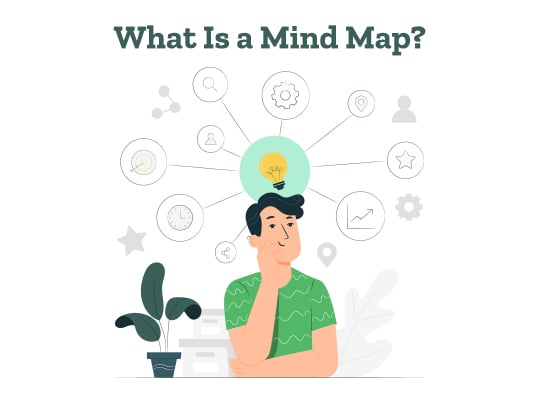
What Is a Mind Map? Free Mind Map Templates & Examples

Whether you’re writing an essay, creating a presentation, or brainstorming strategies with your team, it’s a challenge to sort ideas effectively. There’s a simple solution to this, used by students and established writers alike: mind maps! A mind map helps you organize your ideas in a systematic manner and reveals clues for you to arrange your material better.

In this article, we’ll explore what mind mapping is and learn how to make a creative map for your ideas. We’ll also take a look at some mind map examples to show you unique and innovative ways to create a mind map. But before we begin, let’s establish a mind mapping definition.

What is a mind map?

A mind map is a visual tool used for brainstorming, problem-solving, and organizing ideas. It is a diagram that starts with a central idea and branches out to related subtopics and details.

As you lay out different topics and subtopics visually, you can clearly see the connections between them. In this way, mind mapping helps you see the relationships between different ideas and understand complex topics easily. It’s time to throw away those hefty notes and make note-taking a fun activity!

Let’s see how you can use a mind map in different ways.

Why use mind maps?

Is there any advantage to mind mapping beyond the obvious joy of drawing out your thought process? It’s all very well that you avoid working like a grumpy professor, but what beyond this? 

Here are some benefits of using a mind map:

  • Learning becomes a stimulating process.
  • Difficult topics can be simplified and easy to understand.
  • You can visualize complex points to easily remember and recall dense pieces of information.
  • The freedom to connect ideas without a specific order leads to creative and innovative solutions.
  • You can come up with a hierarchy of points by easily differentiating between primary and secondary topics.
  • The engaging act of making a mind map speeds up brainstorming and improves productivity.
  • Easy collaboration allows an entire team or group to work together on a presentation or project.

Mind mapping allows you to see connections and relationships between different ideas. The process makes it easier to understand complex topics and make the right decisions. In this way, a mind map enhances your memory, comprehension, and productivity.

How to make a mind map

It’s quite easy to create a mind map. All you need is a pen and paper! If you prefer working on a laptop, there are several tools you can use, our mind map template being one of them. Scroll down and you’ll find our template.

Follow these steps to make a mind map:

1.  Start with a central idea

Write down the central idea or topic in the center of a blank page. This can be your essay title, an area of research, or a problem you need to solve. Make sure you leave enough space on all sides to create a spreading map.

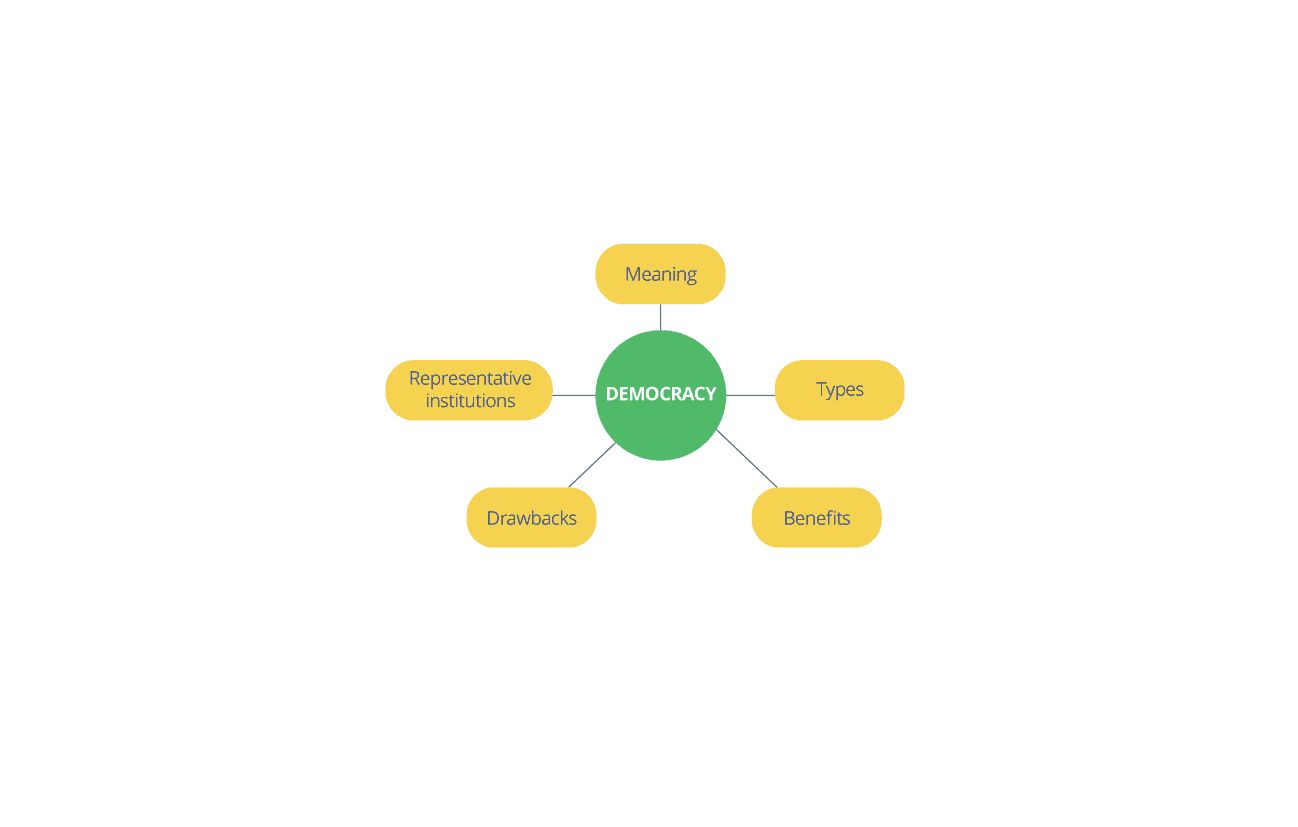
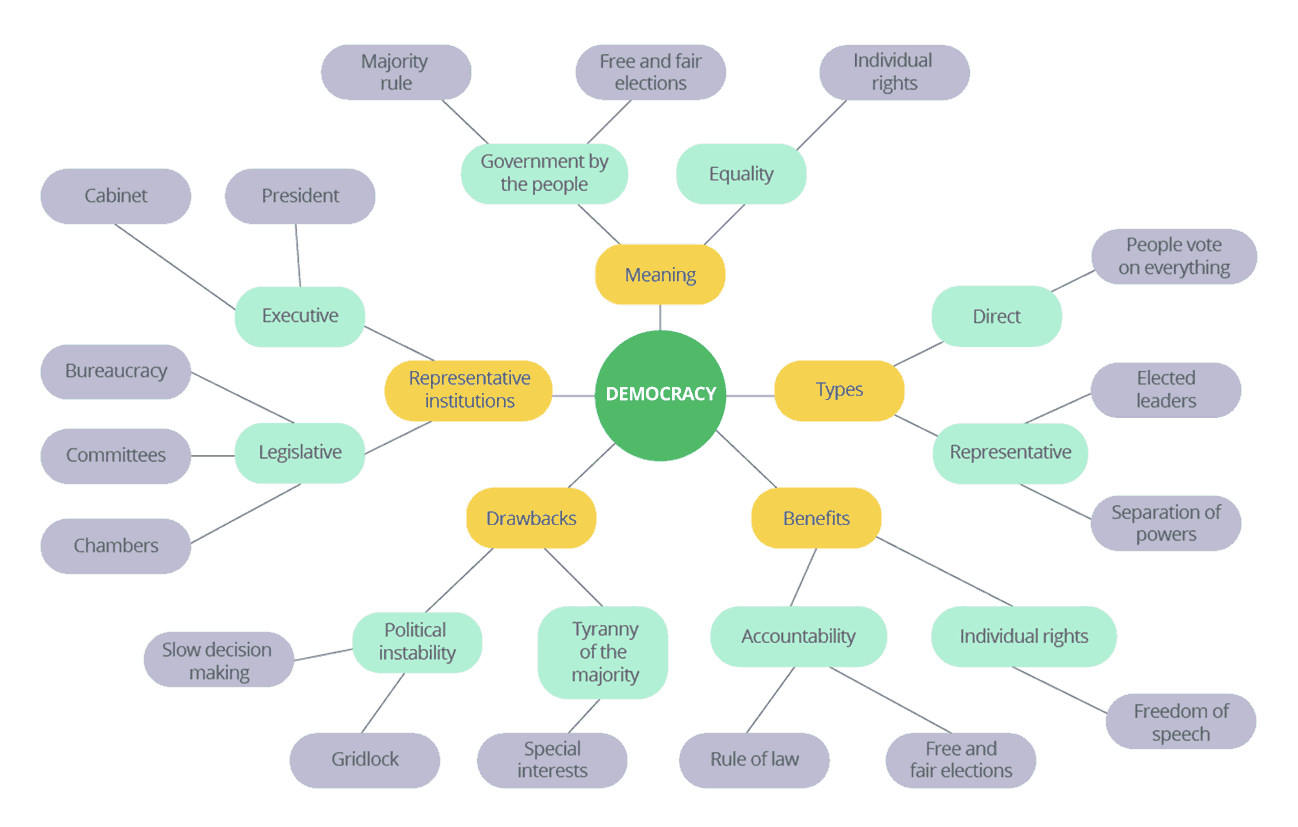
We’ll add a step-by-step mind map example to help you understand the process. Let’s say you had to brainstorm an essay on types of democracy. Your first step will begin at the central point.

Step one of mind mapping with only the central idea on the page.

2. Add related ideas

Think of the most important subtopics or areas of interest and arrange them around the central idea. Connect these to the main topic with lines or arrows to indicate the relationship between the two.

So for an essay mind map, the first relevant bubble will be the essay introduction, which will further lead to your thesis statement. For now, we’ll show you the second stage of mind mapping in this example:

Step two of mind maps with the first layer of related ideas.

3. Create a hierarchy of ideas

Keep adding more layers until you get a spreading map that starts with your central idea and ends with specific facts, evidence, and examples. As you break down your information into smaller and smaller points, you’ll also need to denote the connections between them.

If any facts from separate subtopics are connected, draw a dotted line or arrow between them to indicate this. When you open your mind map later, all hierarchies and connections should be instantly clear to you. Come up with a system of arrows and lines to denote various types of connections between points and subpoints.

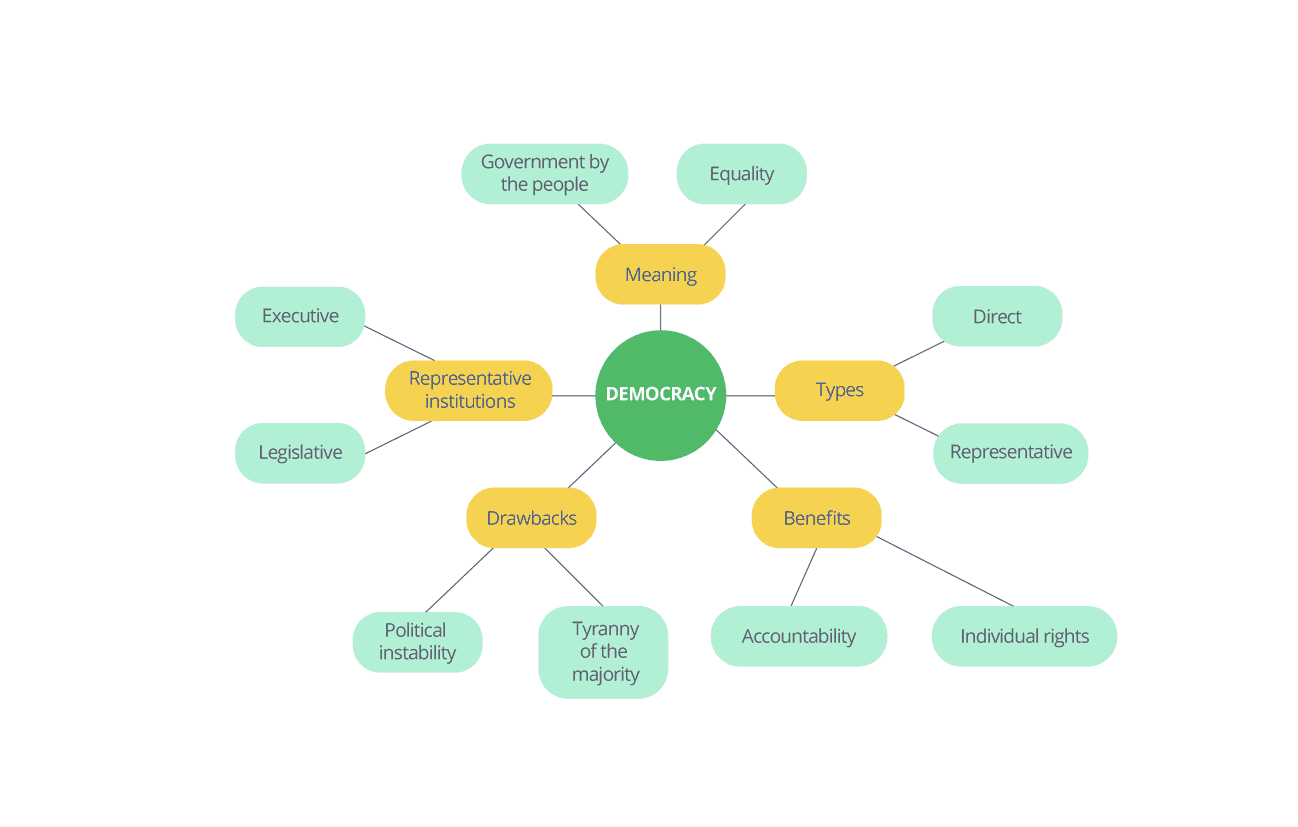
Our mind map example will outline this for you:

Step three of making a mind map with the next later of ideas and information.

4. Review and refine the map

If you don’t have a rough essay outline in your mind, you can just focus on getting everything out on the page. After seeing the rough layout, you can decide on the final set of points and remove everything else.

So, the last step is to review your mind map and refine it until you are satisfied with the outcome. In this stage, you’ll add all the smallest details to your mind map and establish important connections through lines.

In a mind map for essay writing, the last few points will be the evidence you use to support your arguments. It’s a good idea to mark the page numbers or other citation indicators so you don’t have to go looking for them later.

Your mind map should look something like the example below:

Step four of creating a mind map with all topics, subtopics, and ideas laid out on the page.

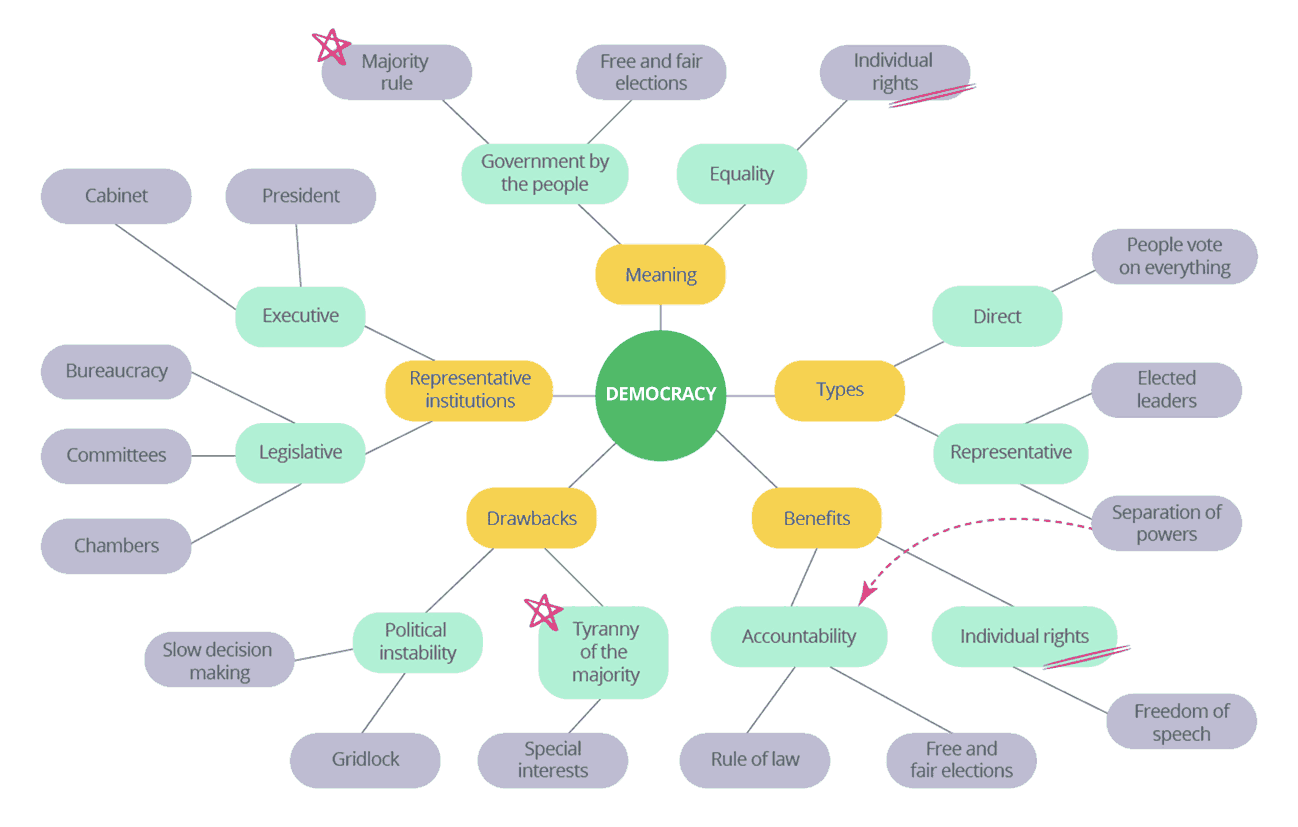
5. Add symbols and images to help you remember

While making mind maps for writing essays, it’s essential to use any techniques that can help you remember information better. A great way to ensure this is to use symbols and images to signify specific things.

You could develop a system of meanings for different signs. A star can represent important data figures, while a vertical arrow can highlight ascending or descending order. While you can utilize mind mapping tools and software to achieve this, it helps to use symbols that are personal to you. This way, it’s much easier to memorize things!

Let’s add some symbols to our mind map example and breathe life into it.

Step five of mind mapping with symbols and images showing connections between different topics.

If you’d like us to add more mind mapping examples, let us know in the comments below!

Note: Keep your mind maps clean! Add only the most central points in one or two words rather than writing entire phrases or sentences. Making a cluttered and chaotic mind map serves no purpose. Keep your focus on the bigger picture and what you want to achieve through the mind map.

If you’re using the mind map for essay writing, you should know how to transfer ideas and information from your map to your essay. Knowing how to write a MEAL paragraph can help! 

Done brainstorming and writing your essay? Let’s make it perfect

Free mind map templates

If you need innovative mind map ideas and templates, we have no shortage of them! Mind mapping for writing differs from mind mapping for a presentation or brainstorming session. Accordingly, mind mapping methods also differ from one another.

So, we’ve created four blank mind map templates to help you find the format that works best for you. Based on your requirements, you can choose from the mind map templates available below. 

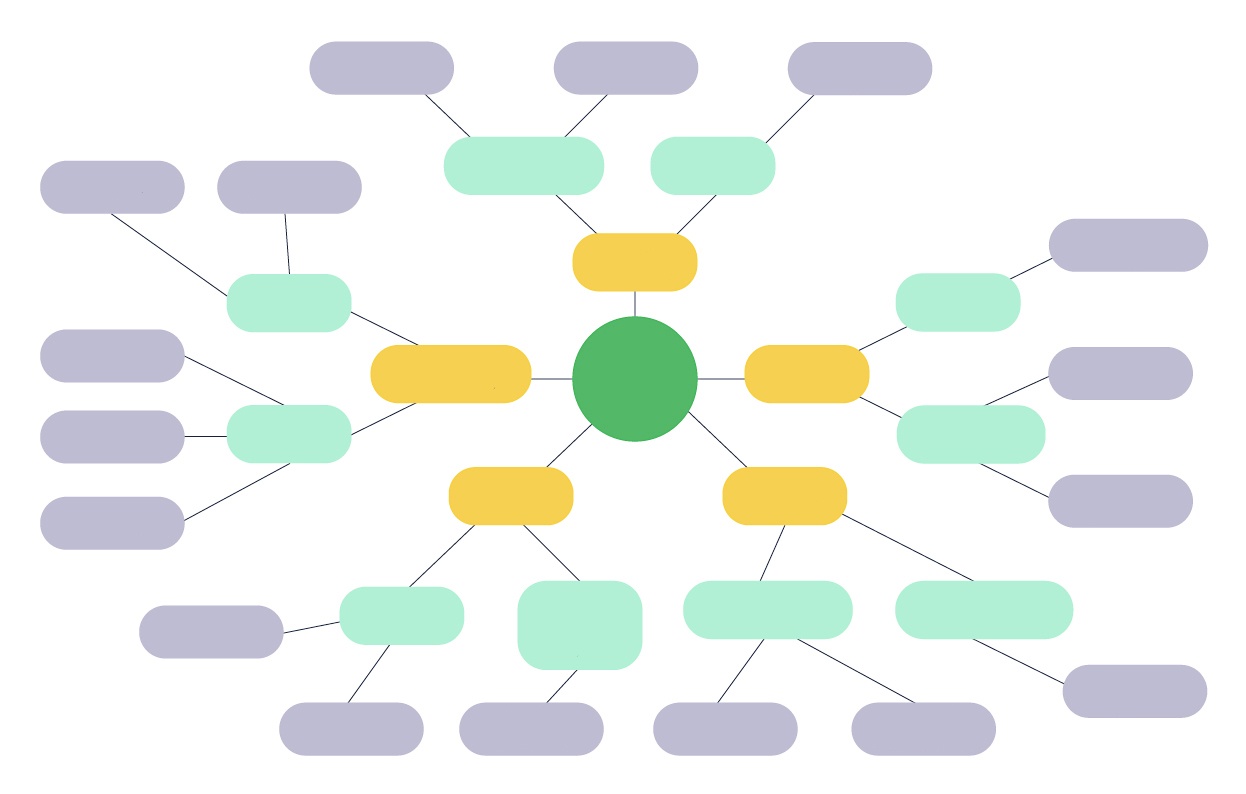
1. Basic map that radiates outward

Blank mind map template that radiates outward.

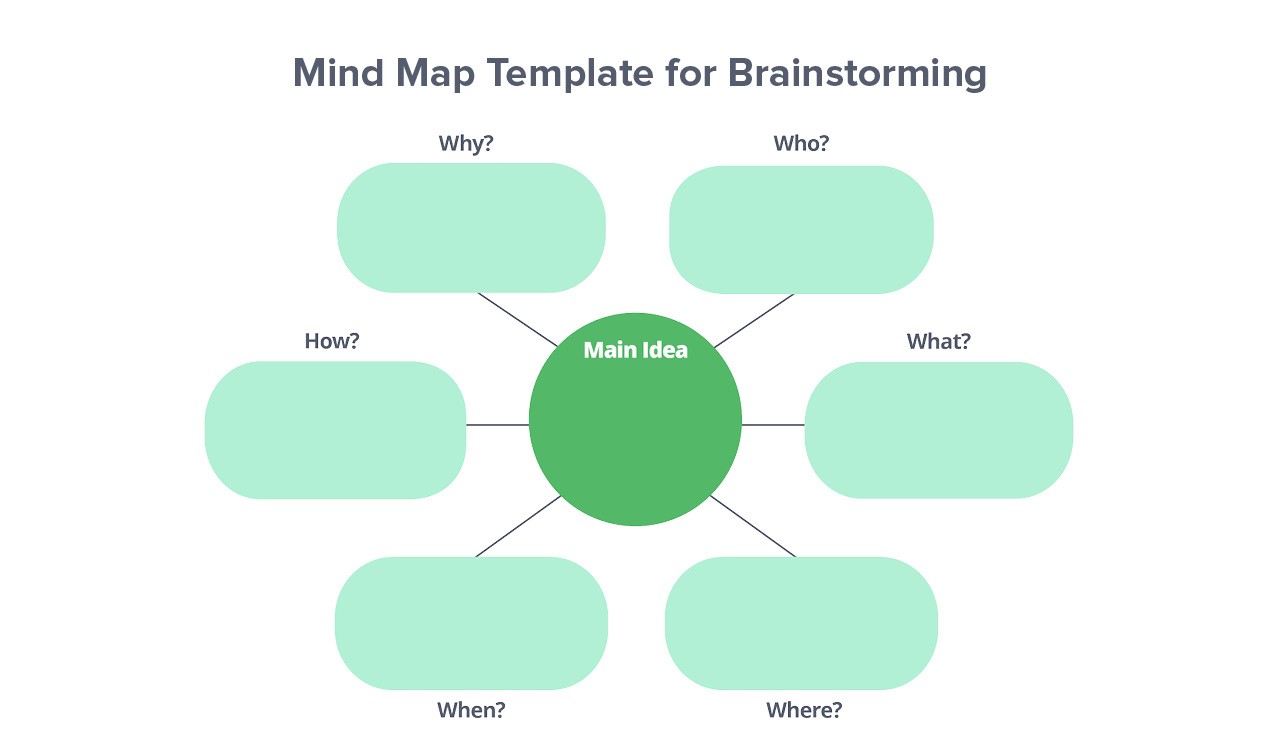
2. Template to brainstorm a topic

A mind map template to brainstorm a topic for making a presentation or forming a strategy.

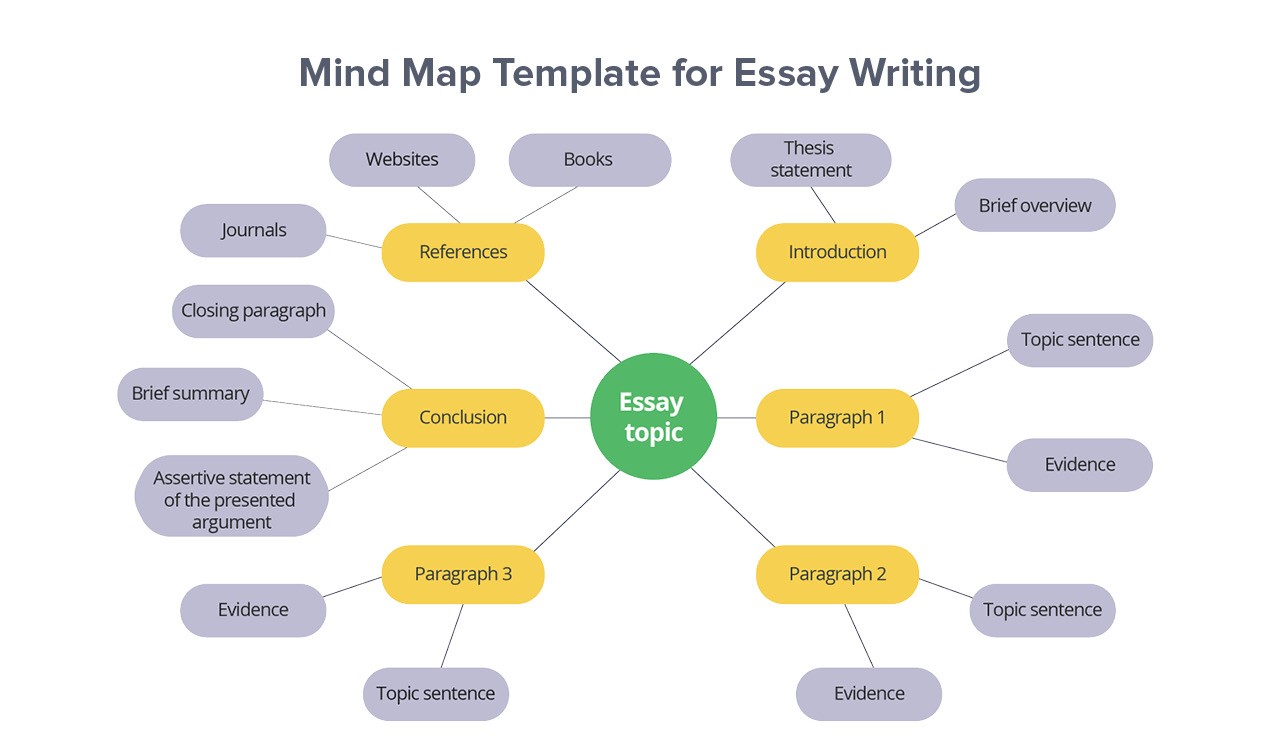
3. Mind map for writing an essay

Mind mapping template that shows the various topics and subtopics you need to outline while writing an essay.

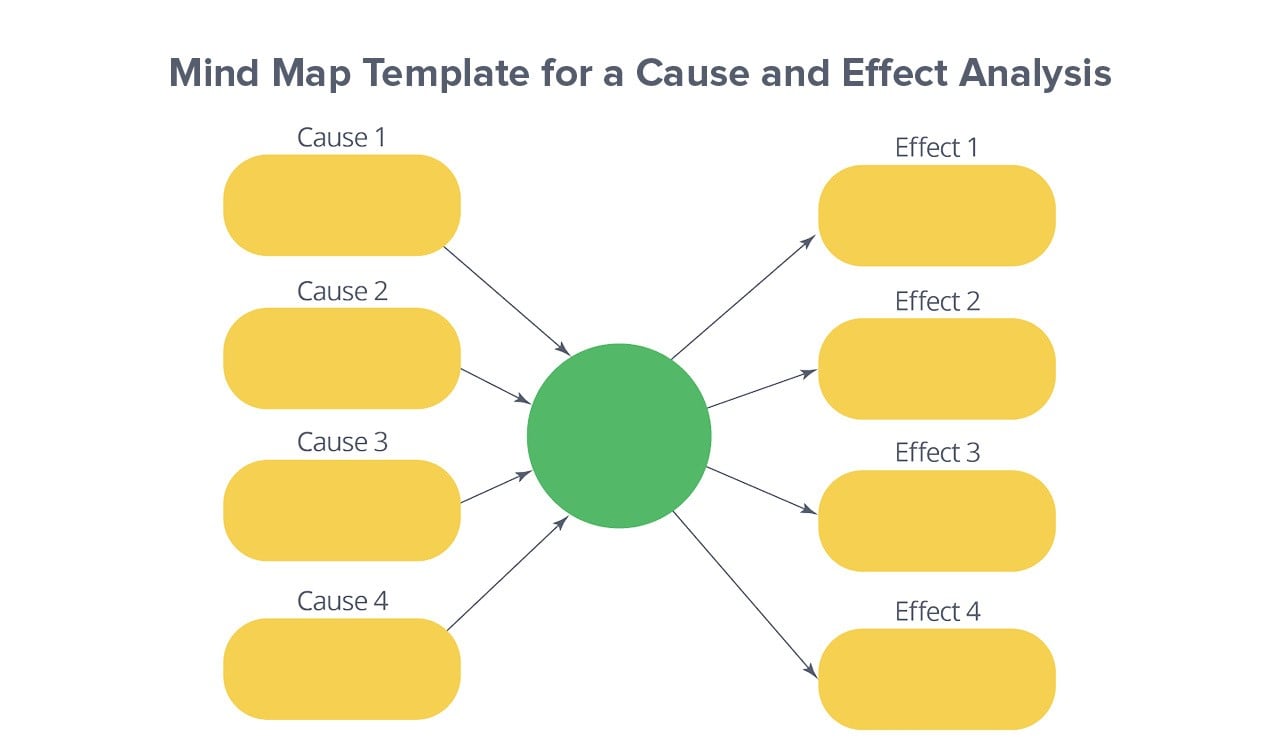
4. Mind map that uses arrows for cause-and-effect

Mind mapping template to establish a cause and effect relationship between various factors involved.

If you’ve created a mind map for your assignment and need an editing and proofreading service, we’re here to help.

Keep reading with more resources from your loyal editors and proofreaders:

How to Write a Cover Letter: 7 Tips from Business Editors

Cover letters are written as a humanized form of a candidate’s resume for recruiters. They help employers better assess an applicant’s preparedness for the role as opposed to a cold, hard document. In this article, we’ll understand what a cover letter is, find out how to write a good cover letter, and learn from some cover letter examples.

Whether you are a fresher who’s just graduated or an associate who has been actively job-hunting, you already know the pain of landing a long-wished job. For some, it can stretch to years of “job-board scavenging” while others can spend hours on social media platforms, just to find that perfect fit.

What most applicants fail to realize is that ensuring a keyword-friendly resume for Application Tracking Systems (ATS) is only half the battle. A well-written cover letter attached to your job application can get you the rest of the way.

So what makes an impressive cover letter? Let’s start from scratch.

What is a cover letter?

A cover letter is a document that you attach with your resume to better highlight your skills, experience, and knowledge related to a given job position. Additionally, it highlights your leadership skills and achievements, which boosts your chances of getting selected. 

A cover letter has three parts:

    • Opening paragraph (brief introduction of yourself)
    • Body paragraphs (elaborating on your skills and achievements)
    • Closing paragraph (eager and enthusiastic closing remarks)

Let’s be practical here: not every job position requires you to send in a cover letter. Mostly, candidates attach a cover letter to their profile only when it’s required by the company or when they’re applying for their dream job. But why go through this additional hassle?

But if you’re already attaching a resume, what is the purpose of a cover letter? Let’s take a look.

Why is a cover letter important?

A cover letter expands and explains the information in your resume, creating a story of your professional life for the recruiter. It gives you a chance to stand out from a crowd of applicants who might as well have job experience and achievements equivalent to yours.

Additionally, a cover letter:

    • Reflects your individuality and better highlights your unique suitability for a job role.
    • Showcases your eagerness toward the opportunity and your willingness to understand its needs.
    • Presents how your current skills can contribute to the growth of the company.

For job applications that require a cover letter, you must ensure that yours is well-written, well-formatted, and impactful. For job applications that don’t require a cover letter, we still recommend sending one if you want a fighting chance.

Time to learn how to write a cover letter!

Tips to write a cover letter

Often, the success of your job application depends on your cover letter. A thoroughly researched cover letter shows your sincerity and diligence, but more importantly, showcases your suitability for the role. 

Here are some tips to help you write a remarkable cover letter. 

1. Outline your vision for the future.

The recruiters know your past job roles and contributions through your resume or CV. So, the additional application letter is your space to sell them the future. This includes both, your own plans for professional growth and the company’s future goals.

Obviously, this means that you have to put in some serious research into the company you’re applying for. Find out their journey so far and their growth trajectory for the coming years. Then it’s only a matter of narrowing down those goals to your team and job position!

The most important thing hiring managers look for in a candidate is how well their future plans align with the company’s goals. If you manage to do this, half the battle is won!

2. Write an arresting first paragraph.  

On average, 118 candidates apply for a particular job vacancy. Unless your cover letter starts strong, you’ll find it very hard to beat the other 117! Let’s see how to write a cover letter with a strong introduction with the help of an example:

“I’ m applying for the role of a copywriter that I saw had a vacancy at Spice Media.”

“With more than a decade of experience in the advertising industry, I’m a copywriter on a mission to express multitudes in the matter of a few words.”

This cover letter example reveals your superpower. Find out your strengths as an applicant and figure out a way to use them in the very beginning. But remember, an eye-catching opening sentence must be backed up with enough substance! 

But if you’re someone who has the substance but struggles with putting it into words, we have a solution for you! There are power words that you can use to appropriately express your achievements and abilities. You can use them in the opening paragraph and sprinkle them throughout the letter to impact the recruiters positively.

Here’s a list of power words you can use in your cover letter:

  • Achieved
  • Accomplished
  • Implemented
  • Innovated
  • Exceeded
  • Resolved
  • Strengthened
  • Transformed
  • Streamlined
  • Optimized
  • Impacted
  • Boosted
  • Initiated
  • Spearheaded
  • Collaborated
  • Influenced
  • Amplified
  • Pioneered
  • Proven
  • Accelerated 

3. Highlight your unique value to the company.

The entire point of writing a cover letter is to show why you’re an ideal candidate for not just the position, but for the company. This is what you’ll do in the body paragraphs of your cover letter. Dig deep into your skillset and show your past experiences and proven abilities have prepared you to take on this new role. 

Make sure to also connect your own abilities with large-scale, industry-wide happenings in your niche. For instance, the healthcare infrastructure took a severe blow during the pandemic. If you are someone who is associated with the industry, your cover letter needs to address the recent years in some capacity.

“My name is Alex and I have been a healthcare professional for the last 15 years.”

Instead, observe this cover letter example:

“My name is Alex and I’ve been active in the healthcare industry for 15 eventful years. Recently, I have been helping firms restore their systems and processes to adapt to the pandemic and its lasting effects.”

You can also use the body paragraphs to explain any gaps in your resume or address any specific requirements or qualifications listed in the job posting.

4. Express your enthusiasm for the role.

It’s essential that your cover letter reflects your excitement about joining the company. The first few paragraphs should clearly outline everything you like and admire about the company or the team you seek to join. 

Make sure you mention specific projects, policies, and initiatives that make you want to join the organization. Along with this, you should also maintain a positive tone throughout the letter to drive home the point.

5. Maintain a friendly but formal tone. 

Aim for a professional and confident tone in your cover letter. While it’s important to show your enthusiasm for the position, a cover letter is still a formal document! Use language that is friendly, respectful, and courteous, but not overly casual. No slang!

You should also ensure that you don’t pull a 180 and use overly formal or stiff language. The key is to avoid unprofessionalism while also not sounding impersonal and distant. Your emerging voice in the letter should be warm and engaging, while still maintaining a level of professionalism.

By striking the right balance of tone in your cover letter, you can show the hiring manager that you are a qualified and personable candidate.

6. Stick to standard formatting. 

We live in the age of social media where a person’s attention span hovers a little over 8 seconds. So, it’s best that you keep the cover letter short and format it according to the standard guidelines.

Here are some formatting tips for a cover letter:

  • Leave a standard margin (usually 1 inch) on all sides of the page.
  • Use a standard font such as Times New Roman or Arial and keep the font size between 10-12 points.
  • Mention your name, address, phone number, email address, and date at the top left corner of the page.
  • Address the recipient of your letter by their name, using “Dear” followed by their title and last name (e.g. “Dear Ms. Smith”).
  • Use single spacing for your paragraphs and double spacing between paragraphs.
  • End with a professional closing remark such as “Sincerely” or “Best regards”, followed by your name and signature.

7. Edit and proofread your cover letter.

A job application is the last place for language and formatting errors. If you don’t want silly typos to take away from your sincerity and dedication, you must edit and proofread your cover letter thoroughly.

If the position you’re applying for is highly important, it makes sense to hire a cover letter editing service. But if it’s just another opportunity, you can probably do some rounds of editing yourself and have friends and colleagues do some reviews for you.

Here’s a cover letter editing checklist to make things easier for you:

Make sure to approach your cover letter with a fresh eye and do several rounds of edits. Also ensure that there aren’t any additional mistakes once you’re done revising the cover letter according to your colleagues’ advice! Proofread, proofread, proofread!

Want a quick guide so you don’t forget these tips? We’ve got you covered.

Cover letter example

Here’s a sample cover letter in the healthcare industry for the position of Medical Assistant. If you’d like some more cover letter examples from us, be sure to let us know in the comments!

February 23, 2023


Matt Bernard,

Administrator

Adonis Hospital

1234 Lee Avenue

STE 107, Oklahoma City


Dear Mr. Bernard,

I am writing to express my keen interest in the Medical Assistant position currently available at Adonis Hospital. As a highly organized and detail-oriented individual with a passion for healthcare, I believe I would make a valuable addition to your team.

In my previous role as a Medical Assistant at Care Clinic, I gained extensive experience in providing exceptional patient care, managing patient records, and assisting physicians with a variety of procedures. I am confident that my skills and experience make me an ideal candidate for the position at Adonis Hospital.

The recent years put both my skillset and personal courage to the test, and I have emerged from them with a new viewpoint on the value of healthcare. Leapfrog recognized my work with the Pandemic Heroes Award, a badge I wear with pride but also with the recognition of the effort put in by all healthcare professionals.   

I am particularly drawn to ABC Clinic’s reputation for providing high-quality healthcare services to a diverse patient population. I believe that my commitment to patient care and my ability to work collaboratively with physicians and other healthcare professionals make me an ideal candidate for this position.

Thank you for considering my application. I look forward to the opportunity to discuss my qualifications further in an interview!

Sincerely,

Cecelia Hume

PaperTrue: The Company Catering to China’s English Writing Needs

The 21st century has enabled booming international trade and business like never before. And English is the lingua franca for its communication to keep global commerce in speed. This has led to the development of Business English, which the world is scurrying to catch up to. China is at the forefront! But that road for now, is paved with many lingual obstacles. 

The challenges of Business English in the Chinese context

Though China is catching up with ESP (English for Specific Purposes) in a big way, learners face big challenges in learning the nuances of English due to the vast differences in the construct of the two languages. Let’s look: 

  • The academic level language lessons only cover basic conversational English. It doesn’t cover advanced English writing in-depth.
  • Graduates from the best of schools and universities consider Business English writing to be the most difficult course in the program.
  • Lack of language proficiency makes it difficult to put across thoughts and ideas sufficiently.
  • Improper use of grammar can distort the meaning of the message you’re trying to send across to your overseas clients or partners.

Written communication is important 

Business documents can make or break important deals. These days, a lot of commercial communication happens over the internet. As meeting associates face-to-face can be time and cost-intensive, sending across a smartly worded letter is more effective. That’s how most business deals get sealed through emails, telephones or video conferences. This makes the written word highly valuable for all involved parties. 

A well-written business letter conveys trust, interest, and assurance of high-quality. Whereas a poorly written piece shows a lack of due diligence, interest, and weak preparedness.

Written communication is important

What we do

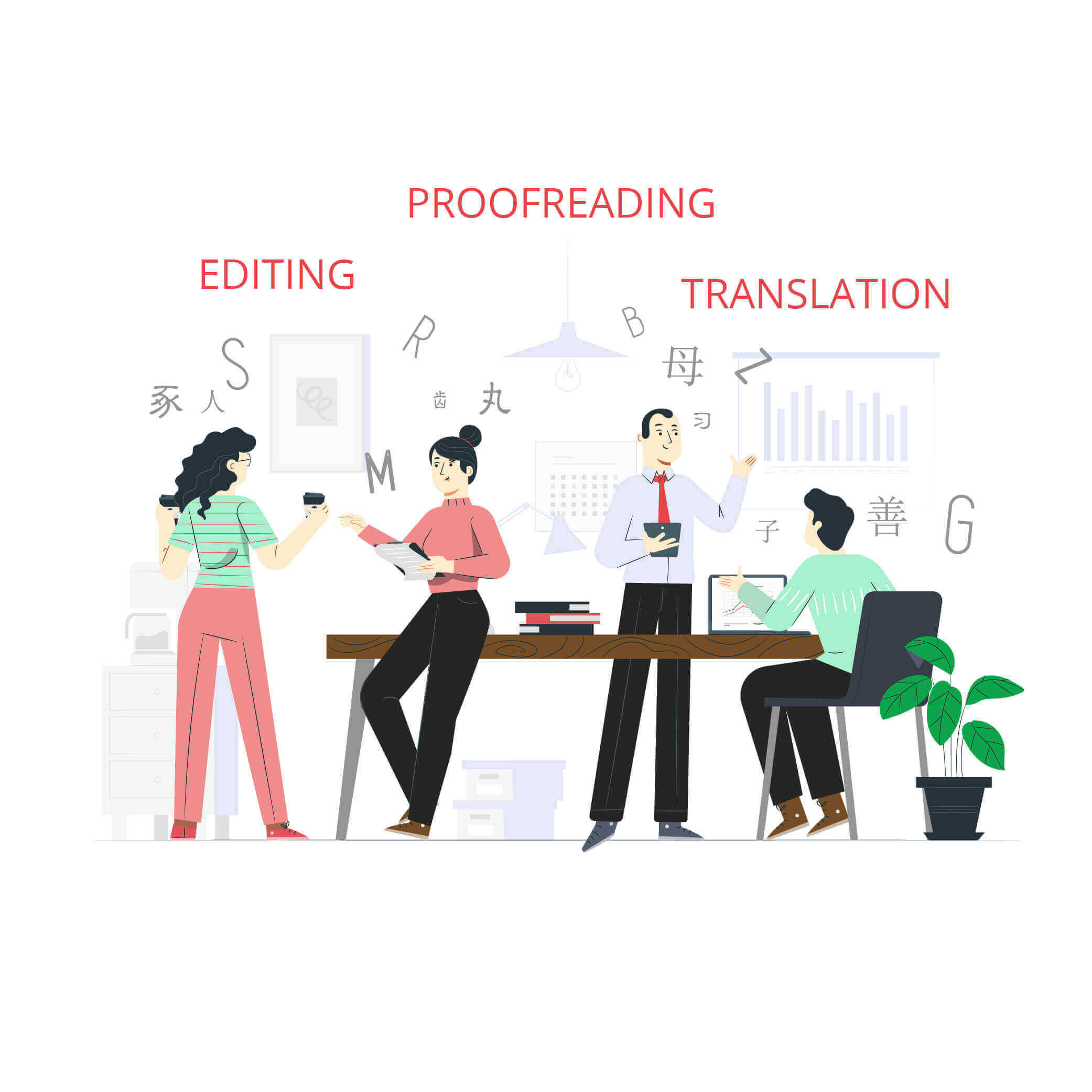
Studies show there is an increasing need for business English editing, proofreading, and translation services in China. PaperTrue has been at the forefront of the editing and proofreading service space in Europe and the U.S. for over a decade now.  So we realized that it is our duty to fill in the void with the highest quality English writing services in China. Today, we stand proud as enablers of that. Here are our main areas of function: 

Editing 

Our expert editors scan your documents from a business lens. We ensure your documents appear clear and professional, conveying the best of your abilities. Whether it’s for internal circulation or sent out to stakeholders, we make sure to add the required level of tone and voice to carry with the underlying message. 

While writing business letters, you must ensure you don’t make it jargon-heavy, improper sentencing and have any grammar or spelling mistakes. That will surely give a bad impression and not be taken seriously at all.

Proofreading

Global business houses make sure that the annual reports and other crucial documents they circulate among stakeholders are thoroughly proofread by professionals. That’s what we do as a company; make sure that each page and every word is perfectly arranged by eliminating all language and grammatical errors. 

Translation

Over the years, we have built a reputation for providing world-class services in the translation, editing, and proofreading industry. Having worked closely with Chinese business professionals on a variety of English documents, they remain our main focus as we understand their specific needs.

Plagiarism check 

Our tech team has developed an AI-powered software that instantly scans through the text of millions of web pages to detect if any part of the document has been plagiarized. 

How we help businesses:

Impeccable business documents are crucial to winning new deals and partners. Our expert editors understand your particular needs as a Chinese business. Your document is thoroughly proofread to ensure it is entirely free of errors in grammar, spelling, punctuation, and typography.

If your document requires deeper editing, we also refine the style, sentence structure, clarity, and coherence and give you detailed feedback so that your document makes the right impact on your target audience

Business documents we refine: 

  1. Business Reports
  2. Presentations 
  3. Magazines 
  4. Presentations 
  5. Blogs 
  6. Website Copy 
  7. Business Plans 
  8. Newsletters 
  9. Translations

Our mission is to provide laser-sharp English editing and proofreading to all our clients. We polish the ideas and aspirations of countless businesses, professionals, and students from around the world. With a team of over 100 in-house translators and editors who edit and process 40 full-length documents every day, PaperTrue is one of the world’s foremost companies in the editing, proofreading, and translation service space.

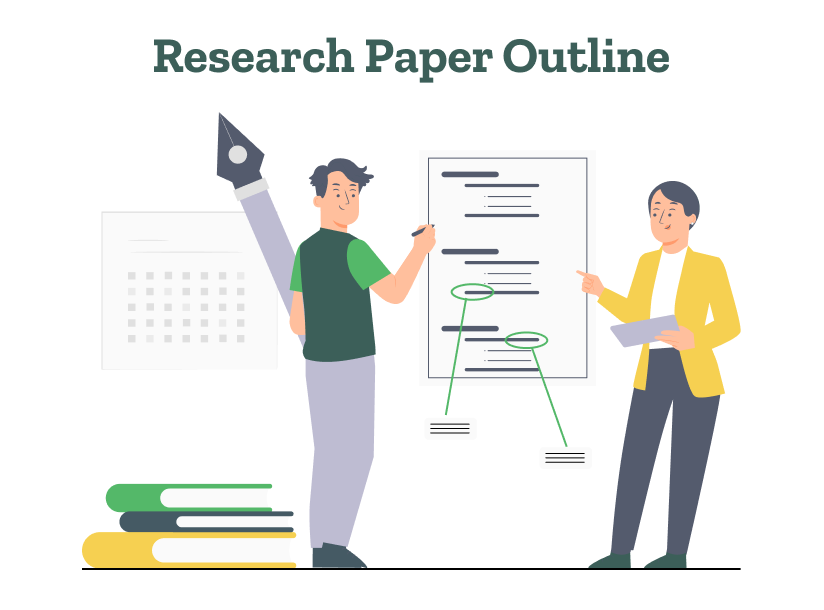
Research Paper Outline: Free Templates & Examples to Guide You

Writing research papers is an extensive, time-consuming, and complicated task. Forming a research paper outline does, however, simplify this process. It helps organize your thoughts, create a logical flow, and give structure to otherwise haphazardly arranged information. 

As your academic editors and proofreaders, we have provided you with all the necessary resources such as an outline for a research paper template, plenty of research paper outline examples, and tips and tricks to construct your research paper outline. Our goal is to help you write a well-structured, clear, and succinct research paper outline.  

Ensure flawless formatting for your research paper.

What is a paper outline?

A research paper outline is a skeleton or a guideline for your final paper. It is typically created after the thesis statement is formatted but before the first draft is written. In this process, you group information into appropriate headers, sub-headers, points, and sub-points.

It is easier to make changes during the outlining stage rather than streamlining the first draft. You can easily identify and remove redundant information and also incorporate essential information in the outline, which is helpful while writing your first draft.

Why create a research paper outline?

An outline is a helpful tool that acts as a roadmap for organizing your information and ideas. It serves as a visual representation of the flow and structure of your content. 

As a student, it can be hard to understand the flow that is expected out of your paper. A college research paper outline allows you to see how the information fits together and how you can arrange it while writing. By creating an outline, you can also get a clearer understanding of the relationships between different topics. 

How to write a research paper outline

When writing a research paper, the length and detail of the outline may vary depending on the guidelines set by the academic institution. However, the core structure of the outline remains the same and consists of three key parts: introduction, body, and conclusion.

Introduction: Introduces the topic of your research paper and provides background information to set the context for your study.

Body: Divides your research into manageable sections and provides detailed information and analysis on each section.

Conclusion: Summarizes your findings and presents conclusions based on the evidence you have presented in the body of the paper.

By following this basic structure, you can ensure that your research paper outline is comprehensive and organized. This way, it can serve as a useful guide while writing your paper.

Here are some additional tips to keep in mind when writing a research paper outline:   

1. Pick a topic of your interest. Make sure the scope of the topic is not too broad or too narrow.

2. Formulate a thesis statement.

3. Gather all relevant ideas that give support to your thesis statement.

4. Group related ideas into subsections.

5. Arrange the subsections into a structured format.   

6. Frame appropriate headings and subheadings for these subsections.

Types of formats for research paper outline

After doing your necessary research and forming your thesis statement, it is a good idea to start building your outline. The type of outline you use depends on the type of research article you write.

There are a number of formats you can use to build your outlines, but the alphanumeric, decimal and full-sentence formats are the most popular. Let’s take a closer look at these formats with the help of a few research paper outline examples.   

Alphanumeric outline 

The alphanumeric format is the most widely recognized of the three formats. The structure for this format is as follows:

  • Headings: Roman numbers (I, II, III)
  • Subheading: Capital letters (A, B, C)
  • Points: Arabic numerals
  • Sub-points: Lowercase letters

Information in this format is written in short blurbs rather than full sentences. This allows for a short and succinct outline. However, it is difficult to convey detailed information. Here’s an alphanumeric outline example for a research paper:

Do standardized tests improve teen education?

1. Introduction

A. Standardized tests history

B. Standardized tests types

1. Achievement tests

2. Aptitude tests

3. Diagnostic tests

C. Standardized tests uses

2. Body

A. Student performance pre-standardized tests

B. Student performance post-standardized tests

C. Results

3. Conclusion

A. Results restated

B. Provide evidence supporting or contradicting the topic of the research paper outline

Decimal

The decimal format does away with the use of uppercase letters and Roman numerals and  uses Arabic numerals with increasing decimal points to categorize information. The structure for this format is as follows.

  • Headings- Whole number (1.0, 2,0…)
  • Subheadings- Single decimal  (1.1, 1.2…)
  • Points- Double decimal (1.1.1, 1.1.2)
  • Subpoints- Triple decimal/lowercase letters (1.1.1.1, 1.1.1.2)

Similar to the alphanumeric outline, the decimal outline uses short blurbs to categorize information. The decimal format is the most detailed and precise but can get complicated. It is recommended for detailed outlines with multiple headings and subheadings. Let’s understand this better with the help of a research paper outline example: 

The Matrix commentary on the perception of reality

1. Introduction

1.1. Summary

2. Body

2.1. Influences

2.1.1. The brain in a vat

2.1.2. Plato’s cave

2.1.3. The oracle of Delphi 

2.1.4. Jean Baudrillard’s Simulacra and Simulation

2.1.5. Marxist allegories

2.1.6. Meditations on First Philosophy by René Descartes

2.2. Reception and impact

3. Conclusion

Note: In the case of multiple subheadings, we recommend using lowercase letters instead of increasing decimal points.

Full-sentence

As the name suggests, the full sentence outline uses incomplete sentences instead of blurbs, for arranging information. Although it is more extensive and takes longer to write, it is also more specific and easy to understand. It can follow either the alphanumeric or the decimal method of organization. Here’s a full-sentence research outline example. 

Impact of the Inactivated Poliovirus Vaccine on the eradication of polio

1. Introduction 

A. History of polio and its adverse effect on society.

B. The effectiveness of various initiatives implemented for the eradication of polio.

C. Thesis statement: The advent and distribution of the inactivated poliovirus vaccine led to the eradication of polio.

2. Risks associated with polio

A. Signs and symptoms.

B. Infection and mortality rates with statistics.

C. Methods of contamination.

3. Diagnosis and prevention

A. How polio is diagnosed.

B. What are preventative measures taken once diagnosed?

1. Diagnosis before the advent of the inactivated poliovirus vaccine.

2. Diagnosis after the advent of the inactivated poliovirus vaccine.

C. Effect of preventative measures along with statistics.

4. The advent of inactivated poliovirus vaccine

A. Creation and spread of vaccine.

B. Effects of the vaccine on the eradication of polio.

C. Statistics comparing the spread of polio and its adverse effect on people before and after the vaccine.

1. Statistics before the advent of the inactivated polio vaccine.

2. Statistics after the advent of the inactivated polio vaccine. 

Thesis statement restructured: From the above data we can conclude that the advent and distribution of the inactivated poliovirus vaccine has almost eradicated the disease.

Outline for a research paper template

In order to simplify your paper writing journey, our experts have drafted this research paper outline template to help you create your own research paper outline. 

It will help you categorize important ideas into smaller pieces of information. We have crafted this template taking inspiration from sources provided by several renowned universities and educational institutions. 

You will find the three main headings of introduction, body, and conclusion along with multiple subheadings, points, and sub-points. We’ve included an alphanumeric outline for a research paper template.

If you need any help refining your paper, you can always consider working with a research paper editing service.

Here are some related articles that you might find interesting:

How to Create Powerful Conflict in Your Story | Useful Examples

Conflict is not a secret sauce to telling stories; it’s the basic ingredient. It moves the plot forward and makes characters more engaging. Without genuine conflict in your story, it’s just a narration of events where nothing exciting happens. So, let’s find out how to create conflict that is engaging. We also have some examples of conflict in literature to ease the process!

Enhance your conflict with perfect editing!

What is conflict? 

Before you learn how to create conflict, you need to learn what it is.

Simply defined, conflict is an element of struggle. It’s the barrier that a (central) character must overcome in order to achieve what they want or need. Essentially, it’s what goes wrong in the novel.

Let’s take the most basic example: In Little Red Riding Hood, the conflict is the Big Bad Wolf. Without the wolf, Little Red Riding Hood would safely reach her grandmother with no threat to her life. If this happens, there is no tension in the story. Now, what reader would want to read a story like that?

There has to be some scandal in the industry, some turmoil in the family, or some personal enmity between characters. These are the big and small issues that amount to conflict in a story. Conflict can be major (societal problems like sexism) or minor (familial struggles, personal enmity). A story becomes more interesting if characters have to solve a series of minor conflicts before they combat the major one.

For example, Arya and Sansa’s enmity in A Game of Thrones is a minor conflict while the same between Ned Stark and Cersei is a major one.

Did you know that there are five important types of conflict? It’s impossible to know how to create conflict in a story when you’re unaware of the different shapes it comes in! Let’s tackle that head-on.

Types of conflict

There are two major types of conflict: external and internal. These can be further divided into five important types of conflict, as follows:

External conflict

External conflict is the tussle between a character and an outside force. This force can be another character, or nature, or even the situation they’re in.

Yes, it’s that simple. There are four types of external conflict:

  1. Character vs. character
  2. Character vs. nature
  3. Character vs. society
  4. Character vs. technology

Internal conflict 

This struggle happens within the mind of a character. Internal conflict in a story is a character’s battle with their own emotions, opinions, or ambitions. The most popular example of such a conflict is Shakespeare’s Hamlet.

There is only one category under internal conflict:

1. Character vs. self

We can now take a deep dive into each type of conflict, and visit a few examples along the way!

1. Character vs character 

This is the most common type of conflict in all stories. A classic example: Hero against the villain.

Superhero comics and movies are entirely based on this conflict. The heroes are out to uphold the law while the villains are out to break it. This conflict of values and interests leads to their clash. The origin stories of both the protagonist and antagonists are rooted in such conflict.

Conflicting values

Most often, character vs. character struggles have the basis of a conflict of values. Often, this works with or alongside a conflict of interest to make different storylines. For example, what if Batman and the Joker together want to stop the Riddler? Here, Batman and Joker have conflicting values, but their interests are the same. This makes for an engaging story, doesn’t it?

Therefore, the character vs. character conflict can take any shape based on the surrounding circumstances. It’s the most common conflict because it’s that versatile: you’ll find it everywhere!

2. Character vs. nature 

Popular in both books and movies, this is when characters have to face the wrath of nature in different forms.

The unpredictability and immense power of nature makes for a strong challenge to the characters. Often, this conflict is quite difficult to overcome.

While every apocalyptic movie comes to mind, forces of nature don’t always mean geographical occurrences like a tsunami or a volcano. A disease like cancer is also a force of nature. So, stories like The Fault in Our Stars and The Normal Heart are also examples of character vs. nature type of conflict.

3. Character vs. society 

When a character feels out of place in the social life around them, their struggle amounts to this type of conflict. Cyberpunk and dystopian novels often feature a conflict where the character stands up against unequal or oppressive social structures.

This conflict is well represented in Ray Bradbury’s Fahrenheit 451 through the protagonist’s struggle against his dystopian world. Another notable example can be Margaret Atwood’s The Handmaid’s Tale.

Most tragic plays feature this conflict in some capacity. The protagonist’s inability to overcome their conflict with the surrounding society eventually leads to their death.

4. Character vs technology 

Common in sci-fi stories, this conflict usually unfolds in a future where technology has become highly advanced. Technological advancements then reach a level where machines and A.I. begins to pose a threat to humanity. Naturally, the human characters then have to battle technology.

In Isaac Asimov’s The Evitable Conflict, machines in the far future decide to take control of humanity and break the first law of robotics. This is a pretty typical example of conflict between character and technology.

This conflict is appealing because it brings back the Renaissance-era questions of intelligence, creation, and divinity. The next time you watch a Terminator movie, you’ll know exactly what we’re talking about!

5. Character vs self 

Hamlet can’t arrive at a decision about how to exact revenge upon his uncle. He struggles with his own self, and not any outside force. This is an example of the sole internal conflict, which is character vs self.

This type of conflict often brings forth themes of mental instability and madness. Often, characters succumb to this struggle and lose their grip on reality.

This also features as a minor conflict in many stories. In this case, it helps the characters become better or more able versions of themselves, allowing them to evolve.

How to create conflict

Conflict is embedded in every story. If you have a story to tell, it will naturally have a “situation”, unfolding from a beginning to an end. The question is, how do you refine this situation into an exciting battle between different powers?

How to create conflict from the base elements of a story like character and setting? This is nothing short of a craft, and we’re here to help you master it.

Here are our five tips for writing conflict like a pro:

1. Create conflict with a purpose

Remember, the conflicts in your story aren’t just hurdles that your characters need to cross. They need to serve a thematic and literary purpose.

Basically, it should make sense why character A is against character B. Or, for that matter, how character A battles against a robot uprising. The place to do this is in your characters’ backstories and character traits.

Ground your conflict in your characters, and show your readers how it affects them. Conflict, external or internal, is only effective if it has a purpose.

2. Set differing goals and agendas

Remember the scene in Marvel’s The Avengers where the six superheroes interact for the first time? Why is this scene so effective?

No one likes to watch people agreeing with each other. Dialogue gets interesting only when people disagree, and the plot becomes gripping when they try to find ways to counteract each other.

Make sure to set different, opposing goals for your major characters. It’s a given that heroes and villains will be set against each other. But your story becomes more engaging when friends or allies also have distinct, clashing viewpoints.

It’s like Batman and Joker working together to defeat the Riddler. A narrative is entertaining when not just the characters, but also their agendas are in conflict with each other.

3. Define the problem 

The easiest way to set the narrative in motion is to start with a problem. It can be a mystery, a theft, or an old secret being revealed. How many times has a movie begun with a gimmick being stolen?

Give your characters simple goals like getting back the stolen item, rescuing the kidnapped child, or searching for the lost treasure. This helps you develop the plot, and provides a chance to complicate or deepen the theme of your story.

4. Play on setbacks and failures 

A way to make the middle of your story is to fail your characters. Make them lose the battle, or fail an exam, or get negative results in a crucial experiment stage.

Your protagonist’s struggles with their emotions and mental health help the readers get to know them better. How they deal with failure may also lead to other conflicts you can explore. So, don’t be afraid to let your characters get defeated.

5. Keep your genre in mind 

There are certain conventions about how different genres feature conflict in a story. Take cues from the types of conflict you observe in other works. When you sit down to watch an apocalyptic movie, don’t you expect to watch humans struggle against nature?

If you’re writing a story in fifteenth century England, your conflict is likely to feature the Wars of the Roses. If it’s  romance you write, the main couple’s struggles to be together will form your central conflict.

Your characters’ struggles need to align with the generic conventions your audience will come to expect.

To enhance your novel further after writing an engaging conflict and completing your piece, you can consider taking our editing and proofreading services

Still have doubts about how to create an engaging story? We’ve answered a few in the next section. Keep reading!

What Is Point of View? Definition, Types, & Examples in Writing

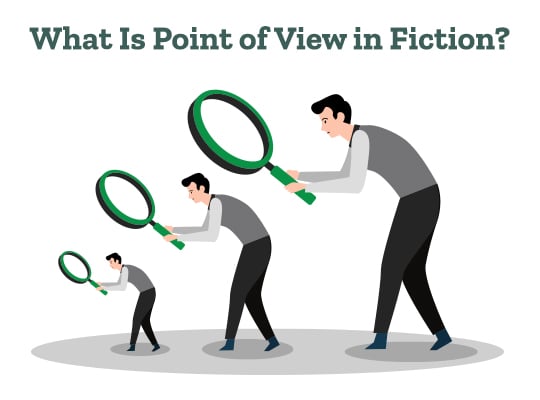
A point of view is an inseparable part of writing. It is the perspective through which the narrator recounts their story. Every piece of literature, be it novels, stories, or blogs, has a distinct point of view. 

Refine your novel’s point of view with our expert editing services!

What is point of view?

A point of view is the perspective through which a story is narrated. It is crucial in determining the relationship between the narrator and the characters in the story. In a first-person point of view, the narrator is a part of the story and can interact with other characters in that story. 

In a third-person point of view, the narrator is removed from the story and cannot interact with the characters in it. On the other hand, the narrator assumes the reader to be a part of the story and addresses them directly in a second-person point of view. 

Let’s look at the different points of view along with a few relevant point of view examples.

 What is a first-person point of view?

In the first-person point of view, the narrator uses first-person pronouns such as “I”, “we”, and “us” to express their thoughts and feelings. We get an insight into the mind of the narrator with the help of personal anecdotes, thoughts, and experiences. 

The narrator can either be the protagonist recounting their own experiences, or a secondary character narrating the protagonist’s story.

There are two ways in which the first-person point of view can be written.

1. First-person central

In this perspective, the narrator is also the protagonist of the story. Let’s take a look at a first-person point of view example to see how this is done:

“Soon after my return from Leyden, I was recommended by my good master, Mr. Bates, to be surgeon to the Swallow, Captain Abraham Pannel, commander; with whom I continued three years and a half, making a voyage or two into the Levant, and some other parts. When I came back I resolved to settle in London; to which Mr. Bates, my master, encouraged me …”

Gulliver’s Travels, Jonathan Swift

In the above example, we can see writing that is quite similar to a journal entry but is in fact a fictional novel. Swift makes use of a diary-like, first-person central narrative which is typically used for journaling or writing autobiographies. This gives the story an intimate, authentic feel despite being entirely fictional.  

2. First-person peripheral

In this narrative, the protagonist’s story is narrated from the perspective of a secondary character in the story. Here’s an example: 

“My poor friend. I have described him many times. Now to convey to you the difference. Crippled with arthritis, he propelled himself about in a wheelchair. His once plump frame had fallen in. He was a thin little man now. His face was lined and wrinkled. His moustache and hair, it is true, were still of a jet-black color, but candidly, though I would not for the world have hurt his feelings by saying so to him, this was a mistake.”

Curtain, Agatha Christie

In the above example of a first-person narrative, Hastings, a friend of the novel’s protagonist, observes significant changes in his friend’s appearance. The use of the first-person peripheral point of view makes it easier to describe the physical appearance of the protagonist. The repetition of “I” is avoided and the situation is also more believable.

Why use the first-person point of view?

When used effectively, the first-person narrative:

1. Creates suspense.

The first-person narrative limits our access to information and helps create suspense.

2. Creates a sense of “togetherness”.

The narrator recounts personal anecdotes and experiences which allows for an engaging experience. It gives us an insight into the mind of the narrator and creates a sense of “togetherness”.

3. Creates an element of suspicion or intrigue.

Similar to real life, the narratives of characters in stories may not always be objective or reliable. The concept of an unreliable narrator who interprets circumstances incorrectly due to their personal biases and opinions adds an element of intrigue to the story.

What is the second-person point of view?

The second-person point of view uses the pronoun “you” and assumes the reader to be the main character of the story. It is a highly immersive viewpoint in which the narrator describes “your” thoughts, actions, and emotions.

This point of view is commonly used in immersive stories, nonfiction, advertisements, or even our Resource Center! Although uncommon, it can also be used in longer fictional novels like  The Fifth Season by N. K. Jemisin.

“You know this voice. Young, male. Familiar, and soothing in a familiar way. Lerna, Makenba’s boy from down the road, who went away for a few years and came back as a doctor. He’s not a boy anymore, hasn’t been for a while, so you remind yourself again to start thinking of him as a man.”

— The Fifth Season, N. K. Jemisin

In the above example, the protagonist Essun, a grieving mother of two, recounts her experiences using the pronoun “you” instead of “I”. This narrative creates an intense and immersive experience and makes us relate to the protagonist.

Why use the second-person point of view?

When used effectively, the second-person perspective:

1. Creates an immersive experience.

The second-person perspective is the most intimate of all points of view since the narrator directly addresses us with the pronoun “you”. This allows for a highly immersive experience that allows us to contemplate and self-reflect.

2. Creates an uncommon narrative.

Using the second-person narrative in literary fiction is difficult, and if used too often, can make the story look gimmicky. Hence, the first and third-person points of view are mainly used in fiction. However, if used correctly, the second-person point of view can add an element of uniqueness to the story.

What is the third-person point of view?

In the third-person point of view, the story is recounted by a narrator who is removed from the story. Characters in this viewpoint are either addressed using names or third-person pronouns.

The third-person point of view can be written in three ways.

1. Third-person limited

In this point of view, the narrator relays the thoughts, actions, and emotions of a single character at a time. The writer can switch between characters from chapter to chapter, but doing this too often can be confusing to the reader. Let’s look at a third-person point of view example: 

“The Dursleys hadn’t even remembered that today happened to be Harry’s twelfth birthday. Of course, his hopes hadn’t been high; they’d never given him a real present, let alone a cake – but to ignore it completely…”

— Harry Potter, J.K. Rowling

In the example, Rowling offers a glimpse into the mind of the protagonist, Harry Potter, revealing his thoughts, emotions, and feelings. This allows us to empathize with Harry and experience a similar sense of loneliness and abandonment as we get to experience his inner world.   

2. Third-person omniscient

In this point of view, the story is narrated through the eyes of an all-knowing entity. It is inclusive  of multiple points of view and allows for flexibility in storytelling without limitations on time, and place. Here’s an example: 

“The boy with fair hair lowered himself down the last few feet of rock and began to pick his way toward the lagoon. Though he had taken off his school sweater and trailed it now from one hand, his grey shirt stuck to him and his hair was plastered to his forehead. All round him the long scar smashed into the jungle was a bath of heat.”

— Lord of the Flies, William Golding

The above passage not only describes the boy with fair or blonde hair, but also creates an imagery of the beautiful surroundings around him. This is characteristic of the third-person omniscient point of view.

3. Third-person objective

In this point of view, the narrator adopts an observational narrative and takes the role of a bystander, simply observing a set of events and reporting them as they are. This point of view is mainly used in news reports, but can also be used in literature. Here’s an example:

“The hills across the valley of the Ebro’ were long and white. On this side there was no shade and no trees and the station was between two lines of rails in the sun. Close against the side of the station there was the warm shadow of the building and a curtain, made of strings of bamboo beads, hung across the open door into the bar, to keep out flies.”

— Hills Like White Elephants, Ernest Hemingway

As we can see from the above paragraph, Hemingway’s writing style is known for its minimalism and objective, “just the facts” approach, which is similar to that of reportage or news writing. 

He often focuses on describing physical details and actions, rather than delving into the characters’ thoughts and emotions. This gives his stories a sense of realism and immediacy but also allows us to come up with our own interpretations. 

Why use the third-person point of view?

When used effectively, the third-person point of view:

1. Creates a biased or unbiased narrative.

Unlike the first-person point of view, the narrator in this point of view is removed from the story. The narrator views the story from a bird’s eye view and in most cases provides an objective and often omniscient perspective. 

But, this is not always the case. In certain cases, the narrator withholds information from us to create suspense and mystery. 

2. Creates narrative flexibility.

The third-person point of view allows for greater flexibility and objectivity because the narrator is not a character in the story. The narrator can switch between different characters and perspectives and can move freely through time and space. This can create a rich and complex narrative experience for us, as we can gain insight into multiple characters and events. 

Additionally, the use of the third-person point of view can create a sense of detachment which helps to build a sense of objectivity or emotional distance, depending on the author’s aim.

3. Creates overall character development.

The omniscient point of view allows for rich character development and the growth of multiple characters in a story. This makes the story more diverse and engaging as it allows us to gain insight into the thoughts, feelings, and motivations of multiple characters. 

The omniscient narrator is an all-knowing entity that has access to the internal and external lives of characters, their past, and future, which can present a detailed and nuanced picture of the characters. 

Additionally, the omniscient point of view allows us to form our own opinions about the characters, as the narrator doesn’t impose their perspective or feelings on the characters. This can make the story more complex and open to interpretation.

 Can you switch points of view?

Many of us have put a book away because it has too many characters talking all at once. We can only enjoy a story when we understand the context and the perspective from which it’s told. Switching points of view too often can be confusing or jarring and can disrupt the flow of this story. Although some writers have mastered the art of switching points of view in the same sentence, it’s a good idea for most of us to use chapter, paragraph, or even line breaks.

But, if done correctly, switching points of view adds an interesting element to the story for example, switching between first and third-person can be used to show the different perspectives of different characters, or to reveal information gradually. 

If overused, the second-person point of view may be disorienting for us, but if used efficiently it can create a sense of self-affirmation or allegory.

When it comes to doubt about your narrating style and POV, your editor is the best person to seek advice from. Luckily for you, we have somewhat of an expertise in providing novel editing services! The next time you’re stuck while writing your book, you know whose door to knock!

It’s our duty to provide you with the tools you need to write wonderfully. Here are some resource that you’ll find useful:

How to Copyright Your Book?

If you’ve thought about copyrighting your book, you’re on the right path.

Explore more