The internet has enabled widespread access to information like no medium before it. It’s a lucrative space for business organizations, especially those in technical fields, to help their customer base to understand more about their products or services. And while many tech companies do have such a presence online, their content is often a wall of text, perhaps riddled with jargon, or is not properly crafted. (Writing, after all, isn’t often a technician’s field of expertise). This is where a technical editor comes into the picture.
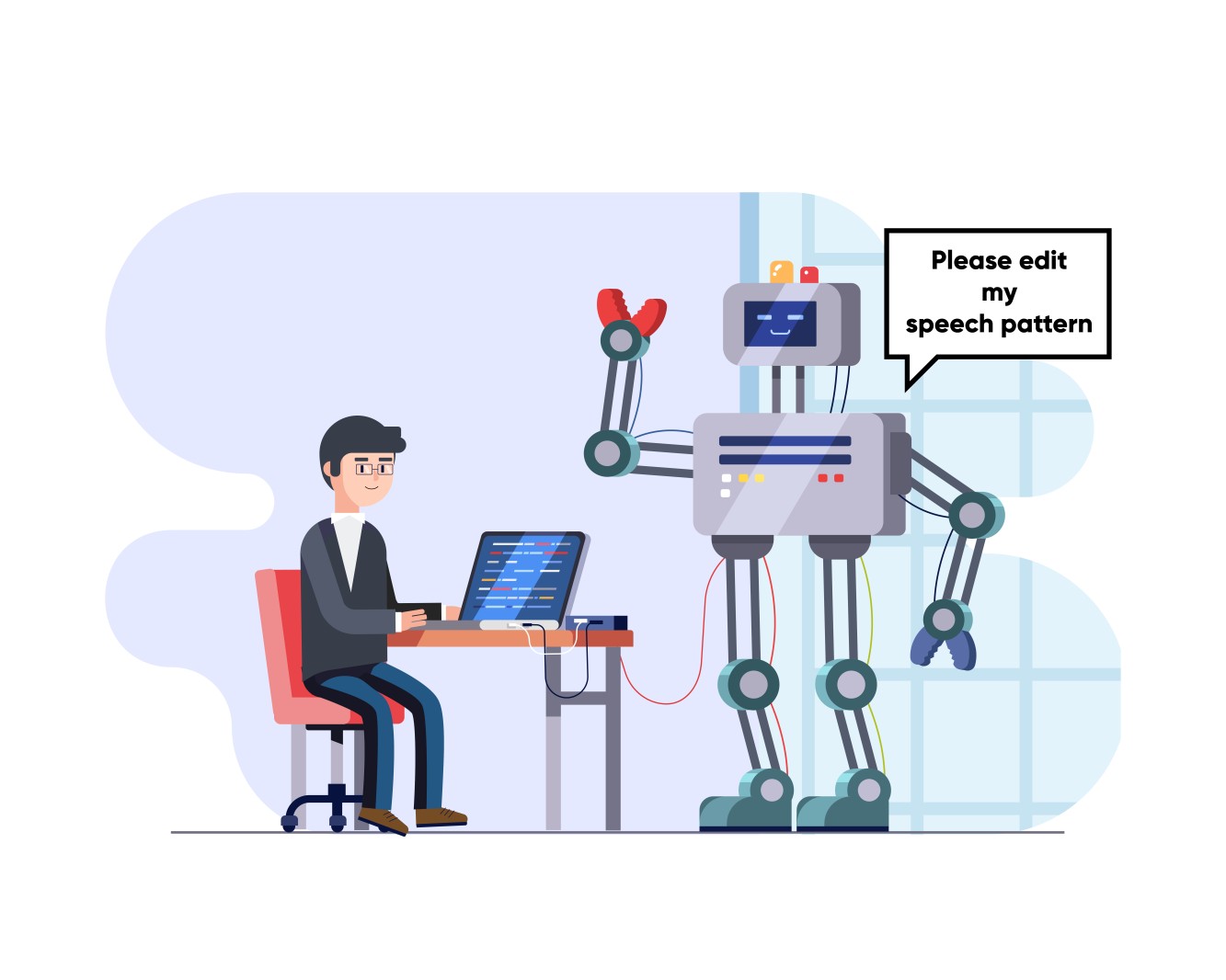
A technical editor, as the name suggests (pretty straightforward), checks for language and quality in technical writing. The degree of editing that a technical editor does could vary depending on how much the organization wants, but here are some of the things a technical editor does:
Technical editors work on a variety of documents including manuals, technical reports, and online content.
As a scientific researcher or a technical expert, you may find yourself short of the tools you require to communicate. Sure, you know what to say, but you may forget that how you say something is of equal importance. An editor can help you bridge the gap.
Technical editors are committed professionals who improve your writing to make it error-free and interesting. They bring their language skills to your expertise, finding the right words for your ideas without compromising or diluting it.
There are many editors who specialize in particular fields. There are, for example, editors who dedicatedly work on medical or legal documents. The most obvious advantage of working with such editors is that they are likely to not only understand your field of expertise, but also what it takes for a layperson to understand your work, research, or service offerings. Let’s explore some less obvious reasons closely.
The advantage of hiring an editor who is well-versed in the subject and writing conventions is that they understand your needs deeply. They recognize what you are trying to say while being sensitive to the fact that writing might not be your cup of tea. Editors are then the people who will guide your writing to the right audiences.
Editors will be sensitive to your business goals and use language as an arsenal for your business to realize its business goals.
An editor is a support system, and an “objective” third party to tell you whether your information and the way you have chosen to present your information makes sense: the focus being logic, structural coherence, and clarity.
The issue with technical writing is that it becomes tempting to use excessive jargon. While jargon is immensely useful internally, it just doesn’t translate when the same information is being written for the public. Excessive usage of jargon can sound alienating, or worse, exclusive.
An editor is a fresh pair of eyes for your work—even if your English is on point, a professional is far more efficient in identifying errors that you may have missed. They give your work a professional look. An editor, in addition to rectifying grammar and punctuation, will help you format your text so that it stands out. They are well versed in various style guides and will easily adapt to your requirements, or even suggest ways to arrange content to improve its readability.
They will help you expand your writing horizons and help you reach out to people in a more effective way. They will work alongside writers you have hired for your company to test their limits in finding innovative and interesting ways to present content.
With their combined knowledge of the subject matter of the text and knowledge of language conventions, they will be an invincible ally.
As we said easier, how you say something is of immense importance. An editor can help you narrow down on the tone and vocabulary you should use to ensure that your content does not come across as amateur or shabby. This is also true of presentation; they will help you curate and display your content in a way that exudes professionalism.
While editors and writers are in abundance, you may find it difficult to hire someone who is knowledgeable in both your niche as well as its writing conventions. Here are three routes you can take to hire technical editors and writers for your company:
Deadlines are a dreaded thing in academics, and so is plagiarism. If you’re short on time or were late to start your dissertation or thesis, you’d hope the submission day would never arrive. And days pass by as they should, they seem to pass faster than your dissertation is still in the works. You have no clue how it will turn out, or will it even be completed before the judgment day. Now you want to put a pedal to the metal and just get done with it. But you also want to impress your professor and get good grades. This is when most students put the copy to the paste. And once you include matter that’s not yours, and omit it, too bad. You have contributed to plagiarism.
Don’t even…
Every college course demands that students be creative and original in presenting their ideas for research submissions. Presenting someone else’s ideas or words as your own is an act of Plagiarism. It is considered an academic malpractice and can land you in serious trouble. University policies and plagiarism will decide the severity of the disciplinary action. If caught, offenders could be given a failing grade or the more severe penalty of being suspended from a program or college.

Direct Plagiarism is the most blatant form of plagiarism where one includes a word-for-word transcript of a section of someone else’s writing. No citation, no paraphrasing. Do not do this even in the most desperate times. Direct plagiarism will lead to direct termination!
Patchwriting is a crafty method of plagiarism mostly undertaken by students who are more cautious in how they plagiarise. Also known as Mosaic Plagiarism, its when you copy and paste text from multiple sources while adding bits of original sentences and rewording existing ones. Patchwriting is paraphrasing taken to a whole new level!
Even if more efforts go into patchwriting, with the intent of coming across as original, it’s an effort in vain. The latest plagiarism-check software like iThenticate & Turnitin has the capacity to sift through tons of documents, even those that are not available on the web database and call you out! Save the struggle on this one.
And then, there are the more fortunate ones who can afford to hire ghostwriters to complete their dissertations on demand. Buying a copy of work written for you by a professional writer is also plagiarism. It also stands true when it’s not a paid service and you get it done by one of your friends or family members. The slightest effort doesn’t go into doing this and no one appreciates that.
Careful! You could do it unawares
There is much confusion even among the experienced lot in academia as to what constitutes for Self-Plagiarism. Some students think that it’s okay to add excerpts from their previous essays and submissions without adding a citation. Or submit essays in graduation that they had already written in high school on a similar topic. PhD students pick up huge chunks out of their previous work and add it to their thesis. This happens because most would ask “how can I plagiarize myself?” and then ignorantly accept that that’s not possible.
It’s important to understand that even if it’s your own ideas and words that you have used in your work, it is still not original. You have produced results based on your previous knowledge. For that, you must provide a citation.
Please consult your University’s plagiarism policy and academic code of conduct. That will give you a better idea of where to draw the line when using your previously published study.
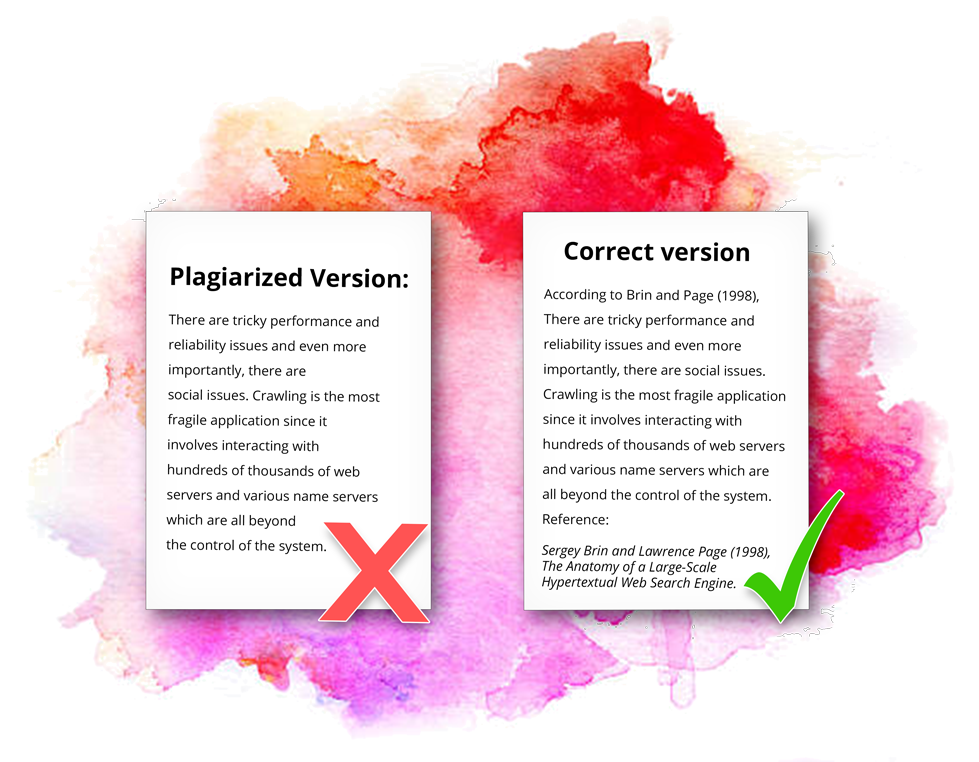
Another type of ‘accidental’ plagiarism is Paraphrasing Plagiarism. It’s committed when you summarize ideas or text from another source and fail to cite the original author and give a proper reference. If the string of words resembling the original text run too long, it could also be taken for word-for-word plagiarism.
1. Cite your sources
Provide citation wherever it is needed and no one can point fingers at you. This is the easiest way to avoid plagiarism. When in doubt, cite it.
2. Use quotation marks
When paraphrasing, use quotation marks and give a proper reference wherever needed. Clarify that it’s a borrowed piece and you acknowledge it.
3. Hire professional proofreaders and academic editors
Instead of hiring ghostwriters to write your theses and dissertations from scratch, hire proofreaders and academic editors to finish them with neat altercations and structuring. You can partner with PaperTrue to create plagiarism-proof works for any academic requirements.
4. Ask for help
Talk to your supervising professor or thesis advisor and be honest with them about your work. Seek advice on how much-borrowed material could be added to your papers.
The landscape of publishing has changed drastically in the past decade or so, with the rise of digital publishing and a shift toward self-publishing.
Publishers all over the world, both in trade and education publications, are facing a lot of challenges adapting to this new world. Many of these organizations are especially concerned about the rising costs of the publication process. This is putting pressure on profit margins and at the same time, the demand for traditional paper-based products is falling as a lot of consumers prefer to read their news online and read books on a Kindle.
If publishers want to keep up with the rapid changes seen in this industry, then they should consider looking outward for support.
As a result, publishers are becoming more open to outsourcing. Outsourcing allows them to reduce fixed costs as well as gain access to skills and technology that may not be available in their company. Hiring freelancers and outsourcing offers numerous advantages to the publishing industry apart from reducing fixed costs like increasing output, using freelancers as an on-demand solution to business needs and more.
An in-house editor is a salaried employee who will be paid every month, therefore an expense the company has to incur irrespective of whether or not it makes any sales. This is a fixed cost. This situation is ideal for companies that produce content on a weekly, even daily basis. The demand for an editor in that context is high.
But let’s say you don’t publish content that frequently. You may be a journal that puts out quarterly editions or a company that wants to produce a handful of case studies. In these situations, hiring a full-time editor hardly makes sense.
On the other hand, a collaboration with a freelance editor or a partnership with a professional editing firm is not that hard on the pocket, relatively, at least. You have to pay them only when you have work, unlike your other salaried employees to whom their salary is your company’s fixed cost.
Editing is a crucial part of any writing process; aiding in delivering a flawless end product. Editors correct the grammar, syntax, and punctuation of a piece of text along with giving you tips on how to improve it regarding content and structure. Editors are absolutely indispensable to companies, especially those that produce sizable amounts of content on a regular basis. These include publishing houses, digital marketing agencies, academic journals, and web design companies.
This brings a hoard of problems to the table, especially a huge financial crunch for your company. Editing is a highly specialized skill that requires extensive training and experience. If you hire an editing team, the amount of work given to them has to be substantial, otherwise there is no use in keeping a bunch of skilled individuals waiting and resorting to doing tasks that don’t require that amount of expertise.
This is a reason outsourcing editing becomes a viable option. You pay none of their expenses, except the project costs. The rest is taken care of by the team, whose editors work out of their own office and use their own resources. As opposed to full-time editors, freelance editors and the team that you outsource work to don’t incur the burden of benefits (insurance, medical expenses, etc). All you have to pay them for is the work, and this is usually on a pro rata basis.
There is an additional benefit to outsourcing editing. There are different kinds of editing; developmental, copyediting, substantial editing, line editing, etc, which need specialized editors. It becomes much more feasible to outsource this kind of specialized work to an editor instead of recruiting full-time editors, who might have to be trained for this.
Often, as a company, you have to train your editing and proofreading team for at least a few months. There is a substantial amount of resources that you have to invest; training material, time, and salary. There is also the added pressure of impeccable performance that is expected of them, because during their training, they are supposed to work on projects assigned to them, which may be of regular clients. In this case, outsourcing work to a professional and experienced editing and proofreading team unburdens you of that responsibility, and at the same time, lowers your fixed costs by a considerable margin.
Outsourcing your work to a professional editing team rakes in many benefits, the most important one being the substantial reduction of your company’s fixed costs. To understand what parameters to look for in an editor, you have to understand your needs and your client’s needs and according to that, settle on hiring the right editor.
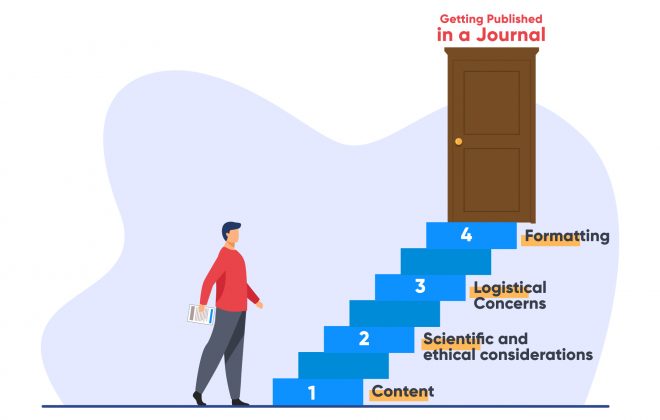
Submitting a journal article is a significant milestone for researchers and students. However, even the most groundbreaking research can face rejection if the manuscript is incomplete, poorly formatted, or does not comply with the journal’s submission guidelines. To avoid these pitfalls, it is essential to prepare a comprehensive pre-submission checklist.
This checklist helps ensure that your manuscript is in top shape before submission, increasing its chances of being accepted and published. From manuscript quality checks to journal requirements compliance, following a structured process will ensure a smoother submission experience.
A pre-submission checklist serves as a final quality control mechanism. It allows authors to address any details they might have overlooked and catch mistakes before their manuscript is submitted. By reviewing key elements, such as formatting, citation styles, and ethical compliance, the checklist helps you ensure that your article adheres to the journal submission guidelines.
Also, it saves time and reduces the likelihood of receiving desk rejections, which can happen when basic requirements are not met. Ultimately, a pre-submission checklist makes your manuscript look professional and ensures it is ready for review.
To successfully publish articles online or in reputable journals, following a step-by-step checklist is essential. This checklist helps ensure that your manuscript meets the journal’s submission requirements and that it is ready for peer review.
Before you submit your article for publication, it is essential to verify the quality of your manuscript. This involves a thorough evaluation of your work to make sure it is complete, error-free, and well-structured.
Ensure that all major sections—Title, Abstract, Introduction, Methodology, Results, Discussion, and Conclusion—are included.
A complete manuscript reflects a coherent and well-organized research article that adheres to the standard journal structure. Missing sections can lead to delays in the review process or result in outright rejection.
Manuscript writing should be precise, concise, and free of grammatical and typographical errors. Professional proofreading can help eliminate mistakes and ensure clarity.
Journals are less likely to accept a submission riddled with language errors, as it can affect the credibility of your research.
Adhering to the required citation style is crucial. Incorrect citations can lead to plagiarism issues and reduce the chances of your manuscript being published.
Ensure that all references are properly formatted and check for consistency in your bibliography.
Double-check that all figures, tables, and datasets are presented clearly and correctly. Make sure that captions and labels are accurate and that all figures are referenced in the text. A thorough review of these elements ensures that your manuscript is professionally presented.
Each journal has independent submission guidelines. Failure to comply with these can result in a desk rejection, no matter how brilliant your research might be.
So, answer the following questions to check if your journal article is on the right track.
It is advisable to ensure that your manuscript follows the journal submission guidelines for font type, size, margins, spacing, and required headings. Ignoring these formatting details could lead to delays or even outright rejection. Always consult the journal guide before submitting.
A compelling abstract and title are key to grabbing the editor’s attention. They should concisely summarize the main findings of your study while engaging the reader. Journal editors often make their first impression based on the abstract, so it must be well-written.
For many journals, it is mandatory to include ethical statements, such as conflict of interest declarations, and ethics approval.
Stating that informed consent was taken for studies involving human subjects is crucial. Make sure that all necessary ethical declarations are included to avoid complications during the review process.
Before hitting the ‘submit’ button, final checks are essential to ensure your manuscript is flawless.
Getting feedback from colleagues or peer reviewers before submission is always a good idea. Their suggestions can help you identify areas for improvement, refine your arguments, and clarify any ambiguous sections in your paper.
Plagiarism, even accidental, can result in serious consequences, including rejection and damage to your reputation. Ensure that your manuscript is original and that all sources are appropriately cited. Run your manuscript through plagiarism detection software as a precaution.
If your manuscript includes third-party content such as images, charts, or data, make sure you have obtained the necessary permissions and copyrights.
Failure to do so can result in legal issues and delays in publishing. Additionally, the process of resolving these problems can feel burdensome.
A well-written cover letter should accompany your journal submission. It should highlight the significance of your research and explain why it is a good fit for the journal.
This is your opportunity to make a strong first impression on the editor, so make sure the letter is clear, concise, and professional.
Here’s a sample checklist:
Manuscript quality check |
|
Compliance with journal requirements |
|
Final checks before submission |
|
A pre-submission checklist is essential if you wish to ensure that your journal article is well-prepared and meets the journal submission requirements. By systematically reviewing your manuscript for quality, adherence to guidelines, and ethical compliance, you can significantly increase the chances of your article being accepted.
To bring you one step closer to publication success, PaperTrue offers journal editing and proofreading services. Contact our team to learn more about what our editors can do for you.
Here are some other journal-publication-related articles you might want to check out:
For anyone who’s looked up recommendations for must-read books, Lolita (1955) by Vladimir Nabokov is a common sighting. This novel is a cornerstone in the English literature world. Such is the impact his first work in English has garnered over the years. His first nine novels were in Russian. This makes Nabokov a champion of sorts in exophonic writing.
Exophony is the practice of writing (normally creative) in a language that is not one’s mother tongue. Exophonic writers or ESL writers thoroughly grasp another language because of various reasons. It could be because of migration, political motivations, or out of personal interest. But the main motivation for modern exophonic writers is commercial success.
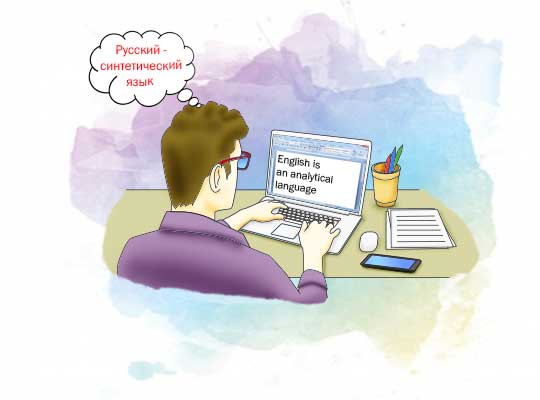
Creative or academic writing in a second language is a challenging task. It takes time and effort to understand the structure and grammar of another language.
Even the native speakers notice such complexities once they write for serious purposes. So it is understandable when ESL students struggle to gain proficiency in a language that is widely spoken throughout the world.
There is much to learn from how these exophonic writers think, write and operate.
Here’s how they can inspire you for personal and professional success:
1) Mastering a second language.
Once you move to a new country, you learn a little of the language that is spoken there or try once you are there. Don’t learn the language just so you can speak with people. There is a lot of creative potential in you to use the new language. Aleksandar Hemon, a Bosnian who moved to America, wrote his first English short story within three years. Today, he is a well known ESL writer!
2) Professional Advancement
Making small talk is convenient and easy. But it takes time to have engaging conversations with your new friends and colleagues. Indulging from time to time in creative writing can help you get there. That is when you gain insights into topics of your mutual interest and it will naturally flow out in your conversations. ESL students can start conversations with their friends, however small the topic might be and try to make complex sentences.
3) Improved capacity of thinking
You may encounter many words, meanings and concepts that only exist in a particular language, which other languages and cultures have not conceived or defined. This makes you think in a greater capacity. It could introduce you to new concepts of freedom, norms and ethics which do not exist in your first language or local culture. ESL writers do a tremendous amount of research in a language that is not their mother tongue and still pull off accuracy in terms of the representation of another culture.
4) Increased Opportunities
Developing proficiency in a new language can have profound effects on a student’s global perspective and social perception. An acquired language with its tools can also help you refine your first language and understand its intricacies.
Being fluent in a language (especially English) improves an ESL student’s chances of being admitted to social groups with greater amounts of social and political influence.
We know that ESL students go through tough times in their academic pursuits. You will have to work on your given dissertations, essays and thesis. What might help you have an edge in all such assignments is to develop a habit of creative writing?
We don’t suggest you write a novel right off the boat. But once you have the basics clear, you can start to dabble in creative writing. Blog writing, articles for a college magazine, publishing a short story or keeping a personal journal can do wonders in the way you speak and write an acquired language.
We hope you venture into the uncharted territory of creative writing and put out some brilliant stuff out there. If you need any help with academic or creative writings, you can trust PaperTrue to proofread and edit your written material.
Nothing about self-publishing a book is easy. What are the self-publishing options in front of you? What are the best self-publishing companies for your editing needs? Which publishing platforms will help you reach wider markets, and which choices will favor your budget?
Let’s start with the basics.
A self-publishing company is a platform that helps authors publish their own books without the involvement of an established publisher. Unlike a publishing house, a self-publishing company is not listed as the publisher of the book and it does not take any part of the author’s royalties.
In self-publishing, the author is the publisher. They retain all of the creative control and most of the book earnings, only paying the self-publishing company a fixed, predetermined amount as fees.
Once you have chosen to publish your book yourself, there are many self-publishing options waiting for you. Among other things, you need to select the best self-publishing companies to handle different pre-publishing tasks for your book. It’s not a simple matter of paying an author service and expecting the profits to roll in.
While self-publishing, you own the book. So, it’s your job to ensure that it sells well. This involves choosing the right book marketing model, setting the right price, offering the right discounts, and switching your self-publishing platforms when it’s profitable.
But before all of that, you need to question what kind of publishing help you need. The answer to this will determine the self-publishing options available to you and the decisions you should make.
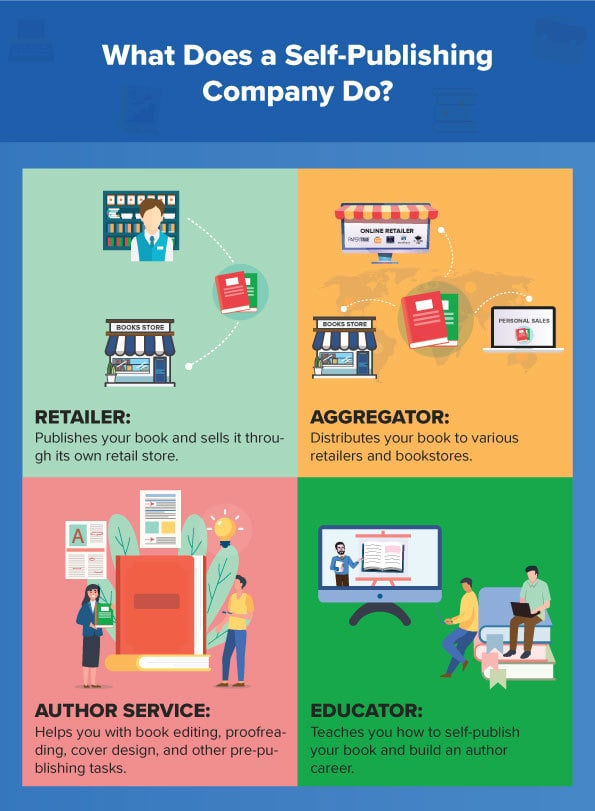
Self-publishing companies fall into one of four main categories:
Let’s see what the different types of self-publishing companies are and how they help you self-publish your book.
A retailer company has a wide chain of circulation both online and in print stores. Once you upload your book here, their channels will distribute it to the market and make it available for people to buy.
Self-publishing companies such as Amazon KDP, Barnes & Noble, and Apple Books fall under this category.
An aggregator is a company that distributes your book across various bookstores and uploads it on all the online selling platforms of your choice. The difference between a retailer and an aggregator is that a retailer company will have their own selling mechanism, while an aggregator simply distributes your book to various retailers.
Companies like Draft2Digital, Smashwords, and PublishDrive are popular aggregators in the publishing industry.
Perhaps the most important kind of self-publishing company, an author service is the company that works on your manuscript, polishing both cover and content.
Companies like PaperTrue, with their array of pre-publishing services, help your book match the industry standards so it can compete with books that are traditionally published. If you want to publish a book that sells, you’ll need to hire an author service.
This is the rarest type of self-publishing company, simply because most services and retailers also offer educational content through their own channels. Exhibit A: PaperTrue’s Resource Center!
The Self Publishing School is probably the only company that is primarily an educator. They offer paid instruction videos and guides to help new writers learn how to handle all self-publishing tasks, or even how to execute control over the book publishing process.
The best self-publishing companies specialize in one out of four of these tasks. So, you’ll have to work with more than one company while publishing your book.
For example, while self-publishing a children’s book, you’ll edit and typeset the manuscript with an author service. But once the pre-publishing tasks are done, you’ll rely on a retailer to distribute your book to your readers.
But which one of these self-publishing options do you need to explore? Depending on your unique case, the answer will differ.
Do you have a manuscript that is ready to be published? Have you gone through the necessary publishing processes such as manuscript editing, book formatting, and book cover designing? If you haven’t, it might be useful to go through some online courses about self-publishing, or hire an author service company.
You can either choose to learn and perform these tasks yourself, or hire a reliable author service to handle tasks ranging from editing and proofreading to getting an ISBN and creating a copyright page.
Let’s see if paid online courses are your thing, or if you’d rather only learn the basics and pay experienced professionals to perfect your manuscript.
All self-publishing companies usually feature some resources to help new authors learn more about the publishing industry and self-publishing process.
PaperTrue, for example, runs a blog that updates authors on topics ranging from what editing steps a book requires, to why writers should turn their book into an audiobook.
Some companies, however, are established with the express purpose of guiding someone to become a professional author. The Self-Publishing School is one such educator. They feature paid or free courses that teach new authors how to manage finances while publishing, how to maintain a trajectory of growth in book sales, and how to strategize in their evolving career.
Some of their paid programs include Become a Bestseller, Fundamentals of Fiction, and Sell More Books. Aside from these paid (and expensive) programs, they also offer free weekly training sessions.
Among your many self-published options, this one is a bit tricky. If you have limited funds, you can’t afford to spend them on tutorials. But if you absolutely cannot afford to pay author services, then learning to self-publish is your only way to get your book published.
Not to worry: there are plenty of free resources for new writers out there. Use these to get started on the process, and let experience teach you the rest!
Self-publishing educators might teach you to assert creative control and make the right business decisions. But it’s a long and tedious process to learn all the tasks that publishing a book requires. Even if you do invest your time in learning these skills, publishing steps like editing and cover design simply cannot be subpar if you want your copies to sell.
You need the help of an industry professional.
Author service companies are designed specifically to play this role. They relay tasks such as editing and cover designing to experts within those fields, thus delivering a polished book that meets industry standards.
Keep in mind that author servicing companies are different from vanity publishers. Author services charge a specific fee for the help they provide, but they take no royalties and don’t have any publishing rights to your book. You remain the publisher, retaining your rights and royalties.
Don’t trust any random company with your book. Look for reviews from previous customers, and ask for samples. PaperTrue, for example, has a rating of 4.8/5 on Google reviews, and 4.6/5 on Reviews.io.
Once you know the feedback from other writers, it’s easy to decide whether you can trust a self-publishing company. All you need to do after that is decide upon which of the publishing tasks you can handle alone, and which ones you’ll need help with.
You will, of course, have to think about the financial side to this. Read this article to find out how much you can expect to pay while self-publishing a book.
Once you have a book that looks polished and reads well, you can either upload it to retailer platforms or hire an aggregator. A retailer company like Amazon KDP or Apple Books has its own store to sell your books.
Amazon’s Kindle Direct Publishing is the most popular platform among self-published writers, and for good reason. Amazon makes up more than 50% of the American print book market, and nearly 75% of the ebook industry. These aren’t numbers that any writer can afford to ignore!
KDP Select publishes your book for free and it is easy to use. Through Kindle Unlimited, the platform gives you new readers and a payment based on the number of pages people read from your book. The program also offers added promotions and countdown deals, giving you a greater chance to sell your book copies.
However, when you publish your book through KDP Select, you are tied to Amazon for a period of 90 days. You won’t be able to sell your book anywhere else. If you have a considerable audience ready to buy your book, it’s better to go global than restrict your sales with Amazon. But if you’re a beginner, then KDP Select definitely has more pros than cons for you.
Other retailers like Barnes & Noble and Apple Books also offer similar easy-to-publish platforms, but none of them have the kind of external industry presence that Amazon does.
The only problem with retailing companies is, you need to upload your book onto all these platforms and navigate their mix-and-match of exclusivity options, promotion opportunities, and style of doing business.
It can be much easier to simply hire an aggregator that will distribute your book onto all platforms of your choice, including online retailers and physical bookstores.
Hiring an aggregator can be beneficial if you don’t want to put all your eggs in one basket. Plus, publishing your manuscript onto every publishing platform out there isn’t an easy task! As an author, you may even miss out on some niche but influential platforms and international companies that aggregators keep track of.
Aggregator companies upload your book on more than 30 different retailing channels, ensuring a widespread, international distribution of your book. A wider reach translates into more buzz, which ultimately helps boost your book sales.
Draft2Digital and Smashwords are among the best self-publishing companies that specialize as aggregators. They take a percentage of your sales in exchange for distributing your book onto retailers and bookstores across the world.
PublishDrive is a relatively new player on the scene, but it has gained a lot of traction due to its promotion opportunities and dashboard feature. They charge a monthly subscription rate and do not take any part of your book earnings.
The obvious confusion for any new writer is between the exclusivity benefits provided by publishers like KDP and Apple Books, or the widespread reach of aggregators like Publishdrive and D2D. Plus, hiring an aggregator means paying an aggregator!
Along with the payments you make to retailing platforms, an aggregator’s fees will curtail your profits. So, what should a writer do?
Let’s resolve this along with any other doubts you may have about your self-publishing options.
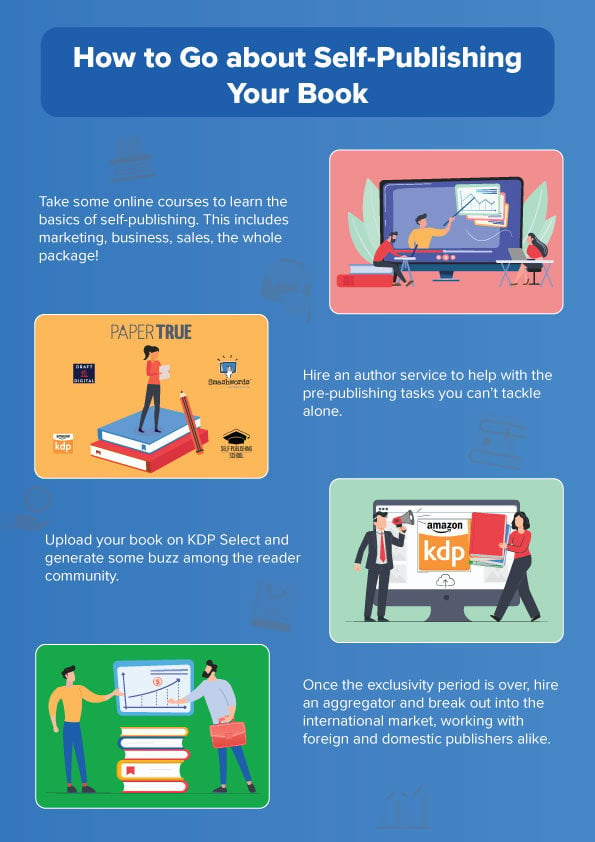
We hope this gives you a clear idea about how to pick and choose from the self-publishing options in front of you. Of course, this is not a fixed roadmap to success. It is merely a guide for new writers to make the best of the options they have while self-publishing.
Do you agree with the solution we have offered? Let us know in the comments!
There are several great options here. The retailing company Kobo has a significant presence in Canada. StreetLib is an Italian aggregator company that’s influential in Latin America and Europe. It has also been recently spreading into Africa. XinXii is another Europe-based aggregator with a solid presence in Germany, Austria, and Switzerland.
If you don’t go the KDP route and need to generate some buzz about your newly launched or soon-to-be launched book, you can always make an author profile on Goodreads! The platform features millions of readers and writers, making it the perfect place to promote your book.
Frankly, it depends on the company you’re working with. Most services will offer you a set of prices depending on your word count. If you work with them on all pre-publishing tasks, they might even offer you a discount! Enter your book’s word count here to get a price quote.
Editing and proofreading are very important parts of the writing process. They help polish your writing by focusing on and eliminating grammar, punctuation and syntax errors. They also improves the effectiveness of your writing style and the clarity regarding the content of your writing. Editing is a crucial part of your writing even if you are a native English speaker, so it becomes twice as important for ESL researchers, publications and anyone whose first language is not English.
More than often, there is an unavailability of a professional editing team in the house. This may be because of lack of funds, more emphasis given to content or in case of translation companies, more focus on translating content rather than editing it.
A professional proofreading and service can help you develop clear, faultless documents at every level of your organization. Any business or individual whose end product is content itself needs a talented editing team.
In this day and age of content not being barred by language barriers because of translation, editing and proofreading becomes even more necessary. Translation editing requires skill and knowledge of translation as a process itself so that editing becomes easier and accurate. Another thing that translation companies need to keep in mind is that no matter how skilled your translator is, they will lose sight of smaller mistakes because they are not trained to do that. This is where an editor’s job becomes absolutely crucial to the document, to ensure that it’s grammatically accurate.
We know an editor who specialises in editing translated content as a translation editor. Their job is to ensure that there is clarity and consistency in the translated text. Their work is guided by these three questions:
When you don’t have an in-house team, coordination between the styles of the multiple translators working in the industry becomes impossible, because one has to maintain a consistency.
Editing is a crucial part of any writing process, delivering a flawless end product. Apart from correcting the grammar, syntax and punctuation of a piece of text, they will give you tips on how to improve it regarding content and structure. They’re indispensable to our ESL audiences, which include:
Since editing is a highly specialized skill that requires extensive training and experience, your work will be cut into half if you hire a team that’s already trained and ready instead of hiring someone and training them again. Outsourcing editing becomes a viable option. Except the project costs, you have to pay nothing. As opposed to full-time editors, freelance editors and the team that you outsource work to don’t incur the burden of benefits (insurance, medical expenses, etc).
Outsourcing proofreading work gives companies access to ‘specialists’, who bring in-depth experience on a variety of projects. Although in-house teams know the structure and functions of their company, outsourcing work to a proofreader might provide with a fresh perspective, and can provide a skills or a knowledge boost. They can also provide inputs regarding the overall content plan and editorial management.
There you have it! Outsourcing an editing and proofreading team may seem like a lot of work and it might be difficult to get the hang off. But if you look at it from a financial and skill-based aspect, you’ll see that it provides long-term results and enhances the quality of your content, further developing trust between you and your customers. Check out the PaperTrue Resource Center for more insights into writing, editing and proofreading!
The main purpose of a dissertation is to contribute knowledge to your field of study. So it goes without saying that a dissertation is rather pointless if you don’t document the results of your research clearly! This is where you document the findings of your research, where you make sense of what you have discovered throughout the research process and explain its relevance to the research question or problem. Let’s explore how to write the results section of your dissertation.
Conventionally, the results section is the fourth chapter of your dissertation, written after you present your method of study. How exactly you present your findings differs from study to study, depending on the topic and discipline your research is situated in, the methods you used, and what kind of data you are presenting.
Here’s what you’ll cover in the results chapter:
Pro-tip: Always check your university’s guidelines for specific details on what you are required to write about in this section.
It’s important to note that the results chapter is usually not the same as the discussion. The purpose of the results section is to present findings in a logical, objective, and impartial manner. At this stage, you do not include your interpretation as a researcher or discuss the implications of the research. Observations that you make, as a researcher, are better suited for the next few chapters. In other words, you simply present the data in the results chapter, and you interpret it in the discussion chapter.
Although, in some cases (for instance, if your university tells you to), you may be asked to combine the two sections. In this case, you’ll have to weave your interpretation and analysis into the segments where you’re presenting data.
It’s important to note that the results chapter is usually not the same as the discussion. The purpose of the results section is to present findings in a logical, objective, and impartial manner. At this stage, you do not include your interpretation as a researcher or discuss the implications of the research. Observations that you make, as a researcher, are better suited for the next few chapters. In other words, you simply present the data in the results chapter, and you interpret it in the discussion chapter.
Although, in some cases (for instance, if your university tells you to), you may be asked to combine the two sections. In this case, you’ll have to weave your interpretation and analysis into the segments where you’re presenting data.
Regardless of whether your dissertation is qualitative or quantitative in nature, there are certain aspects common to this chapter. It has an introduction that reiterates the aims and purpose of the research, a body that deconstructs the results obtained during the research process, and a conclusion that summarizes the study’s findings and sets the stage for a discussion about its implications for your research area.
This chapter is written in the simple past tense, as you are reporting a study that has been conducted in the past.
The purpose of qualitative research is to explore the depth and nuances of a particular topic. So you’ll be engaged with uncovering it through words and detailed descriptions, rather than hard numbers. A qualitative study sees data being presented primarily in the form of words, often supplemented with quantitative data that supports relevant claims. You’re likely to resort to this kind of analysis if you’re working in humanities and social sciences.
The first decision you’ll need to make at this moment is whether you’ll be structuring your data chronologically (in order of how you conducted the research) or thematically (in terms of patterns and trends that you see in your data).
Ensure that each finding you highlight is directly relevant to your research question. You may have made many discoveries over the course of your research, but your chapter has to be concise and report findings that either support or contradict your hypothesis. There is a lot of raw data that you will need to sift through to decide what’s important.
Include excerpts and quotations from appropriate sources such as interviews, discussion transcripts, supporting literature, and so on, to back each of your findings.
Although your chapter is mostly just a barrage of words, it’s useful to have graphs, tables, charts, and other visual elements that illustrate what you’re saying in text. Having such quantitative parameters within the chapter is not mandatory (and may not even apply to certain types of research, like a literary analysis), but is often helpful with establishing a story for your research.
Commonly used qualitative research methods: in-depth interviews, case studies, focus group discussions, theoretical research, literary analysis, and so forth.
Quantitative research, as the name suggests, focuses on studying data through statistical and mathematical techniques. If you’re doing this type of research for your dissertation, your results chapter will be dominated by statistics and numbers (represented through graphs, tables, charts, etc.), explained succinctly through text.
Here’s what you have to include in the chapter:
Since numerical data can be dense and difficult to understand at the first glance, it’s always advised that you articulate them visually, through graphs, tables, charts, and perhaps even relevant figures. Not only does this allow you to deconstruct data in a more appealing way, but it also allows you to spell out a narrative for your data, which you will support with text that explains your findings.
Commonly used quantitative research methods: Surveys, polls, simulations and modeling of data

Get carefully curated resources about writing, editing, and publishing in the comfort of your inbox. [contact-form-7 id="12723" title="Subscribe Form"]
How to Copyright Your Book?
If you’ve thought about copyrighting your book, you’re on the right path.
Explore more [email protected]