Newsletter Sign Up

How to Write Dialogue: 7 Rules, 5 Tips & 65 Examples

When it comes to writing dialogue in a story, even the best of the best writers take a pause. How to write dialogue correctly? Let’s take a look at some rules of writing dialogue to find out how you should write conversations in a story. If you need some examples of dialogue writing to ease the process, we’ve got that covered too!

But before we learn how to correctly write dialogue, we need to know the purpose of dialogue. Why is dialogue important? What does it achieve in a story?

Ensure crisp and engaging dialogues with perfect editing!

Importance of dialogue in a book

A conversation between two characters brings them to life. It provides insight into their psyche and informs the reader what they feel in that moment. It is through dialogue that different types of characters reveal themselves, other characters, and events in the story.

Of course, the chief purpose of dialogue is to develop the story. For a novel to progress, the characters need to communicate with each other. This applies not only to short stories, but also to nonfiction books!

Here is the different ways in which dialogue is useful:

  1. Helps develop characters and deepen their relationships with each other
  2. Provides space to play around with the main ideas in your novel
  3. Adds dramatic moments to your story, without which it is boring
  4. Matches the rhythms of human speech, making your characters more real
  5. Reveals the characters’ desires, fears, and motivations
  6. Lends a tone to the story and the characters
  7. Depicts, deepens, or reflects upon the theme of your story
  8. Changes the direction of plot
  9. Holds the reader’s attention

Knowing how dialogue is important to your book will help you better appreciate how it should be written. Now, there are a few rules of writing dialogue you must learn. Before you understand how to write character dialogue, you need to understand the rules that you need to follow.

Rules of writing dialogue

Writing dialogue in a story or a novel has a few basic rules. If you follow them well, you’ll have nothing to fear from writing dialogues. We’ve added some handy examples of dialogue writing so you can understand these rules better.

Here are the rules of writing dialogue that you should always keep in mind:

1. Use double quotation marks for your dialogue

It is the oldest rule of dialogue writing to enclose the spoken words in double quotation marks. Here’s a sample dialogue:

“Mr. Bennet, you have no compassion for my poor nerves!”

However, there is an exception to this rule. In British English, single quotation marks are used instead of double to show dialogue.

2. Use single quotation marks for quotes within a dialogue

In American English, single quotation marks are used to show a quote within a quote. So if your character is quoting someone else, that phrase should be enclosed within single quotation marks. For example:

“I heard Percy say, ‘the new teacher is absolutely brilliant!’”

3. Every new speaker gets a new paragraph

Every dialogue begins with a new paragraph. Each time a character says something, even if it is only a word, the dialogue should begin on a new paragraph. Here’s a dialogue writing example:

“Don’t worry, the information they have of our whereabouts is misleading.”

“So this was a trap?”

“Precisely.”

4. When (and how) to use dialogue tags

Dialogue tags are a means for you to connect the narration with the dialogue. The “he said” and “she said” you often come across? They’re the most widely used dialogue tags.

Take a look at this:

“Did you think it was over,” screeched Dr. Octavia. “My plan has just begun!”

In the above example of dialogue writing, the dialogue combines the narration and the speech to create the villain in our minds. However, it also provides an interruption in the character’s words. So, a dialogue tag is useful to add a pause in the dialogues.

“Don’t worry,” he whispered, “everything will be alright.”

If the dialogue tag ends the sentence, then use a period after it. But as in the example above, the tag can also occur in the middle of a dialogue to indicate a pause in speech. In that case, you can use commas to separate the speech from the narration.

5. When (and how) to use action tags

Action tags, also called action beats or dialogue beats, are short descriptions of action that break up the dialogue. You can use them to avoid repeating the usage of dialogue tags.

When it’s established that only a certain number of characters are speaking, it’s safe to use an action tag without confusing the reader. Let’s have a look at this example:

“Don’t tell me you lost it again!” She rolled her eyes, flopping down on the bean bag chair. “We’re so grounded.”

6. How to write longer dialogues

When a character delivers a long monologue, you have to create multiple paragraphs for a single dialogue. This can happen when a character narrates a story within your story, or during a flashback sequence.

In this case, end quotes are not used at the end of every paragraph. They only appear at the very end, when the character stops speaking.

“It was a long time ago,” said the old man. “The forests were yet untouched and man hadn’t succumbed to greed. I remember going to forage for produce with my mother. And then the machines came.

“By the time I was a grown man, they had already cut a long line through the forest.”

7. Use italics for internal speech

Your characters’ thoughts and internal monologue is represented through italics. This helps readers differentiate between what is said and what is thought. This is useful when you narrate your novel in the third person or through an omniscient narrator.

“I have no idea where to go,” said Martha. But I will keep you all safe.

Note that the end punctuation mark of the inner speech is also italicized. Think of it like this: instead of enclosing the sentence in quotes, we’re italicizing it.

Some writers choose to use double or single quotation marks to represent inner thoughts as well as dialogue. The key thing is to maintain consistency in your novel, no matter what style you choose to follow.

As is clear from the above examples of dialogue writing, there is much room for error while writing dialogue. Simple mistakes in dialogue punctuation can hamper the reading experience and take your reader out of the fictional world you have created. This is where an expert proofreader comes in.

Of course, any manuscript editing service will help ensure that you follow the important rules of writing dialogue. It’s their job to ensure consistency in your writing, even if you choose to deviate from the norm!

Now you understand the importance of dialogue and rules of writing dialogue. It’s time to understand how to write conversations in a story.

How to write dialogue in a story?

When it comes to writing dialogue in fiction, novelists and short story writers have a challenge at hand. They have to weave in dialogue while they construct scenes, setting, action, and context, also maintaining the flow and narrative of the story.

In his book The Anatomy of Story, John Truby says that dialogue is a “highly selective language that sounds like it could be real.” It is “always more intelligent, wittier, more metaphorical, and better argued than in real life.”

So, terrific dialogue isn’t just important when writing fiction— it’s essential. To impress the agent to win a book deal, and for your readers to keep coming back to your next book, you need to deliver superb dialogue in every scene.

 So, how to write dialogue that always hits the mark? Here are some tips to write dialogue:

1. Punctuate your dialogue properly

Writing dialogue punctuation is tricky, but extremely important. How you punctuate your dialogue determines the tone and meaning of your sentences. More than that, your use of punctuation also reflects upon the characters’ personality.

Take note of the following examples of dialogue writing:

“I don’t know, I don’t know, I really don’t know!”

“I don’t know. I don’t know. I really don’t know!”

“I— I really don’t know.”

“I don’t know… I don’t know, I really don’t know.”

All the variations create different images inside your head. This is because dialogue punctuation creates a speech pattern for your character, and all memorable characters have unique speech patterns.

After all, aren’t you immediately reminded of a certain Star Wars character when you read:

“Know that, I don’t.”

So, the key to writing successful dialogue is to format it properly. Dialogue formatting hinges on five essential punctuation marks. Let’s go through them one by one.

Don’t worry, you’ll find plenty of dialogue formatting examples in the infographic below!

1. Quotation marks

Your dialogue, including all punctuation in the utterance, goes inside double quotations. If you’re in the UK, just replace this with single quotes.

US: “Whatever is said here— the deal, the discussions, the results, everything stays between us.”

UK: ‘Whatever is said here— the deal, the discussions, the results, everything stays between us.’

The end punctuation of a dialogue always goes inside quotation marks.

“When do we leave?” Fatima asked.

“Who goes there!she challenged.

Note that the first word of the dialogue tag is in lowercase. This is because your sentence is a combination of the dialogue and the tag. Since the sentence isn’t complete when the dialogue ends, there is no reason to write the tag in uppercase.

Unless, of course, if the first word happens to be a proper noun!

2. Quotes within dialogue

When you’re quoting a complete sentence, the punctuation remains inside the quote. But when your quote is an incomplete sentence, a book title, or an explanation of something, the punctuation goes outside of the quote

“Samantha called me up and said, ‘I want to see you right now!’

“Samantha called me up and insisted on meeting ‘right now’.

3. Comma

Commas appear with the dialogue tags. So, they connect the narration with the dialogue. Here is the correct way to punctuate with dialogue tags:

Tom said, “I will perform the main act tomorrow, when the time is right.”

“I will perform the main act tomorrow,” said Tom. “When the time is right.”

“I will perform the main act tomorrow,” said Tom, “when the time is right.”

4. Em-dash

Em-dashes are instrumental in setting a rhythm for dialogue. They represent disjointed speech or sentences that are abruptly broken off.

“I didn’t— I didn’t do anything!” Kyle was bewildered. “You— you have to believe me— I’m innocent!”

“They haven’t said—”

“We don’t have the time for this right now!” Anika yelled.

“I wish I could help—”

The alarm sounded: it was time for Wuxian to leave.

Aside from this, em-dashes can also be used to show when characters speak over each other. Here’s a dialogue writing example for overlapping speech:

“Mr. Jackson couldn’t see us—”

“Are you being serious right now!”

“—but he’s headed over here within the next hour.”

Sometimes, action and dialogue overlap to an extent where neither action tags nor dialogue tags are sufficient. In this case, a couple of em-dashes help the writer sprinkle narration between the dialogue.

“Little does our little prince know” — the witch stirred her potion — “what I have in store for him!”

5. Ellipsis

When a character gets stunned into silence or trails off while speaking, ellipses are the way to show it. Consider this:

“When did they…”

“Last night, when half our troops were asleep.”

He looked out at the distant stars. “I thought I had more time…”

It’s easy to deduce from the above examples of dialogue formatting that punctuation can make a huge difference. Different ways of writing dialogue in a story create different meanings. If you want to be a master dialogue writer, mastering dialogue punctuation is an absolute essential!

Also read: How to Punctuate Dialogue in Fiction

2. Character-specific dialogue

Obviously, writing effective dialogue requires a good understanding of your characters. Develop a speech pattern for your character that reflects their personality. Then, take into account their worldview, their present mental and emotional state, their accent, or some sayings they love to use.

Remember two things when you write dialogue for your characters:

Characters aren’t mouthpieces for the writer

Your characters have a life of their own. The dialogue you write for them needs to reflect this. Beware of setting two heads talking in space: scene and setting influence dialogue as much as they influence plot and story.

Dialogue between characters can engage with the surrounding to build tension and add drama. Don’t settle for anything less than the most character-specific, setting-influenced conversations between your characters!

All your characters can’t sound the same

Some characters talk a lot, some talk a little. Some talk wisely, and some talk frivolously. Effective dialogue writing lets the readers know exactly who is speaking.

A stuttering child will obviously have a different style of talking from a hotheaded matriarch. Idioms, catchphrases, accent: it all goes into the making of great dialogue.

3. Balance dialogue with narration

Dialogue from stories and novels is always more intelligent, metaphorical, and sassy than it is in real life. The simple reason for this is that dialogue is not real talk. It is a highly vetted language that is cleverly constructed to depict action, movement, and conflict.

Consider this:

“Hey, Eric,” Wendy said.

“Oh, hi! What’s up?”

“Do you know where Kenny is? He hasn’t been home in two days”

“I’ve been busy lately, don’t have a clue”

Your texts with random colleagues are more interesting than this, right? The dialogue in this example sounds realistic, but it’s also boring because it has no weight.

It does not contain any tensions and adds nothing to the plot. It tells you nothing about the characters, aside from the surface information.

A dialogue writing sample

Dialogue and internal monologue are necessary to the story but can quickly turn boring. So, your dialogue needs to be rich in conflict. More than this, it needs to be balanced with conflict in action and narration!

Make sure that your dialogue has an impact. It should change the direction of the plot, the movement of the story, and the behavior of your characters. If characters talk and nothing happens, your readers will lose interest.

This is how you can achieve a balance between narration and dialogue to depict a better picture:

“Hey, Eric,” Wendy said, trying to play it cool.

“Oh, hi!” Eric said brightly, rubbing the back of his neck. “What’s up?”

“Do you know where Kenny is?” She observed his expression. “He hasn’t been home in two days.”

Eric won’t give away anything so casually, she thought. I must corner him after the meeting.

“I’ve been busy lately,” he smirked, shrugging. “No clue.”

See how some well-placed narration makes the same lines more engrossing? A drab conversation takes on more meaning if you use the right dialogue tags and action beats.

4. Avoid exposition

Exposition is the writer’s way of giving context to their readers. It tells the readers more about the setting, the backstory, and the recent or distant events before the story begins.

It’s important for the readers to know where the characters come from and where they are going. But this doesn’t have to be told through a dialogue between two characters. Too much exposition in dialogue makes your characters talking heads, rather than the real people they’re supposed to be.

Relying heavily on your dialogue is as harmful as not using it enough.

Ideally, a large part of the exposition should be set in the story’s narrative. Other developments like suspense, revelations, or secrets can unravel through dialogue. This adds dramatic effect to your narrative.

5. Revising your dialogue is important

No one can write good dialogue in one go. If it’s impactful, it tends to be unrealistic. If it’s believable, it becomes lackluster. This is why revising your dialogue is so important. Aside from the content, even changes in dialogue formatting and punctuation can make it more substantial.

It’s natural to come up with a clunky length of conversations in your first go at writing dialogue. But a round of revision helps you refine it by leaps and bounds.

Go through individual dialogue segments and inspect them carefully. Ask if the dialogue is logical for the character’s disposition. Is it true to the story’s time and character’s maturity? Does it fit the character’s credible thinking?

Create a list of such questions to suit your individual process. Include things that you often forget to consider. Add considerations like personality, slang, rhythm, mood, and emotion to your list.

If you lack the critical eye to examine and correct your writing, seek expert help. As always, your novel editors and proofreaders are here to help

6. Study and practice 

Finally, the most important advice from anyone who has mastered any art: practice!

Observe how your favorite author writes dialogue in their books. Note down all remarkable examples of dialogue writing and study them for why they work. You can also make use of some dialogue writing exercises.

A dialogue writing exercise can be as simple as starting with a prompt and making it intriguing. Basic as it sounds, there’s nothing like some good old writing practice to get you going! So, here are some quick dialogue writing prompts that can help you practice:

  1. “I heard you’ve been missing something.”
  2. “Ah, how the mighty have fallen!”
  3. “I never said—”
  4. “Have you heard? Old man Lan is dead.”
  5. “Her mother knew. All this time.”
  6. “Did they help? You don’t look any better.”
  7. “It’s time to finish what we started.”
  8. “I never thought it could go this wrong.”
  9. “How did you…”
  10. “How old are you again? I keep forgetting!”

We hope these dialogue prompts get you excited to write. Of course, knowing what you need to do isn’t enough to make powerful dialogue. You also need to know what to avoid.

Avoid these dialogue writing mistakes

There are two reasons that dialogues become boring: either writers expect dialogue to do the heavy lifting, or they don’t rely on it at all. There is a fine balance for dialogue in a story: it needs to do enough, but never too much.

But how can you achieve this? Where does the limit lie? Now that we’ve told you how to write dialogue, we’ll also inform you about some common dialogue mistakes you need to avoid. It’s all about that balance, isn’t it!

Avoid these pitfalls in when you write dialogue in a story:

1. Boring dialogue tags

There is a wide variety of tags you can use, aside from “he said”, “she said”, and “they said”. The common mistake to make while writing dialogue in a story is using the same or similar tags too often. This gets repetitive and boring for the reader.

No one wants to read something like this:

“Barry,” said Melanie, “I didn’t know you were in town!”

“You hardly know yourself these days,” he said.

“Hey!” she said. “No fair!”

Let’s make some corrections:

“Barry,” beamed Melanie, “I didn’t know you were in town!”

“You hardly know yourself these days,” he mocked.

“Hey!” she protested. “No fair!”

You know what? I still feel like this is lacking, and we’ll soon see why.

2. Too many tags, not enough beats

Using an abundance of dialogue beats and no action tags make for poor dialogue. The reverse is also true; what you need is a proper mix of both.

Tags tell you how the words are being said, but beats tell you what action is happening alongside the words. For engaging dialogue, you need both! Here’s our previous dialogue writing example, edited, proofread, and improved:

“Barry!” Melanie hugged him, smiling brightly. “I didn’t know you were in town!”

“You hardly know yourself these days,” he mocked.

“Hey!” She punched him on the shoulder. “No fair!”

3. An abundance of the same style

We’ve seen multiple ways to write and punctuate dialogue. You can write it with a tag, a beat, or an interruption. Find ways to mix and match between these styles, so the repetition doesn’t become boring.

Here’s an example that mixes various styles of dialogue writing:

“Barry!” — Melanie hugged him, smiling brightly — “I didn’t know you were in town!”

“You hardly know yourself these days,” he mocked.

“Hey!” She punched him on the shoulder. “No fair!”

4. Scene-blindness

A scene is a moment in your story: it includes action, conflict, and some immediate consequences. To maintain the flow of action, nothing should interrupt the scene.

Let dialogue build tension, and cut back on it when the tension is highest. Too much dialogue can dilute the scene and create no impact. Assess the needs of every scene, and write your dialogue accordingly.

Now that you know how to creatively use dialogue, you can create intriguing dialogues to hook the reader to your text. The next step after writing is editing. As experts in editing and proofreading services, we’d love to refine your text! 

Here are some other articles that you might find useful: 
Final Submission Checklist | Dissertation & Thesis

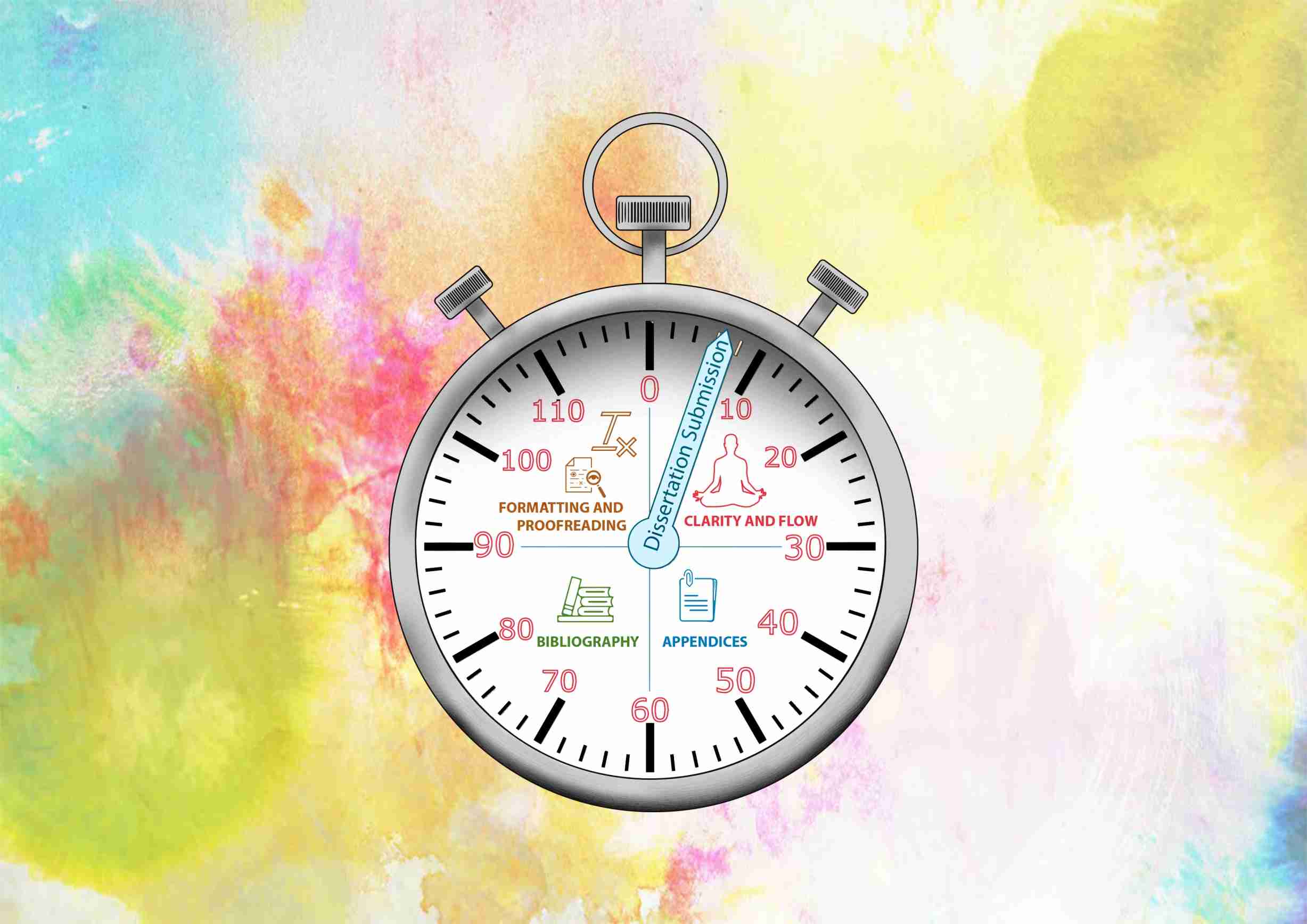
Writing a dissertation is a lengthy process that often takes months or even years. Over time, your thesis is likely to have taken a lot of unexpected turns which see changes in the way you write, the arguments you’re putting forward, and even the direction of your research! To wrap all of this up in a professional and coherent manner, it’s a good idea to go through a comprehensive checklist before submitting the final dissertation to your university. Here’s a last-minute dissertation checklist that will get your draft in order. 

Why do you need a dissertation checklist?

There are some researchers who rush through the dissertation writing process and others who take weeks and months to perfect the final report. A final checklist is crucial for both groups because there are numerous aspects of the dissertation to review: everything from the title to the final entry in the reference list.

Having a handy checklist when you’re revising the dissertation will help you streamline the editing process. It will help you identify precise goals and focus on them in each stage. For example, you will want to dedicate specific rounds for content checks, formatting, tables and images, the reference list, grammar and language, and so on. The goal is to ensure that you give each of these aspects enough time and effort during the final check. 

After writing, it’s best to keep the dissertation aside for a few days and then jump into this. Let’s explore a few things you will be paying attention to while crossing off items in the final dissertation checklist. 

What’s in the last-minute dissertation checklist? 

Content check 

The actual contents of your dissertation is undoubtedly the most important of the whole piece. This round of checking involves you reviewing the body of your entire dissertation, from the abstract to the conclusion or recommendations section. Your aim here is to see if the content flows well and is coherent to anyone who reads it. 

At this point, you’re checking to see that you’ve answered all the questions you’ve asked and tied up other loose ends. This is NOT when you’re reworking the arguments of your dissertation. This is simply a cursory check, so if you’re having last-minute jitters and want to change the direction of your thesis, don’t give in to it! Trust that you’ve already put your best foot forward. Now it’s just about fine-tuning minor kinks. 

Here are some guiding questions for this stage: 

  • Have I answered my research question(s) adequately? 
  • Do my title and abstract accurately convey the purpose and aims of my research? 
  • Have you been clear about the impact of your research and the contribution it will make to the field?

Citations and references 

Citing sources and adding detailed (and impeccably formatted) references are two of the most tedious processes in academic writing. It gets to the best of us, especially in times of stress. But it has to be done. If your citations and references are not properly done, you could easily get a lower grade on an otherwise well-done research project. So dedicate ample amount of time to checking your citations and references so you don’t lose marks for silly mechanical errors. 

Citations and references also allow you to clarify which parts of your dissertation document your findings and which paraphrase, quote, or reference someone else’s work. It will also clarify that your work has not been plagiarized. 

If you’re struggling to do this round of editing on your own and you have some cash to spare, consider taking a professional editor’s help to perfect your dissertation’s in-text citations and references. 

Pro-tip: Don’t forget to note the edition of the style guide you’re working with! 

Tables, figures, and visual elements 

Pay close attention to the non-text elements of your dissertation. If you have images, figures, appendices, and other things that are slightly disjointed from the text, consider reviewing them separately. In this round, you are likely to check for things like alignment, accuracy, proper formatting, readability and coherence, labeling, etc. Recheck of each element accompanies the text it’s supposed to and corresponds with the table of contents (if necessary).

Language and grammar 

Last but not least, proofread your dissertation before you submit it. In the larger scheme of things, a typo or two may not seem to matter. But your grades are on the line — and silly language errors are a gateway to bad grades. You must absolutely do a round of proofreading to rectify misspelled words, grammar errors, misplaced punctuation, incomplete sentences, etc. 

Head over to this guide to know more about how you can self-edit your dissertation

Just to summarize + the FINAL dissertation checklist 

This is quite a lengthy process with many rounds. Here’s a checklist that will make things a bit easier: 

If you’re interested in an extensive chapter-by-chapter last-minute dissertation checklist, click here.

How PaperTrue Maintains Document Confidentiality

As a business editing service, we get queries about document confidentiality all the time. So, we’ve decided to elaborate how PaperTrue ensures confidentiality of your important documents while editing them.

As part of our business editing services, PaperTrue helps companies create polished documents. Whether it’s a data report or a financial statement, we ensure that your document is free of errors. Aside from checks for spelling, punctuation, and grammar, we also check for proper document layout and formatting.

However, these documents often contain sensitive or proprietary information. Business editors and proofreaders have the onus of not only ensuring confidentiality of the documents they edit, but also of protecting it from others.

So, document confidentiality and security is one of our chief concerns, right beside proper formatting and refined language! PaperTrue has six steps to enforce both of these. Without further ado, let’s get into it. 

PaperTrue’s strategy to keep documents safe and confidential

1. Strong 256-bit encryption

PaperTrue protects your documents with 256-bit encryption, which is one of the most secure encryption methods in the world. It’s secure enough to be used to encrypt military data! In fact, all important documents of the U.S. government are protected by 192-bit or 256-bit encryption methods.

But what is 256-bit encryption?

Any type of encryption used to secure data achieves this through an encryption key. The 256-bit encryption means that a hacker will require 2256 different combinations to break the encryption and read the file.

Since this is almost impossible to achieve with even the world’s fastest computers, you can rest assured that your documents are safe with us. 

2. The OMS limits document access

PaperTrue’s Order Management System (OMS) allows only your editor to access your document. The operations team assigns you an editor based on your niche and your requirements, but they don’t have access to your document.

Plus, our editors have access to no details but your document they’re editing and the editing guidelines provided by you. On the other hand, the operations team, which does have access to client details, cannot access your document.

In this manner, the OMS ensures that even within the company, sensitive files such as legal documents or medical documents don’t go outside the concerned departments.

3. Regular OMS updates

We regularly update the Order Management System with newer provisions for safety. These updates improve upon existing features and tighten the screws on our confidentiality and security measures.

Our latest update was rolled out in June 2022.

4. Our editors sign a confidentiality agreement

What can be a greater assurance of safety than the fact that your editors are, quite literally, sworn to secrecy!

At the time of onboarding, our editors and operations executives sign non-disclosure and confidentiality agreements. This prevents them from disclosing any sensitive information. To be perfectly honest, they don’t have client information, so the whole ordeal would be a futile endeavor anyway!

5. We can sign a non-disclosure agreement

All editing contracts you make with PaperTrue feature a confidentiality clause. So, document confidentiality is guaranteed to you the moment you sign a contract with PaperTrue!

But in case of extremely sensitive information, we can sign an additional non-disclosure agreement. This is a rare occurrence due to the similar clause that is present in every contract, but we do it to allay any remaining concerns.

While confidentiality is the foundation of PaperTrue’s business editing services, we undertake this process to provide a written guarantee.

6. Entirely erase order details from our system

After a certain amount of time, we archive old customer data and order details. This includes the original document sent by the customer and subsequently edited documents. Archived data cannot be accessed by anyone from the operations or editorial teams.

We archive this information in order to better serve our customers. But if a customer requests us to delete the order details from our archive, we can do that.

This is the rarest occurrence out of all the steps we take to guarantee document safety. However, in case of extremely sensitive documents like legal or business contracts, we can do this for our customers.

At PaperTrue, we seek to do much more than providing the best editing and proofreading services to business organizations. We primarily seek lasting work relationships based on trust and loyalty. If you still have any questions regarding document confidentiality, feel free to ask us in the comments.

You can also get in touch with us via email, chat, or phone. We look forward to hearing from you!

So You Want to Hire a Proofreader? Here’s What You Need to Know

Bad typos are embarrassing, formatting errors in essays cost you your grades and your protagonists who have red hair in the first chapter suddenly have black hair in the next. Honestly, a lot of this is haste, and quite easily fixable. You are excited to get your content out in the world but you have to check it before doing so. This is where a proofreading service rears its stern head. Hire a proofreader and fix all your language woes! 

Proofreading is the final step in the entire editing process, and it ensures that your writing is free from grammar, punctuation, and formatting errors. After proofreading, your document is ready to go! It is necessary to give your content that final touch before it is a finished product. We have 4 major areas of content in which proofreading is crucial to ensure that it is free from errors. If your content falls into any of these, hire a proofreader to give it a final review. 

What documents do proofreaders work on? 

1. Academic documents

Academic documents comprise term papers, research papers, dissertations, and essays. If you have sent in an essay with a huge typo that felt like the end of the world, you know what I am talking about. Proofreading is essential in academic documents because it

  • Omits repeated phrases and words: When the word limit is 3000 words, you try to stretch it as thinly as possible. While this may work for you, it does not work for your essay, leaving it a blubbering pile of mess. A proofreading service offers a solution in the form of refining your sentences and deleting those heavy words like “therefore” in every single sentence that you have typed. 
  • Gives you your own personal “Eureka!” moment: It is not possible to squeeze out every single bit of perspective to your academic writing in one sitting. Try as much as you can, some bits completely escape your brain. Proofreading your essay a couple of times jogs your memory and all the things that you missed light up like a thousand light bulbs. 
  • Checks formatting errors: Why is one subheading font size 12 but the subsequent one is a size 14? Those paragraphs that you typed in one long, brilliantly creative stroke now seem too long to read. All those sources that you have cited are all jumbled up and you don’t know who is the author and what the book is about. But that’s where a proofreader can help you out. They align your documents, segregate your writing into smaller paragraphs, even out the font size, and cite your sources according to whatever format you’ve been prescribed.  

 2. Business documents 

Business documents are at the top of the list for proofreading. There are confidential emails, intricate legal documents, and important client pitches that need to be refined and checked before they are dispatched. A proofreading service will help you achieve

  • Error-free language: Typos are embarrassing. And when you make them in an email that will go to your boss, it may shut the door on your face. A similar thing might happen in an important presentation that you are making in front of an important client and it says “Introsuction” instead of “Introduction”. You will most definitely want the earth to swallow you whole. 
  • To-the-point communication: Business is all about being direct and diplomatic. If your clients or fellow partners do not understand what you’re trying to spin, it will pretty much backfire. Proofreading ensures that you cut out the going-around-in-circles drama and present your points clearly. It cuts out flamboyant words, unnecessary jargon, and repetitive sentences so that your pitch is an immediate success!
  • Refined tone and style: Business documents need to be devoid of any words that might make them seem emotional. If your email sounds like you want to extend the hand of brotherhood to another company, it’s probably time to proofread it. Proofreading helps you spot any trace of “dear”, “amazing”, or in some extreme cases, ‘lit!’ (yes, with an exclamation mark) and delete it furiously. 

 3. Online content 

Ah, the place where everything stays forever. Online content is our endless pit of information and the source of endless laughs. Be very, very, very careful about what you post online because it might end up being one of the worst mistakes of your life. 

  • Checks your typos and spelling mistakes. On the web, millions of people view your content. While this is a good thing in terms of visibility and growth, it can prove terrible if it’s troll-worthy. Proofreading online content for typos and spelling mistakes can save you from years worth of embarrassment. 
  • Keywords and SEO. After you proofread your website or your online articles, it is more likely that you include trending keywords that make your content easily visible and widely accessible. Proofreading your website also includes correcting your hyperlinks, checking whether there are any broken hyperlinks or so, etc.  
  • Maintain a consistent style and voice. If your website has a lot of content from multiple bloggers and writers, a professional proofreading service will ensure that the voice of your website remains consistent. 
  • Save time and embarrassment. It’s always better to give time to proofread your website for spelling errors, punctuation mistakes than to have your readers point them out to you.

4. Books (Fiction and Nonfiction) 

Proofreaders also often work on full-length books. Unlike editing, the steps of proofreading remain fairly standard regardless of the genre of your book. In fact, in the traditional publishing context, proofreading is one of the last steps of the entire manuscript. 

  • Correct grammar and punctuation errors, and typos. When you hold a piece of work dear to your heart, you don’t see minute errors in your copy, which a professional proofreading service might. Even if proofreading is the last step in the entire editing process, it is vital for the book to become a properly finished copy.
  • Formatting your book. Proofreading is the final step in the editing process which checks whether the formatting of your book is even and consistent. People mistake the two to be the same thing. But there’s a clear distinction. Those are two different services, with a different set of skills required, and they are also priced differently.

Another common misconception is that online proofreading services only serve authors and students. That’s just the major clientele. Here at PaperTrue, we’ve processed documents for clients from various walks of life, like editing resumes and CVs for job seekers, formatting film scripts, proofreading text for comics, processing business documents, and more. You can hire a proofreader no matter what document you’re working on. 

If it’s written word you got, online proofreading services will surely help you make it better.

10 Things to Look for Before You Hire a Proofreader 

There are tens and hundreds of proofreading services out there. Not to mention the thousands of freelancers whose services you may consider availing. Here are the 10 things you should look for while you do research to hire a proofreader. 

1. Experience and qualification 

While hiring an employee, you look at their resume to assess their experience and qualifications in order to choose the best.

Similarly, when you hire an online proofreader or such a service, it’s essential to know what your proofreader can do for you. Does the proofreader have a good command of the English language? Is the proofreader well-versed with digital proofreading and the various formats? Do they have any formal training?

There are various questions to be asked, and you need to make sure you’re asking the right ones.

2. Excellent customer support: 

Online proofreading services have solid client support. The round-the-clock support they provide is a must because users often have doubts about the pricing, the level of service, and the turnaround time before they opt-in to go ahead. In case, they’re not satisfied with how the document has turned out, they come back for a round of revision, with the particular requests for what they want changed. 

3. Comprehensive service offerings 

Proofreading is essentially a very streamlined process and involves the correction of grammar, spelling, punctuation, style, etc. It is the clinical correction and polishing of your document and typically takes place at the very end.

It’s possible for you to get unwittingly misled since editing and proofreading often tend to cross paths. It is important to note the difference between editing and proofreading and be very sure of the type of service you’re expecting.

4. Affordable pricing 

This one is on top of the list, especially for students and first-time authors. Editing and proofreading is an extensive activity, requiring meticulous work and a considerable amount of time. But some services charge exorbitant rates for 1000 words and that puts people off. Many people cannot publish their work, however good it is, just because of the price. Academic documents like dissertations, essays and papers lose marks because of formatting errors, something that could have been easily fixed by proofreading. 

Hire a proofreader who offers affordable pricing per thousand words. A few proofreading services offer discounts around Thanksgiving, Christmas, and Halloween, going up to 30%, which can mean the world for forever broke college students. 

5. A reasonable turnaround time

Some websites have reviews by disappointed clients, many of them stating that the document did not turn up on the day that it was scheduled. Lazy turnaround time pushes away clients even if the work is good and up to the mark. 

6. A respectful author-editor relationship 

There is no greater joy than clicking with your editor. This is true, especially when you hand months and months of hard work to them. A good professional proofreading service will have people that go above and beyond what we require and assist you in fine-tuning your book or document. Apart from this, it is also your responsibility to cooperate with them and keep things up to the mark on your end. 

7. A portfolio or work samples 

How will you trust a proofreading service if you don’t know what kind of work it does? It is ideal to look up editing and proofreading samples on their website and go through them. Check whether they have a variety of documents; ranging from academic to fiction. Through their editing samples, you will be better able to understand the editing style and whether that suits your sensibilities.

8. Good reviews and testimonials 

The best place to check the credibility of a service is its review page. Companies often ask clients to review their service if they liked it. Dissatisfied clients take to reviews to nudge people away from the service and make them aware of its shortcomings. A good proofreading service will have the maximum number of good reviews. Look for reviews that highlight all the aspects of their service (turnaround time, price, constant communication and follow-ups, editing samples, etc.)

9. User-friendly website 

If the website takes an eternity to load, you will be frustrated and eventually throw your phone or laptop. Don’t do that. Instead, check other websites. One might load fast, but don’t stop at that. Check how accessible the information is. If you can’t find basic information like the pricing or their services, then immediately move to another website. The website of a proofreading service says everything about its functionality. Therefore, it is a must that it is smoothly functioning. 

10. A guarantee of confidentiality 

If you’ve never availed of the services of an online proofreading service before, we understand that you might be worried about how confidentiality is guaranteed. Whether you’re a student about to submit a dissertation, a writer sending in their manuscript, or someone sending in a sensitive legal document, you can be assured that these professional firms have had ample experience securing the safety of your document. 

Most websites, on the onset, guarantee the confidentiality of the documents and other information you’re sharing with them. But before you hire a proofreader, you must be absolutely certain of the exact terms of confidentiality they guarantee. The best way to do this is to look for a confidentiality clause in the contract you sign with them. 

You should ideally be looking for all of these 10 qualities in the proofreader of your choice. Are you looking to hire a proofreader? Here are some options you may want to consider.

Keep reading with more resources from your loyal editors and proofreaders:

The History of Proofreading

Having harped on about it for a while, we’re sure (mostly!) that you know all about the importance of proofreading. 

But where did it all begin? Why is it so important? How much do we really know about the history of proofreading?

Proofreading? Who’s that?

Proofreading is quite similar to putting the finishing touches on a cake. Just the way icing covers any cracks or flaws in the cake and takes it to a whole new level, so does proofreading polish and perfect your document.

The final step of any writing process; proofreading essentially checks for spelling, grammar and punctuation errors which are identified and corrected. You can identify a good proofreading job if the overall readability and style of your document seems to be smooth and improved.

On a side but very important note, it’s important to understand that proofreading and editing are not the same. Editing involves a lot more effort and skill, since it involves altering and correcting content and syntax. But that’s a story for another blog.

Digging up the past

Seriously though, where did all of this start? Who were the first Grammar Nazis?

The first known forms of proofreading differ vastly from the methods we employ today, and dates as far back as the 15th century! You’d be surprised to know, that proofreading is about as old as printing itself. Following the invention of modern movable printer taking place in Strasburg, Germany, in 1439 A.D. by Johannes Gutenberg, a contract written in 1499 places responsibility for proofreading on the author.

We told you it was important.

What else though?

Proofreading is a lot, lot, lot more intricate and complex than a simple spell or grammar check. It involves formulating style sheets that could be individual to each document being edited, and there are numerous methods that can be employed to do the same.  

Here’s a list of some of the more commonly used ones for you to get a better understanding:

  • Copy holding or copy reading is generally done with 2 readers for any given document. The first reads the text aloud literally as it appears, at a uniform rate. The second reader follows along while also marking discrepancies between what is being read and the typeset. This method comes in handy in the case of boilerplate text where people generally tend to overlook seemingly small errors.
  • Double reading is slightly similar to copy holding in the sense that the responsibility of the proof is shared by 2 people. It is essentially the first proofreader following the traditional method, and then passing it ahead to the second person for the same.
  • Scanning, as the name suggests is used to proofread without exactly reading it word for word. It has only gained popularity in the last few years with the advancements in technology, and is now common with computerization of typesetting and the popularization of word processing. While established publishers usually prefer their own proprietary typesetting systems, an average customer ends up using commercial programs such as Word.

What’s it like today?

The Internet is swarming with free spell checkers and softwares designed to supposedly edit and proofread your document. It’s easier, but it’s also trickier since most of these softwares don’t end up doing more than 10% of the proofreading required.  

So if you believe that professional proofreaders are not as useful as they once were, you’re very badly mistaken. There are too many types of errors, and no matter how much Word insists that your document is corrected – it most probably isn’t. Punctuation errors, misused words, repetitive words and missing words are just among many common mistakes that go unnoticed on such online platforms.

Moreover, professional proofreaders have a far lower rate of false positives than software programs, because real time experience and a human understanding of grammar structures will always beat an algorithm.

A noticeable error in any document, be it in a book, a newspaper, a social media post or even a text can change your entire perspective of it. It creates a sloppy image of the writer in your head, and doesn’t make for a good read experience by itself. So now that you know about the origins and intricacies of proofreading – take the plunge! Make the smart choice, sit back and PaperTrue.

Remember, practice (along with) proofreading makes perfect.

How to Promote Your Book Using a Goodreads Author Page

While marketing your book, you can’t afford to ignore the immense advertising potential of Goodreads. It is an online community of readers and writers over 90 million strong, and you can access it with a Goodreads author page.

Before you start using Goodreads to promote your book, you should know how readers use it. What do readers want from Goodreads, and how do they interact with authors?

How to Use Goodreads

Goodreads is primarily a site for people to find book reviews and recommendations. Readers can look up books and flip through book previews, if Kindle versions are available. The platform also offers a selection of books that people can click and simply start reading!

On Goodreads, you can connect with people you know or befriend fellow book lovers. Readers on this platform set reading goals, participate in challenges, and most importantly, leave reviews on the books they read.

With a member profile on Goodreads, you can do all of these things. A key component of promoting your book on any platform is building connections. So even if you haven’t made an author profile yet, you can start writing reviews and making friends!

Plus, getting at least twenty reviews of your book is essential if you want to sell any copies. So, authors can benefit from having their book read and reviewed on Goodreads. Of the many ways you can use Goodreads to promote your book, this is probably the easiest one.

Let’s first understand what a Goodreads author page is and how you can use it to promote your book.

What is a Goodreads author page?

An author page is a part of the Goodreads Author Program where authors can make profiles to interact with readers and promote their books. It’s an upgraded version of the member profile on Goodreads, where writers can hold events and post updates about upcoming books.

So, a Goodreads author page is an important tool that can help you promote your book to millions of readers. In this article, we’ll tell you how to make an author profile, how to get your book on Goodreads, and how to promote it on the platform.

Now that you know how to use Goodreads from a member profile, it’s time for you to learn how to use Goodreads as an author.

How to make an author profile

Creating an author profile on Goodreads costs you nothing. It’s completely free! All you need to do is to create a member profile. Then, claim authorship of your book and get your profile updated to an author page.

There are three steps to making a Goodreads author account. Let’s go through them one by one.

1. Find your book on Goodreads

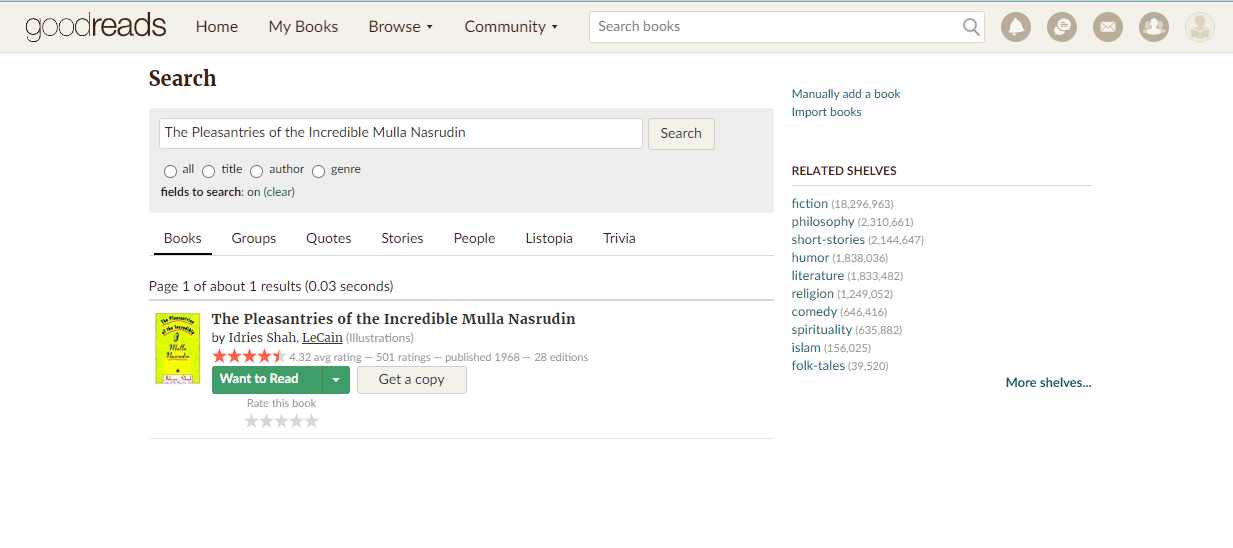
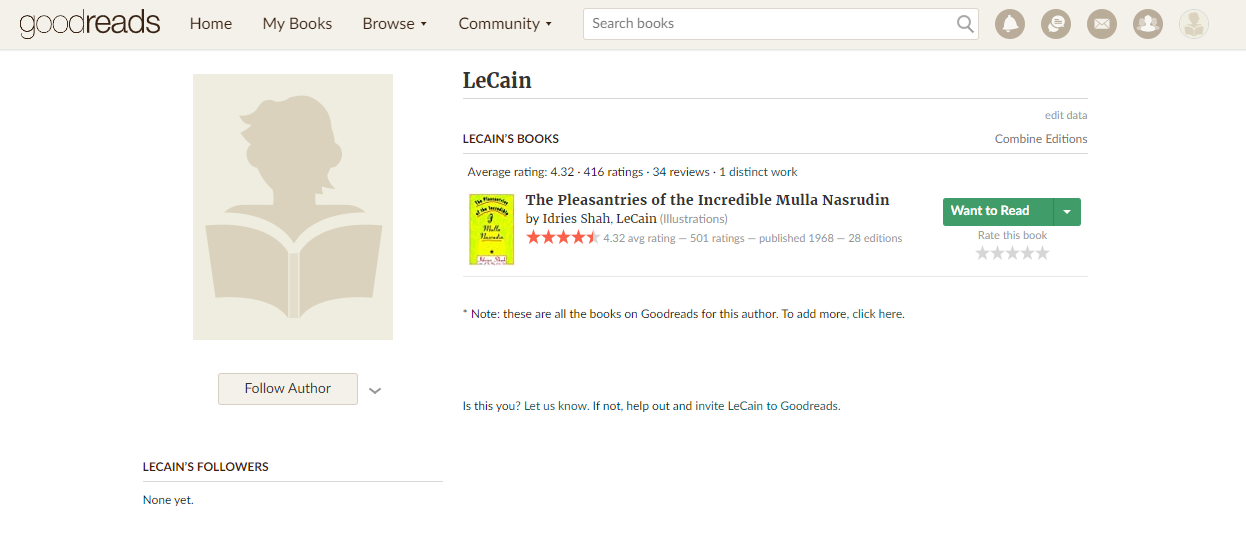
Sign in to the Goodreads desktop site and search for the name you have used as a published author. It should appear under the title of your book in the search results.

Search your book on Goodreads to claim your author page.

If your book is not published yet, you can still enlist it on Goodreads by filling an application form. This way, your book marketing mechanism will be in place long before your book is launched.

2. Claim your author page

Once you click on your name, Goodreads will take you to the basic author page. This is merely a part of Goodreads’ database of books and authors, and it is separate from your personal member profile.

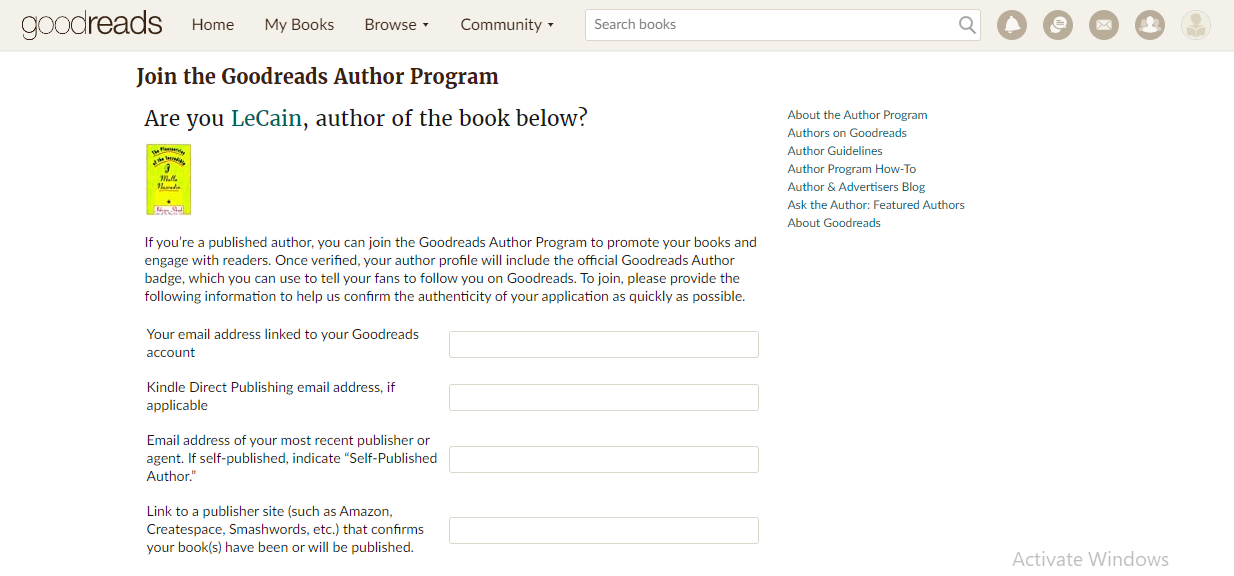
At the bottom of this page, click “Is this you? Let us know” and send a request to join the Goodreads Author Program.

A book page on Goodreads with an unidentified author. At the bottom of the page, text reads "Is this you? Let us know."

The form authors need to submit in order to get an author page on Goodreads.

You will get an email confirmation in a few days and your member profile will be merged with your Goodreads author page to create an author profile.

3. Use Author Program resources

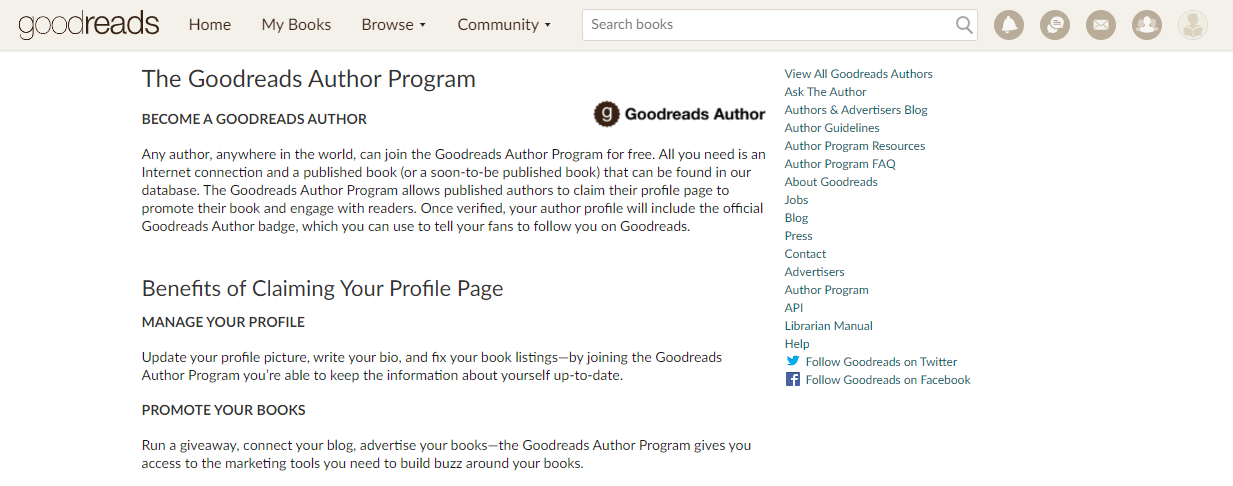
Goodreads has made it extremely easy for a new author to shape their author page. Be sure to make full use of their Authors & Advertisers Blog, Author Guidelines, and other Author Program resources.

A screenshot of the Goodreads author program webpage.

Having an online presence on a new social media platform is often overwhelming, so take all the help you can get!

How to use Goodreads as an author

Using Goodreads to promote your book is beneficial to all writers, but especially so to the self-published writer who lacks the reach and resources of a big publishing house. While you have your self-publishing guide to help out with the pre-publication tasks, you’ll need to handle book marketing by your own self!

The site helps you find more readers, maintain a stable readership, and develop an author brand for yourself.

1. Use Listopia to find more readers

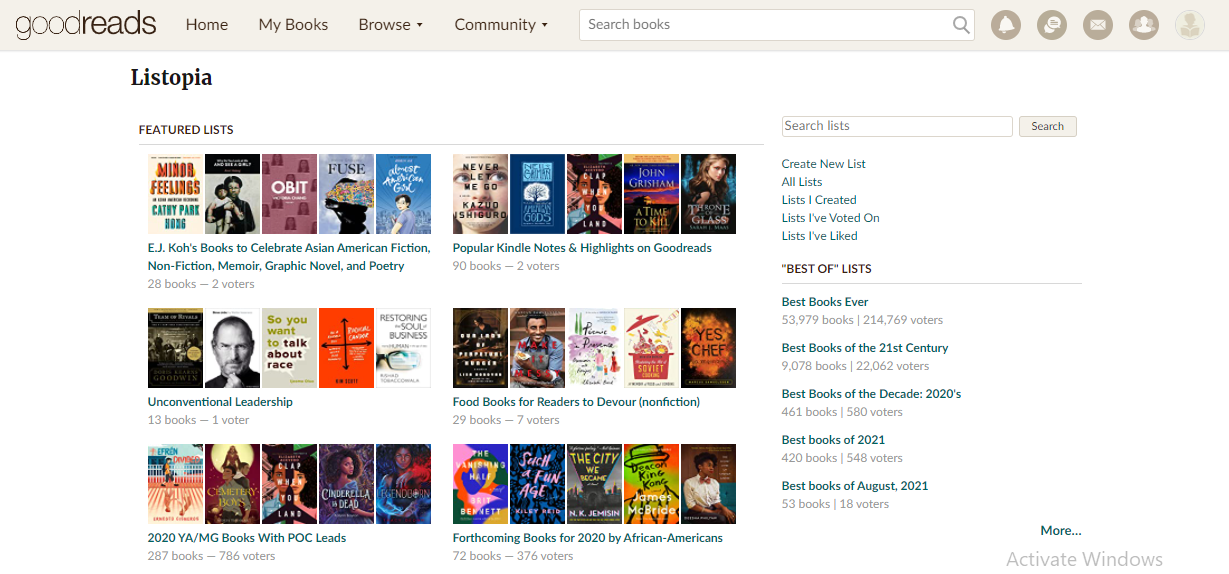
In its “Listopia” section, Goodreads has specialized book lists corresponding to specific genres and categories of books. Members create these lists based on their preferences in reading and vote on the books in a particular list to rank them accordingly.

Naturally, your target here is to feature on these lists and rank well on them. This will get you more visibility, which means more readers, which means more reviews, which means more sales!

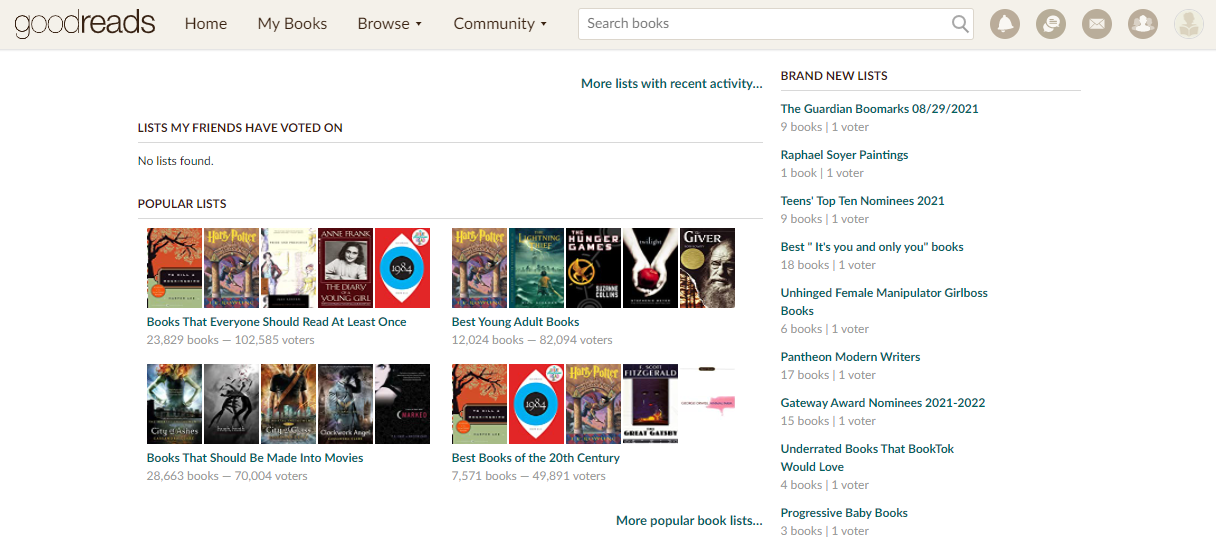
Book lists in the Listopia section of Goodreads. Authors can use it as a tool to promote their book.

First and foremost, you need an online network to vote for your book on these lists. This network can be a combination of your fans, friends, and family. Remember how we told you to make lasting connections on this site? Yeah, this is where it can come in handy.

Ask your friends on the site to add your book to relevant lists and to vote for it. Even if you get only a small number of votes, you will have a presence on the list, which in itself is great for your visibility. Starting from here, you can communicate with more people, expand your network, gain more votes, and work your way to the top.

Several lists featuring books from the Harry Potter series.

Keep in mind that Goodreads’ algorithm determines the genre of your book based on the categories assigned to it by your readers. So if you want your book to be labeled correctly, you need to communicate well with your readers.

As you learn about how to promote your book on Goodreads, you’ll realize that interacting with your readers is a big part of online book marketing. You need to create a support system with a dynamic author profile and use that to expand your readership!

2. Use the Q&A section to interact with readers

Book lists will help you find new readers, but it is your job to convert them into your fans by engaging with them. Not only is interacting with your readers necessary to boost your position on book lists, but it is also essential to maintaining a strong readership.

People always want to know their favorite writers personally. So, it helps to have an author page that tells your readers more about you.

In the Q&A section of Goodreads, readers can directly ask you their book-related questions. They often want to know what books you’re currently reading, what books have inspired your writing, and what books you recommend to your fanbase.

If you use this tool to make genuine interactions with readers on Goodreads, you can form an engaging social network to support and promote all your work.

Another way of engaging with the readership is to review books by other writers. On your author profile, you can also make a bookshelf for your readers, or create events like book giveaways and reading sessions. These activities help establish your persona as an author, supplementing your book promotion strategy on Goodreads.

3. Use the author page to build your author brand

Aside from functioning as a great book marketing platform, an author profile can also function as an online repository for everything you write. You can update this regularly and let your readers know all your various projects and undertakings.

If you connect your social media with your Goodreads author page, your author brand gets even more visibility. Basically, the more dynamic your author profile is, the more buzz it will generate, keeping you current in various search engines.

The easier you are to find, the easier your books are to be sold!

4. Use paid advertising to promote your book

Outside of free tools such as Listopia, Goodreads also provides paid advertising. With over 300 million page views and 45 million unique visitors a month, Goodreads increases your reach exponentially, boosting your popularity among readers around the world.

Running ads on Goodreads can help you target specific reader groups. You can choose your approach and monitor your advertising statistics to get better results.

Goodreads has a great wealth of readers and resources, and you can access both with an author page. In this network of readers and writers, it’s time for you to establish yourself as an author. Wouldn’t you agree?

Essential Research Tips for Essay Writing

The biggest reason why essay writing seems so hard is because most students solely focus on external rewards like scoring high grades or to earn the professor’s approval. This fixation on rewards and validation is the problem. It makes writing less fun and significantly harder.

In this series of blog posts, we’re going to lay out a precise process which will help you write brilliant essays. We’ll walk you through how to plan and conduct research, how to organize information and determine your own stance, how to plan and structure your arguments, and finally how to write and revise your essay. Keep reading the PaperTrue blog to gain ground of the English language and improve your writing skills.

This post, the first in our series on essay writing, will focus primarily on planning and conducting research that meets the requirements of the essay topic. Let’s get going:

Understanding the assignment

Figure out what is it that you are tasked to do. Look out for information words like “Describe,” “Summarize,” “Illustrate.” These words ask you to explain what you know about the subject. For example, if your subject is the French Revolution, your essay topic could be, “Summarize the main events that happened during the French Revolution.”

Relation words, such as “Compare,” “Relate,” “Apply” mean that you must explain how different ideas or concepts are connected. An economics assignment could ask you to “Compare the Great Depression with the global financial crisis of 2008.”

And finally interpretation words such as “Assess,” “Analyze,” “Evaluate,” “Prove,” “Argue,” “Support,” “Justify” are asking for your opinion, which you should support with concrete evidence. If you’re asked to “Analyse the historical context of Leo Tolstoy’s War and Peace” you’ll have to read the source material, and also do some additional reading related to the subject matter so that you can put forth a thorough argument.

Talk to your professors

A student consults her professor about research for her academic essay.

Aspects of the essay that are given special attention to during evaluation are the thesis statement, organization, support and development of ideas, your insights into the subject, and the clarity and style of your writing.

Once you understand the question, don’t set off straight to writing. There’s the all-essential research you must carry out before you put pen to paper. Before you start researching the question, consulting with your professor about the given topic will give you an insight into the subject that you wouldn’t find anywhere else.

The internet can misguide you sometimes

The web is definitely a treasure trove of information. But you’ve got to be careful these days – there’s a lot of unverified, biased, and outright false information floating out there. So there’s a reasonably high chance you’ll end up sabotaging your own work if you don’t verify your sources.

Where do you find reliable resources?

An image of bookshelves in a library, showing reliable sources for academic research.

Going to the college library, exploring archives, referring to academic journals, and talking to experts are some legit ways of conducting academic research. Trust us, you’ll be able to compile your resources faster this way, with all the pertinent information in one place. Relying on random online sources will probably get you faster results, but going through tons of unrelated and unreliable information will also end up prolonging your research process.

Now, let’s jump into the most reliable sources for academic research:

#1. Digital libraries

With digital libraries, you potentially have an infinite number of resources to access and cite in your essay. These make the best source for researching, as they are accessible anywhere, at any moment, even with the most basic smartphone. This means you can refer to online books, images, videos, and all other educational content without having to leave your desk.

Digital libraries have quick access features to the latest information and data collections, which allow you to perform sophisticated searches. And with intuitive search engine technologies, the level of sophistication is only growing enormously.

The best online libraries you can access any time now are Google Scholar, JSTOR, Project Muse, LexisNexis, ResearchGate, and Academia.edu.

#2. School / College Libraries

Well, libraries remain the most sought-after place for academic research. With thousands of books available; well-cataloged by field and topic, and easy to find on an online catalog, these knowledge centers are the ideal place for collaborative research. You’ll also find the recommended reading lists for your course syllabus which also contain books vetted by your professors.

What’s more, once the class is given an assignment, you’ll have the sincere bunch of students huddled up in the school library. Now that provides you with an avenue to exchange ideas, thoughts, and opinions about the assigned topic and bolster your research with combined efforts.

Also, seek the librarian’s help. They can guide you to exactly what you need. One look at your essay topic, and they can bring out the most relevant academic journals you can apply in your essay, which otherwise you’d have no clue about.

#3. Expert Interviews

A man making a presentation to a class.

This one works for every topic under the sun. Interviewing field experts is not only a great way to add to your knowledge, but it’s also the smartest way to learn about professions and professionalism, to gain insight into career choices, and to network for your future.

Once you’ve determined the appropriate person you want to interview, you must have a clear idea of the purpose of your interview. Write it down in one or two sentences. Clearly define what you want from the exchange. Do your background reading and literature search first; then you’ll have a specific, concise list of questions to ask the expert.

#4. Archives

Archives make for an interesting place for research because they include materials that can’t be found anywhere else, such as photographs, personal letters, diaries, artifacts, all of which could be explored to add depth to your essay. If you’re willing to walk an extra mile for the sake of research, these specialized and rare objects can add an edge to your essay.

How to evaluate a source for quality and accuracy

Conducting essay research is more than just collecting sources. In order to do proper research, you must also evaluate the quality of the sources you find.

A student sits at a desk, comparing sites on their laptop. They are evaluating their research sources for credibility.

#1. Trust library sources first

You can start your research with, say, Google or Wikipedia, but it should not end there. Be skeptical of sources you find outside of the school library. It’s always safer to rely on internal sources as they keep getting updated along with the school curriculum.

#2. Choose sources written by experts in the field

How do you know the source you’re referring to is legit? Check the writer’s credentials on the document you’re referring to. If the “expert work” you’re looking into is by someone who has a doctoral degree like a Ph.D., Ed.D., etc. you can safely say the source being referred to is legit.

#3. Look closely at the text

Source evaluation is a lot like detective work. Once you have verified the author credentials, check the date of publication (if it’s recent enough for the information to be current), and the writing style; poor spelling and grammar are an indication that the source may not be credible.

#4. Pay close attention to website URLs

For any research you’re carrying out on the web, check the domain address. Some domains such as .com, .org, and .net can be purchased and used by any individual. However, the domain .edu is reserved for colleges and universities, while .gov denotes a government website. These two are the most credible sources of information.


Taking notes

A student types on their laptop and takes notes in their notebook. Taking notes is an essential part of research for academic essays.

Passive reading or solely relying on memory can lead to a mental mess later on. Promptly note down any vital clues related to the subject topic you come across while researching.

An essential part of researching, note-taking allows you to organize facts and bits of collected information. The notes you prepare will prove immensely valuable in the next stages of essay writing. These help you collate the information you’ve picked from a diverse set of sources into a proper structure and avoid any information overload. You’ll also find the answers and opinions to the research question in the process. You’d realize as you go that notes usually form the framework of your final essay.

Types of Research Articles to Boost Your Research Profile

Academia is a vast and diverse world. While the pursuit of knowledge is a goal common to all its participants, they often use different methodologies to arrive there. Since there are different ways of conducting research, there are different types of research articles to present it.

Let’s go through them one by one.

Types of research articles

The research paper that comes to mind when you think of a “journal article” is called original research. This is only one kind of research article among many. Aside from the final results of any research query, the method itself yields several different outputs. This kind of secondary writing can be published as supporting work in various formats.

If you’re only beginning to establish yourself as a researcher, it can help you to publish a few of such articles. Your research profile benefits from having multiple types of research articles under your name.

The variety in research papers is difficult to cover in the span of a single article. In fact, some journals have types of research articles unique to them! It always helps to undertake a simple survey of the journal you’d like to get your name in. Check for the variety of publishing options it offers, and choose which ones you can benefit from.

Here are the different types of research articles:

  1. Research article
  2. Brief communication
  3. Registered report
  4. Review article
  5. Dataset
  6. Data notes
  7. Clinical study report
  8. Position paper

These article types are divided into two major categories: primary literature and secondary literature.

Primary literature

Primary literature refers to the papers that represent the direct results of a research activity. As the name suggests, they’re the primary document that a researcher is supposed to compose. The researcher conducts field work, carries out experiments and interviews, and produces original data to put in this article.

1. Research article

The most common kind of research papers, original research articles introduce new knowledge in a particular field.

Original research typically includes the following sections:

  1. Abstract
  2. Introduction
  3. Methodology
  4. Results
  5. Discussion
  6. Conclusion

While this outline is a fairly standard format, it’s always best to check the specific journal for instructions.

2. Brief communication

Also known as a letter, rapid communication, or short report, brief communication is a brief report of data from original research.

This article is published to help stimulate further research in the field. If crucial data from longer research might prove useful to other researchers, a short report is the way to publish it. In fact, some journals are wholly dedicated to publishing rapid communications.

This type of article is necessary where the field is dynamic and ever-changing and new data needs to be released immediately. Often, brief communications have a strict length limit. So, all details of research get published only after the researcher puts out an original research article.

3. Registered report

A registered report is a type of article where research methodology and study protocol is submitted before the research process begins. So, this article consists of two entries, submitted one after the other:

  1. Study protocol
  2. Original research

This method helps eliminate publication bias by reviewing methods and proposed analyses before data collection begins. Once the study is complete, the results and discussion section of the article is published by the researcher.

A registered report helps you get feedback from peers and scholars at an early stage. Based on this, you can adapt or change your methods to fine-tune the process.

Secondary literature

Secondary literature, also called desk research, is derived from existing primary sources. It can be a compilation, an evaluation, or a critique of existing original research. Secondary research doesn’t seek to generate new data. It instead uses the data provided from primary research to arrive at its analyses.

Secondary literature is essential in academia because it provides a broader overview of latest ideas brought forth by primary research. It traces patterns across various studies and identifies research gaps, for which individual research articles lack the scope.

4. Review article

As the name suggests, this type of article reviews existing literature in a particular field to offer criticism and analysis. It summarizes previously published research on a topic to provide an overview of what academia has made of it.

A review article lets the researcher perform a summary, comparison, and analysis of available data. This helps them identify gaps in research or newer problems, and offer recommendations for future research.

The review article has three important types:

  1. Literature review: Surveys published literature on a topic to summarize the information available. It organizes the data provided by different articles and offers a critical analysis on it.
  2. Systematic review: Identifies articles to analyze in order to answer a specific research question. It follows a clearly defined search strategy and includes its search methodology in the review for transparency.
  3. Meta-analysis: Combines the results of various individual studies. It is a statistical analysis of multiple scientific studies that share the same research topic. A meta-analysis uses statistical methods to eliminate errors from different studies and presents the most accurate results.

5. Dataset

Original research aims to present new findings in a field, but this process often takes a long time. The data obtained from experiments and studies can be useful to other researchers.

Publishing it in the form of a dataset can also help your career. Once the journal or repository gives this dataset a DOI, other researchers can cite it. When people cite your dataset, you get credit for your work.

Research data comes in many shapes and formats, depending on discipline or subject. Besides data files or spreadsheets, it can come in the form of transcripts, slides, videos, or questionnaires. You can share datasets along with your research, and some journals even require you to do so.

6. Data notes

Data notes are a short, peer-reviewed article that describe your data in brief. They make your research more accessible to other researchers. This boosts the impact of your data and lets people cite your research more easily.

Data notes include methods of data creation and can present a diverse variety of data. Through these, you can publish data from an unpublished article as well as data that didn’t make it into the article. Data notes help reuse research data.

Data notes don’t feature any analysis. However, you can link them to the article where you have analyzed and discussed the data.

7. Clinical study report

In the field of medicine, a clinical study report is a type of article that is based on clinical trials. It documents the methods and practices undertaken in a clinical study. It is similar to original research in terms of length, format, and structure, but its scope is smaller than research articles.

This study report presents research that uses human volunteers to add to medical knowledge in that field. This may include a specific medicine, or a comparison of two treatments, or a study of placebos.

8. Position paper

A position paper is a type of article that represents the writer’s or an entity’s opinion on a given topic. It is also called position piece or brief items, and you may write it in the simple format of a letter to the editor. Position papers are more common in the field of law and politics.

A position paper helps the writer argue for the validity of their ideas and opinions. For this reason, groups and organizations use it to publicize a set of beliefs or opinions on a given matter. Naturally, one needs to be careful while choosing the arguments in this paper and developing them.

These eight types of research articles are the most important formats of publishing in academia. You can choose to write any type of article among these and add credit to your profile.

As your loyal academic editors, of course, we eagerly await your draft. Good luck!

Short stories: Do’s and don’ts

Where else does the phrase “Less is more” fit more perfectly than in relation to short stories? Well, hundreds of other contexts in the modern world, yes! But the origins of the phrase can be drawn back to the golden era (mid-nineteenth century until 1917) of short stories. Anton Chekhov, F Scott Fitzgerald, and Roald Dahl were masters of the writing form who set the ground for others to write brilliant short story collections and singles.  

You too can still do a lot more with fewer words to serve the attention deficit crowds hooked to all the visual content social media has to offer. Short stories remain popular and sought out as readers get to leaf through more stories, characters, emotions, and lessons in a shorter span of time.

Writers, beginners, and experts have a lot to experiment with this medium. Authors have to be sharp, precise & succinct with their words and sharpen their storytelling technique which effectually improves their total writing skills.

It has become easier than ever to make your short stories reach the masses with social media platforms, writing competitions and self-publishing.

So, what does it take to craft a memorable short story? Take a look at the dos and don’ts of short story writing:

The do’s of short stories

1) Keep it short

Duh. Thanks captain obvious!

While this is self-evident, it needs to be emphasized. Unnecessary words and long descriptions are luxuries short story writers cannot afford. Try to maintain a swift flow of the story through to the end. It’s best if it is a short read within 30 mins.

2) Have a single focus

In full-length novels, writers can allow characters to change and develop as time passes. They can also have subplots. Characters, setting, atmosphere, action can all be developed in a novel. But in a short story, the focus is only on one of these aspects.  

3) Limit the characters

Only the most important characters deserve a place in short stories. Because only major characters have a place in short stories, that is introduced requires a description and background information. Adding an unnecessary character would only take away crucial time and space from the essential elements.

4) Devices

As mentioned already, this is a medium where writers get to experiment. If you have to, you could change the narrative style to something non-traditional. Like telling your story through a device. Think of letters, diary entries, emails, chats. Anything with which the readers are able to relate more and improve your plot.

5) Surprise your readers

Give them an ending that shocks them to the core. One that makes their reading time all worth it in the end. Shorts with sickly twists that make a harrowing finish remain memorable for ages.

Don’ts of Short Story writing:

1)Being verbose

Elaborate descriptions for characters and setting, exhaustive information and details don’t have a place in any story, let alone racy short stories. Expand your vocabulary and feed your imagination with fewer words.

2) Changing POV

Wisely decide who tells the story and stick to that voice throughout the book. Making a change in the viewpoint would distort the narrative of the story. Choose between first person, third person or the narrator’s voice to tell your story.

3) Sticking to the same genre or theme

To compromise on the length and word count is mandatory for this form of storytelling. However, no need to cut short on experimentation. Short stories provide you the avenue to explore more of your skills and genres you haven’t written before. Readers also take delight in reading an array of genres in a short story collection.

Remember these when you start writing your next short story. Check out this short story writing platform and a competition where you can submit your stories. You can always trust PaperTrue with proofreading and editing to make prize-winning short stories.   

How to Copyright Your Book?

If you’ve thought about copyrighting your book, you’re on the right path.

Explore more