Newsletter Sign Up

How To Write Better Letters In Your Novel

Traditionally, when you think of letters in novels, you might go back to the epistolary novel. The epistolary novel is a form of novel which is written in the form of letters, for example, Samuel Richardson’s ‘Pamela’, or Stephen Chbosky’s ‘The Perks of Being a Wallflower’. Epistolary novels are written with the general commendations that you undertake in letter-writing; dates, salutations, etc.

This is why they might come off as extremely formal. But when it comes to writing a letter in a novel right now, the conventions might change. Language becomes less formal, there might be no salutations, references will be refined and taken from all over the place, change of tone, and many more things. So if you’re writing a novel that’s letters or you’re writing a letter in your novels, here are some tips to help you out:

Have more book-writing questions? An editor can help.

Tips To Write Better Letters

#1 Use a different font. If you’re writing a letter in your novel, it helps the reader to distinguish between the rest of the novel and a letter, if you use a different font. Or use italics, which is usually the preferred format. 

#2 Make a smooth transition between your text and the letter. The sentence preceding your email should give the reader a little bit of room to understand that they’re going to be diving into the letter. 

#3 Let your character’s personality shine through most authentically through the letter. They are written through the character’s perspective and have the opportunity to be personal and messy, because that’s the side effect of putting pen to paper (from the character’s POV). 

#4 Make your characters have a conversation through letters. Most of them are one-sided, with the reader never getting to know the receiver’s response (Perks of Being…). Instead, it would be worth trying out an experiment in which the letters become the source of conversation in a novel that is, for example, written in third person perspective. 

#5 Make optimum use of your unreliable narrators! Using letters is a great way to give a new direction to the plot. If your narrators are interesting and engage the reader, they don’t have to be the bearers of truth. It becomes amazing to add suspense and mystery to your story that way.

Additional Pointers

#1 Make it feel authentic and natural. If you’re writing a series of emails, you should strive to render the formatting of the subject line, address field, and signature blocks as realistically as possible. Or a fictional telegram should mirror the syntax of the real thing. Getting these details right will only add to the naturalism and authenticity of your story. 

#2 Ensure that every voice is unique. The format of writing letters can get repetitive and boring, and if your characters slip into that rhythm of writing the same kind of letters because of your bias, it will become very boring. Make notes about how each character will write the letter and consciously incorporate them into the novel. 

#3 Don’t explain yourself. If you’re writing a series of telegrams/emails into your novel, don’t feel the need to explain why you’re writing them, that might ruin their essence. If your story is compelling enough, the reader will piece together the story from them. 

#4 Try writing letters to your friends and family to understand your comfort with the craft. See how you write letters; do you have a voice that might interfere with your character’s? You don’t have to send them the letters, just write a ton to understand how authentically you might incorporate them into your novel. 

#5 Don’t write letters unless it’s absolutely necessary. Your letters should be conducive to the development of your characters or plot. Don’t use letters just for the heck of it!

So there you have it! Writing letters can be termed as a lost art now, but incorporating that in your novel might give it a new life and it could be your way of reviving it. After writing letters and completing your novel’s first draft, the next step is to edit your novel. If editing is not your strength, you can choose our professional editing and proofreading services.

Here are some other resources that you might be interested in: 

5 Thesis Writing Tips for Master Procrastinators

At some point in a university student’s academic career, they must face the gargantuan task of writing a thesis. Don’t worry, because we’ve got five thesis writing tips for all the procrastinators out there!

A thesis can be defined as a long essay or dissertation that involves personal research and is structured around one argument. So, a thesis is restricted to one debate on one particular topic.

Since a thesis requires consistency in your argument, it is important to start working on it as soon as possible. For all the procrastinators out there, this means that you need to accomplish a lot of work in a minimal amount of time. But with the right structure and a few tips from your favorite editors, finishing your thesis in time is not only possible but also doable.

1. Make a plan

This doesn’t mean you have to start planning your research from the get go. Rather, you should develop a tentative outline for your thesis.

Everyone knows the bare bones of a thesis: introduction, literature review, methodology, and so on. Your thesis structure will trace these general chapters, but with added points that are specific to your thesis statement. This way, you get a rough idea of what your thesis looks like.

By breaking your thesis into smaller chunks of ideas and arguments, it becomes a much easier task to handle. You only have to handle one small step at a time!

2. Get off your phone

We’ve all been there: we pick up our phone for a second and end up watching reels for three hours. Don’t let yourself do this. Time is valuable to all students, but to the procrastinators, every second is precious!

If it’s possible, get off social media completely. Everyone can do with a nice detox once in a while! But if that’s not an option, consider setting a timer when you use social media. Limit your phone time to make sure you don’t lose track of the work ahead of you.

3. Take enough breaks

Remember that you are only human, and working on a heavy project like a thesis is mentally taxing, especially if you procrastinate your way through it! It can be tempting to work continuously for 24 hours and make up for the time you’ve lost, but sadly, that’s not how the human brain works.

Or the human body, really.

So make sure you stay physically and mentally healthy throughout the long process of thesis writing. Don’t overwork yourself in the very beginning, only to burn out by the time you get to your methodology!

The downside of being human is, you need to take care of your body for your brain to work well. So keep yourself fed and hydrated, and take scheduled breaks to stretch out that spine!

4. Work in public spaces

Although a thesis is an individual project, it is easier to work when others are working around you rather than sitting at home with multiple distractions. If possible, work in a library or other similar places.

It’s basically shaming yourself into being productive. It’s efficient!

5. Consult your supervisor frequently

Set up meetings with your professor or thesis guide. These meetings mean deadlines—and what motivates a student to write more than a deadline? So keep in touch with your professor and communicate your progress to them from time to time.

Your supervisor can guide you through  every step of your thesis writing journey, which keeps you on the right track. Your supervisor may also provide academic resources that can help you write.


Writing a thesis can seem daunting, especially when you first join college. But try to think of a thesis not as a massive work but as a collection of chapters. With each chapter you write, you are one step closer to completing your thesis. With a clear-cut outline and regular meetings with your supervisor, it can become much easier to finish writing your thesis in time.

Announcement: PaperTrue’s very own referral program

PaperTrue is as busy as ever editing and proofreading for our clients from around the globe. Our success is much thanks to our dedicated base of patrons and we want to take a moment to give something back. So today, we are happy to introduce our referral program! 

The referral program is our way to reward our devoted customers! Here’s what you get when you refer your friends to PaperTrue: 

You pay less 

Whenever a friend orders from your link, they get a 10% discount on all editing services at PaperTrue. 

Receive a cashback 

There’s something in it for you too! When they shop using your link, you get 10% on your next order. No frills like bonus or reward points. 10% cash, back in your bank account! 

Win-win-win

And that’s what makes it a lucrative program for everyoneyou and your friends save up money and we make new friends along the way. 

How this works: 

  1. Visit our page on ReferralCandy to generate your personal referral code.
  2. Encourage your friends to try PaperTrue’s premier online editing services by sharing your referral code through social media.  
  3. Enjoy discounted prices and cashback. 

As easy as that! 

What are you waiting for? Spread the love!  

7 Essential Elements of a Book Cover Design

One deciding factor in making a book a best-seller—out of the thousands available at a bookstore—is its book cover design. Some classics can be recognized to this day by their iconic covers alone (for example: The Godfather by Mario Puzo). So, what ideas for book covers can you use to captivate the attention of any reader who comes knocking?

Get an eye-catching cover that captivates your readers!

Why is book cover design important?

A book cover tells your readers what to expect from your book. It makes readers stop their stroll through the bookstore and pause in front of your book. It directs them from various corners of the internet to your Goodreads profile or website, or your book’s Amazon retail page. So, a book cover is also an essential marketing tool!

But before you begin to dream of bestselling book cover designs, you need to find a designer. Before you go looking for this designer, you need to learn how to brief one about a particular design. And before this, you need to be well-versed in what the basic parts of a book cover design are.

Let’s get straight to it, then. Here are the seven essential elements of a book cover design:

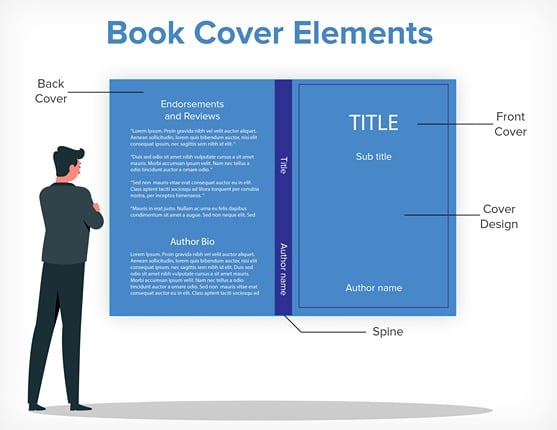
A man looks at an open book cover design with its parts displayed: 1. Title 2. Subtitle 3. Cover Design 4. Spine 5. Author Bio 6. Endorsements and Reviews

1. A riveting title for the book

You may have googled “ideas for book covers” in hopes of design inspirations, but things like the title, the subheading, and author bio are essential parts of a book cover! Take any book cover example: aren’t your eyes drawn to the title first?

Your book title is the first text piece a reader will look at when they stop to consider your book. Obviously, it needs to be cleverly devised.

A title should be easy to read and easy to remember. Remember, you’re designing a cover for potential readers, which means you need to be as direct and straightforward in your title as possible. This gets even more important for a nonfiction book cover.

In a book title, clarity and directness are often as important as wit and intrigue.

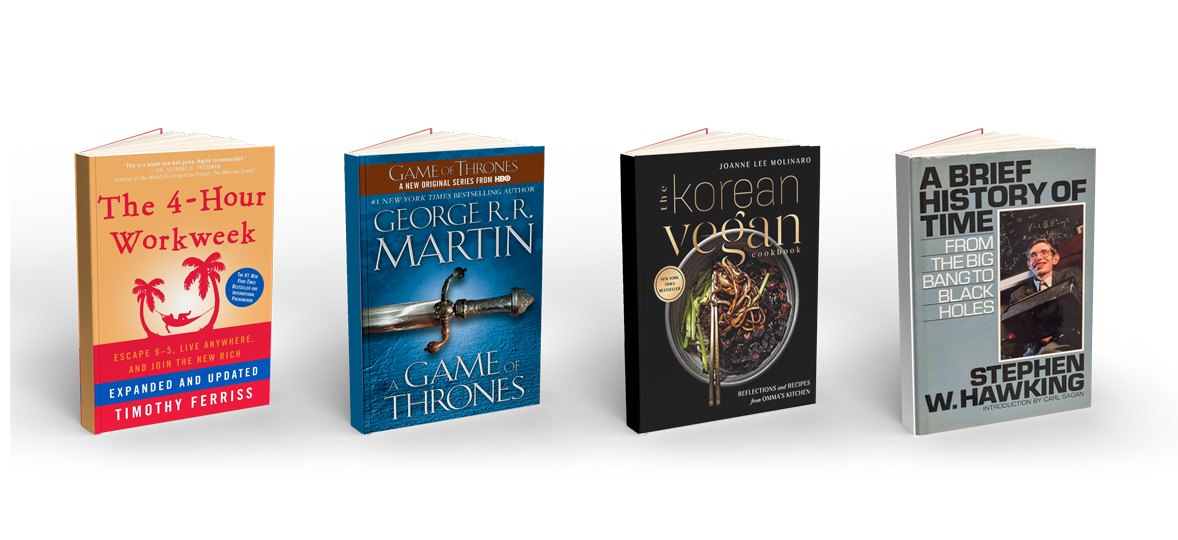
Let’s take a look at some book cover examples:

Four books with evocative titles, namely: "The 4-Hour Workweek", "A Game of Thrones", "The Korean Vegan", and "A Brief History of Time".

2. An evocative subtitle

In the book covers above, do you notice how the title is always accompanied by a smaller line of text? That is the subtitle. It provides additional information about your book through a clear line that complements the book title.

If the title is the hook that draws eyes to your book, the subtitle should finish the job. It should make people want to pick up your book and study it further.

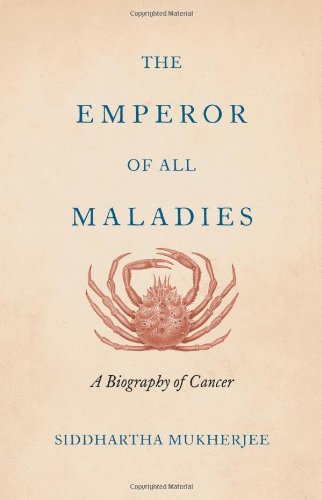
A great subtitle gives more context to an otherwise obscure title and adds some new information to it. In Siddhartha Mukherjee’s The Emperor of All Maladies, for example, the title is intriguing but obscure. It is the subtitle that offers a short but effective clarification, in the phrase “a short biography of cancer.”

The front cover of "The Emperor of All Maladies", where the subtitle reads "A Biography of Cancer".

You can also observe how the subtitles for A Brief History of Time and The Korean Vegan Cookbook provide more information about the books.

3. Interesting typography

Typography is the part of book cover design that highlights your title and subtitle, making them stand out. Great ideas for book covers always translate the central theme of the book through the typography.

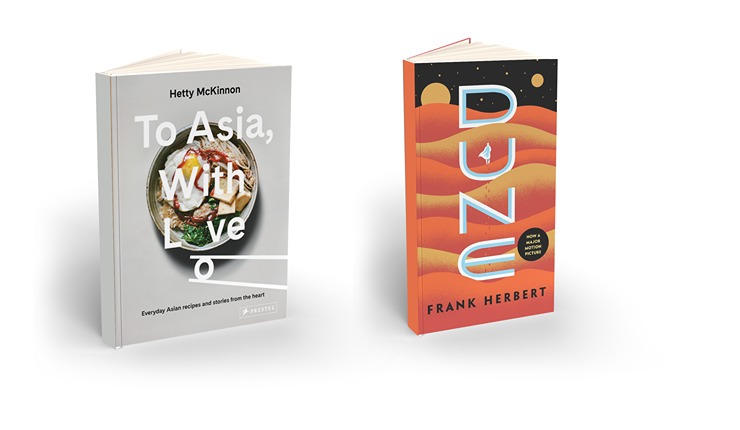
It helps to keep the genre in mind while deciding upon the font and style for your book. Nonfiction and self-help books benefit from a modern font while books in the fantasy genre can afford elaborate fonts. Let’s take a look at the following book cover examples:

The typography of two book covers on display: "To Asia, With Love" and "Dune".

As you can see, words can also be turned into shapes. The mark of a great cover designer is their ability to combine cover art and the words on the cover into one coherent whole.

4. Coherent cover design and layout

Book cover design layout is the perfect blend of typography and imagery, the most important parts of a book cover design. It communicates the single message you want to give your readers when they buy your book. For this, it is crucial that you have a perfect understanding of your target audience. You need to know exactly who you’re selling to, so you can determine how you’ll be selling to them.

A good cover design layout will leave a clear idea of your book in the reader’s mind. Once you know what this idea is, you can decide on colors, images, and font types that complement it. If you’re crafting a mystery, a large, foreboding title with shadowy images is a fairly standard cover prototype. In the case of romances, bright colors and happy images are the way to go. No matter your specific case, you need to make sure that all elements on the cover work together.

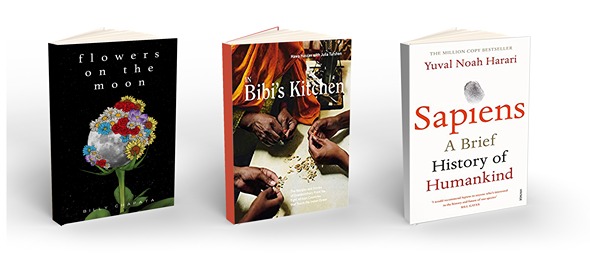
Here are a few self-explanatory examples as to why the following cover design and layouts work in the book’s favor:

Three examples of cover design and layout: "Flowers on the Moon", "In Bibi's Kitchen", and "Sapiens".

5. Endorsements and reviews

In the digital world, reviews and ratings appear right alongside your book’s entry, on any retailing service. But in the case of printed books, you don’t have scores of reviews readily available. Here, reviews are printed over the front and back cover as a mark of quality. 

“Blurbs”, as they are called, go on the front and back of the cover. These are the reviews by prominent critics, authors, or newspapers that help you sell more copies. Positive comments made by these reviewers can be printed on the cover. They act as social proof to validate your book.

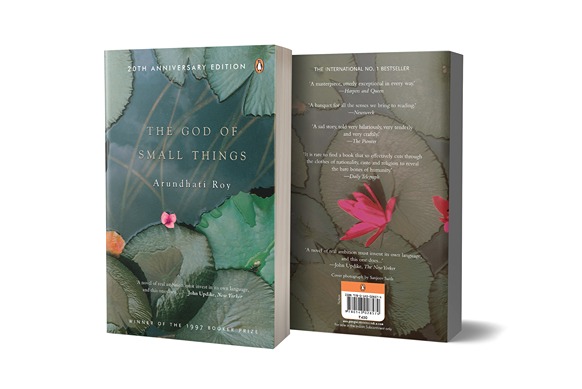
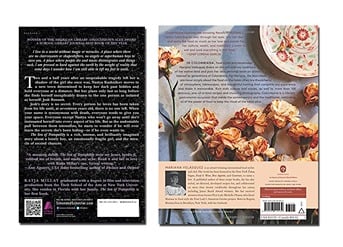
Usually, the shorter reviews appear on the front cover of a book while longer, detailed ones appear on the back. Here’s a handy back cover example:

The front and back cover of "God of Small Things", displaying endorsements and reviews.

6. A well-placed author bio

Whenever they’re looking at a book, readers instinctively want to know the author. The author bio is printed on the back cover to serve this purpose. It tells your future readers about who you are as a writer. It’s usually about three sentences long and is accompanied by information on where the readers can find you online, such as your blog or website address.

What you mention here also depends on your genre. If you’re a fiction writer, it helps to establish an author persona. If your book is nonfiction, you’re better off presenting yourself as an expert in your subject. Mention your credentials and other work in this specific field.

An author bio helps you market yourself and establish an author brand. While selling your book, you’re also selling yourself as a talented writer.

Book back cover examples featuring two author bios.

7. An eye-catching spine

It’s a luxury to have your book extensively marketed and stacked tall in any given bookstore. Sadly, this is not the case for self-published writers. Your book will probably have to share space with its genre rivals on a bookshelf, with only its spine for display. If this small space is to capture the readers’ eyes, it must be striking.

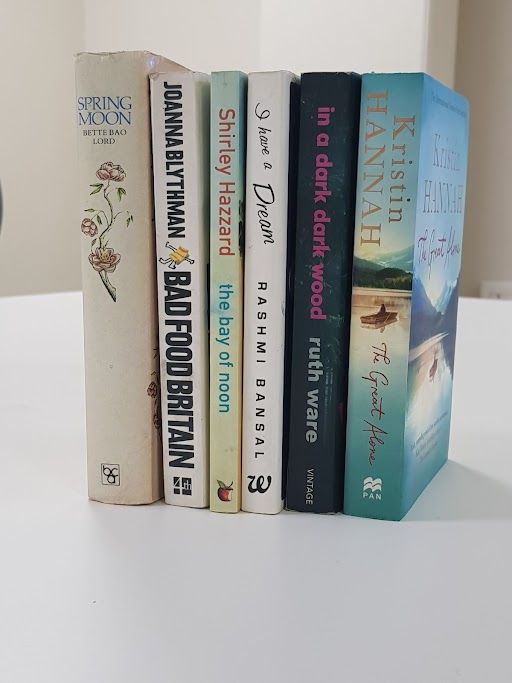
The spine is cohesive with the design and theme of the entire cover. The choice of text here is particularly crucial. Remember, the spine of a book only features the title, the author’s name, and maybe the logo of your publishing company, if you’re going the traditional route.

Here are some interesting examples:

Spines of "Spring Moon", "Bad Food Britain", "The Bay of Noon", "I Have a Dream", "In a Dark Wood", and "The Great Alone".

All the great ideas for book covers use these seven parts to make up one brilliant whole. Be sure to use them well, because having a great book cover design is an essential step to book marketing!

Designing book covers is also included in PaperTrue’s self-publishing services. If you wish to design a book cover, we’d love to help you! Here are some other articles you might find useful: 

7 Useful MS Word Formatting Tips for Dissertation Writing

Have you started working on your dissertation already? If you have, this will help you finish it better. If you haven’t, you’ll get a structured start! Although every university and journal’s style and formatting guidelines are different, there are common formatting options that every student should know and understand. Here are some formatting tips and tricks for writing your dissertation in Microsoft Word.

Get a perfectly formatted and edited dissertation.

1. Use styles to manage formatting

Using styles makes the management of the formatting much more manageable. Styles saves you more time than any other feature.

Styles allow you to dictate groups of formatting.

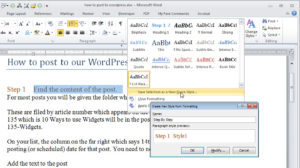
A style is a pre-defined set of formatting specifications that can include both font and paragraph settings.

When you apply a style, Word formats the text according to how the style has been defined.

If you want to apply styles easily, use the Quick Styles gallery.

If you want to work fully with styles, you will need to use the Styles pane.

Be sure that the options under select formatting to show styles are deselected in the Style Pane Options dialog box.

If these are selected, every time you apply direct formatting (for example to make text bold or italic), entries will appear in the Styles pane making it very cluttered.

2. Create an automatic table of contents

Thanks to MS Word, you need not write a table of contents manually! It’s annoying to do it by hand, and if you add stuff and some heading shifts to another page you’re screwed! Edit all of it manually to adjust the new page numbers.

Make use of styles to create a table of content.

Next, you need to create heading as “Heading 1″, Heading 2” etc.. depending on if it’s a heading, subheading, sub-sub heading, etc.

After that:

Go to the “References” tab

Select “Table of Contents”

Click on pre-defined style if you like (otherwise, you can select “Insert Table of Contents…”) and customize the settings.

3. Create templates

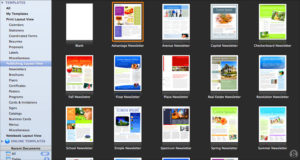
Now that you have the styles and table of contents in place, you need to create a template to use for each chapter of your dissertation. The templates are used to store information about your margins, styles, images, charts, reports and various other elements that make up a dissertation.

Click the file menu

Select the new panel on the left-hand side

Then, double click your desired template from the resulting list of options.

4. AutoSave your document

You absolutely do not want your work to be lost due to a power cut or something. So, configure your file to automatically save. The newer versions of MS word are by default set to this feature, but if you are using an older version, just make sure your file is set to autosave.

5. Use split view feature for easier access

It sometimes happens that you might need to refer to two parts of the same document at the same time. Enjoy referring to a set of points on page 10 while writing a paragraph on page 14.

Use the Split View feature of MS word to avoid going back and forth endlessly to refer to your data. The feature is quite well hidden, and there are two ways to use it.

You can access the “split” button on the “view” tab, or use the tiny black bar you see above the scrollbar. Both will allow you to split your window in 2.

6. Collaborate with others

This is not a formatting tip, but very important for any collaborative effort you take on the dissertation. If you are working with a partner in the study, you’ll probably be exchanging various sections with each other for reviews and comments.

When you do this, use the Track Changes and other Reviewing tools of Word.

Suppose you send the first chapter to your friend for review. Ask your friend to turn the “track functionality” on. Word starts monitoring changes your friend makes to the document.

Another way to do this would be that your friend doesn’t modify anything, but uses the comments functionality to write down her ideas and annotate the document. Then you can make the changes yourself, as per the comments you find worth acting on.

Pick a tool which is convenient for you.  

7. Use equations feature to create neat equations

If you’re writing an engineering or a scientific dissertation, you presumably need to enter quite a few equations. Don’t type them normally. All the formatting usually disturbs their positioning and makes your document messy. Highly not recommended!

Use Microsoft Word’s “Equation” functions. It’s simple, just go to the Insert Tab, then select the Equation function and start typing to include brackets, indices, and fractions to create neat equations. 

There is so much more that can be done with MS Word, but we’ve only included the simpler steps to keep it that way for you. Hope this helps you. If you need any further assistance with formatting and editing services, you can always reach out to us.

Keep reading with more resources from your loyal editors and proofreaders:

White Label Editing and Proofreading Services Explained

Editing companies commonly use white label services to optimize their time and resources. But what is white labeling? How does it benefit the company that provides the product? Let’s find out.

What is white labeling?

White labeling is when a company hires another to manufacture a product, but sells it with their own branding. The client can’t tell if the seller is also the manufacturer, so companies use white labeling to offer a wide range of products and services to their clients.

Take, for example, a grocery store chain that sells a large variety of products under its name. The store doesn’t actually manufacture all these products. Instead, an assortment of smaller companies provide these products and the store simply repackages them with its own brand name. This is white labeling.

White label editing and proofreading is slightly different. Editing and proofreading is a service, so white labeling in this case applies to the service, and not a product.

An editing or content company can outsource editing and proofreading work and hire an editing service. But while selling this service to their clients, they use their own name and branding.

How does white label editing and proofreading work?

Under white label editing and proofreading, a company hires another to handle the core service of editing a variety of documents. Meanwhile, they design the service according to their brand guidelines and company identity.

So what about the company that provides white label editing services? Well, a model like this means a lot for an editing service that hasn’t yet developed a competitive brand identity. For a new company that offers high-quality services but doesn’t have the reach and presence of larger firms, white labeling is an easy way to gain more business.

White labeling also helps editing companies to focus solely on developing their services instead of investing in marketing and promotion.

White labeling: Leave it to the experts!

PaperTrue has worked with an educational consultancy, based in Chengdu, China. Chengdu is a B2C, which means that they get documents from their clients for which they require editing services. They send these documents to us for a polished style and presentation.

Editing and proofreading services like PaperTrue offer white labeling services to new companies who wish to cement their brand presence in the editing industry. This helps companies that have specific but varied needs.

For example, Chengdu requires native English speakers to edit their documents, for which they work with PaperTrue. Similarly, firms who don’t have subject matter experts, or simply enough editors to handle the workload, can end up hiring other editing services.

Why do companies need white label editing?

  1. It boosts brand visibility. If a company offers multiple services and has multiple sets of target audiences, white labeling some of these services is a good way to proliferate brand name. For example, an editing service might accept white label typesetting and offer that to its clients. This improves the brand image and benefits the company.
  2. It strengthens client loyalty. On average, services that provide white label editing make sure to do a good job at it. So, clients come to associate the host company with good quality and return to place orders multiple times.
  3. It saves time and money. Sometimes content companies need expert editing and proofreading for the content they’ll eventually deliver to their clients. In this case, white labeling is less expensive and complicated than maintaining an in-house editorial team! 
  4. It widens the service base. White labeling opens up an array of service options for your editing and proofreading company.
  5. White labeling improves service quality. By choosing experts to work on the niche service a company can’t provide, they choose to offer their clients high-quality work instead of a patch-up job. Where editing is concerned, it’s always better to leave it to the experts!

White labeling allows a firm to stand on the shoulders of talented editors and provide their clients with flawlessly edited documents, all under the name of their own brand. At PaperTrue, we think that white labeling is an excellent option for new editing services. To know more about the kind of work we do, visit our website!

What Are Foil and Stock Characters? Easy Examples from Harry Potter

Characters in fiction come in many shapes and forms. We can divide them into various types of characters, such as round or flat, major or minor, and static or dynamic. But the types of characters we’re looking at in this article are the character foils and the stock characters. We’ve also added a few examples of character foils, so you can understand them better. Let’s get started!  

What are stock characters?

Stock characters are the archetypes you often encounter in fiction, be it the femme fatale, the nerd, or even the hero. Writers have used these stereotypes for centuries, so it’s very easy for us to recognize them as character archetypes.

How often does it happen that you’ve started writing your book, and you notice that one of the characters is far too familiar? Like you know them from some book or movie already.

Though it’s completely an original character you brewed from your imagination, it feels like the Simpsons already did it. That’s a stock character in the making! A couple of them always find their way into stories.

Let’s take the example of Shakespeare: the stock character of the Fool props up in many of his plays, from Twelfth Night to King Lear. When you look at the wisecracking loony character in these plays, it’s easy to be reminded of Luna Lovegood from the Harry Potter series!

Archetypes are formed when people in different books and plays are formed from the same elements of character. Someone who embodies the elements of bravery, justice, and kindness becomes the hero, while the cowardly, cruel tyrant becomes the villain.

Character archetypes like the hero, the villain, the damsel in distress, and—as seen above—the fool, are known as stock characters. They form the stock of people that you can easily expect to find in any given story, be it a play, a novel, or even a movie.

Often, stock characters do not change during the course of a story. They also often form the minor characters in a story.

Stock characters gained popularity through the Commedia dell’ arte style of theater. The audience of these comic plays was quickly able to identify each character based on similar characters in previous plays. The longstanding tradition persists today in sitcoms, where a specific group of stock characters is always present.

What is a character foil?

Writers mainly rely on characters to create conflict. To achieve this effect, they often create a character who is the polar opposite of the protagonist. This character is known as a foil.

However, unlike the antagonist, who is the opposing force to the main character, a foil does not always play a negative role. A foil character serves as a contrast to better highlight the protagonist’s qualities.

Often, an antagonist’s characteristics are easier to play off against the main character. This is the reason that antagonists are often foils of the main character.

Let’s consider a simple example: if one of your characters is Positive Peter and his best friend is Negative Nancy, then Nancy is a foil to Peter. Nancy is the opposite of Peter, but she’s his best friend, not an enemy.

Foil characters share few or no values or traits with the main character. This allows for interesting types of character relationships to emerge.

Using foils is the easiest of literary plot devices. You simply put together two contrasting characters who highlight each other’s character traits. The most common foil characters are heroes and villains, whose goals and values are opposite to each other.

A famous character foil example is that of Watson in the Sherlock Holmes stories, whose ordinary foresight serves to highlight the genius of Holmes. You will also find many foils in Shakespeare. For example, the skeptical Mercutio in Romeo and Juliet is a clear foil to the emotional Romeo.

Why are foils important?

There are three reasons why foils are important in a story:

  1. Foils establish the protagonist as central to the story.
  2. They accentuate the protagonist’s traits and motivations.
  3. They help separate the good from the bad, the ideal from the undesirable, in a given story.

Can there be more than one character foil? 

Yes, many works of literature have more than one set of foils.

There can be multiple characters that foil each other or simply many sets of foil characters for the major characters in a story. This tends to happen more in longer stories. Book series and TV series often feature many characters that foil each other.

Foils in the Harry Potter series

Harry Potter and Draco Malfoy are pretty much textbook examples of foil characters. They have a lot in common: They both study at Hogwarts, are the same age and gender, and play the same position on their respective Quidditch teams.

But beyond these surface similarities, they are polar opposites. Harry adores Dumbledore while Draco grows up idolizing Voldemort. The former cares deeply about those he loves, while the latter only cares about himself. Harry is strong while Draco is weak.

Harry’s maternal cousin Dudley Dursley is another foil to him. Dudley is pompous, arrogant, and greedy, everything that Harry isn’t. Vernon and Petunia treat Harry poorly, while they spoil Dudley endlessly.

Note that even if Dudley is a foil to Harry, the antagonist of the story is Draco Malfoy. So, foils can come in many different variations.

Now that you have a clear idea about stock and foil characters, you can employ them in your next story. We can hardly wait for the manuscript to arrive on our story editor’s desk!

No matter foil or stock, all types of characters need great dialogue. So go ahead and read up on how to write powerful dialogue in your story!

Here are some related articles that you might find interesting:

News Update: We Had a Contest, and Here Are the Results

The PaperTrue office is usually always a celebration of your work. But we decided to take it up a notch by holding a contest for you – our people. 

After working on editing your novels and books, it is very exciting for us to actually see your book on its way to becoming the next bestseller.  But alas, what if marketing is not your forte? Lucky for you, PaperTrue is still at your side – so that you’re not so swept up in the romance of writing that you actually forget to spread your words!

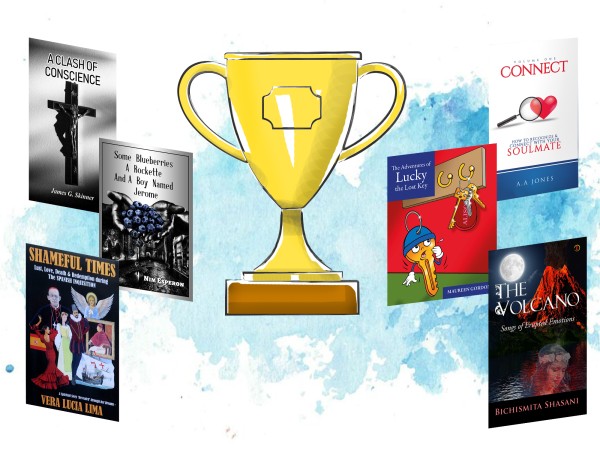
In that spirit, some nice folks here suggested that we – as your editors – should also be part of the post-editing marketing process. So, a few weeks ago, we sent out an email requesting entries of those who to be a part pf this initiative. And to make it a bit more fun, we added a bit of competition: we would choose our top five picks and give them a shout-out on our social media platforms. 

And thus, the Great Shout-Out Contest of 2019 was born. 

Needless to say, the office was bustling with excitement as we set off to scour our archives of the last one and a half years. After some mundane data search (well, we are human after all), we went to your editors and senior editors to find out the reason they are happy to come to work every day. 

Of course, literature is subjective, but our dedicated editors spent their blood, sweat, and tears defending your work – just as they always do. And now we’re very excited to announce our top picks!

(Now, we know we said top 5, but you’ll notice there are 6 entries here. You see, we just couldn’t resist your good work!)


1. “Some Blueberries, A Rockette, and A Boy Named Jerome” by Nim Esperon

Love. Pain. Redemption. Identity. These are human complexities that take a lifetime to understand. But 23-year-old Nim Esperon decided to take these heavy ideas when he decided to pursue his dream of becoming a published author. Meet Franklin Amzi – detective, husband, future father – as he pursues what turns out to be perhaps the most important case of his life. This is a mysterious cold case from 25 years ago, and it’s sure to cause a storm in his life. At this point also enters Ms. Lana, who makes him question everything he has ever known in his life. This is a story of dual explorations of history: of the case, and of his own. 

Here’s what Nim’s editor had to say about working on “Some Blueberries”: “Nim Esperon’s novel stood out to me right from the first page because of its distinct voice and vivid detail. It was a pleasure to read!”

Sounds pretty exciting, doesn’t it? Go get your copies now! 

You can also follow the author on Facebook, Twitter and Instagram


2. “Adventures of Lucky and the Lost Key” by Maureen Gordon 

How often have you stopped to think about how important keys are in your life? In this adorable children’s book, we meet Lucky, one of the millions of keys that get lost far too often. But in the midst of all the “losing”, he also realizes how truly special he is. No matter how many times he gets lost, he will always be missed. And more importantly, he will always be found. Delve into Lucky’s adventures as he discovers his true purpose.

A person with an eternal enthusiasm to help people, Maureen Gordon has explored many forms of writing. A social worker and counsellor by profession, she primarily works in the social care and education sectors. She can be found on Facebook and Instagram.

Her book is available both as a paperback and as an e-book.


3. “Connect: How to Recognize and Connect with your Soulmate” by A.A. Jones

Love always feels like a great mystery. It is thrilling, daunting and euphoric.

But not for A.A. Jones, who, like a true romantic, explores the nuances of relationships in what he promises for us to be a different perspective. He is calm and elegant as he deals with the heavy task of understanding the path to recognizing one’s soulmate.

A.A. Jones is an international speaker, relationship expert, and a relationship counsellor. The central theme of his message is focused on intrinsically repositioning people to enable them to find true fulfillment in life. You can follow his work on Facebook.

Kindle users: get, set, ready to go get your copy now!


4. “Shameful Times – Love, Lust, Redemption during the Spanish Inquisition” by Vera Lucia

As we speak of the idea of exploring ourselves through history, it would be a shame not to mention this book. In a touching romance between Isa, a farmer’s daughter, and Gutler – a court nobleman, Vera Lucia explores the phenomenon of an afterlife, and the idea of how we carry ourselves through generations and lifetimes. In this book, she dares to reinterpret the horrors of the Spanish Inquisition.

Pat, her editor says, “The novel draws its strength from its intricately drawn characters and its meticulously constructed theme which lets the author explore some rich complexities and profound contradictions. A thoroughly intriguing read!”

Vera Lucia Lima is an international psychic author, with a penchant for vividly expressing her psychic dreams and exploring spirituality. Vera can be found on Twitter as @327vera

You can get your copy of “Shameful Times” here, and follow the book on Facebook as well. 


5. “A Clash of Conscience” by James G. Skinner

James Skinner’s rivet book starts off when Jenny, an English teacher, takes up a job offer in 1976 Tehran. She steps into a whirlwind of a life, as she meets Juan Miguel, a Spanish diplomat, also a fellow foreigner. For the next two decades, they are inseparable: with an epic’s worth of highs and lows in their lives. And then, tragedy strikes: Juan slowly develops Alzheimer’s disease, and the couple returns to his home town in Galicia, northwest Spain. Juan is eventually confined to home.

Meanwhile, Jenny has met and befriends Ramon, a young social worker that is dealing with their case. The inevitable occurs. They become passionate lovers. 

How will Jenny reconcile her past with her present? 

What started out as a romantic thriller eventually becomes an exploration of passion and guilt: two seemingly paradoxical facets to the human condition. 

There’s a lot to delve into here, and you really don’t want to miss this one


6. “The Volcano” by Bichismita Shasani

Hailing from Dhenkanal, India – the country of love and spirituality – Bichismita took to writing as a means of seeking refuge in tough times, which later on turned into her greatest passion. Her book “The Volcano” is an anthology of poems born of an uncontrollable eruption of human emotions. These poems collectively express the long-suppressed painful voice of a heart that the world never heard, the tenderness of tearful eyes that the world never saw, and the promises that the world never kept.

If soulful poetry is your kind, then you will definitely want to look out for this one.

Although she is most easily found via email, you can also catch her on Facebook.

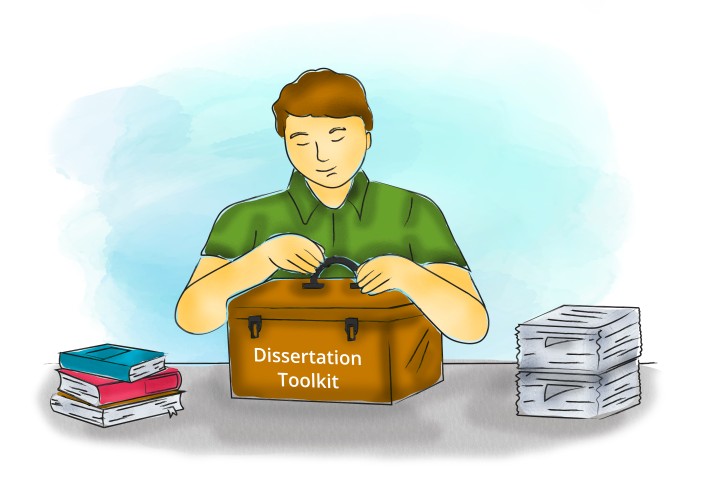
The Only Dissertation Toolkit You’ll Ever Need!

The college experience is multifold and defined by so many experiences. But one of the most important parts of life at university (whether or not you like it) is finishing up your dissertation. 

Now, you could cram all your work just days before it is due, or you could space it and ace it like a boss!

The internet is booming, so this means that the resources used to write an A grade thesis are more accessible than ever! Here’s our curated list of resources that you should keep coming back until the day your hard-bound book is in your professor’s office. 

#1: Mind Mapping Apps

The beginning is the hardest. It’s a cliche, yes, but only because it’s true. Once you’ve found your jam, your life is a lot easier. But until then, your head is going to be a jumble. So, first things first, get your literature review sorted. They say a good beginning is half the work done…in academics, that beginning is a lit review. 

Since there’s a lot of organizing involved, mind maps are a wonderful way to start. There are lots of cool ones on the internet, including XMind, FreeMind and Mindmaple

While mindmaps help you narrow down what you want to write about, they also help you structure your thesis itself.

#2: Google Scholar

As the name suggests, it is Google for academic works. While it will take a little more time for you to access journal articles and books on a regular Google search, Google Scholar is an archive of the same information that is presented to you quickly as it filters out other random web pages that are on the radar of your keywords. 

It’s totally free, and accessible to anyone who has Google. 

#3: Microsoft Office

MS Office is undoubtedly one of the most efficient sets of tools to use while preparing information. Extend that to your thesis as well! You can write (duh!), create tables and diagrams, make presentations, and so on. 

Using MS Office is so obvious, it should have been at the top of our list. 

If you have a MacBook (or you just like working online), then Google Docs is also a pretty great option. 

Pro-tip: Work online, so you don’t have to worry about losing stuff. 

#4: Mendeley

Developed by Elsevier, Mendeley is a reference management software that helps you in citing your paper – it generates citations depending on the format that you are using. What even cooler is that Mendeley also lets you manage your literature! You can save and study your papers within the app itself. Mendeley helps you manage all your material in one place! 

#5: Paperity

On their website, Paperity describes themselves as an aggregator of open-source journals. This means that you don’t have to burn a hole in your pocket to carry out good research. Unlike aggregators like JSTOR and Taylor & Francis, you don’t have to pay exorbitant sums of money to access literature in your field. 

With resources and 8,300 resources and a welcoming attitude towards research, there’s little that could go wrong with Paperity.

#6: Canva 

Turns out, Canva has many uses apart from helping you design your local movie screening. With hundreds of built in templates, you can use Canva to design illustrations and diagrams that your dissertation needs. If you don’t have any (yay!), use them to give your presentation the aesthetic appeal it deserves. 

#7: Evernote

Note-taking is very important in writing a good paper. It is a step that is with you every way of the process: from brainstorming to writing the conclusion of your paper. If mind maps help you plot your trains of thought, then notes help you flesh them out. Evernote is an incredibly reliable app to do just that, and you can connect it to your email so you can access your notes wherever you go. Just had a genius idea in the bus? Just open up Evernote! 

#8: LaTeX

APA, MLA or Chicago? How on Earth is a person manually supposed to remember all the differences? 

When your mind is preoccupied with revolutionary ideas, technical things like formatting are last in your mind. That’s when LaTeX should be your ally. It is an automatic way to get your dissertation down in the format you desire. Aside from regular formatting, it is also one of the most reliable citation generators.

Some other things to remember, offline or online

Self-care is super important! This is something you don’t want to skimp on, EVER, lest you drown yourself in the complication of your research. It is, after all, an important part of your life – you’ll be writing, re-writing, editing and proofreading your dissertation constantly – but make sure that you take breaks from time to time. Have a hot mug of tea, read a nice non-academic book in your bath, and go out with friends. Do whatever you must to keep yourself sane in this time. 

Once you’re done, you can also check out our post about the final checklist you should refer to make sure you’ve checked off all the steps in the thesis writing process.

Now, go. Conquer the world with flying colours! With the combination of this toolkit and self-care on your team, you’ll be indestructible in the academic world.

How to Copyright Your Book?

If you’ve thought about copyrighting your book, you’re on the right path.

Explore more