Newsletter Sign Up

Farther vs. Further: What’s the Difference?

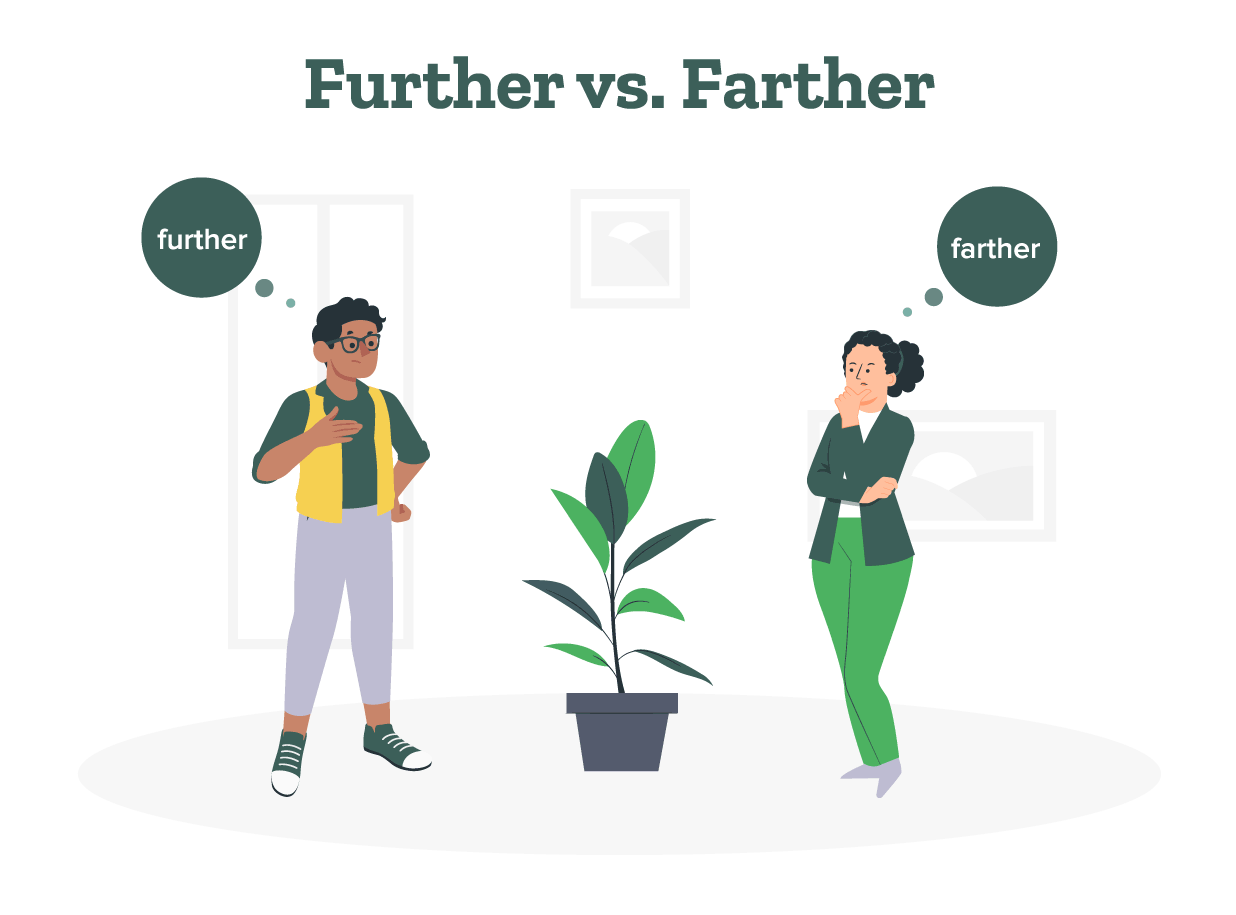
Further and farther are both used to indicate more distance. This similarity creates confusion about whether to use further or farther. However, there’s a slight difference between farther vs. further. In this article, we’ll explain how the meanings of further and farther differ with the help of specific examples. 

We’ve also explained when to use farther and further. With this, we’ve also clarified whether to use further or farther in well-known phrases. So let’s get started! 

Difference between further and farther 

Further means a greater distance but doesn’t refer to physically how far the distance is. It’s used in a non-literal, figurative, and symbolic way to show distance. In such cases, further is an adverb, describing the action in the sentence. 

He went further down the road. (adverb) 

She went further away from him. (adverb) 

The word further also has another meaning. Further also denotes the advancement or progress of something. Further, in such cases, shows the action and is the verb. 

She wished to further her ambitions through his influence. (verb)

He had to go to France to further her special assignment.  (verb) 

The word further also can mean more, additionally, or beyond something. 

To understand the concept further, he read more books. (adjective)

He gave further guidelines to ensure safety. (adjective) 

The word farther means a greater distance in literal, physical terms. Farther, in these cases, is an adverb. Here are some examples for clarity: 

He drifted farther away from the Hawaiian islands. (adverb) 

The astronauts traveled farther into space, beyond the Milky Way galaxy. (adverb) 

These further vs. farther examples clearly show the difference between farther and further.  However, further and farther are also used in various phrases while communicating. Dive deeper to understand whether to use farther vs. further in various phrases! 

Further vs. farther examples 

1. Further away or farther away

Both these phrases are correct but their usage differs. Use further away to show symbolically how something is far. If you want to express the physical distance, use farther away. 

He went further away from him. 

The post office was farther away from the village. 

2. Further along or farther along

Both further along and farther long are used as phrases, depending on the context. If there is no reference to the physical distance, further can be used. If the physical distance needs to be defined, farther can be used. 

Further along her career, she will receive many good opportunities. 

Farther along the road to Niagara Falls, Sonya saw something strange. 

3. Further or farther from the truth

Both further from the truth and farther from the truth are used worldwide. However, further from the truth is widely considered the appropriate answer. The reason for this is that truth is an abstract, subjective concept that cannot be physically measured. 

She realized that she had gone further from the truth

I know that I am not further from the truth

4. Further away or farther away 

Both further away and farther away can be used to show how something is at a greater distance from another object/person. However, further away is used to show symbolically how something is distant. In contrast, farther away is used to depict how something is physically distant. 

He went further away from the anonymous parcel. 

She drove farther away from the Great Wall of China. 

5. Further out or farther out 

Both further out and farther out are considered correct, but have slightly different meanings. While further out means that something is far metaphorically, farther out means that something is at a greater distance physically. 

She explored further out into the Amazon forests. 

The horses rode farther out into the Rocky Mountain National Park. 

6. Moving further or farther 

While moving farther refers to distancing oneself physically from someone or something, moving further denotes going ahead figuratively. For example: 

She was moving further away from the catastrophe. 

They were moving farther away from the Leaning Tower of Pisa. 

7. Further behind or farther behind 

Further behind is used to show a greater distance at the back of something, metaphorically. In contrast, farther depicts how something/ someone is physically far from something. 

He was left further behind in the race. 

The horse Confidence Game fell farther and farther behind in the Kentucky Derby. 

8. Farther vs. further time 

Further time is widely accepted as the correct phrase. The reason is that time is considered as an abstract concept. Let us see some farther vs. further examples. 

He planned to have lunch with her at some further time

We need further time to take the decision. 

9. Look no further vs. farther

The appropriate phrase is look no further. This is because, look no further symbolically denotes a greater distance. It means something that is exactly what someone desires. This phrase doesn’t refer to the physical distance between someone/ something. 

If you’re searching for a romantic vacation, look no further than Venice. 

If you wish to explore the English countryside, look no further than Cheshire. 

10. Go further vs. go farther 

Though both phrases go further and go farther can be used, there is a slight difference in meaning. While the phrase go farther refers to a greater distance metaphorically, go further means a longer distance in literal, physical terms. Go further also means taking a bigger step forward and advancing in something. Here are some examples to make the meanings more clear: 

He would like to go farther, towards Mount Fuji. 

She decided to go further than the base camp of Mount Everest and complete the trek. 

They decided to go further with the Russian deal and finalize the payments. 

11. Step further vs. Step farther 

Both phrases step further and step farther are correct. However, step further is more commonly used. 

He took one step further and destroyed all documents that could implicate him. 

They went a step further and invited Irene to their home. 

12. Further up and farther in 

While both phrases indicate a greater distance, there is a slight difference. Further up means at a higher point, near the topmost point. In contrast, farther in denotes going deeper into a place. 

He climbed further up and reached the peak of Mount Elbert. 

Farther in, there were ancient relics in the Mayan caves. 

When to use further and farther

Further can be used when you don’t want to mention the physical distance, instead, you only want to convey that something/someone is far. You can also use further to show progress or refer to something extra. On the other hand, you can use farther when you understand the physical distance and wish to communicate this distance. 

A simple trick to remember the difference between these two words is to keep in mind the first three letters of “farther.” Since “far” is used to describe physical objects, remembering this difference will help to determine whether to use “further” or “farther”. 

We’ve traveled far but we’ve to travel farther still, deeper in Asia. 

We hope this article has dispelled all your doubts about further and farther. You can save this article and revisit it if you’re ever confused about whether to use farther or further! We’re always ready to help you clear your concepts and prevent common grammar mistakes

As experts who provide professional editing services, we realize that there are many commonly confused words in the English language. To help you avoid making any errors, we’ve curated the following list of resources: 

MLA Annotated Bibliography | Guidelines and Examples

A crucial aspect of academic writing is listing all the texts you have referenced throughout your paper. In an MLA-style document, this is typically done in the Works Cited section and in-text citations. However, some papers call for a more detailed list of sources, called the MLA annotated bibliography.

So, what is an MLA-style annotated bibliography and when should you include one? We’ll answer both these questions and get you familiar with how to write an annotated bibliography in the MLA style.

What is an annotated bibliography in MLA 9? 

An MLA annotated bibliography is a list of sources with a summary for each entry, in addition to the standard text and publication details. Unlike a Works Cited section, the purpose of an annotated bibliography is to provide context for the inclusion of a particular source. The accompanying note establishes a source’s relevance, credibility, or contribution to the research topic that the paper explores. 

An MLA format annotated bibliography may include additional sources that aren’t referenced in any in-text citations in your MLA-style paper

When can you use an annotated bibliography? 

While annotated bibliographies are not mandatory according to the official MLA 9 guidelines, there are many contexts that call for one. 

  1. Literature reviews: Writing annotated bibliographies is an excellent way to explore a new research topic. In addition to helping you keep a meticulous record of all your reference material, it compels you to read each source more critically and map out how its core talking points relate to your thesis statement. 
  2. Aid for future research: An annotated bibliography also helps evaluators and other researchers understand the scope of the study better. Your notes will guide readers and give them a comprehensive overview of the research done in your field and how it can be taken forward.

Annotated bibliographies can be included in research papers, essays, and longer works like dissertations and theses. If you’re unsure about whether you should include an annotated bibliography in your MLA paper, consult your instructors or the prescribed guidelines. 

MLA annotated bibliography format guidelines

Follow the guidelines below to style an MLA annotated bibliography:

  • Start the annotated bibliography on a new page, after the Works Cited section. 
  • Title the section “Annotated Bibliography” or “Annotated List of Works Cited”.
  • Follow the reference style format for MLA citations provided in the 9th edition handbook.
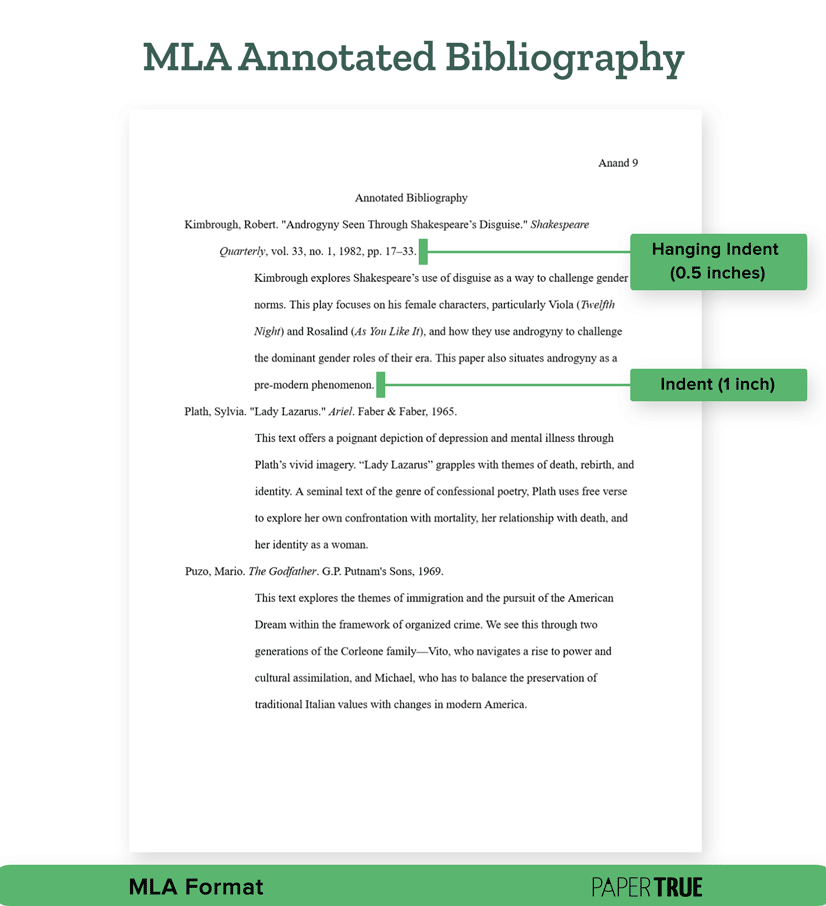
  • Start the annotation directly below in the next line, indented 1 inch from the first line of the entry. 
  • Describe the source in succinct phrases or short sentences. 
  • If required, add a brief evaluation of the source, explaining its relevance to your research.
  • Avoid including minor details, evidence, quotes from the source, and detailed breakdowns of the source’s arguments.
  • Organize the annotated bibliography alphabetically by the name of the title or author.

Here’s an example of an MLA annotated bibliography:

A template showing the MLA 9th edition annotated bibliography.

While these are general guidelines listed in the MLA 9th Edition Handbook; you may need to take note of minor variations asked of you in your university or publication’s guidelines. If you’re unsure of any aspect of styling and formatting an annotated bibliography, consult your instructor.

MLA annotated bibliography examples

Let’s take a look at some MLA annotated bibliography samples.

1. Book 

This is an annotated bibliography example in the MLA format for Mario Puzo’s novel The Godfather

Puzo, Mario. The Godfather. G.P. Putnam’s Sons, 1969.

This text explores the themes of immigration and the pursuit of the American Dream within the framework of organized crime. We see this through two generations of the Corleone family—Vito, who navigates a rise to power and cultural assimilation, and Michael, who has to balance the preservation of traditional Italian values with changes in modern America.

2. Poetry 

Here’s an annotated bibliography MLA example for Sylvia Plath’s 1965 poem “Lady Lazarus”. 

Plath, Sylvia. “Lady Lazarus.” Ariel. Faber & Faber, 1965.

This text offers a poignant depiction of depression and mental illness through Plath’s vivid imagery. “Lady Lazarus” grapples with themes of death, rebirth, and identity. A seminal text of the genre of confessional poetry, Plath uses free verse to explore her own confrontation with mortality, her relationship with death, and her identity as a woman.

3. Research paper 

Kimbrough, Robert. “Androgyny Seen Through Shakespeare’s Disguise.” Shakespeare Quarterly, vol. 33, no. 1, 1982, pp. 17–33.

Kimbrough explores Shakespeare’s use of disguise as a way to challenge gender norms. This play focuses on his female characters, particularly Viola (Twelfth Night) and Rosalind (As You Like It), and how they use androgyny to challenge the dominant gender roles of their era. This paper also situates androgyny as a pre-modern phenomenon. 

Now that you’ve understood how to write an MLA annotated bibliography, it’s time to ace your paper. As providers of expert paper editing services, we want you to achieve your ultimate potential. Here are some resources that’ll help you do just that:

How to Create an MLA Header | Format Guidelines & Examples

Like many other formatting styles, the MLA style requires headers to be included on every page. An MLA header focuses on authorship, so the header format contains the author’s name(s) and page numbers.

In this article, we’ll be exploring guidelines around the MLA header format, how to create one, and sample headers. Without further ado, let’s get started!

What is an MLA header? 

The MLA header is a line of text above the contents of every page in your MLA-style paper. It contains the author’s last name and the page number. The MLA format header is a mandatory element of MLA-style academic writing and must be present on every page (except the MLA title page, if you have one).

The MLA header helps your readers easily track the page numbers of your paper. It is also known as an MLA running head. 

Note: An MLA paper header is not the same as a heading.

MLA header format guidelines 

Crafting MLA-style headers requires precision and attention to detail. In this section, we will provide detailed guidelines to format your paper.

Follow these steps to format your MLA format header:

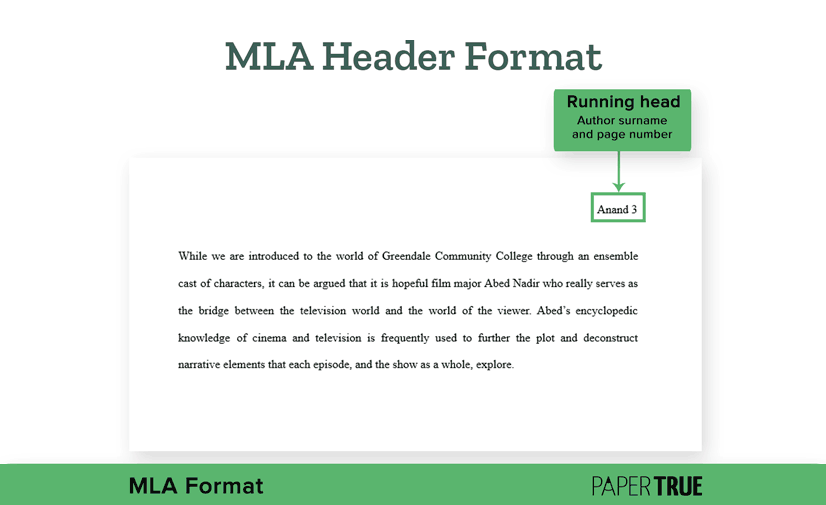
Include the author’s last name(s) followed by the page number after a space.
(Example: Hume 24)

  • Write your page number in Arabic numerals, starting with “1” on the first page of the paper body.
  • Do not include any punctuation marks in the header. 
  • Place your header in the top-right of the page. 
  • Leave a margin of 0.5 inches (1.25 centimeters) from the top and right side of the page, as shown in the infographic below. 
  • Maintain the same font style and size you’re using in the rest of the paper. (This is usually 12-point Times New Roman.)

MLA header with a last name and page number included on the top right corner of the page.

MLA format header for more than two authors 

The official MLA Handbook does not prescribe detailed guidelines for how headers are written in papers with multiple authors. We’ve compiled some commonly used guidelines that you can consider while creating your header.

MLA header for two authors

If you’re writing your paper with someone, your header must contain both your names followed by the page number. For example: 

Hume and Bachchhav 24 

Separate your names with the conjunction “and”. Avoid the use of ampersands (&). 

MLA header for three or more authors 

If you’re working on a group project or a paper with three or more authors, you can list only the surname of the first listed author of the paper, followed by “et al.” and the page number. For example, the header for a paper written by Hume, Bachchhav, and Scott will look like this: 

Hume et al. 24

Another acceptable header format for a paper with more than three authors is to list down all the authors’ last names, provided that your header doesn’t become too long. Here’s one such MLA header example: 

Hume, Bachchhav, and Scott 24 

Since there are multiple commonly acceptable variants of MLA format headers, you should consult your university’s style guide and get clarification from your instructor. You can also look for an MLA header example in papers that your peers or seniors have written. 

How to create an MLA style header 

Popular word processors like Microsoft Word and Google Docs come with built-in features that let you format MLA-style papers. This makes it quite easy to format MLA-style headers. In MS Word, you can create a header under the “Insert” menu.

  1. Double-click the top of the page.
  2. Click the “Insert” menu in the toolbar.
  3. Click “Page Number”, hover over “Top of Page”, and click “Plain Number 3”.
  4. Enter your last name along with the page number, both right-aligned

Now that you know how to format an MLA running head you can write your paper with confidence. If you’d like to keep reading about the MLA style, here are some more resources:

How to Create an MLA Title Page | Format, Steps, & Examples

If you’re writing an MLA-style paper for your class, you may need to include a title page or a cover page before the body. While the official MLA 9 Handbook does not mandate a title page, you should include one if your professor asks you to or you’re working on a group project.

In this article, we’ll break down the MLA format title page (also known as an MLA cover page). It’s always easier to just learn from samples, so we’ve included some great MLA title page examples!

When to use an MLA title page

An MLA title page is usually required for formal research papers, essays, and other academic assignments. It is also used while writing dissertations, graduate theses, and other extended works. A title page in the MLA format may not be necessary for shorter assignments or in-class essays. 

If you’re unsure about whether your assignment needs an MLA cover page, consult with your professors or check your university’s guidelines.

What goes in an MLA format title page 

An MLA format title page typically includes the following elements: 

  • Author’s name 
  • Professor/instructor’s name
  • Course name 
  • Title of the paper 
  • Date of submission 

For bigger projects or papers that you plan on submitting to journals, you may also need to include your university’s name on the title page. Just to be sure, it’s advised that you check the journal’s submission guidelines for a detailed list of elements to include in this section. For reference, you can also look up samples or check the publication’s previous editions.

MLA title page formatting guidelines 

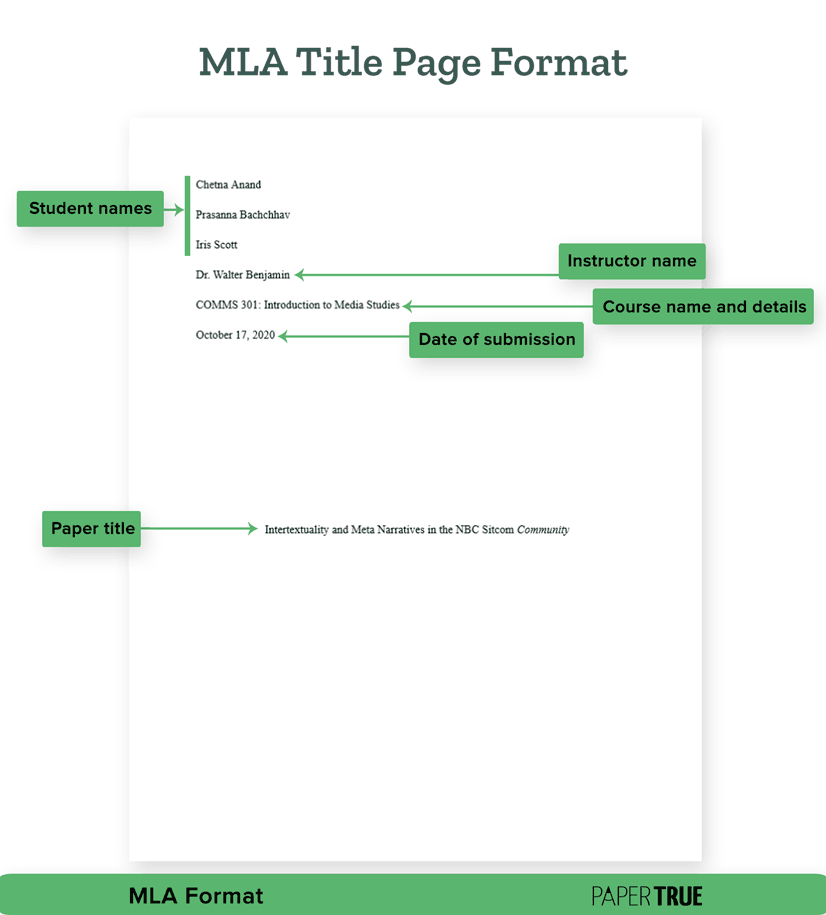
The MLA Handbook specifies important formatting guidelines you must follow while creating a title page. Refer to the guidelines below while writing your MLA cover page:

  • Double-space all the elements on the title page.  
  • Do not include a header on the title page. 
  • Use the same font type and size you have adhered to throughout the paper (preferably, 12-point Times New Roman).
  • Align each element (except the paper title) with the left margin. 
  • List the information in the following order: 1. Author’s name 2. Instructor’s name 3. Course name and details 4. Date of submission 5. University name
  • If there are multiple authors, list each of their names in separate lines. 
  • In the center of the page, center-align the title of your paper. 
  • Use the title case while writing the title of your paper. 
  • Italicize names of media such as books, films, and TV shows. 

An MLA Style paper with labels indicating different formatting guidelines under the 9th edition.

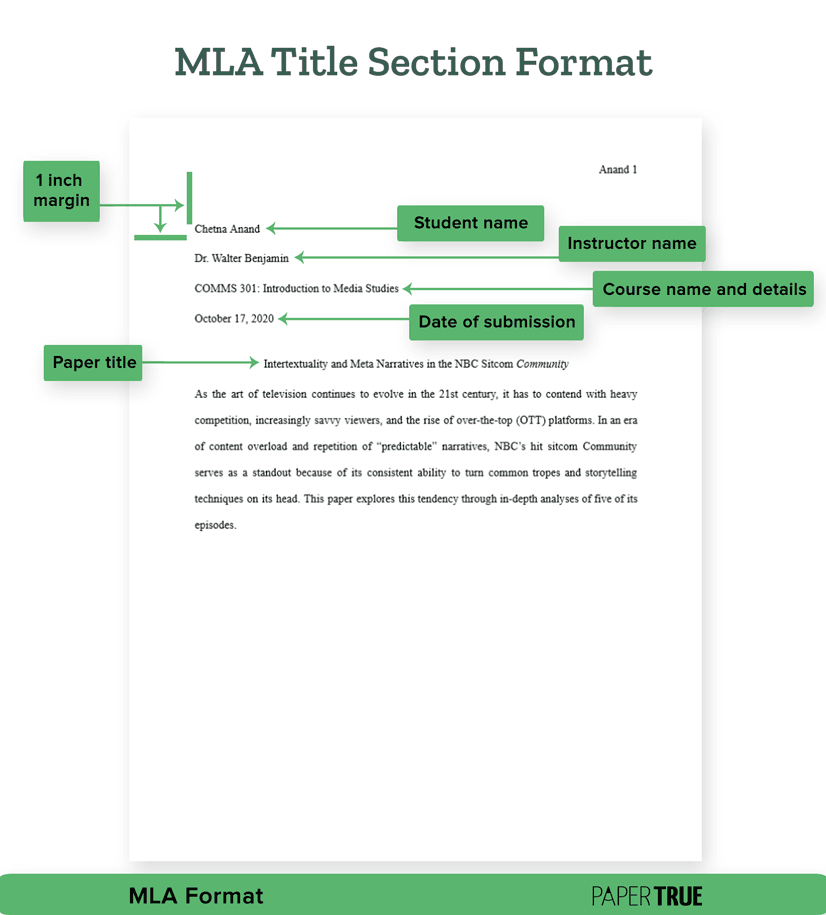
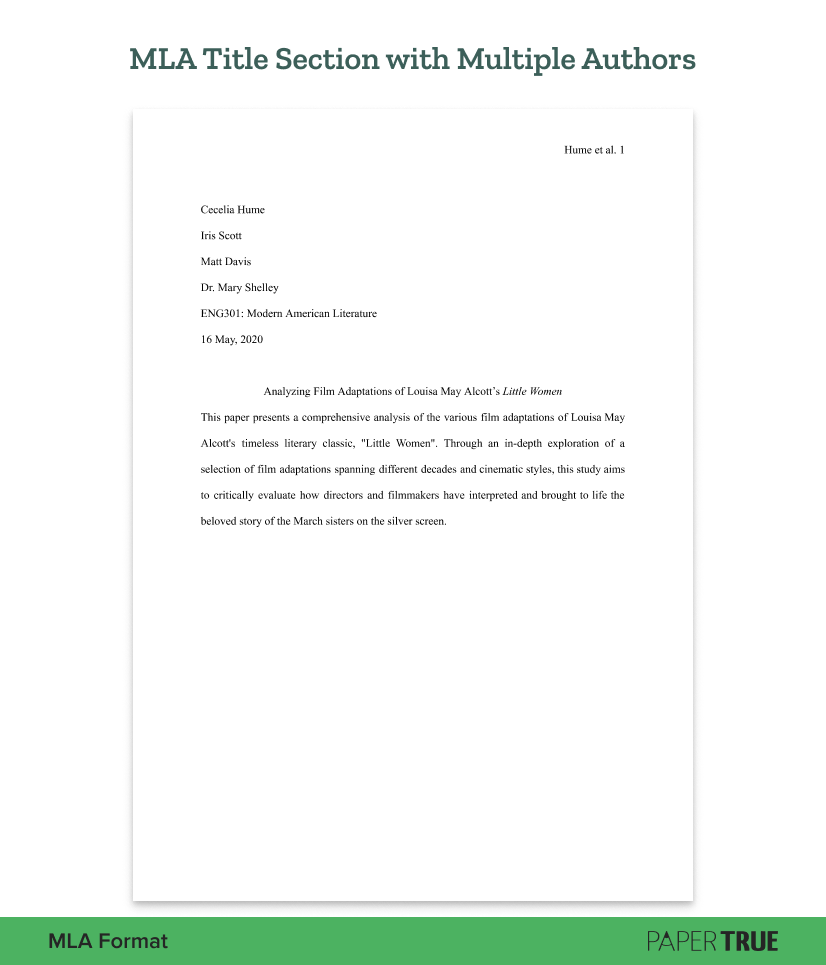
If you don’t need to include an MLA cover page, you will have to include a title section in the top half of your paper’s first page. The formatting guidelines for this are largely the same as the title page, except that the title is center-aligned in the line following your name and credentials.

Since this is the first page of your paper, you’ll have to add an MLA header in the top right corner of the page. Here’s how the page should look:

An MLA Style paper with labels indicating different formatting guidelines under the 9th edition.

How to create an MLA title page on MS Word 

Students no longer have to manually format their academic papers and can rely on the blessings of Google Docs and MS Word. These word processors come with built-in templates that automatically format documents according to the MLA style. You can use these features to format your title page as well as the rest of the research paper. 

Follow these steps to write a title page in MLA format: 

  • Launch Microsoft Word and open a blank document. 
  • Under the “File” menu, click on the “New” tab. 
  • Use the search bar and type “MLA” to find a sample template. 
  • Select the template that corresponds to your document type (research paper, essay, etc.). 
  • Check the preformatted document to see if it largely matches your university or department’s style guidelines. 
  • Replace the placeholder text in the document with your paper’s information. 
  • Cross-check what you have with your guidelines once again and fill in additional details that the template may have missed.
  • Save your document and continue to add the rest of your text. 

MLA title page examples 

The guidelines we’ve laid out give you a general overview of the MLA title page format. Whether you’re working on a paper, essay, dissertation, or journal article, you will be required to adhere to these conventions. 

The format required of you may vary from the standard MLA cover page depending on the university guidelines or submission rules. To make it easier for you, we’ve put down some MLA title page examples that you can refer to while formatting your paper. 

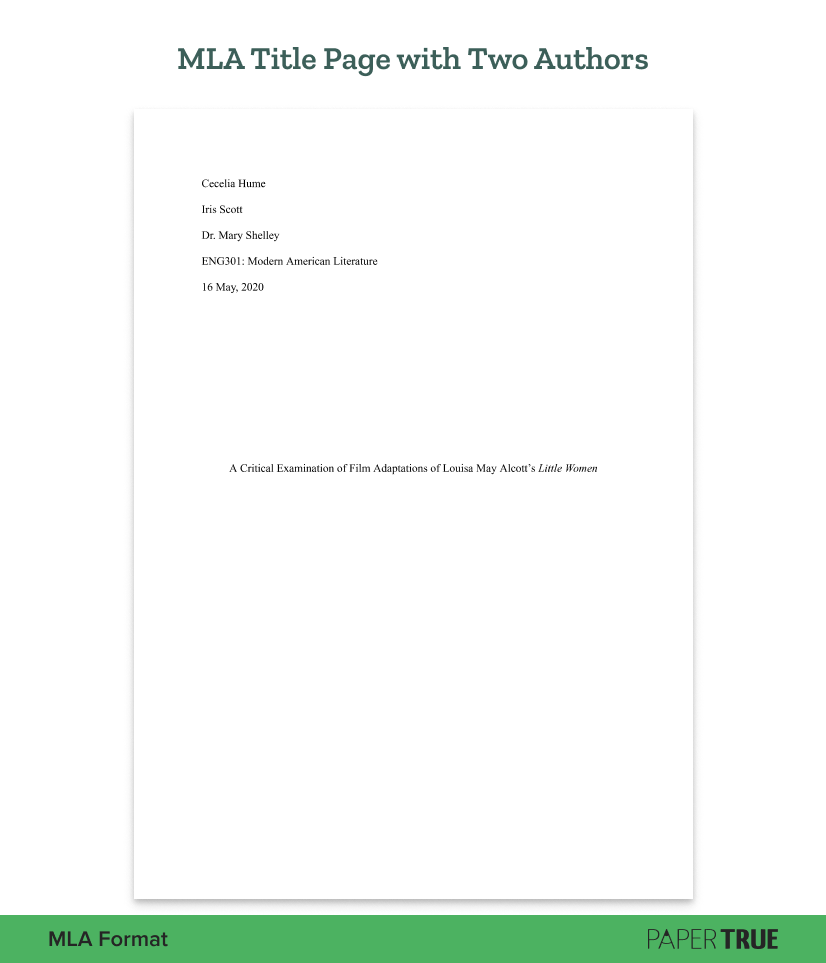
MLA title page example: Two authors 

1. MLA cover page with two authors

 An MLA cover page example with two authors.

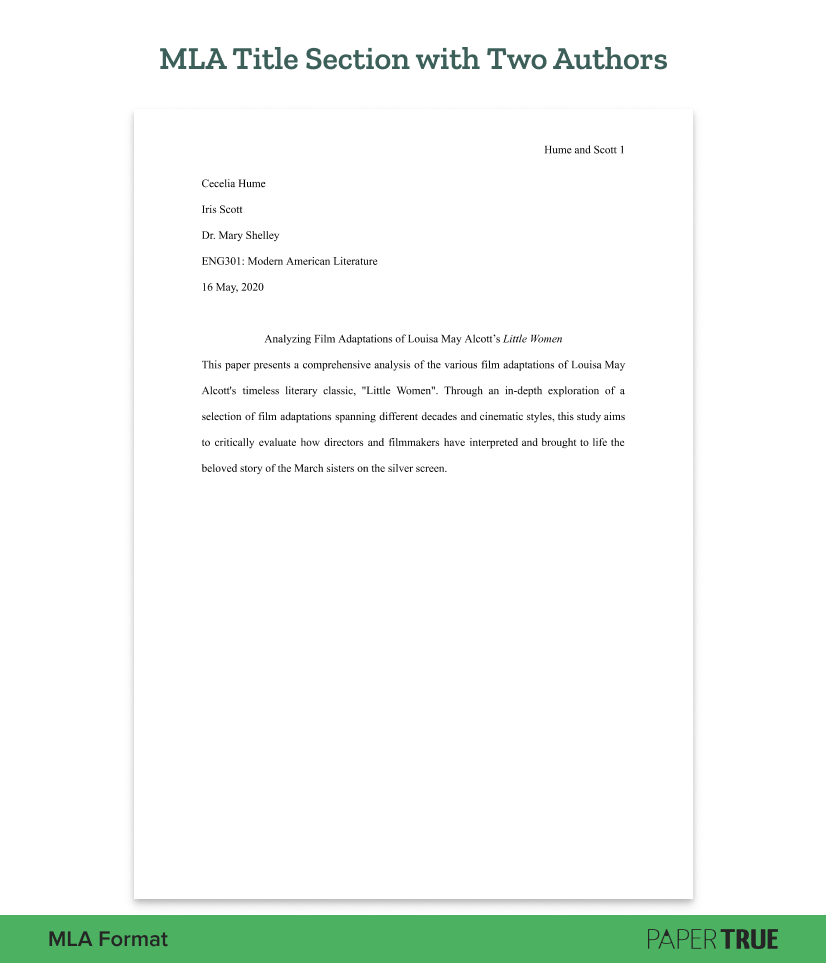
2. MLA title section with two authors

MLA 9 title section example for papers and essays.

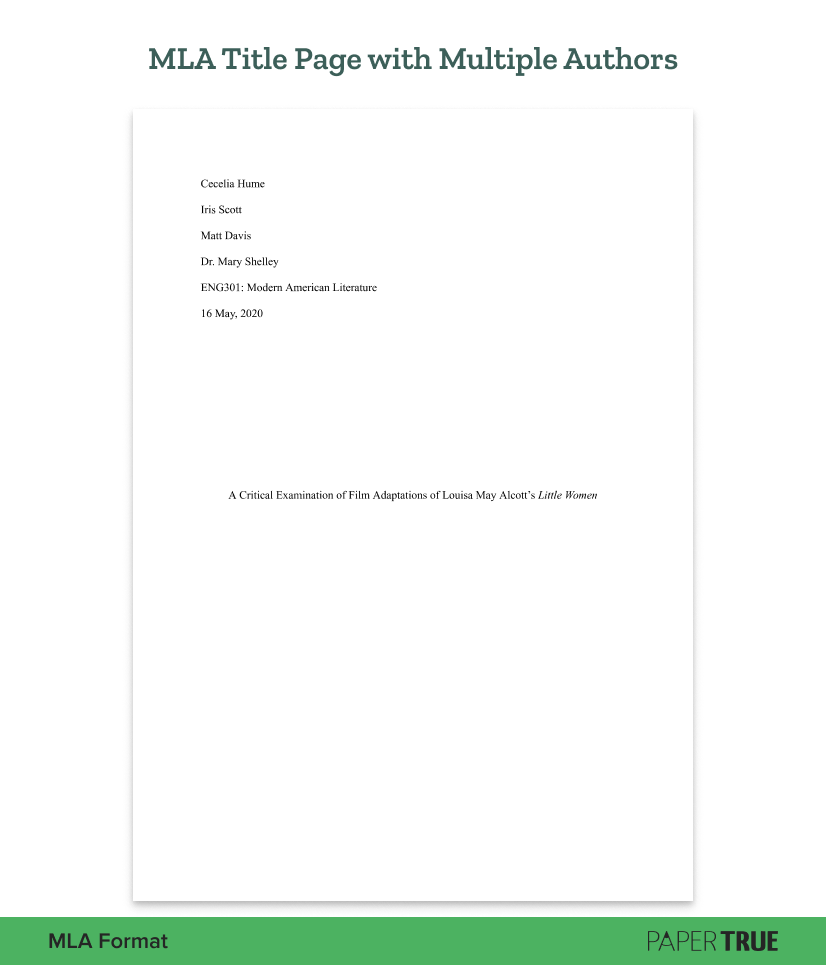
MLA title page example: Three or more authors 

1. MLA cover page with multiple authors

An MLA format title page with three or more authors.

2. MLA title section with multiple authors

An MLA title page example showing a title section with three or more authors.

If you need experts to review your paper, our paper editing services are at your… well, service! Meanwhile, here are some resources to help you learn more about the MLA style and academic writing: 

Formatting an APA Reference Page | Template & Examples

You have finally checked, rechecked, edited, and thoroughly proofread your document. But the arduous task of creating your APA reference page still remains! If you need help formatting your reference page and understanding how different APA works are cited, this article is for you!

You may question if the correct terminology to be used is “APA references” or “APA works cited”. We will answer this question and many more in this quick guide. We will also take a look at the APA reference page formatting guidelines with the help of examples as well as templates.

APA reference page formatting guidelines

Every APA in-text citation included in your paper must be mentioned at the end, on a separate reference page. A reference page citation is simply a full citation of the source mentioned in your document. Let’s take a look at how these citations are formatted.

Here’s the general formatting of a reference page in the APA style:

  • Add an APA running head to the page.
  • Double-space the entire text.
  • Place and bold the heading “References” at the top of your page.
  • Organize your citations in alphabetical order*. 
  • Barring the first line, leave a hanging indent of 0.5 inches for every line in a paragraph.

*Do not consider articles such as “a”, “an”, or “the” while alphabetizing your citations.

Let’s understand the individual aspects of an APA-style reference page and learn how to format them.

1. Author name

Start your reference page for your APA-style paper with the author’s name. Here are a few formatting guidelines on how you should know while including the name of the author:

  • Begin your citation with the name of the relevant author. 
  • Include the last name followed by the first name initial of the author. End the name of the author with a period.
  • If the name of the author is not known, simply replace it with the title of your source.
  • If two or more authors are present separate the name of each author with a comma followed by an ampersand. 
  • In case the two authors have the same last name and first name initials, include the first name of each author in brackets.
  • In case of three or more contributing authors, include the first author’s name followed by “et al.”
  • If you want to include a study conducted by an organization, simply include the name of the concerned organization.

2. Date of publication

  • Include the date of publication in parenthesis after citing the names of the author/s involved (or in some cases, the title of the source.) 
  • Follow the year, month, and day format. If the month and day are not available, you can simply include the year.
  • If the publication date is not mentioned, simply include “n.d”., which refers to no date, in the parenthesis.

3. Title of publication

  • If you are referring to a specific chapter in a book or journal, include it before the title of your source. Use the sentence case* and end with a period.
  • When it comes to names of books, apply the sentence case* and italicize the title.
  • For names of newspapers, magazines, and journals use the title case** and italicize the title.
  • For journals and periodicals, include the volume, issue, and page number*** followed by a period after the title. 
  • In cases where the name of the author is known, place the title of the chapter and the source before the date of publication.
  • When it comes to sources like lecture notes or audio podcasts, you can include a brief description of your source directly after the title. Capitalize only the first letter of the source.

* In the sentence case, only the first letter in sentences and proper nouns is capitalized.

** In the title case, the first letter of the first word and the starting letter of all words except for articles and prepositions are capitalized.

*** The volume is followed by the issue number in parentheses with the page number at the end. All the numbers are italicized.

Links to online and offline resources

You may have derived information from a variety of online and offline publications.  Include the sources for these pieces of information after the title of the publication. 

Let us first take a look at how to format physical sources:

  • Include the title of the book, journal, newspaper, or magazine you’ve derived information from.
  • Do not use the publisher’s name while citing journals, newspapers, or magazines.
  • Include an abbreviated version of the name of the publisher when it comes to books.
  • Exclude details such as the publisher’s name and information in books. However, include terms that are a part of the publisher’s name such as “press” or “book”.

Now, let us understand how to format online sources:

  • Make sure to link the URL of the relevant book, publication, newspaper, or journal without a period.
  • If your citation has a DOI number*, use that instead of the URL as it is static.

*DOI or Direct Object Identifier is a permanent electronic link to a journal. 

Here’s a complete APA citation example:

Last name of author 1 & Last name of author 2. (Year of publication). Book chapter. Title of Book. Publisher. Link to URL

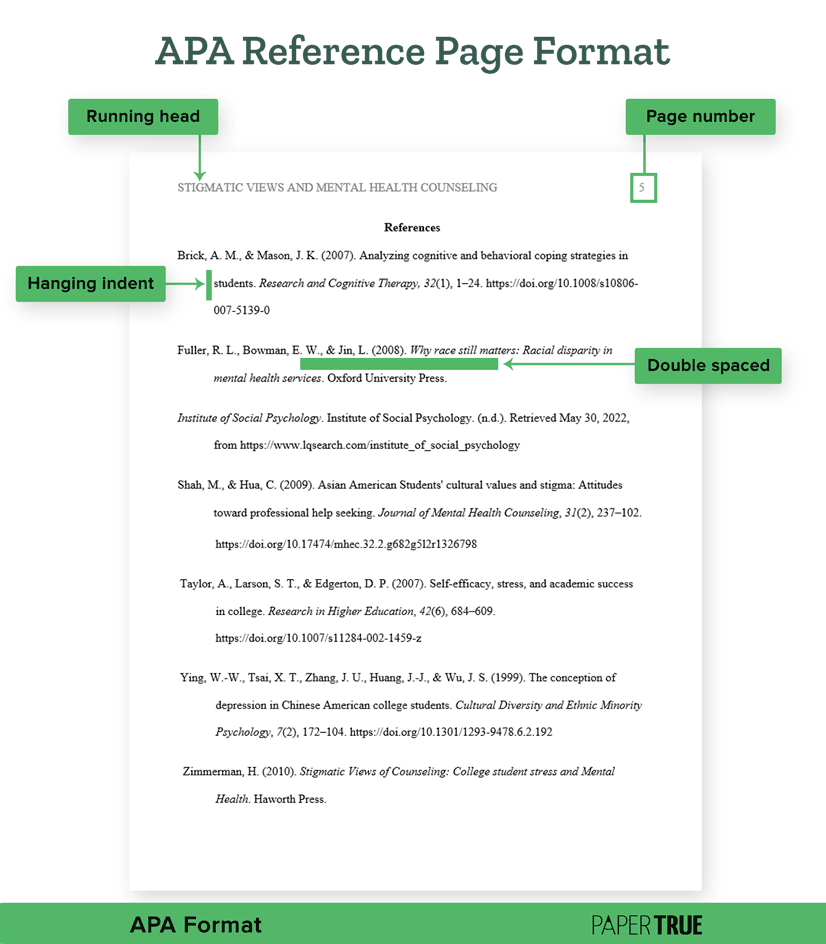
To better understand how these citations are formatted, let’s look at a finished APA 7 reference page. 

APA reference page example

Different APA sources use different formats for citations. To better understand these sources, we’ve compiled a list of various types of sources present in an APA format reference page. The following reference page example is based on the use and relevance of vestigial organs in humans. 

An APA reference page with citations arranged in alphabetical order. The entries have a hanging indent of 0.5 inches and are double-spaced.

APA reference page template

To help you create your reference page for APA format, we’ve included a template to make things easier for you. This template is available in Google Docs and provides an overview of citation styles for different sources. 

Now that your paper is completed and formatted to the T, it’s ready to be submitted. All the best!

As providers of professional academic editing services, it’s our duty to provide you with useful resources to aid you in writing. Take a look:

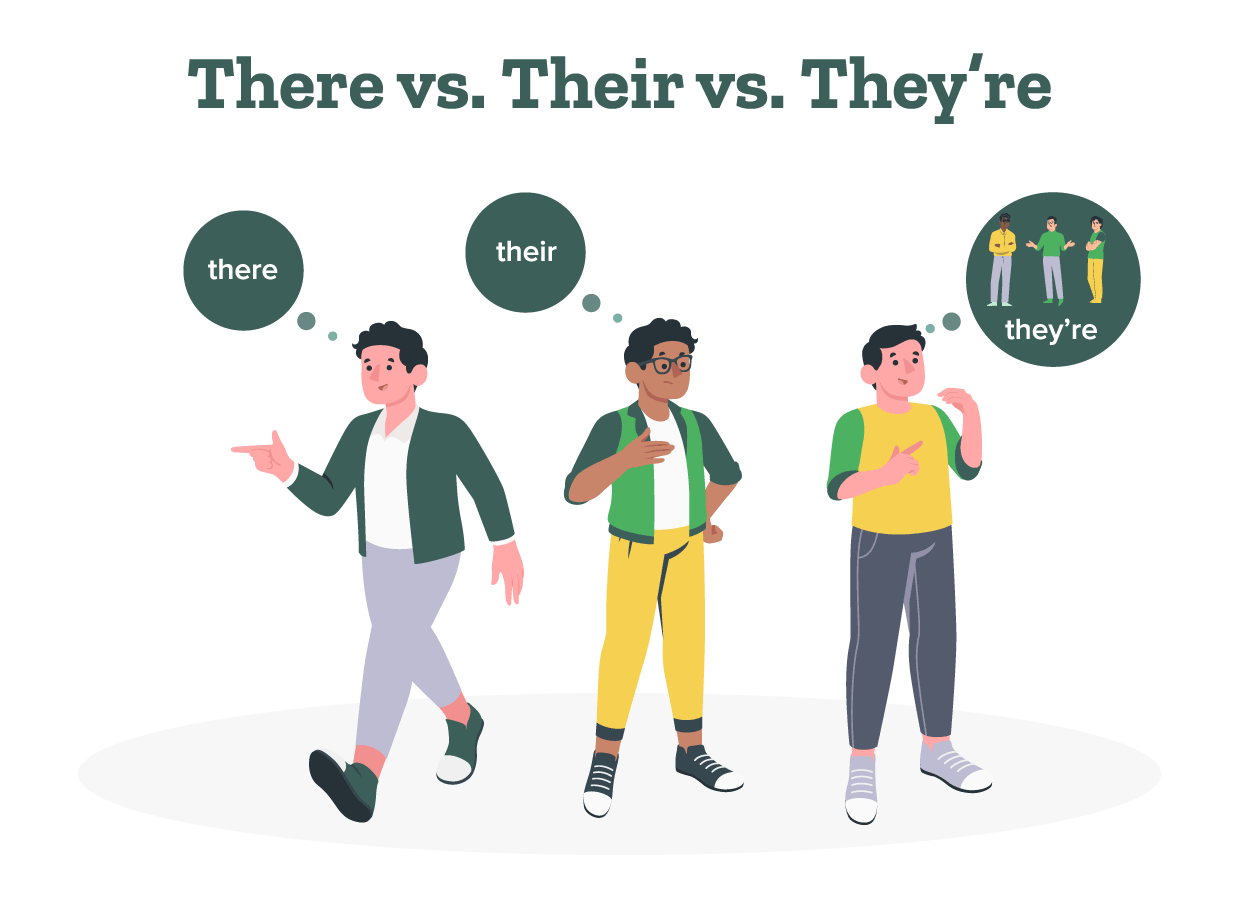
Their vs. There vs. They’re: Meaning and Differences

If you’re confused about whether to use there or their, this article is for you! Their vs. there sound exactly alike when spoken aloud, making them homophones. Although they have very different meanings, using them wrong is one of the most common grammar mistakes even native speakers make!

In this article, we’ll look at these commonly confused words and their meanings with the help of plenty of charts and examples. Let’s start by understanding what their and there mean and what is the difference between the two.

Their vs. there meaning and difference

There means that point or that place, as opposed to here, which means to this place

There, on the horizon, I saw the shimmering waters of the Caribbean Sea.

I have kept the book over there.

Their means belonging to them. It can also be used as a gender-neutral possessive pronoun, replacing him or her.

The people will choose their leader tomorrow.

George placed their book on the table.

The following table better illustrates the uses and differences between there and their:

There meaning and uses

The word there is more commonly used out of the two. It is generally used to indicate a faraway location or a particular point in time. However, it can also be used as an interjection to reassure, console, or encourage someone. 

Let’s understand the different uses of there with the help of the following table: 

Their meaning and uses

Their is a third-person possessive pronoun for them. It is usually used to refer to something belonging to a group. But, in recent times it is also used as a gender-neutral pronoun to replace him or her

Here are a few example sentences with their:

The successful couple just bought their new home in Manhattan.

Orangutans take care of their young throughout their life.

Whether to use their or there 

A simple way to determine whether to use the homonyms there or their is to look at the way they’re spelled. 

When it comes to there, simply replace the t with a w and see if there can be an answer for it. Here’s an example:

Where is Waldo?

He’s right there, by the fireplace.

Any question starting with where can be answered by there. The word there also consists here in it, which is essentially its opposite.

The word their contains the word heir, which indicates legal ownership of a property. You can use this to remember that their means ownership or belonging:

The royal couple claimed the heir as their own.

Their vs. there examples 

To better understand the meanings and the uses of there or their, let’s take a look at a few there vs. their examples. These sentences are constructed using a similar context but have distinct meanings. Let’s take a look:

There are plenty of cabbages left in the refrigerator for Timmy the Hampster.

The bunch of cabbages with their bright green leaves belong to Timmy the Hampster.

There vs. their vs. they’re

Another homophone of there and their is they’re. It is a contraction of the third-person pronoun they and the verb are. They’re is usually used in plural settings, however, it can also be used in place of he or she is. 

Here are the differences between the uses of their vs. there vs. they’re:

Their vs. they’re

As discussed before, their is a possessive pronoun indicating ownership and belonging. On the other hand, they’re is used to indicate a state of being. The trick to understanding, whether to use they’re vs. their, is to check if it can be expanded to they are. However, this shouldn’t alter the meaning and context of the sentence. Here are some examples:

They’re leaving for Tokyo today.

They are leaving for Tokyo today.

Their dog is friendly, happy, and healthy.

They are dog is friendly, happy, and healthy.

There vs. they’re

An easy way to decide whether to use there or they’re is to associate there with a point,  location, or possibility and they’re with to be. This can be better explained with the help of the following example:

There is no way in which you will be able to complete the document by tomorrow without their help. They’re expecting it to be completed as soon as possible.

The above example begins with there, which is used to introduce the topic of the sentence. On the other hand, their is used to indicate the help provided by a group of individuals. Finally, they’re (they are) is used at the beginning of the second sentence to refer to a group of unspecified individuals.

So whether it is their or there, or maybe they’re, you’re one step closer to perfect grammar! If grammar is not your strong suit and you need a little guidance editing and proofreading your personal projects or academic documents, consider working with professional editing services.

If you’d like some more resources on word choice and writing, you might find these useful:

Novel Outline: A Proven Blueprint [+ Free Template!]

Do you have a fantastic idea for a novel? A novel outline will help you to analyze whether the story is interesting enough to hold the reader’s attention. In this article, we’ll explain how to write a novel outline. We have also provided a novel outline template to kickstart your writing journey. 

A novel outline is an organized document with important elements such as the plot, characters, and setting. It helps to understand how to use these elements while creating the novel draft. We have also provided additional steps to help you create your novel outline. So let’s get started! 

Here’s how to outline a novel in seven easy steps: 

  • Define your story idea 
  • Define the novel’s themes and genres 
  • Finalize character personas 
  • Jot down details about the setting 
  • Decide the novel’s structure  
  • Create the novel’s plot outline 
  • Summarize the chapters briefly

1. Define your story idea

The first step to outlining your novel is writing down the heart of the story that you wish to convey to the readers. The protagonist’s journey,  the conflict he/she faces, and the end resolution are the heart of the story. The message or theme you wish to highlight through your story can also be a part of your story idea. This story idea can be written in 2-4 sentences.

Answering the following questions will help you define your story idea:

  • What does the protagonist do? 
  • What does he/ she wish to achieve? 
  • Which obstacles does he/she face? 
  • Does he/ she achieve their desired goal? 

2. Define the novel’s themes and genres 

Noting down the novel’s themes and genres while writing a novel outline has a huge advantage: There is more clarity while conducting research for the novel. This will also help to determine which tropes to use in the novel. You can define the theme in one word and then build around the theme. 

Ideally, the novel’s themes and genres must be described before developing the characters. This will help develop characters later on. For example, you can decide whether the character’s traits suit the novel’s themes and genres or are different from what you originally thought. 

3. Finalize character personas 

When learning how to write a novel outline, it’s crucial to recognize the importance of grounding your characters. A good strategy is to list all essential primary and secondary characters and their traits.

You can note down the characters’ names, strengths, weaknesses, occupations, qualities, and how these characters are related. Following are some factors to consider while describing characters in the outline of a novel: 

  • Determine your major and minor characters and the general arcs they follow. 
  • Note down if the characters have any biases or unusual qualities. 
  • Use popular stock characters such as mentor, common man, creator, joker, and explorer to show the motivations or qualities of the main characters. You can utilize stock characters smartly by including them at specific points in the story to hook the readers’ attention. For example, to diffuse tension after a conflict, to motivate the hero after defeat, to create conflict etcetera. 
  • Create mind maps to build character personas. 

4. Jot down details about the setting

The setting is the novel’s foundation that cannot be ignored in the outline of a novel. The novel’s setting is the place, time, and environment where the story takes place. Following are some tips to effectively define the novel’s setting: 

  • Use maps: You can mark relevant cities and important tourist attractions on maps with different colors. If you’re using fictional settings, you have the option to get creative and create a map of all fictional places. 
  • Attach sticky notes and photos to the novel outline of location details that will play an important part in your novel. 
  • You can also divide the setting into two parts: the main setting and sub-settings in the novel outline. 
  • Instead of writing minute details, the better approach is only to mention those setting details that are important and unique to the novel. 

Pro tip: You can use Google’s Streetview app to find interesting locations for your characters and jot them in your novel outline. 

Answering the following questions will also help to accurately describe the setting in your novel outline: 

  • What are the characters’ relationships with the setting? 
  • How will the setting affect the characters’ lives? 
  • Which are the important landmarks of the setting? 

The history of the places can also play a key role in the novel’s plot. For example, Charles Dickens’s A Tale of Two Cities is set in London and Paris. Since the novel centers around the French Revolution and Paris played an important role in it, the setting of Paris is significant. 

5. Decide the novel’s structure 

The novel’s structure is the order in which you’ve organized all your novel content. This refers to the chronology of events, whether the events occur in linear progression or if are there any flashbacks in the story. Mentioning the novel structure in 1–2 sentences gives clarity about content flow and sequence of events. Following are some of the types of novel structures you can use: 

  • Three-act structure: The beginning, middle, and end are the three parts of the structure. In the beginning, the protagonist and other important characters are introduced. This is followed by a conflict involving the protagonist (rising action) after which there is a resolution. 
  • Begin from the middle: Novels using this structure start the story with an important event that sets various events in motion. In this type of novel structure, no background information or backstory is given to readers in the beginning.
  • The hero’s journey: This is one of the most well-known concepts given by Joseph Campbell. The Hero’s Journey involves a hero going on an adventure, facing various obstacles, and overcoming them. 
  • Parallel plot structure: In this structure, there is more than one plot and all plots are linked by common characters. All parallel plots have their own rising actions and these parallel plots later play an important role in the climax. Using this plot structure helps to make the climax intense and emotional.

What is a trope?  

A trope refers to concepts that have been very frequently used. The crazy  scientist, the old man with wisdom, and the anti-hero are some examples of tropes. 

6. Create the novel’s plot outline 

This is the most crucial step of writing a novel outline which gives clarity about the core story. A plot outline is a brief summary of what happens in the novel. You can create a plot outline of 1-3 pages summarizing the main events that take place in the novel.

You can also use the concept of Freytag’s pyramid to create a simple plot outline. Freytag’s pyramid has five elements which are exposition, rising action, climax, falling action, and resolution. While exposition is the introduction to the characters and setting, rising action is the build-up between characters before the climax. Falling action is what happens to the characters after the climax and resolution is how the story ends. 

7. Summarize your chapters briefly 

While this is an optional step of how to outline your novel, including chapter summaries gives a sense of direction while writing. Writing a summary of 2-3  sentences summarizing the main event that takes place in every chapter gives clarity while writing.’

You can also mention how one chapter is linked to the next chapter while writing chapter summaries. This will help you to write the scenes effectively while creating a novel draft. 

Pro tip: You can also use various apps for creating novel outlines such as Pluot by Pluot Studios and Fabula. Story Planner by Natasha B.

Novel outline template 

Go through the following novel outline example of Jane Austen’s Pride and Prejudice to create your own novel outline: 

We hope this novel outline example has given clarity about how to outline a novel. Writing a novel isn’t easy,  but we’re here to help! PaperTrue provides expert novel editing services and valuable feedback to enhance your novel. However, this is not all.

Whether it’s how to create unforgettable antagonists or how to punctuate dialogues, we have all the answers. Here are some other useful resources to help you in your novel writing journey:

APA Headings & Subheadings | Formatting Guidelines & Examples

APA headings and subheadings provide a clear structure to your document and make it easy to navigate through. This is especially beneficial when it comes to longer documents. 

The APA format makes use of headings and subheadings to indicate a hierarchy. But what is an APA paper heading and how do you customize it? We will answer all these questions with the help of concrete examples and templates.

Let’s start off with understanding the basics of how to customize these APA format headings and subheadings. 

APA heading format

There are five APA heading levels that can be used as per the latest APA guidelines. You can decide which level of heading to use, depending on the length and complexity of your document.

  • The level 1 heading is the main APA heading for your paper, which is used to indicate all the major sections (excluding the introduction). 
  • The level 2 heading is included under the level 1 heading and is used to indicate its different aspects.
  • The level 3 heading is used to indicate the subpoints to be included under the level 2 heading and so on.

Here are the formatting guidelines for the APA heading formats for the 7th edition:

  • Avoid creating too many subheadings. This makes your document shabby and difficult to understand. 
  • Do NOT number the APA-style headings and subheadings. The APA paper format does not make use of Roman and Arabic letters and numerals to number the headings.
  • Include a double space between the content and the heading for the first 3 levels.
  • Use the title case for all your headings.
  • Avoid creating a single APA subheading under the parent heading. 

Let’s take a look at how to format each of these APA heading levels in more detail.

APA heading levels

As stated above, the APA Style guide consists of 5 levels of headings. Each level heading should be bolded and in some cases italicized. Here are the guidelines for the five APA format headings:

APA level 1 heading

The level 1 heading for an APA paper is the main heading in an APA-style paper. It is used for all the significant sections of the paper such as “Methods”, “Results”, and “Discussion”. 

Do NOT include the Introduction in the level 1 heading. The heading of your paper present in the APA title page serves as a de facto heading for your introduction. 

Here are the formatting guidelines for an APA level 1 heading:

  • Centrally align and bold the heading.
  • Leave a double space between the heading and the text under it. 
  • Begin writing the text on a new line, leaving an indent 0.5 inches from the left margin. 

Here is the APA heading format example:

APA Level 1 Heading

The text is indented and begins on a new line.

A section label is used to indicate specific parts of your paper including. It is similar to a level 1 heading but is formatted slightly differently. It is bolded and centrally aligned but is placed in a separate line at the top of a new page. 

APA level 2 heading

A level 2 heading is a subsection that is included under the level 1 heading. For instance, subheadings such as “Test Sample” are included under the main heading “Method”. Make sure that there are two or more subheadings present under each main heading. 

The level 2 APA subheading format is as follows:

  • Left align and bold the heading.
  • Leave a double space between your heading and the text pertaining to it.
  • Leave an indent and begin writing the text on a new line.

Here is a level 2 APA heading example:

APA Level 2 Heading

The text is indented and begins on a new line.

APA level 3 heading

Level 3 APA subheadings are used to further categorize characteristics included under the level 2 subheading. For instance, the level 2 subheading “Test Sample” may further be divided into sample groups such as “Preteens”, “Adolescents”, and “Adults”

Here are the formatting guidelines for an APA level 3 heading:

  • Left align, bold, and italicize the heading.
  • Leave space between the heading and the text included below it.
  • Leave a 0.5-inch indent and begin writing the text on a new line.

Here is a level 3 APA heading example:

APA Level 3 Heading

The text is indented and begins on a new line.

APA level 4 heading

The level 4 APA subheadings are rarely used when it comes to school papers. They’re more often used in more complex and detailed papers such as postgraduate or professional research papers. It is used to further categorize information included in the level 3 heading. For instance, the sample group of “Preteens” can further be divided into categories such as “Children (6–8 years)” and “Children (9–12 years)”. 

Following are the formatting guidelines for an APA level 4 heading:

  • Left align, indent, and bold the heading.
  • End the heading with a period.
  • Begin writing the text after the period in the same line.

Here is a level 4 APA heading example:

APA Level 4 Heading. The text begins in the same line.

APA level 5 heading.

The level 5 heading is the final heading included under the APA formatting guidelines. It is used to further categorize information included under the level 4 heading. For instance, the category “Children (6–8 years)” can be further divided into “Boys” and “Girls”.

Following are the formatting guidelines for an APA level 5 heading:

  • Left align, indent, bold, and italicize the heading.
  • End your heading with a period.
  • Begin writing the text after the period in the same line.

Here is a level 5 APA heading example:

APA Level 5 Heading. The text begins in the same line.

When you put all of the headings together, it should look something like this:

APA Level 1 Heading

The text is indented and begins on a new line.

APA Level 2 Heading

The text is indented and begins on a new line.

APA Level 2 Heading

The text is indented and begins on a new line.

APA Level 3 Heading

The text is indented and begins on a new line.

APA Level 3 Heading

The text is indented and begins on a new line.

APA Level 4 Heading. The text begins in the same line.

APA Level 5 Heading. The text begins in the same line.

APA heading format for Microsoft Word and Google Docs

Things get much easier when it comes to formatting APA headings in MS Word and Google Docs. Instead of individually inserting each heading, you can simply make use of the “styles” feature. This allows you to select a heading of your choice with a single click.

Make sure to edit your heading as per the APA formatting guidelines, since these default settings are not available in MS Word or Google Docs.  

APA heading example

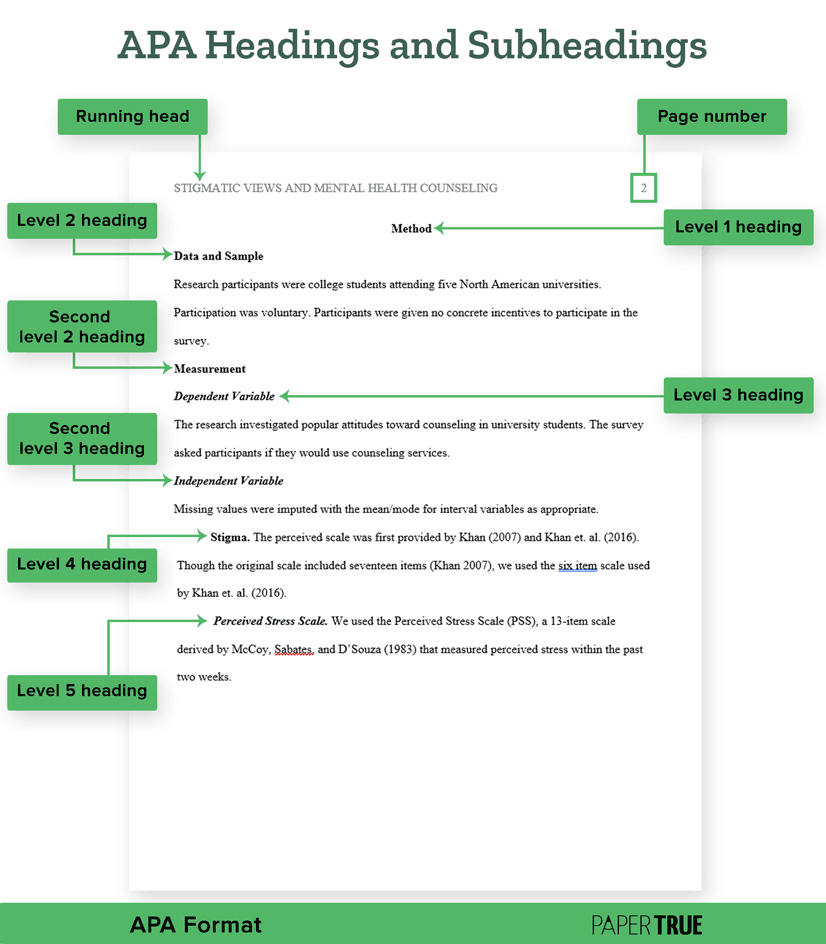
To understand how the APA levels are structured, let’s take a look at an APA format for headings. The following research paper outline highlights the methods used to collect the effect of coffee on preteens and young adults. 

Here’s how the headings and text should be structured in the following example.

A page showing different heading and subheading levels according to the APA format guidelines. 

If you think formatting is not your strong suit and you want to make things easier, consider working with professional editing services. These professionals not only correct structural errors and content flow but also rectify all proofreading errors. 

Need help with formatting your paper? Here are a few more articles you can refer to:

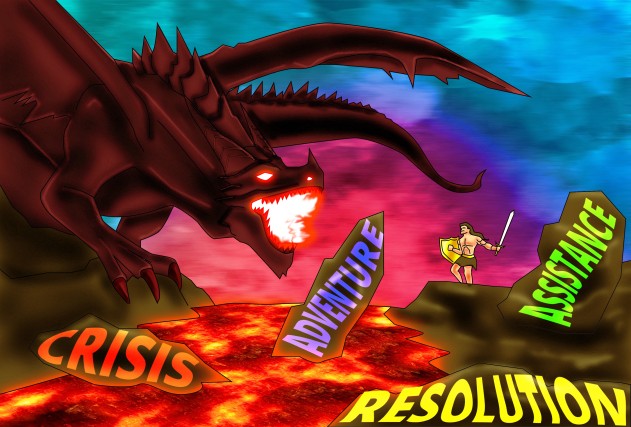
Joseph Campbell’s Hero’s Journey: Worksheet & Examples

Are there 17 steps in the hero’s journey, or 12, or 8? Let’s visit Joseph Campbell’s Monomyth, study some examples of the heroic quest, and find out how you can write memorable heroes. We’ve also added a hero’s journey worksheet to make sure you get some writing practice!

As your editors, we always want you to do your best, and the hero’s journey worksheet is our way to ensure this. But first, what is a hero’s journey?

Have a book to publish? We can help.

What is the hero’s journey?

What unites all stories of the world, despite colossal differences in genre and plot, is the fact that their characters will follow a fairly straightforward path. It’s a path that has been taken by everyone from Odysseus and Achilles to Frodo Baggins and Katniss Everdeen.

As an author, you must accept that the success of your story hinges on your hero or protagonist. The challenge here is to write a well-rounded hero who also follows an age-old pattern. If you want to innovate, you first need to understand the source material—the 17 steps in the hero’s journey—inside out.

For starters, here’s a simple definition of the hero’s journey:

The hero’s journey or the monomyth is a universal pattern followed by the main character (hero) in a book or a movie. This pattern usually involves the hero going on an adventure and overcoming a set of different challenges. By the time the hero returns home, they find themselves changed.

Of course, it helps to remember that this formula has different applications in all books. Often, the 17 stages of the hero’s journey adapt to the story and setting of the given book or movie.

It isn’t great if your hero’s journey doesn’t sit right with your setting or the theme of the story. You need to let the story take its own turns and figure out a well-paced arc for the hero accordingly.

The origins of monomyth: a brief history

The concept of monomyth goes back to the last century. Sigmund Freud’s theories led many critics to psychoanalyze heroes and trace similarities between different myths.

The psychologist Otto Rank studied the hero psychoanalytically in his book The Myth of the Birth of the Hero (1909). Thirty years down the line, Lord Raglan used ritualism along with Freudian psychoanalysis to publish his book The Hero, a Study in Tradition, Myth and Drama (1936).

So, more than a century’s worth of study has led to our present understanding of the monomyth. Joseph Campbell’s The Hero With a Thousand Faces (1949), however, deserves most of the credit for this.

Joseph Campbell’s hero’s journey

According to Joseph Campbell, the narrative of monomyth has a fixed pattern:

A hero crosses the threshold between ordinary and supernatural worlds. In this magical world, they encounter monsters, magic, and mysterious forces that test their abilities. The hero wins a decisive victory and returns home with the power to help those around them.

As you’ll soon find in the worksheet, Joseph Campbell lays down the 17 steps in the hero’s journey. However, not all myths follow this cycle accurately. Most stories and myths focus on one particular stage of this journey, while some change the order of these events.

It’s possible to think of Joseph Campbell’s monomyth as a comprehensive hero’s journey template. Its structure is that of a wheel divided into three acts:

1. Departure

The hero leaves his home behind. They not only leave their physical, ordinary world, but also their past self behind. The hero accepts that they must undergo metamorphosis in order to survive and succeed.

2. Initiation

The hero undergoes a series of trials that prepare them for the final battle. These challenges purify them and reveal some key knowledge from the ordinary world that is essential for a victory.

The hero faces all challenges and undergoes significant change. As a reward for their resilience, they’re granted an “ultimate boon”.

3. Return

Once the hero has overcome the obstacles and gained new knowledge, they must return home. The hero is initially reluctant to return, but then finds guidance and divine help on their journey back.

Once they return, the hero becomes a master of both worlds and gains the freedom to live in the moment.

Let’s take a close look at the 17 stages of Joseph Campbell’s monomyth. You can practice writing your own heroic quest once you know all the steps in the hero’s journey!

17 steps in the hero’s journey

Departure (stages 1–5)

These steps in the hero’s journey consist of their departure from home. The hero gets a call to adventure, refuses it, but ultimately finds themselves crossing the threshold.

1. Call to adventure

The hero begins in an ordinary world where they have an established place. This situation of normality is interrupted by some omen, letter, or other information that beckons them on the journey.

This information is the hero’s call to adventure. Almost all hero’s journey examples will feature this first call to action. Remember when Katniss volunteers as tribute, or when Gandalf entrusts Frodo with the ring?

If we’re talking classics, how about Achilles getting summoned for the Trojan War by Agamemnon?

For Katniss, the call comes as the ritual of Reaping, where she volunteers as tribute to save her sister. For Frodo, it is an unknown object thrust upon him by an old friend. In the case of Achilles, it’s a literal message that calls him to battle.

All three calls to adventure tell us something about the characters or the main theme of the story. Katniss loves her sister, Frodo is a trustworthy friend, and Achilles is destined to a glorious but short life.

So, you can get creative with the first step in your hero’s journey. Use this moment to solidify some character or thematic aspect.

2. Refusal of the call

It often happens that the hero initially refuses the call to adventure. After all, who likes to have a burden thrust upon them? But the hero may refuse for a number of reasons. They may have someone to provide for or protect, some duty to the king and state, or some anxieties regarding the future.

Frodo doubts whether a lowly hobbit can carry the ring to its destruction. He worries that the task is beyond his capability. Achilles refuses Odysseus’ request because he wants to live a long, ordinary life instead of a short but great one. Katniss, on the other hand, doesn’t refuse the call at all.

As you can see, the steps in the heroic quest are open to interpretation and experimentation. Since Katniss chooses the adventure, she can’t possibly refuse the call. As we have said above, the hero’s journey wheel isn’t a set formula that you must follow at every stage.

Depending on the character, how many possible reasons can you conjure up for the refusal? You can use the hero’s journey worksheet to brainstorm some ideas and jot down the best choice.

3. Supernatural aid

Most myths feature some divine aid being offered to the hero. Often, this help comes only after the hero decides to embark upon the adventure. Once they have committed to the journey, their mentor, guide, or simply a benevolent being offers them some help.

There are many hero’s journey examples of supernatural aid. Our three heroes receive this help as guidance and gifts from their mentors.

Frodo receives many gifts as he embarks on his adventure. Bilbo gives him mithril and Sting, while Galadriel gives him a phial of light.

Achilles becomes invincible thanks to his mother, and Hephaestion makes him strong armor. In the case of Katniss, her mentor Haymitch sends her healing salve through the game sponsors.

Supernatural aid is a great way to show vulnerability and humility in your heroes. It also allows you to symbolize the relationship between the hero and their mentor.

4. The crossing of the first threshold

This is the most important moment in departure, where the hero actually steps into the unknown world. This entry into the supernatural region is a physical marker that the hero has left behind everything they had held certain.

Since the hero leaves behind their known boundaries, they also step away from their old self. From this point on, they begin to be transformed by the unfolding steps in the hero’s journey.

When Frodo reaches the boundary of the Shire, Sam reminds him that they are leaving their known world behind. This realization is Frodo’s crossing of the first threshold. In the case of Achilles, his crossing of the first threshold is open to interpretation.

It can be the moment he first sets sail to Troy with 50 ships. It can also be his first battle against Troy. But his irreversible crossing of the threshold is when he steps into the battlefield after Patroclus dies. From that point, there is no return for Achilles.

Katniss’ crossing of the threshold is a physical boundary like Frodo’s. But it is much more dramatic and intense, because it puts her in an active adventure zone.

As you may have noticed by now, these events don’t have to unfold chronologically. Katniss receives Haymitch’s help after crossing the threshold and not before. You can always switch things up. The worksheet is more of a map that you can customize to create the most fulfilling story for your hero.

5. Belly of the whale

This is the stage in the hero’s journey where they are completely isolated from the world. They are swallowed into the unknown, out of which they emerge a changed person. This ordeal shows the hero’s resilience and their ability to adapt.

Joseph Campbell takes this name from The Book of Jonah, where Jonah is thrown overboard and swallowed by a “great fish”. He is vomited back to the shore in three days, which is a kind of rebirth for him.

So, the belly of the whale has come to represent a period of total separation from the outside world. This separation leads the hero to separate from their old self. Remember this when you go through the worksheet!

In various examples of the hero’s journey, this stage comes as a physical or mental isolation for the hero. For Frodo, this happens when Shelob stings and immobilizes him, covering him up in the spiderweb. Separated from everything and everyone, he reflects upon his own actions.

For Achilles, this stage is in his mourning for Patroclus. He shuns the world and smears ash all over himself. After this, he emerges into battle with the single intention of getting revenge.

Katniss’ belly of the whale stage is when she climbs up a tree to protect herself from the other competitors. As you’ll notice, many things that apply well to Frodo and Achilles are difficult to align with Katniss. This is due to the setting and story of The Hunger Games.

So, Katniss Everdeen can be your example of how to incorporate the templatized heroic quest into your novel while also reinventing the wheel.

Initiation (stages 6–11)

These steps in the hero’s journey pack the thickest action. The hero faces several challenges, overcomes them, and meets the biggest hurdle of their path.

In this act, the hero is initiated into the social order of their world. Let’s see how this happens.

6. The road of trials

The road of trials is the series of obstacles that the hero faces on their journey. Aside from making the story gripping, these obstacles can also add some real substance to your story.

In ancient stories, these trials often come in packs of three. So, the number becomes important for many myths. However, all stories don’t follow this convention.

Often, these obstacles take the shape of monsters or mysteries. They can unlock hidden powers or character aspects of your lead characters. However, they also need to carry some thematic meaning.

Frodo’s trials on the road include Orc troops, the Nazgul, and Gollum. Sparing Gollum’s life serves as an important character point as well as story point in the book.

Achilles’ road of trials can be said to be his rampage on the battlefield. He massacres Trojan soldiers, fights the river God as well as Apollo before he can enact his revenge upon Hector.

Katniss’ road of trials is her struggle within the arena. However, her tests can be said to begin during her training, where she has to garner attention from the sponsors. As always, Collins interprets the hero’s journey loosely.

Examples of the hero’s journey across genres will provide differing versions of a road of trials. On this road, the hero makes friends, allies, and enemies. The story deepens and the challenges they face change the hero.

7. The meeting with the goddess

This is one of the steps in the hero’s journey that have become a bit dated. Joseph Campbell’s study of (mostly male-centric) myths leads him to this stage in the journey where the hero meets the goddess.

The goddess supposedly represents the ideal feminine form. She is beautiful, kind, gentle, and gives hope to the hero. She reminds the hero that he will soon return to the peaceful home where his journey began.

Campbell writes that in the case of a female hero, she finds a “heavenly husband” instead of the goddess. Aside from the misogynistic and male-centric perspective here, we can boil this down to its essential thematic meaning.

At this stage, the struggling hero needs to be reminded of love, hope, and goodness in the world. Whoever they meet in this step of the quest should give them the strength to go on. It’s here that you can pack a stunning emotional scene or two!

Frodo’s visions of Galadriel are a classic example of meeting with the goddess. For Achilles, the Greek goddess Athena serves as a guide and a helper on several occasions.

Katniss’ meeting with the goddess is open to interpretation. Rue guides her in a moment of extreme desperation and they develop a loving relationship. But Katniss also cares for Peeta and forms a bond with him. So, there is more than one way of going about this.

When you go through the hero’s journey worksheet, remember that this is a way to put a spin on a classic model.

8. Woman as the temptress

The misogyny here can’t be completely attributed to Joseph Campbell. For millennia, women in mythology and folklore have been divided into the holy mother and the sinful temptress. They appear in myths as either divine mother figures or as wicked beauties.

Lord of the Rings combines the two figures in Galadriel. She gifts Frodo a maical phial and offers words of encouragement later on in the story. But on meeting her, Frodo is also tempted to give the ring to her.

Of course, this step in the hero’s journey can feature any temptations that make them stray from their path. Even in Iliad, Achilles’ temptress is not a woman. Apollo disguises as the human Agenor to challenge Achilles to a duel, distracting him from his goal of fighting Hector.

Like Frodo, Katniss’ goddess also becomes her temptress. If you consider Peeta as the goddess, he soon becomes the temptress by asking Katniss to kill him. He tempts her to kill him and win the game, but she refuses to do so.

So, you may think of the goddess and the temptress as features of the two steps in the hero’s journey. They don’t even have to be characters! Get creative with this, and put that worksheet to good use!

9. Atonement with the father

In this stage of the hero’s journey, the hero must face the penultimate challenge. They have to face the father figure, which can be anyone or anything that is all-powerful in that specific world. The hero needs to either overcome or reconcile with this almighty figure, to truly become their best self.

This stage initiates the hero into the dominant world order. They let go of their ego to become their purest self, leaving behind the conflicts that defined their childhood. If you can see signs of Freud here, you’re absolutely right.

Of all the steps in the hero’s journey, this is most directly inspired by Freud’s theories. The man must face the almighty father in order to lead a well-adjusted life. For the modern writer, this stage can simply consist of the hero facing the single most powerful entity in their world.

If you can somehow connect this to their past, kudos to you! You’ll do much justice to our hero’s journey worksheet.

Now, for our three hero’s journey examples. Frodo faces the father of power, which is Sauron. He is the single most powerful entity in that world, and Frodo must destroy him.

Achilles’ atonement with the father is a bit different. His atonement with Priam, Hector’s father, helps him move away from mindless brutality.

Katniss faces the makers of the game when she threatens to die with Peeta. She emerges as a victor and goes on to become the Mockingjay.

10. Apotheosis

This is the climax of the hero’s journey. In this stage, the hero achieves some greater understanding of the world. The word “apotheosis” literally means “achieving godhood”, so the hero in this stage achieves perfection.

The hero now attains the abilities that ordinary people don’t have. Their ordeals have purified them to their core, and now their own revelation changes their worldview.

This is the moment where we may have to tweak our hero’s journey examples a bit. Frodo’s Apotheosis, for example, is difficult to pin down while Gandalf presents a much clear instance of it. Gandalf faces the abyss and is reborn as Gandalf the White. His rebirth enlightens him.

Achilles also doesn’t reveal a certain moment of apotheosis. However, when Patroclus dies disguised as Achilles, there is a symbolic death and rebirth of the demigod. After this moment, Achilles fights armies and gods to become a great hero.

Katniss’s revelation that the Capitol is her true enemy, helps her avoid a certain death. She refuses to kill Peeta and wins the game with him, becoming a victor.

What moment of revelation will you write for your hero? Our worksheet has space for your ideas, but you don’t have to limit yourself to it. You’re free to innovate, and in case of apotheosis, innovation is the rule!

11. The ultimate boon

This is the stage in the hero’s journey where they achieve a great bounty. It is a reward for their efforts, or the goal they set out to achieve. In any case, gaining this boon helps both the hero and their world.

They can now go back and help others with this boon. However, this boon doesn’t have to be an object or riches or any abilities. Often, the finishing of the ordeal and the defeat of the “father” is a boon in itself.

Frodo’s biggest boon is permanently freeing Middle Earth from Sauron’s power. Achilles’ boon is winning the Trojan War by killing Hector. However, Katniss’ boon is a different case.

It can be said that Katniss’ boon is being allowed to win alongside Peeta. But a greater boon is her newfound status as a symbol of resistance. It is due to this that she eventually becomes the Mockingjay.

Return (stages 12–17)

The final steps in the hero’s journey map their return from the supernatural realm. There are setbacks, challenges, and chase sequences in the hero’s return journey, too, so let’s get to it!

12. Refusal of the return

Joseph Campbell’s monomyth wheel requires the hero to bring back their trophy to the ordinary world. The cycle must continue, and for that the hero needs to return to their world and share their wisdom with their people.

However, the hero can be reluctant to return, refusing to complete the cyclical diagram of the hero’s journey. This may be for a number of reasons, like the refusal of the call to adventure. The hero may doubt whether other people are ready for their newfound wisdom. They may worry about something or someone in the supernatural world they’re in.

If nothing else, it may simply be tempting to remain in the fabulous world like a human in paradise. In Frodo’s case, it is the exact opposite. He is dismayed at not being able to resist the Ring’s temptation. Even as Sam hopes to return home, Frodo surrenders to death.

Achilles’s refusal to return is, interestingly, the same as his answer to the call. He knows that if he answers the call to adventure, his prophesied death is certain. So, he has no hopes of ever returning to Phthia.

Katniss does not refuse her return. She is actually eager to go home and reunite with her family. So, as we have said numerous times before, not all the steps in the hero’s journey have to be followed. Just make sure you’re doing something interesting with the ones you do end up following!

13. The magic flight

In many cases, the hero’s return is less a triumphant march and more of an escape from the supernatural world. This may be due to magical entities guarding the gates or preventing the hero’s return.

Joseph Campbell writes that the hero’s return can turn into a lively chase sequence. This can be comical or thrilling, depending on the story. What do you think you’ll enter for this stage in the hero’s journey worksheet?

Let’s turn to our hero’s journey examples. Frodo’s return home is a literal magic flight. The eagles save Frodo and Sam as they fall, carrying them away to safety.

Achilles does not get a magic flight. His story is a tragedy, so his death comes at a moment of triumph for him. He does not return home.

Katniss’ magic flight is symbolic. Joseph Campbell writes about the presence of the mentor in the hero’s magic flight. As Katniss imagines Cinna and Haymitch, her supernatural mentors, preparing her wardrobe, this can be considered her magic flight.

14. Rescue from without

Sometimes, the hero may need to be rescued from the supernatural world. In this case, mentors and guides aid the hero in coming back home.

More than the physical danger, these mentors have to help the hero adjust to the ordinary world. The hero may be in a state of shock or disbelief. So, rescue from without can be a mental ordeal, rather than a physical one.

As an example of the heroic quest, we can look at Frodo’s return. He needs time and Gandalf’s guidance to go back to normal. Katniss has Haymitch, Effie, and Cinna to support her, but there is no definite rescue from without.

Will you mix the rescue with the magic flight, or will you leave your hero alone to find their way back? Work it out in the hero’s journey worksheet, and let us know. We’re always eager to help!

15. The crossing of the return threshold

This is the actual moment of crossing the threshold between supernatural and ordinary worlds. The hero comes back a changed person, riddled with questions.

It can be difficult to return to everyday perils of ordinary life after witnessing intense magical events and achieving spiritual perfection. When Katniss returns home, she is filled with the certainty that President Snow and the Capitol are her true enemies.

When Frodo returns to the Shire, he finds it overrun by foreigners. He decides to save the Shire from the ruffians, thus crossing the return threshold.

How will you write this last crossing between the hero’s two worlds?

16. Master of the two worlds

Internal and external conflicts interweave through the 17 stages of the hero’s journey. Even if external conflict gets resolved in the atonement with the father and magic flight, the internal conflict isn’t resolved.

This stage in the hero’s journey resolves their internal conflict. Frodo saves the Shire and becomes a true leader. This doesn’t happen for Katniss, but she comes to occupy both worlds as a victor.

She is moved into the Victor’s Village to live in comfort and luxury. Even though she experiences and embodies both worlds, her internal conflict isn’t resolved. It gets resolved in the later books, after she finally becomes the Mockingjay.

17. Freedom to live

Becoming a master of both worlds frees the hero from his fear of death. This itself gives them the freedom to live fully. They recognize the passing of time, but choose to live in the moment. They are at peace with themselves and the rest of the world.

Different hero’s journey examples will lead the hero to this point in different ways. Even when Frodo goes back to the Shire, he does not find peace there. It is only when he leaves for the Undying Lands that he finds rest.

If the book is a part of a series, it’s likely that this final stage of the hero’s journey isn’t accomplished. The hero may find a temporary rest, but they have to embark on another adventure right after.

This is the case for Katniss. At the end of the first book, she has emerged as a victor and can live freely. There is no imminent danger, and she can lead a luxurious life. However, she doesn’t find peace. She will soon have to leave for the Quarter Quell, and compete in the games again.

What’re you planning to do with your hero? Will they complete their journey within one book or several? How do you plan to divide the 17 stages of Joseph Campbell’s monomyth in your story?

If you’re not certain yet, our heroic quest worksheet is at your service!

Hero’s journey worksheet

In your story, you get to erase the hero’s journey diagram and redraw it as you think best. Pay attention to the demands of your theme, story, and setting.

The hero’s journey worksheet here is a basic template that you can modify as you want. So, let your creative juices flow!

Without further ado, here’s the worksheet:

Download the Hero’s Journey Worksheet

Good luck on your writing adventure!

After completing your masterpiece, if you need editing services, we’re here to help. Continue reading to add depth to your story! 
How to Copyright Your Book?

If you’ve thought about copyrighting your book, you’re on the right path.

Explore more