Writing a dissertation literature review can seem challenging, but it is an essential part of your academic research. It helps you connect the dots by showing how different studies in the field relate to each other.
Literature reviews provide a foundation for dissertations by summarizing existing research. They demonstrate the context of your work within your field.
This article offers detailed guidance on how to write a dissertation literature review, explaining literature review objectives, structure, and key tips for success.
Research Can Be Tough, But Editing It Need Not Be. Get Editing Support. Learn More
What is a literature review?
A literature review is a comprehensive survey of existing research, theories, and findings related to your dissertation topic. It evaluates and collates input from relevant sources to provide a framework for your research.
By exploring current knowledge and gaps in your area of study, the literature review justifies why your research is necessary and establishes its importance. It gives your independent research a solid foundation and makes references clear and relevant.
The objectives of a literature review go beyond mere summary; it requires you to critically assess sources to give your research context and meaning. Its key objectives include:
Familiarity with the topic and your field: Show that you understand your academic field well. Identifying key concepts and theories relevant to your research topic is crucial.
Identifying gaps: Recognizing the shortfalls of existing research helps reveal the unique contribution of your dissertation.
Establishing a theoretical framework: Define the concepts and theories that will guide your study. This will help you develop the scope of your research without including unnecessary points or excluding important aspects of your research work.
Justifying the need for your research: Show why your research is necessary by highlighting limitations in previous studies. For this, begin by analyzing existing research findings and then highlight what your research work is likely to address.
A well-organized literature review structure helps you present information logically and cohesively. There are several approaches to structuring a literature review. The most common approaches include:
Chronological approach
A chronological approach organizes the literature review chronologically, from the earliest to the most recent studies. It arranges sources by their publication dates, showing how the research on a topic has evolved.
This literature review outline works well when the development of a theory, method, or perspective is essential to your review.
Thematic approach
The thematic approach groups the literature by theme or topic, which enables researchers to undertake a focused analysis of specific issues. It organizes information around specific themes or issues relevant to your research problem.
By grouping sources based on similar topics or themes, you can analyze and compare the perspectives of different researchers within each area.
Since this method allows you to arrange sources by their research methodologies, it is useful when you need to compare methods used in previous studies or examine the strengths and shortcomings of various approaches to your research question.
A literature review, which is a critical analysis of scholarly articles, books, and other sources relevant to a specific research topic, requires a researcher’s full attention.
To develop a strong literature review, follow these steps to maintain focus.
Step 1: Define your research problem and objectives
Before diving into the literature, clearly define your research problem and objectives. This will help you focus your search and ensure that the literature you review is relevant to your study.
Understanding your focus will help you identify the most relevant sources for your dissertation literature review.
Step 2: Conduct a comprehensive literature search
Conduct a thorough literature search using a variety of databases, such as Google Scholar, JSTOR, and PubMed. Use relevant keywords and search terms to identify potential sources. The success of your review depends on a thorough literature search.
Including both classic works and recent studies to capture a balanced view of the research landscape is recommended.
Step 3: Evaluate and select sources
Not all sources can be considered equal. Evaluate the quality and relevance of each source. Select sources that are credible, up-to-date, and directly related to your research topic.
Selecting high-quality sources ensures that your literature review is well-supported and sounds authoritative in your field of work.
Step 4: Organize the review logically
Choosing a coherent structure is key to a successful review. Once you have selected your sources, organize them logically based on your chosen structure (chronological, thematic, or methodological).
This structure will determine the flow of your writing and help readers understand how each source contributes to your topic.
Write a clear, concise introduction that outlines the purpose of your review. When you start writing, focus on integrating sources rather than summarizing them individually. Finalize and present the literature according to your chosen structure after consolidating the key findings and identifying gaps.
Conclude your review by summarizing the main points and highlighting the implications for your research. Take a look at the language of your review and confirm that each section supports your objectives. Also, seek feedback from peers or mentors to understand if changes are needed.
Tips for writing a successful literature review
Writing a literature review can be complex, but the following literature review tips can streamline the process.
With these strategies, you can write a strong and effective literature review that boosts the overall quality of your dissertation.
Revising and seeking feedback: Revise your literature review multiple times to ensure clarity, coherence, and accuracy. Seek feedback from peers, supervisors, or writing centers to improve your writing. This way, you can address potential problems in your research.
Managing references and citations: Use a reliable citation management tool, such as Zotero, EndNote, or Mendeley, to organize your references and generate accurate citations in the required format (e.g., APA, MLA, Chicago). This guarantees academic integrity.
Developing a dissertation literature review is a vital step in proving your research project’s effectiveness and defining its relevance within your academic field. It helps you showcase your understanding of the field. Though the process can be challenging, following a structured approach makes it manageable.
If you have spent countless hours on research, let PaperTrue support you with professional editing and proofreading services. Our expert editors will refine your writing and ensure your literature review makes a lasting impact.
Here are some other articles you might want to check out:
Are you looking for an effective way to begin your speech or essay?
Do you want to keep your audience/readers hooked from the get-go, but are not sure where to begin?
Well, you’re at the right place—here is a comprehensive guide on the different types of introductions with examples to help you begin your speech/essay with a bang!
Get Expert Editing and Proofreading Services for Your Writing Today! Learn More
Why are introductions important?
Before we get into the specifics, it’s important to clarify exactly why introductions are so important. To put it simply, the first impression is the best one—if you fail to hook your audience at the beginning, it’s quite likely that they will zone out and not pay attention to the rest of your points, no matter how interesting they may be.
Introductions are also important because they serve three major functions:
1. They set the tone for your article/speech and help the readers/audience get an idea of what to expect.
2. They help build your audience appeal and also serve as a way to acknowledge their time and attention.
3. They provide a sneak peek of your topic that helps build up to the main points.
There is no one right way to make an effective introduction—here are some different approaches or ‘hooks’ which all work equally well. It is important to keep in mind the nature of the topic and tone of your speech/article before choosing the type of introduction that will suit you best.
1. Straightforward introduction
As the name suggests, this approach involves diving directly into the topic and cutting away any unnecessary flourishes. There are two ways in which one can do this: by asking a rhetorical question or using a quotation.
a. Rhetorical question
A rhetorical question is one where the audience is not expected to answer, as it is obvious. Beginning with such a question is impactful as it helps build up to a solid argument.
For example:
Can you imagine a world without hunger?
b. Quotation
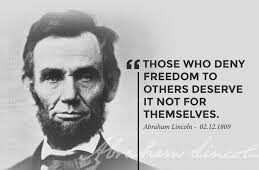
A quotation by a famous personality helps to ground your argument in a solid, proven stance, thus lending it credibility even before you’ve begun.
For example:
“Those who deny freedom to others deserve it not for themselves.” – Abraham Lincoln.
2. Audience-centric introduction
This is a more personal approach that involves getting the audience emotionally or intellectually invested in your topic from the get-go.
a. Relatability
Beginning your essay/speech by mentioning something your audience/readers can relate to helps them feel more personally invested in your topic.
For example:
If delivering a speech about the environment, you could begin by talking about how overconsumption and fast fashion is leading to landfills getting rapidly filled with single-use plastics and clothes that are just one season old.
b. Current/historical events
Mentioning well-known current or historical events gives the audience/reader a frame of reference against which to ground your upcoming argument.
For example:
If writing about the need to fight terrorism, one could reference the 09/11 attacks in New York that caught the world’s attention.
c. Hypothetical scenarios
A hypothetical scenario helps the audience/readers put themselves in a particular situation and imagine how they would react/feel about the argument you are going to present.
For example:
Imagine living in a place where you have to walk ten kilometres a day to access clean water.
This approach has various ways to hook the audience. Here are some of the most popular ones:
a. Anecdotes
Using a personal anecdote helps the audience/reader connect you with the topic better, hence making your argument sound more personal.
For example:
“When I got my first book deal, I did not expect to receive an advance on royalties—this served as a motivating factor in my writing career.”
b. Provocative statements
A surefire way to get the audience to sit up and take notice is to make a statement that could provoke a strong emotion or possibly stir controversy.
For example:
Did you know that when the Big Ben was being constructed in London, its iconic bell cracked, leading to a delay of four years?
c. Weird facts
Mentioning a weird or strange fact at the beginning of your speech/essay is bound to pique your audience’s/reader’s curiosity and get them invested in what you have to say next.
For example:
Did you know that pepper was found stuffed up the nostrils of the mummy of Egyptian Pharaoh Ramses II?
The next time you face that daunting blank page, don’t let the pressure of creating the “perfect” introduction paralyze you. Instead, experiment with these different approaches, find what feels authentic to your voice, and remember that the best introduction is one that genuinely connects with your readers while setting up your message effectively.
Check outPaperTrue’s professional editing and proofreading services to enhance your writing today! With our expert editors, detailed instructional blogs, and AI-powered services, we can help you write insightful and compelling essays and speeches that help you captivate your readers.
Have you just completed writing what feels like the best manuscript of your life, but are you unsure of how it will be received by publishers?
Do you believe a fresh pair of eyes would help gain perspective on your writing? Do you wish you could get a sneak peek at a professional opinion before putting your baby out into the world?
It sounds like you would benefit greatly from a manuscript critique! Read more to learn all about it.
Get a Helpful Manuscript Critique From The Experts! Learn More
What is a manuscript critique?
While the word ‘critique’ might make some authors nervous, let us make one thing very clear: a manuscript critique is all about constructive criticism that will help you fine-tune and improve your manuscript and help it achieve its best possible form. While a critique may involve some suggestions for improvement, it is not all negative—you can also learn many wonderful things about your writing in the process.
To put it simply, a manuscript critique is an evaluation of your work by a professional editor before sending it out to literary agents or publishing houses. Most authors have spent so much time and energy writing and rewriting their manuscripts that they have become desensitised to any possible errors or scope for improvement.
While it is important to go in for a thorough manuscript edit to rule out any possible errors, it also helps to have a professional read through your manuscript from both a subjective and objective point of view and give you constructive criticism on how best to improve and shape it to increase its chances of acceptance by credible publishers.
Manuscript critique vs. book editing
Before we go further, it is important to clarify the difference between manuscript critique and book editing. While book editing is concerned with copy and line edits, such as grammatical and linguistic corrections, and developmental or structural edits, such as checking the flow of the passages and the logic of the story as a whole, a manuscript critic does not step into grammatical or linguistic edits.
A critic’s job is more to take an overall view of the manuscript via a detailed read and then provide the author with feedback similar to developmental or structural editing that will help to enhance the quality of the manuscript as a whole. However, unlike an editor, a critic does not make any changes to the text.
What does a manuscript critique involve?
Here are the steps involved in the process of manuscript critique:
1. Finding the right person
It’s important to find a professional critic or editor whose personality gels with yours—it’s important that you’re both on the same page and there is no room for miscommunication.
2. Negotiating the rate
Like all other professional services, manuscript critique is a paid service. Average manuscript critique rates would be around 0.006–0.024 USD per word, depending on the critic’s level of experience and expertise. The payment is usually made in two installments—one at the beginning of the process, and another before the critic submits their final feedback to the author.
3. A thorough reading
The critic must give the manuscript—including the ancillary documents such as the author bio and summary—a thorough, in-depth read, making note of points they wish to discuss with the author and feedback they would like to share.
4. A detailed discussion
Next, the author and critic need to have a detailed discussion, going over the points the critic had in mind. It is important for the critic to be gentle and at the same time pragmatic with the feedback they offer in order to motivate the author to improve their manuscript without discouraging them.
5. Reworking the manuscript
Finally, it is up to the author to choose which parts of the critic’s feedback to keep and incorporate, but it is worth keeping in mind that a seasoned critic’s advice would only enhance the manuscript.
If you are interested in offering manuscript critiquing services, here is a quick guide on how to go about the process:
1. Get familiar
First, in order to familiarise yourself with the manuscript you are about to critique, read the summary, sample chapters, and author bio submitted by the author. This will put you in the right frame of mind and prepare you for your reading ahead.
2. A quick overview
This step is optional, but some critics find it helpful to skim through a manuscript before reading it in detail, as an overview helps them perform a deep reading with greater accuracy.
3. A detailed read
Next, perform a detailed read of the entire manuscript, chapter by chapter. It is okay to go a little slower here (but make sure you adhere to any deadline you have promised the author!), as long as you can view the manuscript from an objective point of view.
4. Mark out errors/important points
It’s important to make note of errors or any points/suggestions for improvement as you read—this can be done the analog way in a notebook, or as comments in the document itself. Make sure to do this as you read so that you don’t forget anything important. Keep in mind that if you are reading nonfiction or a work requiring specific subject knowledge/information, you will also have to perform your own research side-by-side to cross-check facts.
5. Client email
Once you’re done, send an email to your client outlining your thoughts on the manuscript and giving an overview of your critique. Use this as an opportunity to schedule a call with them so that you can discuss the points further.
6. Client call
Finally, get on a call with your client—either audio or video—and go over all the points you’ve noted down in detail. It’s important to keep your tone polite and encouraging and not make the author feel small for any mistakes. A condescending critic usually makes the author feel defensive and less likely to accept their suggestions. Answer the author’s doubts, if any, and help them brainstorm how to improve on the suggested areas.
If you are wondering whether or not opting for a manuscript critique is worth it, allow us to put it simply: it is an investment in yourself and your work. While it may seem like an extra expense, here are some benefits of opting for a manuscript critique that justify the cost:
1. A fresh perspective
As an author who has spent considerable time writing and rewriting a manuscript, it is easy to get desensitised and overlook certain errors or areas that need improvement. A fresh pair of eyes can easily pick these out and improve the quality of your work.
2. Improved quality
When a professional takes the time to read your manuscript and offer guidance, you can be sure their tips and suggestions will improve the quality of your work and polish your manuscript to achieve its best possible form.
3. Greater chances of acceptance
Once you have got your manuscript professionally critiqued and have incorporated the feedback, it has a higher chance of acceptance by credible literary agents or publishing houses.
Check outPaperTrue’s expert self-publishing services and writer support to enhance your writing today! With our expert editors, detailed instructional blogs, and AI-powered services, we can provide insightful manuscript critique and self-publishing services that will help you achieve your dreams as an author!
The number of self-published books in the U.S. has almost tripled in the last six years.
Self-publishing lets authors publish their work independently without dealing with traditional publishing houses. Authors have turned this into a thriving multi-billion-dollar industry that gives writers complete control of their creative work and the chance to earn a lot more money.
This detailed guide will show you everything about self-publishing. You’ll learn different publishing models and see the process step-by-step. The information will help you decide if self-publishing lines up with your goals, whether you’re writing your first book or thinking about leaving traditional publishing behind.
You Wrote The Book. We’ll Handle The Rest! Get Published
What is self-publishing?
Self-publishing lets authors take control of their book’s journey without going through traditional publishing houses. Authors can chart their own path to publication success.
Self-publishing puts authors in charge of managing and funding their book’s publication journey. Authors can publish their work without any third-party publishers. Digital platforms andprint-on-demand technology have substantially changed this approach since the internet began. Authors can now publish both physical books and eBooks easily.
Authors who self-publish have complete control of their work’s creative process. They handle everything from writing and editing to formatting, design, and marketing. The authors keep full ownership of their content and can set their own timelines and prices.
What does it mean to self-publish a book?
Self-publishing makes you the publisher of your work. You can handle everything yourself or hire professionals to help with specific tasks. The process needs writing, editing, cover design, content formatting, ISBN numbers, and distribution planning.
Authors can earn more through self-publishing. They getup to 70% royalties on eBooks while traditional publishing only offers 10-15%. This financial benefit and creative freedom make many writers choose this path.
Speed is another advantage. Traditional publishers take months or years to get books into stores. Self-published books can reach readers within weeks.
The self-publishing world offers different models that match author goals:
Volume publishing focuses on quick book releases and high productivity. Authors create multiple books rapidly and build series to keep readers engaged.
Engagement publishing builds strong reader connections. Authors create communities around their work and stay in touch with their audience.
Craft publishing values artistic quality and creative expression. Authors spend more time perfecting each book rather than rushing to publish more.
Assisted self-publishing guides authors through the process while keeping their creative control. This is different from vanity publishing, which charges authors money but doesn’t offer proper support or let them keep their rights.
Self-publishing vs traditional publishing
Authors face a life-changing decision between self-publishing and traditional publishing paths. Your choice will shape your creative freedom, timeline to publication, and money-making potential.
Creative control and ownership
Traditional publishers want authors to give up much of their creative control. A publishing contract might limit your input on vital elements like cover design, title choice, and content edits. Publishers often change your manuscript based on their priorities. Your contract with them usually means they own most or all rights to your work. This limits what you can do with your content later.
Aself-published author keeps full creative control. You get the final say on everything about your book – from editing choices to how it looks. Your original ideas stay exactly as you want them. You also keep all rights to your work. This means you can create audiobooks, translate your work, write sequels, or bundle books without asking anyone’s permission.
Time to market and flexibility
Books take two to three years to reach stores through traditional publishing. The process starts with finding an agent, which takes 1-8 weeks just to hear back. Then comes manuscript review (3-6 months), publisher acceptance (3-4 months), contract talks, and production planning.
Self-publishing moves much faster. Your book can go from finished manuscript to published work in days or weeks. This quick timeline lets you catch market trends or release time-sensitive content. You can also change your content, adjust prices, or try new formats whenever you want. No need to wait for publisher approval.
Royalties and revenue differences
Money makes the biggest difference between these paths. Traditional publishers pay 7-15% royalties after they recover any advance payments. Self-published authors earn much more – between 35% – 70%, depending on price and where they sell.
These numbers add up fast. To name just one example, see how selling 6,000 copies as a self-published author could earn you $35,700. The same sales through traditional publishing would only bring in $8,940. Traditional publishing does save you from upfront costs. Self-published authors pay for professional editing ($500-$5,000), cover design ($200-$1,000), and marketing.
Benefits and challenges of self-publishing
Self-publishing opens exciting possibilities but comes with meaningful challenges. Authors must understand the digital world before making informed decisions about their publishing future.
Advantages of being a self-published author
1. Creative freedom
Authors maintain complete control over their book’s content, cover design, and formatting without any compromise, and there are no pushy editors enforcing arbitrary deadlines.
2. Higher financial rewards
Self-published authors earn 60-70% royalties on digital books compared to only 10-15% through traditional publishing channels, with these higher earnings helping to offset initial investments, especially when building strong reader communities.
3. Faster time to market
While traditional publishing takes 18 months to three years from acceptance to bookshelf, self-published authors can release their work within weeks of completion.
4. Full rights retention
Authors keep all rights to their work and can freely create audiobooks, foreign translations, or other adaptations without needing to ask for permission.
You’ll need $1,000-$5,000 before your book is ready
This covers: editing, cover design, formatting, and initial marketing
Solution: Budget carefully and prioritize essential services first
2. You’re Your Own Marketing Team
No publisher means no built-in promotional network
You must reach readers on your own
Solution:
Build a strong presence through:
Social media platforms
Your author website
Book events and signings
3. Finding Quality Professionals
Many editors, designers, and formatters exist, but quality varies
Hard to know who’s truly skilled
Solution:
Read client reviews carefully
Compare multiple service providers
Stay within your budget while prioritizing quality
4. Overcoming Self-Publishing Stigma
Some readers still view self-published books negatively
Poor quality reinforces this bias
Solution:
Invest in an excellent editor (this is crucial!)
Ensure professional-quality work throughout
Match or exceed traditional publishing standards
Is self-publishing right for you?
Authors with entrepreneurial mindsets thrive in self-publishing. This path offers great potential if you enjoy business aspects beyond writing and can dedicate time to marketing, distribution, and production details.
Writers with niche interests often succeed through self-publishing. Traditional publishers might see your work as too specialized for mainstream appeal. Self-publishing lets you reach your specific audience without gatekeepers.
Your timeline needs matter. Self-publishing’s accelerated process benefits those who need quick publication, whether for business purposes or time-sensitive content.
Success in self-publishing comes from balancing creative passion with business sense. You must craft exceptional content while becoming skilled at the many aspects of publishing.
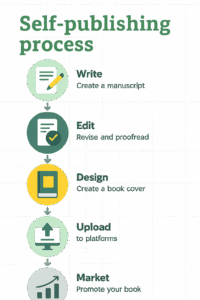
How the self-publishing process works
Self-publishing involves several vital stages that need specific skills and clear decisions. A good understanding of this process will help new authors turn their manuscript into a published book quickly.
1. Writing and editing your manuscript
Your first task is to create a book that sells well. Take time to study bestsellers in your genre. This will help you spot trends and reader priorities while keeping your unique vision that strikes a chord with readers. The editing process becomes significant after you complete your original draft – this is where “the real magic happens”.
Start by self-editing to polish your storyline and characters. Your next step should be sharing your work with beta readers who can give constructive feedback. Professional editors are a great investment for your book. Quality self-published books typically go through multiple editing stages:
Developmental editing: Addresses structural issues like plot and character development
Copy editing: Corrects grammar, punctuation, and improves sentence structure
Proofreading: Provides final polish to catch remaining errors
2. Designing your book cover and layout
A compelling book cover is your strongest marketing tool that can double your sales. You can create designs using templates from platforms like Canva or Adobe Express, or hire professionals (typicallyUSD 500-800 for quality work).
Your book’s interior format matters just as much. Publishing standards dictate specific margins, font selection, and spacing requirements. Reedsy’s free book formatting tool can prepare your manuscript in under an hour.
PaperTrue can create amazing professional book covers to bring your stories to life!
3. Choosing a self-publishing platform
Your choice of distribution platforms should align with your format priorities. Ebook publishers can distribute directly through retailers to keep all profits or use aggregators to reach multiple platforms. Print book authors should look intoprint-on-demand services like Kindle Direct Publishing (KDP), IngramSpark, and even PaperTrue.
Each platform has its own royalty structure and distribution reach. KDP gives 70% royalties for ebooks priced USD 2.99-9.99, while IngramSpark offers 45-65% with wider distribution potential.
4. Marketing and promoting your book
Smart marketing starts before publication. You should build your author platform through a website and a focused social media presence. Early reviews from family, friends, and influencers will boost your book’s credibility.
Strategic pricing works well with pre-order campaigns and promotional discounts. Newsletter promotion services like Freebooksy can help, and Amazon ads can start from just USD 5 per month. Your book’s success depends heavily on effective marketing, no matter how good it is.
Why authors choose to self-publish
Publishing has changed in remarkable ways. More authors now take the self-publishing path. This change goes beyond just having new options – it shows how writers view their craft and careers differently now.
Creative control draws many authors to self-publishing. Self-published authors keep full control of their book’s content, formatting, and cover design, unlike traditional publishing. Writers can stay true to their vision without any compromises from publishing committees.
Money plays a big role in self-publishing decisions. Traditional publishers give royalties of 10-15%, whileself-published authors can earn between 50-70% of their book’s list price. This means self-published authors make about five times more money per book than their traditionally published peers.
Authors choose self-publishing for several personal reasons:
They want to preserve their family’s stories
They have special knowledge for specific readers
They plan to build speaking or consulting businesses
They want to test new ideas freely
They need to write about current trends quickly
They want to keep rights for movies, TV shows, or other adaptations
Self-publishing breaks down the walls between writers and readers. It makes publishing accessible to anyone who wants to share their stories or knowledge with the world.
Your book’s publication marks just the beginning. The “publish” button click changes your life as publishing tasks consume every moment – even during laundry, your mind drifts to social media posts, blog topics, and marketing possibilities.
Self-published authors quickly become their own best promoters. Many authors hope for publisher support, but this path often guides them to disappointment. Daily life shifts to include website updates, promotion coordination, and review tracking.
Reality hits hard with book sales. Authors face disappointment when supportive friends who cheer announcements don’t buy books.The average self-published digital book sells about 250 copies in its lifetime. Some self-published authors reach remarkable success with six-figure incomes, yet published authors’ median annual income stood at just $2,000 in 2022.
The post-publication phase needs you to:
Reach out to bookstores and libraries (many libraries accept only local authors’ books)
Build reader connections through newsletters and social media
Stay alert to scammers targeting new self-published authors
Focus on your next book since your backlist becomes your strongest marketing asset
With this complete understanding, you can now decide if self-publishing matches your goals as an author. This path lets you join countless writers who connect directly with readers worldwide, bypassing traditional gatekeepers.
PaperTrue is here to help you throughout your whole self-publishing journey. We provide expert self-publishing services from editing to publishing. Check out our website and start your publishing journey today!
Most of you might be expected to submit a personal statement as part of your college application. Having an impactful personal statement is vital in getting into the college of your dreams.
The personal statement is a crucial component of your application, and mastering college essay writing can significantly boost your chances of acceptance.
We’ve compiled some impactful personal statement examples for colleges, scholarships, and jobs. These examples should help you learn how to write a personal statement, but if you need a personal statement template for college, we’ve got you covered there, too! But first, let’s understand what goes into creating a strong personal statement or statement of purpose.
Boost your acceptance chances with a perfectly edited personal statement.
What to include in a personal statement?
In order to impress the admissions committee, it is crucial that your personal statement answers key questions about who you are as an applicant. Here are some questions your personal statement should answer, similar to common college essay prompts:
Why am I choosing this program?
What are my primary motivators?
What are my future goals, and how can I achieve them?
Summarizing your life’s goals, aims, achievements, and motivating factors into roughly 600 words can certainly be complicated! It’s confusing what to include and what to omit.
Let’s look at the main points you can include in order to answer these questions.
Adding a touch of character to your personal statement can give the admissions committee insight into your personality beyond your transcripts. By including specific experiences and anecdotes, you can make your personal statement more engaging and informative.
In addition to highlighting your achievements and qualifications, sharing stories about your journey can help answer important questions such as “What sparked your interest in the field of your choice?” or “What motivates you to pursue your goals?”
Personal insights help the admissions committee understand your character, values, and your unique perspective.
Example:
(Engineering applicant)
“At age ten, I watched my grandmother struggle with her walker on our uneven sidewalk. That afternoon, I spent hours with cardboard and tape, designing a miniature ramp system for our front steps. While my prototype collapsed under her weight, her proud smile when she saw my effort sparked something in me. Since then, I’ve been captivated by the idea that engineering isn’t just about building things—it’s about building solutions that improve lives.”
2. Qualities that make you stand out
To create a strong impression on the admissions committee, simply listing out your achievements doesn’t cut it. Since they already have access to your transcripts, it’s important to go beyond the surface-level accomplishments and highlight the unique qualities and skills that make you a perfect candidate for the program of your choice.
Instead of solely focusing on your achievements, emphasize what you learned and how it impacted you. Discuss the challenges you faced, the lessons you learned, and the skills you developed.
Highlight how these experiences have shaped your values, perspectives, and goals. By highlighting the specific qualities and skills cultivated from each of your experiences, you can paint a compelling picture of who you are as an individual and what you can bring to the institution.
Example:
(Computer Science applicant)
“Yes, I won the regional hackathon, but the real victory happened at 3 AM when our code crashed for the fifth time. My teammate wanted to quit; I wanted to throw my laptop. Instead, we took a walk and laughed about our disaster. That break gave us a fresh perspective—we’d been overcomplicating the solution. We scrapped 12 hours of work and started over with a simpler approach. This experience taught me that innovation isn’t about writing perfect code; it’s about resilience, collaboration, and knowing when to step back. These skills matter more than any trophy.”
3. Specific reasons for selecting the program of your choice
It’s important to showcase your research and highlight specific aspects of the program that you appreciate in your personal statement. This can help show your interest and commitment to the program.
There are a variety of aspects you can research. For example, if the program has access to state-of-the-art equipment that is not commonly available in other programs, you can emphasize its value and explain how it aligns with your research interests.
You can also highlight a niche topic or research area that is not covered in other programs and explain how it helps you reach your goals.
Example:
(Environmental Engineering applicant)
“Cornell’s unique partnership with the Cayuga Lake monitoring station sets your program apart. Your real-time water quality database, maintained continuously since 1998, offers an unparalleled dataset that directly supports my interest in studying harmful algal bloom prediction models. Professor Martinez’s machine learning approach to early detection, combined with access to 25+ years of historical data, would allow me to develop predictive algorithms impossible to create elsewhere. Additionally, your program’s emphasis on community engagement demonstrates how academic research can drive immediate environmental impact—exactly the type of applied science I want to pursue.”
Following these personal statement tips can help set you apart from other applicants and increase your chances of being accepted into the program.
Now that we’ve taken a look at what goes into the best personal statements, let’s look at some sample statements and essay examples.
From a young age, I have been fascinated by the workings of the human mind.
My interest in psychology only deepened with time. I began reading books and watching documentaries about the latest research in this field. I was particularly drawn to the areas of cognitive psychology and neuropsychology, which explored how the brain processes information and how this affects behavior.
So when the time came to choose a major in college, I knew that psychology was the natural choice for me. This is precisely why the Clinical Psychology program at Stanford University has my deepest interest. The university has produced a significant amount of research in the field, some of which includes studies on student stress and cognitive biases.
I currently volunteer at a local mental health clinic, where I work with patients with a range of mental health conditions. During high school, I also had the opportunity to intern for a study that conducted studies on the effects of mindfulness meditation.
Through these experiences, I became passionate about the potential of psychological research and its real-world impact.
Now, as I prepare for college, I am excited to continue exploring the frontiers of this fascinating field. I am particularly interested in the intersection of psychology and technology, and the ways in which virtual reality and other emerging technologies interact with mental health.
Ultimately, I hope to use my skills and knowledge to make a meaningful difference in the lives of others. I believe that psychology can unlock new levels of human potential and I’m committed to helping others achieve this through the power of psychology.
I was fascinated with television ever since I could remember. I always wondered how people fit into a box that small, wanting to dismantle and rebuild it. As I got older, my curiosity only grew stronger, and I found myself drawn to science and technology.
As a young teenager, I stumbled upon a programming book at the library. Intrigued by the idea of creating something out of nothing, I delved into the world of computer science. As I learned more about programming, I discovered a whole new way of understanding and interacting with the world.
Over the years, my love for technology continued to grow, and I knew that I wanted to pursue a career in this field. In college, I studied computer science and engineering, immersing myself in the latest developments in the field. I also had the opportunity to work on several projects that allowed me to put my skills into practice, including designing and building a small robot and creating an app that helped people track their carbon footprint.
As I approached graduation, I knew that I wanted to use my skills to make a positive impact on the world. I began volunteering at a local non-profit that focused on using technology to address social and environmental challenges. Through this work, I discovered a passion for using technology to create meaningful change in the world.
Now, as I prepare to take the next steps in my career, I am more excited than ever about the possibilities that lie ahead. I am eager to continue exploring the intersections of technology, social impact, and environmental sustainability. One small step at a time, I am committed to using my skills and knowledge to make a positive difference in the world.
Chemistry has always fascinated me. From the chemical reactions that occur in our everyday lives to the intricate mechanisms of the human body, chemistry is the foundation of everything around us.
My interest in chemistry sparked when I watched my mother make cheese from whole milk, witnessing firsthand how she separated the cream from the milk and transformed it into cheese.
Because of this interest, I delved headfirst into the world of chemistry. I took advanced courses and consistently received top grades. I also participated in a number of extracurricular activities, including science clubs and competitions. In addition, I conducted research in this field, working with my teacher to investigate the effects of different solvents on chemical reactions.
My experiences have taught me the importance of attention to detail, careful observation, and teamwork. I believe that these skills will be essential as I continue my studies and pursue a career in this subject. I am confident that my passion for the subject, combined with my academic achievements and research experience, make me a strong candidate for this scholarship.
In conclusion, I am deeply grateful for the opportunity to apply for this scholarship. I am committed to pursuing a career in chemistry and believe that this scholarship will help me to achieve my goals.
With the financial support and encouragement provided by this scholarship, I am confident that I will be able to make a meaningful contribution to the field of chemistry and to society as a whole.
Personal statement example for jobs
As I left home, I vividly remember my mother urging me to stay safe and call her every week. I had to move to Texas, leaving my mother behind in Honduras for 10 years.
When we were finally reunited, she shared the horrors she had faced back home, the worsening violence and poverty caused by drug abuse. Her experiences finally pushed me to take some form of action within my sphere of activity. Of course, there was no option but to excel at school.
Due to the recurring culture shocks and adjustments, I had to work harder on my academics. But it was through extracurriculars such as the debate team and volleyball that I truly felt included. This gave me the confidence to lead the Model United Nations (MUN) in college. We organized events to collect funds for relief centers in Somalia, raising over $20,000.
When elected student council president, I organized teams to conduct drives in Somalia and Guatemala. Even having heard stories from my mother, witnessing the daily struggles in these countries completely changed my perspective toward human rights, privilege, and global accountability.
My experiences have given me deeper insights into the trials and tribulations faced by people of color, especially in African countries. As part of your organization, I can make a larger difference in the global politics of racial equity.
This personal statement template for college is a foolproof guide to help you craft a successful application. Our relevant personal statement examples and carefully curated template will answer all the questions of the admissions committee and will provide valuable insights into your qualifications and aspirations.
Download this free personal statement template to showcase your academic and extracurricular achievements, highlight your relevant experience, and express your passion for the program.
If you think you need additional help editing and proofreading your personal statement, you can consider approaching a professional essay editing service like PaperTrue for an impeccably formatted personal statement.
Do you have your dream manuscript complete, and are you looking for the right literary agent to represent it?
Are you confused by the vast number of literary agents you come across online, and are you unsure about whom to approach?
Then you are in the right place, for we have compiled a checklist of the qualities and services you need to look for in a literary agent, which will help you distinguish the genuine agents from the fake ones.
Your Book. Our Expertise. Let’s Publish It! Learn More
Who are literary agents
Before we get into our checklist, we must answer an all-important question: Who exactly is a literary agent, and what exactly is their role?
To put it simply, a literary agent is a middleman between the author and the publisher. They are especially relevant in the field of traditional publishing, as major traditional publishers receive tons of submissions each day and do not often have the time to read through all of them. Submitting a ‘solicited manuscript’—a manuscript represented by a literary agent, as opposed to an ‘unsolicited’ or self-submitted one—greatly increases your chances of having your manuscript read by the publisher.
The literary agent’s job, therefore, is to solicit manuscripts from authors, select the ones that appear promising, help the author fine-tune it, write a proposal email, submit the book to traditional publishers, and help the author understand their publishing contract and negotiate rights and royalties. Some agents also shop book rights to film directors and production houses, and help authors strike book-to-movie deals with competitive royalties and payments.
What does a genuine literary agent do
The typical duties of a genuine literary agent are as follows:
1. ‘Discovering’ authors
Literary agents/agencies usually invite submissions from authors via email. They may take some time to reply due to the volume of submissions they receive, but their job is to sift through the submissions and ‘discover’ works and authors of potential and help them get published. Many agents also have a roster of old authors whom they have represented before whom they have developed a strong working relationship.
2. Fine-tuning manuscripts
Once the manuscript has been accepted, the agent typically gives the author detailed instructions on how to tweak and fine-tune certain areas in order to help it achieve its best possible form, and therefore have a high chance of acceptance with credible traditional publishers.
3. Approaching traditional publishers
A credible agent has contacts with a wide range of well-known traditional publishers who have a track record of publishing acclaimed work of literary merit. The agent’s job is to pitch the author’s work to such publishers, who might otherwise be out of the author’s reach.
4. Negotiating contracts and royalties
The agent goes through the publishing contract given to the author and helps fine-tune it to help the author get the best possible deal in terms of services offered by the publisher and percentage of royalties.
To put it simply, a genuine literary agent gets paid when the author does. They typically take a cut of the advance on royalties given to the author by the publishing house—usually about 20 per cent—as their fee. They may take a similar cut of the payment made to the author by a production house if the book is accepted to be made into a movie.
Some literary agents also offer paid editorial services, which are separate from their typical agenting duties. However, it is important to note that a genuine agent offering editorial services must always show the author the complete, edited manuscript with the edits clearly marked out for their approval.
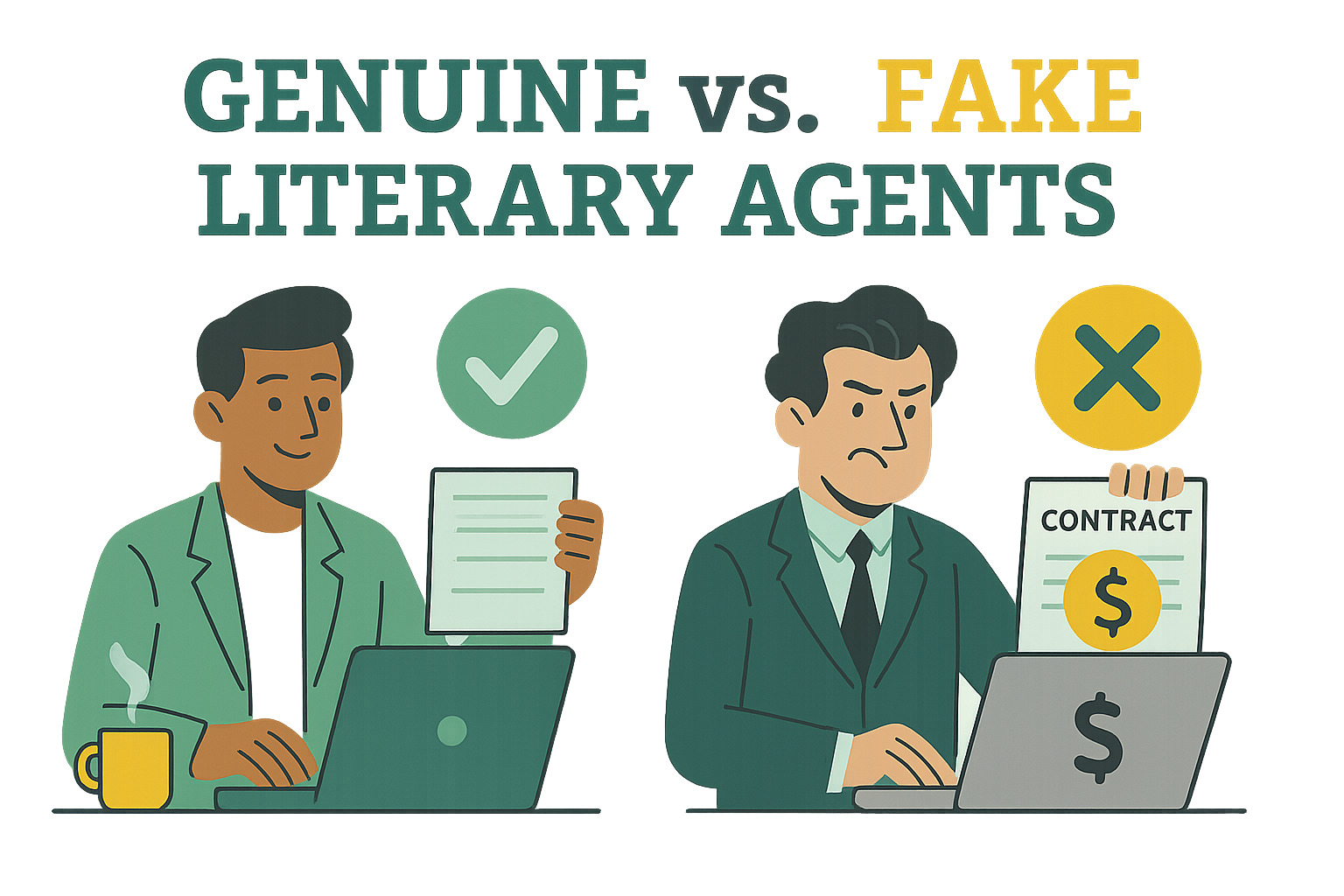
Fake literary agents have one defining quality—they prioritize money-making over literary merit. Here are some red flags to keep an eye out for when dealing with literary agents:
1. They do not have a screening process
A credible literary agent/agency typically has a screening process that involves first reading the sample chapters and synopsis and, if they are considered of literary merit, reading the whole manuscript of the author before making a decision as to whether to represent it or not. This process typically takes a minimum of a month. If an agent has a very short or non-existent screening process and accepts almost every manuscript that comes their way, it is clear that their focus is more on optimizing their earnings rather than finding good writing.
2. They demand payment up front
As mentioned earlier, the agent gets paid when the author gets paid. If an agent demands a signing amount or upfront payment from the author even before submitting their work to publishers, they are fake and must be avoided.
3. They are not transparent
A literary agent should keep the author informed as to which publishers they are submitting the manuscript to. A lack of transparency in this regard is a sign of a fake agent.
4. They do not pitch solely to well-known traditional publishers
The whole point of using a literary agent’s services is to gain access to publishers who might otherwise be out of the author’s reach. If literary agents submit manuscripts to sundry publishers who are not very well known or who take payment from the author and are essentially self-publishers, it defeats the purpose—the author could have found such publishers themselves without an agent’s help. An agent must pitch only to well-known traditional publishers who have a proven track record of producing works of literary merit.
5. They do not show edits
If a literary agent offers editing services, they are duty-bound to show the author the edited manuscript WITH the edits clearly marked up, along with explanations of why developmental edits were made, if any. It is also the author’s final call whether to accept or reject any of the edits. Some fake agents collect payment for editing and then avoid showing the author the final manuscript before submitting it to publishers—in such cases, the edits made may be insignificant, or may not have been made at all.
6. They insert unnecessary clauses in their agreements
If a literary agent has inserted clauses such as ‘the agent has the right to represent the author’s next work’ or ‘the author must mention the agent in the acknowledgements of their work’, RUN! Such things are not enforceable on any author, and so making them a clause in the agreement that the author has no choice but to agree to is unethical.
Differences between genuine vs. fake literary agents
Use this guide to make sure you are well-equipped when stepping into the world of literary agents, and do not get cheated. We wish you the best of luck!
Check out PaperTrue’s expert self-publishing services and writer support to enhance your writing today! With our expert editors, detailed instructional blogs, and AI-powered services, we can help you create the perfect SEO-optimized content your website needs to shine!
So you’ve got your blog or website article topic, but are not sure how to ensure it grabs eyeballs on the web? Here is a practical guide to writing SEO-optimized content that will increase traffic to your webpage!
Polish and Perfect Your SEO Content with Expert Editing Today! Learn More
What is SEO content?
SEO or Search Engine Optimization is an essential part of web content writing today. In the race to get hits on your website, using the right keywords and phrases and tailoring your content to rank high in search engine results pages (SERPs) plays a massive role in your success.
Essentially, you are getting into the skin of the person searching for results and predicting what they are looking for. Therefore, it is of prime importance to use the phrases they are likely to type into their search engine in your content.
How to write SEO-friendly content
So you have a website or blog, you have a topic in mind, but you’re not sure how to write something that will make your work a top result on major search engines? Here are some simple, logical, and effective tips to write good, SEO-backed copy that will ensure your website or blog grabs eyeballs!
Step 1: Get into the reader’s head
The very first step when it comes to writing web copy that will resonate with readers is to get into the reader’s head. Suppose you were searching for answers on a particular topic, what sort of questions would you ask? Frame your article around answering those questions, and research commonly used keywords in articles on the same topic as you use. Insert these at strategic locations in your text and voila! You have what the reader is looking for.
Step 2: Use headings effectively
No one likes to read through a massive chunk of text online with no paragraph breaks, unless they want a headache! Break up your text into short paragraphs and use H2 and H3 subheadings to give the reader an idea of what the paragraphs are about at a glance. These headings should be short and to the point, incorporating SEO keywords that the reader is likely to be looking for. This also increases the chances of your article ranking high on major search engines.
Step 3: Make your content viewer-friendly
Once you are done dividing your text into paragraphs, it is important to dress it up a little in order to make your blog more viewer-friendly. Use bullet points, insert relevant images at strategic places, and format your subheadings in bold so that they catch the reader’s eye.
Step 4: The technical stuff
Once you’ve got the basic text in place, it’s time to insert a few technical details that will bring it all together nicely, like icing on a cake! Write a meta description of 145–155 characters that is sharp, snappy, and brings home the point of your article to a casual skimmer. Keep your URLs short to avoid links with large amounts of trailing text. Finally, ensure your images all have alt text that provides the reader with some context.
Step 5: Link it up
Now that your article is ready, it’s important to include internal links before publishing—internal links lead the reader to articles on related topics elsewhere on your website. This way, you can increase traffic and readership!
Now that you’ve got the basics sorted, it’s time to dive into the specifics of SEO optimization. Keywords are of prime importance—the path to success in the world of SEO is to insert the right keyword at the right place. Here is some detailed information about keywords that will help you:
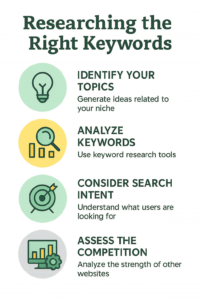
How to research the right keywords
As mentioned before in this article, the key to getting your keywords right is to ask questions from the reader’s perspective. Suppose you were a reader looking for recommendations for the best thriller movies to watch, you’d likely enter some of the following phrases in your search engine: new thriller releases, new English (or insert any other language) thriller movies, thriller movies playing near me, and so on. Voila! There you have it—some ready-made keywords and keyphrases. Researching the right keywords would involve working backwards, in a way—taking a deep dive into the topic, and then making a note of all the points that would likely be asked by a reader looking for information on that particular topic.
How to insert keywords without being over-the-top
Once you’ve got your list of keywords, it’s important to perfect the delicate art of inserting them at the right place—an article peppered with two or three keywords per sentence can come across as repetitive or overpowering. Instead, insert one keyword or keyphrase every two or three lines, and build the rest of the passage around it. This way, you answer the reader’s questions and create SEO-optimized content without compromising on readability.
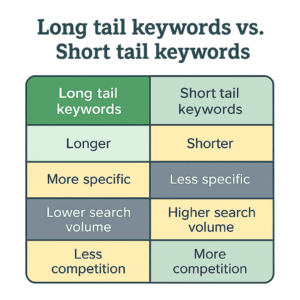
It is also important to know what are long- and short-tail keywords and how to use them. To put it simply, short-tail keywords are what a reader would type when in a hurry—brief phrases that would provide a wide swathe of information on a particular topic. For example, ‘Disney movies’. Long-tail keywords, on the other hand, are more like detailed questions a reader would ask when looking for specific information. For example, ‘Disney movies based on fairy tales’ or ‘21st-century Disney movies’. Short-tail keywords typically have a higher search volume than long-tail keywords, but it is important to have a mix of both in your article to ensure your content stays at the top of search engine results.
Writing good SEO-optimized content does not look the same for all websites. While keyword research is important across topics, the tone of different kinds of sites can vary, requiring the writer to tailor their content accordingly.
Personal blog: As the name suggests, when writing for a personal blog, the tone should be light and informal—even vulnerable, if the occasion calls for it—and the topics need to be relatable and should give an insight into who you really are. Some examples include fashion blogging, travel blogging, food blogging, parenting, skincare, makeup, or simply writing about your life experiences as a kind of online diary. Effective use of fashion SEO can help style-focused blogs reach a wider and more engaged audience.
E-commerce site: Since the primary goal of an e-commerce site is to sell something to the audience, the language must be smart, snappy, and persuasive. It is best to avoid long, waffling descriptions and unnecessarily wordy passages. Craft your descriptions with keywords related to the products you are selling, for example, ‘gold-plated watch for women’.
Informative/research site: Providing information aimed at researchers or students calls for a more formal tone. It is best to avoid casual phrasing and have a more grounded approach to sharing research-backed information. It helps to imagine you’re explaining a topic to a class when writing these kinds of articles.
Entertainment site: The language on an entertainment site is usually fun, bubbly, and gossipy. The tone can be casual, and the topics need not necessarily be too deep or philosophical. Popular topics include those about upcoming TV shows and movies, reviews of new shows and movies, and pieces about what celebrities are up to.
How to write for local SEO
It is very important to ensure your website ranks high in localised searches. The best way to do this is to use keywords that are popular in local SEO. For example, if your website is promoting a jewelry store in a particular city, the meta description could include phrases like ‘best hallmarked gold in <enter city’s name>’, or ‘oldest and most trusted jeweller in <enter city’s name>’. It could also include short-tail keywords like ‘gold jewelry in <enter city’s name>’, ‘silver jewelry in <enter city’s name>’, and so on to show up high in the localised search results in that particular city or region.
Check out PaperTrue’s expert editing and proofreading services to enhance your writing today! With our expert editors, detailed instructional blogs, and AI-powered services, we can help you create the perfect SEO-optimized content your website needs to shine!
Imagine this: you’re finally ready to launch your website in Spanish, but you’re not fluent. Or maybe you need to translate a legal document for a client in Germany. The world is shrinking, and the need for language translation services is growing faster than ever.
But with so many options out there, finding the right translation service can feel like navigating a foreign language itself! Don’t worry; this guide is your key to online translation services. We’ll break down the best options, highlighting their strengths and features for you!
Get professional editing for your translated text!
The 10 best language services are:
1. RWS
RWS is a global leader in language translation services. Their strengths lie in their industry expertise, specializing in technology, healthcare, and finance. RWS leverages advanced technology to ensure accuracy and efficiency, helping businesses grow and reach more customers.
Has a vast network of translators worldwide
Offers localization, interpretation, and content management
Provides a transcreation service that adapts the text, style, and design to create a unique cultural and linguistic experience
Review by skilled linguists after initial translation by a custom machine translation system
Translators are native language speakers to ensure the correct meanings after translation
Pricing: You can get a customized quote based on your needs.
2. Lionbridge
Lionbridge is another global powerhouse with a strong reputation for delivering high-quality translation services. They have a global presence, with offices and translators around the world. Lionbridge’s technology-driven approach streamlines the translation process.
Specializes in various industries, including marketing, e-commerce, and technology
Offers excellent customer support to ensure a smooth experience
Language services include online translation, document translation, and website localization
Localize devices, apps, and software targeted to a certain language and culture
Pricing: You can get a customized quote based on your needs.
3. TransPerfect
TransPerfect offers a diverse range of translation services, including interpretation, localization, and voice-over. They have a vast network of professional translators worldwide. TransPerfect is also known for providing excellent customer service to understand your needs.
Specializes in various industries, including legal, medical, and financial
Language services include document translation, video and audio translation, and transcription
Offers a translation management system, GlobalLink, that simplifies creating, managing, and deploying global content
Provides email, chat, AI, and machine translation services
Localize software and mobile applications across various platforms
Pricing: You can get a customized quote based on your needs.
LanguageLine Solutions specializes in providing interpretation services for various settings, including healthcare, legal, and education. They use advanced technology to connect interpreters with clients quickly. LanguageLine Solutions provides 24/7 customer support.
Has a vast network of interpreters worldwide
Provides professional translation services in more than 200 languages, such as Arabic, Bosnian, Serbian, etc
Users can translate documents, marketing materials, forms, communications, and how-to guides
Offers localization of websites, hardware, software, in-game content, and e-learning
Has options for AI translation using machines and integrated translation tools
Pricing: You can get a customized quote based on your needs.
5. The Translation Company
The Translation Company has a strong reputation for delivering high-quality language services. They offer competitive pricing for their online translation services. The Translation Company also focuses on providing excellent customer service.
Specializes in various industries, including marketing, legal, and technical
Provides translation services in more than 200 languages, including French, German, Portuguese, etc
Language services include education, non-profit, and business translation
AI-translated documents reviewed by linguistic experts
Guarantees high-quality translation with a quick turnaround time
Pricing: Around $249 for 1000 words to be translated into English.
6. CSOFT International
CSOFT International has a global presence, with offices and professional translators around the world. They have a strong reputation for delivering high-quality translation services. They specialize in various industries, including technology, healthcare, and finance.
Offers effective terminology management
Language services in 250+ languages, such as Hindi, Japanese, Polish, etc
Provides end-to-end medical document translation
Localization services for software and websites
Provides translation solutions to NGOs, manufacturers, media, and entertainment sectors
Pricing: You can get a customized quote based on your needs.
Gengo offers a user-friendly online platform for ordering translations. They use a network of professional translators worldwide and offer competitive pricing for their translation services. They provide quick turnaround times for translations.
Serves industries like E-commerce, hospitality, entertainment, business, etc
Translates various types of content such as user reviews, product descriptions, website copies, and more
Official translation services in more than 60 languages, including Pashto, Hebrew, Tagalog, etc
Translations for platforms such as YouTube, Magento, and WordPress
Offers website and app localization services
Pricing: Standard services start from $0.06 per word.
8. TextMaster
TextMaster specializes in translation and localization services for marketing content. They have a vast network of professional and localization experts worldwide. TextMaster offers specialized translation and localization services for various marketing channels, including websites, social media, and email.
Provides technical, legal, and financial translation services
TextMaster’s interactive glossary, LEXIO™, can be used for customized translations
Supports file formats like PDF, CSV, TXT, and HTML
Language translation services for more than 50 languages, such as Finnish, Mandarin, Danish, etc
Integration for translation with tools like Shopify, Salesforce, Drupal, and Magento
Pricing: Standard services start from $0.088 per word.
9. Smartling
Smartling offers a cloud-based platform for managing translations. They integrate with other popular tools, including content management systems and marketing automation platforms. They have a vast network of professional translators worldwide.
100% native-speaking translators
Professional and specialized translation options
Online translation services include machine translation as well as AI-powered human translation
Performs translation quality assessment
Ensures language quality and maintains visual and linguistic consistency when localizing a product
Pricing: They offer two customized plans: Core (for individuals) and Enterprise (for companies).
Blend offers quick turnaround times for translations. They support a wide range of language pairs. They offer competitive pricing for their translation services and provide excellent customer support to ensure a smooth experience.
Offers voice-over, multilingual content writing, and transcription
Custom local insight reports to analyze the local appeal of a brand or product
Live translation for business meetings, press conferences, seminars, and events through simultaneous professional interpretation
Online translation services for legal, finance, life sciences, and marketing industries
Innovative virtual assistant and synthetic voice applications
Pricing: Around $154 for 1000 words to be translated into English.
Translation services are essential for businesses and individuals alike. They allow us to communicate effectively across borders and cultures, expanding our reach and opportunities.
On average, online language services are estimated to be about 70-85% accurate for common language pairs and straightforward text. However, accuracy can vary depending on the complexity of the content, the language pair, and the specific translation service being used. For more specialized or nuanced content, accuracy rates may be lower, around 50-70%.
When choosing a language service, look for features such as language pair availability, translation accuracy, user-friendliness, and additional tools like glossaries and translation memory. Some services also offer real-time translation and document translation capabilities. You can also consult a language services directory to find the best option for your needs.
To ensure that your translated content is error-free, check out PaperTrue’s expert editing and proofreading services. Let us help you make a lasting impression, no matter what language you’re speaking!
If you always end up confusing different punctuation marks with each other, you’ve ended up at the right place! Different punctuation styles are used in various writing formats, such as academic, creative, and informal writing.
Our list of punctuation marks will tell you what the 14 punctuation symbols are in English and how to use each one. We’ve added plenty of examples and a free guide so you never have to look for this information again!
It’s best to start with the meaning of punctuation marks. What role do they play in writing, and why are they important? Let’s dive in.
Punctuation errors are easy to miss. We can help!
What are punctuation marks?
Punctuation marks are a set of symbols used in writing to separate sentences and phrases in order to indicate pauses, stops, emphasis, and tone. Without punctuation, writing will consist of blocks of text that can’t reflect major aspects of language.
Different languages use different types and numbers of punctuation marks, for various purposes. French, for example, has 17 of them while Arabic only has 6. English has 14 punctuation marks, used to separate or connect elements of grammar, indicate a pause, denote ownership, and more.
In this guide, we will cover the basics of punctuation, including the different types of punctuation marks, their uses, punctuation examples, and how to use them correctly. We will also discuss common punctuation errors and provide tips on how to improve punctuation skills.
Why are punctuation marks important?
Punctuation marks are important in writing to capture the meaning and flow of spoken language. They help you communicate your thoughts and ideas clearly and create an easy reading experience for your reader. Proper punctuation enhances the clarity and rhythm of written sentences, making them easier to read and understand.
Take a look at this punctuation marks example:
“Can you tell me who wrote ‘The Bell Jar’? I can’t seem to remember,” Jin said. He scratched his head, frowning, making a show of thinking very hard. “Plath,” said May, not looking up from her sketchbook. “The only novel she wrote—published under the pseudonym ‘Victoria Lucas’, though.”
Here’s the same paragraph with no punctuation:
Can you tell me who wrote The Bell Jar I cant seem to remember Jin said He scratched his head frowning making a show of thinking very hard Plath said May not looking up from her sketchbook The only novel she wrote published under the pseudonym Victoria Lucas though
There is no rest for the eye, no pauses or separations, and absolutely no tonal changes. Beginning to see why punctuation is important?
Here are five ways punctuation improves your writing:
Reduces ambiguity and makes your writing clear.
Communicates your tone and emphasis effectively.
Breaks the sentence into smaller chunks, making it easier to read.
Makes it easier for the reader to trust your authority.
Prevents misunderstandings and confusion.
Now that we’ve seen the importance of punctuation, let’s understand how to use punctuation marks correctly. We’ve added several punctuation marks examples so you never forget how to use each mark!
What are the 14 punctuation marks?
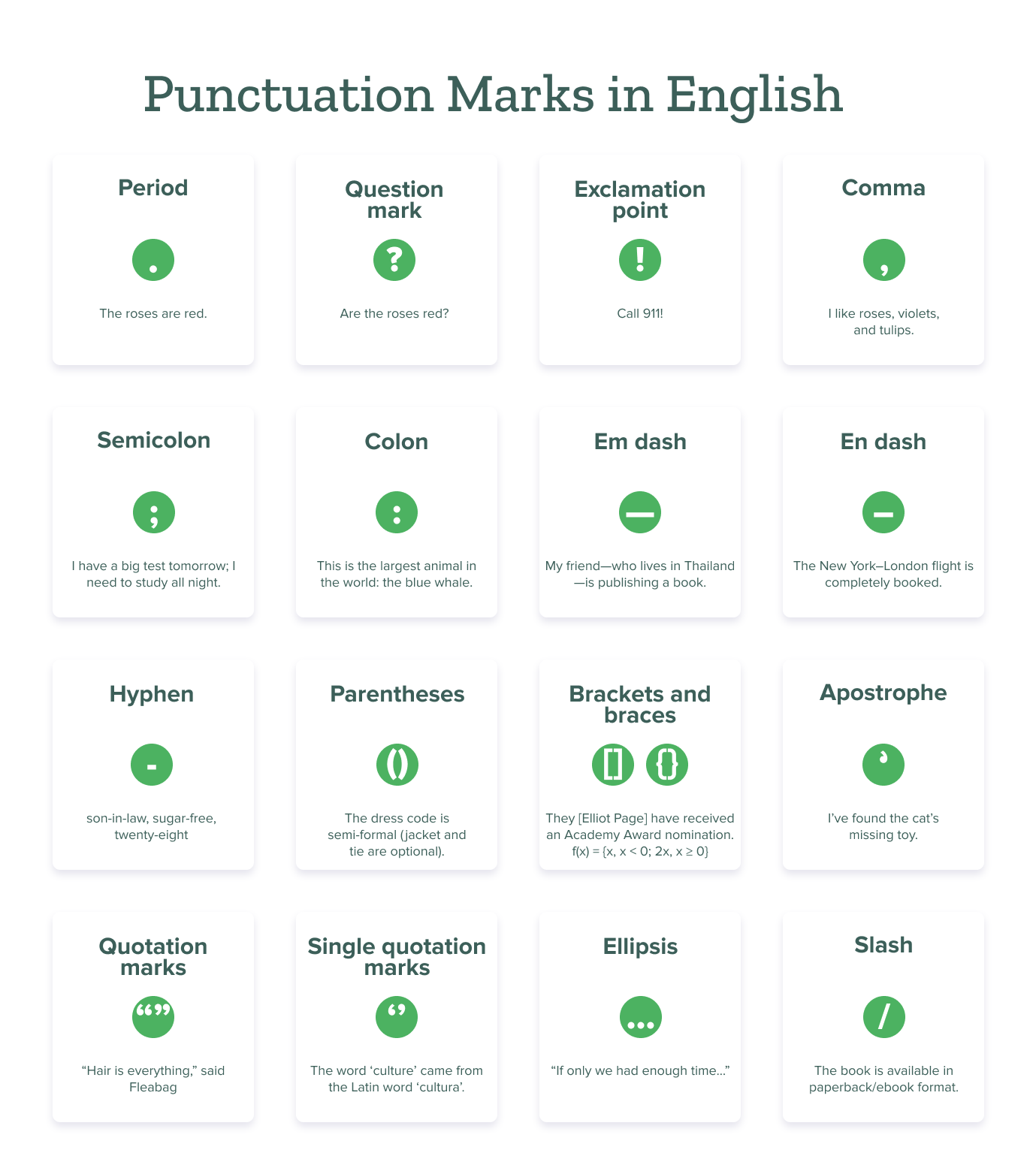
Here are the 14 punctuation marks in English: the period, question mark, exclamation point, comma, semicolon, colon, dashes, hyphen, parentheses, brackets, apostrophe, quotation marks, ellipsis, and slash.
Some consider the two dashes, en dash and em dash, as separate punctuation symbols. The use of these punctuation marks is quite different, so this characterization isn’t strictly wrong. Some guides also consider braces as more deserving of a place in the punctuation marks list than the slash. However, we’ve considered the 14 punctuation marks most commonly taught in English educational courses around the world.
Ultimately, the characterization is of little importance. It’s much more important to know the use of punctuation marks than how they’re characterized! Let’s dive in.
1. Period (.)
The . is called a period or a full stop. It is most commonly used to end a sentence. That is, all sentences that aren’t direct questions or exclamations! Here are some examples:
The roses are red.
Please close the door.
Violet asked me if she could come to the event. (An indirect question, but written as a statement.)
The second most common use of the period is to denote abbreviations, initialisms, and decimals.
Abbreviation: Dr. Susan and Mr. Ziyuan are headed to the clinic.
Initials:Agents of S.H.I.E.L.D. aired at 8 p.m. yesterday.
Decimal: The value of pi is 3.14.
2. Question mark (?)
The ? is called a question mark. It is most commonly used to ask direct questions.
Are the roses red?
Can you close the door?
Confusion and disbelief:
How is this possible?
Are we sure it’s a power cut?
Questions within quotation marks:
“Can I come to the event?” Violet said.
“Are you ready, Ziyuan?” said Dr. Susan.
Question tags:
The value of pi is 3.14, isn’t it?
You went clubbing last night, didn’t you?
Note: It’s important to consider the tone of the utterance while using question marks. A questioning tone is the best indicator of when to use these punctuation marks and not wh-words.
3. Exclamation point (!)
The ! is called an exclamation point or exclamation mark. You can also call them bangs or shrieks if that suits your fancy! They’re used to show strong emotion, urgency, or an outcry. Exclamation points are crucial for conveying intense emotions and providing clarity in writing.
Here are the ways in which you can use an exclamation point:
Excitement or enthusiasm: How lucky I am to win the lottery!
Surprise or shock: I can’t believe that just happened!
Urgency: Call 911! Hurry, we don’t have much time!
Command: Apprehend him!
Strong emotion: I’m so happy for you!
Exclamations come with a forceful tone and impact, so it’s best to use them in small doses. Otherwise, you can tire your reader with excess excitement!
4. Comma (,)
The , is called a comma. It is used in a number of ways, the most common of which is to separate elements within a sentence. Commas are also used to separate two complete sentences, which are independent clauses.
Serial comma:
Sharon bought needles, string, and ten bolts of fabric for her dress.
Bracketing comma:
Al Pacino, who was born in 1940, is one of the most celebrated actors of all time.
Born in 1940, Al Pacino is one of the most celebrated actors of all time.
Joining comma:
Violet wanted to stay home, but her friends convinced her to go out.
Introductory comma:
On the other hand, some people prefer apples over mangoes.
The comma is also used to separate two adjectives of the same type.
Ibrahim is a kind, caring friend.
In the English language, we also use commas in numbers and dates:
Li Guangli accepted the war treaty with a tribute of 3,000 horses.
The day was Friday, April 28, 2023.
Improper use of commas can lead to errors such as comma splices. Understanding how to connect two complete sentences effectively is crucial to avoiding punctuation errors.
5. Semicolon (;)
The ; is called a semicolon. It is used to connect two independent clauses that are closely related to each other.
The restaurant was too loud; we decided to go elsewhere.
Paramount Pictures didn’t want to cast Al Pacino in The Godfather; the studio was uncertain about casting an unknown actor.
I have a big test tomorrow; I need to study all night.
Semicolons are also used to separate items in a list that already consists of commas.
The menu today is steak with mushrooms, onions, and peppers; grilled salmon with lemon, garlic, and dill; and roasted chicken with potatoes, carrots, and onions.
Kyoto, Japan; Rio de Janeiro, Brazil; and Cusco, Peru are among the most beautiful cities in the world.
6. Colon (:)
The : is called a colon. Mostly, it has one and only one major use: elaborating on whatever precedes it. (See what we did there?)
Colons (:) are punctuation marks primarily used to introduce explanations, lists, or to emphasize points within sentences. They connect related ideas, clarify sentence structure, and improve readability.
You can use this punctuation mark to introduce a list, further explanation, or a quote.
List:
His groceries stumbled out of the paper bag: eggs, bread, cheese, and lots of oranges.
Elaboration:
Anong saw it with complete clarity: She was in danger.
Quotation:
Yeats said it best: “All dreams of the soul end in a beautiful man’s or woman’s body.”
A colon can also help add emphasis on a phrase or word.
There is one creature larger than any other animal on the planet: the blue whale.
When using a colon, always capitalize the first word if—and only if—the following element is a complete sentence.
Less commonly, we also use the colon in the following instances:
Subtitle: The Beam: Part One
Time: 05:05 a.m.
7. Dashes (—/–)
There are two types of dashes in the English language: em dash and en dash. They are horizontal lines slightly longer than a hyphen and are mainly found in typeset documents.
Em dash (—)
The — is called the em dash, and it is the longer of the two dashes. The em dash is used to provide additional information and indicate an interruption or an emphasis.
Additional information:
My friend—the one who lives in Thailand—is publishing a book.
Interruption:
“I’m so glad we finally met—”
“Truly! This was such a great evening!”
Emphasis:
It’s time to study the most intriguing of all astrological bodies—black holes.
En dash (–)
The – is called an en dash, and it is the shorter of the two dashes. It indicates a range of values or a connection between two grammatical units.
Indicating a range:
The decade 2010–2020 was a time of great technological advancements.
Connecting two units:
The New York–London flight is completely booked.
Showing conflict or opposition:
The Lakers–Celtics rivalry is well-known in the sports world.
Note: Unless your style guidelines recommend it, never use spaces with dashes. Aside from some rare instances (01 January 2023 – 31 December 2023), using spaces with the en dash is never permitted.
The – is called a hyphen. Shorter than both dashes, it is most commonly used to join words or parts of words. A hyphen is specifically used in the creation of compound words, connecting two or more words to form a single term.
The spelling of pheromones is p-h-e-r-o-m-o-n-e-s.
Why is it so c-c-cold in here?
It is important to distinguish hyphens from dashes, as confusing them can lead to common punctuation errors.
9. Parentheses ()
The ( ) are called parentheses. They enclose additional information that isn’t strictly necessary in the sentence but provides context.
Clarification:
The company’s profits have increased by 20% (largely due to their new marketing campaign).
Abbreviation:
The World Health Organization (WHO) has substantiated this information.
Alternatives:
The dress code for the party is semi-formal (jacket and tie are optional).
Emphasis:
I can’t believe she said that (of all things) in front of the new joinee.
10. Brackets [] and braces {}
The [] are called brackets, and along with braces {}, they are known as bracket braces. Brackets are mostly used to clarify the meaning of a sentence, while braces are often used for grouping or organizing content, especially in technical writing.
They [Elliot Page] have received an Academy Award nomination.
Shanice knew it [the ship] had come from another world.
You’ll find brackets more commonly in academic writing, where authors use them to clarify quotes.
According to Bronkovich, “The president [was] expected to resign soon.”
In the above quote, square brackets are used to change the verb tense. In this manner, brackets can help an author modify the original statement for better clarity and understanding by their readers.
Academic writing also uses brackets to add parentheses inside parentheses, called nesting parentheses.
The study (conducted by researchers from Harvard University [Cambridge, MA] and Oxford University [Oxford, UK]) found that exercise can reduce the risk of heart disease.
11. Apostrophe (’)
The ’ is called an apostrophe. It is a punctuation mark used to indicate possession or to show that some letters have been omitted from a word.
Possession
My cat’s toy has gotten old.
The fight for women’s rights is a fight for human rights.
The boys’ dormitory is that way.
Contraction
Apostrophes are used in contractions to show where one or more letters have been omitted.
I have: I’ve
Do not: Don’t
They are: They’re
Plural for letters and numbers
Make sure to dot your i’s and cross your t’s!
How many 10s are there in this deck?
12. Quotation marks (“”/‘’)
The “” are called quotation marks, or more specifically, double quotation marks. They’re most commonly used to indicate dialogue writing in fiction. In American English, commas and periods are always placed inside quotation marks.
“Hair is everything,” said Fleabag.
“My good opinion,” said Mr. Darcy, “once lost, is lost forever.”
“That is a failing indeed!” cried Elizabeth. “Implacable resentment is a shade in a character.”
Quotes:
Mulaney (2019) observed that “the unexpected finding of pitting corrosion in Alloy B warrants further investigation”.
Titles:
“A Temporary Matter” is the first short story in Interpreter of Maladies.
Maya Angelou wrote “And Still I Rise” in 1978.
Single quotation marks (‘’)
The ‘’ are called single quotation marks. They are used to indicate a quotation within a quotation or to highlight a word or phrase being discussed.
Quote within a quote:
“It’s like Emeze said, ‘Some people can’t see softness without wanting to hurt it.’”
Highlighting words or phrases:
The word ‘culture’ came from the Latin word ‘cultura’, which means ‘cultivation or growing’.
Single quotation marks are more widely used in British English. While American English favors double quotation marks, British English favors single quotes.
13. Ellipsis
The … is called an ellipsis. This punctuation mark is used to indicate the omission of a word, phrase, or sentence in a quotation or to create a pause, trailing-off speech, or unfinished thought in both formal and informal writing.
Omission:
“Musicians still find inspiration in the Beatles’ songs…allusions to their work and lives can be found almost everywhere.” (Malek 37)
“I was thinking that maybe we could… well, never mind.”
“If only we had enough time…”
14. Slash (/)
The / is called a slash. It is used to represent a number of different things, including division, fractions, and options.
Options: The book is available in paperback/ebook formats.
Fraction: ⅔ of the Earth is covered in water.
Division: It’s simple math; 24/3 equals 8.
Common Errors with Punctuation Marks
Comma Splices
One of the most frequent mistakes is joining two complete sentences with just a comma. For example: “I love writing, it’s my passion” should be “I love writing; it’s my passion” or “I love writing. It’s my passion.”
Apostrophe Confusion
Writers often mix up “it’s” (it is) with “its” (possessive), or add apostrophes to plural nouns. Remember: apostrophes show possession or contractions, not plurals. “The dog’s toy” is correct, but “The dog’s are barking” is wrong.
Misplaced Semicolons
Semicolons connect two related independent clauses, not fragments. “I write every day; because practice matters” is incorrect. The correct version is “I write every day; practice matters” or “I write every day because practice matters.”
Quotation Mark Placement
In American English, periods and commas go inside quotation marks: “I love this story,” she said. Question marks and exclamation points only go inside if they’re part of the quoted material.
Hyphen vs. Dash Confusion
Hyphens (-) connect compound words (well-known author), en dashes (–) show ranges (pages 10–15), and em dashes (—) create dramatic pauses or set off information—like this.
With the slash, our list of punctuation marks and symbols comes to an end. As providers of editing services, we realize the importance of using correct grammar while communicating. Want to keep reading about language, grammar, and writing? Here are some useful resources:
Get carefully curated resources about writing, editing, and publishing in the comfort of your inbox.
[contact-form-7 id="12723" title="Subscribe Form"]
How to Copyright Your Book?
If you’ve thought about copyrighting your book, you’re on the right path.