Newsletter Sign Up

Top 10 Online Thesis Editing and Proofreading Services

Thesis writing gives goosebumps to even the most dedicated students. After slogging away on a document that will be eventually responsible for the ‘partial completion’ of your degree, temperatures will run high. That’s why giving your thesis to a proper thesis editing service is mandatory. We have the top 10 thesis editing services that will ensure your grades are top-notch.

Are you struggling with finalizing your thesis? After months of research and writing, many students find themselves overwhelmed by the final editing process. Professional thesis editing and proofreading services can transform your academic work from good to exceptional, ensuring your ideas shine through clear, error-free writing.

Get Your Thesis Edited by Experts. Explore our Services! Learn More

Why professional thesis editing and proofreading services are essential

Your thesis represents years of hard work and determines your academic success. Even the most brilliant research can be undermined by:

  • Grammar and punctuation errors
  • Inconsistent formatting
  • Unclear arguments
  • Technical inaccuracies
  • Citation mistakes

Professional thesis editing and proofreading services address these issues and more, helping you submit a polished document that meets the highest academic standards.

#1 PaperTrue

PaperTrue provides professional thesis editing and proofreading services to ensure your thesis is error-free and impactful, with improved flow and formatting.

With expert editors, who are native English speakers from diverse academic backgrounds and who know how to thoroughly process your projects, you won’t have to worry about your thesis being factually incorrect or replete with errors.

It ensures your thesis is free from all English language errors (grammar, punctuation, spelling, and typography) and has an improved style, clarity, sentence structure, and coherence. Along with this, you will get SME (Subject Matter Editing) experts who will help structure your thesis to bring out your thesis statement with more clarity.

View PaperTrue’s sample edits and get your free one here.
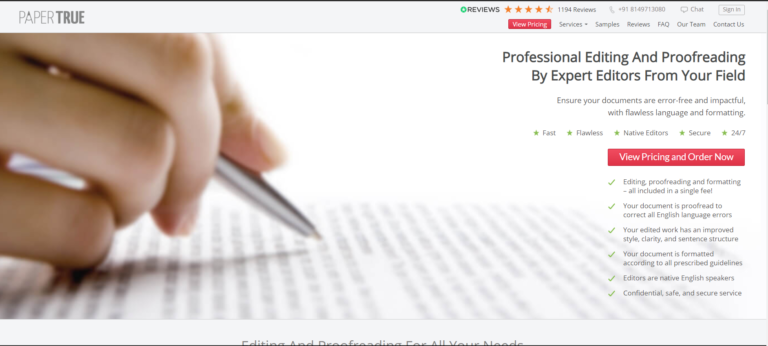
PaperTrue thesis editing and proofreading services

Services included:

  • Comprehensive error correction (grammar, punctuation, spelling)
  • Improved style and clarity
  • Enhanced sentence structure and coherence
  • Subject Matter Expert (SME) review
  • Thesis structure optimization

Pricing: Express editing of a 1000-word academic document within 24 hours will cost you US$ 36.

#2 Scribendi

Scribendi provides a wide array of English editing and proofreading services, which include academic editing (dissertation, thesis, and proposal editing). Apart from thesis editing, they also offer admissions essay editing, author editing, and more.
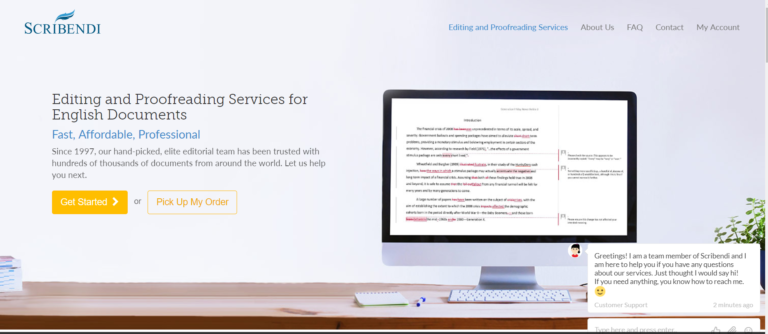
Scribendi thesis editing and proofreading services

Services included:

  • Academic editing (dissertation, thesis, proposal)
  • Grammar and spelling correction
  • Style consistency
  • Document formatting
  • Citation review

Pricing: A 24-hour proofread of a 1000-word academic text will cost you about US$ 40.

#3 Wordy

This UK-based thesis editing service provides online proofreading and copy-editing services. They have a wide variety of editing services: book/manuscript, business documents, and academic documents. Check out their website and get to know the ordering process and what to expect from their thesis editing services.

They process your work across 11 major file formats, including MS Word, PowerPoint, Excel, PDF, LaTeX, Google Docs, and more.

Wordy thesis editing and proofreading services

Services included:

  • Online proofreading
  • Copy-editing for academic documents
  • Support for 11 major file formats
  • MS Word, PowerPoint, Excel, PDF, LaTeX compatibility
  • Google Docs integration
  • Formatting assistance
  • Style guide adherence

Pricing: A proofing job for 1000 words will cost you a little over US$ 40.

#4

Editage

Editage focuses solely on English language editing services for Academic, Scientific Manuscripts, Articles, and Papers, and their service is recommended by more than 1600 international journals.
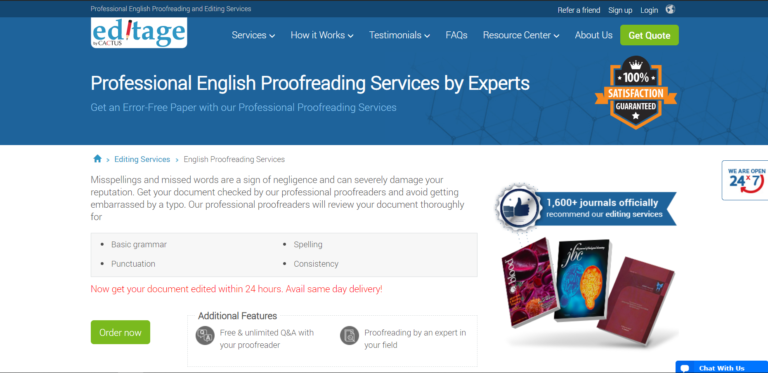
Editage thesis editing and proofreading services

Services included:

  • Academic manuscript editing
  • Journal-specific formatting
  • 4-step editing process
  • Citation formatting
  • Subject-specific expertise

Pricing: You can have your Papers checked with Editage for prices starting at $30 USD per 1000 words.

#5 Enago

Apart from the standard thesis editing and proofreading, Enago also offers additional translation, statistical analysis, video abstracts, medical writing, and publishing help. With a claim to have a near 100% client satisfaction, Enago’s editing team has Ph.D./Master’s qualified native English-speaking editors with vast experience.

Enago thesis editing and proofreading services

Services included:

  • Standard thesis editing and proofreading
  • Statistical analysis
  • Video abstracts
  • Medical writing
  • Publishing assistance
  • PhD/Master’s qualified native English-speaking editors

Pricing: Enago has its services bundled in various packages.

#6 Vappingo

Apart from the standard editing and proofreading, Vappingo offers specialised academic (thesis editing) services.

Vappingo claims to have a high-quality editing team that is qualified native English-speaking editors with vast experience. Every thesis you submit to them is reviewed to ensure technical accuracy and to rid it of any errors.

Vappingo thesis editing and proofreading services

Services included:

  • Specialized academic thesis editing
  • Technical accuracy review
  • Document formatting
  • Citation checking
  • Style guide compliance

Pricing: They have a customised price generator that will give you a quote for your type of document.

#7 Proofreadingpal

Proofreading Pal’s main USP is its two-proofreader model. Every submission is edited by not one, but two professional proofreaders who check for grammar, punctuation, capitalization, verb tense, spelling, sentence structure, and clarity. But double-checking is standard procedure at all thesis editing and proofreading firms.
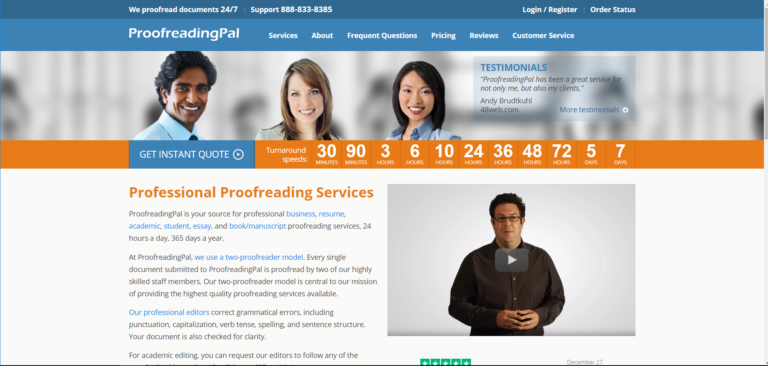
ProofreadingPal thesis editing and proofreading services

Services included:

  • Two-proofreader review model
  • Grammar and punctuation correction
  • Spelling verification
  • Sentence structure improvement
  • Clarity enhancement

Pricing: According to the kind of document and style, a 24-hour turnaround can cost you between US$ 30-US$ 100.

#8 Wordvice

Wordvice is a thesis editing service that makes sure that your thesis is structurally sound and flawless. It caters to scholars, researchers, students, writers, and businesses around the world. Apart from thesis editing, they also work on admissions and scholarship editing services to critique undergraduate, graduate, and professional school essays, along with scholarship applications and recommendation letters.

Wordvice thesis editing and proofreading services

Services included:

  • Structural assessment
  • Language correction
  • Admissions and scholarship editing
  • Clarity improvement
  • Academic style enhancement

Pricing: A 1000-word academic document worked within 24 hours costs US $80.

#9 EliteEditing

Elite Editing is Australia’s most trusted academic editing service. It has expert, PhD-qualified editors to provide you with thesis editing services. Along with making sure that your thesis is flawless and error-free, they even provide expert coaching to improve your academic writing post-order. Your document is returned to you with a comprehensive letter that explains the changes in your document and provides advice on how you can improve it further.

EliteEditing thesis editing and proofreading services

Services included:

  • PhD-qualified editors
  • Comprehensive error correction
  • Expert coaching
  • Detailed feedback letter
  • Document assessment
  • Australian academic standards compliance

Pricing: You will have to shell out AUS$ 130 for a 24-hour turnaround of a 1000-word academic document.

#10 EditMyEnglish

EditMyEnglish provides thesis editing and proofing services across the board: Academic, Business, and Literary. Expert editors carefully check and modify your documents to ensure that they are 100% grammatically correct, flawless, and error-free, along with tracked changes in your document.
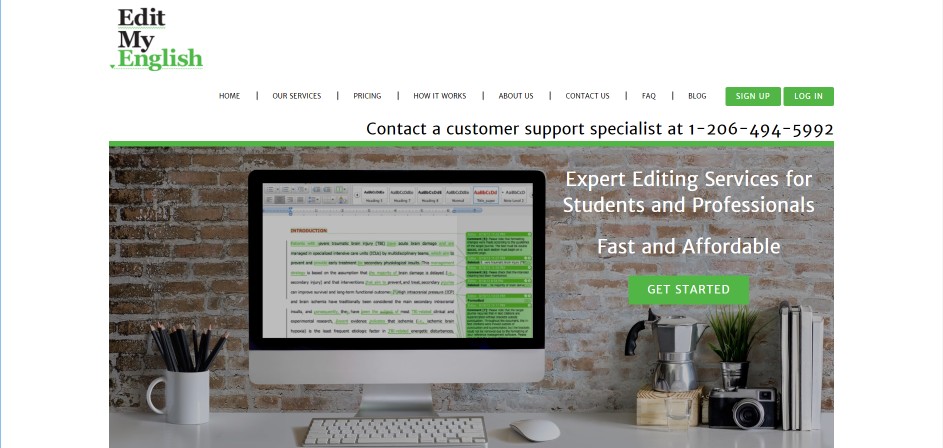
EditMyEnglish thesis editing and proofreading services

Services included:

  • Academic, business, and literary editing
  • Grammar correction
  • Document modification
  • Style consistency
  • Formatting assistance

Pricing: The per-page cost is USD $6.49.

How to choose the right thesis editing and proofreading service

When selecting among thesis editing and proofreading services, consider:

  1. Editor qualifications: Look for native English speakers with advanced degrees in your field
  2. Turnaround time: Ensure they can meet your submission deadline
  3. Service scope: Determine if you need basic proofreading or comprehensive editing
  4. Price: Balance quality with your budget constraints
  5. Reviews: Check testimonials from other academic clients

Investing in professional thesis editing and proofreading services can make the difference between a passing grade and academic excellence. With experts handling the technical aspects of language and formatting, you can focus on the substance of your research.

For error-free, polished academic writing that truly reflects your research quality, consider PaperTrue’s comprehensive thesis editing and proofreading services. Their subject matter experts and language professionals will ensure your thesis meets the highest standards of academic excellence.

Here are some more resources for you:

Quick Guide to Book Editing [Complete Process & Standard Rates]

Writers may think of editors as ruthless butchers of innovation, ideas, and creativity, but that’s not the case. With the right editors, book editing can be an incredibly creative and fruitful process that takes your book to new heights.

Professional book editing elevates your book to global standards of quality. But which types of book editing does your manuscript require? In this article, we’ll tell you the standard book editing rates, the processes involved, and why you can’t rely on self-editing alone. It is also crucial to hire a proofreader in the last stages of the process to ensure all typos and grammar errors are corrected before publication.

Free Professional Editing Sample for Your Book! Get Started

Without further ado, let’s get started!

What is book editing?

Book editing is the process of reviewing a manuscript to improve its quality, clarity, coherence, and overall readability. It removes all types of language and grammatical errors from your manuscript, so your reader receives a polished product. While self-editing is essential, it should not replace a professional edit, which is crucial for ensuring the highest quality before submission to an editor.

Depending on the scope of changes suggested by the editor, there are various types of book editing. They’re mostly defined by the scope of activity the editor has. Large-scale issues of content quality and organization are taken up first, while small-scale issues of grammar and spelling are considered at the end.

There are various types of editing, each with its own unique focus and goals. Developmental editing, for instance, looks at the big picture, addressing content, structure, and overall impact. Copy editing, on the other hand, focuses on the mechanical aspects of writing, such as grammar, punctuation, and consistency. Proofreading is the final step, catching any remaining errors before publication. Understanding these different stages helps authors appreciate the importance of editing in transforming a rough draft into a finished manuscript.

What are the five types of book editing?

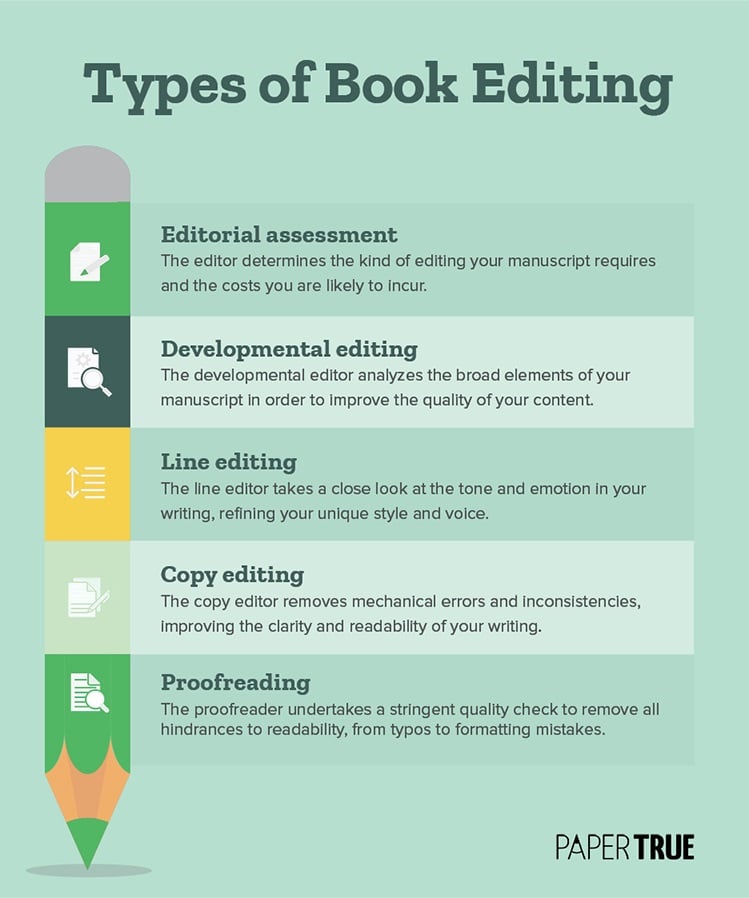
The five types of book editing are editorial assessment, developmental editing, line editing, copy editing, and proofreading. Some may tell you that there are seven or four types of editing, but it’s mostly a matter of policy. The five basic processes listed below can be broken down or combined to create a variety of editing steps.

For example, we’ve treated structural editing as a part of developmental editing, but some firms may offer it as a separate service. As long as your book undergoes a structural edit, it doesn’t matter whether it was done under development editing or as a separate process.

Now that we’ve cleared this up, let’s get into the five types of book editing!

1. Editorial assessment

Editing a new book is a layered process, so each manuscript must go through all types of book editing before it’s ready to be published. However, you may need some types of editing more than others, depending on your book and writing style. An editorial assessment finds this out for you.

Although it’s more of a pre-editing check than strictly a type of editing, it’s an essential part of the book editing process.

In an editorial assessment, the editor goes through your manuscript to ascertain the levels and types of editing your work will require. This step is often referred to as a manuscript review, providing crucial feedback before the more intensive editing phase. Based on this, you can also calculate your book editing costs. After this assessment, you should have a clear idea of the editing processes your book needs most and how much you should expect to spend on them.

Typically, an editorial assessment takes about a week and produces a page-long review of your manuscript. You may choose to skip this step, but it can help you optimize your cost of book editing. The editorial assessment ensures that you direct your time, effort, and money in the right places.

The editorial assessment helps you assess the health of your manuscript. It ensures that you’re prepared for the big-picture edits that developmental editing will offer.

2. Developmental editing

Developmental editing, also known as content editing, story editing, or substantive editing, reviews the content, structure, and overall impact of your manuscript. A developmental editor analyses your book as a whole, focusing on the important elements that contribute to the overall structure and cohesiveness of the story.

Let’s consider developmental editing for a cookbook. This will ensure a coherent structure across different recipes, their arrangement in the book, and the overall tonal consistency. For a book of nonfiction essays, on the other hand, the editor will focus on the order of the involved topics and subtopics that make up the manuscript.

Essentially, developmental editing adopts a bird’s-eye view of the broad strokes that make up the landscape of your book. In the case of fiction book editing, this means your plot, characters, story arcs, and narrative development. The editor’s job is to point out plot holes, ineffective story points, or undeveloped character arcs. They will also touch upon your sentence composition, dialogue writing, and word choice (a line editor will take a closer look at these elements).

An expert editor will keep in mind your target audience as well as your genre expectations. Based on the two, they will shape and edit your document, sometimes making major changes to the content. This is why developmental editing comes before copy editing and proofreading.

Once your book has passed the substantive check, it can be taken up by the copy editor.

3. Line editing

Line editing, as the name suggests, is a line-by-line perusal of your manuscript. It focuses on the style, emotion, and unique voice that is apparent in your book. Line edits are crucial for refining your writing style and ensuring clarity in your manuscript. To do this, the editor pays attention to your sentence structure, word choice, grammar, punctuation, and syntax.

Line editing helps make your writing more polished, engaging, and readable. It also aims to make your text clear and coherent, which is somewhat similar to the scope of copy editing. For this reason, these two services are often offered together.

But if you opt for line editing separately, the editor will help you tighten your sentences, eliminate unnecessary repetition or verbosity, and suggest alternative phrasing when needed. In the case of a novel or memoir, this also involves refining your dialogue, pacing, and narrative voice.

So, a line editor ensures that you’re using the right language to communicate with your reader. They help you mold your book into a more engaging read. 

4. Copy editing

Copy editing reviews the mechanical aspects of writing to ensure accuracy, consistency, and clarity in your book. A copy editor checks for your spelling, punctuation, and grammar, preserving your unique style while removing obvious language errors. They also examine overall language use, such as repetition and clarity, to ensure polished and coherent writing. Copy editors often maintain various manuals for this purpose, and sometimes create a style sheet that they can refer to while editing your manuscript. 

The editor also combs through your paragraphs to maintain internal consistency in your writing. After all, you don’t want to mix up your 1948s with your 1984s! Or, for that matter, have a character be seen in jeans when they were rocking denim shorts just a couple of pages ago!

The mechanical aspects of copy editing help improve the readability of your book, which plays out together with the editor’s attention to the mood and style of your writing. The editor removes redundant words and phrases, offering better alternatives where necessary. They make sure that your intended tone translates clearly and that there aren’t any disruptions or sudden tonal shifts.

In this way, a copy editor gives your manuscript a comprehensive style, preserving your voice while promoting clarity and readability.

5. Proofreading

Proofreading is the last stage in the editing process of a book. It is the final inspection of the final draft. Any work of writing that is released to an audience is always proofread before publishing. Proofing your manuscript removes all minor errors, from a misplaced hyphen to a random inconsistency, from your book.

Believe it or not, the initial types of book editing that help improve your document are likely to add some new errors to it! A proofreader can spot these mistakes due to their experience and skill. Once they’re done with your manuscript, you can be sure that your book is good to go.

In this way, proofreading is the final inspection, removing all errors before your book is released to the world. While other editors might offer a cursory proofread, a standard proofreading round happens after your book has been typeset. A proof copy of your final book is then proofread to ensure the highest quality.

A rundown of the types of book editing: 1. Editorial assessment 2. Developmental editing 3. Line editing 4. Copy editing 5. Proofreading

The process of editing

The process of editing typically involves several stages, each crucial for refining the manuscript. It begins with self-editing, where the author reviews and revises their own work to improve its quality and clarity. This step helps identify obvious errors and areas for improvement. Next, beta reading comes into play. Here, the manuscript is shared with a small group of readers who provide feedback and suggestions for enhancement. This honest evaluation from fresh eyes can be invaluable. The final stage is professional editing, where a trained editor meticulously reviews the manuscript to catch any remaining errors and elevate its overall quality. This process is often iterative, involving multiple rounds of revisions and edits to ensure the final product is polished and ready for publication.

Pre-editing steps

Before diving into the formal editing process, authors can take several pre-editing steps to prepare their manuscript. Start by reviewing the manuscript for consistency and accuracy, ensuring that all elements align and make sense. Check for grammatical errors and spelling mistakes, as these can distract from the content. Organize the manuscript logically, making it easy to follow. Utilizing editing software and tools can help identify areas for improvement and streamline the editing process. Additionally, consider hiring an expert editor for an initial review. Their feedback can provide valuable insights and set the stage for a more efficient and effective editing process.

How much does book editing cost?

On average, book editing costs between $1,500 and $3,000. This may vary depending on the type of book editing you opt for as well as your manuscript’s genre, complexity, and length. The cost can also be influenced by the number of drafts required, as working through several drafts with a professional editor can add to the overall expense.

Different entities in the professional book editing arena price their services differently. Some editors charge an hourly rate while others charge a per-page price. The cost of editing a book also varies based on the types of editing you opt for. At PaperTrue, for example, book editing services are offered in three tiers:

If you were wondering how much book editing costs, we hope you have your answer now! You can analyze the editing packages offered by various editing firms and individual editors. You can budget effectively by balancing the needs of your manuscript with offers and packages available out there.

Should you self-edit your book?

You may benefit from going over your manuscript a few times on your own and asking friends and beta readers to do this for you. This can help root out many errors in the manuscript and bring down your book editing fees. However, self-editing does not accomplish much more than this.

You may be tempted to believe that self-editing is the best way forward, but that is not true. No matter how many times you go over your document, some errors are bound to slip in. Readers will easily catch on to these mistakes and end up with a poor impression of your book.

It is easy for editors to spot mistakes in your manuscript because they bring an objective perspective to the page. Professional editors have years of training and experience with different methods and types of book editing. Since you lack the proper training to approach your work with distance and objectivity, you need to hire someone to do that on your behalf. This is the chief reason that self-publishing platforms offer book editing and proofreading as primary pre-publishing services.

Working with a professional

Working with an editor can be a valuable investment for authors aiming to produce a high-quality final product. Editing professionals bring a wealth of training and expertise to the table, capable of identifying areas for improvement across various types of editing, including developmental editing, copy editing, and proofreading. They provide detailed feedback and suggestions, helping authors refine their writing style and voice. When collaborating with a professional editor, authors can expect a thorough and detailed editorial report, outlining suggestions for improvement and necessary revisions. This partnership not only enhances the manuscript but also helps authors grow and develop their writing skills.

Finding an editor

Finding the right editor can be a challenging task, but there are several steps authors can take to ensure they find a qualified and experienced professional. Start by asking for referrals from other writers or publishing professionals. Online directories and databases can also be valuable resources. Review the editor’s portfolio and testimonials to gauge their experience and expertise in your genre or subject area. 

Read our article on this topic to get in-depth information: How to Find an Editor for Your Book in 8 Steps (+ Costs!)

An editor’s role is more than just cutting mistakes from your book. Editors provide valuable suggestions from their experience that help perfect your manuscript. If you’re hoping to publish your book and sell copies, hiring an experienced editor is the wise thing to do. At PaperTrue, we provide professional editing and proofreading services to make your manuscript perfect!

Want to read more? Here are some articles for you:

How to Write a CV with AI in 9 Steps (+ AI CV Builders)

Artificial intelligence is transforming the way we write CVs. Discover the best AI-powered tools and useful prompts to build a professional CV! These AI tools can help to create a CV that highlights your unique skills and experiences..

Using AI, you can easily summarize information about your work experience and personal details. The best part? You can also add industry-specific keywords, edit, and format your CV using AI. 

Make Your CV Stand Out with Professional Editing! Learn More

So let’s take a look at the 9 steps to create a professional CV! 

How to write a CV with AI

To write a CV with AI, gather all necessary information about your educational background, work experience, skills, and achievements. Then perform the following steps: 

1. Summarize your achievements using AI 

Give prompts to AI writing tools like Claude-3-Opus and ChatGPT to summarize your information. The following are some examples of sample prompts you can use: 

  • Summarize the following information about my achievements in the field of [Insert Occupation] in concise bullet points – [Insert information] 
  • Refine the following information about my achievements without expanding the content – [Insert information] 

Pro tip: If you’re unsure about which achievements to add, you can ask these tools to suggest which achievements to include. To do so, you can give these tools prompts. For example:

Tell me which of the following job achievements I should include for the job position [Insert job position] – [Insert the list of achievements]

2. Choose AI resume builders to enhance your CV. 

You can use AI resume builders to create the perfect CV. Some popular options include Resume Builder, Resume.io, and Teal. These tools provide a variety of templates and tips to enhance your resume. 

Several AI for resume writing, like Kickresume and Wonsulting AI, also give your CV a score. You can research and select the one that best suits your needs. 

3. Create an account

Once you’ve chosen an AI resume writer, create an account on their website. Most platforms offer a free trial or a basic free version. 

You will be asked to provide some basic information, such as your name and email address. Some platforms may also require you to create a username and password. Fill in the required information accurately and create your account.  

4. Input your information

Add the required information, such as your personal information, educational background, work experience, skills, and achievements. Include relevant keywords that highlight your strengths and align with the job you’re applying for.

Now, let us see the next step for using AI to write resumes and CVs. 

5. Select a template

Choose a template that aligns with the industry and job type you’re targeting. For example, a creative industry like graphic design might prefer a more visually engaging template, while a traditional industry like finance may require a more conservative and professional design.

Look for AI CV generator templates that offer options, such as the ability to change colors, fonts, or the order of sections. This allows you to customize the template to your specific needs and preferences.

6. Customize and refine

You can use AI resume checkers to customize your CV. Resume Reworded, Enhancv Resume Checker, and Ladders are some of the best options you can consider. 

These tools give CV and resume tips to add industry-specific words, use strong verbs, improve formatting, and organize the sections of your CV. They also check if the resume’s length is appropriate and give the resume an overall score. 

If you don’t want to use resume checkers, you can give prompts to AI tools like ChatGPT and Claude-3-Opus to enhance your resume. For example: 

  • Suggest which industry-specific words I should use for applying for the following job – [Insert job details]
  • Tell me if the following CV’s length is appropriate and if its sections are organized in the correct order – [Add resume details] 
  • Suggest which strong verbs I can add to enhance the following details of my C.V. – [Add C.V. details] 

Want to understand how to use AI for resume and CV editing? Let’s explore how to do this! 

7. Edit and proofread 

It’s important to edit and proofread your CV for any spelling, grammar, or formatting errors. You also need to ensure that all the information is accurate and up-to-date. 

Many AI CV tools like Ladders, Enhancv, Rezi, and Live Career Resume Checker can help you do this. If you’re not using AI resume checkers, you can give AI writing tools like ChatGPT and Claude-3-Opus prompts such as: 

  • Analyze if there are any spelling and grammar errors in the following paragraphs and give me a corrected version without expanding the content – [Insert text] 
  • Simplify the meaning in the following sentence without expanding the content – [Insert the sentence]

8. Download and save

Once you’re satisfied with your AI-generated CV, download it in your preferred format (e.g., PDF or Word document). Save a copy on your computer and consider creating variations for specific job applications.

9. Update regularly

As you gain new experiences, skills, or accomplishments, update your CV accordingly. Most AI CV builders allow you to easily edit and update your information.

5 simple CV and resume writing tips 

The following are 5 quick tips for writing a CV or resume: 

  1. Understand the specific job you’re applying for and write your CV or resume accordingly.
  2. Start with a strong summary that highlights your key skills and experiences. Make sure that it’s not more than 5 sentences. 
  3. Focus on experiences that are directly related to the job you’re applying for.
  4. Use strong action verbs like “achieved,” “implemented,” and “led” to describe your accomplishments.
  5. Whenever possible, use numbers and metrics to quantify your achievements.

Best practices for using AI for resumes and CVs

The following are four best practices to keep in mind while using AI: 

  1. Use AI as a tool, not a replacement: AI can be a powerful tool, but it’s important to use it to enhance your own creativity and expertise. Avoid using 100% AI-generated output. You can also explore Apply IQ, an AI-powered tool by Adzuna that helps automate and streamline the job application process, ensuring your CV reaches the most relevant openings efficiently.
  2. Provide clear and specific prompts: The more specific your prompts, the better results AI tools will provide. 
  3. Use AI to create strong summary statements: Many AI tools provide examples of summary statements for reference. Read summary examples and accept relevant suggestions from AI tools to create a strong summary. 
  4. Use AI to quantify your achievements: AI can help you identify key metrics and achievements to quantify your impact. Consider the inputs given by AI tools to highlight your achievements. 

Now, you can use the potential of AI for CV generation. However, it’s important to get AI outputs reviewed by human editors. At PaperTrue, we can simplify this task for you. 

We provide professional CV editing services to enhance your CV. Our trained team not only eliminates language errors but also rectifies any formatting mistakes as well. 

Want to polish your CV to make it stand out from competitors? Get in touch with us today! 

Here are some useful resources for you: 

How to Write a Descriptive Essay | Examples and Structure

A descriptive essay is the most creative of all essay types. It involves the use of sensory descriptors and impactful narratives to depict an object, person, or even something abstract like an emotion. This type of essay is administered by teachers and professors to gauge your understanding of language. 

In this article, we will guide you through everything there is to know about descriptive essays. This includes the descriptive essay definition, some descriptive essay topics, and various examples. To help you in your essay-writing process, we have also included an outline of a descriptive essay. 

But let’s start from the beginning: What is a descriptive essay?

Perfect your essay with our expert editing services today! Get started

What is a descriptive essay?

A descriptive essay is a highly creative form of writing that describes an object, person, location, experience, emotion, or situation. It makes use of vivid imagery and different figures of speech to create a beautiful and immersive experience for the reader.

This type of essay is often assigned in creative writing courses in schools or colleges. It does not involve the presentation of arguments or information. It just involves creatively expressing yourself with the help of various language devices. 

Unlike a narrative essay, which involves telling a story, a descriptive essay only focuses on one particular object or idea. Although most essay topics are non-fictional, descriptive essay topics can either be fictional or non-fictional. 

Let us look at a few examples of topics for a descriptive essay.

Best descriptive essay topics

Since writing a descriptive essay is a creative form of writing, it can cover a wide range of topics. These topics can range from practical experiences, such as “My Grandpa’s Couch,” to thought experiments, such as “Living in a world with no concept of time”. 

Here are a few more descriptive essay topics:

  • Exploring a ghost town
  • A starry night in the mountains
  • A day in the life of an explorer
  • Trip to the Metropolitan Museum of Art
  • Wandering through the Swiss meadows 
  • My childhood home
  • Memories of grandma’s farm
  • Experiencing euphoria for the first time
  • My description of utopia
  • My most treasured possession
  • A life-changing experience 
  • A thrilling adventure 
  • My proudest achievement 
  • My Role Model
  • My Dream Job

Descriptive essay structure

Since descriptive essays are highly creative in nature, the descriptive essay structure is much more fluid as compared to most academic essay types. Although they do follow a general structure, there is no specific descriptive essay format. It serves more as a guideline than a hard and fast rule. 

Descriptive essays generally don’t revolve around proving a point or making an argument. The goal is to simply provide a vivid and detailed description of a particular subject.   

Let’s study the basic structure of a descriptive essay:

1. Introduction

Wondering how to start a descriptive essay? Like all essay types, the introduction of a descriptive essay is composed of three key elements: A hook, some background information, and a thesis statement. 

However, the thesis statement of a descriptive essay is different from the thesis statements of most academic essays. It simply makes a claim regarding the subject of your choice.

Here’s an example of a descriptive essay introduction: 

  1. Hook
  2. Background information
  3. Thesis statement

The last day of school—a momentous occasion that marks the culmination of a year’s worth of hard work and growth. Excitement hangs in the air as students gather for one final day of shared experiences and unforgettable memories. The hallways buzz with chatter and laughter, mingling with the anticipation of summer freedom. It’s a day of mixed emotions, as the promise of lazy days ahead clashes with the bittersweet farewell to teachers and classmates who have become like family. The last day of school is a mosaic of emotions, a snapshot of a moment that holds the weight of an entire academic journey, and a prelude to the new adventures that lie just beyond the horizon.

2. Body paragraph 

A descriptive essay usually has three body paragraphs. However, the length and number of paragraphs may vary depending on the complexity and scope of your essay topic. 

A body paragraph comprises a topic sentence that focuses on a particular aspect of the subject. The topic sentence is elaborated upon by sensory, contextual, and emotional descriptors. Each paragraph ends with a transition sentence that provides context for the next paragraph.  

Let’s understand this better with the help of an example: 

  1. Topic sentence
  2. Description
  3. Transition sentence

Classrooms brim with finality and accomplishment. Doodles and scribbles now grace once-neat desks, testifying to idle daydreams and shared laughter. Colorful displays and academic achievements adorn the walls, silently witnessing each student’s growth. Empty lockers echo the countless exchanges and whispered secrets they once held. Yearbooks circulate like cherished artifacts, pages filled with smiling faces and heartfelt messages. Laughter and hugs fill the hallways as friends make promises to keep in touch and embark on summer adventures. The last day of school etches indelible memories, a tapestry of nostalgia and celebration that encapsulates the joy, camaraderie, and growth of their academic journey.

3. Conclusion

The conclusion of your essay should begin with the restatement of your thesis statement along with its broader implications. You can then provide a quick summary of all the important aspects mentioned in the body paragraphs. 

Finally, you can end your essay with a powerful statement or a clincher. This can include anything from a powerful lesson to a thought-provoking quote. The goal is to leave the reader with something to think about.

Here’s an example: 

  1. Restated thesis statement
  2. Summary of body paragraphs
  3. Concluding statement

As the final bell echoes through the hallways and students scatter in all directions, the school leaves behind a lingering sense of closure and anticipation. It is a day filled with mixed emotions—a blend of nostalgia for the memories created, gratitude for the knowledge gained, and excitement for the new chapter that awaits. The last day of school symbolizes a milestone in each student’s journey, marking the end of one chapter and the beginning of another. It is a time to reflect on the growth, challenges overcome, and friendships forged along the way. The last day of school is not an end, but rather a stepping stone towards new horizons, where each student will continue to learn, explore, and thrive.

Note: It’s important to avoid introducing new information while writing the conclusion in descriptive essays.

Now that we’ve understood how to structure a descriptive essay, let’s figure out how to write it!

How to write a descriptive essay

In order to write a perfect descriptive essay, you must effectively make use of multiple creative writing devices. These creative writing devices include figures of speech, imagery, sensory and emotional descriptors, as well as evocative language.  

If you find the essay writing process challenging, we’re here to equip you with essential tips on writing a descriptive essay. Let’s take a look at how to write a descriptive essay for college and school students: 

1. Use figures of speech

Literary devices such as similes, metaphors, and imagery are creative devices that describe an object or a person in a figurative sense. These creative devices add an element of interest to your essay, making it more vivid, vibrant, and colorful. 

The use of figures of speech can turn an otherwise boring piece of writing into a masterpiece. Take a look at the following example:

On that spot stood an old banyan tree with thick bark and intertwining branches.

Although this example is a good start, it can be made much more interesting with the use of figures of speech.

On that spot stood an old banyan tree with its resolve as strong as iron. Its arms intertwined as they reached for the skies, yearning for the sun. 

The use of literary devices such as personification and metaphor makes the banyan tree in the second example come to life. This is how you can make your writing more vivid, descriptive, and poetic.

2. Use your senses

Sensory descriptors are one of the most important aspects of a descriptive essay. The key is to make the reader experience what you’ve experienced. This means appealing to all five senses of the reader. 

Although the visual aspect is important, you should also focus on how something sounds, feels, and smells. The experience of touching, smelling, or feeling something is more evocative than simply viewing it. 

Some sensory descriptors are used in a literal sense:

The smell of rain in July takes me back to my childhood. The pitter-patter reminds me of my mother’s footsteps, bringing us delicious snacks. 

They can also be used metaphorically:

The beautiful, cold gaze of the moon stunned us all.

Some other descriptive writing tips for using sensory details are: 

  • Show, don’t tell: Instead of simply stating a fact, use descriptive language to show the reader what you mean. For example, instead of saying “The room was messy,” you could write: “Clothes were strewn across the floor, books were piled high on the desk
  • Use specific details: Avoid vague descriptions. For example, instead of saying “It was hot,” specify the temperature or describe the heat as “scorching” or “oppressive.”

3. Use evocative language

It is a good idea to use strong, evocative language that conveys an intense action or emotion. Creative use of words is an important factor in writing a descriptive essay since passive language leads to a dull, boring essay.  Let’s take a look at the following sentences: 

The 100-meter race was completed by Usain Bolt in under 10 seconds.

Usain Bolt whizzed through the 100-meter race in under 10 seconds!

The use of the word “completed” indicates no action, and the use of passive voice makes the example dull. On the other hand, the phrase “whizzed through” indicates speed and intensity, which makes the second example much more interesting to read. You can use strong, impactful verbs like ‘whizzed’ to make your essay more engaging.

Now that we’ve understood the different methods of writing a descriptive essay, let’s understand its outline.

Descriptive essay outline

The outline of a descriptive essay is less structured compared to most academic essay types. It merely serves as a guideline that you can use to flesh out your essay. It also helps you develop a coherent structure and logical flow for your topic sentences. 

If you’re not familiar with creating an essay outline, you can take the help of essay outline generators. In order to help you further develop your essay, we’ve created an outline for your reference. The following descriptive essay outline revolves around the nostalgia experienced when going through an old diary.

Turning the Pages of Time

I. Introduction

A. Hook: Engaging opening sentence to grab the reader’s attention.

B. Background: Briefly explain the significance of finding your old diary and the memories associated with it.

C. Thesis statement: Clearly state the main idea of the essay, highlighting the emotional journey of rediscovering your old diary.

II. The discovery

A. Setting the scene: Describe the circumstances and location where you stumbled upon your old diary.

B. Initial emotions: Express the range of emotions that flooded your mind upon finding the diary.

C. Anticipation: Share the anticipation and curiosity about what lies within the pages of the diary.

III. The diary’s contents

A. Opening the pages: Describe the physical act of opening the diary and the smell and texture of the pages.

B. Memories unfolded: Reflect on the memories and experiences captured in the diary entries.

C. Emotional impact: Discuss the emotional response evoked by reading your own words and reliving past moments.

IV. Nostalgic reflections

A. Time traveling: Explain how reading the diary transported you back to the time and place when the entries were written.

B. Reconnecting with your past self: Describe the process of reconnecting with your past self and reevaluating your thoughts and experiences.

C. Lessons and insights: Highlight any valuable lessons, self-discoveries, or personal growth revealed through the diary’s contents.

V. Resonating with present self

A. Relevance to current life: Discuss how the insights and reflections from the diary still resonate with your present self.

B. Perspective shifts: Explain any shifts in perspective or newfound understanding that arose from revisiting the diary.

C. Appreciation: Express gratitude for the diary and its role in preserving and enriching your personal history.

VI. Cherishing the rediscovery

A. Preservation: Discuss the steps you took to preserve and protect the diary after finding it.

B. Future reflections: Share your intentions and plans for continuing the habit of journaling or preserving personal memories.

C. Closing thoughts: Reflect on the lasting impact of finding your old diary and the value of personal reflection and self-expression.

VII. Conclusion

A. Recap: Summarize the emotional journey of rediscovering your old diary.

B. Significance: Emphasize the personal and emotional significance of reconnecting with your past self through the diary.

C. Closing remarks: Conclude with a reflection on the power of personal artifacts and the importance of preserving one’s history.

Now that we have taken a look at the descriptive essay structure, let’s look at an example.

Descriptive essay example

To help you better understand the process of descriptive essay writing, we’ve constructed an example. The following example revolves around an imaginary situation. It describes the writer’s voyage through the cosmos.

Exploring the Cosmos

As the rocket engines ignited, the powerful thrust propelled us into the vast expanse of space. The vibrations rattled through the cabin, merging with the palpable anticipation that filled the air. We were embarking on a remarkable journey through the cosmos, leaving behind the familiarity of Earth and venturing into the unknown.

Outside the small window, the twinkling stars grew brighter, casting a mesmerizing glow on the infinite darkness. The view was awe-inspiring, as if we were floating amidst a sea of diamonds, each one beckoning us to explore its mysteries. The depth and grandeur of space stretched out before us, reminding us of the minuscule nature of our existence in the universe.

As we traversed through the cosmic void, weightlessness engulfed our bodies, releasing us from the Earth’s gravitational pull. Every movement became a ballet, effortlessly gliding from one corner of the spacecraft to another. The sensation was both exhilarating and disorienting, as if the boundaries of physical limitations had dissolved.

The silence in space was profound, a symphony of tranquility. Without the interference of atmospheric sounds, we were left with the gentle hum of the spaceship’s systems and the rhythmic beating of our own hearts. It was a humbling reminder of the vastness and serenity that lay beyond our home planet.

Further into our journey, celestial bodies came into view, captivating us with their sheer beauty. The fiery hues of neighboring planets illuminated the darkness, displaying their own distinct personalities. We marveled at the majestic rings of Saturn, a delicate masterpiece encircling the giant planet, and the crimson swirls of Jupiter, a tempestuous giant with its own cosmic dance.

Time seemed to lose its grip on the vastness of space. Hours felt like mere moments as we traveled through light-years, witnessing the unimaginable beauty of celestial phenomena. We were reminded of the sheer magnitude of the cosmos, a testament to the wonders that lie beyond our earthly confines.

Eventually, the time came for us to return to our home planet. As we reentered Earth’s atmosphere, the fiery descent illuminated the sky, marking our triumphant return. The journey through space left an everlasting mark on our souls, forever changing our perception of our place in the universe.

Our journey was more than a physical exploration; it was a voyage of wonder and introspection. It taught us the fragility and interconnectedness of all things and ignited an insatiable curiosity to continue unraveling the mysteries of the cosmos. We were forever transformed by the immensity and beauty that awaited us beyond our pale blue dot in the vast expanse of space.

This example accurately demonstrates how to write descriptive essays. You can read similar examples of descriptive writing styles online to enhance your essay writing skills.

After writing the essay, it’s important to edit and proofread it, which is not easy. If you find essay editing challenging, you can consider taking the help of an essay editing service.  

At PaperTrue, we provide professional essay editing services to enhance essays. Our trained editors can remove all sentence errors, including grammatical mistakes, awkward phrasing, and spelling mistakes. We also ensure that references formatted in different styles, including APA, MLA, and Chicago, are consistent.

Want to keep reading? Here are the newest articles we’ve worked on:

How to Format an Appendix: APA and MLA

Formatting an appendix might not be the most exciting part of writing, but it plays a crucial role in academic and professional documents. Appendices, as the name indicates, offer space to include supplementary materials. 

These could include tables, charts, or detailed data. While they do not form part of the main content, they enhance your content without overcrowding it. Hence, proper appendix formatting is necessary. It ensures clarity, accessibility, and a professional presentation of your work. 

This guide provides comprehensive instructions on how to format an appendix, covering key guidelines, styles like APA and MLA, and common pitfalls to avoid.

Are Appendices In Your Research Stressing You Out? Let Us Help. Learn More

Importance of proper appendix formatting in academic and professional writing

An appendix is a versatile tool in academic and professional writing, often used to provide additional context, background, or supporting information. However, its value is lost if it is poorly formatted. Proper appendix formatting ensures that:

  • Readers can quickly locate supplementary material.
  • The document maintains a professional and polished appearance.
  • The appendix aligns with specific formatting styles like APA or MLA, often required in academic settings.

When formatting an appendix, the focus should be on clarity, organization, and consistency. A well-structured appendix strengthens your work by making it more comprehensive and easier to understand than documents written without appendices.

Proper appendix formatting also ensures the reader can easily locate and reference the necessary information. And that is exactly what you must focus on to ensure your audience does not skip reading your research! 

General guidelines for formatting an appendix

Although specific requirements might vary depending on style guides, some general appendix guidelines apply universally. 

Here are some rules you could consider following for effective formatting: 

  • Label clearly: Use titles like “Appendix A”, “Appendix B”, and so on for multiple appendices. Ensure these labels correspond to references in the main text.
  • Organize logically: Present materials in the same order in which they have been mentioned in the main text. This helps your readers follow your argument without disruptions in reading and interpreting.
  • Use consistent formatting: Maintain uniformity in font style, size, and spacing across the appendix and the main document.
  • Separate each appendix: Start each new appendix on a fresh page for better organization.
  • Provide descriptions: For tables, charts, and other elements, include concise descriptions or titles to clarify their purpose.

Appendix format in APA style

Formatting an appendix may vary depending on the style guide you have decided to follow, such as APA, MLA, or Chicago style. Let us examine some of the common formatting requirements for each, starting with APA.

The APA appendix format requires adherence to specific guidelines that ensure clarity and standardization. Here’s how to format an appendix in APA:

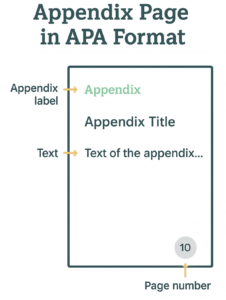
  • Labeling: Per this style, label each appendix with a title such as “Appendix A,” “Appendix B,” etc., at the top of the page. Use the title “Appendix” for just one set of information, but “Appendix A, B, C” for multiple appendices. Center the title on the page. Each appendix should begin on a new page.
  • Order: Appendices appear after the references section in an APA paper.
  • Font and spacing: Use the same font and double-spacing as the rest of the document. Standard fonts give the best results here. 
  • Content placement: Include supplementary materials like raw data, survey forms, or large tables that might distract from the main text.
  • Headings: If the appendix contains subsections, format these with APA’s heading styles for clarity.
  • Titles: Use a clear title that describes the appendix contents (e.g., “Appendix A: Survey Results”).

APA style appendix formatting

By following these guidelines, you ensure that the appendix adheres to APA standards, enhancing your paper’s credibility.

Appendix format in MLA style

Formatting an appendix in MLA style also involves a structured approach. Below are the MLA appendix format requirements:

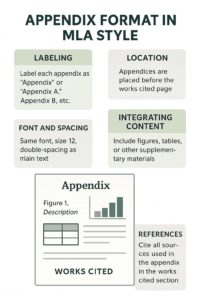
  • Labeling: When using this style, label each appendix as “Appendix” if there’s only one. Use “Appendix” followed by a letter if there are multiple appendices (e.g., Appendix A, Appendix B, etc.). The title should be centered.
  • Location: Appendices are typically placed before the works cited page in MLA.
  • Font and spacing: The same font and spacing rules as the main document apply—usually a readable font like Times New Roman, size 12, and double-spacing. While keeping the same formatting as the rest of the document is recommended, appendices should be clearly labeled.
  • Integrating content: Include figures, tables, or other supplementary materials with appropriate titles and descriptions.
  • References: Cite all sources used in the appendix in the works cited section, ensuring consistency with MLA guidelines.

For those new to MLA formatting, reviewing a detailed MLA format example can be an invaluable starting point.

Another well-known style is the Chicago style appendix. In this, do the following:

  • Similar to APA, use a clear heading for each appendix.
  • Place appendices after the main text and before the bibliography.
  • Each appendix should begin on a new page, with a label like “Appendix A: Detailed Data.”

MLA style appendix formatting

In each style, the main idea is to provide clear labels and ensure that readers can easily find each appendix. Be sure to refer to the latest guidelines for each style, as these recommendations may periodically be updated.

Formatting tables, figures, and other items in an appendix

When your appendix includes tables, figures, or other supplementary items, it is crucial to present them professionally:

  1. Provide titles and descriptions: Each table or figure should have a clear title and a brief description explaining its relevance.
    • Example: Table A1. Survey Results on Consumer Preferences
  2. Number sequentially: Number all tables and figures to avoid confusion, especially when referencing them in the main text.
  3. Maintain consistent style: Use the same formatting style for all items within the appendix. For instance, align all tables and use consistent font sizes.
  4. Use separate pages if necessary: For large tables or figures, dedicate a full page to ensure readability.
  5. Cite sources: If data or figures are sourced externally, provide appropriate citations to maintain academic integrity.

Proper formatting of visual and supplementary content ensures that readers can easily interpret your findings or supporting materials.

Tips for ensuring clarity in your appendix

An appendix should be clear, concise, and easy to navigate. Wouldn’t you agree? This is because you want your readers to focus on your research and not be hassled by where to find the relevant information that corresponds to your findings and observations. 

So, here are some tips to enhance clarity:

  1. Use numbering: For multiple appendices, label them as Appendix A, Appendix B, and so on, and reference them accordingly in the main text.
  2. Headings and subheadings: Use headings or subheadings for better organization, especially if the appendix contains diverse materials.
  3. Align references: Ensure all references in the main text point to the correct appendix items. Misalignment can confuse readers and reduce the effectiveness of your research work or academic papers. 
  4. Avoid overcrowding: Presenting data or charts succinctly can be a challenge in many cases. However, it is important to offer clarity and ease of access to your readers. If there is too much content, consider breaking it into multiple appendices.
  5. Review for accuracy: Double-check all information in the appendix, including labels, titles, and citations, for correctness and consistency.

By following these steps, you can create an appendix that complements your work and enhances the reader’s experience.

Mistakes to avoid when formatting an appendix

Despite its importance, formatting an appendix can often lead to errors in your work. So, instead of impressing your audience with insights and useful information, you might end up confusing or annoying them. 

To avoid such a scenario, watch out for common mistakes that might occur during formatting. Here’s a quick list:

  1. Incorrect labeling: Failing to label appendices or using inconsistent labels can frustrate readers. Always double-check appendix references in the main text.
  2. Missing titles for figures and tables: Each figure, chart, or table must have a clear and descriptive title. Without it, readers may struggle to understand the purpose of the content.
  3. Improper margins or spacing: Adhering to standard margins and spacing is critical for maintaining a professional appearance. Avoid cramped or misaligned layouts.
  4. Overloading the appendix: Including excessive or irrelevant material can detract from the main document. Be selective and include only that which is necessary.
  5. Lack of citations: If your appendix includes borrowed data or images, ensure all sources are properly cited to avoid plagiarism.

When you eliminate such mistakes and inconsistencies, your work becomes appealing. Your appendix will look professional and sound well-thought-out. 

Learning how to format an appendix is a vital skill for academic and professional writers. Whichever style you need to follow—APA appendix format, MLA appendix format, or general appendix guidelines—consistency and clarity are key. A well-formatted appendix makes your document credible and user-friendly for readers.

Whether you are creating an appendix in a book example or a detailed academic report, the principles of good formatting remain the same: clear organization, proper labeling, and adherence to style-specific rules.

We are sure that with these guidelines, tips, and examples, you are now equipped to create appendices that look as polished and professional as the main content. However, if you need professional assistance with appendix formatting, get PaperTrue’s editing and proofreading services

Here are some other articles you might want to check out: 

Fourth-Person Point of View: A Unique Narrative Guide

When discussing narrative styles in writing, most of us are familiar with the first, second, and third-person points of view. However, another perspective can be used in storytelling: the fourth-person point of view. 

Writers have taken this path less often, though. While it is not as commonly discussed or used as the other narratives, the fourth-person perspective offers unique opportunities for storytelling, especially in abstract and philosophical contexts. 

In this article, let us examine what the fourth-person point of view is, its characteristics, examples, and how it compares to other narrative styles.

If The Fourth-Person Narrative Feels Alien To You, Talk To Us! Learn More

What is the fourth-person point of view?

The fourth-person point of view is a relatively abstract narrative perspective that focuses on a collective or generic “you”. It moves away from directly addressing individuals or narrating a personal or external perspective and instead communicates with a broader, universal audience. 

This POV employs generic pronouns such as “one”, “we”, or “they” in contexts where the narrator aims to explore universal truths or collective experiences.

Unlike the first-person point of view, which is deeply personal, or the third-person point of view, which is external and often observational, the fourth-person adopts a more inclusive tone. It speaks to a shared human experience, usually making readers reflect on their connection to the whole. 

Writers use this POV to delve into abstract concepts, philosophical inquiries, or generalized scenarios that transcend specific characters or events.

Characteristics of the fourth-person POV

The fourth-person point of view, an often overlooked narrative style, offers a lens through which writers can explore universal truths, collective experiences, and abstract concepts. 

Here are some defining characteristics of the fourth-person narrative:

1. Use of generic pronouns

The fourth person relies heavily on pronouns such as “one”, “someone”, or “they”, often implying inclusivity or detachment from specific individuals. This linguistic choice enables writers to establish a more contemplative tone than otherwise.

For instance, “One might argue that freedom is an illusion” is a typical fourth-person expression.

2. Abstract and universal themes

Writing in the fourth person often helps writers explore ideas or truths that seem broad and apply universally. It seeks to examine the “human condition” rather than focusing on individual story characters. 

The fourth-person POV is particularly well-suited for exploring abstract themes through generic pronouns. Writers can pursue philosophical questions, moral dilemmas, and fundamental human experiences. It allows for a more expansive and contemplative exploration that transcends specific periods or cultural contexts.

For example, “One cannot deny the power of human connection, even in the digital age.”

3. Detached tone

This POV can feel impersonal or detached, making it suitable for philosophical essays, academic writing, or self-help books. It refrains from emotional intimacy, unlike the first-person or direct involvement, unlike the second-person point of view.

For example, instead of a personal anecdote, a fourth-person narrative might explore a universal truth like, “One often finds solace in solitude, a quiet moment of reflection.” 

4. Lack of specific protagonists

Unlike traditional narrative styles, the fourth-person POV discourages the development of specific protagonists. The focus is on collective or hypothetical scenarios, meaning specific characters or individuals might not be central to the narrative.

By talking about collective experiences, hypothetical scenarios, or abstract concepts, this POV lacks a central character. The narrative is set to explore broader themes and universal truths, rather than being confined to the specific journey of an individual.

For instance, “One often wonders if heartbreak is a necessary evil, a bittersweet experience that shapes the human soul.”

Examples of fourth-person usage in literature and media

While the fourth-person point of view is not mainstream in types of writing, it has made appearances in specific contexts. Here are some examples:

1. Academic writing

Academic papers often adopt a fourth-person tone when discussing general concepts. For example, “One observes that cultural differences shape human interaction.”

Learn more about academic writing here.

2. Philosophical texts

Philosophical works such as those by Friedrich Nietzsche or Ralph Waldo Emerson frequently use generic pronouns to universalize their arguments. For instance, Emerson’s essays often reflect on human nature with phrases like, “One finds peace in understanding oneself.”

3. Self-help books

Self-help literature, like Dale Carnegie’s How to Win Friends and Influence People, uses phrases like “One can improve one’s communication skills by practicing active listening.”

4. Speeches

Public speeches addressing societal issues often employ the fourth person. For instance, Martin Luther King Jr.’s famous line, “One day, we will live in a nation where all are treated equally,” conveys a collective aspiration.

When and why to use the fourth-person point of view 

While the fourth-person POV is not suitable for every scenario, it works exceptionally well in the following cases:

1. Philosophical essays

Writers tackling existential questions or universal truths often find the fourth person useful for framing their arguments in a neutral, inclusive way. It allows the author to address humanity at large rather than specific individuals.

“One might ponder the nature of consciousness, the essence of existence, and the purpose of life itself.”

2. Abstract narratives

Stories with an experimental or surreal tone may employ the fourth person to evoke a sense of detachment or universality. These narratives often explore themes like time, identity, or societal constructs.

“They drifted through the timeless expanse, a solitary consciousness in a universe devoid of form.”

3. Self-help and motivational writing

When addressing a broad audience, self-help authors often use generic pronouns to include readers in hypothetical scenarios, making the advice feel applicable to all.

“One must cultivate a growth mindset to overcome challenges and achieve one’s full potential.”

4. Educational content

Textbooks or instructional materials sometimes adopt this perspective to make their explanations more accessible. 

“One calculates velocity by dividing distance by time.”

5. Creative writing

While less common, the fourth-person can be used in creative writing to create a unique and experimental narrative voice.

“You might find yourself wandering through a dreamlike landscape, where reality and illusion intertwine. The world, a canvas painted with hues of the surreal, looks inviting.”

By adopting this POV, writers can engage readers intellectually while encouraging them to connect with broader concepts or ideas.

Challenges of writing in the fourth-person

Writing in the fourth person presents unique challenges. Here’s what writers might face:

1. Difficulty in maintaining reader engagement

The detached and generalized tone can make it hard for readers to emotionally invest in the content. Unlike first-person or second-person narratives, the fourth person lacks intimacy and directness, often leaving readers feeling distant and uninvolved.

2. Risk of overgeneralization

Because the fourth person often deals with universal truths, there’s a tendency to make broad, sweeping statements that might come across as vague, offensive, or unsubstantiated. It is crucial to balance the universal with the specific to avoid losing the reader.

3. Limited use in fiction

The fourth person does not lend itself well to traditional storytelling, where readers expect a connection to specific characters or events. As a result, it is rarely seen in genres like romance, mystery, or action, often being relegated to philosophical or experimental fiction.

4. Abstract nature

The highly conceptual tone of this POV might alienate readers who prefer concrete details and relatable characters. To overcome this, writers can use vivid imagery and concrete examples to ground abstract ideas.

To overcome these challenges, writers must strike a balance between universality and specificity. Ensuring that the content remains thought-provoking without becoming inaccessible is necessary when adopting this writing style.

Fourth-person vs. first, second, and third-person POV

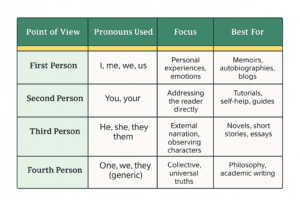
To understand the fourth-person POV in detail, here’s a comparative breakdown of how it differs from the other perspectives:

Fourth-person vs first, second, and third-person POV

Each POV has its strengths and weaknesses, and the choice depends on the type of story or content you aim to create. 

The fourth-person point of view offers a refreshing alternative to traditional storytelling. While its abstract nature and use of generic pronouns can be challenging, it opens up exciting possibilities for exploring universal truths and collective experiences. If you are writing a philosophical essay, crafting a self-help guide, or delving into abstract narratives, consider employing this POV. It will allow you to connect with readers on a broad, inclusive level.

If your content is ready, have our editors review it for clarity, relevance, and coherence. PaperTrue’s expert editing and proofreading services ensure your content comes across as professional and engaging. Let us help you bring your vision to life. Reach out today!

Here are some articles you might want to check out: 

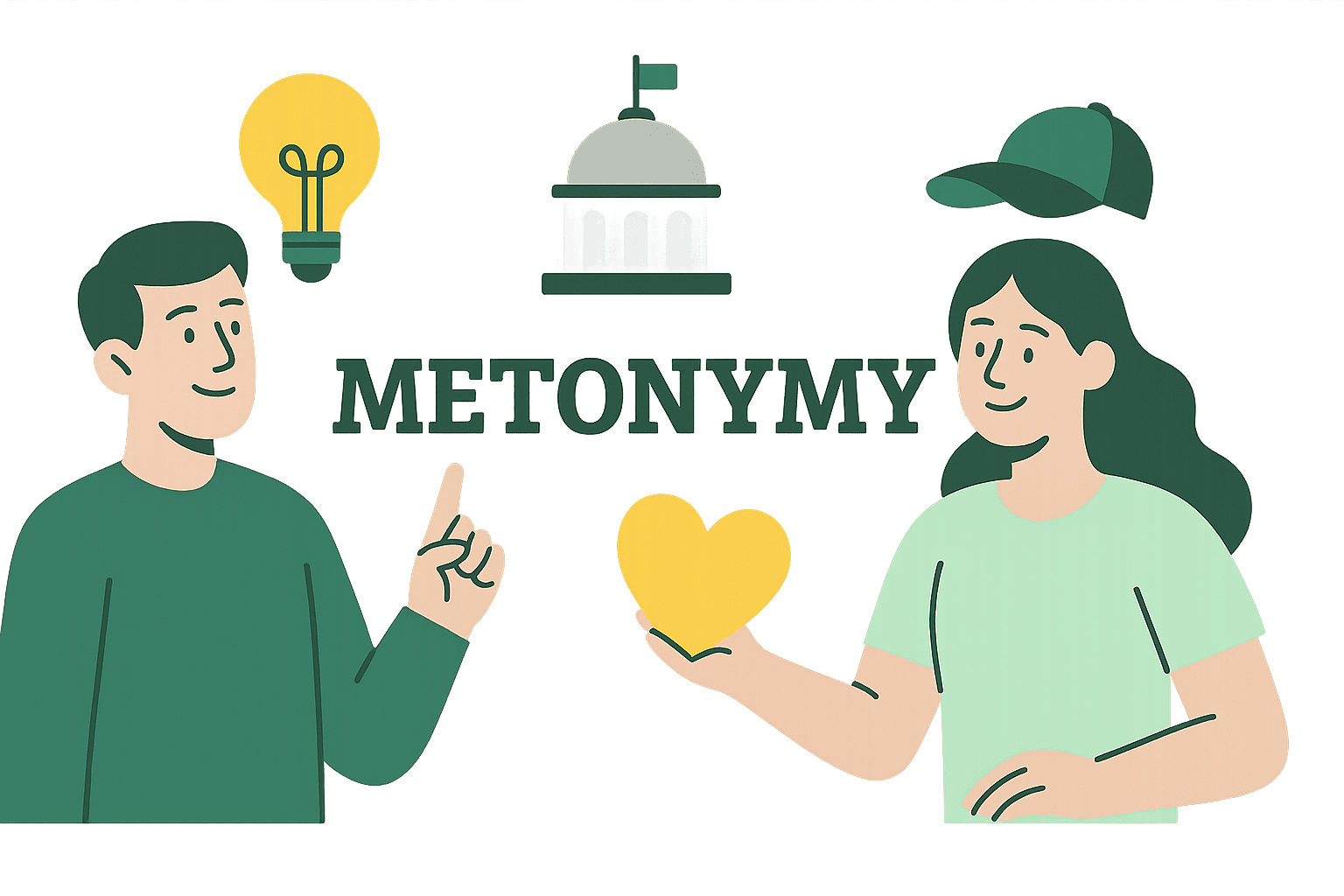
Metonymy: Definition, Examples, and How to Use It In Writing

Language has an enchanting way of enriching our thoughts and expressions, especially through literary devices. Among its many facets, literary devices play a crucial role in helping writers create engaging and memorable narratives. One such device is metonymy, which is quite often overlooked by many.

In this blog, we will explore the definition of metonymy, its importance, and how to use it effectively in your work. By the end, you will understand what metonymy is and gain insights into its types, examples, and unique role in literature and beyond.

Ensure Metonymy And Other Figures Of Speech In Your Work Are Correct!  Learn More

What is metonymy?

Metonymy is a figure of speech in which one thing is substituted for another based on a close association. Unlike metaphors, which rely on similarity or resemblance, metonymy draws its powerful effects from concept-level relationships. 

For instance, when we say, “The crown will decide the nation’s fate,” the word “crown” refers to monarchy or royal authority. This simple substitution conveys complex ideas while adding elegance to the language.

In essence, the definition of metonymy can be summarized as using a related term to represent something larger or more abstract. It is a subtle yet effective tool for conveying meaning, often employed in poetry, prose, and everyday speech.

Importance of metonymy

Why is metonymy important? The metonymy meaning states that the importance of this figure of speech lies in its ability to enhance communication through familiar associations for effective communication. 

Here are some key benefits of using metonymy:

1. Clarity through context: Metonymy simplifies communication by helping you employ a single word or phrase that audiences readily associate with on a broader level or as a broader concept. For example, “Hollywood” is often used as a metonym for the American film industry.

2. Adding depth to writing: It helps writers infuse their work with nuance and depth, which naturally makes the text more engaging.

3. Creating emotional resonance: By evoking shared cultural or historical associations, metonymy can strike an emotional chord. For instance, referring to “the Oval Office” prompts thoughts of presidential authority and decision-making.

When used correctly, this figure of speech enables you to sound persuasive and influential. By understanding what metonymy means and applying it effectively in your writing, you can create vivid imagery and connect with your audience on a deeper level.

How does it differ from other literary devices?

It is quite common to confuse metonymy with other literary devices like metaphor and synecdoche. Their usage seems similar and can be considered overlapping, so we believe it is important to understand how they are different. 

In this section, let’s break down the distinctions:

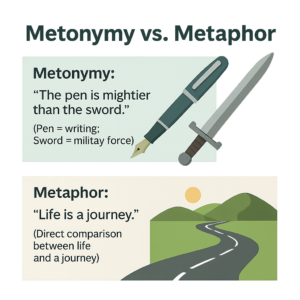
1. Metonymy vs. Metaphor

While both involve indirect references, metaphors are based on similarity, whereas metonymy relies on association. 

For instance:

  • Metonymy: “The pen is mightier than the sword.” (Pen = writing; Sword = military force)
  • Metaphor: “Life is a journey.” (Direct comparison between life and a journey)

Example of Metonymy vs. Metaphor

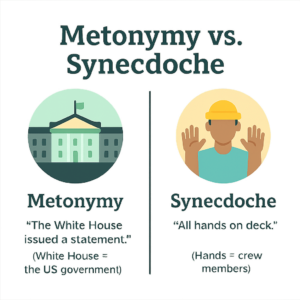
2. Metonymy vs. Synecdoche

Synecdoche is usually considered a subset of metonymy where a part represents the whole or vice versa, and this is a practical approach to learning this figure of speech. It is interesting to note, however, that some language experts believe it is an independent figure of speech. 

For example:

  • Metonymy: “The White House issued a statement.” (White House = the US government)
  • Synecdoche: “All hands on deck.” (Hands = crew members)

Example of Metonymy vs. Synecdoche

Understanding these distinctions can sharpen your grasp of figurative language examples and help you use each device skillfully.

Types of metonymy

Metonymy is seen appearing in text in various forms, each offering unique ways to enrich writing. Here are two primary types of metonymy:

1. Conceptual Metonymy

Conceptual metonymy links abstract concepts to tangible objects or ideas. It is commonly used in academic and creative writing to illustrate complex themes. For example:

  • “She has a good head on her shoulders.” (Head = intelligence; here, the attribute intelligence is reflected in the word “head”). 
  • “The stage was her life.” (Stage = theater or performance; here, the place denoted by stage is used to describe life). 

By making abstract ideas more relatable, conceptual metonymy can boost the impact of your writing.

2. Referential Metonymy

Referential metonymy involves direct substitutions, often with cultural or historical significance. Some examples are:

  • “The Kremlin declined to comment.” (Kremlin = Russian government)
  • “Reading Shakespeare enriches the mind.” (Shakespeare = his works)

This type is widely used in journalism, literature, and rhetoric for its clarity and impact.

Examples of metonymy in literature

Literature abounds with examples of metonymy, demonstrating its versatility and effectiveness. Here are some notable uses:

  • William Shakespeare, Julius Caesar:

“Friends, Romans, countrymen, lend me your ears.”

Here, “ears” represent attention or listening, creating an immediate connection with the audience.

  • F. Scott Fitzgerald, The Great Gatsby:

“The eyes of Doctor T. J. Eckleburg are watching.”

In this example, the billboard symbolizes moral judgment and societal oversight.

  • George Orwell, 1984:

“Big Brother is watching you.”

“Big Brother” acts as a metonym for oppressive government surveillance.

These examples of metonymy in literature illustrate how the device effectively conveys themes, character emotions, and societal critiques.

Why do writers use metonymy?

What is the use of a figure of speech if it does not make writing appealing and engage the reader? That is exactly why writers use metonymy, too. 

Writers across genres employ metonymy to achieve various artistic and practical goals. Here’s why:

1. Creating memorable imagery

Metonymy enables writers to paint vivid pictures in readers’ minds. Phrases like “the silver screen” or “the bottle” evoke strong, immediate associations that transcend literal meaning.

2. Eliciting emotional responses

Metonymy can effortlessly stir emotions through shared cultural references. For instance, “Wall Street” evokes thoughts of financial power and economic influence.

3. Improving narrative flow

By condensing complex ideas into concise phrases, metonymy enhances readability and storytelling. That is why it works well in poems and short stories. 

4. Building symbolism

Metonymy often doubles as a symbolic device in fiction and poetry, adding layers of meaning to the text.

5. Engaging readers

By forming unexpected, imaginative, or thought-provoking associations across text, this figure of speech engages readers and brings novelty to writing. 

If you are looking to expand your creative writing techniques and skills, metonymy offers endless possibilities for enriching prose and poetry alike.

How to use metonymy in your writing

Ready to incorporate metonymy into your work? Here are some tips that might help you: 

1. Start with familiar associations

Use commonly recognized symbols or terms to ensure your readers understand the connection. For example, refer to “the press” when discussing journalism.

2. Align with tone and context

Metonymy should complement the tone of your writing. A playful metonymy might not suit a solemn piece, and vice versa.

3. Avoid overuse

Like any literary device, metonymy should be used judiciously. Overloading your text with it can dilute its impact.

4. Experiment with subtlety

Challenge yourself to craft nuanced metonyms that resonate with readers. For example, instead of saying “She was ambitious,” write, “Her eyes were set on the horizon.”

Metonymy is a dynamic literary device that enriches writing by linking concepts and associations. It works well in poems, novels, and essays. Learning what metonymy is and how to use it effectively can transform your prose. From conceptual metonymy to figurative language examples, the possibilities are endless.

If you are looking to enhance your writing with precision and flair, consider PaperTrue’s editing and proofreading services. Our expert editors ensure that your content sounds impactful while preserving your unique voice. Let us help you improve your text—start your journey with PaperTrue today!

Here are some articles you might want to check out: 

What Is a Poem? Poetry Definition, Elements, & Examples

We’ve all read one, but what is a poem, exactly? Is there a poetry definition that can pinpoint where poetry and prose separate from each other? What is a stanza in a poem? We’ve answered all the questions for you, complete with a rundown of all the parts of a poem.

We’ll begin with a poem definition, understand the poetry elements, and survey some well-known types of poems. So are you ready to find out what makes a poem a poem? Let’s begin!

Elevate your poetry with expert feedback!

What is a poem?

A poem is a form of literary expression that uses rhythmic and figurative language to convey vast meaning and emotion. Unlike prose, which uses language in a conventional and straightforward manner, poetry defies language norms to please, and sometimes shock, the reader. Prose has to only be understood while poetry invites interpretation.

A poet uses literary devices like rhyme, meter, symbolism, and imagery to pack complex ideas and themes in sparse words. These words often take the form of verse which is often arranged in stanzas. If this poem definition isn’t enough, let’s dig some more.

Introduction to poetry

Poetry is a unique and expressive art form that has been used for centuries to convey emotions, thoughts, and ideas. It is a form of literature that uses aesthetic and often rhythmic qualities of language to evoke meanings. The term “poetry” comes from the Greek word “poiesis,” meaning “making.” A poem is a particular instance of poetry written by a poet, and poets use various techniques called poetic devices, such as assonance, alliteration, euphony, and cacophony, to create a specific rhyme scheme and rhythmic structure. These elements work together to transform simple words into powerful expressions of human experience.

Understanding the basics

To understand poetry, it’s essential to know the basics of poetic form and structure. Poetic forms vary by language and cultural convention, often using rhythmic meter and repeating patterns of phonemes, phoneme groups, tones, words, or phrases. Most written poems are formatted in verse, a series or stack of lines on a page, following the poetic structure. Verse has become a synonym for poetry due to its formatting. Poets also use stressed and unstressed syllables to create a specific rhythmic structure, such as iambic pentameter, which is commonly used in English poetry. This rhythmic pattern helps to create a musical quality in the poem, enhancing its emotional impact.

Poem vs. poetry: What’s the difference?

Often used interchangeably, the terms “poem” and “poetry” have distinct, although related, meanings. What is poetry and how is it different from a poem? Let’s take a look:

Poem: A single literary work that embodies various aspects of poetry such as rhyme and meter.

Still I Rise by Maya Angelou is a powerful poem about endurance in the face of oppression.”

Poetry: The art of writing poems as well as the collective body of poetic work.

“African American poetry is an important part of the American literary tradition.”

So, poetry refers to both, the genre of poetic literature and the artform that makes it possible. Here’s one last example to clear things up:

“Including Maya Angelou’s poem Still I Rise is essential while studying African American poetry.”

Now that we have a satisfactory poetry definition, it’s time to understand the characteristics of a poem.

What is a stanza in a poem?

A stanza is a basic structural unit in a poem, similar to a paragraph in prose. It is composed of some lines that are connected in terms of rhyme, meter, and theme. Stanzas in a poem are separated from each other by a space or a line break. This visual separation guides the reader through the developing mood, tone, and thought in a poem.

Here are some common names for a stanza based on the number of lines in it:

  • Couplet: A stanza consisting of two lines
  • Tercet: A stanza consisting of three lines
  • Quatrain: A stanza consisting of four lines (the most common stanza form in English poetry)
  • Quintain: A stanza consisting of five lines (also called a quintet)
  • Sestet: A stanza consisting of six lines
  • Septet: A stanza consisting of seven lines
  • Octave: A stanza consisting of eight lines

Ballads, for example, often consist of four-line stanzas that follow specific rhyme schemes, enhancing their musical quality.

Traditional poetry in cultures throughout the world has had a rigid stanza structure. The English Elizabethan sonnet, for example, always has 14 lines divided into 4 stanzas, while the French rondeau comprises 13 lines in 3 stanzas. The Spanish seguidilla and the Arabic ghazal also have fixed stanza structures.

Over the course of history, however, poets began to favor free verse over structured stanzas in a poem. For English poetry, this move was gradual at first but was given an explosive impetus by World War I.

The image explains the history of poetry through the ages.

As the world becomes more connected, poetic forms from various cultures have started intermixing. The haiku and ghazal have become major poetry types in English, while free verse has been embraced worldwide.

We’ve been discussing rhyme, meter, form, and metaphor, but what exactly do these terms mean? What are the elements of poetry? It’s time for some definitions and a whole lot of poetry examples!

Poetic elements

Poetic elements are the parts of a poem responsible for its aesthetic appeal. Poets don’t always use them deliberately or actively: No one’s listing off poetry elements to include in their work. But knowing them can help you better understand the art of composing a poem and its enduring power.

What is a rhyme scheme in a poem?

A rhyme scheme in a poem is the pattern of rhyming words at the end of each line. It is a way of organizing and structuring the rhyme relationships between the lines in a poem. Aside from the aesthetic pleasure they offer, rhyme schemes can also be used to add an additional layer of meaning.

Shakespeare’s Sonnet 18 is a good poetry example for understanding rhyme scheme:

Shall I compare thee to a summer’s day? (A)

Thou art more lovely and more temperate: (B)

Rough winds do shake the darling buds of May (A)

And summer’s lease hath all too short a date: (B)

Since “day” and “May” are rhyming words, the lines are said to rhyme with each other. If we denote them both the letter A and the other rhyming pair of lines the letter B, we get a rhyme scheme of ABAB. Similarly, different poems have varying rhyme schemes, depending on their tone, mood, and theme.

What is a blank verse?

A blank verse is an unrhymed verse typically written in iambic pentameter. It lacks a specific rhyme scheme but relies on the rhythmic structure of the lines.

What is a meter in a poem?

The meter in a poem refers to its rhythmic structure, determined by the pattern of stressed and unstressed syllables in each line. In the lines of a poem, a fixed combination of stressed and unstressed syllables called a poetic foot, is repeated over and over again:

“Shall I compare thee to a summer’s day?”

While reading this line, try to focus on the sounds you unwittingly stress. It’ll give you this structure, with an unstressed syllable (unbolded) followed by a stressed syllable (bolded):

“Shall I / compare / thee to / a sum / mer’s day?”

In this line, there are 5 poetic feet, each with an unstressed syllable followed by a stressed syllable. Such an arrangement of poetic feet, responsible for the rhythm and musicality in a poem, is precisely what meter is! The above type of meter is called iambic pentameter, which is the most common type in English poetry.

What is the structure of a poem?

The structure of a poem, or poetic form, refers to the organization of syllables, lines, and stanzas in it. The art of poetry is most distinct from other types of writing, a large part of which is due to its structure. From deliberately organized syllables (meter) to carefully composed stanzas (rhyme scheme), poetic form helps make a poem meaningful.

The form is immensely important to sonnets, haikus, villanelles, and ghazals. The villanelle, for example, follows a strict form that is particularly suitable for themes of obsession and emotional intensity. In these cases, it offers the poet a framework to channel their creativity. Readers can also analyze a poet’s use of the poetic form to better appreciate the poem itself.

What are alliteration, assonance, consonance, and repetition in a poem?

Since poetry is rooted in oral traditions, sounds are immensely important to it. One of the simplest ways to achieve a poetic effect is to manipulate sound. Alliteration, assonance, consonance, and repetition are tools that help a poet manipulate sound.

1. Alliteration: Repetition of initial consonant sounds in a sequence of closely placed words in a line.

“Five miles meandering with a mazy motion” —Kubla Khan by S. T. Coleridge

“In a sort of Runic rhyme” —The Bells by Edgar Allan Poe

“The woods are lovely, dark, and deep” —Stopping by Woods on a Snowy Evening by Robert Frost

2. Assonance: Repetition of vowel sounds in closely placed words. 

“Where thoughts serenely sweet express” —She Walks in Beauty by Lord Byron

“With a shower of rain; we stopped in the colonnade,” —The Waste Land by T.S. Eliot

“Monuments of unageing intellect.” —Sailing to Byzantium by W.B. Yeats

3. Consonance: Repetition of consonant sounds, especially at the end of words, in closely placed words.

“Two roads diverged in a yellow wood” —The Road Not Taken by Robert Frost

“And the silken, sad, uncertain rustling of each purple curtain” —The Raven by Edgar Allen Poe

“Things fall apart; the center cannot hold;” —The Second Coming by W. B. Yeats

Note: Alliteration is a type of consonance in which the repeating consonants are placed at the beginning of words.

4. Repetition: Repeated use of words, phrases, sounds, or structures within a poem. It can occur at various levels within a stanza or throughout the poem.

“Break, break, break,

On thy cold gray stones, O Sea!” —Break, Break, Break by Alfred, Lord Tennyson


“Water, water, everywhere,

And all the boards did shrink;

Water, water, everywhere,

Nor any drop to drink.” —The Rime of the Ancient Mariner by S. T. Coleridge


“Leaving behind nights of terror and fear

I rise

Into a daybreak that’s wondrously clear

I rise

Bringing the gifts that my ancestors gave,

I am the dream and the hope of the slave.

I rise

I rise

I rise.” —Still I Rise by Maya Angelou

As you may have observed, alliteration, assonance, and consonance lend a rhythm to a poem and set its tone. Repetition, on the other hand, helps reinforce the central emotion or a recurring theme.

What are metaphors and similes in poetry?

About 95% of all poetry consists of comparison: Poets compare their beloved to the moon, the moon to a lover, a lover to a rose, and so on. Metaphor and simile are the two figures of speech that allow poets to make these comparisons.

Metaphor: Direct comparison between two, unlike things by asserting that one thing is another. A metaphor suggests a similarity between two entities without using words such as “like” or “as”.

“All the world’s a stage,

And all the men and women merely players;” —Seven Ages of Man by William Shakespeare


Love is an endless mystery,

for it has nothing else to explain it.” —Love by Rabindranath Tagore


“beautiful Signor

my long ship,

my opulence,

my garland

beautiful Signor” —Beautiful Signor by Cyrus Cassells


Simile: Indirect comparison between two unlike things by using the words “like” or “as”. 

“O my Luve is like a red, red rose

That’s newly sprung in June;

O my Luve is like the melody

That’s sweetly played in tune.” —A Red, Red Rose by Robert Burns


“Some words are open

Like a diamond on glass windows

Singing out within the crash of passing sun

Then there are words like stapled wagers” —Coal by Audre Lorde


“The body’s grave,

so serious

in its dying,

arduous as martyrs

in that task and as

Glorious.” —The Cleaving by Li-Young Lee

Comparison in poetry can be simple or complex, physical or philosophical, and in the best of poems, it is both. As you can see from the poetry examples above, though, metaphor and simile make a poem vivid, imaginative, and impactful.

What is imagery in poems?

Imagery in poems refers to the use of vivid and descriptive language that creates a mental picture or sensory experience for the reader. Poets use sensory details related to sight, sound, taste, touch, and smell to evoke an emotion or create an environment.

Here’s an example of imagery in a poem:

“The apparition of these faces in the crowd:

Petals on a wet, black bough.” —In a Station of the Metro by Ezra Pound

In Matsuo Basho’s famous haiku, the imagery of a silent pond captures a tranquil natural scene, demonstrating the essence of haiku by portraying a fleeting moment in nature.

What is symbolism in poetry?

Symbolism in poetry is a literary device where a symbol—a word, phrase, image, or object—is used to represent an abstract idea, concept, or theme. Poets use symbols to evoke images, reflect on a theme, or explore an idea with nuance.

Symbols can be conventional or invented, and you often need some context to understand them. Here’s an example to illustrate symbolism in poetry:

“What happens to a dream deferred?

Does it dry up

like a raisin in the sun?

Or fester like a sore

And then run?

Does it stink like rotten meat?

Or crust and sugar over

like a syrupy sweet?


Maybe it just sags

like a heavy load.

Or does it explode?” —Harlem by Langston Hughes

In the poetry example above, the images of a raisin, a wound, and rotting meat symbolize burnout, degradation, and resignation. Notice how the poem combines imagery and symbolism to create a lasting effect on the reader.

What is the tone/mood in a poem?

The tone in a poem is the speaker’s apparent mood, attitude, or emotional stance. You can gauge this by observing the rhythm, imagery, and word choice in a poem. The tone is crucial for a poet in shaping the reader’s interpretation and emotional response to the poem.

For example, the poet’s tone in Harlem (see above) starts out conversational but is undercut by word choice and imagery. So, the tone and mood in the poem reveal an oppressed person’s internal struggles.

What is the theme of a poem?

The theme of a poem is its central idea or underlying message. This isn’t necessarily the poet’s intended “message”, but more so what the poem is composed around and what it is about. All the same, the theme of a poem often reflects the poet’s perspective on a subject.

Themes in poetry can range from human nature and emotions to society, relationships, and much more. They can be tragic, comic, grand, mundane, and everything in between. All the other elements of a poem help the poet articulate the theme to the best of their ability.

Types of poetry

There are many types of poetry, each with its unique structure and style. Some of the most influential and widely used forms of poetry include sonnets, free verse, and ballads. You can read our article on types of poems for better understanding these types.

Notable poets and their work

Notable Poets

Many notable poets have contributed to the evolution of poetry, including William Shakespeare, Langston Hughes, Maya Angelou, and Robert Frost. Shakespeare is known for his sonnets and plays, which are still widely performed and studied today. Hughes is known for his powerful and expressive poetry, which often explores themes of racism and social justice. Angelou is known for her autobiographical poetry, which explores her experiences as a black woman in America. Frost is known for his rural New England settings and his use of traditional forms, such as the sonnet and the blank verse. These poets have left an indelible mark on the world of poetry, influencing countless others with their innovative use of language and form.

That sums up everything you need to know under “What is a poem?” We hope we’ve answered the question sufficiently! In case you are getting started, use AI poem writer. The tool helps you write poems on your context in different styles making it easier for you to learn the art quickly. If you’ve written a poetry manuscript, PaperTrue’s poetry editing services are at your disposal.

If you’d like to keep reading, here are some more of our resources:

30 Powerful Poems About Life to Inspire and Uplift You

Life is an ever-changing narrative, a mixture of joy, struggle, and reflection. Poems about life help us process this journey, offering a mirror to our experiences or a guiding light through challenges.

Whether you’re looking for inspiration, solace, or a moment of introspection, life poems capture the essence of what it means to live. In this article, we’ll explore 30 of the best life poems across various genres, from famous classics to modern masterpieces.

Turn Your Poetry Into a Published Book! Learn More

Why poetry about life resonates

Poetry has the unique ability to put into words the emotions and experiences we often find hard to express. Poems about life resonate because they connect us to universal truths, whether they celebrate the beauty of existence, reflect on struggles, or ponder deeper meanings.  

Throughout history, poets have used their craft to explore the complexities of life. From philosophical musings to motivational verses, poems about life inspire us to embrace the highs and navigate the lows. They remind us of our shared humanity and offer a sense of hope, comfort, and understanding.

30 Poems about life

This list of motivational poems for life is divided into five categories, each capturing unique aspects of the human experience. Whether you’re seeking solace, inspiration, or a deeper understanding of life, these poems will speak to your soul.

Poems celebrating the beauty of life

Life’s simple joys, nature’s wonders, and the magic of existence are often celebrated in poetry. These short poems about life remind us to cherish the present and find beauty in everyday moments.

1. “Leisure” by W.H. Davies

What is this life if, full of care,  

We have no time to stand and stare?

Davies invites us to reflect on how modern life’s busyness robs us of the ability to savor life’s beauty. The poem urges us to pause and embrace nature’s wonders, reminding us that life is richer when we have time to “stand and stare.”

2. “My Heart Leaps Up” by William Wordsworth

My heart leaps up when I behold 

A rainbow in the sky:

So was it when my life began; 

So is it now I am a man; 

So be it when I shall grow old, 

 Or let me die!

Wordsworth marvels at the joy he feels when seeing a rainbow, a symbol of life’s magic. This poem highlights the eternal nature of awe, urging us to maintain our childlike wonder as we grow older.

3. “Ode to a Nightingale” by John Keats

My heart aches, and a drowsy numbness pains

         My sense, as though of hemlock I had drunk,

Or emptied some dull opiate to the drains

         One minute past, and Lethe-wards had sunk:

‘Tis not through envy of thy happy lot,

         But being too happy in thine happiness,—

                That thou, light-winged Dryad of the trees

                        In some melodious plot

         Of beechen green, and shadows numberless,

                Singest of summer in full-throated ease.

Keats contrasts the immortal song of the nightingale with the fleeting nature of human life. The bird’s song becomes a metaphor for the timeless joys of art and nature that offer solace amidst human suffering.

4. “Hope Is the Thing with Feathers” by Emily Dickinson

“Hope” is the thing with feathers –

That perches in the soul –

And sings the tune without the words –

And never stops – at all –

Dickinson compares hope to a bird that sings, even in life’s darkest moments. The poem reassures us that hope is always present, requiring no effort from us, and remains steadfast through life’s storms. 

5. “A Psalm of Life” by Henry Wadsworth Longfellow

Tell me not, in mournful numbers,

   Life is but an empty dream!

For the soul is dead that slumbers,

   And things are not what they seem.

Life is real! Life is earnest!

   And the grave is not its goal;

Dust thou art, to dust returnest,

   Was not spoken of the soul.

Longfellow’s motivational poem reflects on life’s brevity and the importance of living meaningfully. He encourages readers to act courageously, leave an impact, and inspire others to do the same.

A Plasm of Life - Henry Wadsworth Longfellow poem

Poems about life’s struggles

Life’s challenges shape who we are. These poems explore resilience, perseverance, and the human spirit.  

6. “Still Here” by Langston Hughes

I been scarred and battered.

My hopes the wind done scattered.

   Snow has friz me,

   Sun has baked me,

Looks like between ’em they done

   Tried to make me

Stop laughin’, stop lovin’, stop livin’–

   But I don’t care!

   I’m still here!

Hughes recounts the struggles he has endured—physical and emotional—yet proclaims his survival. The poem inspires strength and defiance, showing that life’s hardships cannot defeat a determined spirit.

7. “Rise” by Sagar Yadav

I will rise

After every fall.

I will rise

And stand tall.

I will rise

Over the wall.

I will rise

Above them all

Yadav’s modern poem reminds us to rise after every fall and face life’s battles with courage. It’s a motivational call to action, encouraging readers to stand tall no matter how many times they fail.

8. “Invictus” by William Ernest Henley

Out of the night that covers me,

      Black as the pit from pole to pole,

I thank whatever gods may be

      For my unconquerable soul.

In the fell clutch of circumstance

      I have not winced nor cried aloud.

Under the bludgeonings of chance

      My head is bloody, but unbowed.

Written after Henley’s battle with illness, this famous poem about life celebrates the human spirit’s resilience. The closing lines, “I am the master of my fate, / I am the captain of my soul,” affirm our ability to control our responses to life’s challenges.

9. “The Laughing Heart” by Charles Bukowski

your life is your life

don’t let it be clubbed into dank submission.

be on the watch.

there are ways out.

there is a light somewhere.

it may not be much light but

it beats the darkness.

Bukowski’s poem encourages readers to live authentically and resist societal pressures. It reminds us that, even in darkness, we have the power to choose our own path and embrace life’s opportunities.

10. “How Did You Die?” by Edmund Vance Cooke

Did you tackle that trouble that came your way

With a resolute heart and cheerful?

Or hide your face from the light of day

With a craven soul and fearful?

Oh, a trouble’s a ton, or a trouble’s an ounce,

Or a trouble is what you make it,

And it isn’t the fact that you’re hurt that counts,

But only how did you take it?

You are beaten to earth? Well, well, what’s that?

Come up with a smiling face.

Cooke challenges readers to reflect not on the obstacles they face but on how they respond to them. The poem inspires dignity, urging us to meet life’s challenges with strength and optimism.

How did you die - Edmund Vance Cooke poem

11. “The Road Not Taken” by Robert Frost

Two roads diverged in a yellow wood,

And sorry I could not travel both

And be one traveler, long I stood

And looked down one as far as I could

To where it bent in the undergrowth;

Frost’s iconic poem explores choices and their lasting impact. It reminds us that life is shaped by decisions, and sometimes the less-traveled path makes all the difference.

12. “If—” by Rudyard Kipling

If you can keep your head when all about you

Are losing theirs and blaming it on you,

If you can trust yourself when all men doubt you,

But make allowance for their doubting too;

Kipling’s timeless advice poem outlines the virtues of patience, resilience, and integrity. It serves as a moral compass for navigating life’s trials with grace.

13. “Do Not Go Gentle Into That Good Night” by Dylan Thomas

Do not go gentle into that good night,

Old age should burn and rave at close of day;

Rage, rage against the dying of the light.

Thomas’s passionate plea to resist death’s inevitability speaks to the human desire to fight for life, even in the face of the end.

14. “Desiderata” by Max Ehrmann

Go placidly amid the noise and haste,

and remember what peace there may be in silence.

As far as possible without surrender

be on good terms with all persons.

Ehrmann’s prose poem offers gentle wisdom on living harmoniously, embracing life’s uncertainties, and finding inner peace.

15. “The Guest House” by Rumi

This being human is a guest house.

Every morning a new arrival.

A joy, a depression, a meanness,

some momentary awareness comes

As an unexpected visitor.

Rumi’s poem teaches acceptance, viewing emotions and experiences as temporary guests that shape our growth.

The guest house - Rumi poem

Poems About Love and Loss

Love and grief are intrinsic to life’s journey. These types of poems capture the heartache, beauty, and resilience found in human connections.

16. “When Great Trees Fall” by Maya Angelou

When great trees fall,

rocks on distant hills shudder,

lions hunker down

in tall grasses,

and even elephants

lumber after safety.

Angelou’s powerful metaphor for loss illustrates how death shakes the world, yet reminds us that love endures beyond grief.

17. “Funeral Blues” by W.H. Auden

Stop all the clocks, cut off the telephone,

Prevent the dog from barking with a juicy bone,

Silence the pianos and with muffled drum

Bring out the coffin, let the mourners come.

Auden’s heartbreaking elegy expresses the overwhelming sorrow of losing a loved one, capturing the desire for the world to halt in grief.

18. “i carry your heart with me” by E.E. Cummings

i carry your heart with me (i carry it in

my heart) i am never without it (anywhere

i go you go, my dear; and whatever is done

by only me is your doing, my darling)

Cummings’ tender love poem speaks of an unbreakable bond, where love transcends physical presence.

19. “One Art” by Elizabeth Bishop

The art of losing isn’t hard to master;

so many things seem filled with the intent

to be lost that their loss is no disaster.

Bishop’s villanelle explores loss with a tone of reluctant acceptance, revealing how grief accumulates, yet life continues.

20. “Remember” by Christina Rossetti

Remember me when I am gone away,

Gone far away into the silent land;

When you can no more hold me by the hand,

Rossetti’s melancholic yet comforting poem asks to be remembered but also urges the living to find happiness after loss.

Remember - Christina Rossetti poem

Modern Poems About Life

Contemporary poets continue to explore life’s complexities with fresh perspectives. These modern works resonate with today’s readers.

21. “The Hill We Climb” by Amanda Gorman

For there is always light,
if only we’re brave enough to see it,
if only we’re brave enough to be it.

Gorman’s stirring inaugural poem speaks of resilience, unity, and hope in the face of adversity.

22. “Instructions on Not Giving Up” by Ada Limón

More than the fuchsia funnels breaking out
of the crabapple tree, more than the neighbor’s
almost obscene display of cherry limbs…

Limón finds strength in nature’s persistence, drawing parallels to human endurance and renewal.

23. “Good Bones” by Maggie Smith

Life is short, though I keep this from my children.
Life is short, and I’ve shortened mine
in a thousand delicious, ill-advised ways…

Smith’s poignant reflection on life’s fragility balances harsh truths with the hope of making the world better.

24. “The Thing Is” by Ellen Bass

to love life, to love it even
when you have no stomach for it
and everything you’ve held dear

Bass’s poem acknowledges life’s pain but insists on embracing it fully, despite hardships.

25. “Blessing the Boats” by Lucille Clifton

May the tide
that is entering even now
the lip of our understanding

Clifton’s blessing poem is a wish for safe passage through life’s uncertainties, offering hope and courage.

Blessing the boats - Lucille Clifton poem

Short Poems About Life’s Wisdom

Sometimes, a few lines hold profound truths. These brief yet powerful poems distill life’s lessons into simple verses.

26. “This Is Just to Say” by William Carlos Williams

I have eaten
the plums
that were in
the icebox

Williams’ deceptively simple poem captures fleeting moments of pleasure and regret, reminding us of life’s small but meaningful experiences.

27. “Red Brocade” by Naomi Shihab Nye

The Arabs used to say,
When a stranger appears at your door,
feed him for three days
before asking who he is…

Nye’s poem celebrates hospitality and kindness, emphasizing human connection over suspicion.

28. “Happiness” by Raymond Carver

So early it’s still almost dark out.
I’m near the window with coffee,
and the usual early morning stuff
that passes for thought.

Carver finds joy in quiet, ordinary moments, reminding us that happiness often lies in simplicity.

29. “The Summer Day” by Mary Oliver

Tell me, what is it you plan to do
with your one wild and precious life?

Oliver’s famous closing lines challenge readers to live intentionally and cherish their fleeting time on Earth.

30. “Love After Love” by Derek Walcott

The time will come
when, with elation,
you will greet yourself arriving
at your own door…

Walcott’s poem speaks of self-acceptance and rediscovery, urging us to return to ourselves after life’s trials.

Love after Love - Derek Walcott poem

Life’s journey is beautifully complex, and poetry helps us navigate its highs and lows. Whether celebrating joy, enduring struggles, or seeking deeper meaning, these poems offer wisdom, comfort, and inspiration.

Which of these life poems resonated with you the most? Let their words guide you, challenge you, and remind you that you are not alone in this ever-unfolding story.

If you’ve already written poems that you want to share, you can self-publish them with PaperTrue’s self-publishing services!

Read the following articles for more resources:

How to Copyright Your Book?

If you’ve thought about copyrighting your book, you’re on the right path.

Explore more