Newsletter Sign Up

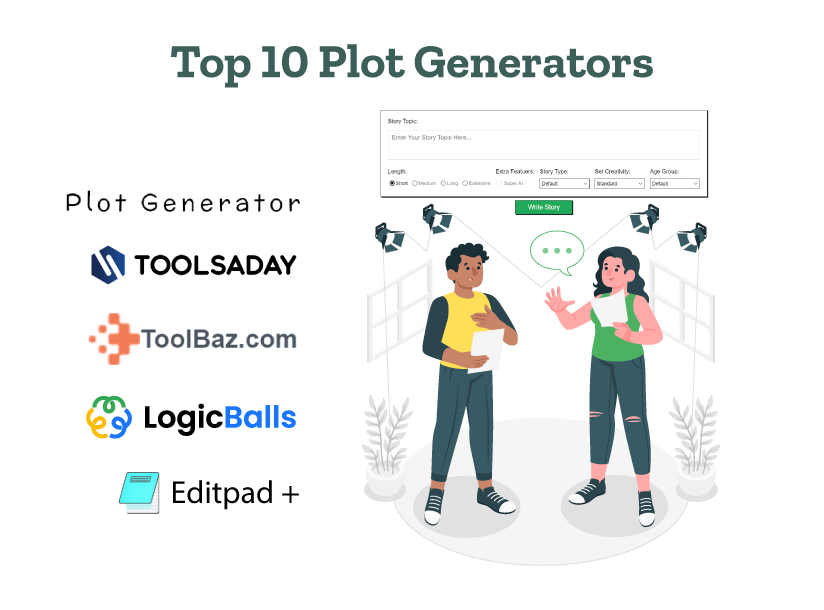
10 Best Plot Generators for Engaging Storytelling in 2025

Need some inspiration to create the best plot? Explore the 10 best plot generators to discover out-of-the-box ideas! 

Whether you’re writing a romance, mystery, thriller, or any other genre, this article will help. Let’s together begin this journey to discover the best tools!

Refine your plot with professional editing services! 

1. Plot-Generator.org

This website includes a Short Story Generator, Movie Script Generator, Picture Book Generator, and Fairytale Generator. However, this is not all. From killer opening lines and viral memes to click-worthy headlines, this website generates everything you need. 

Features

  • Feature to choose between a happy ending, sad ending, or twist 
  • Additional tools like a romance plot generator, fantasy plot generator, crime plot generator (Pro: You can add details about the protagonist, antagonist, setting, and plot for customized plots) 
  • Various generators for character development such as Name Generator and Character Generator

2. Toolsaday 

To generate the plot, this tool allows users to select from 7 popular story structures (Freytag’s Pyramid, the Hero’s Journey, Three Act Structure, Dan Harmon’s Story Circle, Fichtean Curve, Save the Cat Beat Sheet, and Seven-Point Story Structure).  

Features 

  • Options to mention the story idea, theme, and genre for plot generation
  • Various tone options like friendly, funny, casual, excited, professional, witty, etc 
  • A chat mode to enhance the writing prompt generated 

3. Toolbaz 

This AI plot generator allows you to fill in the details of your story ideas to create customized plots. You can also use it to create character profiles and generate unique metaphors and dialogues

Features

  • Generates a detailed plot of 8-9 paragraphs
  • Additional tools: back story generator, fantasy story generator, and book title generator 
  • Includes a Poem Generator, Rhyme Generator, Haiku Generator, Rap Lyrics Generator, and Lyrics Generator 

Now let us see the next plot idea generator! 

4. LogicBalls 

This story generator has the option to add details to generate a customized plot. It can be used by game designers, screenwriters, novelists, and educators to generate plots.

Features 

  • Can generate a detailed plot of 5 paragraphs 
  • 14 tone options: Casual, formal, convincing, critical, funny, humble, humorous, informative, inspirational, joyful, passionate, thoughtful, urgent, worried 
  • Generates the plot in multiple languages like English, Italian, Japanese, German, Russian, French, Hindi, etc. 

5. EditPad

Unlike many other tools, this story plot generator gives unique options to decide your story’s creativity. The options are: Standard, Conservative, Innovative, Imaginative, Visionary, and Inspired. 

Features 

  • Options to generate a short, medium, long, and extensive story
  • Various categories like classic, humor, sci-fi, love, thriller, realism, etc
  • Option to select the age group for the story (3-6, 7-13, 13-20, 21-35, 35+ years) 

Bonus: This tool also functions as a horror plot generator! 

6. Reedsy 

This tool generates 1 million combinations of random plots for writers. And the best part? You can choose from genres such as drama, romance, fantasy, and sci-fi to generate the plot. 

Features

  • Prompts include specific information about the protagonist, secondary character, and plot 
  • An exciting plot twist to create engaging plots 
  • A unique note section about a character with a unique quality, or behavior (For example, “Note that someone in the story has had problems with addiction for a while now.”) 

7. WritingExercises

Whether you require writing prompts for stories or crafting film scripts, this plot gives many exciting ideas. It also includes a random character name generator that generates exciting names for characters. 

Features 

  • A random plot generator: Generates prompts about two characters, a situation, a setting, and a theme
  • Murder plot generator: Generates random prompts about the victim profile, where, when, method of killing, and clue 
  • Additional AI generators: Character Generator, Town Name Generator, Random First Line of Dialogue, Story Ideas 

8. Squibler 

Squibler is a free random plot generator that can generate thousands of ideas quickly. It also has an option “Try Dangerous Mode” using which you can generate prompts or start writing without any prompt. 

Features 

  • Generates 1-line random prompts 
  • A huge variety of prompts that include: intriguing questions, character descriptions, shocking, nostalgic, and happy statements 
  • Incomplete sentences that allow you to fill gaps using imagination 

9. RanGen 

This random prompt generator provides thousands of exciting free prompts. It also includes a setting generator using which you can create continents, countries, and fantasy races to enhance your plot. 

Features 

  • Options for prompt generation: Premise (short), Detailed & Complete 
  • 3 genre options: Action, fantasy, and romance 
  • A useful Plot Devices Generator (It gives detailed prompts about people, locations, threats, feelings, and events.) 

10. Storytelling.com 

This short story plot generator generates detailed writing prompts of 5 paragraphs. Using this tool, you can generate any number of writing prompts within seconds. 

Features 

  • Options to select from genres like action, comedy, drama, fairytale, historical, horror, etc 
  • Various ending choices to select from like happy, sad, mysterious, romantic, twist 
  • A feature to add details about the plot’s topic, setting, and characters 

After understanding the best story plot generators, you can start brainstorming! Once you complete writing your story, the next step will be to edit it. As experts in editing and proofreading services, we’d love to help you perfect your story! 

What do you think about these AI plot generators? Share your thoughts in the comments section! 

Here are some other useful resources for you: 

Your vs. You’re: Learn the Differences with Easy Examples

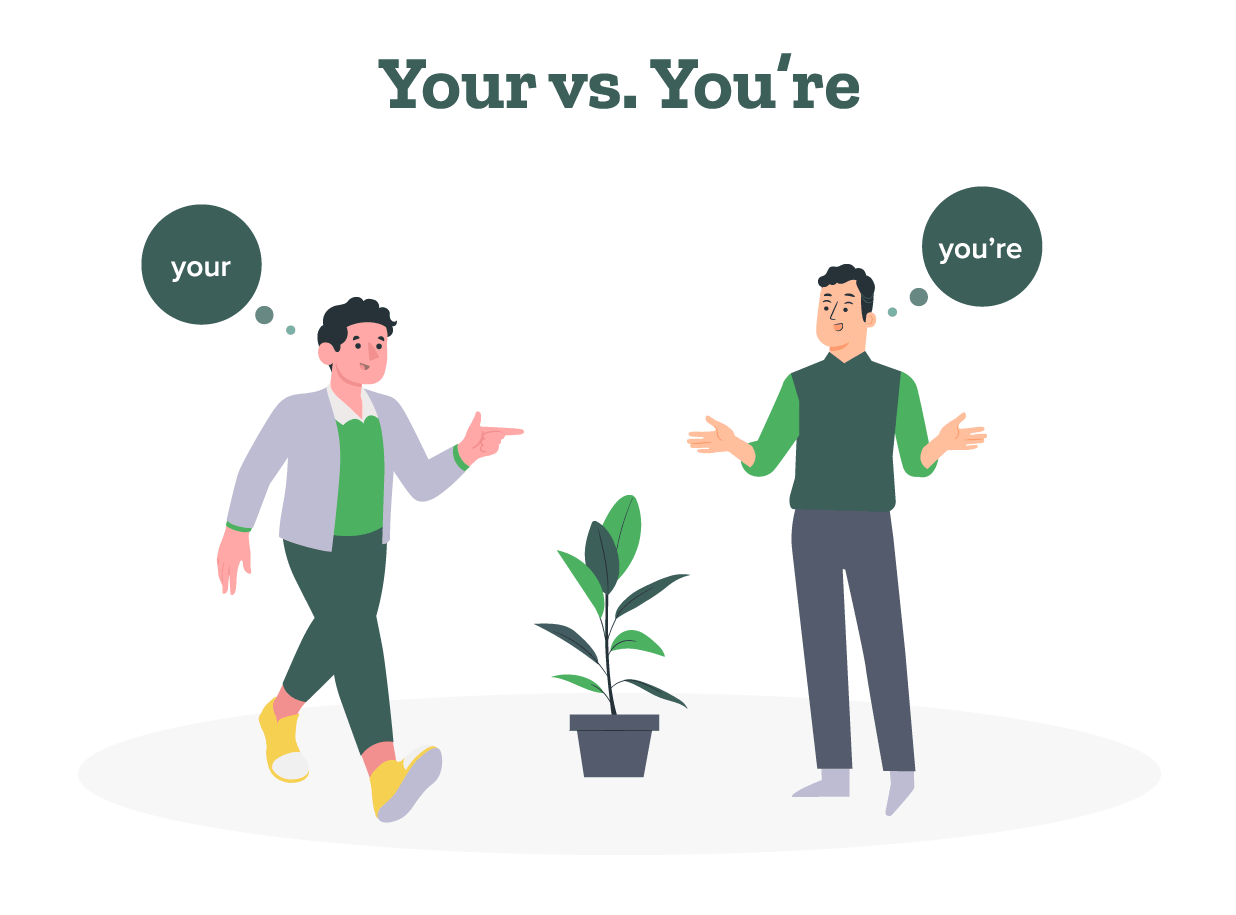
You’re and your are two of the most commonly confused words by students and professionals. Though their pronunciation is the same, their meanings are different. A big reason for this confusion is the common association of apostrophes with possession, which misleads people into mixing up the two terms. In this article, we’ll explain the meaning and difference between your vs. you’re.

We’ve also given specific examples to help you understand whether to use your or you’re in various phrases. So let’s get started! 

Are You Facing Vocabulary Errors? Let Our Editors Help You Write Better. Get Started

What is the difference between your and you’re? 

Here’s the difference between you’re vs. your: 

Your is a possessive pronoun that shows belonging and ownership. It is derived from the personal pronoun you and is usually used before a noun. ‘Your’ is a possessive form. It indicates ownership, as in the phrase ‘your car’.

This is your book. 

I took your book to read. 

You’re is a contraction of the words you and are. For example: 

You’re not the only one who has problems. 

She knows that you’re a senior manager at Deloitte. 

The above examples demonstrate the difference between these two homophones. However, you may also have been unsure about whether to use you’re vs. your in certain phrases. Let’s look at some examples of the correct word choice in certain phrases. 

Your vs. you’re examples

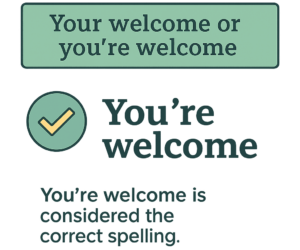
1. Your welcome or you’re welcome 


your welcome vs. you're welcome


You’re welcome is considered the correct spelling if you’re responding to someone saying thank you, as it is used to express a state of being appreciated. However, if you are describing someone’s welcome, your welcome can be used. Here are some examples to clarify the meaning further: 

You’re welcome! I’m happy to help. 

Your welcome was grand and memorable. 

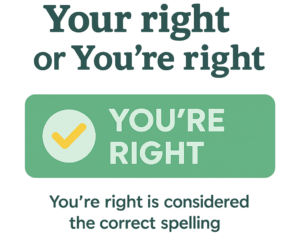
2. Your right or you’re right


your right vs. you're right


You’re right is regarded as the appropriate spelling if you wish to acknowledge that someone is correct about something. However, your right is the accurate spelling if you are talking about someone’s rights. 

You’re right about finishing the foreign assignment first. 

Know your rights and avoid getting duped by anyone. 

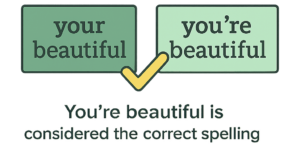
3. Your or you’re beautiful 


your beautiful vs. you're beautiful


You’re beautiful is correct as a standalone phrase. However, if you are referring to someone’s beauty in a sentence, your beautiful is the right phrase. If you wish to use the contracted form of you and are, you’re beautiful is the right usage. 

You’re beautiful!  

You don’t know you’re beautiful!  

Your beautiful eyes reminded me of a famous dancer. 

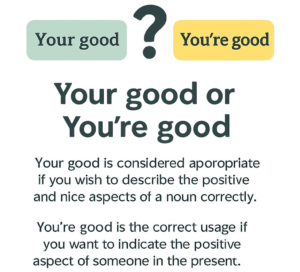
4. Your good or you’re good 


your good vs. you're good


Your good is considered appropriate if you wish to describe the positive and nice aspects of a noun. You’re good is the correct usage if you want to indicate the positive aspect of someone in the present. 

Your good jacket has been spoiled. 

I know that you’re good people. 

5. Your pretty or you’re pretty 


your pretty vs. you're pretty


You’re pretty as a standalone phrase is the correct usage. However, if you wish to commend the beauty of a noun in a sentence, your pretty is the right usage. Here are some your and you’re examples of this phrase: 

You’re pretty!

Raj said that you’re pretty

I love your pretty bag.

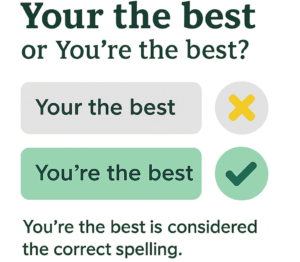
6. Your the best or you’re the best 


your the best or you're the best


You’re the best is widely accepted as the right usage. Your the best is the incorrect phrase which should not be used. 

You’re the best friend in the world. 

He thinks that you’re the best artist in the class. 

To determine if ‘you’re’ is correct, replace it with ‘you are’ and see if the sentence still makes sense.

7. Your honor or you’re honor 


your honor or you're honor


Your honor is considered the correct usage by dictionaries worldwide. When addressing someone, your honor means respect and high esteem. Your Honor is also used as a term to address the judge in judicial courts. You’re honor is regarded as the incorrect spelling. 

I rest my case, Your Honor

Don’t compromise on your honor

8. Your not or you’re not 


your not vs you're not


You’re not is the right phrase that must be used. Your not is the wrong usage. ‘You’re’ combines the pronoun ‘you’ with the verb ‘are’.

You’re not responsible for his mistakes. 

She hopes that you’re not influenced by the wrong crowd. 

Now that we’ve seen your vs. you’re examples, a question arises: When to use your and you’re? Let’s find out! 

When to use your and you’re 

If you want to show how something belongs to or is associated with someone, “your” is the correct usage. However, if you wish to use the shorter form of you and are to communicate about someone in the present, use you’re.  

We hope this article has resolved all your doubts about your vs. you’re. There are also many other commonly confused homophones like their and there, to, two, and too. To remember the difference between such homophones, you can create mnemonics and jot down simple sentences with these homophones. This will help to remember the meanings of homophones. 

As experts in providing editing and proofreading services, we’d love to make your job easier and help you understand concepts better. Go through our list of resources to avoid making common grammar and word choice errors! 

What Is a Research Proposal: A Detailed Guide

When planning a research project, don’t you think it might be great to know how to write a research proposal? This blog does exactly that! It introduces you to the concept of a research proposal and how to write one. It also provides a roadmap for your study. 

What you can learn while studying research proposals with us is how detailing the purpose of a research proposal makes a difference to your research work. It helps you determine the approach you plan to take. So, let’s explore what a research proposal entails, its structure, and tips for crafting one effectively.

Do Not Let Your Research Work Make You Nervous. Get Expert Editing! Learn more

What is a research proposal?

A research proposal is a structured document that outlines a research project’s aims, methodology, and anticipated results. They are required for academic projects, grant applications, or business proposals since a well-constructed research proposal clarifies your research intentions and makes interpretation easy.

A research proposal is more than just a formality. It is a strategic document that enables you to articulate your research focus, which is particularly important for funding.

Purpose of research proposals

The importance of research proposals goes beyond just fulfilling academic requirements. The purpose of a research proposal is to justify the need for your study, demonstrate the feasibility of your approach, and secure funding or approvals. 

Through this document, you can demonstrate the significance of your research question and how it addresses a gap in existing knowledge. It is a compelling proposal that highlights your understanding of the field. By guiding your research process, this document ensures you do not stray off-topic.

What goes into the development of a research proposal?

A comprehensive research proposal outline includes several essential components. This is no surprise! However, writing a research proposal that creates the right impact and gets you the result you want is crucial. 

In this section, let us study the important components of a research proposal. 

  • Title and abstract

The title should be concise yet descriptive, reflecting the main topic of your study. The abstract summarizes your research proposal in 150-250 words, presenting the key objectives, methods, and anticipated impact of your research.

  • Research objectives and questions

A clear statement of your research objectives and questions is one of the most important components of a research proposal. Objectives clarify what you intend to achieve, while the questions define the specific aspects of your study. 

These elements align your proposal with broader goals in your field.

  • Literature review

A literature review demonstrates how familiar you are with existing research in your chosen field. By analyzing relevant studies, your research proposal outlines the gaps that your research work is expected to fill. 

This section is key in establishing the importance of your research work since it places your study within the academic discourse and emphasizes its relevance.

  • Research methodology

The research methodology section outlines the methods you intend to use to collect and analyze data. Depending on the nature of your study, this could include qualitative, quantitative, or mixed methods. A well-defined methodology builds trust in your research proposal.

For instance, if you mention qualitative research methodology techniques in your proposal, your audience will know what to expect—exploratory, inductive, subjective, or other forms of research.

  • Timeline and budget

Including a timeline and budget showcases your project management skills and the feasibility of your study. This section should break down the stages of your research and the resources you will require, such as materials, participant incentives, and equipment costs.

Research proposal examples

Let us study a research proposal example to see these components in action. 

Title: “The Impact of Social Media on Academic Performance Among College Students”

Abstract: This study will examine how social media usage affects the academic performance of college students. By surveying a sample of 500 students, we aim to assess correlations between time spent on social media and grades.

Research Objectives and Questions:

  1. To determine the frequency of social media use among college students.
  2. To identify patterns between social media use and academic performance.

Methodology: Quantitative surveys will be administered to students, and the data will be analyzed using statistical software.

This example highlights the research proposal format and how each section contributes to a clear and cohesive proposal.


The following is a basic but more detailed example of a research proposal. 

Research Proposal: The Impact of Social Media on Adolescent Mental Health

Introduction

Social media platforms have become an integral part of adolescents’ lives, offering opportunities for connection, information sharing, and self-expression. However, concerns have emerged regarding the potential negative impact of excessive social media use on mental health. This study aims to investigate the relationship between social media usage and adolescent mental health outcomes, including depression, anxiety, and self-esteem.

Research Questions

  1. What is the relationship between social media usage and adolescent mental health?
  2. Are there specific social media features or behaviors associated with negative mental health outcomes?
  3. What are the mediating and moderating factors that influence the relationship between social media use and mental health?

Literature Review

[A detailed review of existing literature on the topic, highlighting key findings and research gaps. Discuss relevant theories, such as social comparison theory, self-presentation theory, and the uses and gratifications theory.]

Methodology

Research Design:

  • Cross-sectional survey design

Participants:

  • A diverse sample of adolescents aged 13-18 years old.
  • Recruitment through schools and online platforms.

Data Collection Instruments:

  • Demographics Questionnaire: To collect information on age, gender, ethnicity, and socioeconomic status.
  • Social Media Use Questionnaire: To assess frequency, duration, and types of social media platforms used.
  • Depression Anxiety Stress Scales (DASS-21): To measure symptoms of depression, anxiety, and stress.
  • Rosenberg Self-Esteem Scale: To assess self-esteem.

Data Analysis:

  • Descriptive statistics to summarize demographic information and social media use patterns.
  • Correlational analysis to examine the relationship between social media use and mental health outcomes.
  • Regression analysis to identify the specific predictors of mental health outcomes.

Ethical Considerations

  • Informed consent will be obtained from all participants or their legal guardians.
  • Participant privacy and confidentiality will be protected.
  • Data will be stored securely and accessed only by authorized personnel.

Timeline

  • Months 1-2: Literature review and finalization of research instruments.
  • Months 3-4: Data collection.
  • Months 5-6: Data cleaning and analysis.
  • Months 7-8: Report writing and submission.

Budget

  • Personnel: Research assistants, data analysts
  • Materials: Questionnaires, consent forms
  • Technology: Computer software, online survey tools
  • Miscellaneous: Printing, postage, travel expenses

Expected Outcomes

This study is expected to contribute to a better understanding of the complex relationship between social media use and adolescent mental health. The findings may inform the development of evidence-based interventions and guidelines aimed at promoting positive social media use and mitigating its potential negative effects.

Structure of a research proposal

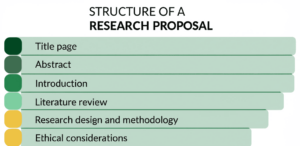
The research proposal structure plays a key role in determining the success of your research project. It is typically divided into distinct sections. Each part builds upon the previous ones to present your study systematically.

Structure of a research proposal

  • Title page

The title page includes your project title, name, institution, and contact details. Ensure it follows any specified research proposal format, particularly in academic settings. 

  • Abstract

Summarize your study’s purpose, methods, and potential impact in a few sentences. This section serves as a brief overview for readers to understand the essence of your proposal.

  • Introduction

The introduction should provide context, outline the significance of your study, and define relevant goals. It helps your audience understand what a research proposal aims to achieve.

  • Literature review

As seen above, the literature review covers previous studies and highlights gaps your research intends to address. Using this section to discuss past findings strengthens the research proposal preparation activity and subsequent research presentation.

  • Research design and methodology

This section makes your research methodology prominent by detailing the methods and tools you intend to use. Clarifying your approach allows reviewers to assess the reliability and validity of your study.

  • Ethical considerations

If your study involves human subjects or sensitive data (financial, medical, defense statistics, disease, etc.), ethical considerations are vital. Discuss how you plan to handle privacy, consent, and any potential harm to participants.

Each section of this blog provides insights into what a research proposal is and a research proposal template. For more information about research paper templates, read this article: Research Paper Outline: Free Templates & Examples to Guide You.

Using the guidelines shared in this blog, you no longer need to wonder about a proposal for your research. You can now start crafting your proposal with confidence. For editing and proofreading support, contact us. Our editors can help you improve and refine your research proposal and make it submission-ready.

Here are some other relevant articles you might want to check out: 

How to Write a Book Report | Steps, Examples & Free Template

Have a book report submission deadline and want to know how to write one? We’re here to help! Book reports are vital in academics, helping students sharpen their understanding and critical thinking, while for authors, they offer a deep dive into a text’s composition and stylistic elements. The author’s contributions are crucial for understanding a text, as their perspective and choices significantly impact the content and structure of the writing.

In this article, we will understand how to write a good book report. It’s a skill that not only helps you get more out of what you’re reading but also lets you create a report that truly reflects how good the book is. Summarizing and analyzing the book’s content is essential to provide insights into its main themes, structure, and arguments. Let’s get started!

Ace your assignment with a perfect book report!

Firstly, let us understand what is a book report.

What is a book report?

A book report is an in-depth analysis, an objective summary of a book’s main content and arguments. It includes a plot summary that encapsulates the book’s plot. Book reports discuss a book’s content, structure, and themes. Far from just a recap of the plot outline, a book report examines the details of a book’s narrative, offering insights into the characters, themes of the story, and the author’s writing style. 

Analyzing the book’s themes is crucial as it provides critical insights into the underlying messages and social commentaries within the narrative.

Note: A book report is usually assigned to students from secondary schools to colleges. As per the book report format, book reports are typically 500–1000 words long. Mentioning the book’s title in the introduction and throughout the report is essential for effectively framing the discussion and analysis.

Elements of a book report

Elements of a book report

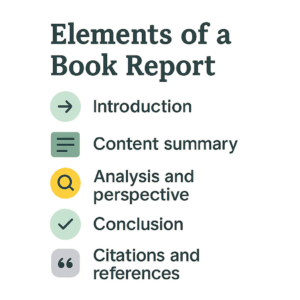
A proper book report outline consists of the following elements:

  • Introduction: Think about how to start a book report with an engaging opening. Mention the book’s title, author, genre, and a brief plot summary. State your main theme or viewpoint.
  • Content summary: Give a clear summary of the plot. Highlight key events and turning points. Avoid spoilers. Be concise due to limited space.
  • Analysis and perspective: Examine the key characters, their traits, motivations, development, and plot roles. Explore major themes, symbols, and motifs, and their narrative effect. Review the author’s style and perspective, and their impact on the story. Note that a detailed character analysis is often unattainable within strict word limits.
  • Conclusion: Summarize your main points. Restate your overall impression of the book and possibly suggest who might enjoy it or what kind of readers would benefit from it.
  • Citations and references (if necessary): If you have used external sources or have been influenced by other analyses, make sure to cite these references properly to avoid plagiarism. Include page numbers in your citations to enhance clarity.

By following this book report outline, your book report will be comprehensive, informative, and engaging.

Knowing the intended audience

When writing a book report, it’s essential to know the intended audience. The intended audience refers to the group of people the author is trying to reach with their book. To identify the intended audience, consider the book’s content, style, and tone. Ask yourself, what type of reader would be interested in this book? What age group, profession, or demographic is the author targeting? Knowing the intended audience will help you tailor your book report to their needs and interests. For example, if the book is a young adult novel, the intended audience may be teenagers or young adults. In this case, your book report should focus on settings and elements that are relevant to this age group.

How to write a book report

Before learning how to do a book report, it is important to remember that following a book report format is essential. 

Here’s how to write a book report:

  1. Read the book carefully: Start by reading the book thoroughly. Take notes on key points, characters, themes, and any passages that stand out.
  2. Create an Outline: Organize your thoughts and notes into an outline. This will be your roadmap and will help keep your writing focused.
  3. Write the introduction: Begin with an engaging introduction that provides basic information about the book, including the title, author, and a brief synopsis. Make sure to identify the author’s main point of view and how it influences the content of the book.
  4. Develop the body: You can follow your outline or a book report template to write the body of your report. Discuss each element (plot, characters, themes, etc.) in separate paragraphs or sections.
  5. Conclude your report: Summarize your main points and offer your final thoughts and evaluation of the book.
  6. Review and revise: Finally, review and proofread your report for clarity, coherence, and correctness. Make sure to correct any grammatical mistakes and ensure your report flows logically. It is crucial to review the final paper to ensure quality and accuracy before submission.

Tips for writing a book report

Writing a book report can be a challenging task, but with some tips and guidelines, you can create a well-structured and informative report. Here are some tips to get you started:

  • Begin by reading the book carefully and taking notes on the main events, characters, and themes.
  • Create an outline to organize your thoughts and ideas.
  • Use a book report template to guide your writing and ensure you include all the necessary elements.
  • Focus on the book’s main ideas and themes, rather than trying to summarize every detail.
  • Use evidence from the book to support your analysis and arguments.
  • Edit and proofread your report carefully to ensure it is free of errors and easy to read.
  • Consider including a few examples or quotes from the book to illustrate your points and add depth to your analysis.

By following these tips, you can create a well-written and informative book report that showcases your understanding of the book and its themes. Remember to keep your report concise and focused, and don’t be afraid to ask for help if you need it. With practice and patience, you can become a skilled book report writer and develop a deeper appreciation for literature and critical thinking.

Taking a look at a few examples of book reports will help you understand how to do a book report easily.  So let’s explore some book report examples next.

Book report examples

Starting with book report examples, let’s look at a book report example on The Diary of a Young Girl by Anne Frank.

Introduction: Diary of a Young Girl by Anne Frank is a powerful and poignant diary that gives an intimate glimpse into the life of a Jewish teenager during the Holocaust.

Summary: The diary chronicles Anne Frank’s life from 1942 to 1944, during which she and her family hid from the Nazis in Amsterdam. The entries detail her daily life in the secret annex, her thoughts, fears, and hopes for a better future.

Analysis and themes: Anne’s diary is a testament to the resilience of the human spirit in the face of unimaginable adversity. Themes of hope, the cruelty of war, the innocence of youth, and the power of writing shine through her words.

Conclusion: Diary of a Young Girl is more than just a diary; it’s a moving narrative that brings to light the horrors of war and the timeless strength of hope and human dignity. Anne Frank’s voice continues to resonate with readers around the world, making this book a must-read for understanding history and humanity.

Now let’s look at a fiction book report example on Percy Jackson and the Lightning Thief by Rick Riordan.

Introduction: Percy Jackson and the Lightning Thief by Rick Riordan is a thrilling fantasy novel that introduces us to a world where Greek gods and mythology come to life in the modern era.

Summary: The story follows Percy Jackson, a young boy who discovers he is the son of Poseidon, the Greek god of the sea. After being accused of stealing Zeus’s lightning bolt, Percy embarks on a dangerous adventure across America to find the real thief and prevent a war among the gods.

Analysis and themes: Riordan’s novel is rich in Greek mythology and cleverly intertwined with modern-day settings and issues. Themes of identity, friendship, and bravery are prominent as Percy navigates the challenges of being a demigod. The book also explores the concept of good vs. evil and the importance of understanding one’s strengths and weaknesses.

Conclusion: Percy Jackson and the Lightning Thief is an engaging and imaginative novel that offers a fresh perspective on Greek mythology. It’s a captivating read for young adults, effectively combining action, humor, and life lessons, making it a standout in the genre of fantasy fiction.

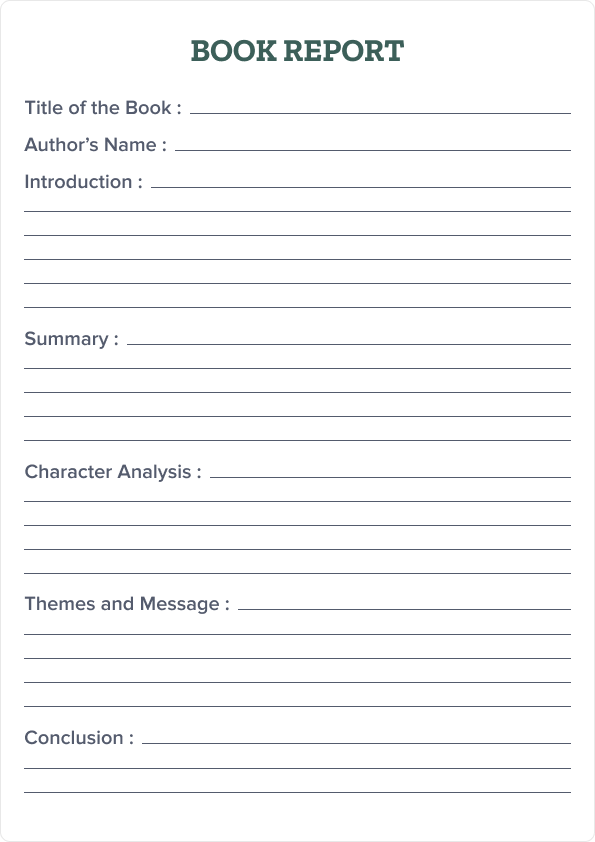
Book report template

You can easily write a book report using our free book report template.

Free book report template.

It’s clear that writing a book report is more than a mere academic exercise; it’s an opportunity to delve deeper into the world of literature and gain insights. 

By using the provided template and examples as starting points, you’re well on your way to writing insightful and compelling book reports. When citing a book, remember to include the publisher’s name and the total number of pages to ensure a complete and accurate citation. Also, to make your book report perfect, we are always here to help you with our expert editing and proofreading services

For more useful tips and resources, keep reading:

What Is an Anthology? Meaning, Types, & Anthology Examples

An anthology is like a mini library of the best literary works. Each work makes you think about a topic or theme in a different way. This blog explains the meaning and types of anthologies in simple language for beginners. 

To simplify the meaning and types of anthologies, we’ve included many examples of popular anthologies. So let’s begin with a basic anthology definition! 

Self-Publish Your Book Now! Get Started

What is an anthology book? 

An anthology is a collection of selected writings by different authors. These works often revolve around a common theme, genre, or time period. For example, they can center around a theme (e.g., love), a genre (e.g., fantasy), or a time period (e.g., the Renaissance era). 

Anthologies don’t have a common writing style. Instead, they help showcase different writing styles and perspectives of authors. 

Anthologies are commonly used in educational settings like schools and colleges. This allows students to compare and contrast different approaches authors apply to write about a common theme, historical period, genre, or subject. 

Popular examples of anthologies 

Each example of an anthology given below celebrates the creativity and versatility of diverse authors. Let’s quickly see these examples! 

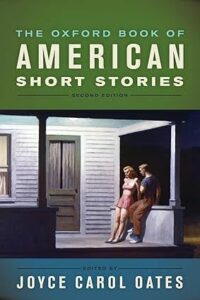
1. The Oxford Book of American Short Stories

This anthology presents a selection of short stories by popular American writers. They include stories written by Ernest Hemingway, Mark Twain, Washington Irving, Kate Chopin, and Stephen King. The book is a great introduction to American literature.

Anthology example: The Oxford Book of American Short Stories

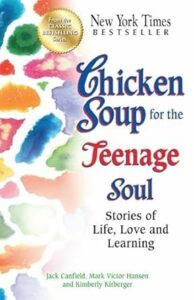
2. Chicken Soup for the Soul

This series of anthologies features inspiring and heartwarming true stories about everyday people. The stories are short, easy to read, and cover a wide range of topics, from love and friendship to overcoming challenges.

Anthology example: Chicken Soup for the Soul

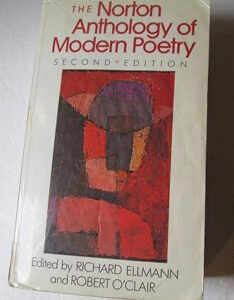
3. The Norton Anthology of Modern Poetry

This anthology book is a collection of poems from different time periods and cultures. It includes works from famous poets like Sylvia Plath, Ezra Pound, and Margaret Atwood, as well as lesser-known poets.

Anthology example: The Norton Anthology of Modern Poetry

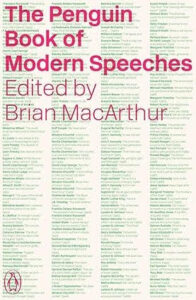
4. The Penguin Book of Modern Speeches 

This book brings together some of the most powerful and influential speeches. It includes speeches by political leaders and activists from around the world, such as Martin Luther King Jr., Nelson Mandela, Barack Obama, Theodore Roosevelt, and Mahatma Gandhi.

Anthology example: The Penguin Book of Modern Speeches

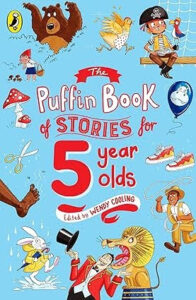
5. The Puffin Book of Stories for 5-year-olds 

Edited by Wendy Cooling, this book is designed specifically for young children who are just starting to read on their own. It contains a collection of short, simple stories that are easy to follow and understand. The stories are by a variety of authors and cover a range of topics, from animals and adventures to friendship and family. The anthology is beautifully illustrated and perfect for parents to read aloud to their children or for beginner readers to enjoy on their own.

Anthology example: The Puffin Book of Stories for 5 year olds

Types of anthologies

There are two main types of anthologies: short-form and long-form. Long-form anthologies have longer pieces of writing, often much longer than 20,000 words. In comparison, short-form anthologies have shorter pieces, usually 20,000 words or less. 

While short-form anthologies are great for readers who like a quick read, long-form anthologies are good for readers who want to study longer works. 

Let’s explore the various subtypes of anthologies! 

1. Poetry anthologies: These books gather poems from different poets, often organized around a theme, style, or time period. A poem anthology might focus on love poems, nature poems, or works from a specific country or era. 

2. Short story anthologies: These collections feature short stories from various authors. They can revolve around a genre like science fiction, horror, or romance. Alternatively, they might include stories from a particular group of writers or time period.

3. Essay anthologies: These books compile non-fiction essays from different writers. An essay anthology is often centered on a specific theme or topic, such as travel, politics, or personal experiences.

4. Textbook anthologies: These collections are specifically designed for use in courses. They feature works that illustrate specific literary techniques, themes, or historical periods.

5. Regional anthologies: These books collect works from writers in a specific geographic region, such as the American South, the Caribbean, or East Africa. 

6. LGBTQ+ anthologies: These collections gather works by and about LGBTQ+ individuals. They often focus on the unique experiences of LGBTQ+ writers. 

7. Women’s anthologies: These books compile works written by women. Their aim is often to recognize women writers of a particular period. 

8. Picture book story collections: These anthologies gather short stories for children, often accompanied by colorful illustrations.

Commonly used literary themes in anthologies 

One of the most common themes of anthologies is identity and self-discovery. These anthologies can cover topics like race, gender, sexuality, culture, and personal growth.

Some other commonly used themes are: 

1. Love and relationships 

These might include stories about romantic love, family bonds, friendships, or even the complexities of difficult relationships. The works in these anthologies often examine the joys, challenges, and emotions that come with human connections. 

2. Social and political issues

Some anthologies focus on social and political themes, gathering works that examine issues like inequality, discrimination, justice, or human rights. These collections might include stories, essays, or inspiring poems that shed light on the experiences of marginalized communities, explore the impacts of historical events, or call for social change.

3. Nature and environment

Many anthologies celebrate the beauty and importance of the natural world. These collections might include works about animals, plants, landscapes, or the relationship between humans and the environment. 

4. Courage and resilience

Anthologies often showcase stories of courage and resilience, featuring characters or real people who have faced and overcome challenges. These works might explore themes of perseverance, hope, and the strength of the human spirit in the face of adversity.

5. Humor and satire

Some anthologies aim to entertain and amuse readers by collecting humorous or satirical works. These might include funny short stories, witty essays, or parody poetry that pokes fun at society, politics, or everyday life.

6. Mythology and folklore

Anthologies may also gather stories and poems that draw on the rich traditions of various cultures around the world. These collections might retell classic tales, explore the symbolism and meaning behind mythological figures, or showcase how these stories continue to resonate with modern readers.

7. War and conflict

Some anthologies explore the themes of war and conflict, collecting works that examine the experiences of soldiers, civilians, and communities affected by violence and unrest. These collections might include historical accounts, personal essays, or fictional stories that shed light on the human costs of war and the search for peace.

Best strategies for contributing to anthologies 

One of the best strategies is to participate in writing contests and challenges. Many writing communities and organizations offer writing challenges or contests throughout the year, often with specific themes or prompts. The winning entries are often published in an anthology. 

1. Experiment with different submission strategies  

Experiment with submitting to anthologies in different genres, styles, or themes to see where your work resonates most. You can also try submitting shorter or longer pieces, or pieces that showcase different aspects of your writing skills.

2. Utilize writing prompts and exercises 

If you’re struggling to come up with ideas for your submission, try using writing prompts or exercises related to the anthology’s theme. Many anthologies provide specific prompts or guidelines to help inspire and direct your writing. You can also find general writing prompts online or in writing craft books to get your creative juices flowing.

3. Seek feedback from beta readers 

Before submitting your work, consider sharing it with a group of beta readers, such as fellow writers or avid readers in your target audience. Ask for their honest feedback on your piece’s strengths, weaknesses, and overall effectiveness. Use their insights to revise and polish your work before submitting it to the anthology.

How to create an anthology? 

To create an anthology, first, decide the central theme or genre for the anthology. Then, establish clear guidelines for submissions, including word count, formatting, content restrictions, and deadline. You also need to decide whether you will accept previously published works or only original, unpublished pieces. 

Once you decide on these steps, you need to take a call on how writers can submit their entries. This can be through post, email, a submission form on the website, or submission management platforms like Submittable or DuoTrope. 

Then, you need to perform the following steps: 

  • Announce a call for submissions

Share your call for submissions on your website, social media, and writing communities or forums. Reach out to writers, poets, or essayists you know and invite them to contribute submissions.

  • Review and select submissions 

Read through all the submissions carefully, keeping your theme and quality standards in mind. Select the pieces that best fit your vision for the anthology and showcase a diverse range of voices and perspectives.

  • Notify the anthology’s contributors 

Thank all contributors for their submissions. Notify the contributors whose works have been selected via email or call that their works have been selected. 

  • Create the anthology 

Write an introduction to the anthology that explains its theme, purpose, and significance. Arrange the pieces in a logical order that flows well and creates a cohesive reading experience. 

How to publish an anthology? 

To publish an anthology, you first need to edit the content you’ve received for the anthology. 

Work with the selected contributors to edit and refine their pieces as needed. You can also consider partnering with professional editing services to refine your anthology. 

You also need to perform the following steps: 

  • Design and format the book 

Choose a visually appealing cover design that reflects the anthology’s theme and tone. Format the interior of the book, including the table of contents, contributor bios, and any additional front or back matter. You can hire book cover design services and book formatting services for this step. 

  • Choose a publishing path 

Decide whether you want to pursue traditional publishing or self-publishing for your anthology. Research different publishing options and their requirements, costs, and distribution channels. If self-publishing, choose a reliable print-on-demand service or eBook platform. 

  • Set pricing and other details 

If you’re publishing your book both as an eBook and as a physical copy, decide the pricing for both. Also, create an attractive book description and book blurb and decide the tags and categories for your book. 

  • Distribute your book on online and offline platforms 

Distribute your book through platforms like Amazon KDP, Lulu, IngramSpark, Apple Pages, Kobo Writing Life, etc. Also, use platforms like OverDrive to reach a larger audience. Plus, you can reach out to bookstores, libraries, and online retailers to distribute your anthology.

  •  Promote your anthology

Some simple marketing strategies you can use are: 

  • Create a marketing plan to promote the anthology through social media, book reviews, and events. 
  • Encourage contributors to share the anthology with their networks and audiences.
  • Consider offering readings, signings, or workshops to generate interest and engage with readers.

To conclude, anthologies are a great way to explore the world of literature and discover new authors. They bring together a mix of voices and styles from different times and places. If you love reading or writing, anthologies are a perfect starting point.

PaperTrue’s editing and proofreading services can help take your writing to the next level. Our professional editors will fix any language mistakes and give you detailed suggestions to improve your work.

Interested in our services? Contact us for more information! 

Here are some useful resources for you: 

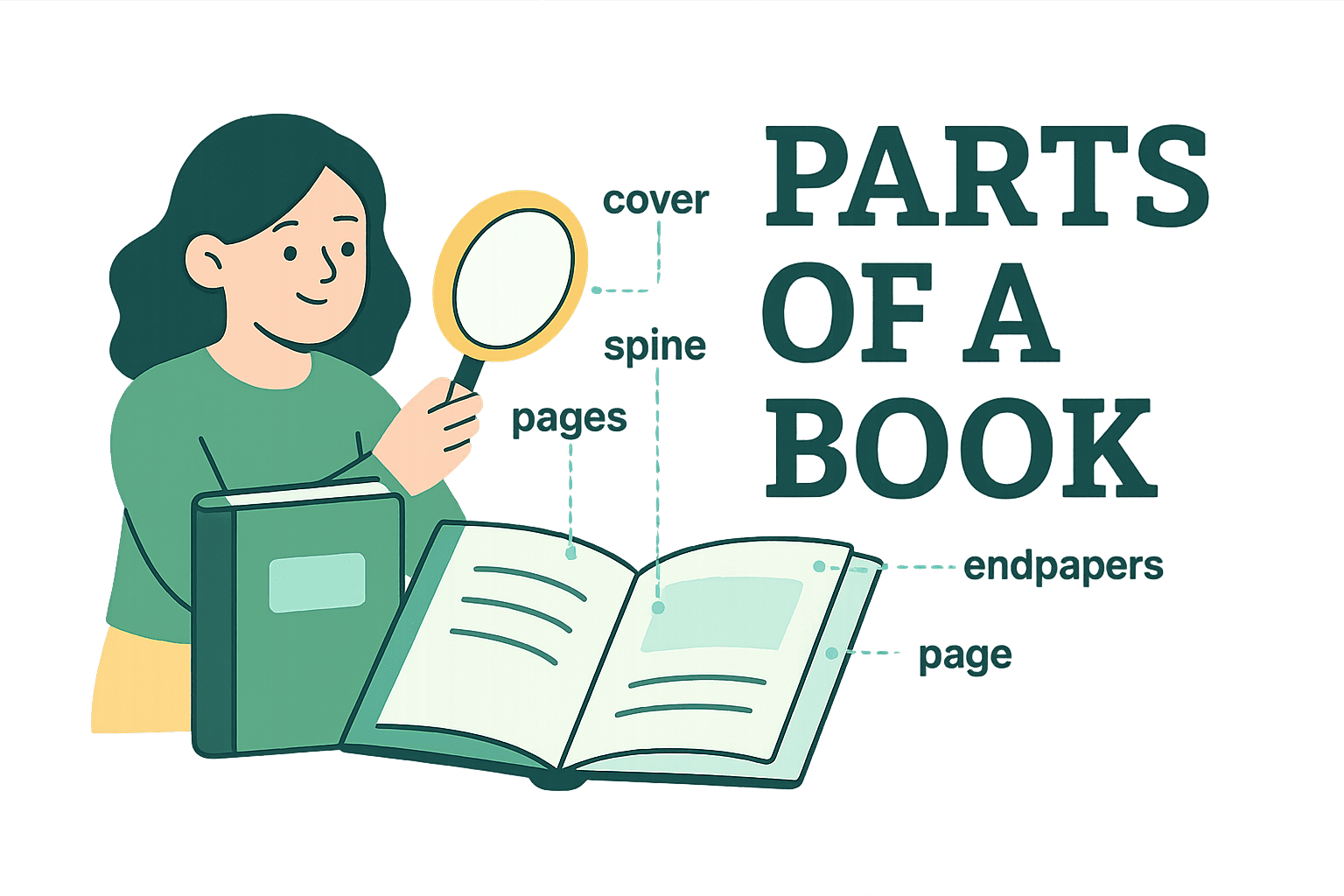
Parts of a Book: A Practical, Easy-to-Understand Guide

When you pick up a book, you might start reading the story right away. However, the main story is just one part of the book. The other parts, found at the beginning and end, help make the book complete.

In this blog, you’ll learn about all the different parts of books with simple examples. You’ll also understand how to organize these parts to create a book structure. So let’s explore the different parts of a book! 

Your Book. Our Expertise. Let’s Publish It. Get Started

What are the different parts of a book? 

Every book has 3 basic parts: the front matter, body text, and back matter. Each part is equally important to complete the book. Here’s a quick overview of these parts: 

1. The Front Matter: The book’s friendly hello!

Author’s Name, Title, Copyright Page, Preface, Foreword, Dedication,  Positive Reviews, Illustrations, Acknowledgements, Epigraph, List of Tables, Figures & Abbreviations 

2. The Main Body: The book’s beating heart!

Prologue, Chapters, Paragraphs, Dialogues, Illustrations, Photos, Sections/Parts, Epilogue, Conclusion, Headings, Subheadings, Footnotes/Endnotes, Page Numbers 

3. The Back Matter: The book’s grand finale!

Author’s Bio, Author’s Note, Acknowledgements, Copyright Permissions, Glossary, Bibliography/Reference List, Index, Appendix, Afterword, Discussion Questions, Reader’s Guide, Book Excerpt, Other Books by the Author
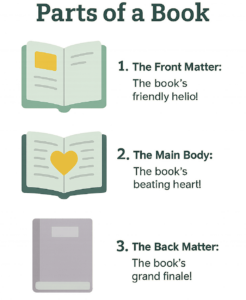
Parts of a book: the front matter, main body, and the back matter.

However, this is just the tip of the iceberg. To understand the parts of a book in detail, let’s dive deeper.

What is included in the front matter of a book? 

The front matter is like the beginning of a movie, setting the stage for what’s to come. Its important elements are: 

1. Half title page (optional): This is the very first page of the book, and it only has the book’s title on it. 

The Mountain God’s Revenge 

2. Frontispiece (optional): This is a picture or illustration that comes right after the half-title page. It gives you a sneak peek into the story or the book’s theme.

The Magical Mountain Castle 

3. Title page (compulsory): This page has the book’s full title, the author’s name, and the publisher’s name. It’s like a formal introduction to the book.

A CIRCUS OF WARRIORS 

            R.K. LIM. 

          Ferns Publishing House 

4. Epigraph (optional): An epigraph is a short quotation or saying. It is usually from a famous person or literary work that is relevant to the book’s theme, content, or tone. 

The epigraph is typically placed on a separate page between the half-title page and the main text, or between the dedication and the table of contents. In some cases, it may appear directly below the dedication on the same page.

Two roads diverged in a wood, and I—

I took the one less traveled by,

And that has made all the difference.

– Robert Frost, “The Road Not Taken” 

5. Copyright page (compulsory): This is super important! It’s the legal stuff – who owns the book when it was published, the ISBN (a 13-digit book identifier), and other publishing details. To know more, you can read the article “How to Copyright a Book in 2024”.
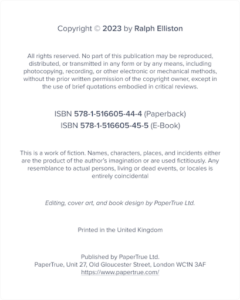
Copyright page as a part of book

6. Dedication (optional): This is where the author writes a short message to someone special, like a friend, family member, or someone who inspired them. You can take inspiration from book dedication examples online to write a book dedication. 

To my incredible partner, Alex, who has been my rock throughout this journey. Your constant encouragement, patience, and belief in me have been the driving force behind this book.

7. Accolades (optional): These are positive book reviews from reputable sources like magazines, agencies, and famous people. They are often placed right after the half-title page or before the copyright page to attract readers. 

“A mesmerizing tale that captivates readers from the very first page.”

         New York Times 

“Johnson’s sophomore novel is a beautifully crafted story that will leave you spellbound.”

           –  Samantha Lee, USA Today

“The book is a powerful reminder of the importance of following our dreams. Sarah Johnson has woven a magical tapestry of words.”

– BookBuzz Magazine

“In ‘The Enchanted Garden,’ Johnson has created a lush and vibrant world filled with wonder and adventure. A must-read for fans of the genre.”

– Emily Davis, The Literary Review

“A spellbinding tale of magic, friendship, and self-discovery. Sarah Johnson’s writing is as enchanting as the garden itself.”

– Michael Thompson, author of “The Lost Tower”

8. Foreword (optional): This is a message from someone other than the author, usually a famous person or an expert, who talks about why the book is important or special. It’s like a friendly recommendation.

Foreward 

In today’s fast-paced and ever-changing world, it’s easy to lose sight of what truly matters. We often find ourselves stressed and worried about the future. It is in these moments that we must pause, take a deep breath, and reconnect with the present moment.

“The Art of Meditation” by Dr. Elizabeth Thompson is a powerful guide that teaches us how to practice meditation in our daily lives. As a meditation practitioner for 25 years, Dr. Thompson has dedicated her career to helping individuals find peace and clarity.

What sets this book apart is Dr. Thompson’s ability to combine ancient meditation practices with modern research. She seamlessly weaves together scientific research, personal anecdotes, and philosophical insights to create an engaging narrative. 

J.F. Winters 

9. Preface (optional): This is where the author talks about why they wrote the book, what inspired them, or how the book came to be. It’s like a behind-the-scenes story.

PREFACE 

When I first set out to write this book, “Exploring the Wonders of the Universe,” I had one goal in mind: to share my passion for astronomy.. As an astronomer, I have spent countless hours gazing at the stars, studying distant galaxies, and marveling at the mysteries of the cosmos. I wanted to capture that sense of wonder and convey it to readers who may not have had the same opportunities to explore the universe as I have.

In this book, I take readers on a journey through the various aspects of astronomy, from the basics of stargazing to the latest discoveries in astrophysics. I have tried to make the content accessible to readers of all levels, whether they are complete beginners or have some prior knowledge of the subject. 

My hope is that by reading this book, you will be inspired to continue learning and exploring on your own. The study of astronomy is a never-ending journey, and there is always something exciting to discover. So, let us embark on this cosmic adventure together and unravel the wonders of the universe, one page at a time.

Dr. Emily Roberts

Department of Astronomy

University of Starlight

10. Acknowledgments (optional): Here, the author thanks all the people who helped them create the book, like their editor, family, or friends. It’s like a big thank-you note.

ACKNOWLEDGEMENTS

Writing this book, “The Path to Inner Peace,” has been a transformative journey, and I am deeply grateful to the many people who have supported me along the way.

First and foremost, I would like to express my heartfelt gratitude to my family. To my loving husband, John, thank you for being my constant source of encouragement. 

To my children, Sophie and Alex, thank you for your patience and understanding during the long hours I spent writing. Your love and laughter have kept me grounded and filled my heart with joy.

I would also like to extend my sincere thanks to my mentor and friend, Dr. Sarah Thompson. Your wisdom, guidance, and invaluable feedback have been instrumental in shaping this book. 

To my editor, Rachel Johnson, thank you for your tireless dedication and meticulous attention to detail. Your insightful suggestions have helped me refine my writing and bring clarity to my ideas.

I am also grateful to my agent, Michael Davis, for believing in this project from the very beginning and for working tirelessly to bring this book to life. Your expertise and guidance have been invaluable throughout this process.

11. Table of contents (optional): This is a helpful list showing all the chapters and sections of the book, along with their page numbers. It’s like a map to help you navigate the story.

Table of Contents 

Chapter 1: Introduction to Climate Change …………………….. 1

Chapter 2: Evidence of Climate Change ……………………….. 15

Chapter 3: Impacts of Climate Change ………………………… 43

Chapter 4: Mitigation Strategies ……………………………. 71

Chapter 5: Adaptation Measures ……………………………… 99

12. List of Abbreviations (optional): A list of abbreviations and their full forms is included in nonfiction books that have many abbreviations. This list is added after the “Table of Contents” in books. 

List of Abbreviations

AI – Artificial Intelligence

AR – Augmented Reality

B2B – Business-to-Business

B2C – Business-to-Consumer

CEO – Chief Executive Officer

CMS – Content Management System

CRM – Customer Relationship Management

CSS – Cascading Style Sheets

API – Application Programming Interface

DB – Database

DNS – Domain Name System

ERP – Enterprise Resource Planning

FTP – File Transfer Protocol

GUI – Graphical User Interface

HTML – Hypertext Markup Language

HTTP – Hypertext Transfer Protocol

HTTPS – Hypertext Transfer Protocol Secure

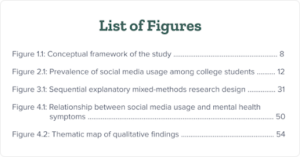
13. List of figures or tables (optional): If the book has a lot of pictures, drawings, or tables, this list tells you where to find them.
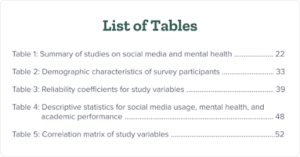
List of tables as a part of book

List of Figures as a part of book

What is included in the body matter of a book? 

The main body is the largest part of a book that contains important information. Its different parts are: 

Parts of a Book’s Main Body

1. Chapters (compulsory): The story is typically divided into chapters, each focusing on a specific part of the narrative. This is also one of the important parts of a novel. 

2. Prologue (optional): A prologue sets the scene or introduces background information before the main story begins.

3. Sections/Parts (compulsory): Larger works of fiction might be divided into sections or parts while writing a book. They often group related chapters together.

4. Paragraphs (compulsory): Within each chapter, the content is further divided into paragraphs. Paragraphs are groups of sentences that all relate to the same idea or topic. They help break up the text and make it easier to read.

5. Dialogue (optional): In fiction books (like novels), you’ll often find dialogues, which is when characters in the story talk to each other. Dialogue is usually enclosed in quotation marks to set it apart from the rest of the text.

6. Conclusion (optional): A conclusion wraps up the main story by summarizing key points or resolving conflicts. 

7. Illustrations and photos (optional): Some books, especially children’s books or non-fiction books, might include illustrations, pictures, or diagrams in the main body. These visuals help explain or enhance the written content.

8. Headings and subheadings (optional): Headings and subheadings are used to organize the content within chapters. These are like mini-titles that help guide the reader and break up the text into smaller, more manageable sections.

9. Footnotes or endnotes (optional): Some books, particularly academic or scholarly works, use footnotes or endnotes in the main body. These are small numbers that refer to additional information or references located at the bottom of the page (footnotes) or at the end of the chapter or book (endnotes).

10. Page numbers (compulsory): Each page in the main body of the book is numbered. This helps readers keep track of their progress and makes it easy to refer back to specific parts of the book.

What is included in the back matter of books? 

The back matter offers additional context, resources, or details that enhance the reading experience. Let’s explore the different elements included in the back matter! 

Important Elements of the Back Matter in Books 

1. Author’s biography (optional): The author bio is a short description of the author’s life, their other books, or their achievements. It helps you get to know the person behind the book.

2. Author’s note: (optional)  An author’s note is distinct from an afterword or postscript. It’s a brief statement, usually just a paragraph, where the author adds a personal note, perhaps about the inspiration behind the book or a dedication. This appears at the very end, after the acknowledgments and bio.

3. Acknowledgments: Here, the author thanks all the people who helped them create the book, like their editor, family, or friends. It’s like a big thank-you note. 

A good practice is to research acknowledgment examples for books in your genre to get a better idea of how to write this section. 

4. Copyright Permissions (compulsory): If the book uses quotes, images, or content from other sources, this section gives credit to the original creators and thanks them for allowing their work to be used.

5. Appendix or Addendum (optional): Non-fiction books, especially textbooks or research-based books, often include an appendix with supplementary material.

6. Glossary (optional): If a book uses many technical, unusual, or foreign words, a glossary is often included to help readers understand these terms. A glossary in books is often arranged in alphabetical order and contains concise explanations of these terms. 

7. Bibliography or reference list (compulsory):  Non-fiction books, particularly academic or scholarly works, typically include a bibliography to cite the sources used in the book. References in books usually follow a style guide such as APA, MLA, Chicago, etc. 

8. Index (optional): Many non-fiction books, such as textbooks, reference books, or historical works, include an index to help readers quickly locate specific topics or keywords.

9. Epilogue (optional): An epilogue is related to the future, showing what happens after the main story ends or offering reflections. This is more common in fiction books, particularly novels, but not all novels have an epilogue. 

10. Afterword (optional): The purpose of an afterword is to provide additional context, reflections, or insights related to the book’s themes, creation process, or reception. 

11. Discussion questions (optional): These are sometimes included in literary fiction or non-fiction books to encourage reader engagement or for use in book clubs or classrooms.

12. Reader’s guide or book club resources (optional): Similar to discussion questions, these resources are occasionally included to enhance the reading experience, but they’re not a standard element.

13. Sneak peek or excerpt (optional): A sneak peek or excerpt is usually a chapter from a new book. This is a promotional tool sometimes used to entice readers to purchase the author’s next book, but it’s not included in all books.

14. Other books by the author: (optional): Similar to the “Also By the Author” page, this section includes a list of all published books by the same author. 

Understanding these book components is crucial to creating a well-crafted book structure. If you’re a writer looking to refine your book’s structure, consider seeking professional editing and formatting services to ensure your work is polished.  

This is where PaperTrue can help. We provide professional editing and proofreading services to refine your text. Plus, our trained team can also format your text as per your requirements. 

To know more about our services and pricing, explore our website! 

Here are some other useful resources for you: 
Best Book Review Sites of 2025: Top 10 Picks
Stay tuned as we reveal the top book review sites for 2024!  Whether you’re in the mood for a classic drama, a modern thriller, or an enlightening non-fiction, there’s a review site that can point you in the right direction.

We’ve also included the advantages of every book review site for readers and authors. So without wasting time, let’s get started! 

Ensure your book gets the glowing reviews it deserves!

1. Goodreads

Goodreads book review site

Goodreads stands out as a titan in the field of book review sites, especially in 2024. As the biggest community of readers, authors, and reviewers on the internet, you can find reviews for almost every book on Goodreads. 

You can also join reading groups, catalog books, engage in discussions with fellow readers, and follow your favorite authors. Moreover, by integrating Goodreads with your Kindle account, you can track your reading progress, get personalized book recommendations, and write reviews that get posted on both Goodreads and Amazon automatically. 

What’s more! You can use Goodreads’s advanced search features to find books based on your interests, reading level, or genre.

Subscription Fee: None

2. Kirkus Reviews

Kirkus Reviews Book review site

Established in 1933, Kirkus Reviews is one of the oldest book review websites that has a solid reputation for its authoritative and unbiased reviews. You can access quality book reviews for a variety of genres on the website by subscribing to the free weekly email newsletter. Another option is to subscribe to the paid semi-monthly magazine.

The main advantages of Kirkus Reviews include access to “best of” lists across many categories and reviews about each book mentioned in the list. The only downside to Kirkus Reviews is the paid nature of the magazine, which can limit access to reviews of new bestsellers to only a few people.

Subscription Fee: Ranging from $49 to $179, based on the chosen duration of the subscription.

3. LibraryThing

Librarything book review site

LibraryThing, a book lover’s haven for cataloging books, is one of the best book review websites. It offers a robust platform for readers to explore reviews, rate books, and meticulously organize their collections by genre.

The charm of LibraryThing lies in its social features—you can connect with fellow readers, share your bookshelves, and exchange thoughts on your latest reads. It’s a cozy corner on the internet for those who take pleasure in tracking their reading journey and finding kindred spirits within the pages of their favorite genres.

Apart from these features, LibraryThing provides a feature for authors to create their own Author page. Besides this, LibraryThing provides readers the opportunity to meet with fellow readers and authors by releasing updates about local book events.

Subscription Fee: None

4. Book Riot

BookRiot book review site

Book Riot is one of the most versatile book review sites where you can access fictional and non-fictional book reviews, articles, and essays about top books across different genres. In addition to this, you can access information about discount deals for e-books and printed books, and purchase from a huge variety of book merchandise.  

The one thing that sets Book Riot apart from other sites is access to podcasts, which you can listen to if you don’t feel like reading book reviews. While it may not have the traditional format of a book review site, it provides a fresh and engaging approach to discussing books.

Subscription Fee: It costs $ 4.99/month for authors who subscribe to Book Riot Insiders for information about new releases.

5. LoveReading

LoveReading book review site

LoveReading emerges as a cherished resource among book review sites, particularly for its UK-based but globally accessible content. As one of the top professional book review sites, it allows you to access ebook and audiobook reviews across multiple genres. 

The advantages of LoveReading include access to books and debuts of the month, weekly staff picks, and yearly list features. While the primary focus might be on UK publications, LoveReading remains a valuable resource for book lovers worldwide since it offers insightful reviews and recommendations.

Subscription Fee: None

6. Amazon

Amazon book review site

Though Amazon is not solely a dedicated book review site, it is one of the top free book review sites in 2024. It allows readers to rate books using a 1–5 star scale and receive a verified purchase tag after they have purchased books, increasing the authenticity of their reviews. 

Additionally, readers can engage with each other by adding comments to other reviews and stand a chance to receive a higher ranking if their reviews are well-received by a larger audience. However, do note this: While reviews can influence a book’s visibility on Amazon, it is not a primary factor in determining rankings. Factors like sales, advertising, and algorithms play a significant role.

Subscription Fee: None

7. Booklist

Booklist book review site

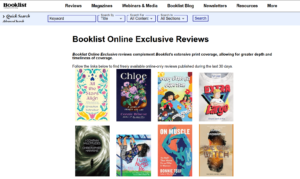
Booklist, a veteran publication by the American Library Association since 1905, has evolved into a premier online destination for book reviews. You can look at the reviews of many print and audiobooks from various genres on Booklist. 

The benefits of using Booklist include access to webinars and a variety of newsletters like Read Alert, Booklandia, and more. While Booklist might not offer a platform for reader interaction, it remains a trusted source for comprehensive and expert book reviews.

Subscription Fee: $184.95/year

8. Publishers Weekly

Publishers Weekly book review site

Dominating the publishing world since 1872, Publishers Weekly is one of the oldest book review sites. It covers a wide range of genres, including adult fiction, non-fiction, children’s books, and more. Apart from book reviews, it provides access to news about upcoming books.

The advantages of Publishers Weekly are access to the latest industry news, stats, bestseller lists, and exciting podcasts about authors and contemporary books. The only downside to Publishers Weekly is that you need to pay a subscription fee for full access to this online book review site.

Subscription Fee: $15/month

9. NetGalley

NetGalley book review site

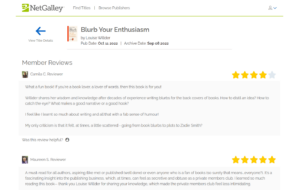
NetGalley is one of the top book review sites for authors and readers alike. Readers can view reviews, request Advanced Reader Copies (ARCs), and write reviews about pre-released books by various authors. Also, readers can check out book reviews, recommendations, and the must-read section at Bookish, an editorially independent division of NetGalley. 

NetGalley’s primary purpose is to connect publishers with reviewers, librarians, booksellers, and media professionals. The only downside to NetGalley is that securing ARCs of highly anticipated books can be difficult due to fierce competition among reviewers.

Subscription Fee: None

10. Fantasy Book Review

Fantasy book review site

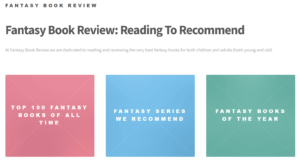
This site includes various categories for book reviews, such as urban fantasy, high/epic fantasy, dystopian/post-apocalyptic fiction, magic users, heroic/ sword and sorcery, etc. Depending on the category, book reviews for the best fantasy books are added to the website. 

With this, the site also provides readers with a list of the top 100 fantasy books of all time, recommendations of fantasy series, and interviews with fantasy authors.

Subscription Fee: Free

Check out the top ten book review sites mentioned above to find your next best read, and let these curated sites lead you to memorable stories and transformative literary adventures. If you need help creating perfect book reviews or refining your book, consider our professional editing and proofreading services for assistance.

Here are some other articles you might find useful: 

Top 10 Recommendation Letter Editing Services | Best Picks

A recommendation letter is often a pivotal factor in unlocking academic, professional, or personal opportunities. Whether you need a letter of recommendation for students, a letter of recommendation for a scholarship, or a job application, its quality heavily determines whether the admission committee says yes or no.  

A well-written recommendation letter highlights an individual’s strengths, achievements, and character in a compelling manner. But even the most heartfelt letter can lose its impact if it is not well-structured or contains errors. That’s why recommendation letter editing services play a key role in determining your success, because simply writing a letter of recommendation is not enough.

In this blog, we will explore the top 10 recommendation letter editing services that can refine your letter into a fine, persuasive document. These services not only improve the grammar and format but also ensure that your message resonates with its intended audience.

Looking for Recommendation Letter Editing Support? Try Our Services. Learn More

Top 10 recommendation letter editing services

Is your recommendation letter ready to wow? Explore these top 10 editing services to ensure your document boosts your chances of success.

1. PaperTrue

At the forefront of professional editing services, PaperTrue is a one-stop solution for recommendation letter editing. Known for its expert editors and customer-centric approach, PaperTrue refines your letter to perfection. 

Want to ensure a flawless letter of recommendation format, or are you looking to enhance the tone and clarity of your letter? Whatever it may be, PaperTrue delivers unmatched results.

PaperTrue Recommendation letter editing services

Why choose PaperTrue?

  • Highly experienced editors specializing in letters of recommendation.
  • Quick turnaround times to meet urgent deadlines.
  • Personalized feedback to help you learn and improve.

They combine human expertise with AI tools for precision, ensuring your professional letter of recommendation stands out.

Pricing: We charge $8 for a recommendation letter of 1000 words as part of our “Essential” editing service.

2. EssayEdge

EssayEdge has established itself as a trusted name in the editing industry, particularly for students and professionals seeking to make a strong impression with their letters of recommendation. 

Their editors specialize in tailoring content to highlight your achievements and strengths while ensuring clarity and impact.

EssayEdge recommendation letter editing services

Why choose EssayEdge?

  • Expert editors with backgrounds in academia and professional writing.
  • Custom feedback to align your letter with your objectives.
  • Proven track record of helping clients secure admissions and scholarships.

Pricing: Under their “Standard” package, EssayEdge charges $149 for 600 words. 

3. Wordvice

Wordvice is known for its fast and reliable services, making it a go-to option for those with tight deadlines. Their editors are adept at editing a letter of recommendation to align with specific goals and audiences.

Wordvice recommendation letter editing services

What choose Wordvice?

  • Transparent pricing with no hidden fees.
  • Editors with expertise in academic writing.
  • Quick turnaround times without compromising quality.

Pricing: $0.023 to $0.044 for standard editing, or around $23 to $44 for 1000 words. For a precise quote for your project, visit the Wordvice website.

4. Scribendi

Scribendi offers comprehensive editing solutions that cater to both academic and professional needs. Their recommendation letter editing services focus on improving clarity, grammar, and tone while maintaining the letter’s authenticity.

Scribendi recommendation letter editing services

Why choose Scribendi?

  • Highly skilled editors with years of experience in professional editing.
  • Multiple service tiers to fit your specific needs and budget.
  • Guaranteed satisfaction with every edit.

Pricing: $55 for 1000 words. 

5. Scribbr

Scribbr is a preferred choice for academic editing, and its expertise extends to letters of recommendation. Their services include detailed feedback and suggestions to ensure your letter is polished and persuasive.

Their editors are skilled in identifying and correcting errors in grammar, punctuation, and syntax. 

Scribbr recommendation letter editing services

Why choose Scribbr?

  • Editors experienced in handling letters for academic purposes.
  • A user-friendly platform for document uploads and revisions.
  • Free plagiarism checks and additional resources for writers.

Pricing: $59 for 1000 words returned in 24 hours.

6. ServiceScape

ServiceScape connects clients with professional editors who specialize in writing and editing letters of recommendation. Their platform allows you to choose an editor that best suits your needs, ensuring personalized and effective editing.

They offer a variety of editing services, in addition to including recommendation letter editing. 

Servicescape recommendation letter editing services

Why choose ServiceScape?

  • Direct communication with your chosen editor.
  • Flexible pricing options for different service levels.
  • Expertise in enhancing tone and readability.

Pricing: Prices charged by different freelance editors differ. Please visit their website for specific pricing information. 

7. Wiley Editing Services

Wiley Editing Services is ideal for academics looking for high-quality editing tailored to institutional standards. Their recommendation letter editing ensures your letter adheres to the required tone and format.

They offer a range of services tailored to meet the needs of researchers, academics, and professionals.

Wiley recommendation letter editing services

Why choose Wiley Editing Services?

  • Editors with deep expertise in academic and professional writing.
  • Focus on delivering polished, impactful letters.
  • Comprehensive support for multilingual writers.

Pricing: Under their “Standard Editing” package, they charge $257 for up to 1500 words returned within 7 days. 

8. ProofreadingPal

ProofreadingPal offers detailed and reliable editing for letters of recommendation, ensuring that your letter is error-free and professionally crafted. Their two-editor review process guarantees precision and quality.

They offer competitive pricing for their services. Hence, they are accessible to a wide range of potential users.

ProofreadingPal recommendation letter editing services

Why choose ProofreadingPal?

  • Dual-editor system for thorough reviews.
  • Affordable pricing with clear timelines.
  • Friendly customer service and personalized edits.

Pricing: Visit their website to generate a specific quote for up to 15,000 words. Clients with 15000+ words to edit must contact them for a custom quote. 

9. TopAdmit

TopAdmit specializes in helping clients craft compelling letters of recommendation that stand out. Their editors focus on highlighting your unique achievements while ensuring clarity and professionalism.

They offer personalized editing services to ensure that your letter suits your specific needs and goals.

TopAdmit recommendation letter editing services

Why choose TopAdmit?

  • Expertise in crafting letters for admissions and scholarships.
  • Affordable services tailored to students and professionals.
  • Emphasis on enhancing tone and narrative flow.

Pricing: $89 for up to 300 words. 

10. Transcend Admissions Consultants

Transcend Admissions Consultants provides specialized editing and consultation services for letters of recommendation. They guide clients in creating letters that align with admissions requirements and showcase their best qualities.

Their consultants can offer strategic advice on how to best position yourself in your letter and maximize your chances of admission to your institution of choice.

Transcend recommendation letter editing services

Why choose Transcend Admissions Consultants?

  • Expert consultants with years of experience in admissions processes.
  • Tailored edits to meet the requirements of top institutions.
  • Strategic advice to maximize your letter’s impact.

How to choose the best recommendation letter editing service

Choosing the right service depends on factors like your budget, deadlines, and specific editing needs. If you are looking for comprehensive feedback and expert guidance, services like PaperTrue or Scribendi are ideal. For quick, free edits, Grammarly may suffice.

Questions to ask before choosing a recommendation letter editing service:

  1. Does the service specialize in letters of recommendation?
  2. What is their turnaround time?
  3. Do they offer personalized feedback or only grammar corrections?

After thoroughly analyzing these factors, you can select a service that aligns well with your goals.

Why editing a letter of recommendation is crucial

The impact of a recommendation letter lies not only in what is said but also in how it is said. A polished letter demonstrates professionalism and attention to detail, qualities that reflect positively on both the recommender and the subject. 

Moreover, institutions and organizations often have specific expectations regarding the letter of recommendation format, tone, and content.

Editing ensures:

  • Clarity and precision in language.
  • Adherence to formatting guidelines.
  • Removal of errors that might distract the reader.

Here’s a sample recommendation letter format for your reference: 

[Your Name]
[Your Position]
[Your Organization]
[Your Address]
[City, State, ZIP Code]
[Email Address]
[Phone Number]
[Date]
[Recipient’s Name]
[Recipient’s Position]
[Recipient’s Organization]
[Recipient’s Address]
[City, State, ZIP Code]Subject: Letter of Recommendation for [Candidate’s Name]

Dear [Recipient’s Name or “Admissions Committee”],

I am writing to wholeheartedly recommend [Candidate’s Full Name] for [specific purpose: admission, scholarship, job, etc.]. I have had the privilege of working with [Candidate’s First Name] as [describe your relationship, e.g., supervisor, professor, colleague], and during this time, I have been consistently impressed by [his/her/their] [key qualities, such as dedication, skills, accomplishments, etc.].

[In the first paragraph, provide context about your relationship with the candidate and how long you’ve known them. Mention your qualifications to give this recommendation.]

In my time working with [Candidate’s Name], [he/she/they] demonstrated exceptional [specific qualities or skills]. For instance, [describe a specific instance or project that showcases these traits]. [His/Her/Their] ability to [highlight unique strengths] was instrumental in [mention results or achievements].

Beyond [Candidate’s] technical skills, [he/she/they] also exemplify excellent [soft skills, like communication, leadership, and teamwork]. [Add a specific anecdote to illustrate these attributes.]

I am confident that [Candidate’s Name] will bring [specific value, e.g., passion, innovation, commitment] to [recipient’s organization/program]. [He/She/They] have consistently shown [list any unique qualities that make the candidate stand out] and have my highest recommendation for [specific purpose].

If you have any questions or require additional information, please feel free to contact me at [your email or phone number]. I would be happy to provide further insight into [Candidate’s Name] and [his/her/their] qualifications.

Sincerely,
[Your Full Name]
[Your Position]
[Your Organization]

Don’t let a poorly written recommendation letter hinder your academic or professional goals. Using professional letter of recommendation help can significantly enhance the effectiveness of your letter, increasing the likelihood of a favorable outcome.Leave all your recommendation letter editing worries to us. PaperTrue’s editing and proofreading services can ensure you have a great recommendation letter ready to present to your chosen institution’s admissions committee. Here are some articles you might want to check out: 

5 Reasons Why It Is Important To Cite Your Sources

If you’re a researcher, you probably know that all research exists in a context. While writing your paper, you’re bound to use ideas, arguments, and supporting evidence from other researchers. But how does anyone track which ideas are your own and which ones are borrowed? That’s where citations come in. So if you’ve been wondering, “Why is citation important?”, your confusion ends now!

So, why is it important that you cite your sources? The short answer is, to ensure you’re not stealing anyone’s work. For the long answer, you’ll have to read the article. Explore the article to understand both the ethical and practical reasons behind citing your sources. Proper referencing not only upholds the integrity of your research but also influences how your academic ability is perceived. 

Get cross-checked citations and professional editing today!

What is academic integrity?

Academic integrity is a cornerstone of the educational community, and understanding its importance is crucial for every academician. At its core, educational integrity means being honest and transparent in your work and giving proper credit to others for their ideas and contributions. This is where citing sources comes into play.

Citing sources is a fundamental aspect of academic integrity. It allows you to acknowledge the work of others and avoid plagiarism, which is a serious offense in academia. The Modern Language Association (MLA) is one of the most commonly used citation styles, providing clear guidelines for source citation in research papers.

Without further ado, allow us to explain the importance of citing sources:

#1 Credits the authors whose ideas you’ve used

As we learn why citing sources is important, we should remember that research is difficult and painstaking. Students and professionals make great efforts to create original knowledge in their field. So, their hard work and contributions deserve to be acknowledged when others use their work and other people’s ideas.

Imagine having to start from scratch in your niche, having no prior data or theories to rely on! You enjoy the fruits of your predecessors’ labor, and so it’s your responsibility to credit them for it. So make sure to follow the dos and don’ts of academic writing where citations are concerned!

#2 Establishes your credibility and authority

Citing relevant and high-quality sources shows that your work is based on reliable information. Accuracy is important in writing, especially when you’re quoting facts and figures. When someone reads your paper, citations will help them look up your sources. In this way, citations serve as an accuracy check. Your readers can use them to double-check a direct quote, analyze your data, or contextualize your work. 

Another reason for citing your sources at the college level is to show your instructor and reviewers that you’ve done your research. You can use a mix of primary (original research, interviews, surveys) and secondary (reviews, analyses) sources. A solid works cited list proves your engagement with, and authority on, your topic.

#3 Strengthen your arguments

Why is citing sources important? Because it provides evidence from reputable sources that supports your arguments and strengthens your position. This is an essential step in the MEAL paragraph. Ideally, your writing should analyze the passage or data you’re citing and highlight key points to reinforce your arguments.

However, take care not to over-rely on your sources. Often, college students take citations to an extreme. You don’t want to submit a paper that’s just a summarization of two existing papers with opposing views! Your paper should present a strong argument by presenting existing research along with your unique take on it.

#4 Makes you a better researcher

Citing specific sources for the facts presented in your paper removes generalizations, clichés, and outright false claims. So when you cite sources properly, you leave no question in your readers’ minds regarding your argument. Citations improve the quality of your research and writing by emphasizing the systematic process involved in conducting research.

Academic writing is a highly formal writing style with specific rules and regulations. When you pay attention to the little referencing details such as italicization and punctuation, such checks become a habit. This helps you develop the sincerity and research ethics you need to become a good researcher.

#5 Helps you steer clear of plagiarism

While this is quite self-explanatory, it’s just as important! You may not actively seek to plagiarize someone’s work, but a missing citation can count the same. Since plagiarism is a grievous offense in academic research, you can be accused of it, leading to severe repercussions such as rejection of your work or damage to your academic reputation.  At the very least, the instructor will dock. 

So, always double-check your in-text citations with the corresponding entries in your works cited page or annotated bibliography. Remember, meticulous referencing is what separates a well-written paper from an academically dishonest one! 

When should you cite your sources?

Here are the instances when you should cite your sources:

  • When you use an exact quote from someone’s work.
  • When you rephrase an idea or information.
  • When you summarize a work in however brief a manner.
  • When you mention works of literature.
  • When you use factual information, data, or statistics from another work.
  • When you discuss specific theories, models, or frameworks developed by others.
  • When you use photographs, diagrams, videos, or any multimedia that you did not create.
  • When you mention any information that isn’t common knowledge.

How to cite your sources

Citing your sources is an essential skill for students to develop. It involves properly acknowledging the work of others in your research papers and other written work. There are several citation styles to choose from, including MLA, APA, and Chicago, each with its own set of guidelines and rules.

Citation styles like MLA, APA and Chicago

To determine which citation and referencing style to use for a particular assignment, consult with your instructor or visit the university library. Citing your sources involves including several key elements, such as the author’s name, the title of the source, the publication date, and the page numbers.

Citation management tools, such as Zotero or EndNote, can help you organize your sources and format your citations correctly. It is essential to cite your sources accurately and consistently throughout your work, as this helps to maintain integrity and avoid plagiarism.

Always check your citations for accuracy and completeness before submitting your work. Citing demonstrates your understanding of the subject matter and shows that you have done your research.

By citing your sources properly, you can build your credibility and reputation as a writer and researcher. The university library offers resources and support to help you learn how to cite your sources effectively and maintain integrity in your work.

So why is it important to cite your sources properly? Citing sources protects intellectual property, bolsters credibility, and fuels academic exchange. It also ensures accuracy, prevents plagiarism, and aids in future research. Different citation styles prioritize different aspects from the lists above.

The MLA citation format prioritizes the work and publisher over the year of publication. The APA citation format, however, prioritizes the publication date over publisher details. Both formats reflect the major concerns of the disciplines in which they’re used.

We hope you found our guide on the importance of citation useful. If you need an academic expert to review your writing before you submit it, our paper editing services are perfect for you.

Here are some more resources on citations and formatting:

How to Copyright Your Book?

If you’ve thought about copyrighting your book, you’re on the right path.

Explore more