Have you ever wondered why some texts seem clearer and more professional than others? The secret lies in proofreading. Proofreading elevates your content by eliminating mistakes and flaws. It is a crucial part of the writing process, ensuring that your text is error-free and effectively communicates your message.
Whether it’s a novel, a business report, an academic paper, or even a simple email, proofreading can significantly elevate the quality of your documents. In this comprehensive guide, we’ll explore what proofreading is, why it’s important, and provide you with actionable tips and insights to perfect your proofreading skills.
Get Professional Proofreading for Your Document!
So, let’s dive into the world where every comma counts and every word matters, beginning with an easy proofreading definition!
What is proofreading?
Proofreading is the final check of a text or content before it’s submitted. Proofreading is the process of reviewing the final draft of a text to ensure that all surface errors concerning grammar, punctuation, spelling, and formatting are corrected.
Think of proofreading as giving your writing a final shine to make sure it doesn’t have any mistakes. The key to understanding proofreading meaning is recognizing that it differs from editing, which involves more significant changes like restructuring and style adjustments. Proofreading helps identify run-on sentences and other errors that may not be obvious during the editing phase.
Even though you’re document might have undergone copy editing or developmental editing, proofreading is your last chance to check for errors! While copy editors focus on broader aspects of the manuscript, proofreaders catch final errors.
After understanding what is proofreading, we’ll move on to see why proofreading is important and whether it is really required.
1. Proofreading helps you catch mistakes like spelling errors or missing words, so your writing is clear and easy to understand.
2. When you proofread your work, it shows that you take pride in what you’ve written and want to make sure it’s the best it can be.
3. Proofreading helps prevent silly mistakes that could make you look bad in front of others, like a teacher or a boss. It is especially crucial for important documents like a job application.
4. By fixing errors, proofreading ensures that your message is communicated accurately without any confusion. Proofreading also helps improve the overall quality of your writing.
5. With proofreading, you know your writing is error-free, and you feel more confident about sharing it with others, whether it’s for school, work, or fun.
Editing vs. proofreading: What’s the difference?
Editing involves making changes to enhance the content, including clarity, flow, structure, and style. It often requires rephrasing sentences, reorganizing paragraphs, and ensuring the content is coherent and engaging.
In contrast, proofreading focuses on correcting any remaining, surface-level errors in spelling, grammar, punctuation, and formatting. Unlike editing, it does not involve major content changes.
10 Proofreading tips for clear and error-free writing
Verify the spelling of names, the accuracy of numbers, and the correctness of dates. Fact-checking is an important part of the proofreading process.
Here are some practical tips to help you proofread more effectively. These tips will help you spot errors more efficiently:
1. Take a break before proofreading
After you finish writing, take a break. When you’ve been closely involved with a text, it’s easy to see what you intend to write rather than what you actually wrote. Stepping away from your work for a few hours, or even a day, helps you return with a fresh perspective.
2. Create a checklist
Develop a proofreading checklist of the most common errors you make. This may include items such as grammar, punctuation, spelling, formatting, and style. A checklist helps you systematically identify errors in your writing. You can use Google Docs, MS Word, and EditPad to create such a checklist.
3. Read aloud
Reading your text aloud is remarkably effective. It forces you to slow down and lets you hear how your words sound together. You’ll catch not just typos and grammatical mistakes but also awkward phrasings and unclear sentences. Identifying awkward phrasing is crucial, as proofreading tools often introduce clunky language that can make your writing sound robotic or out of place.
4. Print out your text and use a ruler or finger to guide your eyes
Print out your document, preferably in a larger font size and with double spacing, making it easier to mark corrections and make notes. This technique helps you focus on individual pages and spot errors more effectively. Place a ruler under each line as you read, or use your finger to point at each word. This technique helps maintain your focus and reduces the chance of skipping over potential errors.
5. Check for one type of error at a time
If you try to identify every type of mistake in one go, you might miss more than you catch. Focus on one problem at a time—start with spelling, then check grammar, punctuation, and finally formatting. This segmented approach ensures thoroughness.
6. Watch out for homophones
Homophones are words that sound alike but have different meanings, such as “there,” “their,” and “they’re.” Spell check might not catch these, so pay extra attention to them. Homophones can lead to spelling mistakes that need to be corrected.
7. Highlight errors
As you proofread, use colored pens, highlighters, or sticky notes to mark different types of errors or areas that need improvement. This visual system allows you to quickly identify patterns in your mistakes and prioritize your corrections. Using proofreading marks can help you indicate corrections more clearly. For example, you might use red for spelling errors, blue for grammar issues, and yellow for formatting inconsistencies. Punctuation errors can be subtle. Pay special attention to the use of commas, semicolons, colons, and apostrophes. Misplaced punctuation can change the meaning of a sentence dramatically.
8. Double-check names, numbers, and dates
Factual accuracy is crucial. Verify the spelling of names, the accuracy of numbers, and the correctness of dates. Checking page numbers is also crucial for maintaining the document’s accuracy. For professional documents, even a small mistake can create a bad impression.
9. Use proofreading tools wisely
Proofreading tools like Grammarly or Microsoft Word’s spell checker are helpful, but they’re not infallible. Use these tools to help identify obvious errors, but rely on your judgment for the final check. You can use grammar checkers, spell checkers, and punctuation checkersto proofread your document. Hemingway Editor, ProWritingAid, and QuillBot are some tools you can use.
10. Ask someone else to proofread
A fresh pair of eyes can catch errors you might have missed. If possible, have another person read your work. They might find mistakes you overlooked and can give you feedback on the clarity of your writing.
Proofread and corrected: You’re going to love the new updates.
Explanation: “Your” is a possessive adjective, used to show ownership. “You’re” is a contraction for “you are.” This sentence requires “You’re” to convey the meaning “you are going to love,” indicating an action that is expected to happen.
Such spelling mistakes can easily be overlooked but significantly impact the clarity of your writing.
2. Its vs. It’s
Sentence: Its important to check if it’s features work correctly.
Proofread and corrected: It’s important to check if its features work correctly.
Explanation: “It’s” is a contraction of “it is” or “it has”, and “its” is a possessive pronoun. In this sentence, “It’s” is needed as a contraction of “it is important,” and “its” is used to indicate possession of “features.”
Correcting grammar errors like these ensures that your writing is clear and professional.
3. Missing comma in a compound sentence
Sentence: I finished the report but he has not reviewed it yet.
Proofread and corrected: I finished the report, but he has not reviewed it yet.
Explanation: A comma is needed before “but” in a compound sentence. It separates two independent clauses, making the sentence easier to read and understand.
Correcting punctuation mistakes like these ensures that your writing is clear and professional.
4. Incorrect punctuation with direct speech
Sentence: “How are you doing today” he asked.
Proofread and corrected: “How are you doing today?” he asked.
Explanation: The dialogue within the quotation marks is a question and should end with a question mark.
5. Misused apostrophe for plurals
Sentence: The company’s new policy’s affect all employee’s.
Proofread and corrected: The company’s new policies affect all employees.
Explanation: “Policies” is the plural form of “policy” and does not need an apostrophe. “Employees” is the plural of “employee” and also does not need an apostrophe. However, “company’s” correctly uses an apostrophe to show possession of the new policies.
How much does proofreading cost?
The cost to proofread ranges from $0.01 to $0.05 per word. Alternatively, some proofreaders charge by the hour, with rates generally ranging from $20 to $50 per hour. For larger projects, such as a book or thesis, proofreaders might offer a flat fee. It is highly advised to invest in professional proofreading services to ensure the quality and accuracy of your document.
However, the cost can vary, depending on the document’s length, complexity, turnaround time, and the proofreader’s level of expertise. They also depend on the type of proofreading required, such as academic proofreading, translation proofreading, business proofreading, etc.
How long does proofreading take?
The time required for proofreading can depend on several factors, including the length of the document and the number of corrections needed. On average, a professional proofreader can proofread about 2000-3000 words per hour.
Select services specializing in your field, such as academic writing, business reports, or creative writing. For scientific work, it is crucial to select a proofreader with expertise in your specific field. Ask to see their previous work portfolio, request references from past clients, or look for previous work samples on their website.
2. Detailed pricing and invoicing
Compare pricing and choose a service that provides detailed pricing information, including per-word or per-page rates, minimum fees, formatting, and additional charges. Understanding the pricing structure is essential, especially in the publishing industry, where costs can vary significantly. Avoid services that have hidden fees or unclear pricing structures.
3. Turnaround time guarantees
Look for services that offer guaranteed turnaround times as per your deadline. Discuss your specific timeline requirements to ensure that they can accommodate your needs without rushing the proofreading process.
4. Sample edit and free trial
Request a sample edit or free trial from the service to assess the quality of their work firsthand. Provide a short excerpt from your document to proofread and evaluate the service’s credibility.
The following are the key attributes to look for in a skilled proofreader:
Ability to spot even minor errors
Grasp of grammar, syntax, and vocabulary
Skill in meeting deadlines
Familiarity with various word processing and editing software
Understanding of cultural nuances and sensitivities in language
Ability to explain changes and suggestions clearly and diplomatically
Expertise in your specific field (e.g., medical, legal, technical)
5. Secure file handling and confidentiality
Look for services that use encrypted file transfers, secure storage systems, and confidentiality agreements to protect your intellectual property. If your text contains sensitive or confidential information, consider getting a non-disclosure agreement (NDA) signed.
6. Revision policy and customer support
Select a service that provides a clear revision policy and responsive customer support. Find out how many rounds of revisions are included and the procedure for requesting changes or clarifications. Test the service’s customer support by asking questions or submitting inquiries before placing an order. This will help you evaluate their responsiveness.
A company that has all these benefits and provides exceptional proofreading services is PaperTrue. We provide expert editing and proofreading services and our team of experienced proofreaders ensures perfection.
With our quick turnaround times, competitive pricing, and satisfaction guarantee, you can trust PaperTrue to elevate your writing!
Writers like Anton Chekhov, O. Henry, Alice Munro, and Tobias Wolff are all big names in the short story genre. Ever wonder how these writers craft such remarkable stories? They are the true masters at combining the five elements of a short story: plot, character, setting, conflict, and theme.
These five elements make short stories the best starting point for novice writers. They’re short and fairly simple, so the writer can focus on the plot, character, and theme. Short stories also allow writers to see their writing flourish as a piece of fiction— a great confidence boost! Additionally, short stories serve as an excellent training ground for new writers, helping them develop unique skills and methods specific to this literary form.
If you wish to write stories worth publishing, you must understand the characteristics of a short story. To help you get there, we have shared these five short story elements in this blog.
How do the five elements of a short story work? How can you naturally include them in your stories? Also, how can you tie them up to create one coherent narrative?
Get a story editor to improve your writing!
What are short stories?
A short story is a brief narrative that typically has a specific goal or theme. Unlike novels, which have the luxury of time and space to develop intricate plots and subplots, short stories must convey their message quickly and efficiently. This brevity often results in a more intense and focused narrative, making every word count. The key elements of a short story—characters, conflict, and themes—must be introduced and developed within a limited word count, often between 5,000 and 10,000 words
Here are the five key elements of a short story:
Plot
Character
Setting
Conflict
Theme
Let’s take a closer look at these elements and figure out how you should use them in a short story.
Five key elements of a short story
1. Plot
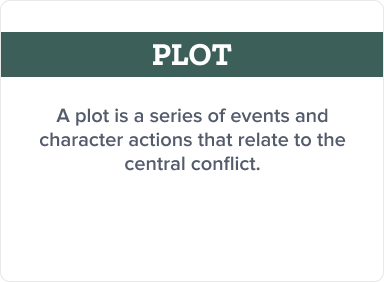
A simple way to define a plot is to call it a sequence of events in your narrative. It is a cause-and-effect chain of events with a beginning point, a climax, and a resolution. A strong plot means you have a captivating narrative ready to enthrall your audience.
Writers use the plot to map their stories before beginning their writing process. For fiction writing, this serves as a creative outline. So, understanding the plot is crucial to crafting a compelling narrative and making it impactful.
The sequence of events in a plot is tied to the central conflict in a story. The plot develops as the protagonist struggles with their given problem, driven by the characters’ goals, finds a solution, and eventually accepts the results.
Six succinct stages of a plot
1. Exposition: An introduction to the characters, setting, and conflict, providing all the necessary background information of a story.
2. Opening incident: This is the incident that leads the main character to conflict and sets the stage for or opens the plot.
3. Rising action: The conflict develops and brings newer and more complicated incidents, leading to the climax.
4. Climax: The conflict reaches a peak, which then leads to a change in the course of events, giving the reader a new understanding of the story either through an event or an insight. The climax often revolves around the major conflict the protagonist must confront.
5. Falling action: The conflict gets resolved, and the action slows down.
6. Resolution: The conflict ends, leaving the reader fulfilled.
Often, plots in short stories are simple but end up delivering great suspense, followed by a grand moment of revelation. For this reason alone, the plot was once considered the most important of all the five elements of a short story.It means it was seen as the key element of a short story.
Modern short stories, however, are often focused on the nuances of character and setting, so the plot becomes secondary. Nevertheless, a plot is the spine of any given narrative, so it still features first in our study of the short story elements!
Your prime goal as a writer of short stories is to blow your readers’ minds, keeping them engaged with the least words possible. An ideal short story is between 5,000–10,000 words long. You must keep it short and creatively blunt.
Every paragraph, every sentence, and every word should lead the reader closer to the climax. Cut anything that doesn’t serve this purpose. Short stories give you a very small space to work with, so brevity becomes important. Hence, planning your short story structure well matters! Sometimes, the resolution of a short story can introduce a new conflict or question for the reader, leading to further engagement.
Some techniques to add more kick to your story are creating suspense, foreshadowing, narrating flashbacks, and a short story staple, the surprise ending.
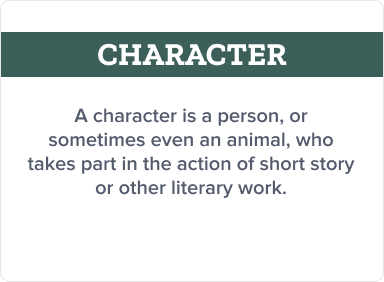
Your characters are the people, animals, or other figures who appear in your stories. They perform actions and say dialogue to move the story along. A story cannot be told without main characters, as they are crucial in driving the narrative and engaging the readers.
Depending on how you see it, a character can be classified as either round or flat, dynamic or static, a protagonist or an antagonist. For a short story, well-rounded and dynamic characters will be your strength.
The easiest way to write interesting characters is to make sure that they have a flaw. Internal conflicts, such as doubt and fear, can serve as significant obstacles for characters. Always keep in mind that in any story, perfect characters fall flat.
Be careful that you don’t put too much emphasis on character traits and backstory. Unlike novels, characters in a short story are only glimpsed at, rather than seen in the round.
You may say that the characteristics of a short story are abbreviated versions of the same in novels. So, short stories will feature only two or three major characters, while novels can boast a dozen!
Short stories can be great character studies, but a good rule of thumb is to focus ondialogue and action. A deeper understanding of human nature can inform how characters evolve in short stories.
Make the interaction between the characters dynamic. This includes what they do and say to each other, how they affect and influence each other, and how the effects of their actions keep the story going toward the climax and the subsequent resolution.
Ever felt transported to another world while reading a short story? That’s the work of a writer who can imagine and write a whole other world into being.
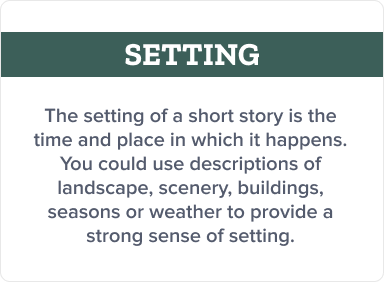
This element of a short story is crucial in making it real to the reader. The setting establishes a time, place, and environment in which the characters and events of the story are based. It also helps explore themes related to the human condition, engaging the reader by delving into complex aspects of life and human interactions.
Aspects of setting:
1. Time: A story is usually set in a time period. This includes the historical time of the story, its specific time frame, and even the time of day when the events take place.
2. Place: Place is the geographical landscape, real or imaginary, where a particular story unfolds.
3. Environment: The environment of a story can include anything from weather conditions to the social, cultural, and political backdrop to a given story. It can also reflect the characters’ internal struggles and human nature, adding depth to their development.
For example, Guy de Maupassant’s short story The Necklace takes place during the 19th century in the city of Paris and has the environmental backdrop of class differences in French society.
Like the main conflict of class difference in The Necklace, all other characteristics of a short story derive from its setting. When well-designed, this can also help set up the dominant emotional tone. Of course, it takesa significant amount of research to deliver a setting both beautifully and believably.
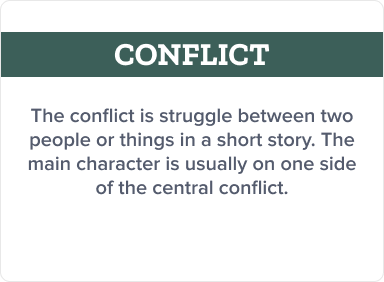
Conflict is closely linked to the theme of a narrative, as it motivates the characters and affects the plot. It usually surfaces when the protagonist (main character) faces an obstacle or hardship. Conflict forms “the heartbeat of a story”, so your story needs to have a defining conflict, both internal and external, to impact the reader’s mind.
There are two main types of conflict: internal conflict and external conflict. Internal conflicts, such as personal struggles, can hinder characters’ growth and goals.
Types of conflict
1. Internal conflict is a person’s struggle with themselves. It takes place inside the psyche of a character, such as Hamlet’s conflicted state of mind about how to take revenge for his father’s murder.
2. External conflict takes place between different people or groups of people. It is possible to further divide this type of conflict based on who or what the protagonist(s) are struggling against, often involving an antagonist who directly opposes the protagonists’ goals.
For example, the conflict in A Game of Thrones is between kingdoms, but also between people and the supernatural elements of the fantasy world.
Regardless of the type of conflict you choose, making it believable will hold the reader’s attention. Various literary devices like mystery, causality, empathy, surprise, insight, universality, or simply high stakes for the character, all add a different dimension of conflict to the plot. Conflict drives your story and makes it interesting.
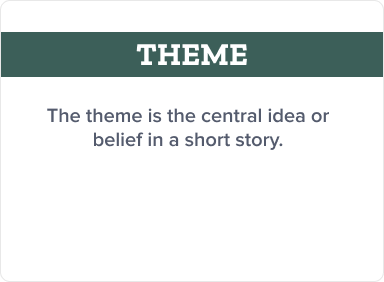
A theme is what children would call the moral of the story. It can be the subject of the story, an idea that runs through it, or simply the message that is conveyed from the writer to the reader through the short story. The writer can use all the other characteristics of a short story to best articulate their theme into words. Various story elements contribute to a cohesive narrative, guiding writers on how to effectively conclude their own story.
A well-told story, the kind that gets published or made into a film, explains itself. For example, while reading O. Henry’s short story The Gift of the Magi, you can easily understand that the story is about the value of love and sacrifice. In this way, the theme is implied rather than stated explicitly, and it is up to the writer’s skill to best convey it through their writing.
For a short story, it is usually best to decide on a single, resonant theme and then build around it. This helps maintain brevity in your story and helps you grasp the reader’s attention.
Short story examples
Short stories can be steered in any direction based on a writer’s judgment. It means a writer can explore various narratives, experiment with different ideas, and introduce twists to take readers on a different journey (or, maybe, even a detour).
Let us quickly see some examples of short stories in this section.
The Forgotten Key
Alicia rummaged through the drawer in a frenzy, her fingers trembling with urgency. She could not believe she had lost the key again—the small, silver one that opened the attic door. It wasn’t just any attic; it held her grandmother’s old chest, rumored to contain secrets of their family’s past. Just when she was about to give up, a tiny glint caught her eye beneath a stack of old postcards. She hesitated, pulled the postcards away, and there it was—the key. With a sigh of relief, she grabbed it and hurried upstairs, her heart pounding with anticipation for what she was about to uncover.
The Last Train Home
The station was eerily quiet as Mark sat on the cold, metal bench, his suitcase beside him. The last train of the night was delayed, and the flickering lights above cast unsettling shadows. He could still feel the weight of his decision, leaving everything behind—his job, his city, and even his old friends. As he watched the mist rolling in along the tracks, he wondered if the new life awaiting him would be any different or if he was simply running in circles. The distant horn of the approaching train broke his thoughts, and with a deep breath, he stood up, ready to face whatever lay ahead.
Point of view: Choosing the right narrative for your short story
Selecting the appropriate narrative perspective is a crucial decision while crafting a short story. The point of view (POV) not only shapes the reader’s experience but also influences how the story’s elements—plot, character, setting, conflict, and theme—are perceived and interwoven.
Renowned short story writers like Edgar Allan Poe, Ernest Hemingway, and Alice Munro have mastered the art of choosing the right POV to enhance their storytelling. They have been able to make their narratives both engaging and memorable by mastering the POV.
There are several narrative perspectives to consider, each offering unique advantages and challenges:
First-person POV: The first-person perspective allows readers to experience the story through the eyes of a character, often the protagonist. It creates intimacy and immediacy, drawing readers into the character’s internal world. However, it can also limit the narrative to the character’s knowledge and biases.
Second-person POV: Less common in short stories, the second-person perspective addresses the reader directly as “you”, creating an immersive and sometimes disorienting experience. It can be effective for experimental or interactive storytelling but may be challenging to sustain over a longer narrative.
Third-person POV: It offers a more objective view of the story than other perspectives, allowing the narrator to observe and describe events from outside the characters’ minds. There are two main variations within third-person POV:
Third-person omniscient: With this POV, the narrator has unlimited knowledge and can access the thoughts and feelings of multiple characters. This POV provides a broad perspective. It allows the exploration of various viewpoints. However, it can also feel distant or detached, making it challenging to relate to individual characters on a personal level.
Third-person limited: This narrator focuses on the thoughts and feelings of a single character. It creates a sense of connection and empathy, but it can also limit the reader’s understanding of other characters and events.
Writing your first draft
When writing your first draft, it’s essential to have a clear idea of the story’s purpose and message. Start by brainstorming and developing your characters, conflict, and themes. Consider the main character’s goals and motivations, as well as the external conflict that drives the plot. Think about the story’s setting, including the physical location and time period, and how it contributes to the overall atmosphere.
Use first-person pronouns, third-person pronouns, or second-person pronouns to create a unique narrative voice. Each perspective offers different advantages: the first person can provide intimacy, the third person can offer a broader view, and the second person can create an immersive experience. As you write, focus on creating dynamic and interesting characters that will captivate your readers. Ensure that your narrative is compelling and that it draws readers in from the very first sentence.
Common mistakes to avoid
When writing short stories, there are several common mistakes to avoid. One of the most significant errors is failing to create a clear main conflict or internal conflict that drives the plot. Without a strong conflict, the story can feel aimless and unengaging. Another mistake is not developing the main character’s character arcs or neglecting to include supporting characters who add depth and dimension to the narrative.
Avoid using overly complex sentence structures or word choices that may confuse readers. Clarity is key in short fiction. Additionally, be mindful of the story’s tone and atmosphere, ensuring that it aligns with the genre, whether it’s science fiction, supernatural elements, or modern day. Finally, don’t forget to proofread your work carefully to avoid errors in punctuation, grammar, and spelling. A polished story is more likely to captivate and retain readers.
Now that you know how to craft a brilliant short story with the 5 elements of a short story and the 6 stages of a plot, you can experiment and create memorable masterpieces. After you write a short story, the next step is to ensure they are edited well.
If editing is not your strength, consider our story editing services. Editors at PaperTrue will ensure you have a well-structured short story ready for publication in time.
Here are some related articles that you might find interesting:
The English language has an abundance of confusing grammar rules. Whether you’ve been composing essays in college for months or just entering high school English courses, there are a handful of typical errors that can land you in a soup. Sometimes, even native speakers are prey to these! But don’t worry, because most common grammar mistakes have easy fixes.
As your editors and proofreaders, we understand the importance of correct grammar and correct phrasing. So, it’s good for you to brush up on these details and ensure you’re clear about these rules. This way, you can showcase the best of your potential to your teachers and peers!
Do Grammar Mistakes Haunt You? Let Our Editors Help You Write Better. Learn More
Listed below are the 10 most common grammar mistakes and tips to avoid them.
1. Then vs. than
This is a simple but somehow incredibly common grammar mistake people make: mixing us “then” and “than”. (We get it, they sound the same and they’re almost spelled the same too.)
The best way to overcome this confusion is to be thoroughly clear about the difference in meaning between the two. “Then” is commonly used to designate the sequence of events. As in— you did x, then did y. These terms refer to different contexts, with “then” indicating time or sequence and “than” used for comparisons.
She finished her project and than started watching a movie.
She finished her project and then started watching a movie.
“Than” is used for comparing two things. As in, x is better than y.
Your score is better then your partner’s.
Your score is better than your partner’s.
2. You’re vs. your
This is a fairly common mistake that makes a world of difference! Again, it’s crucial to be aware of the difference between the two.
The word “you’re” is a shorter form of the phrase “you are”. This is known as a contraction.
Your going to be late for class.
You’re going to be late for class.
“Your” is a possessive adjective (or a determiner), meaning a word that tells you something belongs to the person you are talking to.
You’re hat is pretty.
Your hat is pretty.
There’s a simple tip to remember what to use when: read your sentence by replacing “your” or “you’re” with the phrase “you are”. If the sentence makes sense, then use “you’re”. If it doesn’t, then the word you’re looking for is “your”.
Correct word choice is important in avoiding confusion between ‘you’re’ and ‘your’. While some deviations from grammatical rules can be accepted over time, using the right word ensures clarity and precision in your writing.
Using this technique, try to figure out how many of these sentences are correct. Tick the boxes with the correct sentences.
How many did you guess correctly? Let us know in the comments!
Just like you’re vs. your, this is a mistake that’s easy to make because all three words sound similar. What’s the fix? You guessed it—first, be clear about what each of these words means.
The word “there” indicates a location that is away from the speaker. It is the opposite of “here”.
We went to Spain last summer and had a lovely time there!
We are near the restaurant, we’ll meet you there.
The word “their” is the possessive version of the third-person pronoun “they”, used to indicate something that belongs to a subject that’s already been established.
Their grandfather is retiring next week.
The word “they’re” is a contraction of “they are”.
They’re studying for the geography exam.
Now that you know what each of these words means, see them all used in one sentence:
They’re working on their assignments there.
These words have different meanings and are used in distinct contexts, which is a common challenge for English learners.
Can you identify how each word is used?
Like many others on this list, these words are homophones.
4. Its vs. It’s
As far as common grammar mistakes go, this one is (unfortunately) the most infamous. Sometimes even native speakers get this one wrong, so don’t worry if you’ve mixed these up a few times.
This notorious grammar error may seem minute, but it totally alters the meaning of what you’re saying. The difference between “it’s” and “its” is a matter of a simple apostrophe. Once you’ve figured out when and where to put it, you’ll be able to use both words with ease!
Correct grammar is crucial in both professional and personal contexts, as it reflects your attention to detail and can significantly impact how others perceive you.
The word “its” (without an apostrophe) is a possessive pronoun, referring to objects and nouns that don’t have a gender. For example:
The dog is in it’s kennel.
The dog is in its kennel.
“It’s”, on the other hand, is the contracted form of “it is” or “it has”. Since it is a contraction, place an apostrophe after the “t”.
Its been raining for the past week.
It’s been raining for the past week.
If you’re confused about whether you should use “its” or “it’s”, try the exercise from above. Say your sentence out loud using “it is”. If it makes sense, use the contraction. If it doesn’t, then you’re looking to use the possessive pronoun.
At first glance, you may think that “fewer” and “less” can be used interchangeably since they, more or less, mean the same thing. But the key difference is the kind of nouns both words are used for.
“Fewer” is used for countable nouns, such as apples and books. “Less” (or lesser) is used while referring to uncountable nouns, such as time or water.
There are less books here than we thought.
There are fewer books here than we thought.
He usually takes fewer time than his classmates to finish class tests.
He usually takes less time than his classmates to finish class tests.
It is important to make comparisons complete to ensure grammatical correctness and clarity in communication. Incomplete comparisons can lead to confusion.
6. “i.e.” vs. “e.g.”
This is a common mistake found in college and high school essays. Both “i.e.” and “e.g.” are suitable abbreviations for the purpose of clarification. But contrary to popular belief, these terms should not be used interchangeably.
Generally i.e. and the clarification that follows ends a sentence. The e.g. abbreviation adds information whereas i.e. reinstates information. Here are some examples:
A sports shoe which is synthetic, i.e. not leather.
There were many musical instruments (e.g. drums, guitar, and piano).
7. Subject-verb disagreement
This is when you use the plural-form verb for a single-form noun or a single-form verb for a plural noun.
The dog chase the cat.
The dog chases the cat.
The cats jumps on the dog.
The cats jump on the dog.
Proper usage is crucial to avoid subject-verb disagreement, ensuring clear communication and maintaining a professional image.
8. Verb tense shifting
Verbs in the same clause should use the same tense when talking about a topic. Using different tenses can confuse the reader about the time frame covered by the action/s denoted in a sentence.
Lisa watched the movie and cries out loud.
Lisa watched the movie and cried out loud.
Shifting verb tenses can disrupt the clarity and flow of your narrative, making it harder for readers to follow. Consistent verb tenses help your writing take on a life of its own by enhancing clarity and engagement.
9. Verb form confusion
Wrong verb participle and present participle overuse are the two most common errors associated with the verb form.
British and American English may have different spellings for certain verb participles. For example, “learned” is used in the US, whereas both “learned” and “learnt” are accepted in the UK.
Generally, the present simple tense is used to discuss facts, habits, and the state or condition of something.
The sun is always rising in the east.
The sun always rises in the east.
Understanding the meanings of different verb forms is crucial to avoid confusion and ensure proper usage in various contexts.
10. Sentence fragments
People often write incomplete sentences. Like this. And this. While sentence fragments are technically grammatically incorrect, they are acceptable in less formal situations (when you’re texting, writing them in dialogue, or when you’re writing blogs and other forms of conversational media). But do not use sentence fragments in academic or professional writing.
Completing sentences is essential for clarity, especially in formal writing. A sentence is considered fragmented when it misses a subject or a core figure of speech. Sometimes, phrases and clauses are considered sentence fragments.
Going to work tomorrow.
I am going to work tomorrow.
And she was late to the meeting.
She was late to the meeting.
Fragments often have an easy fix: you can either remove the unnecessary linking word (for example, “and”, as seen in the example above) or you’ll have to add the missing element (in the first example, which was missing a subject, we’ve added “I”).
We hope you’re now one step (or ten steps) closer to speaking and writing grammatically correct English. If you liked reading and learning about the 10 most common grammar mistakes, explore PaperTrue’s Resource Center for more ESL learning resources.
To understand more about grammar-related topics, keep reading!
In academia, research papers help us share key findings and valuable knowledge with everyone. Whether you’re in high school, college, or university, you must know how to format a research paper so you can submit a well-organized document.
The three standard formats of research papers widely used in academia are MLA, APA, and the Chicago research paper format. We’ll discuss all three paper formats in detail with actionable tips and guidelines to help you avoid rookie formatting mistakes.
Take Your Research To The Next Level With Expert Editing! Get Started
We’ve also added several examples of research paper formats so you can easily learn the proper way to structure and format your research paper. Given below are the three types of research paper formats widely used in academia:
1. APA format
The American Psychological Association (APA) format is a research paper format popular among scholars, especially in sciences and social sciences. This style emphasizes clarity and conciseness, making it an excellent format for presenting complex scientific ideas in a digestible manner.
Just so we cover all bases, we’ve included plenty of research paper format examples. Take a look!
General guidelines
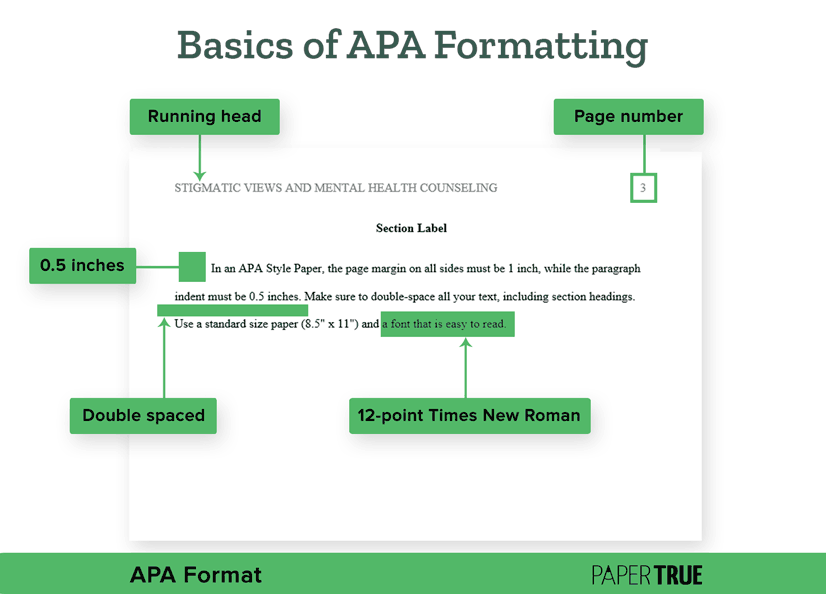
The APA paper format follows a set of simple yet strict guidelines to ensure uniformity across different works. Here are some tips on how to format a paper in APA style:
Double-space all your text.
Maintain one-inch margins on all sides of the paper.
Use a font style that is easy to read (typically 12-point Times New Roman).
Make sure each new paragraph is indented by 0.5 inches.
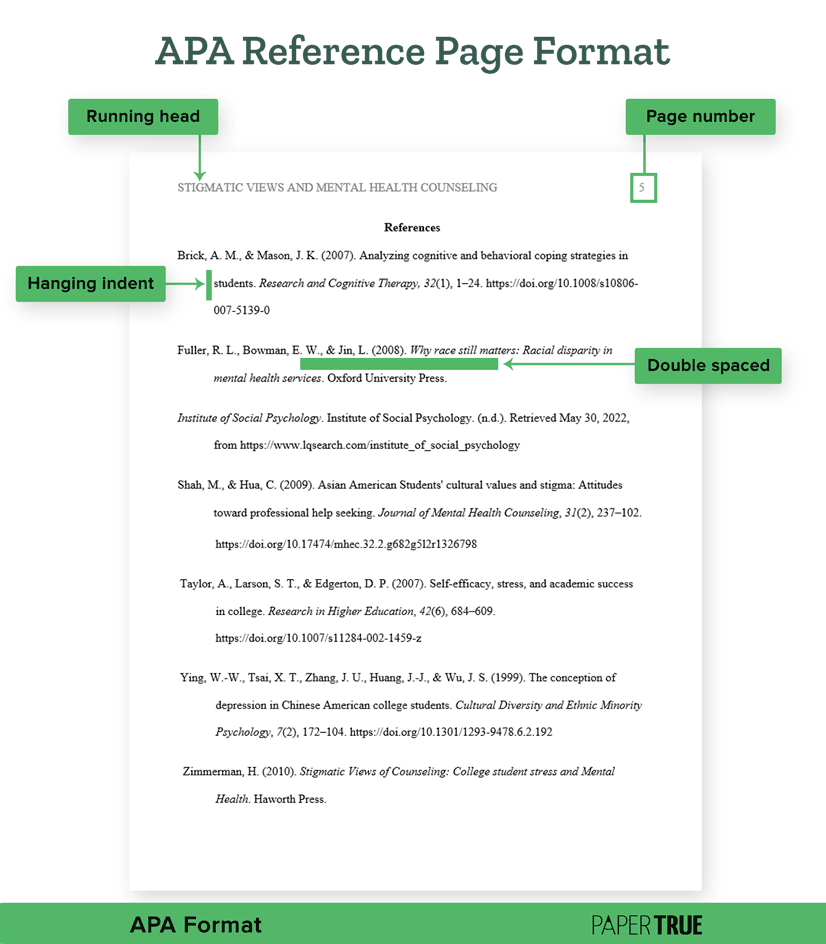
Insert a running head and page numbers in the header of each page to adhere to APA formatting guidelines.
Take a look at this research paper format example outlining the various APA formatting guidelines:
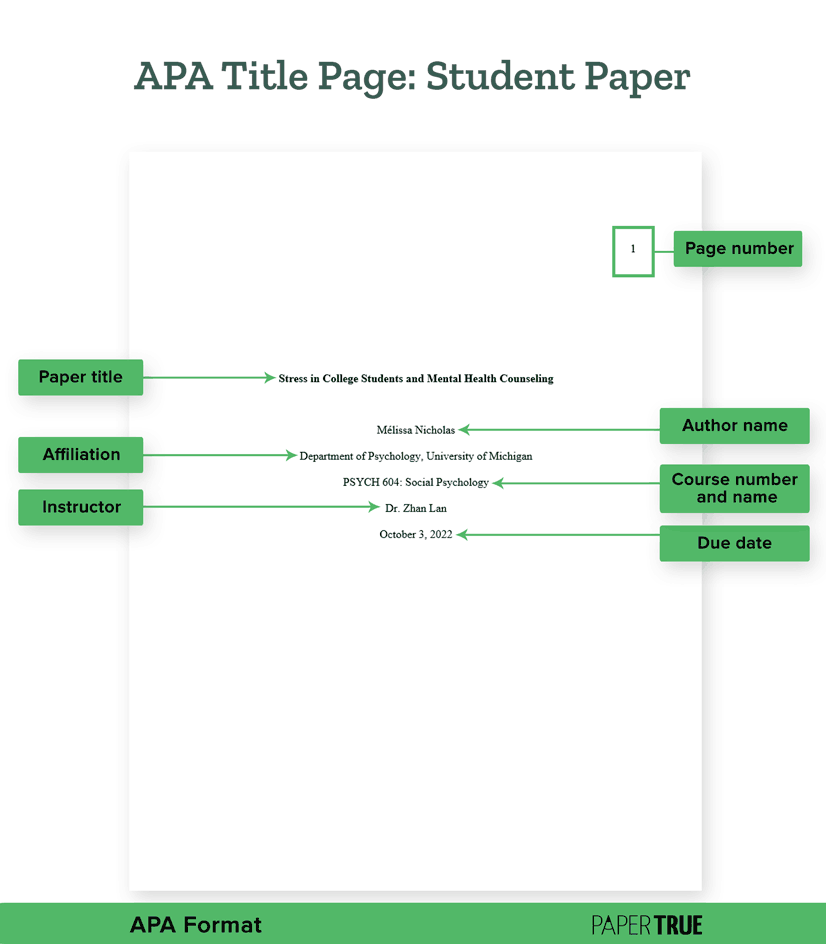
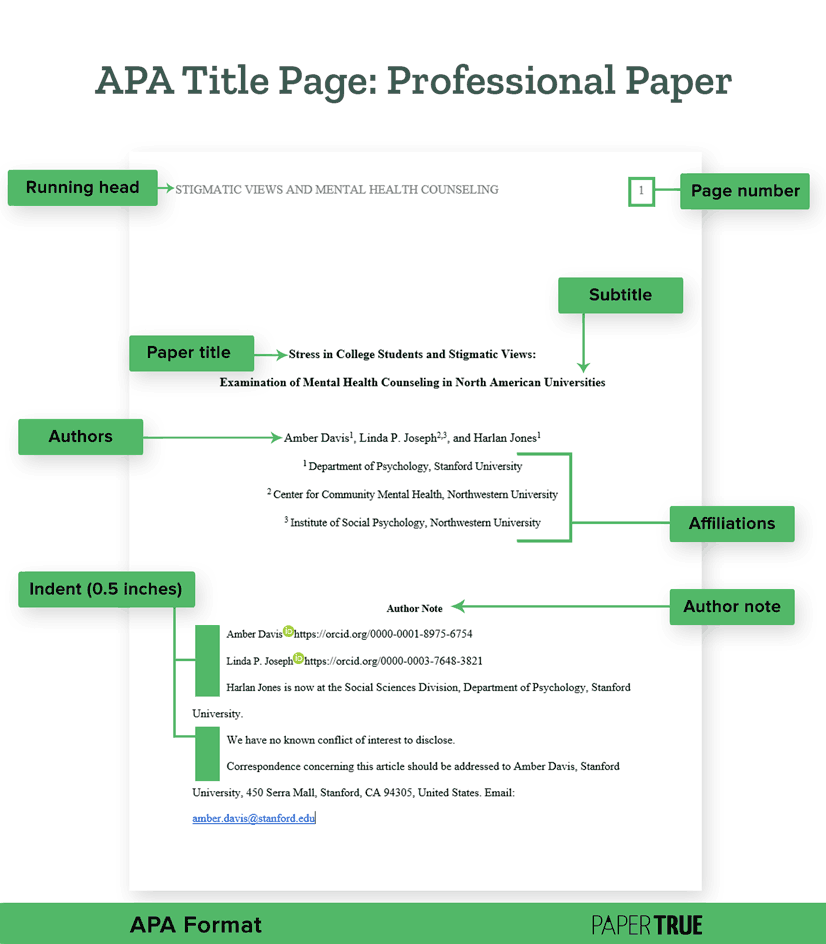
Title page
One of the key features of the APA format is its title page. The APA title page serves as the face of your research paper layout, providing essential information about your work. Keep the following in mind:
Write a title that’s a crisp summary of the paper’s content.
Mention the author’s name without any titles or degrees.
Mention the institutional affiliation (the place where the research was conducted).
Add a header at the top of the page.
Reference page
The reference page is a critical part of the layout of a research paper in the APA style. This page lists all the sources you’ve referenced in your paper. It’s essential for avoiding plagiarism and providing your readers with the opportunity to explore your sources further.
Follow the tips mentioned below when formatting your reference page in APA style:
Add a “References” label at the top and align it centrally.
Organize your entries alphabetically based on the last names of the authors.
Ensure that every entry is double-spaced.
Acknowledge all sources in the text to maintain transparency in your research process.
Special formatting guidelines
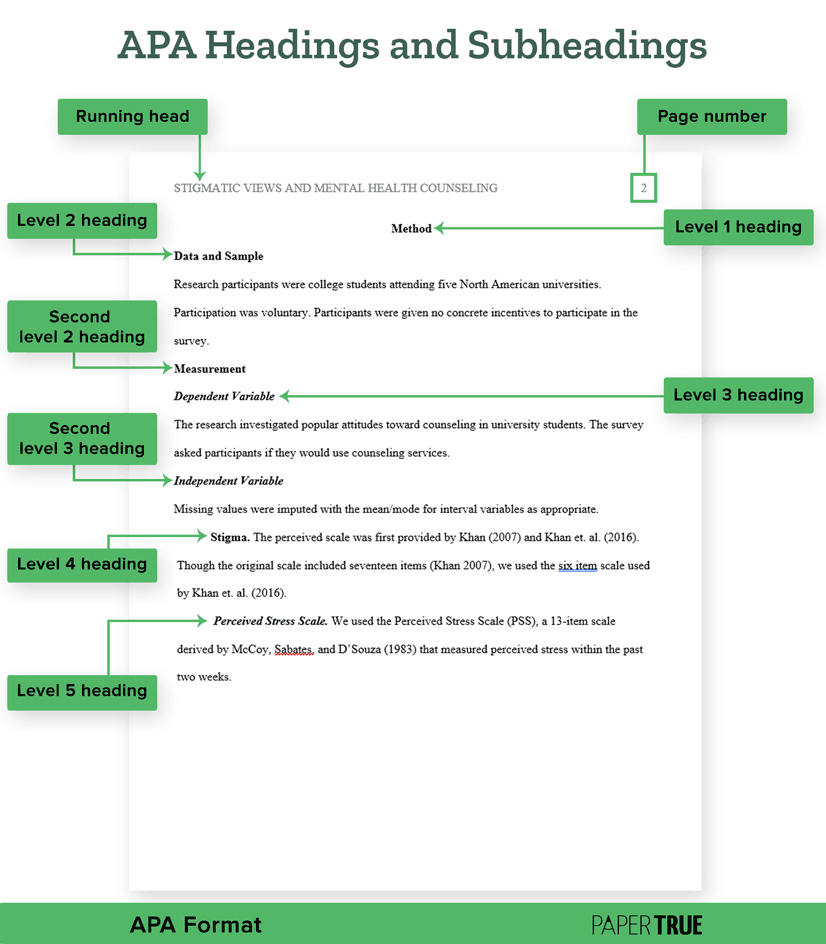
Major headings under APA 7 are bolded and aligned centrally, while the subheadings are indented and end with a period. Subsequent levels of headings are used here:
This format of research papersnecessitates a distinct heading structure, facilitating seamless navigation through the different formats. It also implements a unique citation format, guaranteeing that all your references are accurately acknowledged. Major headings are bolded and center-aligned, whereas subheadings are indented and end with a period.
The subsequent levels of headings are used in the APA paper format:
Level 1: Bold, centered
Level 2: Bold, left-aligned
Level 3: Bold italic, left-aligned
Level 4: Indented, bold
Level 5: Indented, bold italic
Bonus tip: Titles for tables and figures should be succinct and clear and should be referenced in the text by their respective number. For instance, “As demonstrated in Table 1…”
The Modern Language Association (MLA) format is another frequently utilized format for research paper writing, primarily within the humanities. It underscores authorship, making it an excellent choice for papers that concentrate on original analysis.
For the visual learners out there, we’ve added some research paper format examples for your benefit! So, make sure you follow these guidelines while writing your paper.
General guidelines
The general guidelines of the MLA paper writing format are designed to establish a uniform and professional appearance for your work. Follow these steps when formatting your paper in MLA format:
Use double spacing for your text.
Maintain one-inch margins all around.
Opt for a readable font like 12-point Times New Roman.
Incorporate a header with your last name and page number on every page.
Use title case for headings, capitalizing the first letter of each major word.
Include the instructor’s name, course number, and date on the first page to adhere to MLA formatting guidelines.
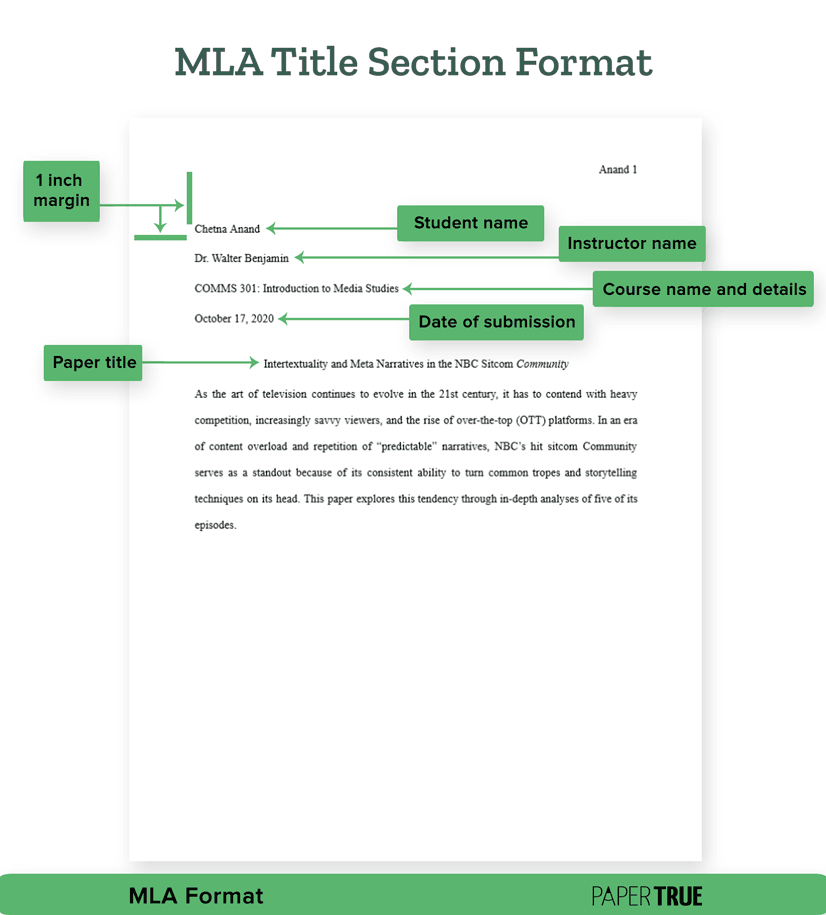
The MLA paper format doesn’t typically necessitate a separate title page. Instead, the required information is positioned on the first page of the paper, which includes the following:
Name of the student
Instructor’s name
Title of the course
Course number
Date of submission
The title of the paper is presented in the next line, bolded and centered. It’s crucial to ensure that your title is informative and mirrors the content of your research paper.
Bonus tip: Refrain from italicizing, underlining, or bolding the title. Also, don’t use a period after the title.
Works cited page
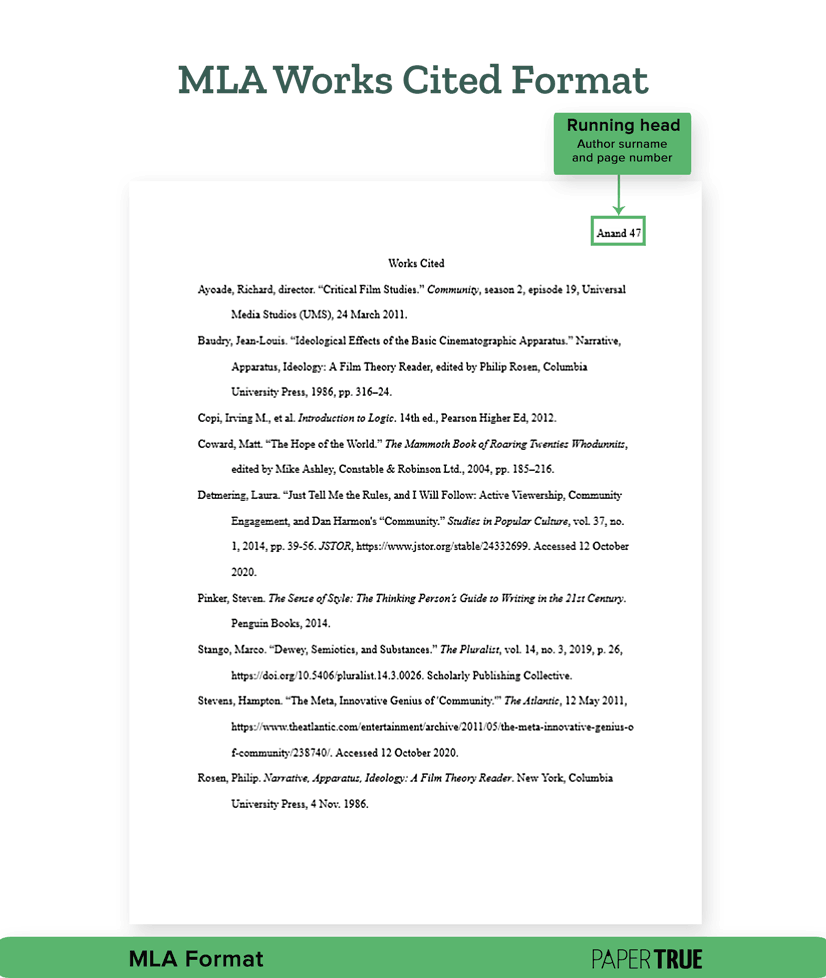
The “Works Cited” page in the MLA 9 format lists all the sources referenced in your paper. This page plays a crucial role in formatting research papers to avoid plagiarism. While working on your MLA works cited page, keep the following points in mind:
Start on a new page with the label “Works Cited”, centered and bolded at the top.
List your entries in alphabetical order by the last names of the authors.
Make sure each entry is double-spaced.
Remember, the works cited page is not a bibliography. It should only include sources you’ve quoted or paraphrased in your paper!
Special formatting guidelines
One of the defining characteristics of the MLA format is its use of parenthetical citations, making the MLA research paper format unique. Instead of footnotes or endnotes, sources are cited in the text using the author’s last name and the page number. For example, (Smith 23).
Here are some additional guidelines for formatting your paper:
In-text citations should directly follow the quote or paraphrase, but they should come before the period at the end of the sentence.
Every major word in the title of a work must be capitalized.
The Chicago Manual of Style (CMOS), or simply the Chicago research paper format, is another commonly used style in academic and professional writing. Preferred by historians, this format offers flexibility and comprehensiveness to accommodate a wide variety of sources.
General guidelines
The general guidelines of the Chicago format are similar to those of the MLA and APA research paper formats, with minor differences.
Here are the key points to remember about the Chicago paper format:
Use double spacing for the main text.
Use single spacing for block quotes, table titles, and figure captions.
Maintain one-inch margins on all sides for a neat presentation.
Use a readable font such as Times New Roman, size 12 pt.
Start page numbers from the second page, and place them in the top right corner.
The Chicago format provides specific instructions for page layout elements like font choices, headings, and the overall organization of the paper.
Title page
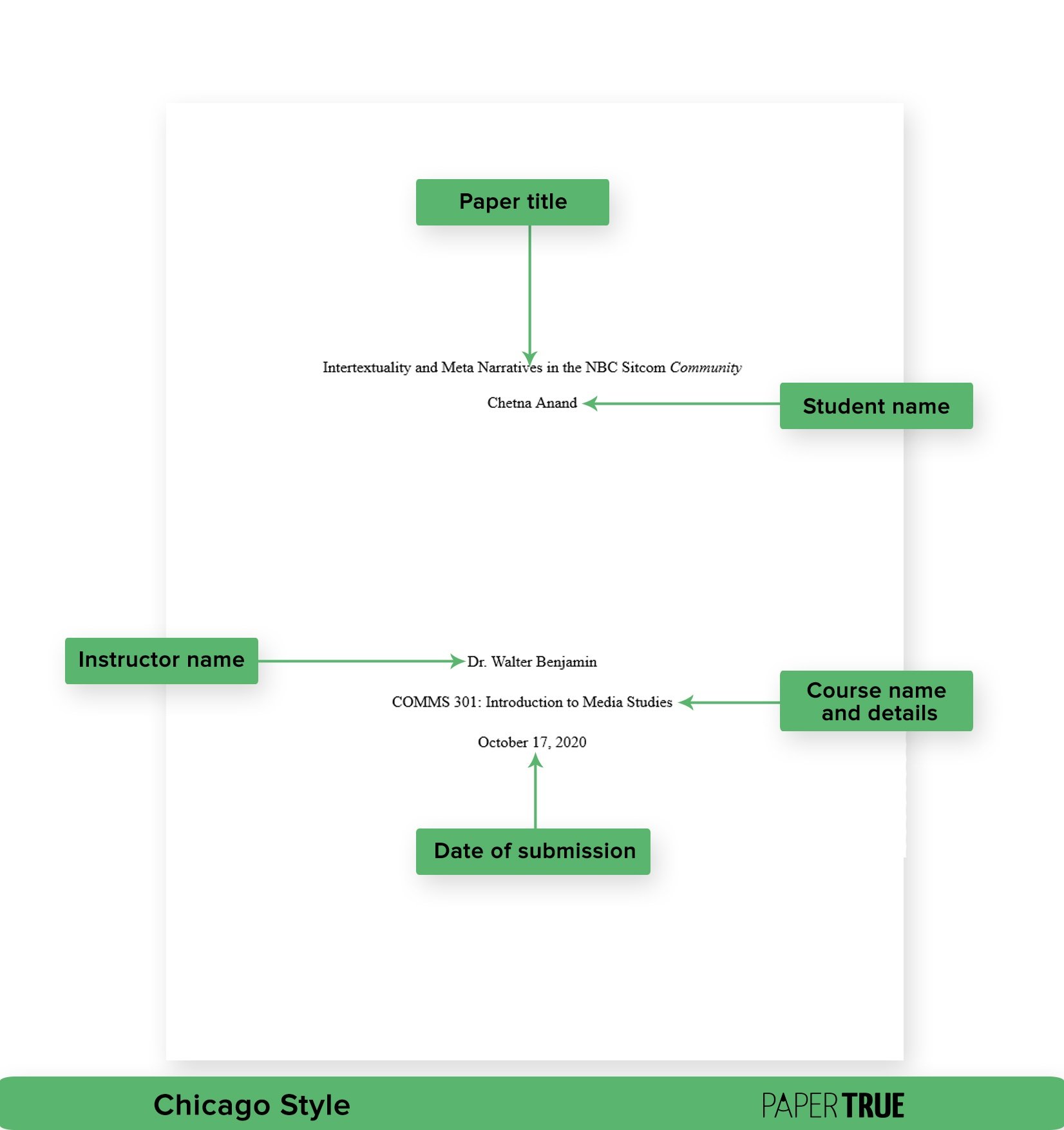
In the Chicago style, the title page includes the title of the paper, the author’s name, and your course information. Unlike other styles, the title page of a Chicago-formatted paper does not carry a page number or a running head.
Remember these two things while formatting your Chicago title page:
Make sure the title is positioned at the center of the page.
Add your name and class information some lines below the table.
Observe the following example for the Chicago research paper format:
Reference page
The reference page in the Chicago style is referred to as the “Bibliography”. This page includes all the sources that you’ve cited in your paper. To correctly format your bibliography, follow the points mentioned below:
Begin on a new page with the title “Bibliography” centered at the top.
List your sources in alphabetical order by author’s last name.
Use a “hanging indent” for each entry (the first line begins at the margin and the following lines are indented).
Bonus Tip: Make sure the bibliography includes all works that were consulted, not just those cited in the text.
Special formatting guidelines
One of the unique features of the Chicago style is its use of footnotes or endnotes for citations. When you quote or paraphrase a source, you’ll include a superscript number in the text that corresponds to a note with the citation information.
Here are some additional guidelines to format your paper in the Chicago style:
Number the footnotes or endnotes consecutively, using Arabic numbers.
You can be flexible with headings: Either stick to the classic five-level style or create your own.
Ensure you stay consistent in your approach throughout your paper.
Bonus tip: The first time you’re citing a source, give all the citation info. Feel free to use the short version after that.
Formatting your research paper is much more than just improving aesthetics. It’s about making things easy to read, keeping everything on-brand, and showcasing your attention to detail. Understanding the nitty-gritty of the APA, MLA, or Chicago research paper formats is essential to producing high-quality and well-organized research papers. Additionally, always understand the specific formatting requirements of the target journal when preparing a research paper.
We hope this article showed you how to format a research paper. After all, it’s our duty to equip you with the tools you need to excel academically. Otherwise, what good is our expertise as a paper editing service?
If you’d like to keep creating well-researched and organized scholarly papers, here are some resources that could help:
Have you come across a fictional character who is the complete opposite of the main character? Think of Draco Malfoy (the Harry Potter series), Vivian Kensington (Legally Blonde), or Peeta Mellark (The Hunger Games). Such characters are called foil characters.
A foil character highlights the traits and characteristics of the main character, adding intrigue and value to the story. In this article, we’ll start with a simple character foil definition and provide several examples from literature and movies to help you understand the concept. Let’s begin with the basics: What are foils in literature?
Remove All Errors and Perfect Your Novel.
What is a foil character?
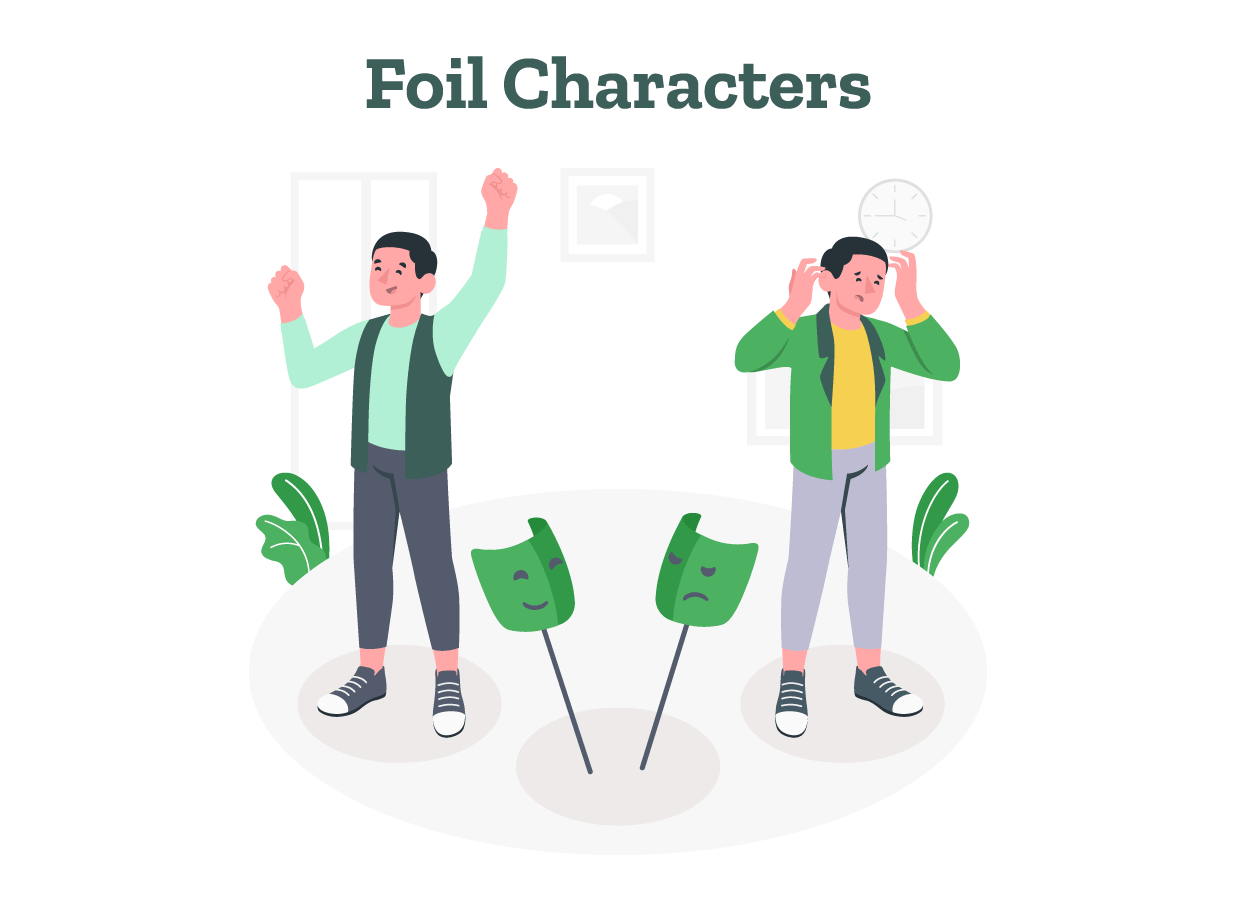
A foil character in literature is a character used to highlight and contrast the traits and qualities of another character, often the protagonist. They help emphasize the distinctive characteristics and traits of the main character, often revealed through how the characters interact. Of the various types of characters, the foil character is unique in that it’s a literary device aimed at enriching storytelling.
Foil characters often end up as the antagonists or villains of the story, but that’s not always the case. Writers enjoy pitting opposite ideas, ideals, and characteristics against each other, but opposites need not always conflict! As we’ve seen from our foil character definition, foils only need to contrast with each other. A contrasting character can reveal new dimensions of the protagonist’s personality, creating conflict and deepening the themes of the story. This can also be achieved through a dynamic team of opposite characters, like Donkey and Shrek from Shrek.
How is a character foil different from an antagonist?
The goal of the character foil is to spotlight the hero’s attributes by showcasing their mutual difference, thereby illuminating the protagonist’s personality. The antagonist’s goal, however, is to stop the hero from achieving whatever they seek.
So, character foils can appear in a story as the antagonist, the best friend, the mentor, or even the love interest. You could pick anyone from your usual set of stock characters, and they can be your character foil! But before we delve into the various examples of foil characters, let’s take a quick look at their history.
A brief history of character foils
Have you ever wondered what “foil character” means? The term “foil” comes from the old practice of backing gemstones with a thin metal foil to make them shine more brightly. Like the metal foil brightens the gem by reflecting light, a character foil highlights the protagonist through contrast and comparison.
The word “foil” in the context of a character has been used for centuries, but it’s difficult to trace its origin. However, Shakespeare makes a direct reference to the term in Henry IV, Part 1, which is its earliest known usage:
“And like bright metal on a sullen ground
My reformation, glittering o’er my fault
Shall show more goodly and attract more eyes
Than that which hath no foil to set it off.” (Shakespeare 1.2.214-217)
Prince Henry says that his faults will act as a foil, making his good deeds stand out even more. In a sense, his past self acts as a foil character for his present one!
A classic example of foil characters can be found in Shakespeare’s plays, where characters like Hamlet and Laertes serve as foils to each other. Although the earliest mention of the term can be found in Shakespeare, foil characters have been used well before his time. Let’s see some character foil examples from ancient Greek and Roman plays and early English literature.
Character foils in ancient Greek and Roman plays
1. Antigone and Ismene in Sophocles’ Antigone: Antigone’s boldness and commitment to bury her brother’s body contrast with Ismene’s cautiousness and reluctance to defy authority. The two main characters, Antigone and Ismene, highlight the conflict between personal duty and societal expectations.
2. Oedipus and Tiresias in Sophocles’ Oedipus Rex: Oedipus’s relentless pursuit of truth and his quick temper foil Tiresias’s wisdom and foresight.
Character foils in early English literature
1. Beowulf and Unferth in Beowulf: Beowulf’s bravery and heroism are juxtaposed with Unferth’s jealousy and cowardice.
2. Sir Gawain and the Green Knight in Sir Gawain and the Green Knight: Sir Gawain’s chivalry and honor are contrasted with the Green Knight’s supernatural qualities and challenges.
3. Everyman and Fellowship in Everyman: In the morality play Everyman, Everyman’s search for salvation contrasts with Fellowship’s abandonment and worldly values.
Now that we’ve answered “What is a character foil?” and traced its history, it’s time to learn more about character foils through examples.
Creating a foil character involves developing a character that contrasts with the main character in significant ways. This can include opposing traits, physical appearances, or backgrounds. A good foil character should be well-developed and multi-dimensional, with their own motivations and goals. When creating a foil character, consider what qualities you want to highlight in the main character and how the foil character can provide a contrasting perspective. For example, if the main character is brave and impulsive, the foil character could be cautious and thoughtful. By creating a foil character that contrasts with the main character, you can add depth and complexity to the story, making it more engaging and relatable for readers.
Foil character examples
Foil characters play a wide variety of roles in modern literature and media. In some stories, a character may even serve as their own foil, highlighting different aspects of their personality over time. Take a look at the following character foil examples:
1. Antagonist
Iago and Othello in Othello
Joker and Batman in the Batman comics
Cersei Lannister and Ned Stark in Game of Thrones
2. Best friend or ally
Dr. John Watson and Sherlock Holmes in Sherlock Holmes stories
Samwise Gamgee and Frodo Baggage in The Lord of the Rings
James Wilson and Dr. House in House
3. Mentor or guide
Don Quixote and Sancho Panza in Miguel de Cervantes’ Don Quixote
Obi-Wan Kenobi and Luke Skywalker in Star Wars
Giles and Buffy in Buffy the Vampire Slayer
4. Love interest
Elizabeth Bennet and Mr. Darcy in Pride and Prejudice
Jack and Rose in Titanic
Jim and Pam in The Office
5. Rival or competitor
Gatsby and Tom Buchanan in The Great Gatsby
Melanie Hamilton and Scarlett O’Hara in Gone with the Wind
There are several pairs of foil characters in Shakespeare’s Romeo and Juliet:
a. Mercutio and Romeo
Mercutio and Romeo are best friends, both belonging to noble families. While Romeo is emotional and idealistic towards love, Mercutio is witty, humorous, and cynical about love. Mercutio’s skepticism contrasts with Romeo’s passion, creating a dynamic that drives the story forward. Mercutio’s wry remarks about love contrast and reveal the depth of Romeo’s feelings.
b. Tybalt and Benvolio
Tybalt and Benvolio are excellent character foil examples because they represent opposite families, ideas, and personalities. Tybalt is hot-tempered and aggressive, while Benvolio is calm and peaceful. The close interaction between these contrasting characters in the play’s opening scene highlights their qualities and roles in the story.
c. Romeo and Juliet
Romeo and Juliet have contrasting personalities, loyalties, and approaches to love. Romeo’s youth is impulsive and passionate, while Juliet’s youth is innocent but practical. Romeo prioritizes his love for Juliet over his familial loyalty, but Juliet struggles with her feelings due to her devotion to her family. Juliet becomes more mature and independent over the course of the play, taking measured steps to obtain her goal. On the other hand, Romeo’s youthful idealism and impulsiveness lead to the play’s ultimate tragedy.
2. Foil character in Hamlet
Here are the central foil characters in Shakespeare’s Hamlet:
a. Hamlet and Claudius
Hamlet and Claudius are natural opposites: Their personalities and actions in the play act as foils to each other. Hamlet is deeply philosophical, intellectual, and morally upright, while Claudius is manipulative, cunning, and morally corrupt. Hamlet’s actions are for justice and revenge, while Claudius’ actions are for power and self-preservation. This dynamic allows for a deeper interpretation of the two characters in all their complexity.
b. Laertes and Hamlet
A schoolbook foil character example, the pair of Laertes and Hamlet follow parallel paths in the play. Hamlet even refers to himself as Laertes’ foil! While Hamlet seeks proof of Colonius’ guilt and debates the ethics of enacting revenge, Laertes is brash and action-oriented. Hamlet has a tumultuous relationship with his family and Ophelia, while Laertes is devoted and protective of his loved ones. In one pivotal scene, Prince Hamlet tells Laertes that he will fence with him, highlighting their contrasting qualities and deepening the narrative. This dynamic articulates the play’s central themes of action and inaction, contemplation and impulsiveness, and vengeance and its consequences.
c. Ophelia and Gertrude
While they’re not true character foils, Ophelia and Gertrude contrast each other in terms of age, agency, and relationship to Hamlet. Ophelia is innocent and lacks agency in a male-dominated world; ultimately becoming a pawn in her family’s game. Gertrude, on the other hand, is the queen and has some agency in courtly affairs. Ophelia descends into madness due to Hamlet’s conduct toward her, while Gertrude attempts to find a balance and retain peace in the court. Their parts in the play show the extent to which court politics and male dominance affected women’s lives in the palace.
Aside from character foils, Hamlet also features a plot foil, where the “story within the story” reflects the themes and events of the main plot.
3. Foil character examples in Disney movies
If we were to list iconic foil character examples in movies Disney has produced, we’d simply run out of space. So here are three popular character foil dynamics we can observe in Disney movies:
a. Hero and villain
This is the most common dynamic in Disney’s foil characters. The movies often feature a brave, courageous, and noble hero who is foiled by a cowardly, cunning, and (obviously) evil villain. This contrast makes for great entertainment, so a lot of Disney movies have used it:
Aladdin and Jafar in Aladdin
Simba and Scar in The Lion King
Hercules and Hades in Hercules
Tiana and Dr. Facilier in The Princess and the Frog
A modification of the hero vs. villain dynamic, the princess and witch dynamic deals with beauty and femininity. The earliest Disney princess movies featured the princess as good and kind, possessing simple beauty. On the other hand, the villains were evil and cruel, making their beauty sinister. Take a look at the following examples:
Cinderella and Lady Tremaine in Cinderella
Aurora and Maleficent in Sleeping Beauty
Snow White and the Evil Queen in Snow White and the Seven Dwarfs
Ariel and Ursula in The Little Mermaid
Rapunzel and Mother Gothel in Tangled
c. Hero and sidekick/best friend
Putting two conflicting characters together offers an opportunity for easy character development and comic relief. Here are some examples:
Mulan and Mushu in Mulan
Ralph and Princess Vanellope (Glitch) in Wreck-It Ralph
Moana and Maui in Moana
Benefits and impact of foil characters
The use of foil characters can have a significant impact on the story, adding depth and complexity to the narrative. By creating a foil character, authors can highlight the main character’s strengths and weaknesses, making them more relatable and engaging for readers. Foil characters can also be used to create conflict and tension, driving the plot forward and keeping readers interested. Additionally, foil characters can provide a fresh perspective on the story, offering a new insight into the main character’s thoughts and feelings. Overall, the use of foil characters is a powerful literary device that can enhance the story, making it more engaging, relatable, and memorable for readers. By incorporating foil characters into their writing, authors can create a more nuanced and complex narrative, adding depth and complexity to the story.
We hope we’ve answered all your questions, and there won’t be any more googling of “What is a foil character?” If you do need help developing your literary foils, our story editing services are at your disposal!
eyWhether we are speaking, reading, listening, or writing, nouns are an inseparable part of our daily life. Knowing what’s a noun is very important to communicate effectively. In this article, we will decode the definition of nouns.
We will introduce the concept of ‘generic nouns’, which represent entire categories of things, highlighting their grammatical flexibility and contextual usage.
We will also understand various types of nouns with the help of simple examples. Whether you’re a language enthusiast or someone looking to deepen their grammar knowledge, this article will make understanding nouns easier for everyone. Let’s start with an easy noun definition.
Transform your nouns and perfect your writing!
What is a Noun?
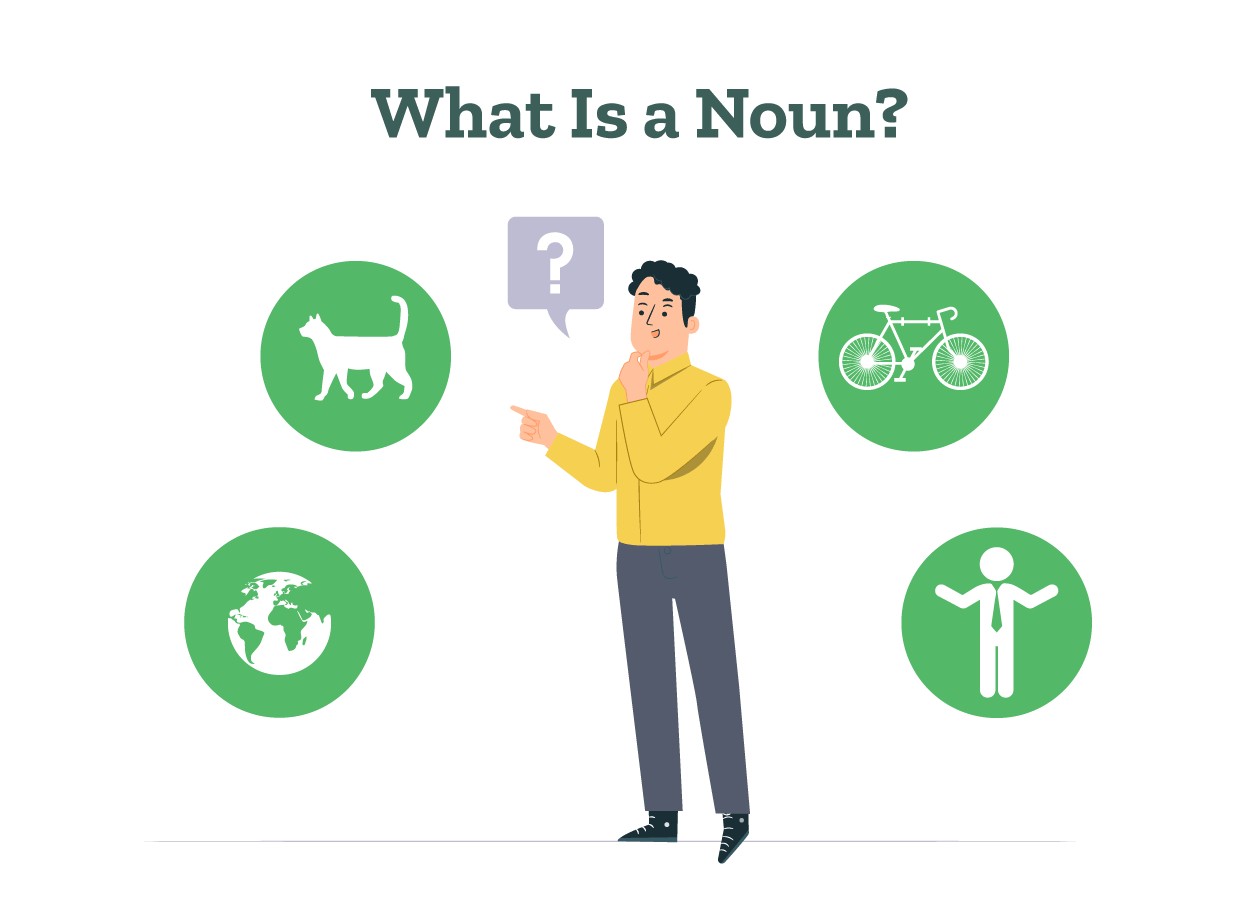
A noun is defined as a word that names or identifies a person, place, thing, idea, or animal.
Nouns are the words in a sentence that represent a certain person (John), place (London), thing (pen), idea (discipline), or animal (dog). Th can be concrete (pen) or abstract (discipline).
Nouns can be categorized into different categories, such as common nouns, proper nouns, collective nouns, count nouns, and mass nouns.
The easiest way to spot a noun is by identifying a name, place, thing, idea, or animal in a sentence.
Being aware of the noun definition, noun meaning, and what are nouns is integral for understanding grammar and sentence structure in any language.
A list of nouns commonly used is:
Animal: Cat
Place: Park
Thing: Bicycle
Person: Girl
To understand the meaning of nouns in detail, let’s take a look at some more examples of nouns.
Noun examples
1. Nouns naming a person:
A man
A postman
The Prime Minister
Indira Gandhi
2. Nouns naming a place
My house
A mall
India
Mount Fuji
3. Nouns naming a thing
A pen
A baseball
A chair
The magical book
4. Nouns naming an idea
Justice
Freedom
Loyalty
Creativity
5. Nouns naming an animal
A dog
A cat
A cow
A tiger
These examples give us a quick insight into the process of identifying and choosing nouns in a sentence. Nouns are one of the eight parts of speech that play a vital role in forming sentences.
What are parts of speech?
Parts of speech are specific roles and functions of a word in the English language. Noun, verb, adjective, adverb, pronoun, preposition, conjunction, and interjection are the eight parts of speech.
Types of nouns
1. Proper noun
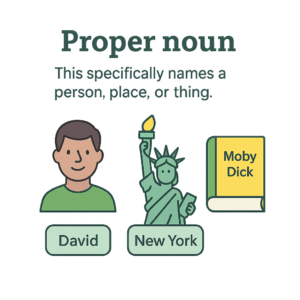
These are nouns that specifically name a person, place, or thing. Proper nouns start with capital letters, making it easy to distinguish them from other types of nouns.
Some proper noun examples are:
The time we visited Delhi was one of the most fun times of my life. (Name of a particular place.)
I watched a film about Freddie Mercury. (Name of a particular person.)
I love shopping at Shopper’s Stop. (Name of a particular brand.)
2. Collective noun
A noun used to refer to a group of individuals, animals, or things as a single unit is called a collective noun. It shows a grouping of similar things. Collective nouns are a type of singular noun, but they represent a plurality of items.
Some collective noun examples are:
A deck of cards.
A class of students.
A hive of bees.
3. Common noun
A common noun refers to a general category of people, places, or things. Common nouns do not represent a particular category or specific instance.
A word that represents an idea, a state, or an intangible concept is called an abstract noun. Abstract nouns are things that cannot be seen or touched physically but are present as feelings or emotions. Abstract nouns refer to things that are intangible and exist as feelings, thoughts, and ideas.
Some abstract noun examples are:
Honesty is the best policy.
Loyalty is a dog’s best trait.
Freedom must not be considered as a liberty.
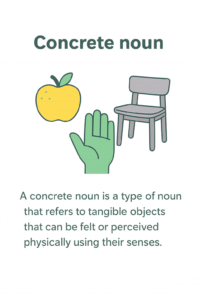
5. Concrete noun
A concrete noun is a type of noun that refers to tangible objects that can be felt or perceived physically using their senses. Unlike abstract nouns, concrete nouns can be seen, touched, heard, and experienced physically.
Some concrete noun examples are:
The tree was 100 years old.
The family traveled by bus.
I want to read a book.
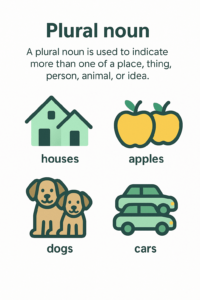
6. Plural noun
A plural noun is used to indicate more than one of a place, thing, person, animal, or idea. Plural nouns are represented by words that are made plural by adding ‘s’,‘es’, or ‘ies’ to the ending. Confusing plural nouns with collective nouns is one of the common grammatical mistakes people make. Plural nouns refer to multiple individuals or objects, while collective nouns refer to a group or collection of individuals or objects.
Some plural noun examples are:
We bought a few oranges from the market yesterday.
There were a lot of dishes to be cleaned.
All the candies were sweet.
7. Possessive noun
A possessive noun is a word used to indicate ownership or possession of something. It shows possession or that something belongs to someone. It is often formed by adding a ‘s at the end of the words, which shows that the noun owns or possesses something.
Some possessive noun examples are:
The king’s reign was over. (Reign of the king)
Students’ assignments were submitted. (Assignments belonging to the students)
All the car’s windows have to be shut. (Windows belonging to the car)
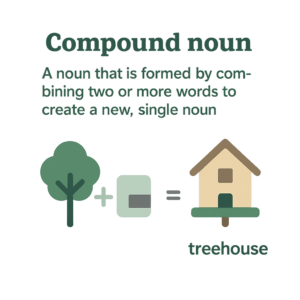
A noun that is formed by combining two or more words to create a new, single noun is called a compound noun. The combination of these two or more words results in the formation of a new word having a distinct meaning. The three types of compound nouns that are commonly used are hyphenated compound nouns, closed compound nouns, and open compound nouns.
Some compound noun examples are:
Bus stop (bus + stop) (open compound noun)
Classroom (class + room) (closed compound noun)
Mother-in-law (hyphenated compound noun)
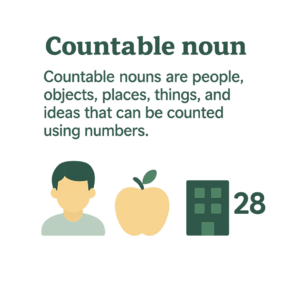
9. Countable nouns
Countable nouns, also known as count nouns, are people, objects, places, things, and ideas that can be counted using numbers. These nouns have plural forms.
Some examples of countable nouns are:
He purchased two dozen apples for his family. (apple + s)
She borrowed two purses from a friend. (purse + s )
There are many temples in India. (temple + s)
10. Uncountable nouns
Uncountable nouns, also known as mass nouns, are those objects and ideas that cannot be counted using numbers. This means that the individual units of these nouns cannot be counted. These nouns do not have plural forms. Words such as some, any, much, and enough can be used to describe the quantity of these nouns.
Some examples of uncountable nouns are:
Trees grew in abundance. (Individual units of “abundance” cannot be counted.)
She has vast knowledge in her field. (Individual units of “knowledge” cannot be
counted.)
She appreciated her tolerance. (Individual units of “tolerance” cannot be counted.)
11. Appositive nouns
Nouns that are used to add specificity or additional context to a noun in the sentence are known as appositive nouns. Appositive nouns give extra information about the subject and make sentences more engaging. They are typically set off by commas, dashes, or parentheses.
Some of the examples are:
The country, India, is known for its culture. (“India” serves as an appositive noun that renames “the country.”)
My dog, Leo, loves to play fetch. (“Leo” serves as an appositive noun that renames “my dog.”)
My sister, Riya, is a dancer. (“Riya” serves as an appositive noun that renames “my sister.”)
The subject of a sentence is the noun or noun phrase that performs the main action of the sentence or is the main focus of the sentence. A subject can be easily identified by asking the question “who?”. It mostly appears at the beginning of a sentence when used as a subject.
Examples:
The baby was crying. (Who was crying? – the baby)
Cyrus was a naughty child. (Who was a naughty child? – Cyrus)
Mother went to the store. (Who went to the store? – mother)
Noun as a subject complement
A noun or noun phrase serves as a subject complement when it follows a linking verb and provides additional information about the subject in the sentence. The subject is typically described or renamed by a subject complement.
Examples:
The painting was a masterpiece. (“A masterpiece” describes the subject, “the painting.”)
He is a scientist. (“A scientist” renames and describes the subject “he.”)
The owner of this house is Alan. ( “Alan” identifies the subject, “the owner.”)
Nouns as subject complements help provide more information about the subject, clarifying its identity, characteristics, or state. They are an important element in sentences that use linking verbs to connect to the subject.
Noun as an object
When a noun is placed in a position where it receives the action of the verb, it is used as an object. An object placed immediately after a verb is known as a direct object. An object can be easily identified by asking questions like “what?” or “whom?”.
Examples:
Izzy loved her skirt. (What did Izzy love? – her skirt)
The baby wanted milk. (What did the baby want? – milk)
Father drove the car. (What did father drive? – the car)
A noun or noun phrase functions as an object complement when it follows a direct object and provides further description or identification of that object. The object is typically described or renamed by an object complement.
Examples:
He painted the wall red. (“red” is the object complement, describing the object “wall.”)
We named our baby Judy. (“Judy” provides additional information about the object “baby”)
She considered the book a good read. (“A good read” describes the object “book.”)
Noun as a modifier
Nouns that act as an adjective and provide additional information or context about another noun are referred to as modifiers. They are also called attributive nouns. Nouns can modify other nouns, acting in various grammatical roles such as complements, object complements, and attributive nouns. They function similarly to adjectives but maintain their classification as nouns, emphasizing their importance in sentence structure and noun phrases.
Examples:
The mechanic understood that the car engine was faulty. (“car” acts as a modifier for “engine” and indicates that this type of engine is used in a car)
She took her Labrador Retriever to the dog park. (“dog” acts as a modifier for “park” and indicates that this type of park is for dogs)
He threw his coffee cup in the dustbin. (“coffee” acts as a modifier for “cup” and indicates that this type of cup is for coffee)
We hope that the given examples will help you use nouns effectively while communicating. As language experts who provide proofreading services, we’d love to help you perfect your words.
Bookmark PaperTrue’s Resource Centre for useful grammar tips!
Do you find it challenging to summarize sources and write annotations? This is where AI is a lifesaver! Using AI, you can easily research and write citations.
This blog explains how to use AI to research, summarize, and cite sources for your research paper. For beginners, the meaning of an annotated bibliography and the types of annotations are simply explained.
So let’s first simplify the basics to help you create an annotated bibliography!
Make sure your annotated bibliography is free from language errors! Learn more
What is an annotated bibliography?
An annotated bibliography is a list of sources (such as books, articles, or websites) that you’ve used for research. It also includes a brief description and evaluation of each source.
Each entry starts with a full citation of the source (the author’s name, year of publication, information taken from the source, title, and publisher). For websites, the website link is also included in the citation.
Annotated bibliographies are used in research papers, theses, and dissertations. They are also found in documents such as legal briefs and grant proposals.
Annotated bibliography examples
Descriptive annotations, evaluative annotations, and reflective annotations are 3 types of annotations. Given below are explanations of these types and three examples for your reference.
1. Descriptive annotation: These annotations summarize the main points, arguments, or findings of the source. For example:
Abbate, J. (1999). Inventing the Internet. MIT Press.
Janet Abbate’s Inventing the Internet offers a comprehensive history of the Internet’s development, tracing its roots from early Cold War research to the rise of the World Wide Web. Abbate explores key technological innovations, the diverse group of researchers and engineers involved, and the social and political contexts that shaped the internet’s evolution.
2. Evaluative annotation: These annotations evaluate the source’s strengths, weaknesses, and credibility. For example,
Jones, A. (2018). The Future of Artificial Intelligence. Oxford University Press.
Jones presents a compelling argument for the transformative potential of artificial intelligence, highlighting its applications in various fields. While the book provides a comprehensive overview of AI’s advancements, it lacks a critical analysis of the ethical implications and potential risks associated with its widespread adoption.
3. Reflective annotations: These annotations explain how the source relates to your research topic and how you plan to use it. They connect the source to your own work and thinking. For example:
Brown, K. (2019). The Psychology of Social Media Addiction. Routledge.
Brown’s book provides a valuable framework for understanding the psychological mechanisms underlying social media addiction. This source will be essential for my research on the impact of social media on adolescent well-being, as it offers insights into the cognitive and emotional factors that contribute to excessive social media use.
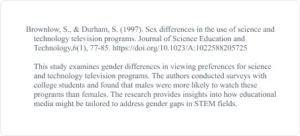
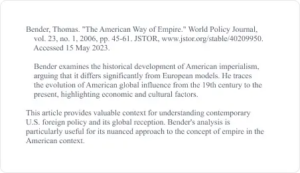
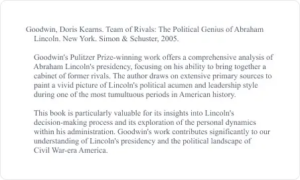
Here are 3 other examples of annotated bibliography in APA, MLA, and Chicago style format
1. Annotated bibliography in APA style (7th edition)
2. Annotation in MLA style (9th edition)
3. Annotation in Chicago style (17th edition)
How to write an annotated bibliography using AI
1. Use AI tools for research
You can use AI tools for research like Semantic Scholar, Research Rabbit, Dimensions.AI, and Scite.AI. Some other tools you can use are Connected Papers, Consensus, and Elicit.
You can also use filters such as publication year and author to research relevant sources. Once you find the relevant sources, you can save and export them.
2. Select the citation style
Choose the citation style (APA, MLA, Chicago, or other) and learn the required guidelines. The content of the annotation is usually double-spaced and left-aligned.
Furthermore, the annotation’s first line is usually indented by half an inch (0.5 inch) from the left margin. All entries are arranged alphabetically, where entries mostly begin with the author’s last name (with few exceptions).
Key differences
APA focuses more on the source’s methodology and findings, while MLA and Chicago emphasize the source’s argument and relevance to your research.
Chicago style often allows for more detailed and lengthier annotations compared to APA and MLA.
Once you learn the citation guidelines, you can use a citation generator. Citation Machine, Zotero, BibMe, and SciSpace Citation Generator are some useful citation generation tools.
Many AI tools for research, like Scite.AI and Consensu,s also provide an option to generate citations. By using these tools, you can generate accurate citations. This is especially beneficial when citing tricky sources like websites or online videos, as citation generators simplify the process. They save time and also ensure accuracy in formatting.
4. Summarize the resource and generate an annotation
You can use AI text summarizersprovided by QuillBot, WriteSonic, and Hypotenuse AI to summarize sources. Another option is to use AI writing tools like Claude and ChatGPT to provide summaries.
For best results, provide the tool with the full citation and key points from the source, and how the source is relevant.
A sample prompt you can use is – “Summarize the following source in 200 words or fewer by referring to the following important points and citation entry– [Insert the citation entry, and important points from the source].
5. Review all annotations, including citation entries
It’s important to proofread every entry for spelling, capitalization, and grammar mistakes. You can use grammar checkersand spell checkersprovided by QuillBot, Grammarly, and ProWritingAid. Once you edit and proofread the entries, you can arrange them alphabetically.
By creating an annotated bibliography, you can organize your research effectively and improve your critical thinking skills. Plus, you can also avoid any accidental plagiarism.
After understanding the importance of annotated bibliographies, let’s quickly see the advantages of using AI tools for bibliographies.
Benefits of using AI for creating an annotated bibliography
AI can streamline the process of creating annotated bibliographies, allowing researchers to focus more on tasks like data analysis. Following are some other advantages of using AI for creating an annotated bibliography:
Improved source discovery: AI-powered tools can identify relevant sources that might be overlooked while searching resources manually. They can analyze relationships between papers to help researchers discover interconnected studies and broaden their literature review.
Time efficiency: AI can rapidly process large volumes of text, generating initial drafts of annotations much faster than manual methods.
Consistency and accuracy: AI ensures consistent formatting across citations and can catch any spelling and grammar errors.
Enhanced comprehension: AI can provide quick summaries of complex texts and identify key themes across multiple sources.
These benefits demonstrate how AI has simplified the process of creating an annotated bibliography. However, AI tools also have certain limitations. Hence, it’s important to let trained professionals check your paper’s citations.
At PaperTrue, our trained team cross-checks citations, ensuring they follow the selected style guidelines. We also provide high-quality editing and proofreading servicesto polish your text. Plus, we also check your text for plagiarism. Contact us to learn more about our services!
From Peter Pan to Harry Potter, literature has given us timeless fictional characters. Amazing Fantasy #15 is where Spider-Man first appeared, marking a significant moment in comic book history. Embark on a nostalgic journey and see the top 101 fictional characters of all time! From the 1900s to the present, we’ve created a list of the most memorable fictional characters.
From old classics to modern literature, we’ve covered everything for you. Mia Thermopolis from ‘The Princess Diaries’ is a prime example of a best fictional character due to her relatable traits and significant life changes. Dive in to see the most beloved characters and see whether your favorite characters feature on the list!
Give life to your characters and elevate your novel.
Characteristics of Iconic Fictional Characters
So, what makes a fictional character iconic? Is it their complexity, relatability, or memorability? Iconic characters often have a unique combination of traits that sets them apart from others. They can be complex, with rich backstories and motivations, or simple, with a clear and compelling goal. They can be relatable, with universal desires and emotions, or larger-than-life, with extraordinary abilities and strengths. Some iconic characters, like Sherlock Holmes or Wonder Woman, have become cultural symbols, representing ideals and values that resonate with audiences. Others, like Harry Potter or Luke Skywalker, have inspired countless fans with their courage and determination. These characters leave an indelible mark on our hearts and minds, making them unforgettable.
Here are the most popular fictional characters loved by everyone:
1) Sherlock Holmes
Created by Arthur Conan Doyle, Sherlock Holmes is one of the best fictional characters of all time. A detective in Baker Street, Holmes has a vast knowledge of science, along with amazing reasoning and observation skills. Able to make accurate deductions, Sherlock Holmes is portrayed as having a brilliant mind. There are more than 200 film adaptations of Sherlock Holmes. The 2011 film A Game of Shadows is regarded as one of the famous adaptations.
2) Harry Potter
This magical character created by J.K Rowling is loved by millions of Potterheads worldwide. Harry Potter’s struggle to fight against Voldemort and grow as a wizard won the hearts of fans. First seen in the book Harry Potter and the Philosopher’s Stone in 1997, Harry’s character developed through the series of 7 books. The themes of love, friendship, and bravery reflected through Harry’s actions made his character extremely famous.
3) Elizabeth Bennet
Brought to life by Jane Austen, Elizabeth is one of the most memorable characters from Pride and Prejudice. Published anonymously in 1813, Pride and Prejudice’s Elizabeth was loved by audiences worldwide. Her lively, and intelligent personality along with her flaw of prejudice make her a relatable character. Elizabeth’s character first made an appearance in 1938 on television. After this, Elizabeth’s character was seen in the 1940 film Pride and Prejudice and later adapted into more than 15 films.
4) James Bond
Created by Ian Fleming, James Bond is an intelligence officer who is given a dangerous mission in every story. Known for his intelligence, Bond manages to kill enemies easily and survive challenging situations. James Bond’s character first appeared in Ian Fleming’s novel Casino Royale, which was published in 1953. This was followed by 11 novels and 2 short story collections featuring the popular spy. The first film on James Bond was Dr. No, which hit theatres in 1962. After this, 24 James Bond films were produced, with the film No Time to Die being the most recent one.
5) Percy Jackson
Percy Jackson’s character, a key figure in Rick Riordan’s 2005 fantasy series, is unforgettable for audiences even today. The son of the Greek god Poseidon, Percy is 12 years old in the series’ first novel, The Lightning Thief. His powers gradually develop and include controlling waters and talking to sea animals. Inspired by Riordan’s 6-book series, Percy Jackson’s character has been adapted in 2 movies, Percy Jackson & The Lightning Thief, and Percy Jackson: Sea of Monsters.
6) Holden Caulfield
This character from J.D. Salinger’s The Catcher in the Rye finds a strong resonance with audiences worldwide. Symbolizing a typical teenager trying to cope with adult life, Holden’s struggle for acceptance makes his character relatable. Holden is a sensitive and deeply emotional character who often acts impulsively in the novel. Interestingly, despite the popularity of Holden Caulfield and The Catcher in the Rye, the story has never been adapted into a movie.
7) Atticus Finch
One of the greatest fictional characters from To Kill a Mockingbird, Atticus Finch holds a special place for thousands of readers. Created by Harper Lee, Atticus is a single father to Scout and Jem Finch. Agreeing to defend a black man, Tom Robinson, Atticus refuses to accept the town’s racial prejudice. His courage and his firm determination to do everything to ensure justice makes his character celebrated even today. The book’s success also led to a film adaptation in 1962.
8) Scarlett O’Hara
Scarlett O’Hara is the main character of the novel Gone With The Wind, written by Margaret Mitchell. Determined to get everything she wants, Scarlett goes to extreme lengths to win Ashley, whom she thinks she loves. After experiencing poverty during the Civil War, she successfully managed to overcome poverty and maintain a luxurious lifestyle. The novel’s portrayal of rising above the hardships of the Civil War made O’Hara’s character immensely popular. This led to a film adaptation of the book in 1939.
Jay Gatsby from the novel The Great Gatsby by Scott Fitzgerald stands out due to his intriguing personality and story. Having grown up in poverty, Gatsby manages to become extremely wealthy by performing illegal activities. Falling in love with Daisy, Gatsby takes the blame for an accident caused by Daisy and is later killed in the novel. The novel’s depiction of wealth and societal issues is central to understanding Gatsby’s character and the world he inhabits. Published in 1925, this novel was adapted as a film in 2013.
10) Jane Eyre
First appearing in Charlotte Brontë’s 1847 novel Jane Eyre, her determination to rise above hardships makes her character special. Despite getting no support from her relatives, she becomes independent and works as a governess. Refusing to marry her cousin, Jane is later united with Rochester, whom she loves. What made her character popular was the fact that it went against the accepted societal norms related to class and women’s rights at that time. Her character has been adapted in more than 15 movies and is memorable even today.
11) Huckleberry Finn
First appearing in The Adventures of Tom Sawyer, Huckleberry Finn is famous for his ability to survive difficult situations. After the success of this 1847 novel, Mark Twain wrote The Adventures of Huckleberry Finn, which was published in 1884. Logical, intelligent, and compassionate, Huckleberry manages to escape his father’s torture and helps to free Miss Watson’s slave Jim. The book’s depiction of survival and societal issues has contributed significantly to its immense acclaim, leading to more than 12 film adaptations.
12) Gandalf the Grey
One of the strongest fictional characters in The Lord of the Rings, Gandalf the Grey, is a shrewd wizard. Created by J.R.R. Tolkein, Gandalf is an old man who strongly believes that The Ring must be destroyed. He not only rescues Frodo and Sam from Mount Doom but also arrives just in time to help achieve victory in the battle. His wisdom, positive outlook, kindness, and fairness make him a loved character. The immense popularity of the series led to three film adaptations in 2001, 2002, and 2003. The themes and character development in The Lord of the Rings were influenced by World War II, adding depth and historical context to Gandalf’s role as a symbol of hope and courage.
13) Heathcliff
Heathcliff is one of the most remembered characters from Emily Brontë’s 1847 novel Wuthering Heights. His intelligence, cruelty, anger, and jealousy make him a fascinating character. He falls in love with Catherine, but class differences and miscommunication lead to their separation. Heathcliff and The Wuthering Heights’s tremendous fame led to more than 13 film and television adaptations.
14) Edward Cullen
A vampire in Stephanie Meyer’s The Twilight Saga, Edward Cullen’s character is hard to forget. His agility, night vision, ability to read thoughts, and superhuman strength make him an interesting character. Determined to protect his love Bella at all costs, Edward doesn’t hesitate to take risks. The Twilight series’ immense popularity led to its film adaptations in 2008, 2009, 2010, 2011, and 2012.
15) Jo March
Courageous, outspoken, and high-spirited, Jo is a tomboy in Louisa May Alcott’s novel Little Women. Passionate about writing, she gets her story published and later goes to New York, where she works as a governess. Deciding to marry Friedrich Bhaer, the couple turns Plumfield into a school for young children. Her character received a lot of love from thousands of readers, leading to its first film adaptation in 1917. After this, there were several film adaptations of Little Women, with Greta Gertwig’s Little Women being one of the most famous. The themes and character development in Little Women were influenced by the storytelling traditions seen in publications like the Saturday Evening Post story.
16) Lisbeth Salander
Skinny, introverted, intelligent, and asocial, Lisbeth Salander is one of the best fictional characters. First seen in the novel The Girl with the Dragon Tattoo by Stieg Larsson, Salander’s character is intriguing. Symbolizing an antiheroine who doesn’t follow society’s norms, Salander is a smart hacker. Fighting back against the injustices against her, Salander finds trusted friends in Mikael Blomkvist, Dragan Armansky, and Holger Palmgren. Her character’s spectacular success led to movie adaptations in 2009, 2011, and 2018, based on The Girl with the Dragon Tattoo series.
Jack Sparrow is regarded as one of the favorite characters of The Pirates of the Caribbean series. First appearing in the 2003 movie The Pirates of the Caribbean, the movie’s acclaim led to a 12-book series. Authored by Robb Kidd, Elizabeth J. Braswell, Tui T. Sutherland, and Carla Jablonski, this series became famous. Witty, brave, and intelligent, Sparrow uses his ingenuity to escape the deserted island of Barbossa. When he’s stuck between life and death, a group of people attempt to restore him to life by traveling to the world’s end (Davy Jones locker).
18) Indiana Jones
Indiana Jones is an archaeologist who does everything to find ancient artifacts. First seen in The Raiders of the Lost Ark book in 1981, the first film adaptation was also released in the same year. Originally created by George Lucas, the character was played by the popular actor Harrison Ford in the first film The Raiders of the Lost Ark. His tenacity, bravery, adventurous spirit, and selflessness make him an unforgettable character.
19) Swami
The protagonist of R.K Narayan’s 1935 novel Swami and Friends, Swami is a schoolboy living in Malgudi. In the novel, he goes to the Albert Mission school and has five friends: Mani, Somu, Sankar, Samuel, and Mani. His childhood innocence and his admiration for Rajam, another student in his school can be seen in the novel. The novel received affection from audiences worldwide which led to its adaptation in a TV series in 1986.
20) Hercule Poirot
A famous detective brought to life by Agatha Christie, Hercule Poirot is remembered for his dramatic flair and intelligence. Poirot solves murder mysteries in the European and Middle East countries. What makes his character interesting is that he doesn’t always obey the law, instead, he follows his moral conscience. First seen in Agatha Christie’s The Mysterious Affair at Styles, Poirot goes on to solve more than 30 murder mysteries. The detective novels’ spectacular success resulted in more than 10 film adaptations.
An innocent child who is brutally treated in Charles Dickens’ novel by the same name, Oliver Twist, became widely popular. A reason for the character’s fame is the novel’s realistic depiction of murder and crimes. Falling into the wrong company of Fagin and trained pickpockets, Oliver manages to escape. Towards the end of the novel, readers are made aware that Oliver is the rightful inheritor of a large fortune. The novel’s success led to its first film adaptation in 1933.
22) Ove
The main character of Fredrik Backman’s novel A Man Called Ove, Ove, is a 59-year-old man who is a stickler for rules. While he initially seems a grumpy man, more to his character is revealed as the novel progresses. Struggling to cope after his wife Sonja’s death, Ove tries to commit suicide. The arrival of his new neighbors and a cat changes his life and shows his kind, warm-hearted personality. The novel’s acclaim and rave reviews led to its film adaptation in 2015.
23) Christian Grey
A protagonist in the romance novel Fifty Shades of Grey, Christian’s character has left a lasting impression on thousands of readers. Created by the author E L James, Christian experienced several childhood traumas that damaged his personality. Young, handsome, and confident, there is a darker side to his personality. The character and novel became immensely popular, leading to its film adaptation in 2012.
24) Prince Caspian
This character from C.S Lewis’s The Chronicles of Narnia has been appreciated by audiences worldwide. Escaping his tyrant uncle Miraz, Caspian must fight him to claim the throne of Narnia. Handsome, noble, good-natured, and brave, Caspian joins forces with Old Narnians to defeat Miraz and his army. The book’s success led to its film adaptation in 2008.
25) Victor Frankenstein
The main character in Mary Shelley’s Gothic novel Frankenstein, Victor, is a science genius. In his attempt to create a living being, he unintentionally creates a monster. The monster runs away and later kills Frankenstein’s close ones. Frankenstein’s intelligence, empathy, and adventurous spirit make him an interesting character. The novel’s fame resulted in its film adaptation in 2015.
26) Juliet
The female protagonist in Shakespeare’s play Romeo and Juliet, Juliet, is a famous fictional character. Falling in love with Romeo, Juliet decides to unite with Romeo despite stiff resistance from her family. Her wit, courage, confidence, and capability are reflected in the play.
27) Anna Karenina
This character from Leo Tolstoy’s 1878 novel Anna Karenina is remembered even today. Beautiful, intelligent, and a voracious reader, Anna dislikes fake and pretentious behavior. Determined to make her own life choices, she has an affair with Count Alexei Kirillovich Vronsky. Her refusal to sacrifice her happiness and remain confined to social norms makes her a popular character even today. The novel’s wide acclaim led to its first movie adaptation in 1935.
28) Morrie
Morrie is the most memorable character in Mitch Alborn’s novel Tuesdays with Morrie. Living life to the fullest, he inspires Mitch with his valuable life lessons. His positivity, wisdom, and empathy for others’ problems make him a loved character. Despite suffering from Amyotrophic Lateral Sclerosis, he refuses to give up. His character’s renown led to the film adaptation of Tuesdays with Morrie in 1999.
29) Liesel Meminger
One of the main protagonists in Markus Zusak’s The Book Thief, Liesel’s struggles made her character widely popular. After losing her parents and her brother, Liesel stays with her foster family, the Hubermanns. Learning how to read, she realizes the power of words and books, even stealing books that she thinks are valuable. Her kindness, courage, and loyalty make her character memorable. More than 15 million copies of The Book Thief were sold, resulting in its movie adaptation in 2013.
A witcher in the series named The Witcher, Geralt of Rivia kills monsters in return for payment. Even though mutants are assumed to be unemotional, Geralt shows a different side of his personality. Acting according to his conscience, he sometimes helps people when he feels it’s the right thing to do. This 6-book fantasy series written by Andrzej Sapkowski received tremendous fame, leading to a TV series adaptation in 2019.
31) Hobbit
The protagonist of J.R.R Tolkein’s novel The Hobbit, Bilbo Baggins has an adventurous spirit. Journeying to find the dwarves’ treasure, Baggins realizes his talent for fighting and also finds a ring that can make one invisible. His intelligence, loyalty to dwarves, and problem-solving skills are reflected in the book. The Hobbit’s fame paved the way for its adaptation into a 3-movie series.
32) Dracula
Created by the Irish author Bram Stoker, Dracula is an unforgettable vampire from an 1847 novel of the same name. He has tremendous strength and not only can he alter his shape but also manipulate nocturnal creatures. With this, he can also control the weather, to some extent. Dracula’s story was adapted into a movie in 1992.
33) Severus Snape
Played by Alan Rickman in the popular Harry Potter movie series, Severus Snape is a renowned fictional character. First seen in J.K Rowling’s Harry Potter and the Sorcerer’s Stone, he plays a vital role in making Harry reach closer to his goals. His sarcastic, bitter, cold character coupled with his loyalty towards Lily Potter makes him a complex character. Snape tries to protect him and help him defeat Voldemort.
34) Fitzwilliam Darcy
One of the main characters in Jane Austen’s Pride and Prejudice, Darcy is initially unfriendly, and vain about his higher social standing. Meeting Elizabeth Bennett gradually improves his personality as he realizes that he’s in love with her. Finally convincing Elizabeth of his love through his actions, Darcy and Elizabeth have a happy ending in the novel. The novel’s immense popularity led to more than 15 film adaptations of Darcy and Elizabeth’s memorable pair.
35) Elinor Dashwood
A loved character from Jane Austen’s Sense and Sensibility, Elinor Dashwood is the oldest of the Dashwood sisters. Her intelligence, practicality, and kindness make her a balanced character. Despite feeling an attraction towards Edward, she is cautious in expressing her feelings. Strongly attached to Marianne, she tends to Marianne when she falls ill. The novel’s popularity led to 3 BBC television series and several movie adaptations.
36) Count of Monte Cristo
Created by Alexander Dumas, Edmond Dantès, also known as the Count of Monte Cristo is a well-known fictional character. Wrongfully put in prison, Dantès manages to escape and takes revenge against those who wronged him. Intelligent, courageous, and strong, Dantes grows cynical as the novel progresses.
37) Bruno
A 9-year-old German boy living in Poland, Bruno is the main protagonist of The Boy in Striped Pyjamas. While his behavior is initially self-centered, Shmuel’s friendship and influence help him to introspect and understand his own mistakes. His innocence and his capacity to have an open mind make him an interesting character.
38) Augustus Waters
Augustus Waters is one of the best fictional characters in John Green’s The Fault in Our Stars. Suffering from cancer, he falls in love with Hazel who has terminal cancer. His funny, charming, empathetic, and witty character has won the hearts of thousands of readers.
39) Elio
The protagonist of the novel Call Me by Your Name, Elio is a smart young man who is also good at music. Created by Andre Aciman, Elio is still an evergreen fictional character for many readers. A voracious reader, Elio has vast knowledge about different subjects. Self-conscious, Elio doesn’t wish to do anything to embarrass himself. His relationship with Oliver and their intense love story make the novel popular.
40) Daenerys Targaryen
Daenerys Targaryen is a princess from the web series Game of Thrones. One of the last survivors of House Targaryen, she stays in exile in Essos. Appearing in the American author George R. R Martin’s A Song of Fire and Ice series, Targaryen is a memorable character.
This character from Miguel de Cervantes’s book Don Quixote is unforgettable even today. His intelligence, honesty, pride, and wisdom make him a loved character. The novel’s success led to its film adaptation in 2000.
42) Dumbledore
The headmaster of the magical school Hogwarts, this fictional characters list is incomplete without Dumbledore. A character in the globally renowned Harry Potter series, Dumbledore plays a major role in helping Harry fight Voldemort. His wisdom and affectionate bond with Harry make him a widely recognized fictional character.
43) Richard Castle
This character from the famous Castle Series received tremendous acclaim. Intelligent, charming, immature, and stubborn, Richard doesn’t always obey Beckett’s instructions. The television series was adapted from the famousbook series Heat.
44) Noah Calhoun
Noah Calhoun is the main male protagonist in Nicholas Spark’s The Notebook. Intellectual, passionate, poetic, and hardworking, Noah falls in love with Allie Hamilton. His humor, strength, and ability to perceive people well make him an interesting character. More than 100 million copies of The Notebook were sold worldwide, resulting in a film adaptation in 2004.
45) Jon Snow
One of the most important characters in the popular Game of Thrones series, Jon Snow has thousands of fans. The son of Targaryens and Starks makes him a potential heir to the Iron throne. His loyalty towards his people and his genuinely wanting the best for people make him stand out from other characters.
46) Katniss Everdeen
Katniss Everdeen is one of the most inspiring fictional characters from the Hunger Games book series. Written by Suzanne Collins, Katniss is resourceful and successfully survives with fewer rations in the forest. Strong, independent, and mature, Katniss is adept at using the bow and arrow. The series’ popularity led to its adaptation into a television series in 2012.
47) Sula Pearce
Sula is the protagonist of Toni Morrison’s novel of the same name. Strong, brave and not caring of other people’s opinions, Sula always follows her heart. The friendship between Sula and Nel is an important theme in the novel. The novel’s fame resulted in its film adaptation in 1975.
A child of Eddard Stark in the Game of Thrones series, Arya Stark is tomboyish and smart. Strong-willed, courageous, and having an adventurous spirit, she learns sword-fighting and horse-riding. Once she sets her mind on a task, she does everything to accomplish it.
49) Scout Finch
Scout Finch is Atticus’s daughter in Harper Lee’s To Kill a Mockingbird. Confident, thoughtful, and ready to fight for her rights, Scout does not know the world’s evils in the beginning. As the novel progresses, Scout’s character loses her innocence and she gradually matures.
50) Scrooge
Ebenezer Scrooge is the main character from Charles Dickens’s famous work A Christmas Carol. A miserly character who doesn’t celebrate Christmas, his life changes with the arrival of three spirits. Towards the end of the novella, Scrooge finally mends his ways and decides to celebrate Christmas with his nephew.
51) Emma
Emma is a cherished character from Jane Austen’s novel of the same name. Witty, beautiful, and rich, Emma loves to play a matchmaker for her friends. While her matchmaking schemes create problems, she later realizes her mistakes and the fact that she loves Mr Knightley.
52) Dr. Watson
A foil character to Sherlock Holmes in The Adventures of Sherlock Holmes, Dr Watson is a celebrated fictional character. Injured during the Second War in Afghanistan, he returns to England. His courage, intelligence, and loyalty toward Holmes make him a widely remembered character.
53) Cersei Lannister
One of the most cunning and smart villains in the A Song of Fire and Ice series, Cersei is impossible to forget. Manipulative and loyal to the crown, she is one of the strongest fictional characters. She kills Ellaria’s daughter Tyrene and is cold and ruthless. The phenomenal success of George R R Martin’s 6 book fantasy series led to its television series adaptation named Game of Thrones.
54) Gollum
Gollum is one of the important characters in J.R.R. Tolkien’s The Lord of The Rings. Once a good hobbit known as Smeagol, he finds a ring that corrupts him. Killing a hobbit for the ring, Gollum is transformed into a hunched Gollum who lies, betrays, and steals.
55) Forrest Gump
Forrest Gump is the protagonist of Winston Groom’s novel of the same name. An amazing chess player, he can also perform complicated mathematical formulae easily and has tremendous strength. His kindness and open-mindedness to new opportunities make him an interesting character.
56) Miss Marple
Miss Marple is a globally recognized fictional character in Agatha Christe’s detective novels. Adept at solving problems, Miss Marple finds a lot of information through gossip. Her kindness, courage, and her knowledge of human nature are reflected in the detective novels.
57) Jacob Black
A popular character in Stephanie Meyer’s The Twilight series, Jacob becomes a werewolf in the story. Developing a strong attraction for Bella, Jacob resents the fact that Bella chooses Edward over him. His love, care, and support for Bella and her daughter make him a memorable character.
58) Allie Hamilton
Allie is one of the most recognized characters from Nicholas Sparks’s novel The Notebook. Friendly, charming, beautiful, and indecisive, her character develops in the novel. Realizing her love for Noah, she returns to him and marries him.
59) Theodore Laurence
Also known as ‘Laurie’ in Louisa May Alcott’s Little Women, Laurie’s character is renowned. Intelligent, handsome, and high-spirited, Laurie falls in love with Jo in the novel. After Jo rejects his love, he marries Amy towards the end of the novel.
Roland Deschain is a well-known character from Stephen King’s novel The Dark Tower. The final gunslinger, his task is to kill the main antagonist, the Man in Black. He’s an introverted, unemotional, and lonely character in the novel.
61) Peeta Mellark
Peeta Mellark is one of the important characters in Suzanne Collins’s The Hunger Games book series. His thoughtfulness, kindness, and love for Peeta make him one of the most remembered characters. He also saves Peeta’s life and gets injured and beaten while trying to help her.
62) Draco Malfoy
An antagonist in J.K Rowling’s famous Harry Potter series, Draco’s character is intriguing. Creating obstacles for Harry, Draco matures during the well-known book series. Deciding not to reveal the true identity of Harry, Ron, and Hermione at Malfoy Manor, Draco in a way gives them time to escape. Played by Thomas Andrew Felton in the movie adaptation of the series, his rendition made Draco’s character memorable.
63) Voldemort
Voldemort is the antagonist in the world-renowned Harry Potter series. Written by J.K Rowling, Voldemort’s character was first seen in Harry Potter and The Sorcerer’s Stone. Committing unspeakable acts of evil like murdering Harry’s parents, Voldemort leaves parts of his soul in special objects. His intelligence, cruelty, and desire for immortality make him one of the most powerful fictional characters. His character and the Harry Potter series’ amazing success led to its film adaptations from 2001.
64) Romeo
This character from Shakespeare’s play Romeo and Juliet has received acclaim worldwide. Originally published in 1597, Romeo and Juliet has been adapted into more than 20 films. Romeo’s character became hugely famous due to the relatable themes of love passion, idealism, and intelligence. His action of killing himself as he thinks Juliet is dead makes the play a tragic romance.
65) Hamlet
Hamlet is one of the most cherished Shakespearean characters in English literature. Despite knowing that his uncle Claudius killed his father, he is indecisive about whether to kill him. His impulsiveness, disgust with his mother for marrying his uncle, and harsh words to Ophelia are reflected in the play. These aspects coupled with his traits of loyalty, morality, and honesty make him a complex character. Hamlet’s popularity has resulted in more than 50 film adaptations of the play.
66) Macbeth
Macbeth is one of the most widely known characters from Shakespeare’s play of the same name. His bravery and ambition to win the throne are reflected in the play. Killing Duncan to ascend the throne, he is later tormented by Banquo’s ghost. The play’s acclaim led to more than 15 film adaptations.
67) Charlie
The wallflower in The Perks of Being a Wallflower, Charlie’s character is interesting and intriguing. Written by Stephen Chbosky, this book focuses on how Charlie copes after the deaths of his friend and Aunt Helen. Thoughtful, sensitive, shy, and caring, Charlie’s bond becomes stronger with Patrick and Sam. Withdrawn and having suffered from sexual abuse, Charlie gets uncomfortable while having sexual contact with Sam. Later realizing that his Aunt Helen had sexually abused him, he decides to let go of this memory and plans to stop writing letters.
68) George
This character from Enid Blyton’s children’s book series Famous Five is one of the evergreen, favorite fictional characters to date. George’s kindness, tomboyishness, courage, and fiery temper make her character immensely likable. Originally published in 1942, the Famous Five was adapted into a TV series in 1978.
69) Nancy Drew
Loved by children, teenagers, and adults, Nancy Drew is a popular American detective who never gives up. Published under the pseudonym Carolyn Keene, the first Nancy Drew novel was published in 1930. In this novel The Secret of the Old Clock, readers are introduced to the clever and brave detective Nancy Drew. Her character was well-received by the audience, leading to 22 more detective Nancy Drew novels written by the original author, Mildred Wirt Benson. After this, more than 30 other Nancy Drew novels were published by different authors.
70) Black Beauty
For thousands of horse and literature lovers, Anna Sewell’s character of Black Beauty holds a special place. Published in 1877, Black Beauty was one of the first autobiographies of an animal to get fame. The horse Black Beauty’s intelligence, elegance, and loyalty to his masters makes him an unforgettable fictional character.
71) Aslan
It’s impossible not to include Aslan in the list of popular fictional characters. A lion in The Chronicles of Narnia series, Aslan helps Peter, Lucy, Edmund, and Susan to reign over Narnia. His strength, wisdom, courage, and act of sacrificing himself to protect Edmund make him an immensely loved character.
72) Hatter
A cherished character in Lewis Carroll’s Alice in Wonderland, the Hatter is a guest in the Mad Tea Party. His eccentricity, craziness, and unconventional dressing style are reflected in Alice in Wonderland. He tries to provoke Alice and is obsessed with tea parties. He popularly came to be known as the Mad Hatter.
73) Heidi
Heidi is one of the famous fictional characters in Johanna Spyri’s novel of the same name. Empathetic, optimistic, and smart, Heidi feels a deep connection to nature. The beloved children’s classic was adapted into a film in 1937.
74) Pinocchio
A puppet who can walk and talk like humans, Pinocchio is an evergreen fictional character. A character crafted by Carlo Collodi, Pinocchio wishes to care for his father Gepetto. Curious, rebellious, and mischievous, Pinocchio often faces difficulties. Whenever he tries to tell a falsehood, his nose grows longer in the story.
75) Amy Dunne
The main character in Gillian Flynn’s Gone Girl, Amy Dunne acts as the novel’s protagonist and antagonist. Falling in love with Nick Dunne, she later experiences emotional abuse as things begin to go wrong in their marriage. Planning her disappearance, she attempts to frame Nick for her supposed death.
76) Don Vito Corleone
The protagonist of Mario Puzo’s novel The Godfather, Corleone is involved in criminal activities. His intelligence, cunning, and ability to see the bigger picture and think ahead make him a formidable character. Building a powerful network of influential judges and politicians, Vito safeguards his criminal enterprise.
77) Susie
This character from Enid Blyton’s The Secret Seven series is a childhood favorite for millions of readers. The sister of Jack, a member of the Secret Seven, Susie tries hard to interfere when the Secret Seven try to solve mysteries. Intelligent, fun-loving, and brave, Susie loves playing pranks on the Secret Seven.
78) Rachel Watson
The narrator of Paula Hawkin’s popular novel The Girl on the Train, Rachel is a confusing and lonely character. Waking up one day, Rachel finds herself bruised and is unable to remember what happened the night before. The film was adapted into a movie in 2016.
79) John Coffey
An important character in Stephen King’s The Green Mile, John Coffey is gifted with unique powers. These include reading thoughts and healing others. Kind-hearted and sensitive, Coffey can feel the pain of people. Though Coffey is innocent, he is ready to die in prison, tired of seeing the suffering around him.
80) Andy Dufresne
Andy Dufresne is one of the protagonists in Stephen King’s Shawshank Redemption. Accused of murdering his wife and her lover, Andy Dufresne is jailed in the Shawshank prison. Despite the negative atmosphere of the Shawshank prison, he refuses to give up hope. His character and the book were well-received by readers. A film was adapted based on the story of Shawshank Redemption in 1994.
81) Greg Heffley
The main character in The Diary of a Wimpy Kid series, Greg Heffley is a student of Larry Mack Junior Middle School. His cockiness, cowardice, and inability to think logically before making decisions make him a relatable character. Despite these negative flaws, there are some moments in the novel that show the positive side of his personality.
82) Michael Oher
One of the most inspirational fictional characters from The Blind Side, this novel tells the true story of NFL player Michael Oher. Written by Michael Lewis, the novel shows Oher’s struggle with poverty in childhood. Oher later applies to the Briancrest Christian Academy. From here, his football career progresses and he gradually becomes a prominent name in football. A movie on The Blind Side’s motivational story was released in 2009.
83) Mitch McDeere
Mitch is one of the most well-known characters in John Grisham’s novel The Firm. Intelligent and resourceful, Mitch is determined to find out the truth about the firm where he works. When he feels that there is something fishy about the deaths of previous attorneys who worked at the firm, he employs a private investigator to uncover the truth.
84) Prospero
Prospero is an important character in Shakespeare’s play The Tempest. Despite being the rightful Duke of Milan, Prospero is unable to ascend the throne due to his brother Antonio. Staying on an island with his daughter, he uses magic to bring his enemies to the same island, under his control. His character’s complexity makes him loved by audiences. While he refuses to set free Ariel and Caliban, he shows kindness towards his brother Antonio.
85) Captain Ahab
One of the protagonists in Herman Melville’s Moby Dick, Captain Ahab’s character is memorable even today. His commanding personality, charisma, and leadership skills combined with his desire to take revenge on the whale make his character complex. His character and the story’s popularity led to more than 10 film adaptations.
86) Cather “Cath” Avery
One of the main protagonists of Rainbow Rowell’s novel Fangirl, Cather’s character became immensely popular. Cath tries to write fanfiction to escape the tension and pressures she feels. Lacking confidence about new places and people, Cather eats in her room as she doesn’t know where the dining room is. Reagan gradually helps Cath to overcome her fear of new places and boosts her confidence.
87) Nick Nelson
Kind, cool, and soft-hearted, Nelson is one of the protagonists in Alice Oseman’s Heartstopper series. Defending Charlie from Ben, he gradually becomes best friends with Charlie. Patient and caring, he always stands by Charlie in his difficult times. Realizing that he has feelings for Charlie, Nelson admits his feelings to Charlie.
88) Elizabeth “Liz” Gilbert
The narrator of the popular novel Eat, Pray, Love, Elizabeth’s character has left a lasting impression in the minds of readers. The book is a memoir of Elizabeth Gilbert, an American journalist and author. Journeying to different destinations like India and Italy, her experiences help her rediscover herself. During her journeys, she met Felipe, gradually falling in love with him and leaving the trauma of her past behind.
89) Louisa Clark
Louisa’s character from the popular romance novel Me Before You cannot be ignored. Written by Jojo Moyes, Louisa Clark’s creativity, unselfishness, cheerfulness, and positive outlook make her a tremendously likable character. Deciding to become a caregiver for Will Traynor, Louisa gradually falls in love with him. Me Before You’s tremendous success led to its onscreen adaptation into a film in 2016.
90) Holly Kennedy
This character from Cecilia Ahern’s P.S. I Love You is cherished by thousands of fans. Struggling to cope after her husband’s death, Holly finds solace in the notes her husband left for her. Holly also reconciles with her mother and her friend and makes a new beginning. The novel was adapted into a major motion picture in 2007.
91) Robinson Crusoe
The protagonist of Daniel Defoe’s novel of the same name, Robinson’s character is popular for surviving on a tropical island. His courage, strength, and adventurous spirit are some of his notable qualities. However, he is also a slave trader and believes in the ownership of human beings. After he rescues a slave whom he calls Friday, the first word he teaches him is “Master”.
92) Miranda Priestly
A hard-working, irrational, and demanding perfectionist, Miranda is one of the most powerful fictional characters in The Devil Wears Prada. Created by Lauren Weisberger, Miranda is a powerful and influential editor of a successful fashion magazine. Treating her employees badly, her behavior results in a high turnover rate of the fashion magazine’s staff. The novel’s fame was instrumental in its film adaptation in 2006.
93) Celia
Celia is one of the top fictional characters from Eric Morgenstern’s novel The Night Circus. Falling in love with Marco, she considers killing herself so that Marco wins the challenge. Her determination to make her own life choices and save Marco’s life makes her character widely recognized by readers.
94) Mariam
An unforgettable character in Khaled Hosseini’s A Thousand Splendid Suns, Mariam is the illegitimate daughter of Jalil. Marrying Rasheed at a young age, she is forced to endure her husband’s torture. Her courage, kindness, love, and her bond with Laila make her an unforgettable character for readers.
95) Hassan
Hassan is one of the main characters in Khaled Hosseini’s The Kite Runner. His loyalty, goodness, kindness, and friendship with Amir make him a cherished character. The novel’s tremendous fame led to its film adaptation in 2007.
96) Santiago
The protagonist in Paul Coelho’s The Alchemist, Santiago is a popular fictional character. His adventurous spirit, curiosity, determination, and courage to explore new horizons make him a delightful character. He finally finds the treasure he was searching for at an abandoned church. Santiago’s character still lingers in the minds of thousands of readers.
97) Sydney Carton
Sydney Carton is an unforgettable character from Charles Dickens’s A Tale of Two Cities. A lawyer who dresses shabbily and drinks a lot, Carton falls in love with Lucie Manette. Determined to save Lucie’s husband, Carton makes the supreme sacrifice of getting hanged instead of Darnay. A Tale of Two Cites sold more than 100 million copies worldwide, leading to several film adaptations after the first film’s release in 1911.
98) Mia Thermopolis
First appearing in The Princess Diaries written by Meg Cabot, Mia is the novel’s main protagonist. Intelligent, responsible, good at studies but terrible at sports, Mia’s life changes when she finds out she is a princess. The novel’s acclaim resulted in its film adaptation in 2001.
99) Sara
This character from Frances Hodgson Burnett’s children’s book A Little Princess received tremendous fame. A student in Miss Minchin’s seminary, her life drastically changes after the death of her father. Her hope, positivity, and desire to help others despite her poor living conditions make her a loved character.
100) Aled Last
This endearing character from Alice Oseman’s Radio Silence has garnered affection from audiences worldwide. The creator of the YouTube podcast The Universe City, Aled is shy, creative, introverted, caring, and soft-hearted. Towards the end of the novel, he finally escapes the negative influence of his mother and performs Universe City at Live! Video.
101) Landon
Created by Nicholas Sparks, Landon is a young, handsome teenager whose character gradually develops in A Walk to Remember. Outgoing and fun, his life changes after he meets Jamie and falls in love with her. While earlier, he is extremely conscious of his self-image, Jamie manages to bring out his best side. He not only agrees to be a part of the school play but also donates his savings to an orphanage.
Now that you know the best fictional characters, you can take inspiration from these characters to create memorable characters. As providers of editing and proofreading services, we realize that writing and editing aren’t a piece of cake. Here are some resources to take your writing to the next level:
Want your book to reach millions of readers? This is where book distribution plays an important role! In this article, we’ll explore the best book distribution services in 2024.
This list includes good options for both: self-publishing authors and those opting for traditional publishing. We’ve also added those companies that offer Amazon book distribution services.
So, let’s begin by understanding the types of distribution services! (Skip this if you already know the types of distributors and directly explore the top 10 services in the next section.)
Maximize your book’s reach with the best book distribution services!
Types of distributors
Wholesalers: They buy books in large quantities from publishers and sell them to retailers, libraries, and other customers. For example, Ingram Content Group.
Independent distributors: These are smaller companies that help publishers promote and sell their books to specific markets or regions. For example, Consortium Book Sales & Distribution, Midpoint Trade Books
Aggregators: They collect and distribute eBooks and other digital content from various publishers to online retailers and libraries. For example, Baker & Taylor, Independent Publishers Group, Smashwords, Ingram Content Group, etc.
Library suppliers: These distributors specialize in providing books and other materials to libraries. For example, Follett School Solutions and Mackin Educational Resources.
Print-on-demand (POD) distributors: They print and distribute books as they are ordered, reducing the need for large print runs and inventory storage. For example, Amazon KDP, PaperTrue, etc.
Ebook Distributors: They focus on distributing digital books (e-books) to online retailers and libraries. For example, OverDrive, Smashwords, Draft2Digital
University Press Distributors: These distributors work with university presses to promote and sell academic books to universities, libraries, and the general public.
Specialty Distributors: They focus on distributing books in specific genres, such as comic books, graphic novels, or religious titles. Diamond Comic Distributors, Anchor Distributors (Christian books).
A globally trusted self-publishing company, PaperTrue provides expert book distribution services. Whether you want to reach readers in Europe, Asia, or beyond, PaperTrue makes it possible.
Important features of Papertrue’s book distribution services are:
Distributing hardcovers, paperbacks, and eBooks worldwide
Online distribution on Amazon, Lulu, CreateSpace, Lulu, Barnes & Noble
Audiobook distribution on Google Play, Apple Books & Kobo
Shipping the books in 2-10 days
With this PaperTrue’s expert team also handles every crucial step – from uploading your eBook and metadata to book promotion and audiobook creation, Plus, they can also edit your book, create a stunning book cover, handle book printing, secure an ISBN, and create a copyright page!
2. Ingram Content Group
Distributing books to 40,000+ bookstores, libraries, and online retailers, Ingram Content Group operates on a wholesale model. They purchase books from publishers and resell them to retailers and libraries at a discount.
Using the Coresource Digital Distribution option, the book can also be easily uploaded as an EPUB, E-PDF, Print PDF, MP3, and Print Cover Files simultaneously. Coresource also provides 50+ sales reports to analyze your book sales. Through this platform, you can easily distribute books on Baker & Taylor Books, Barnes & Noble Press, Amazon, and other online platforms.
With this, the company offers a complete package of services, including book printing, inventory management, marketing support, sales tools, and analytics.
3. PublishDrive
PublishDrive distributes books to 390,000+ stores and 200+ libraries, including India, Europe, and China. They distribute books on all major platforms like Amazon, Apple, Google Books, Ingram, and Barnes & Noble.
With this, PublishDrive also provides in-built analytics, sales reports, eBook conversion, and an in-built tool for effectively managing Amazon ads. They offer a free trial for publishing one eBook on 35 distribution channels for $16.99 per month.
4. Independent Publishers Group
Founded in 1971, Independent Publishers Group (IPG) is one of the largest independent book distributors in the United States. They operate on a commission-based model, earning a percentage of the sales they generate for their client publishers. Orders are usually shipped via UPS and are delivered in 7 to 10 days.
This book distribution company also charges 3% if an author has made a credit card payment of more than $1000. For shipping, the minimum requirement is an order of US$100 or CA$125.
5. ReaderLink
One of the biggest book distributors in North America, ReaderLink distributes hardcover, trade, and paperback books to 100,000+ outlets. It has 6 distribution centers across the United States.
ReaderLink also promises book distribution within two business days in any retail store in the USA. They have also partnered with top book publishing companies like Penguin, HarperCollins, Simon & Schuster, and Hachette for book publishing. Furthermore, ReaderLink also provides additional services like book marketing, publishing, and merchandising.
Based in Charlotte, North Carolina, Baker & Taylor offers book distribution services to small and medium-sized publishers. Partnering with 5,000+ libraries, Baker & Taylor is one of the leading suppliers of library content.
Some of Baker & Taylor’s essential features publishers must agree to are:
A discount of 55% on the retail list price
Any inbound freight prices will be paid by publishers
Payments within 90 days
Publishers must pay $350 for listing one advertised title on Baker & Taylor’s database. The cost is $200 for each additional book title.
7. Bookazine
One of the biggest wholesalers in the U.S., Bookazine supplies books to 1000+ bookstores and libraries. The minimum requirement for distribution is 20 books.
Bookazine requires any vendor or publisher seeking book distribution services to submit one copy of the book along with two sets of promotional materials. This book must have an ISBN, and EAN barcode with the price printed on it.
The vendor must also provide information about the carton pack and the number of books published. Bookazine will then get back to the vendor/publisher within 4 weeks.
One of the best distributors of eBooks and audiobooks, Gardner supplies books to 1000+ retailers, libraries, and educational institutions. The book must have a valid ISBN to be considered for book distribution.
With this, eBooks must also need to be in PDF or EPUB format to be eligible for listing. Also, the publishers must be registered with Nielsen, a leading provider of bibliographic information, book, and sales data.
9. Mindstirmedia
A well-established self-publishing company, Mindstirmedia is a leading global book distributor with an extensive network. Their book titles are distributed worldwide through wholesale distributors like Ingram and Baker & Taylor. With this, their books are also sold online through Amazon, Barnes & Noble Press, Books-A-Million, etc.
Mindstirmedia has relationships with digital printers in various countries, including Brazil, China, Germany, Italy, India, South Korea, and Spain. This allows for efficient and cost-effective printing and distribution of books in international markets.
Now let us see the last platform that provides both book printing and distribution services!
10. BookBaby
A popular self-publishing platform, BookBaby has partnered with other top distributors like IngramSpark, Baker & Taylor, Bookazine, Diamond Comic Distributors, and Christianbook Distributors. This enables BookBaby to distribute its books worldwide.
BookBaby offers print-on-demand services for book distribution. The authors have two options for:
Global Distribution Network: This option enables book distribution on Amazon, Powell’s Books, Books-A-Million, Barnes & Noble, Ingram, Baker & Taylor, NACSCORP, Bookazine, Diamond Comic, BPDI, Christian Book Distributors, and 50+ platforms for $399.
BookBaby Bookshop: By paying $149, authors can distribute books on BookBaby Bookshop and get 50% royalties on the retail price.
How to pick the right distributor?
Here are some points to help you choose the right distributor:
Choose a distributor that has experience and a strong presence in reaching your target market, whether it’s libraries, independent bookstores, or major retailers.
Research the distributor’s reputation. Look for testimonials, case studies, and references from other publishers and on social media to gauge their effectiveness and reliability.
Compare their rates with industry standards and evaluate how they align with your budget and revenue expectations.
If you plan to distribute your books internationally, choose a distributor with a global network and expertise in navigating different markets and regulations.
Carefully review the distribution contract terms, including the length of the agreement, termination clauses, and any exclusive rights. Ensure that the terms are fair and provide flexibility for your publishing business.
This concludes our article about book distribution services! Now, you can select the best distributor for your book.
Feel free to reach out to PaperTrue to fulfill your book publishing dream! Whether you require book distribution, book cover design, marketing, book promotion, securing an ISBN, creating a copyright page, or editing and proofreading services, we can help!
Get carefully curated resources about writing, editing, and publishing in the comfort of your inbox.
[contact-form-7 id="12723" title="Subscribe Form"]
How to Copyright Your Book?
If you’ve thought about copyrighting your book, you’re on the right path.