Newsletter Sign Up

Mastering Metaphors: Definition, Types, and Examples

Have you ever wondered how a writer can make a fairly ordinary idea sound extraordinary? The answer often lies in the use of metaphors. Even in everyday conversations, metaphors are so ingrained in our language that we frequently use them unconsciously. 

In this article, we understand this interesting figure of speech. We will discuss the meaning of metaphors, study their types and examples, and understand why they are important in writing. 

What are metaphors?

A metaphor is a powerful figure of speech that compares two dissimilar or different objects or ideas and states that one thing is the other or resembles it without using the words “like” or “as”. 

They are an essential tool in language, allowing you to express complex ideas and evoke emotions. By creating vivid imagery in the minds of your audience, metaphors help you effectively express yourself and impress your readers. 

In literature, speech, and everyday conversation, metaphors enrich communication by connecting unexpected ideas or things and presenting distinct images through comparison. They help us understand abstract concepts by relating them to concrete, familiar ideas.

Get metaphors right in one go with our editing and proofreading services.

How do metaphors work?

At their core, metaphors work by asserting that one thing is another, even though this is not true in reality. For instance, when we say, “Life is a journey”, we don’t mean that life is a physical trip from one place to another. Instead, we are drawing a comparison between the experiences and challenges of life and those of a long journey. 

The comparison of life with a journey allows us to tap into our understanding and feelings about journeys—the ups and downs, the unexpected turns, the destinations—and apply them to our concept of life. 

It means they shape a reader’s thoughts and perceptions by introducing new ideas through the lens of comparison, even when it is not literal. In doing so, metaphors create a bridge between the familiar and the unfamiliar, the concrete and the abstract.

Metaphors can be used in poetry, prose, novels, dialogues, etc. They can be used as a form of persuasive writing, as metaphors are a great way to convince your readers and make them see the validity of your ideas or thoughts. 

Types of metaphors

Metaphors come in various forms, and each type serves a unique purpose. Below are some of the most common types:

1. Standard metaphor

A standard metaphor directly compares two unlike things without using “like” or “as”. Note how it equates two things directly in the following example. 

“Time is a thief.”

This suggests that time steals moments from our lives, just as a thief would steal possessions.

2. Implied metaphor

An implied metaphor, also called a figurative metaphor, suggests a comparison without explicitly stating it, often using descriptive language. Note how the following sentence creates a mental image of a man “barking”. 

“He barked orders at his team.”

Here, it implies that the person is like a dog, barking, without directly saying so.

3. Extended metaphor

An extended metaphor is a comparison that continues throughout a series of sentences or even an entire work. Notice how the expressions in the following example can create vivid scenes in the reader’s mind. 

Shakespeare’s “As You Like It”:

“All the world’s a stage,

And all the men and women merely players.”

The world is compared to a stage, and people to actors in these sentences. 

4. Dead metaphor

A dead metaphor is an expression that has been used so often that it has lost its original impact and is now a common expression. Such expressions lose their figurative meaning, thereby becoming common expressions. 

“The foot of the bed.”

Originally, this metaphor compared the end of the bed to a foot, but it is now a standard term.

5. Mixed metaphor

A mixed metaphor combines two or more incompatible metaphors, often leading to a humorous or confusing effect. In the example below, you can see that the metaphor does not sound logical. 

“We’ll burn that bridge when we come to it.”

This mixes the metaphors “burning bridges” and “crossing a bridge when you come to it.”

6. Absolute metaphor

An absolute metaphor is one where there is no clear connection between the metaphor and the subject. It means the literal and figurative become the same. See how this works through the example below: 

“The wind was a howling wolf.”

This metaphor suggests that the wind and the wolf are the same. Moreover, it says the wind is a wolf. 

7. Visual metaphor

A visual metaphor uses imagery to convey a comparison, often found in visual arts and media.

A picture of a light bulb above a person’s head to represent an idea.

This visual metaphor equates the light bulb with the concept of having a bright idea. 

Why are metaphors important in writing? 

Metaphors have a profound impact on overall communication, including writing and interpretation. They play a crucial role in enhancing the quality and impact of writing. 

Let us discuss their importance in this section. 

      • Enhanced understanding: By drawing parallels between complex ideas and familiar experiences, metaphors simplify abstract concepts. This relatability helps readers grasp intricate ideas effortlessly.
      • Increased engagement: The use of metaphors generates powerful imagery and stirs emotions. Such vividness ensures that your writing leaves a lasting impression.
      • Depth and nuance: Metaphors enrich text by introducing layers of meaning and interpretations. This depth allows readers to explore various perspectives.
      • Conciseness and clarity: Through clear expression, metaphors facilitate and simplify communication. They reduce verbosity and allow you to convey messages with precision and clarity.
      • Creativity and originality: Employing metaphors in writing fuels creativity, granting you the freedom to craft distinctive narratives. This originality enhances storytelling and distinguishes your work from others.

How to identify a metaphor in a sentence

Identifying metaphors in writing can enhance your comprehension of the text and allow you to see its literary value. Here are some strategies to help you recognize metaphors:

1. Look for comparisons

Metaphors often make comparisons between two seemingly unrelated things. Scan the sentence for any instances where one thing is described as another.

“Her voice was music to his ears.” 

In this metaphor, her voice is compared to music, suggesting it is pleasing and harmonious.

2. Identify figurative language

Metaphors are a form of figurative language, which means they go beyond the literal meaning of words to convey deeper meaning or symbolism.

“The classroom was a zoo.” 

This metaphor implies chaos or disorder by equating the classroom environment with that of a zoo.

3. Check for the absence of words like “as” or “like”

Unlike similes, metaphors do not use “like” or “as” to make comparisons. If a sentence contains a comparison without these words, it might be a metaphor.

“Knowledge is power.” 

Here, knowledge is directly compared to power without using “like” or “as”. In fact, knowledge is equated to power. 

4. Consider context and connotations

Understanding the context can provide clues about whether an expression is metaphorical. Consider the connotations and underlying meanings that go beyond the literal interpretation.

“He has a heart of stone.” 

The context suggests emotional coldness rather than an actual stone heart.

If you are only just starting to learn the figures of speech, consider using online figurative language checkers or metaphor checkers to identify metaphors in sentences. 

Metaphors in different contexts

        • Literature and poetry

Metaphors in literature are a cornerstone of figurative language. Poets like Emily Dickinson used them extensively, such as in “Hope is the thing with feathers,” where hope is compared to a bird.

        • Everyday language

We use metaphors in daily conversation often without realizing it. Phrases like “life is a roller coaster” or “he’s a couch potato” are metaphors that have become part of our daily communication.

        • Business and marketing

In the business world, they are used to make products or services more appealing. Calling a product a “game-changer” or describing a business strategy as “planting seeds for the future” are examples of metaphors in this context.

How to use metaphors effectively

When metaphors become part of your content, your writing can impact readers greatly. To create powerful sentences, consider the following tips for using metaphors effectively in writing: 

        • Choose comparisons that are relatable to your audience
        • Ensure the comparison illuminates the concept you wish to explain
        • Avoid mixing metaphors, which can create confusion
        • Use fresh, original comparisons to capture attention
        • Be mindful of context and tone
        • Use them sparingly
        • Consider the impact and clarity of your metaphors

However, you should avoid the common pitfalls listed below: 

        • Overusing metaphors, which can make your writing feel forced
        • Choosing comparisons that are too obscure or complex
        • Using clichéd metaphors that have lost their impact

Metaphors vs. simile: Key differences

While both metaphors and similes are tools used for making comparisons, they differ in their approach and impact on language.

Simile

        • A simile uses “like” or “as” to make a comparison.
        • The comparison is explicit. It clearly states that one thing is like another.

“He is as brave as a lion.”

Metaphor

        • A metaphor implies a comparison without using “like” or “as.”
        • The comparison is implicit. It suggests that one thing is another.

“He is a lion in battle.”

Metaphors are more than just literary devices; they are fundamental tools of thought and communication. By comparing the unfamiliar to the familiar, the abstract to the concrete, metaphors help us understand and express complex ideas in vivid, memorable ways.

As you become more aware of metaphors in your daily life, challenge yourself to create and use them while writing, speaking, or simply thinking about the world around you.

When you begin using metaphors in your writing, you might need editing and proofreading support. Contact our team at PaperTrue for more information about this. 

Here are some articles you might want to check out: 
What Is a Simile? Meaning, Examples & How to Use Similes

Imagine you’re trying to describe a fluffy cloud. Instead of just saying “cloud,” you could say “The cloud was like a giant cotton ball.” That’s a simile! It helps you paint a picture in someone’s mind.

Learn what similes are with fun examples! We’ve also explained they are different from metaphors! The best part? You’ll also learn how to identify similes and write your own similes. 

So let’s quickly begin with the simile definition! 

Get polished text with professional editing!

What is a simile? 

A simile is a figure of speech that compares two unlike things using “like” or “as”. It’s used to describe something to make it sound more interesting. Also, similes make it easier to understand ideas. 

Here are some examples of similes: 

The ice cream melted as fast as a snowball on a sunny day. (ice cream and snowballs are compared) 

My brother eats like a hungry monster. (brother’s and monster’s hunger are compared) 

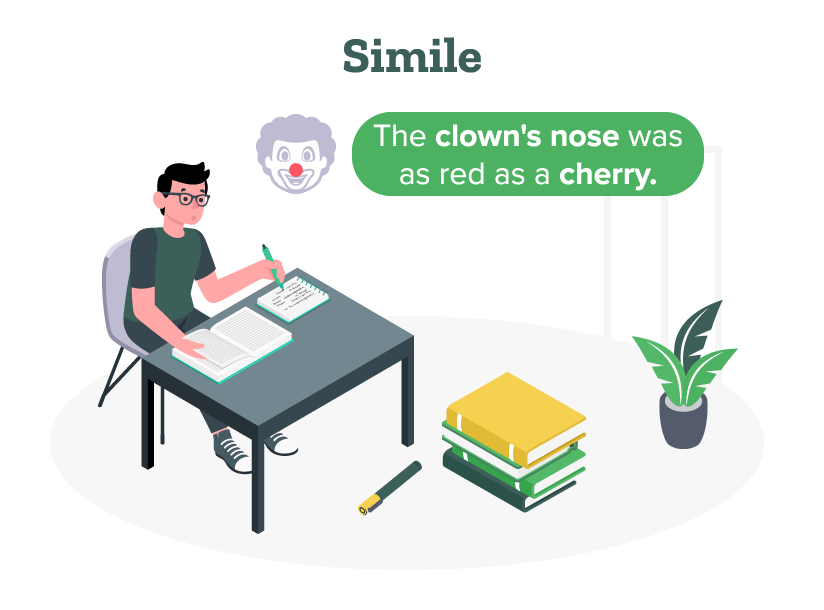
The clown’s nose was as red as a cherry. (clown’s nose and cherry are compared) 

Quick note: To identify similes, just analyze if two concepts are compared using “like” or “as”! 

So how are similes different from metaphors? Let’s find out! 

Simile vs. Metaphor 

While similes have the words “like” or “as” to compare two concepts, metaphors don’t use “like” or “as” to compare two things. 

The following 3 metaphor examples explain this! 

My little sister is a bouncing ball of energy. (sister and ball are compared) 

The sun is a giant ball of fire in the sky. (sun and giant ball are compared) 

The library is a treasure chest full of stories. (library and treasure chest are compared) 

In the above metaphor examples, two concepts are compared without using “like” and “as”. 

Six best examples of similes in literature 

Here are the top examples of similes in literature: 

1. The chocolate river flowed like a river of molten gold. – Charlie and the Chocolate Factory by Roald Dahl

2. Her smile was as bright as the sun, warming his soul. – The Fault in Our Stars by John Green

3. The rain hammered on the roof like a thousand tiny drums. – To Kill a Mockingbird by Harper Lee 

4. The city lights twinkled like fireflies in the night. – The Great Gatsby by F. Scott Fitzgerald

5. The wind howled like a banshee, tearing at the windows. – Dracula by Bram Stoker 

6. The moon hung like a silver coin in the black velvet sky. – The Lord of the Rings by J.R.R. Tolkein.

To understand how to use similes, the next section explores useful dos and don’ts! 

Common dos and don’t while using similes 

It’s important to use similes that are relevant to the subject and setting. For example, you can use sea-related similes for a sailor and cooking-related similes for a chef. 

Here are some other dos and don’ts to follow while using similes. 

Dos 

      • Use comparisons that are easy to understand and relate to. 
      • The two things you’re comparing should have a clear connection. 
      • Avoid overused comparisons like “as white as snow” or “as strong as an ox”. 

Don’ts 

        • Don’t use similes to explain the obvious. 
        • Don’t use similes that are too far-fetched and exaggerated. 
        • Don’t use the same comparison multiple times in your work.

When to use simile in writing? 

Similes should be used sparingly in writing to create impact. The target audience and purpose must be considered while using similes. Following are the contexts where similes can be used: 

        • Creative writing: Similes are fantastic for fiction, poetry, and even creative non-fiction. 

For example, “The old, wooden swing creaked gently, like a tired sigh, as it swayed back and forth in the breeze.” 

        • Descriptive writing: When you want to explain the features of a scene or object and help readers visualize what you’re describing. 

For example, “The old, wooden swing creaked gently, like a tired sigh, as it swayed back and forth in the breeze.” 

        • Explanatory writing: Similes can explain complex concepts by comparing them to something familiar. This can be helpful in essays, articles, or even technical writing. 

For example, “The vapor rises into the sky, just like a balloon floating upwards. Up in the cold air, the vapor turns back into water droplets, forming clouds.” 

        • Persuasive writing: Similes can be used to make your arguments more persuasive by appealing to the reader’s emotions and understanding. 

For example, “Saving money is like planting a seed for your future. It might seem small now, but it can grow into something amazing.” 

When to avoid simile in writing? 

Writers often avoid using similes when discussing sensitive issues and writing about history. This is because incorrectly used similes can upset readers or make serious topics seem less important. Also, they might make the writer seem less trustworthy or knowledgeable. 

Let’s see some other scenarios where similes are avoided:  

        • Formal writing: In academic writing, technical reports, and other formal writing, similes can sometimes be seen as too informal or subjective. Stick to clear, concise language.
        • Technical writing: When writing about technical subjects, focus on precise language and avoid figurative language that could be misinterpreted.
        • When clarity is crucial: If you’re writing instructions, legal documents, or other materials where clarity is essential, stick to literal language and avoid similes that might add ambiguity.

To conclude, similes are a useful device to make writing more creative and engaging. Now, you can use similes to elevate your writing. 

After you complete writing, you’ll need to thoroughly check your text for errors. This involves correcting spelling and grammar mistakes, editing long, complex sentences, improving word choice, and proofreading for minor errors. 

If you want your text to be edited by trained language specialists, consider PaperTrue’s editing and proofreading services. Whether you wish to edit and proofread short stories, essays, theses, dissertations, research papers, or any other text, we can help! 

Here are some useful resources for you:

Persuasive Writing Guide: Techniques & Examples

Are you a student who needs to write persuasive essays? Or are you someone who works in a field that requires you to persuade people to take action or convince them about something? In both cases, you might benefit from learning what persuasive writing is and how to use it for success.  

In this article, we explore the definition of persuasive writing and get some persuasive writing tips to improve your writing style. 

Need persuasive writing support? Explore our editing services.

What is persuasive writing? 

Persuasive writing is a style of writing that focuses on convincing the reader to agree with a specific opinion or point of view or take a particular action. This form of writing is common in advertising, essays, opinion pieces, and speeches. 

It enables the writer to take a clear stand on a given topic. Once the writer takes a stance, they state their opinion and set the tone for the rest of the content. The persuasive writing style relies on logical reasoning and facts (data, statistics, expert opinions, anecdotes, etc.) to ensure the argument sounds believable and cogent.

Elements of persuasive writing

To achieve the chief goal of persuasive writing, which is convincing the reader to accept a given viewpoint, your content should have certain key elements for adequate impact. 

Let us discuss these elements:

      • Convey a strong opinion or idea: Content that follows the persuasive style of writing requires the writer to state their opinions, thoughts, or ideas clearly.
      • Establish the writer’s authority: Content in this form enables the writer to establish their credibility and authority. For example, writers express strong opinions and viewpoints through persuasive essays.
      • Appeal to the readers: When done right, readers engage heavily with such content since it creates a positive impact at a significant level.
      • Present logical arguments: This form of writing involves adding logical statements and arguments that support and strengthen the writer’s viewpoint. 
      • Place facts within the content: When a content piece is fact-driven, it makes for a great persuasive writing example. This is because statistics, data, and expert opinions lend authenticity to it. 
      • State opposing views and arguments: Such content acknowledges and discusses opposing views to negate or nullify them and influence the readers’ views.
      • Strong word choice: Persuasive writing requires the use of expressive, powerful, and stirring words that make readers believe in an idea or urge them to act in a specific manner.

Examples of persuasive writing

In this section, let us study some examples of persuasive writing.

        • Persuasive speech: In the following example, it is evident that the writer aims to encourage people to take action by contributing through donations.

“Imagine a world where everyone has access to clean water. A world where children can go to school without worrying about hunger. A world where people can live their lives free from disease. This is the world we can create by supporting organizations that work to end poverty and inequality.”

“By donating to our organization, you are making a direct impact on the lives of people in need. Your contribution will help provide essential resources, such as food, shelter, and healthcare, to those who are struggling. Together, we can build a more just and equitable world.”

        • A persuasive letter to a friend: In the following example, the writer describes their experience of visiting New York. 

“I had the best time visiting New York last summer. The food was amazing, the people were friendly, and there were so many things to do. You should definitely check out the Statue of Liberty. I’m sure you’ll love it as much as I did. You should visit New York this year!”

Benefits of persuasive writing

Persuasive writing is a powerful tool that can be used to influence readers, change opinions and attitudes, and prompt action. The benefits of employing this writing style can bring about several favorable changes to your content. 

Let us discuss some key advantages of employing this writing style:

        • Critical thinking enhancement: Persuasive writing requires you to analyze information, evaluate arguments, and offer logical reasoning for every idea expressed in a writeup. This can enhance your critical thinking skills.
        • Enhanced communication skills: As a writer, you can connect with your audiences through such writing. Improvement in communication is an important plus, particularly in professional and educational settings where convincing your audience is critical.
        • Confidence and personal growth: Persuasive essays can boost your confidence and help you develop your ability to articulate your thoughts and beliefs well.
        • Decision-making support: Persuasive writing can provide readers with valuable information and different perspectives, helping them make informed decisions.

Techniques to enhance persuasive writing

By now, it is clear that persuasive writing is highly useful in various settings. However, without persuasive writing tips and techniques, it might seem challenging to employ this writing style with flair. 

So here are some persuasive writing techniques that you can use to ensure your content engages its audience and compels them to change their minds or take action. 

        • Organized writing: The writing should be organized to make it easy for the reader to follow every point. Arguments should have a clear introduction, body paragraphs, and a strong conclusion.
        • Compelling expressions: Expert writers often use rhetorical devices such as repetition, rhetorical questions, and parallelism to emphasize their points.
        • Emotional appeal: While facts are crucial here, appealing to the reader’s emotions can be highly effective. Writers often use emotional language or stories to connect with the reader on a personal level.
        • Multiple perspectives: Discussing and addressing opposing viewpoints strengthens the argument. By acknowledging and refuting counterarguments, you can show that you have considered multiple perspectives.
        • Call to action: Persuasive writing accompanied by a call to action is crucial in many cases, particularly when you seek a financial commitment from the readers in response to the idea presented.

Importance of persuasive writing

The persuasive style of writing creates a deep impact on the reader when it is done correctly. Educators, motivational speakers, advertisers, politicians, and many others use it in everyday communication to influence and inspire their audiences. 

Students frequently use it to write argumentative essays, and they can benefit from learning how to write in a persuasive style. 

Let us quickly understand the importance of persuasive writing: 

        • Improves decision-making abilities
        • Builds credibility and trust
        • Drives business success
        • Strengthens critical thinking
        • Encourages engagement and action
        • Enhances communication skills
        • Promotes knowledge sharing
        • Empowers advocacy and social change

Common mistakes in persuasive writing and how to avoid them

Convincing your audience to accept a point of view or think in a specific way is quite tough. When you add the complexity of communicating your message to multiple entities or stakeholders, the problem increases manifold. 

In such cases, persuasive writing can come to your rescue. However, to ensure it is effective, you must steer clear of certain common mistakes. Here are some things you should avoid:

        • Making vague or unclear opening statements, arguments, or thesis statements
        • Offering insufficient or unreliable evidence to support your arguments and claims
        • Ignoring or dismissing counterarguments, leaving matters unaddressed 
        • Relying too much on emotional appeals or ideas
        • Employing a disorganized structure to convey your message 
        • Using an inconsistent or inappropriate tone
        • Generalizing and making sweeping statements
        • Failing to include a clear call to action  
        • Using technical, complex terminology or jargon and overly complex language

Persuasive writing prompts

Here is a list of sample persuasive writing prompts that you can study to independently write prompts:

General 

        • Should schools offer longer school days?
        • Is technology harmful or beneficial to society?
        • Should animals be kept in zoos?

Social issues

        • What are the benefits of diversity?
        • Should there be a minimum wage?
        • Is social media harmful to mental health?

Education

        • Are standardized tests effective in measuring student learning?
        • Is homework beneficial or harmful to students?
        • Are online classes as effective as traditional classroom instruction?

Personal experiences

        • What is the most important value in your life?
        • What is your biggest regret?
        • What is your greatest achievement?

Current events

        • Is artificial intelligence a threat to humanity?
        • Should there be stricter regulations on social media companies?
        • What are the consequences of global warming?

Persuasive writing can make you an influential communicator. By recognizing the power it wields and using it to skillfully convey your message to the intended audience, you can change the minds of not only individuals but also diverse groups. 

For documents that matter, like college admissions essays, you should opt for professional editing and proofreading. You can also benefit from editing and proofreading services for various other documents. PaperTrue, a leading SaaS-based solutions provider, offers artificial intelligence-assisted editing and proofreading. Talk to our team to learn more about our products.  

Want to continue reading? Here are some other articles for you:

What are Clauses? Definition, Meaning, Types, and Examples

If you want to write well, mastering clauses is crucial to enhance the quality of your content. Clauses help build meaningful sentences with a logical structure. Understanding how to correctly use clauses can improve your writing and make it engaging. 

In this article, we will delve into the meaning of clauses and explore the different types of clauses. We will also study some examples of clauses. As a bonus, we will share some tips on how to punctuate sentences with clauses.

Wondering how to improve the quality of your writing? Talk to us!

What are clauses?

A clause is words put together within a sentence that has both a subject and a predicate. The subject, often a noun or a pronoun, carries out the action discussed within the sentence. The predicate comprises the verb and any additional information that tells us more about the action or state of the subject. Together, the subject and the predicate give sentences meaning. 

Clauses primarily belong to two categories: independent and dependent. For effective sentence construction, learning what are clauses, including their types, is crucial. 

Learning about independent and dependent clauses offers valuable insight into sentence construction strategies and styles. This, in turn, helps lay the groundwork for developing advanced writing skills.

What is an independent clause?

Independent clauses, also called main clauses, are self-sufficient. They do not need any additional support in the form of words or phrases to stand independently as a sentence. They carry the central idea, theme, or action in a sentence. 

An independent clause can form a complete sentence. Two or more independent clauses together can help you form and convey more complex ideas. When more than one independent clause is seen in a sentence, it becomes a compound sentence. Conjunctions are used to join two independent clauses in most sentences. 

Examples of sentences with one independent clause:

      • The dog barks. 
      • She danced in the rain. 
      • The sun shines brightly. 

Examples of sentences with more than one independent clause:

        • I love to dance, and she enjoys reading. 
        • Mariah loves to read, but she hates writing essays.
        • Steven studied hard for the exam, so he passed with flying colors. 

Semicolons and colons can also be used to connect two independent clauses. As coordinating conjunctions, they join independent clauses. Here are some examples of this type:

          • I love to read; she enjoys writing.
          • We hiked until the sun began to set: it had been a long day.
          • The sky was a brilliant blue; the ocean glistened in the sunlight.

What is a dependent clause?

Dependent clauses are not capable of communicating the idea or message without a little assistance from an independent clause. Hence, they are also referred to as subordinate clauses. Paired with an independent clause, a dependent clause becomes capable of forming a comprehensible statement. They are called complex sentences.

Some examples of dependent clauses are: 

          • Because I was hungry
          • Although she tried hard
          • When the phone rang
          • Since it was raining
          • Unless you help me

Here is one way to complete these sentences. Note: These statements can be made whole using any other independent clauses as well. 

          • Because I was hungry… (I ate faster than usual.)
          • Although she tried hard… (she could not reach the airport on time.)
          • When the phone rang… (I rushed to answer it.)
          • Since it was raining… (Susan carried an umbrella.)
          • Unless you help me… (I will not succeed.)

Types of dependent clauses

Independent and dependent clauses form the base of sentences. Dependent clauses are further categorized as noun clauses, adjective clauses, and adverb clauses. Let us study them one by one: 

          • Noun clauses: They serve as the subject or object within a sentence, effectively functioning in the same capacity as a noun. Here’s an example: 

“What you said yesterday” can act as the subject in the sentence, “What you said yesterday surprised me”.

          • Adjective clauses: Also called relative clauses, they provide details and add descriptive input to nouns. They give sentences further context and depth. They are introduced by relative pronouns such as “who”, “which”, or “that”. Here’s an example:

“The book, which was lying on the table, is mine,” where the clause “which was lying on the table” modifies “the book”.

          • Adverb clauses: They modify verbs, adjectives, or other adverbs, offering useful information about time, cause, condition, contrast, and manner. They are introduced by subordinating conjunctions like “because”, “although”, or “when”. Here’s an example:

In the sentence “I will call you when I arrive,” the clause “when I arrive” modifies the verb “will call” by specifying the time.

As dependent clauses add detail and intricacy to sentences, they allow you to articulate your ideas and outline relationships between them. Once you know how to recognize and use these different types of clauses, you can develop grammatically correct sentences while effectively adding detail and depth to them.

Essential and nonessential clauses

Let us quickly understand the concept of essential and nonessential clauses in this section. 

Essential clauses: As the name indicates, an essential clause is an expression that holds a sentence together, giving it meaning. Here are some examples:

The book that I borrowed from the library is missing a page.

The clause “that I borrowed from the library” is essential because it states which book is missing a page. Without it, the sentence will be unclear.

People who eat too much sugar are at risk for health problems.

The clause “who eat too much sugar” is essential because it identifies the specific group of people at risk.

Nonessential clauses: These clauses give additional information in a sentence. However, if they are removed, the sentences will still make sense. 

The book, which I borrowed from the library, is a mystery novel.

The clause “which I borrowed from the library” is nonessential because it simply adds extra information about the book. The sentence still makes sense without it.

My dog, who loves to play fetch, is always excited to go for a walk.

“Who loves to play fetch” is nonessential because it describes the dog but doesn’t change the central idea of the sentence.

How to merge clauses?

By correctly combining independent and dependent clauses, you can form cogent sentences to convey a wide range of ideas, thoughts, expressions, opinions, and more. Clauses will enable you to write complex sentences, ensuring your writing becomes informative, detailed, and effective. 

You can combine clauses in the following ways: 

          • Coordinating conjunctions

Words like for, and, nor, but, or, yet, and so can help you combine two independent clauses to form complete sentences. 

Example: 

I wanted to go for a walk, but it started raining.

I love to read, and she enjoys writing poetry.

          • Subordinating conjunctions

Subordinating conjunctions like because, although, since, unless, etc., makes sentences complete and meaningful by introducing dependent clauses.

Example: 

Although it was raining, I went for a walk.

Because it was raining, we decided to watch a movie.

          • Relative pronouns

Who, whom, whose, which, that, etc., are relative pronouns that can be used to link a dependent clause to an independent clause. Together, they can complete sentences.

Example: 

The book that I read was fascinating.

The woman who lives next door is a talented artist

          • Semicolons

When you want to link closely associated independent clauses, you can use semicolons. They can connect two independent clauses that affect each other or show relationships between two ideas. 

Example: 

I wanted to go for a walk; it started raining.

The storm raged through the night; by morning, the town was in ruins.

          • Conjunctive adverbs

Conjunctive adverbs like however, therefore, moreover, consequently, etc., can meaningfully connect two independent clauses, showing cause and effect, contrast, or any other logic-driven connection. 

Example: 

It started raining; therefore, I stayed inside.

The hike was challenging; however, the view from the summit was breathtaking

          • Participial phrases

Participial phrases are words made up with participles along with modifiers, objects, and complements. They give more information about nouns and pronouns in sentences. 

Example: 

Walking through the park, I saw many beautiful flowers.

My favorite book, To Kill a Mockingbird, is a classic of American literature

How to punctuate sentences with clauses?

Learning to correctly use clauses will help you improve your writing skills and create good content only when you correctly punctuate sentences. Here are some common rules to ensure correct punctuation:

          • Dependent clause at the beginning of a sentence: When a dependent clause is used to start a sentence, use a comma after it. For example, “Because I love to write, I spend hours crafting sentences.”
          • Nonessential clauses: Use commas to set off nonessential clauses that add extra information but aren’t crucial to the sentence’s meaning. For example, “My employee, who loves swimming, is always late to work.”
          • Independent clauses: Semicolons, coordinating conjunctions, question marks, and periods are used to punctuate sentences with one or more independent clauses. Here are examples of all four punctuation rules:

Semicolon: I love to write; it’s my passion.

Coordinating conjunction: I love to write, but I also enjoy watching movies. 

Question mark: What is your favorite snack?

Period: I finished painting the garage last evening. 

We hope this article answered the question “what is a clause”, and helps you correctly define clauses. If you’d like a professional review of your work, consider the editing and proofreading services offered by PaperTrue, a leading language solutions provider. 

Also, the following articles can help you improve your writing:

Modifiers: Definition, Meaning, Types, and Examples

Ever thought about how some writers can transform even mundane ideas into vivid descriptions? And would you believe us if we said you can do it too? Yes, you can! The magic lies in the use of modifiers. 

In this article, we explore the meaning of modifiers and study examples of modifiers in grammar. So, read on and improve your language skills and writing competence.

If grammar is holding you back from writing, check our editing & proofreading services.

What are modifiers in a sentence?

The definition of modifiers states that they are words, clauses, or expressions that provide more or additional information about other parts of a sentence. 

Modifiers in grammar enhance the quality of writing by introducing details, descriptions, and additional context about a given idea or theme. Understanding what is a modifier in a sentence is essential for effective communication.

Sentence modifiers are words or phrases that modify nouns, pronouns, verbs, adjectives, or adverbs in a sentence. They can be adjectives or adverbs that describe the main elements in a sentence. 

Modifiers help clarify or emphasize certain aspects of a sentence by drawing attention to them through words or phrases that describe them. They can even limit the meaning of other words in a sentence by defining a specific aspect in it. 

Let us see an example below:

I ate the sandwich.

I devoured the delicious ham and cheese sandwich on toasted rye bread.

Compared to the first sentence, the second one gave additional information about the sandwich and how it was eaten. It gave more information to the reader when the word “delicious” was added as a modifier. It is important to understand that the sentence (I ate the sandwich) was complete without the modifier.  

How do modifiers work?

Modifiers add detail, description, or emphasis to other elements in a sentence. They typically improve the meaning or tone of a sentence or highlight specific parts of a sentence, making them more interesting than before. 

Let us see some examples of modifiers to understand how they work. 

Study the following sentence:

      • The tall man quickly ran to catch the bus.

The modifiers “tall” and “quickly” provide additional information about the man and how he ran toward the bus to board it. 

Here are some more examples of modifiers in a sentence:

        • Time: She arrived later than expected.
        • Place: They walked down the street.
        • Degree: She was extremely happy.
        • Manner: He spoke softly and clearly.
        • Opinion: The delicious cake disappeared quickly.
        • Color: The red car sped down the street.
        • Size: The enormous dog wagged its tail.
        • Quantity: Several birds flew overhead.
        • Frequency: I exercise regularly.
        • Demonstrative: This book is a great read.
        • Possessive: My brother’s new haircut looks sharp.

In the next section, we will learn about the types of modifiers.

Types of modifiers

We are sure you have seen modifiers all the time in written content, but they may be difficult to identify sometimes. In this section, we will see the different types of modifiers and study corresponding examples to understand the concept in detail. 

        • Adjectives: Adjectives work perfectly as modifiers due to their inherent grammatical attributes. They modify nouns or pronouns by describing or limiting them.

Example: The red apple. (“Red” is an adjective that acts as a modifier in the sentence.)

        • Adverbs: They modify verbs, adjectives, or other adverbs by describing how, when, and where. 

Example: She ran quickly. (“Quickly” is an adverb that acts as a modifier in the sentence.)

        • Articles: Definite (the) and indefinite (a, an) articles are modifiers that specify or enhance the noun.

Example: The dog barked. (“The” is an article that acts as a modifier in the sentence.)

        • Prepositional Phrases: When you start with a preposition and end with a noun or pronoun, you can modify another word in the sentence.

Example: She sat on the chair. (“On the chair” is a prepositional phrase that acts as a modifier in the sentence.)

        • Participial Phrases: When you begin with a participle, you can modify nouns or pronouns.

Example: The man wearing a hat is my uncle. (“Wearing a hat” is a participial phrase that acts as a modifier in the sentence.)

        • Infinitive Phrases: By starting your sentence with an infinitive (to + verb), you can modify nouns, pronouns, or verbs.

Example: She has a book to read. (“To read” is an infinitive phrase that acts as a modifier in the sentence.)

        • Gerund Phrases: You can modify other parts or elements in a sentence by beginning with a gerund (verb + ing) that function as nouns.

Example: Swimming in the ocean is fun. (“Swimming in the ocean” is a gerund phrase that acts as a modifier in the sentence.)

        • Appositives: Noun or noun phrases that rename or explain another noun act as modifiers.

Example: My friend Alice, a brilliant artist, will join us. (“Alice” is an appositive that gives more information about “a brilliant artist” and acts as a modifier in the sentence.)

        • Relative Clauses: Begin with a relative pronoun (who, whom, whose, which, that) and provide more information about a noun, which acts as a modifier.

Example: The book that I borrowed was fascinating. (“That I borrowed” is a relative clause that acts as a modifier in the sentence.)

What are dangling and misplaced modifiers?

Now that we know how modifiers work, let us delve into their incorrect use. When modifiers are incorrectly used in a sentence, they are called dangling or misplaced modifiers, depending on where they have been placed in a sentence.

1. Dangling modifiers: These are words or phrases that fail to indicate what is being modified in a sentence. They do not clearly and logically relate to the word, clause, or phrase they are intended to modify. Naturally, this creates confusion because the modifier appears to be describing the wrong noun or a noun that is not explicitly part of the sentence. Some examples of dangling modifiers:

          • Running late, the meeting was postponed. (Who was running late? The meeting can’t run late!)
          • Exhausted after the long hike, a delicious meal awaited us at the cabin. (Who was exhausted? The meal wasn’t exhausted!)

2. Misplaced modifiers: These are words placed considerably far away from the noun they are supposed to describe. This misplacement results in the unintentional modification of other part/s of a sentence instead of the noun, verb, or adverb they are required to modify. 

          • The mail carrier, wearing a bright red uniform, delivered the package to the wrong house. (Was the house wearing the uniform?)
          • We spotted a deer while hiking through the forest, with magnificent antlers. (Did the forest have antlers?)

How to identify modifiers in a sentence?

To identify modifiers in a sentence, look for words, clauses, or phrases that provide additional information about other expressions or parts of the sentence. Adjectives and adverbs are commonly seen acting as modifiers. 

Phrases that function as modifiers can be placed before or after the word they modify. Focus on words that answer questions like “how”, “when”, “where”, or “how much”, as these are often modifiers.

By paying attention to modifiers and their placement in a sentence, you can enhance the meaning and impact of your writing.

Ready to use modifiers then? They are powerful tools in writing through which nuance and detail become noticeable in your writing. By incorporating them skillfully, you can make your content more compelling and your ideas more impactful. 

If you feel unsure about your writing, seek editing and proofreading services like those offered by PaperTrue. Our editors can help you improve your manuscript, research paper, or any other written material and make it precise and appealing. 

Here’s a list of some other articles that you might find helpful: 

The Ultimate Guide to Phrases In English – Types & Examples

Phrases, a key part of language and grammar, greatly impact the effectiveness of writing. They help form meaningful expressions, providing clarity and depth to our thoughts and ideas. As they are essential tools for effective writing, learning the meaning of phrases is important for improving writing skills. 

If you often find yourself struggling with how to use phrases in sentences, this article can help. We will study the definition of a phrase and the types of phrases, along with the differences between clauses and phrases.  

Are grammar issues troubling you? Don’t worry. Explore our services!

What is a phrase? 

A phrase is a group of words placed together to convey a specific meaning, but it does not make a full sentence that can stand on its own. Unlike a complete sentence, it does not have a subject and a predicate. 

Phrases are single expressions within sentences. They typically appear in the form of nouns, adjectives, or adverbs in sentences. They add detail and nuance to sentences, provide additional information or context, and enhance the overall meaning of sentences. 

Using them correctly improves the quality of writing and makes your work engaging. To use them well, you must understand the types of phrases and how phrases are used in sentences. Let us first look at their types. 

Types of phrases

Based on the function they perform in a sentence, phrases can be classified into certain types. These are called grammatical phrases because they work as a single unit in a sentence. Here are the types of grammatical phrases:

1. Noun Phrase

A noun phrase is an expression or a group of words that acts as a noun in a sentence and gives more information through modifiers.

      • The big, red apple is juicy.
      • Running in the park is fun.
      • A group of noisy children played tag.

2. Verb Phrase

A verb phrase is a group of words that functions as a verb in a sentence and consists of a main verb and one or more auxiliary verbs.

        • She has been studying all night.
        • They will have finished by tomorrow.
        • I could have gone to the party.

3. Adjective Phrase

It is a group of words that acts as an adjective and describes a noun or pronoun.

        • The house with the green shutters is charming.
        • The woman wearing the red hat is my aunt.
        • He is a man of great intelligence.

4. Adverb Phrase

Such phrases modify a verb, an adjective, or an adverb, giving more information about a verb, an adjective, or another adverb.

        • They walked very slowly to the store.
        • The bird sang with great joy.
        • She arrived at the party late.

5. Prepositional Phrase

These expressions begin with a preposition and end with a noun or pronoun

        • The book is on the table.
        • I went to the store.
        • She lives in a big house.

6. Participial Phrase

It begins with a participle (verb ending in -ing or -ed) and functions as an adjective.

        • Smiling happily, she greeted her friends.
        • Tired from the long journey, they rested.
        • Written in clear language, the book was easy to understand.

7. Infinitive

Such phrases use “to” plus a verb and act as a noun, adjective, or adverb in a sentence, enhancing its meaning.

        • To succeed in life, you need to work hard.
        • I want to eat ice cream.
        • It is important to be honest.

8. Gerund

When verbs are used in their -ing form, a gerund is formed. If it functions as a noun in a sentence, it is called a gerund phrase.

        • Studying hard is essential for success.
        • I enjoy listening to music.
        • Walking the dog is my daily routine.

Using phrases in these forms, you can create sentences that add meaning, detail, or emphasis to a given idea.

The other type is common phrases. They are:

        • Proverbs offer wisdom or advice. They enhance the impact of a message when they are used as phrases.

Example: “An apple a day keeps the doctor away.”

        • Figures of speech use figurative language for effect. They create dramatic, poetic, humorous, or other forms of effects to make writing more interesting. 

Example: “He’s as strong as an ox.”

        • Adages are similar to proverbs, often expressing general truths. They have the power to move the readers and influence them when used correctly in a sentence.

Example: “You can’t teach an old dog new tricks.”

        • Sayings are general expressions or remarks. They help form strong sentences and can work wonders in persuasive writing.

Example: “Easy come, easy go.”

Though our focus in this article is “phrases in English”, it is interesting to note that various cultures and languages around the world have developed phrases unique to their regional and local lifestyles and practices.

Examples of phrases in literature and other forms of writing

Literature shows you the most magical use of phrases in a sentence like no other writing form can! In this section, let us see some examples of how phrases can be used to paint a picture for the reader.

        • Descriptive Imagery: It helps readers visualize the scene or situation by painting a detailed picture of what is happening. 

“The sky was a deep, inky black, punctuated by the diamond-like twinkle of stars.”

        • Metaphor: They compare two unrelated ideas to show that one thing is another or vice versa. 

“All the world’s a stage, and all the men and women merely players.” — William Shakespeare, As You Like It.

        • Personification: Personification gives human qualities to non-human elements, building a highly relatable and engaging narrative.

“The wind whispered through the trees, telling secrets to those who would listen.” 

        • Parallelism: Parallelism is used to emphasize contrasting, complementing, or related ideas using similar grammatical structures, enhancing the impact of the writing.

“It was the best of times, it was the worst of times, it was the age of wisdom, it was the age of foolishness…” — Charles Dickens, A Tale of Two Cities.

        • Alliteration: Alliteration, the repetition of consonant sounds, can make phrases more memorable as they become rhythmic.

“She sells seashells by the seashore.”

        • Irony: Irony highlights the contrast between expectation and reality, often through a layer of humor or sarcasm.

“The fire station burned down.”

        • Simile: Similes compare two things using “like” or “as,” making the description more vivid and relatable.

“Her smile was like sunshine, brightening even the darkest day.” 

        • Hyperbole: Hyperbole is an exaggerated statement used for emphasis or effect; it is not meant to be taken literally.

“I’m so hungry I could eat a horse.” 

        • Symbolism: Symbolism is the use of objects, characters, figures, or colors to represent abstract ideas or qualities. 

“The green light at the end of Daisy’s dock.” — F. Scott Fitzgerald, The Great Gatsby.

        • Oxymoron: Oxymorons combine contradictory terms to create a striking and thought-provoking effect.

“Bittersweet memories.” 

        • Foreshadowing: Phrases that suggest that certain events might happen in the future are written as part of a literary technique called foreshadowing. 

“The leaves fell early that year.” — Ernest Hemingway, A Farewell to Arms.

        • Antithesis: Antithesis contrasts two ideas in a parallel structure, highlighting the difference and creating a memorable impact. 

“One small step for man, one giant leap for mankind.” — Neil Armstrong.

        • Euphemism: A euphemism is a mild, soft, or indirect expression or word that acts as a substitute for one considered harsh, blunt, or offensive.

“She was let go from her position”.

How to use phrases in sentences?

We know that a phrase cannot complete a sentence on its own. A phrase in a sentence forms part of the sentence, but a subject, a predicate, or both (in most cases) do not accompany it, making the sentence incomplete. 

For example, study the following sentence: 

“The dog under the table is sleeping.”

The phrase “under the table” adds detail about where the dog is located, but it cannot function as a complete sentence on its own. 

So, how do we use phrases in sentences then? Here’s a guide to using them:

        • Identify the purpose of the phrase: Ascertain the role a phrase plays in your sentence. Is it describing a noun, an action, an attribute, or the circumstances of an action? To arrive at the purpose, ask the right questions based on what the group of words are likely to describe, modify, or emphasize. 
        • Place the phrase appropriately: Depending on the type of phrase, place it where it seems to logically belong in the sentence. Typically, this means placing it close to the place, thing, situation, or characteristic it describes.
        • Ensure sentence completion: When you add a phrase, verify that the sentence is complete even without the addition. This means the phrase only makes the sentence richer than before but does not alter its meaning. 

Let us see some examples of phrases: 

The old man walked slowly.

          • Phrase: “The old man”
          • Question answered: Who walked slowly? (Subject)

She is reading a book.

        • Phrase: “a book”
        • Question answered: What is she reading? (Object)

The movie was quite interesting.

        • Phrase: “quite interesting”
        • Question answered: How was the movie? (Complement)

They arrived early in the morning.

        • Phrase: “early in the morning”
        • Question answered: When did they arrive? (Adverbial phrase)

The cat under the bed is scared.

        • Phrase: “under the bed”
        • Question answered: Where is the cat? (Prepositional phrase)

Differences between clauses and phrases

Both clauses and phrases are expressions or groups of words used to add detail, emphasis, and information to a sentence, but they differ in structure and function.

Here are the key differences between them: 

Clauses

          • Structure: A clause contains both a subject and a verb, making a complete idea or thought.
          • Function: Clauses can stand alone as a sentence or function as part of a larger sentence.

Types:

      • Independent clauses: These express a complete idea or action and can stand alone as a sentence.
      • Dependent clauses: These do not express a complete thought and require an independent clause to make sense.

Phrases

                  • Structure: A phrase lacks a subject-verb pair, making it incapable of standing alone as a complete sentence.
                  • Function: Phrases in English modify or add to the meaning of a sentence.

Types: 

        • Grammatical phrases: These include types like noun, adjective, adverb, verb, etc., based on the role a phrase plays in a sentence.
        • Common phrases: These are typical expressions or expressions used together to convey a message.

The importance of phrases in English cannot be exaggerated. They enhance the clarity, depth, and impact of thoughts and ideas. We discussed several key aspects of phrases in this article and explained how to use them in sentences. By mastering the use of phrases, you can give power to your words.

If you need professional editing support after your article, novel, or research paper is complete, consider PaperTrue’s editing and proofreading services. Our editors will refine your document and help you prepare it for the next step. 

To read more grammar articles, click the links below:

The 10 Best Business Editing Services You Should Consider!

Ever felt like you need an expert to look at your content to ensure it sounds relevant and professional? What you might need in such cases is an editor offering business editing services. 

Business editing services focus on refining and enhancing written content intended for use in a professional context or setup. Such editing involves a detailed review of various documents to ensure they are clear, concise, and effective. 

In this blog, let us look at ten popular business editing services that can help you create professional documents like reports, business plans, marketing literature, business proposals, and business letters, among others.

Here are the top 10 business editing services: 

  1. PaperTrue
  2. Proofed
  3. Scribendi
  4. Wordvice
  5. EditorWorld
  6. ProofreadNOW.com
  7. Scribbr
  8. ProofreadingPal
  9. FirstEditing
  10. Cambridge Proofreading

Business editing looks challenging. Not anymore! Explore our services.

Top 10 business editing services

In the business world, effective communication is key. The 10 business editing services listed below can help you refine your message and make a lasting impression. 

Let’s take a quick look at each of these services.

1. PaperTrue

PaperTrue offers comprehensive editing and proofreading with a focus on clarity and error elimination. Known for our global reach and pricing in many commonly used currencies, we recently launched artificial intelligence-assisted editing and proofreading services. 

Whether you need website content, marketing materials, reports, or any other document edited and proofread, we can do it for you. Our easy ordering process will ensure you can place an order in no time. We also provide plagiarism checks as an additional service, making it a strong option for academic and professional documents.

Pricing: It starts at $8 and is quoted based on the word count of your document and your delivery needs.

2. Proofed

Proofed provides editing and proofreading services for a wide range of documents, from academic papers to business reports. 

With a large team of editors, Proofed offers quick turnaround times and services like grammar correction, fact-checking, formatting, etc. The company can assign a team of editors for all your business needs.

Pricing: It starts at $30 for 1000 words under their pay-as-you-go services. However, they also offer subscription services starting at $100 per month. 

3. Scribendi

Scribendi is an industry leader with over 25 years of experience. It provides both editing and proofreading services with fast turnaround times. The editors at Scribendi will take care of every aspect, including tone, style, and clarity. 

With its versatile service offerings, it handles academic, business, and personal documents.

Pricing: It depends on the word count and delivery times you choose while placing your order. For a 1000-word document returned within 8 hours, Scribendi charges around $70. 

4. Wordvice

Known for its specialized academic editing, Wordvice also caters to business professionals. Their business editing services help refine content for websites, reports, brochures, blogs, and any other business document you need. 

The company emphasizes quality and speed, making it a good choice for your urgent editing needs.

Pricing: It depends on the document type, word count, and delivery time. For a 1000-word business document that’s delivered within 7 days (168 hours), the charge is $44. 

5. EditorWorld

This business editing service offers editing and proofreading for various document types, including academics, books, fiction, etc. All editor profiles are visible on their website, and you can select an editor or proofreader based on your needs.  

EditorWorld’s service is known for its transparency and quality. 

Pricing: Delivery times, word count, and service type are key factors that determine the price you will be charged. For example, a 1000-word document delivered within 8 hours entails a fee of around $53. 

6. ProofreadNOW.com

Focused on providing high-quality copyediting and proofreading services for your business documents, this platform uses a two-proofreader model to ensure thorough reviews. 

It is particularly popular among business professionals interested in polishing their reports and marketing materials. They can handle websites, marketing brochures, advertising materials, business proposals, etc. 

Pricing: Starting at $25, prices depend on turnaround time, type of editing, language (English and Spanish), and number of pages. General editing of a 500-word document within 30 minutes costs $66. 

7. Scribbr

Scribbr combines artificial intelligence and human expertise to provide quality editing and proofreading services. It specializes in academic documents and offers additional services like plagiarism checks and structure reviews.

It also has service options like citation editing, paper formatting, and clarity checks. 

Pricing: Starting at $25, the final price depends on the word count and turnaround time. A 1000-word document returned (edited and proofread) within 7 days costs about $42.

8. ProofreadingPal

ProofreadingPal offers a two-proofreader model, with many of its proofreaders holding high educational qualifications like doctorates and masters. With 24/7 support, this business editing service is known for its thoroughness. 

Its services include editing and proofreading business documents and academic papers. 

Pricing: The website gives custom quotes based on your editing and proofreading needs. A business document of 1000 words returned within 7 days costs around $27 if the two-proofreader model is selected. For review by a single proofreader, you will be charged about $21. 

9. FirstEditing

Known for its extensive range of services, FirstEditing caters to businesses, researchers, and authors. It focuses on ensuring clarity, consistency, and overall readability.

In addition to business editing, it offers fiction and academic editing services, copy editing, editorial critique services, editing consultation, and many other services. 

Pricing: You will be asked to fill out a Google form specifying your business editing needs to get a quote. 

10. Cambridge Proofreading

While Cambridge Proofreading is well-known for its academic editing, it also offers business editing services. With its secure and confidential services, you can consider this trusted option for your sensitive business documents.

It has a one-editor premium service, which includes grammar and punctuation correction and structure, style, and clarity revisions. The two-editor advanced service provides reviews from two senior editors. 

Pricing: A 1000-word document with a turnaround time of 7 days costs around $24 if you use the company’s one-editor premium service. The same document will be charged at $48 for a two-editor advanced service. 

Self-employed professionals, employers, executives, and many others frequently require business editing for important documents. Selecting the wrong business editing service can cost you a lot in terms of time and reputation. 

Use this guide to contact the best business editing service providers and ensure your document conveys the meaning you want it to send out to your audience. PaperTrue can assist you if you are looking for editing for your business documents

Our editors are trained to work on business documents (web content, blogs, sales proposals, marketing materials, and more).

Want to keep reading? Here are some other articles that might interest you: 

What Is a Complement in a Sentence? (Meaning, Types & Examples)

Want to write better sentences using complements? This blog includes all the basics of complements. From the complement meaning to the types, we’ve explained everything! 

We’ve added examples for all types to help you understand complements better. With this, we’ve also included basic rules to use complements. 

Let’s quickly start with a simple complement definition! 

Get error-free text with high-quality editing services!

What is a complement in a sentence? 

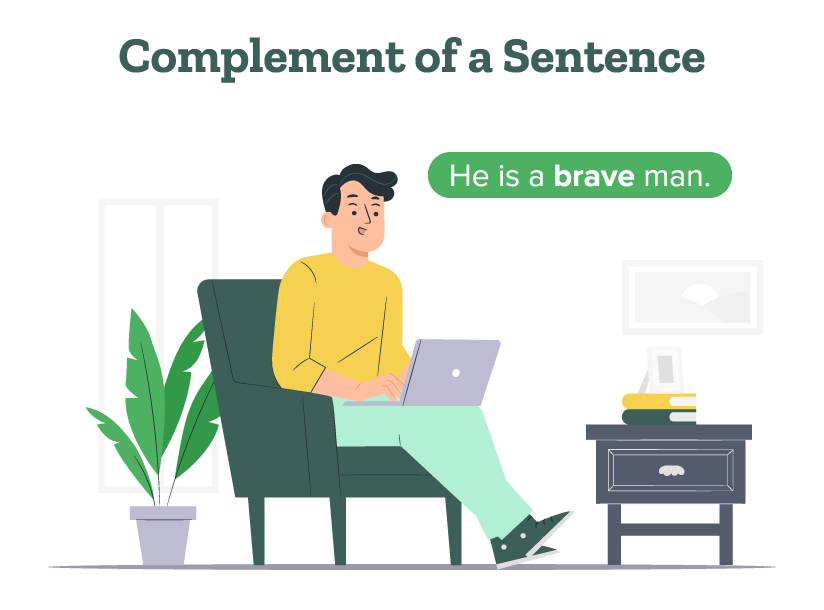
A complement is a word or phrase that provides additional information about the sentence’s subject or verb. They help to provide clarity and complete the meaning of the sentence. 

Here are some complement examples to understand better: 

The child became the center of attention at the party. (center of attention  – complement) 

The old man was mysterious to the villagers. (mysterious – complement)

Following are the two types of complements: 

1. Subject complement 

2. Object complement 

Let’s understand these types in detail in the next section! 

Types of complements 

1. Subject complement 

Subject complements are words that follow linking verbs and provide more information about the subject. 

Some subject complement examples are: 

The sky is blue. (is- linking verb, blue- subject complement) 

The purse looks beautiful. (looks- linking verb, beautiful- subject complement) 

In these examples, the words “blue” and “beautiful” are predicate adjectives. An adjective that describes subject of a sentence is a predicate adjective. 

Now let us look at other examples to understand another type of subject complement! 

She is a teacher. (is- linking verb, teacher- subject complement) 

They became doctors. (became- linking verb, doctors- subject complement) 

In the above examples, “books” and plums are examples of predicate nouns. When nouns describe the sentence’s subject, they are known as predicate nouns. 

Now let us browse through the following examples to understand the third type of subject complement. 

The person who inspired me the most was she. (was- linking verb, she- subject complement) 

The culprit behind the mysterious events turned out to be them. (be-linking verb, them- subject complement) 

In these sentences, “she” and “them” are examples of predicate pronouns. Any pronouns that 

describe the subject are known as predicate pronouns. 

After seeing what is a subject complement, let’s see some rules to use them. 

Important pointers while using subject complements 

a. Subject complements must always follow a linking verb: Subject complements always follow a linking verb, such as “is,” “am,” “are,” “was,” “were,” “be,” “being,” “been”, etc. 

b. Subject complements must agree with the subject: This means that if the subject is singular, the complement’s form should also be singular. In contrast, if the subject is plural, the complement should also be plural. 

For example: 

They are teachers. (are- plural, teachers, plural) 

The culprit turned out to be him. (be- singular, him- singular) 

How to identify subject complements? 

Following are the steps to identify subject complements: 

      • Look for the noun or pronoun that performs the action or is being described in the sentence (subject of the sentence). 
      • Check if the sentence has a linking verb like “is,” “am,” “are,” “was,” “were,” “be,” “being,” “been,” “become,” “seem,” “appear,” “feel,” “look,” “smell,” “sound,” “taste,” “turn,” etc. 
      • Ask questions to identify the subject complement. For example: 

The flowers are beautiful. (What are the flowers? Beautiful.)

John is a doctor. (Who s John? A doctor.)

Now let us understand object complements in detail! 

2. Object complement

Object complements are used to describe, rename, or complete the meaning of the direct object. The direct object is the noun or pronoun that is directly affected by the action in the sentence. 

Here are some examples of object complements: 

They elected him president. (president- object complement, him- direct object) 

The committee named her the winner. (the winner- object complement, her- direct object) 

In the above examples, the words “president” and winner” are nouns that describe the direct objects “him” and “her”. The nouns that describe the object in the sentence are known as object predicate nouns. 

Now, let us see more object complement examples to understand them better!  

The news made him happy. (him-direct object, happy-object complement) 

She found the book interesting. (the book- direct object, interesting- object complement) 

In the above examples, the words “happy” and “interesting” are adjectives that describe the direct objects “him” and “book”. The adjectives describing the object in the sentence are object predicate adjectives. 

After understanding what is an object complement, let’s see some rules on how to use them! 

Important pointers while using object complement 

1. Object complements are not set off by commas: There is no comma between the direct object, verb, and the object complement in a sentence. For example: 

She thought the man was crazy. (man-direct object, crazy-object complement) 

In the above sentence, there is no comma between the direct object “man” and the adjective complement “crazy”. 

2. Object-complement agreement: If the direct object is singular, the object complement should also be singular; if the direct object is plural, the object complement should be plural. For example: 

She made him the coach. (him- direct object, singular, coach- object complement, singular) 

Robert called all players champions. (players- direct object, plural, champion- complement, plural) 

How to identify object complements? 

Following are the steps to identify object complements: 

        • Find the verb and the direct object in the sentence.
        • Look for a noun, pronoun, or adjective placed near the direct object that provides additional information about it.
        • Ask yourself, “What is the direct object being renamed, identified, or described as?”

We hope this article has resolved all your doubts about: “What are complements?” You can bookmark this article for future reference about the complement of a sentence. With this, you can also make a list of complement examples of every type. 

Along with complements, there are also other important concepts for writing like parts of speech, sentence structure, punctuation marks, etc. These elements enhance the sentence’s meaning and provide clarity about the subject and object. Hence, it’s important to use them carefully while writing. 

Once you complete writing, the next step is to edit your text. As experts in editing and proofreading services, we’d love to help you enhance your text! 

Here are some useful resources: 

A Simple 14-Point Self-Publishing Checklist for Authors

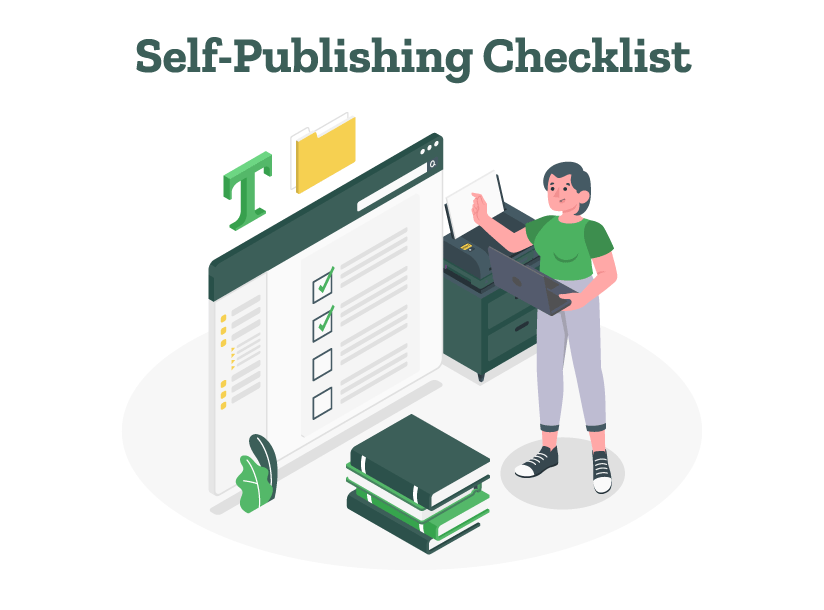
Self-publishing involves a lot of steps like editing, getting a book cover designed, and deciding your book’s pricing. We realize how planning to self-publish can be overwhelming. To help you plan, we’ve created a simple checklist of 14 self-publishing steps. 

In one of the sections below, we’ve also given a simple, downloadable checklist with estimated timelines for every step. So without any delay, let’s first see these steps for self-publishing! 

      • Self-editing
      • Conduct market research 
      • Get professional editing done 
      • Get a book cover designed 
      • Ensure proper book formatting 
      • Obtain an ISBN for your book 
      • Create an author profile, author bio, and book description
      • Write or get a copyright page designed 
      • Opt for book conversion and distribution services 
      • Craft your book blurb
      • Decide your book’s pricing 
      • Finalize marketing strategies 
      • Upload your book on self-publishing platforms 
      • Book promotion (Important checklist!) 
      • Self-publishing timeline checklist (Downloadable) 

Now let’s see a checklist for every step in detail! 

Your book deserves the best – get professional self-publishing services!

1. Self-editing 

It’s important to take a break after completing your first draft before self-editing. This allows you to revisit your text with a fresh perspective.

        • Check and correct any plot holes, inconsistencies, and pacing issues. 
        • Determine if the characters and scenes are well-developed and accurately portrayed. 
        • Verify if the timelines and facts mentioned are correct. 
        • Analyze if the writing style, tone, flow, and structure are consistent. 
        • Review the book for spelling, punctuation, and grammar errors
        • Give your book to alpha readers and make changes as per their feedback. 

Once your first draft is complete, you also need to select a book title. After selecting the title, you can move to the next step. 

2. Conduct market research 

At this step, perform research to create a book description, author bio, and author profile. You can also take inspiration from the best book covers to get ideas for your book cover. Here’s a simple checklist for this step: 

        • Save or note down book descriptions, author bios, and author profiles similar to your book genre (For this step, check the author profile and book description of books in the same/similar categories on the book’s Amazon page.) 
        • Save the best book covers related to your genre for reference. 
        • Check the books’ back covers for ideas for author bios. For some books, check the book’s last page or inner part of the hardcover for the author bio. 
        • Create a list of keywords related to your genre. 

With this, you also need to conduct market research about self-publishing costs. This involves comparing the prices and features of various editing, formatting, book cover design, and self-publishing companies. You must also determine the budget for creating a copyright page, blurb, author profile, book description, author bio, ISBN, book conversion, distribution, and marketing. Once you’re done with this, you can move to the next step! 

3. Get professional editing done 

After selecting the best editing services, follow these steps after receiving the edited manuscript: 

        • Analyze if the manuscript has improved clarity, coherence, and overall readability.
        • Check for consistency in style, tone, and formatting. 
        • Ensure all grammar, spelling, and punctuation errors are rectified. 
        • Verify that the editor’s suggestions align with your point of view and intentions. 

4. Ensure proper formatting 

Once you choose a book formatting service, you need to check the following after receiving the formatted manuscript: 

        • Proofread the entire book for any formatting errors. 
        • Check consistency in fonts, font sizes, margins, and spacing.
        • Verify the accuracy of the table of contents and page numbers.
        • Ensure all hyperlinks and footnotes are working correctly (for eBooks). 
        • Review the visual quality of images and graphics.

5. Get a book cover designed 

You can either design a book cover or hire a freelancer/book cover design services. Once your book cover is ready, you need to ensure the following: 

        • Assess whether the cover design is eye-catching and memorable
        • Check that the title, subtitle, and author name are clearly legible
        • Determine if the font and font size used are correct
        • Assess the quality and resolution of any images, illustrations, or graphics used
        • Verify that the cover design meets the technical requirements of your chosen publishing platforms (e.g., Amazon Kindle Direct Publishing, IngramSpark)
        • Ensure you have received the necessary file formats from the designer (e.g., JPG, PNG)

6. Obtain an ISBN for your book 

At this step, you can get an International Standard Book Number (ISBN) through local or government agencies or self-publishing companies. Several platforms like PaperTrue, BookBaby, IngramSpark, and Draft2Digital can help you get an ISBN. After this, you need to ensure the following: 

        • Check if the ISBN is 13 digits. 
        • Verify if the prefix is 978 or 979 for the 13-digit ISBN. 
        • Analyze whether the ISBN matches the specific book, edition, and format. 
        • Ensure the ISBN contains only valid characters (digits 0-9, and ‘X’ for ISBN-10). 
        • Cross-reference the ISBN with official sources or databases. 

7. Create an author profile, author bio, and book description  

You can hire a publishing company/ freelancer to do this for you. Alternatively, you can create one on your own. For all three steps, follow the checklist given below! 

a. Author bio 

        • Keep it concise and engaging (aim for 100-200 words). 
        • Include relevant professional achievements, awards, writing, experience, or credentials.
        • Mention any personal details that help readers connect with you.
        • Use a third-person point of view for a professional tone.
        • Proofread for clarity, grammar, and spelling errors.

b. Book description

          • Start with a compelling hook or tagline. 
          • Provide a brief, enticing summary of the book’s plot, themes, or main characters.
          • Include relevant keywords and genre-specific terms. 
          • Add reviews from famous personalities or influencers. (Optional) 
          • Close with a strong call to action to encourage readers to buy or read the book.

c. Author profile

At this step, you need to create an author profile for Goodreads, Amazon, and other platforms. Once you determine the platforms, follow these steps: 

        • Choose a professional, high-quality author photo that reflects your genre and brand. 
        • Write a concise, engaging bio that highlights your unique background and writing style.
        • Include links to your author’s website, blog, and social media profiles.
        • List any previous publications, awards, or notable achievements. 
        • Ensure consistency in branding and messaging across all profile elements. 
        • Add reviews from any famous personalities or organizations. 

8. Write or get a copyright page designed 

Once you write a copyright page or get it made by a reliable publishing company, check the following: 

        • The copyright symbol (©) or the word “Copyright”  is present followed by the year of publication and the name of the copyright owner
        • The phrase “All rights reserved” to indicate that the copyright owner retains all rights to the work is present. 
        • The International Standard Book Number (ISBN)  for all book formats is included. 
        • All necessary disclaimers, such as “This is a work of fiction. Names, characters, places, and incidents are either products of the author’s imagination or are used fictitiously” should be there in the text. 
        • Ensure that the manuscript provides credit for any significant quotations, excerpts, or materials used in the book that are not in the public domain (if applicable). 

9.  Opt for book conversion and distribution services 

You need to decide which book formats you’ll require (MOBI, PDF, or other). MOBI is a file format required for eBooks and PDF is a format required for printing physical copies. 

With this, you also need to determine whether you require hardcover, paperback, eBook, or audiobook conversion. Furthermore, you need to make decisions about whether you want print-on-demand or bulk printing, and online platforms, libraries, and retail outlets for distribution. 

After making these decisions, follow the checklist given below: 

        • Confirm the file formats provided by the conversion service are compatible with your chosen distribution platforms.
        • Verify that the converted files maintain the original formatting, layout, and design elements.
        • Test the converted files on various devices and e-readers to ensure proper display and functionality.
        • Ensure your distribution service offers access to your desired sales channels and territories. 
        • Review the distribution agreement, including royalty rates, payment terms, and any exclusive distribution clauses

10. Craft your book blurb 

A blurb is an exciting sneak peek at your book’s content. It is mentioned on the book’s back cover. Ensure that the blurb contains the following elements: 

        • A clear and compelling book 
        • An introduction to the main characters
        • A summary of what the book is about 
        • A powerful conclusion to intrigue readers

Now let’s see the next step of this self-publishing checklist! 

11. Decide your book’s pricing 

This is a crucial step before uploading your book on the self-publishing cost. Following is a checklist to help you decide the most appropriate pricing: 

        • Research prices of similar books in your genre and compare them to your book’s length and format.
        • Consider your book’s production costs, including editing, cover design, formatting, and ISBN purchase. 
        • Evaluate your target audience’s purchasing power and willingness to pay for your book.
        • Assess your book’s perceived value based on its content, quality, and author reputation.
        • Ensure your pricing strategy aligns with your overall marketing and promotional plans. 

Now let’s see the next step of this checklist for self-publishing a book! 

12. Finalize marketing strategies 

This includes planning your book launch and deciding how to promote your book on social media. From a book teaser and promotional video to book launch events in cafes and libraries, you need to organize everything.

Following are the steps you need to follow at this stage: 

        • Confirm that you have detailed profiles of your target audience, including preferred online platforms.
        • Verify that your marketing budget is clearly defined. 
        • Check that you have an active and consistent social media presence, with a content calendar and scheduled posts. 
        • Get high-quality promotional materials ready like digital graphics, physical items, and an up-to-date author website ready. 
        • Review your book launch plan. Finalize the event schedule, promotional activities, and outreach efforts. 

You can also start a pre-launch campaign by sharing insights about your book on social media. This will create a buzz about your book before its launch. 

13. Upload your book on the self-publishing platform

This is the crucial step after which you can begin marketing your book. At this stage, follow this checklist for self-publishing a book: 

        • Format your manuscript according to platform guidelines.
        • Prepare and upload your book cover.
        • Add your book metadata (Title, Author, Description, Keywords).
        • Set your book pricing and royalty options 
        • Select your book distribution location. 
        • Preview and check details before uploading. 

14. Book promotion (Important checklist!) 

Now, you can start promoting your book as per the finalized marketing strategies. Following are the steps that you need to follow at this point: 

        • Announce the launch on social media. 
        • Send out a press release. 
        • Organize a launch event or virtual reading.
        • Engage with book bloggers and reviewers.
        • Run promotional campaigns and ads.
        • Update your author’s website with launch details.
        • Send an email newsletter to your subscribers.
        • Offer limited-time discounts or freebies.
        • Participate in author interviews or podcasts.
        • Encourage readers to leave reviews on online platforms.

In the next section, we’ve given a simple downloadable self-publishing checklist with a timeline. 

15. Self-publishing timeline checklist  

                 Self-publishing timeline checklist

Note: The timings given are estimated timings and can change (Depending on your book’s complexity and service providers’ deadlines). You can customize the self-publishing timelines as required. 

Now you can begin your self-publishing journey! We’d also love to help you achieve your self-publishing dream. At PaperTrue, our trained team provides high-quality self-publishing services like editing, book cover design, formatting, securing an ISBN, and crafting a copyright page. 

Not only this, but we also can upload your book on online self-publishing platforms! If you require paperback and hardcover book printing services, we’ve got you covered. We can also create a promotional video, blurb, teaser, promotional post, and press release for book marketing. 

Feel free to reach out about any of our offered services! 

What did you think about this self-publishing checklist? Share your thoughts in the comments section! 

Here are other useful resources for you: 

How to Copyright Your Book?

If you’ve thought about copyrighting your book, you’re on the right path.

Explore more