Every great story needs a strong antagonist to create conflict in the story. In this article, learn how to create an antagonist with 7 expert tips! We’ve also included amazing examples from literature to help you.
An antagonist is not always the completely evil, bad guy in the story. So what is an antagonist in a story? We’ll quickly define antagonists to explain this.
Bring your antagonist to life with in-depth editing!
What is an antagonist?
An antagonist is a character who creates obstacles and challenges for the protagonist (main character) of the story. Their role is to create tension and drama in the story.
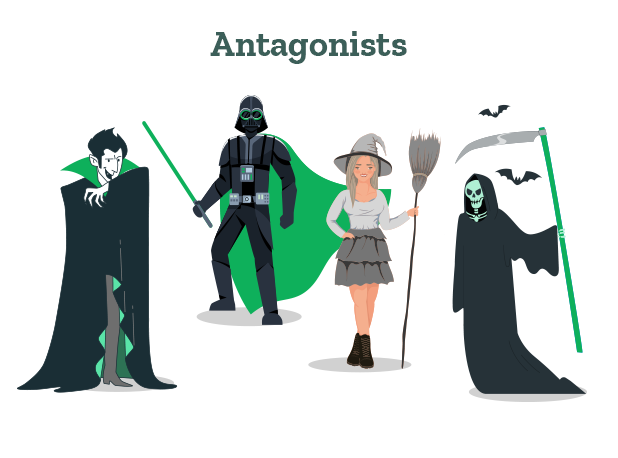
Strong antagonists are often intelligent, have multiple talents, and have their reasons for opposing the protagonist. Lord Voldemort, The White Witch, The Joker, Darth Vader, and Thanos are some famous antagonist examples.
The following can play the role of an antagonist in a story:
An intelligent mastermind
An animal
An oppressive system
A bad society/culture
An authoritative character/government
A natural disaster
Machines/robots
Rivals competing for a common goal
A bad institution
A supernatural force (e.g. aliens)
The protagonist’s weaknesses, inner conflicts, and illnesses
After understanding the antagonist definition and types, let’s see how to create an antagonist.
How to write an antagonist
1. Give the antagonist motives
Your antagonist should have a strong reason to oppose the protagonist. This can be a desire for power, success, fame, or a personal stake. The reason can also be due to the character’s past experiences. Some important points while giving characters motives are:
Reveal the motives gradually: Show the motives as the story progresses through the character’s thoughts (inner monologue), dialogues, and reactions to other characters. You can also use flashbacks of past experiences to show the character’s motives.
Use literary devices: Use metaphors and similes to compare the character’s motivation to something else, giving a deeper meaning to the story. Browse through the following antagonist example to understand better:
“John’s ambition was like a hungry beast, always lurking beneath the surface, waiting to devour any opportunity that might feed its appetite.”
The above example is a simile where John’s ambition is compared to a hungry beast using the word “like”. Now let’s see the next tip to create a strong antagonist
2. Make the antagonist relatable
To make them relatable, you can give your antagonist flaws and weaknesses that the readers can easily recognize and understand. For example, pride, insecurity, a desire for acceptance, etc.
Some other ways to make the characters relatable are:
Highlight similarities with the protagonists: You can show similarities in their struggles, abilities, thought processes, and desires. Use conversations and interactions between the protagonist and antagonist to highlight their similarities in thought processes, values, or perspectives.
Describe their emotions: Depict how the antagonist feels love, fear, vulnerability, and other emotions. You can do this by describing the physical sensations the antagonist experiences during emotional moments. For example,
“As the news of her father’s death reached Olivia, a cold numbness spread through her body. Her knees buckled, and she felt the world spinning around her, the ground threatening to swallow her whole.”
3. Develop the antagonist’s backstory
To create a backstory, list the key events that shaped your antagonist. You can create a complete timeline of the antagonist’s life using writing apps like Scrivener to make notes.
Also, instead of telling your antagonist’s backstory in the order it happened, share pieces of their past at different points in a non-linear order. You can also show the character reflecting on the past using inner monologue.
Some other ways to create a backstory are:
Use a framing device: Employ a framing device, such as a character recounting the antagonist’s past to another character, to reveal their backstory. This can create a sense of intimacy and immediacy, drawing the reader into the antagonist’s history.
Explore cultural or societal influences: Consider how your antagonist’s cultural background, upbringing, or societal norms have influenced their development. This can provide context for their actions and beliefs, making them more relatable and complex.
4. Develop the antagonist’s relations with other characters
Develop their allies: Give your antagonist allies who support or help them achieve their motives. Explore what makes these different types of characters stand by the antagonist, and how their loyalty influences the story and other relationships.
Create unexpected connections: Surprise readers by revealing unexpected connections between your antagonist and other characters. For example, show that they have a secret history or are related in some way.
Challenge reader expectations by having your antagonist evolve in unexpected ways. You can show how they find redemption, or how their growth takes them in a surprising direction. Some ways to show character development are:
Use red herrings: Employ false clues to suggest your antagonist will experience a predictable, negative outcome. Then, surprise readers by taking their growth in an unexpected direction.
For example, throughout the story, the antagonist’s actions suggest they are becoming more villainous. However, in a twist, it’s revealed that they were secretly working to reveal and stop the true villain all along.
Employ a role reversal: Have your antagonist’s evolution lead them to take on a role that is traditionally associated with a positive character. This role reversal can challenge reader expectations.
For example, The antagonist, who was earlier an enemy, evolves to become a friend or even a mentor figure.
You can do this by showing some moral principles antagonists follow, despite the wrong actions they commit. For example, the antagonist refuses to harm children or innocent bystanders, despite their willingness to commit other crimes.
Some other ways to depict redeeming qualities are:
Show their positive relationships: Depict your antagonist’s positive relationships with other fictional characters, such as a loyal friend, a loving family member, or a respected mentor. For example, the antagonist has a close bond with a sibling who brings out the best in them.
Give them moments of mercy or kindness: Include scenes where your antagonist shows mercy, kindness, or forgiveness, even if it’s brief or unexpected. For example, the antagonist spares the life of a character who wronged them, showing compassion.
Now let’s see the last tip for how to write an antagonist.
7. Make the antagonist’s defeat satisfying
You can make the antagonist’s defeat satisfying by giving hints of the antagonist’s downfall before the final conflict. For example, showing a mistake the antagonist makes, an unexpected event that makes the good forces stronger, a secret weapon that the hero uses, etc.
Some other ways to do this are:
Use a twist or revelation: Employ a surprising twist or revelation that contributes to the antagonist’s defeat. This can be a hidden weakness, a secret alliance, or an unexpected turn of events that shifts the balance of power. For example, It’s revealed that a character who is the antagonist’s trusted partner has been working against them the whole time.
Show the consequences: Depict the consequences of the antagonist’s defeat, both for the story’s characters and the larger world of the story. For example, The antagonist’s defeat leads to the liberation of oppressed people or the restoration of balance in the story’s world.
Now let’s see 3 exciting antagonist vs. protagonist examples in literature. Every example also includes a tip that you can use to create suspense and intrigue between a protagonist vs. antagonist.
Antagonist vs. protagonist examples
1. Professor James Moriarty vs. Sherlock Holmes
These two characters from the story “The Final Problem” by Arthur Conan Doyle are famous for their conflict. The protagonist Holmes is portrayed as a brilliant detective, while Moriarty is depicted as a criminal mastermind.
A strategy used: Creating mystery by withholding information. In this story, specific, detailed information about crimes Moriary committed and how he did them is withheld to build suspense. For most of the story, Moriarty is an unseen presence, orchestrating crimes from behind the scenes. Following is Holmes’s description of Moriarty to explain this:
“He is the Napoleon of crime, Watson. He is the organizer of half that is evil and of nearly all that is undetected in this great city. He is a genius, a philosopher, an abstract thinker. He has a brain of the first order. He sits motionless, like a spider in the center of its web, but that web has a thousand radiations, and he knows well every quiver of each of them.”
Readers learn about Moriarty’s crimes through the information Holmes’ has gathered, rather than through direct confrontations or detailed descriptions of Moriarty’s actions. This secondhand account creates an air of mystery around Moriarty’s character while emphasizing his criminal activities.
2. Iago vs. Othello
In William Shakespeare’s play Othello, Iago is the antagonist whereas Othello is the protagonist. Iago manipulates Othello by planting seeds of doubt about Desdemona’s faithfulness.
A strategy used: Rhetorical questions and ambiguous statements
For example, in Macbeth, Iago questions, “ “Did Michael Cassio, when you woo’d my lady, / Know of your love?” Through this action, Iago creates doubt in Othello’s mind about Cassio’s knowledge of his relationship with Desdemona. Iago also makes ambiguous statements like “Men should be what they seem; / Or those that be not, would they might seem none!” This ambiguous statement suggests that men should be honest about their true nature, but it also implies that some men, like Cassio, might be deceiving others.
These lines show Iago carefully choosing his words to imply something inappropriate about Cassio and Desdemona’s relationship indirectly. By asking rhetorical questions and making ambiguous statements, Iago lets Othello’s imagination fill in the gaps, exploiting his insecurities.
You can make your antagonist utter ambiguous statements and rhetorical questions similarly to create doubt. Now let’s see the last example.
3. Sauron vs. Frodo Baggins
In J.R.R. Tolkien’s The Lord of the Rings, Sauron is the antagonist whereas Frodo is the protagonist.
A strategy used: Motif (The Eye of Sauron)
In “The Lord of the Rings,” the eye motif is closely associated with Sauron and appears throughout the story, constantly reminding readers of Sauron’s presence and power. One notable example is the Eye of Sauron, depicted as a fiery, lidless eye atop the Dark Tower of Barad-dûr in Mordor. The characters, particularly Frodo, feel its gaze, as he journeys closer to Mordor.
You can similarly create motifs for your antagonist.
This concludes our guide about antagonists! You can bookmark this article to revisit the definition of an antagonist and tips. After understanding the antagonist’s meaning, you can start developing a strong protagonist using the best writing software like Novlr and Novel Factory.
With this, you also need to brainstorm: What is a protagonist and antagonist’s ultimate outcome in their conflict? Deciding a logical outcome that makes sense is essential for a satisfying conclusion.
Once you complete the story, the next step is to edit it. As experts in editing and proofreading services, we’d love to help you perfect your story!
You can always use an online tool to create your APA journal citation, but tools are still prone to error. So, you should know how to write an APA citation for a journal. Tools can save you time, but knowing the citation format can help you fix any errors before submitting your paper. So what are the rules of APA citation for a journal article?
Let’s clarify the basics at the get-go: The volume number is italicized and the issue number is placed in parentheses. There is a comma between the journal title and the volume number. But there’s no comma nor a space between the volume number and the issue number. If you’re still confused, we’ve added an APA journal article citation example to clear things up for you.
Strengthen your paper with superior editing!
How to write an APA journal citation
Here are some specifics of the APA citation format for a journal article:
Write the title of the article in the sentence case (capitalize only the first word and proper nouns).
Write the title of the journal in the title case and mention the volume number after adding a comma.
Don’t italicize the comma between the journal title and volume number.
Italicize both the journal title and volume number.
Mention the issue number in parentheses right after the volume number, leaving no space.
After the issue number and page range, mention the DOI and don’t add a period after it.
If the article doesn’t have a DOI, mention the URL instead.
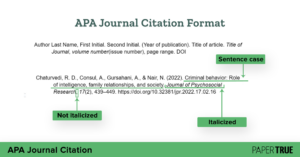
Suddenly, the APA journal citation seems a lot easier, doesn’t it? So let’s simplify this a bit. Here’s an APA journal citation example:
Note that in the case of more than one author, the names are separated with commas and an ampersand (&). The most confusing parts of a journal citation in APA Style are the punctuation marks separating the journal title, volume number, and issue number. So make sure to commit those parts to your memory!
We’ve understood the basics of the APA journal citation format, so you won’t lose any marks on your APA reference page. Now, let’s find out how to do an in-text citation for a journal article in APA Style!
The APA in-text citation for a journal article consists of the author’s last name and the article’s year of publication. You may add a page number or page range depending on the nature of your reference. The APA Style guide mentions two types of in-text citations: parenthetical and narrative.
A parenthetical citation is enclosed in parentheses and often accompanies a direct quote. It mentions the author’s last name, year of publication, and page number, all separated by commas.
(Author’s Last Name, Year, pp. XX–YZ)
(Wei, 2016, pp. 38–45)
The report observed that “the coal mine will spread over an area of 1300 hectares, displacing more than 10,000 people” (Wei, 2016, p. 38).
Note that a page range is indicated by “pp.” while a single page is denoted by “p.”.
A narrative citation is one in which the author’s name is part of the text while the year of publication and page range are mentioned in parenthesis.
Wei (2016) observed that “the coal mine will spread over an area of 1300 hectares, displacing more than 10,000 people” (p. 38).
If you’re directly quoting a paragraph of more than 40 words, you should indent it and add a parenthetical citation. This is called a block quotation, and it doesn’t feature quotation marks. In this case, this is what the APA in-text citation for a journal article will look like:
Epigenetic mechanisms encompass a variety of processes that regulate gene expression. One of the most well-studied mechanisms is DNA methylation, where methyl groups are added to cytosine bases in DNA, often repressing gene transcription. Histone modification is another crucial mechanism, involving chemical modifications to histone proteins around which DNA is wrapped, influencing chromatin structure and gene accessibility. (Lan, 2016, pp. 76–7)
While writing your dissertation or research paper, you’re likely to come across a wide variety of journal articles. Some will have some missing citation elements, while others will use different location markers. So, we’ll list the APA 7 journal article citation formats for all of them.
1. Journal article with three to twenty authors
List all the authors and add an ampersand (&) before mentioning the last author.
Morrison, T. O., Smith, A. B., Iman, L. S., Johnson, C. D., Williams, E. F., Iosua, Q. R., Chavez, K. W. Brown, G. H., Taylor, I. J., Anderson, K. L., & White, S. P. (2021). New Insights into Number Theory: Collaborative Efforts in Prime Factorization. Journal of Mathematical Research, 25(3), 123–135. https://doi.org/10.12345/jmathres.2021.123456
In-text citation: (Morrison et. al., 2021, pp. 123–135)
2. Journal article with more than 20 authors
List the names of 19 authors and add an ellipsis (…) before mentioning the last author, omitting the names in between.
Morrison, T. O., Smith, A. B., Iman, L. S., Johnson, C. D., Williams, E. F., Iosua, Q. R., Chavez, K. W. Brown, G. H., Taylor, I. J., Das S. S., Jones, K. C., Anderson, K. L., Davis, N. Y., Kutty, S. B., Garcia, G., Tanaka, L. M., White, I. P., Kim, R. M., Devereux, E., … Freeman, H. K. (2021). New Insights into Number Theory: Collaborative Efforts in Prime Factorization. Journal of Mathematical Research, 25(3), 123–135. https://doi.org/10.12345/jmathres.2021.123456
In-text citation: (Morrison et. al., 2021, pp. 123–135)
3. Online journal article
An APA online journal citation is the same as the basic journal citation minus the DOI but with an added article link.
Cole, R. (2023). Inter-rater reliability methods in qualitative case study research. Sociological Methods & Research. https://journals.sagepub.com/00491241231156971
Note that our APA citation for an online journal lacks the volume number, issue number, and page range. In case of missing information, you may skip the element and list the next available one.
Under APA style citation, you should mention the DOI of a print journal article if you’re able to find it. We’ve done the same in the APA journal citation example below.
Zhai, W. (2009). On the prime power factorization of n! Journal of Number Theory, 129(8), 1820–1836. https://doi.org/10.1016/j.jnt.2009.02.016
In-text citation: (Zhai, 2009, pp. 1820–1836)
5. Retracted journal article
While writing the APA 7 journal citation for a retracted article, mention the details of the original articles first. Then, add the details of the retraction in parentheses, including as many details as you can.
Estruch, R. (2012). Effects of Mediterranean diet on the primary prevention of cardiovascular disease. The New England Journal of Medicine, 368(14), 1279–1290. https://doi.org/10.1186/isrctn35739639 (Retraction published 2018, The New England Journal of Medicine, 378[25], 2441–2442)
6. Journal article with an article number
In case a journal article has an article number, simply replace the page range with the article number.
Thomas, F. & Jaleel, R. (2021). The effects of climate change on biodiversity. Environmental Science Journal, 15(2), Article e12345. https://doi.org/10.12345/envsci.2021.123456
7. Abstract of a journal article
In the rare cases that you need to cite the abstract but not the whole article, you should add the accession number.
Thomas, F. & Jaleel, R. (2021). The effects of climate change on biodiversity (Accession No. 1987643256) [Abstract from Environmental Science Abstracts]. Environmental Science Journal, 15(2), 145–168. https://doi.org/10.12345/envsci.2021.123456
Sometimes, databases use different terms for the accession number, like the PubMed ID. While writing your APA 7 journal article citation, use the term used by the database.
That concludes our guide on how to do an APA citation for journal articles. We hope it helps you write your citations correctly! But if you’re ever unsure about your writing, our paper editing services are at your disposal.
If you’d like to keep reading, here are some more resources:
In academic writing, learning how to create a brief and informative abstract for your research paper is really important. An abstract serves as a sneak peek into your research, giving readers a quick look to decide if they want to read more.
But what exactly is an abstract in a research paper, and how to write an abstract for a research paper that captures the essence of your study effectively? Let’s dive into the nuances of writing a standout research paper abstract!
Improve your paper’s quality with top-notch editing!
Let’s start by understanding what is an abstract in a research paper:
What is an abstract in a research paper?
A research paper abstract is a summary that outlines the key points of your research paper. It serves as a condensed version of your work, allowing readers to quickly grasp the purpose, methodology, results, implications, and conclusion of your study. Think of it as a mini-version of your paper, where you highlight the most critical information to entice further reading.
What is the purpose of an abstract in a research paper?
The primary purpose of an abstract in a research paper is to inform potential readers about the essential contents of the document. It will help them decide whether it aligns with their own research interests or objectives. Also, it’s important because it helps your paper show up in academic databases, making it easier for people to find and read.
Typically, the abstract is placed right after the title page and before the main body of the research paper. This arrangement guarantees that it is the first in-depth synopsis of your work that readers will come across.
How long should an abstract be for a research paper?
The length of an abstract for a research paper typically ranges from 150 to 250 words. This short length summarizes the research’s main aspects clearly and briefly. Sticking within this word range is important to maintain clarity and brevity so that readers can quickly grasp the important information. You can use academic ChatGPT prompts to reduce your abstract’s length if it exceeds the word count.
What does the abstract of a research paper contain?
A research paper abstract usually contains the following key elements:
Purpose of the study: Clearly states the main goal or issue addressed by the research, providing insight into its importance.
Methodology: Concisely explains the methods or approaches employed in the research, including the type of study conducted (e.g., experimental, observational, qualitative) and specific techniques or tools utilized.
Results: Summarizes the primary findings or outcomes of the research, highlighting key data points, trends, or discoveries relevant to the research question and objectives.
Conclusions: Outlines the implications of the findings. This could involve discussing the significance of the results in the context of the field, potential applications, or future research directions. If your study has significant limitations, it’s advisable to briefly note them in the abstract.
Keywords: Often, research paper abstracts include a list of keywords that help categorize the paper and make it easier for others to find through searches. Select words that are directly related to your research topic. Typically, 5-7 keywords are sufficient. Check the journal’s guidelines for specific requirements.
Use the following steps to write your research paper abstract perfectly:
1. Start with clarity and precision
Begin your abstract by clearly stating the research problem or the main objective of the study. This should address the ‘what’ of your study—what was your research trying to find or prove?
Avoid vague phrases and focus on delivering a specific and concise statement that encapsulates the essence of your research.
Use active voice and confident language to state your research aim. For example, instead of saying “This research attempts to explore,” you could say, “This research explores.”
Ensure that the first one or two sentences encapsulate the critical motivation behind the study.
Poor example: “This paper looks at climate change.”
Improved example: “This study quantifies the impact of industrial emissions on urban air quality, addressing a critical gap in environmental policy formulation.”
Avoid filler words or overly complex sentences that do not add value to the core understanding of your research.
2. Describe your methodology
Provide a concise overview of the methods you employed for your research. This part should give readers a clear understanding of your approach and techniques. The goal is to provide enough information to understand the foundation of your findings.
Focus on including only the most crucial methods used in your research. Typically, this would be the overall approach (e.g., qualitative, quantitative, mixed methods), significant techniques or instruments used, and the type of analysis conducted.
Avoid jargon or overly technical terms that might be unfamiliar to a broader audience, aiming instead for clear, accessible language.
If specific tools, software, or technologies are central to the results, mention them by name.
Example: “Data was analyzed using SPSS software.”
Abstracts do not allow for extensive methodological descriptions. Provide enough detail to understand the framework briefly.
For example: Instead of saying, “We conducted several tests to analyze the samples,” specify briefly, “Samples were analyzed using X-ray diffraction and gas chromatography.”
3. Highlight key findings
Briefly summarize the most significant results of your study. Make sure to capture the importance and implications of your results. This part typically grabs the most attention from readers.
Focus on mentioning quantifiable results if applicable, as these often convey the impact of your findings more powerfully.
Use phrases that summarize significant trends rather than complex data details. For example, “Results show a 50% increase in efficiency” or “Findings indicate a significant reduction in incidence rates.”
Use strong, positive adjectives to describe your findings, such as “significant,” “substantial,” “robust,” etc., where appropriate and accurate.
Include critical statistics such as p-values or confidence intervals to support the significance of your findings.
4. Discuss the implications
In a few sentences, describe the broader implications of your findings. How does your research contribute to the field? What are the practical or theoretical implications?
Consider questions like, “Why does this matter?” and “Who will benefit from this research?”
This can be framed as, “These findings suggest new pathways for clinical treatment,” or “This research informs policy by demonstrating…”
Clearly state how your findings contribute to the existing body of knowledge in your field. Do they extend, contradict, or refine previous theories?
Example: “These findings challenge the conventional understanding of X, suggesting a revised model for Y.”
Use strong action verbs to describe the effect of your research, such as “transforms,” “enables,” “revolutionizes,” or “underscores.”
5. Keep it concise
Focus on writing within the word limit and keeping the information that is required to be showcased or highlighted.
After drafting your abstract, review it specifically for redundancy and verbosity. You can edit your research paper abstract using content editors and grammar checker tools to ensure an error-free research paper abstract.
Word counter tools like QuillBot, Semrush, Word Count, etc. can help ensure you stay within the typical 150-250 word range.
Additionally, asking a colleague to review your abstract format can provide insights into any unnecessary details or unclear wording. Proofreading your research paper abstract is a crucial step.
Research paper abstract example
To solidify your understanding, let’s look at a research paper abstract example:
In this study, we explored the impact of climate change on Arctic marine life. Using a combination of satellite imagery and direct observation methods over five years, we observed a significant decrease in sea ice coverage and its direct effects on the indigenous marine populations. Notably, the reduction in ice has led to altered migration patterns and decreased population stability in polar bears and seals. These findings highlight the urgent need for policies aimed at mitigating the effects of climate change in polar regions.
Creating a strong research paper abstract goes beyond simply summarizing your work. It involves offering a clear, concise, and captivating overview that sparks interest and showcases the significance of your research. By adhering to these tips, you can develop an abstract that meets academic requirements while also engaging your target audience effectively.
To refine your abstract, consider PaperTrue’s expert editing and proofreading services. Our team of professionals can help ensure that your abstract—and your entire research paper—meets the highest standards of academic excellence and is ready to make a lasting impression in the scholarly community!
Here are some more research-related articles for you:
Sentence structure is the way words are put together in a sentence to convey meaning. It involves placing subjects, verbs, and objects in a specific order to communicate clearly. Dive in to understand everything about the rules and types of sentence structure!
We’ve also included practical sentence structure examples for you. So without delaying further, let’s begin!
Elevate your text’s sentence structure today!
Let’s quickly understand the sentence structure meaning.
To understand this sentence structure definition better, let’s see the various parts of a sentence.
Important parts of a sentence
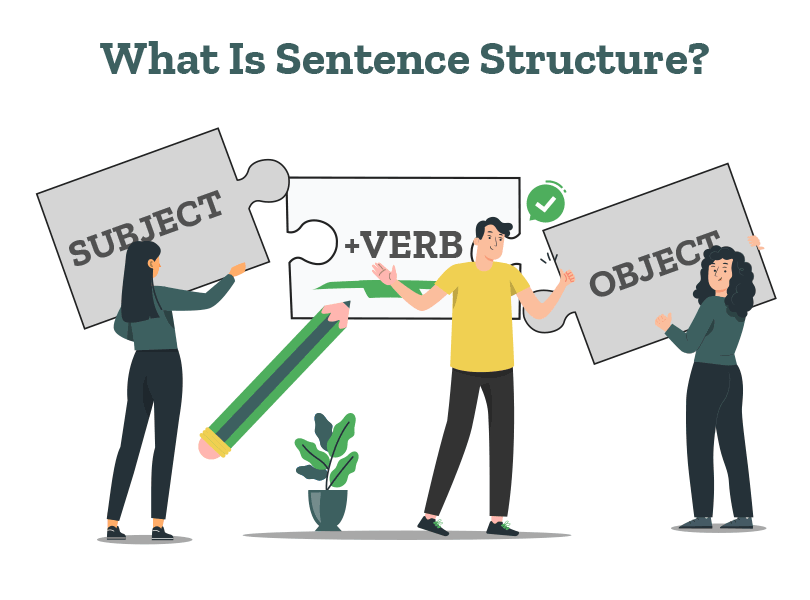
The subject, verb, and object are important parts of sentences. Here is a simple explanation to understand these three parts:
Subject– The main focus of a sentence is the subject of the sentence. It can be a person, place, animal, thing, or idea.
Hina took an exam. (Subject- Hina)
Verb- The word that conveys action is the verb in the sentence.
He ran to the door. (Verb- ran)
Object- The person or thing that is impacted by the action is the object.
He broke the window. (Object- window)
The following example of sentence structure demonstrates all three concepts:
The above sentence clearly demonstrates the common sentence structure: Subject-Verb-Object (SVO). As objects are important parts of sentences, let’s quickly see the types of objects!
There are two types of objects, the direct object, and the indirect object.
Direct object- The person or thing that is directly affected by the action is the direct object. By asking the question “What?” or “Whom?”, you can understand the direct object.
Indirect object- The person or thing other than the direct object that also receives the action is the indirect object. It is indirectly affected by the action. Asking “To what?”, “To whom?”, “For what?”, and “For whom?” give us the indirect object.
John gave her a gift. (To whom did John give a gift? – her)
He returned the book to the library. (To what did he return the book?- the library)
She made pudding for the party. (For what did she make pudding?- the party)
Max played soccer for his son. (For whom did Max play soccer?- his son)
While these examples follow the Subject-Verb-Object (SVO) pattern, the structure of a sentence can vary. To understand English sentence structure better, let’s quickly understand the 4 basic rules to create sentence structures.
Sentence structure rules
1. Start every sentence with a capital letter.
2. At the end of every sentence, use a punctuation mark such as a full-stop, question mark, exclamation mark, or quotation marks.
3. All the connecting words used (e.g. and, because, if, when, who, which) must help to understand the subject of the sentence.
4. The verb and the subject must have the same form, meaning either both should be singular, or both should be plural. This is known as subject-verb agreement. For example:
Jim is not there. (Jim- Singular noun form, is- Singular verb form)
They are sincere and honest. (They- Plural noun form, are- Plural verb form)
Every sentence structure contains at least 1 clause. Hence, before seeing the types of sentence structure, let’s briefly understand clauses.
What are clauses and their types?
A clause is a group of words that include a subject and a verb. There are two types of clauses: independent clauses and dependent clauses.
1. Independent clause
Also known as the main clause, the independent clause contains a subject and a verb and expresses one single idea. It makes sense as a single sentence and doesn’t need any other clause to complete it.
Here is an example:
I read books.
The above sentence sounds complete and doesn’t need any additional words to clarify its meaning. The whole sentence “ I read books.” is an independent clause.
2. Dependent clause
Also known as the subordinate clause, the dependent clause contains more than one verb and expresses several ideas. It needs the independent clause to complete the sentence. Without the independent clause, the sentence feels incomplete and lacks clarity.
Here is an example:
I read books that inspire me to achieve my goals.
Here, the words “that inspire me to achieve my goals” is the dependent clause. Without the independent clause “I read books”, it would be difficult to understand the inspiration and the sentence would be incomplete.
Now that we know the basics of clauses, let’s understand the types of English sentence structure!
Types of sentence structure
The four main types of sentence structure are simple, compound, complex, and compound-complex.
1. Simple sentence
A sentence that has only one independent clause is called a simple sentence. It has only one verb and subject and expresses a single idea. For example:
A sentence formed by joining two or more independent clauses is known as a compound sentence. The sentences are connected by using conjunctions like and, but, or, yet, so. They can also be linked by using punctuations like the semi-colon. Let us see some examples:
I went to the shop and Ipurchased some onions.
Ms. Martha knew the truth, but she couldn’t tell anyone.
We can go swimming on Friday; you can also bring your friend along.
A sentence that consists of one independent clause and one or more dependent clauses is known as a complex sentence. Such sentences are usually linked using words like because, although, if, when, who, which, that.
Understand this structure in a sentence through the following examples!
Although it was cold, their son didn’t wear a warm jacket.
When I reach the airport, I will immediately call you.
Your mom realized who I was talking about and smiled.
4. Compound-complex sentence
A sentence that has two or more independent clauses and one or more dependent clauses is known as a compound-complex sentence. It is a combination of compound and complex sentences. Let us see some sentence structure examples to understand better.
I wanted to attend the meeting but I was unable to do so because of an emergency.
He said that he had a new red jersey which his wife had purchased, although I never saw him wearing it.
They knew that he was lying but couldn’t do anything about it because someone powerful was involved.
This concludes our guide about what is a sentence structure. Now, you can use these sentence structure types to communicate effectively. To improve sentence structure in written documents, it is essential to thoroughly edit them.
At PaperTrue, we provide expert editing and proofreading services to perfect your document. Whether you want to edit an academic or professional paper, we can help!
Here are some articles that you might find interesting:
Want to create better sentences and express yourself using conjunctions? Explore our practical guide and learn everything about using conjunctions! We’ll define conjunctions, and types and explain everything with examples.
We’ve also added commonly used conjunctions and given practical tips for using conjunctions. So without wasting time, let’s begin!
Achieve error-free text with our top-notch editing!
What are conjunctions?
Conjunctions are words that create a logical connection between two or more sentences, words, phrases, or clauses. It’s one of the parts of speech that help to form complex sentences and ensure better content flow.
To understand the conjunction definition, here are some examples:
I bought a gift and couriered it to my brother.
She told me the truth because she had no other option.
They didn’t know how to cook, but they tried their best.
For readers wondering about: Is “and” a conjunction? Is “but” a conjunction? The answer is yes! The words “and” and “but” are used to link sentences and clauses together.
Now, let us see the types of conjunctions in detail.
Types of conjunctions
1. What is a coordinating conjunction?
Words that link two or more sentences or independent clauses that are equally important are known as coordinating conjunctions. Some examples of coordinating conjunctions are and, but, or, nor, for, yet, and so.
Here are some coordinating conjunction examples:
Amy went to the market, and she came home in the evening.
He wanted to go to Paris but he couldn’t go due to an emergency.
You can have an apple or you can have an orange.
Ms. Jenny tried her best yet she could not convince him.
We must hurry, for the store closes in an hour.
They didn’t know and nor did I have any knowledge about it.
Your meeting went on for a long time and so we had to reschedule our lunch plans.
Note: The independent clause is a group of words that contains a subject and a verb and makes sense as a complete sentence. For example: In the first sentence, “Amy went to the market” and “she came home in the evening” are two independent clauses joined by the word “and”.
Subordinate conjunctions connect dependent and independent clauses and show a cause-effect relation in a sentence.
Examples of subordinating conjunctions are: after, although, as, because, before, even, if, even though, once, in order that, provided that, once, since, so that, than, that, though, till, unless, until, when, whenever, where, whereas, wherever, while, will, as if, as long as, as though, in as much as, in case, lest, now that, rather than, since, so, supposing whether, whichever, whoever, by the time, in the event that, only, only if, whether or not
Browse through the following subordinating conjunction examples to understand better!
He would help me if I gave him something in return.
They came as soon as they heard the news.
Since I was on leave, I ignored the message.
By the time I reached the station, everyone was gone.
She didn’t want to leave unless he went with her.
Even though he was younger, he had more knowledge.
Even if they didn’t return, I knew they would never forget me.
3. What is a correlative conjunction?
The words used in pairs to join two parts of a sentence are known as correlative conjunctions. Some correlative conjunction examples are: either..or, neither..nor, not only…but also, whether..or, no sooner…than, rather…than, scarcely…when, such…that, hardly…when, both…and, just…so.
Here are some examples of conjunctions used in sentences:
Neither she nor her sister participated in the competition.
No sooner did Jack finish his homework than his friend called him.
Either Ray or Brandon had played this clever prank.
He not only won the race but also set a new record.
Scarcely had she come from school when her mother called her for an important task.
The weather was such that we decided to postpone our meeting.
Hardly had the guests arrived when the power went out.
After understanding what is a conjunction and its types, let’s quickly understand some rules while using conjunctions. These rules will help you to effectively combine sentences with other nouns, verbs, adjectives, and adverbs.
Essential rules while using conjunctions
1. Use a comma before a coordinating conjunction while joining two independent clauses. For example:
He visited the museum, and he saw ancient artifacts.
2. Don’t use commas when the second clause is a dependent clause or a short phrase. For example:
They came home and partied hard.
3. You can start a sentence with a subordinating conjunction like “when”, “if”, and “although” as long as it is followed by a complete clause. For example:
When I saw Jack, I remembered a shocking incident.
4. Ensure that the subject and the verb in the sentence are the same in number (both are either singular or plural) while using conjunctions. This reduces the scope of grammar errors.
For example:
They are very happy because their son graduated and topped in economics.
In this sentence, the pronoun “they’ and the verb “are” are both plural.
5. If you’re using many subordinate clauses while using conjunctions, separate the clauses using proper punctuation for clarity.
For example:
The project was challenging, but she persevered, eventually succeeding in getting the desired results.
In this sentence, commas are used to separate the clauses.
6. Avoid using too many conjunctions in the same sentence as it can make the sentence complex.
Now that you know what is a conjunction, you can use them to create meaningful sentences. You can bookmark this article and revisit it to read the conjunction definition and types. To enhance your understanding, you can also make a list of conjunctions and categorize them into types. You can use this conjunctions list for reference while writing.
Once you finish writing, you need to edit and proofread your text to rectify any errors. As experts in editing and proofreading services, we’d love to help you ensure a high-quality document!
In higher education, few milestones hold as much significance as the completion of a dissertation. Embarking on a dissertation journey can be both exciting and challenging. To assist students from various academic streams, we have compiled an extensive list of 350 dissertation topic ideas.
Let our professional editors refine your dissertation!
Without further ado, let’s explore the best ideas and examples for dissertation topics for the stream of your choice!
Business management dissertation topics
1. Exploring the Impact of Artificial Intelligence on Customer Relationship Management: Opportunities and Challenges.
2. Investigating the Role of Emotional Intelligence in Entrepreneurial Success.
3. Analyzing the Influence of Corporate Culture on Innovation and Creativity.
4. Examining the Effectiveness of Sustainable Supply Chain Management Practices in Enhancing Organizational Performance.
5. The Rise of Remote Work: Managing Virtual Teams in the Digital Age.
6. Investigating the Role of Corporate Governance in Ensuring Ethical Business Practices.
7. The Impact of Diversity and Inclusion Initiatives on Organizational Performance and Employee Engagement.
8. Exploring the Role of Social Media Marketing in Building Brand Loyalty.
9. Assessing the Effectiveness of Change Management Strategies in Successfully Implementing Organizational Change.
10. Investigating the Relationship between Leadership Styles and Employee Motivation in Times of Crisis.
Education dissertation topics
1. The Impact of Gamification on Student Engagement and Learning Outcomes.
2. Exploring the Role of Student Voice in School Decision-Making Processes.
3. Analyzing the Effectiveness of Project-Based Learning in Developing Critical Thinking Skills.
4. Investigating the Benefits and Challenges of Online Learning in K-12 Education.
5. The Influence of Teacher-Student Relationships on Academic Achievement and Well-being.
6. Examining the Role of Emotional Intelligence in Teacher Effectiveness and Classroom Management.
7. The Impact of Inclusive Education on the Social Integration and Academic Performance of Students with Disabilities.
8. Analyzing the Effectiveness of Multicultural Education in Promoting Cultural Awareness and Acceptance.
9. Investigating the Factors Influencing Parental Involvement in Early Childhood Education.
10. Exploring the Role of Technology in Enhancing STEM Education and Career Readiness.
Psychology dissertation topics
1. The Impact of Mindfulness-Based Interventions on Stress Reduction and Well-being.
2. Investigating the Relationship between Social Media Use and Body Image Disturbance in Adolescents.
3. Exploring the Role of Resilience in Coping with Trauma and Adversity.
4. The Influence of Parenting Styles on Emotional Regulation and Social Skills in Children.
5. Examining the Effects of Video Games on Cognitive Abilities and Aggression.
6. Investigating the Relationship between Personality Traits and Job Satisfaction across Different Professions.
7. The Role of Attachment Styles in Romantic Relationships: Predictors of Relationship Satisfaction and Stability.
8. Exploring the Impact of Early Life Experiences on Adult Attachment Patterns.
9. The Effectiveness of Cognitive-Behavioral Therapy in Treating Obsessive-Compulsive Disorder.
10. Investigating the Relationship between Sleep Quality and Mental Health in College Students.
Leadership dissertation topics
1. The Role of Emotional Intelligence in Effective Leadership Practices.
2. Exploring the Relationship between Authentic Leadership and Employee Engagement.
3. Analyzing the Impact of Transformational Leadership on Organizational Innovation and Change.
4. Investigating the Influence of Cross-Cultural Leadership in Global Organizations.
5. The Role of Ethical Leadership in Fostering Corporate Social Responsibility.
6. Exploring the Effects of Leadership Styles on Team Performance and Productivity.
7. Analyzing the Leadership Challenges and Strategies in Nonprofit Organizations.
8. Investigating the Role of Servant Leadership in Enhancing Employee Well-being and Job Satisfaction.
9. The Impact of Gender and Leadership: Breaking the Glass Ceiling.
10. Exploring the Role of Leadership Development Programs in Nurturing Future Leaders.
Finance dissertation topics
1. The Impact of Financial Technology (Fintech) on Traditional Banking Systems.
2. Analyzing the Relationship between Corporate Social Responsibility and Financial Performance.
3. Exploring the Determinants of Capital Structure in Small and Medium Enterprises.
4. Investigating the Role of Behavioral Finance in Investment Decision Making.
5. Analyzing the Effectiveness of Risk Management Strategies in Financial Institutions.
6. The Impact of Financial Literacy Education on Personal Financial Management.
7. Exploring the Relationship between Corporate Governance and Firm Value.
8. Investigating the Effectiveness of Financial Regulations in Ensuring Market Stability.
9. The Role of Blockchain Technology in Revolutionizing Financial Transactions.
10. Analyzing the Impact of Macroeconomic Factors on Stock Market Volatility.
4. Natural Language Processing and its Application in Sentiment Analysis.
5. The Use of AI in Enhancing Precision Agriculture Techniques.
6. The Development of AI-Driven Assistive Technologies for the Visually Impaired.
7. AI in Space Exploration: Autonomous Rovers and Spacecraft Navigation Systems.
8. The Integration of AI in Creative Industries: Music, Art, and Literature and Story Generation.
9. The Role of Artificial Neural Networks in Financial Market Prediction.
10. The Challenges of Implementing AI in Healthcare: Diagnostics, Treatment, and Patient Privacy.
The 350 dissertation topics presented in this blog are composed to resonate with the diverse interests and scholarly pursuits of graduate students across all streams. In the end, the journey of crafting your dissertation is a unique narrative of personal and academic growth.
To ensure that your work reaches its fullest potential and makes the impact it deserves, consider partnering with professional editing and proofreading services. PaperTrue stands ready to elevate your dissertation to the pinnacle of academic excellence!
Choosing the right dissertation topic is pivotal in our academic and career paths. Your dissertation topic should capture your interest, meet academic requirements, and contribute to your field of study. Whether you’re just starting to think about your dissertation or trying to refine your ideas, this guide is designed to help you in choosing a perfect dissertation topic.
Let our professional editors refine your dissertation!
Without further ado, let’s see how to find a dissertation topic:
How to choose a dissertation topic
The following steps will help you select a dissertation topic that resonates with you and will be interesting to work on!
1. Understand your interests and strengths
Take some time to think about what you’re passionate about academically and where you excel. What topics have caught your eye during your studies or previous research? A dissertation is a long-term engagement, and genuine interest in your topic can be a great motivator when challenges arise.
Reflect on past courses and projects: Review your coursework and past research. Identify patterns in your interests and consider how these can evolve into a dissertation topic.
Write down ideas: Keep a journal or digital note of ideas as they come to you over days or weeks. This can help you see which topics consistently engage your interest.
Before you settle on a topic, it’s important to see what research has already been done in your field. Do a deep dive into the existing literature to see what gaps your dissertation could fill. Use academic resources, databases, journals, and books to get a good background on your potential topic.
Utilize academic databases: Make extensive use of databases like JSTOR, PubMed, and Google Scholar to access existing research.
Create an annotated bibliography: As you review the literature, summarize key points and how they might relate to your potential topic. This will be invaluable as you narrow down your topic.
3. Define the specifics of your problem statement
Once you have a broad understanding of your area of interest and have reviewed the existing literature, it’s time to articulate the specifics of your problem statement. This step is critical as it forms the backbone of your dissertation.
Narrow your focus: Use the issues identified to narrow down your topic to a specific problem that is manageable and significant. The specificity will help in focusing your research and discussions.
Draft a preliminary problem statement: Write a clear and concise statement that describes the problem your research intends to address. This should indicate the scope, aim, and rationale of your study.
4. Consider the scope and resources available
One common mistake is picking a topic that’s either too broad or too narrow. Consider how much ground your topic covers and if you have the time and sources to do it justice. This includes access to data, research materials, or people for surveys and interviews.
Assess resource availability: List the resources you need (e.g., data sets, lab equipment, specific populations for surveys) and confirm access to them.
Set realistic goals: Ensure the scope of your topic matches the time and word count limits for your dissertation. Too broad or too narrow can lead to significant problems later.
5. Get feedback
Once you’ve got a few ideas, talk them over with your advisor and peers. They can give you valuable advice on whether your topics are relevant and doable. This step can also help you tweak your ideas based on practical considerations.
Consult with advisors: Regular meetings with your advisor can provide guidance and insight into the feasibility and academic value of your topic.
Engage with peers: Discussing your ideas in study groups or seminars can provide new perspectives and constructive criticism that refine your topic further.
Consider what impact your research could have. Ask yourself: “What makes a great dissertation topic?” Ideally, it should contribute something new to your field, whether that’s solving a problem, filling a knowledge gap, or challenging existing ideas. Your topic should also fit with current trends and debates in your field.
Identify the contribution to the field: Clearly define how your research will contribute to existing knowledge. Could it change how people think about the subject?
Align with current trends: Research current trends in your field. Attending conferences and reading recent journal articles and publications can help you understand what is relevant and in demand.
7. Finalize and get approval
With insights from your research and feedback from your peers, refine your topic until it’s just right. Make sure it meets all the requirements of your department and get the green light from your dissertation committee. This step is key to making sure you’re on the right track and have the support you need to move forward.
Prepare a formal proposal: Write a detailed proposal including your research question, methodology, and expected outcomes. This will be crucial for approval from your committee.
Seek pre-approval feedback: Before submitting your proposal for final approval, get feedback from trusted mentors or colleagues. This can help catch any potential issues early.
Choosing the right dissertation topic is a thoughtful process that can set the foundation for a rewarding research experience. By understanding your interests, conducting thorough research, and seeking guidance from advisors, you are well on your way to selecting a topic that not only meets academic standards but also holds personal significance.
Remember, once you’ve chosen your dissertation topic and are ready to present your findings, professional editing and proofreading services are critical to ensuring clarity, coherence, and a polished presentation of your research. PaperTrue can enhance your dissertation, ensuring it communicates your ideas effectively and meets the highest academic standards!
Here are some more dissertation-related resources for you:
Characters are the focal points of a story. Understanding the different types of characters is crucial for both readers and writers, as it enhances comprehension and storytelling ability. Whether it is a novel, a short story, or a screenplay, characters are the soul that breathes life into the plot and setting.
In this article, we’ll delve into the different kinds of characters found in literature, stories, and fiction, offering definitions and examples to help you understand the diverse range of character types!
Bring your characters to life with immaculate editing!
Let’s begin with an easy-to-understand characters in a story definition:
What are the characters in a story?
In literature, characters are the individuals who populate the narrative and drive the plot forward. But they’re more than just names on a page; they’re constructs through which authors convey themes, propel plots, and engage readers.
Have you thought about how we understand or make up our minds about a character? This character is evil or that character is good! This is because of the different traits and types of characters. Character types are categories that help in identifying how each character functions within the story.
Types of characters in a story
1. Protagonist
The protagonist is the central character around whom the main plot revolves. This character is often the hero or the main figure through whom the audience experiences the story.
Protagonists give us a lens through which we can see the events of the story unfold. Be it Rapunzel from our beloved childhood books or Nancy Drew, the dashing heroine of mystery novels, we all put ourselves in their shoes while reading their stories.
Some examples of protagonists are:
Elizabeth Bennet from Pride and Prejudice by Jane Austen.
As the protagonist, Elizabeth’s wit, intelligence, and independent spirit guide the reader through the narrative, as she navigates the complexities of love, marriage, and social expectations in Regency-era England.
Jane Eyre from Jane Eyre by Charlotte Brontë.
As the protagonist, Jane’s experiences, emotions, and moral convictions shape the narrative, as she faces challenges such as poverty, loss, and societal constraints.
Sherlock Holmes from the Sherlock Holmes series by Sir Arthur Conan Doyle.
As the protagonist, Holmes’ intellectual prowess, keen observation skills, and logical reasoning guide the reader through the mysteries and investigations that form the core of the narrative.
2. Antagonist
Often serving as the counterpart to the main character, the antagonist plays a crucial role in storytelling by opposing the protagonist’s goals or desires. This opposition creates tension and conflict, which in turn propels the narrative forward. Antagonists are different from anti-heroes who are protagonists portrayed by evil characters. Darth Vader from Star Wars is a well-known powerful antagonist.
Some examples of antagonists are:
The Joker from The Dark Knight by Christopher Nolan.
The Joker is a criminal mastermind who terrorizes Gotham City, serving as the primary antagonist to the protagonist, Batman.
Sauron from The Lord of the Rings by J.R.R. Tolkien.
Sauron is the primary antagonist of the Lord of the Rings trilogy, a powerful and malevolent force seeking to dominate Middle-earth.
Loki Laufeyson from Marvel Comics by Stan Lee.
Loki, the Asgardian god of mischief, is a recurring antagonist in the Marvel Comics universe, often serving as a foil to his adoptive brother, Thor, and the Avengers.
The deuteragonist is the second most important character after the protagonist, often a sidekick or a major character who has a separate but intertwined storyline. This character plays a pivotal role in shaping the plot’s development. These characters often serve as the protagonist’s confidant, offering support, and guidance, or providing contrasting perspectives that enrich the narrative’s complexity. We all love how Ron Weasley is always helping Harry Potter in the famous series by J.K. Rowling.
Some examples of deuteragonists are:
Dr. John Watson in the Sherlock Holmes series by Sir Arthur Conan Doyle.
Dr. Watson is Sherlock Holmes’ trusted friend, roommate, and chronicler of his detective cases.
Robin in various iterations of the Batman comics by Stan Lee.
As a deuteragonist, Robin complements Batman’s dark, brooding personality with youthful energy, optimism, and a more lighthearted approach to crime-fighting.
Han Solo in the Star Wars franchise, ghost-written by Alan Dean Foster.
As a deuteragonist, Han Solo brings a sense of humor, skepticism, and practicality to the story, contrasting with Luke’s idealism and naivety.
4. Tritagonist
The tritagonist is the third most significant character in the story, playing a crucial role in supporting the narrative. While not as central as the protagonist or deuteragonist, the tritagonist often brings depth and complexity to the storyline. While Andy Dufresne is the central character striving for freedom, Ellis Boyd Redding serves as his loyal friend and confidant in The Shawshank Redemption.
Some examples of tritagonists are:
Gale Hawthorne in The Hunger Games by Suzanne Collins.
While Peeta Mellark (the deuteragonist) is Katniss’s partner in the Hunger Games and eventual love interest, Gale remains a constant presence in her life, providing support, friendship, and a shared understanding.
Hermione Granger in the Harry Potter series by J.K. Rowling.
While Harry is the protagonist and Ron Weasley can be considered the deuteragonist, Hermione’s intelligence, skills, and unwavering loyalty make her an indispensable part of the trio.
Saul Goodman from the TV series Breaking Bad.
While not as central to the story as Walter and Jesse, Saul plays a significant role in the plot, providing legal advice, facilitating criminal connections, and serving as a source of comic relief.
5. Confidant
A confidant character serves as a trusted ally to the protagonist, allowing them to share their innermost thoughts and emotions with the audience. This confidant often acts as a sounding board for the protagonist, providing support, advice, and insight into their psyche. This character helps the audience to better understand the main character’s journey and struggles. The volleyball becomes Chuck’s confidant in Castaway where he is stranded on an island with no other humans.
Some examples of confidants are:
Joey Tribbiani is Chandler Bing’s confidant in the T.V. series Friends.
Joey and Chandler are best friends and roommates, sharing a close bond that allows them to confide in each other about their personal lives, relationships, and insecurities.
Jane Bennet is Elizabeth Bennet’s confidant in Pride and Prejudice.
As sisters, Jane and Elizabeth share a close, loving relationship that allows them to confide in each other about their feelings, hopes, and concerns.
Aled Last is the confidant of Frances Janvier in Radio Silence by Alice Oseman.
As confidants, Aled and Frances share their fears, doubts, and personal struggles with each other, finding solace and support in their friendship.
The love interest character plays the romantic counterpart of the protagonist. Their connection often impacts the protagonist’s development and journey throughout the narrative, shaping their growth and decisions. Romeo and Juliet were each other’s love interests, and their love story was the basis of William Shakespeare’s famous play Romeo and Juliet.
Some examples of love interests are:
Hazel Grace Lancaster and Augustus Waters play each other’s love interests in The Fault in Our Stars by John Green.
Hazel and Augustus are two teenagers who meet at a cancer support group and develop a deep, meaningful connection.
Noah Calhoun and Allie Hamilton play each other’s love interests in The Notebook by Nicholas Sparks.
Noah and Allie’s love story spans decades, beginning with a passionate summer romance in their teenage years and rekindling later in life.
Catherine Earnshaw and Heathcliff play each other’s love interests in Wuthering Heights by Emily Brontë.
Catherine and Heathcliff’s love story is a tumultuous, passionate, and ultimately tragic tale that spans their lives from childhood to adulthood.
7. Foil
The foil character’s primary purpose is to highlight the traits of another character through contrast. In storytelling, a foil is a character that illuminates other characters. They’re used to define the relationship between a plot’s antagonist and protagonist. Draco Malfoy was a foil to Harry Potter: Rude, bigoted, arrogant, and generally horrible throughout most of the series, antithetical to what Harry is.
Some examples of foil characters are:
Hank Schrader is the foil to Walter White in the famous TV series Breaking Bad.
Hank’s role as a DEA agent and his strong moral compass contrast sharply with Walter’s descent into the criminal world of drug manufacturing.
Nurse Ratched is the foil to Randle McMurphy in One Flew Over the Cuckoo’s Nest by Ken Kesey.
Nurse Ratched’s cold, controlling demeanor and adherence to strict rules serve as a foil to McMurphy’s rebelliousness, free spirit, and desire for individual expression.
Javert is the foil to Jean Valjean in Les Misérables by Victor Hugo.
Javert’s strict adherence to the law and his relentless pursuit of justice serve as a foil to Jean Valjean’s compassion, redemption, and moral ambiguity.
Types of characters in fiction
1. Dynamic
Dynamic characters change throughout the story. All the mentioned characters in this article can be dynamic. Well-developed characters naturally turn out to be dynamic. The change comes about through internal or external conflict that they have to deal with. In A Christmas Carol by Charles Dickens, Ebenezer Scrooge is a classic example of a dynamic character. He is introduced in the story as a crotchety, greedy old fellow. However, after the eye-opening experience with the ghosts of the past, present, and future, he turns into a pleasant charitable man.
Some examples of dynamic characters are:
Sydney Carton in A Tale of Two Cities by Charles Dickens.
Sydney initially appears as a lazy, alcoholic lawyer but ultimately finds redemption and purpose, sacrificing his life for the sake of others and demonstrating great courage and selflessness.
Jamal Malik in the film Slumdog Millionaire.
Jamal’s experiences and struggles throughout his life shape him into a resilient, determined individual who overcomes adversity to find love and success.
Scout Finch in To Kill a Mockingbird by Harper Lee.
Scout’s innocence and naivety are challenged as she witnesses prejudice and injustice in her community, leading to her growth in understanding and moral awareness.
These are characters who don’t change much through the course of the novel. They don’t have a lot of scope in the story and have a limited role. The author creates them with a single or specific purpose in the hero’s journey. Enemies and foils are mostly static, as they pose a challenge to the main character. They serve as steady elements within the narrative. Mr. Collins from Pride and Prejudice is a good example of a static character.
Some examples of static characters are:
Mary Poppins in the Mary Poppins series by P.L. Travers.
Mary Poppins is a magical, no-nonsense nanny who remains consistent in her behavior and attitudes throughout her various adventures with the Banks family.
Cinderella in the fairy tale Cinderella.
Cinderella’s kindness, resilience, and goodness remain unchanged throughout her story, even in the face of cruelty and adversity from her stepmother and stepsisters.
James Bond in the James Bond film series.
Despite the different actors who have portrayed him, James Bond remains a suave, confident, and skilled spy who consistently outsmarts his adversaries and maintains his signature style.
3. Round
These are complex characters fleshed out with backstory, strengths, weaknesses, etc. Readers can get into the skin of these characters. Writers spend a considerable amount of time creating “round” characters. They have character arcs, unlike static and flat characters who get a one-dimensional playfield and are easily forgettable. Atticus Finch is a principled, compassionate, and morally upright character in To Kill a Mockingbird.
Some examples of round characters are:
Jay Gatsby in The Great Gatsby by F. Scott Fitzgerald.
Gatsby is a mysterious, wealthy, and idealistic character whose pursuit of love and the American Dream ultimately leads to his downfall.
Daenerys Targaryen in A Song of Ice and Fire series by George R.R. Martin.
Daenerys is a complex character who evolves from a timid, exiled princess to a powerful, sometimes ruthless leader as she seeks to reclaim her birthright and rule the Seven Kingdoms.
Scarlett O’Hara in Gone with the Wind by Margaret Mitchell.
Scarlett is a strong-willed, ambitious, and adaptable character who undergoes significant growth and change as she faces the challenges of the Civil War and Reconstruction era.
4. Flat
These characters are simple and one-dimensional, often based on stereotypes. They do not undergo substantial change or growth. But they’re important nonetheless, they have some scope to create genuine conflict if used well. Thomas Buchanan is a flat character from The Great Gatsby who is Daisy’s immensely wealthy husband, once a member of Nick Carraway’s social club at Yale.
Some examples of flat characters are:
Red Shirt characters in the Star Trek original series.
“Red Shirt” characters in Star Trek are minor characters who often accompany the main cast on missions and are frequently killed off to demonstrate the danger of the situation.
Mrs. Micawber in David Copperfield by Charles Dickens.
Mrs. Micawber is a kind but ineffectual character who constantly asserts that she will “never desert Mr. Micawber,” despite their financial struggles.
Crabbe and Goyle from the Harry Potter series by J.K. Rowling.
Draco Malfoy’s sidekicks, Crabbe and Goyle, are simple-minded, loyal followers who do not exhibit much depth or growth throughout the series.
A stock character is one that the audience can easily recognize due to its predictable traits. You know them through other books or other mediums such as movies, history, or mythology. You’ll mostly find them in satirical or historical books. They find a place in the books for stylistic purposes. A thug, a town drunk, a tragic hero, a femme fatale, and an absent-minded professor are all examples of stock characters.
Some examples of stock characters are:
The wise old mentor
Gandalf in The Lord of the Rings
Dumbledore in Harry Potter
Obi-Wan Kenobi in Star Wars
These characters serve as guides, teachers, and sources of wisdom for the protagonist.
The mad scientist
Dr. Victor Frankenstein in Frankenstein
Dr. Emmett “Doc” Brown in Back to the Future
Dr. Moreau in The Island of Dr. Moreau
These brilliant but eccentric scientists often pursue knowledge or experiments that push the boundaries of ethics and reason.
The evil stepmother
Lady Tremaine in Cinderella
Queen Grimhilde in Snow White
Mrs. Hannigan in Annie
These cruel and often jealous maternal figures mistreat the protagonist and serve as a source of conflict.
7 Archetypes of characters
Character archetypes are familiar types of characters that appear in stories worldwide and are easily understood by people from different cultures. These characters represent fundamental human desires, fears, and relationships. Some popular character archetypes include:
1. The hero
Heroes are the epitome of courage and strength, embodying the qualities of bravery and resilience. They are driven by a strong sense of determination to accomplish their goals, even in the face of daunting challenges and adversity.
Some examples of the hero are:
Simba from The Lion King.
Wonder Woman/Diana Prince from DC Comics.
Katniss Everdeen from The Hunger Games trilogy by Suzanne Collins.
2. The innocent
This archetype is characterized by purity, optimism, and naivety, often seeking happiness.Dorothy Gale in L. Frank Baum’s The Wizard of Oz is a prime example, driven by her belief in a better world as she travels through Oz.
Some examples of the innocent are:
Buzz Lightyear in Toy Story.
Paddington Bear in Paddington.
Pippi Longstocking in Pippi Longstocking.
3. The everyman
It is represented by the ordinary individual thrust into extraordinary circumstances, relying on common sense and inherent virtue.Bilbo Baggins from Tolkien’s The Hobbit is an ordinary hobbit who becomes a hero through his relatable and simple wisdom.
Some examples of the everyman are:
Arthur Dent in The Hitchhiker’s Guide to the Galaxy.
Marty McFly from Back to the Future.
Bridget Jones from the Bridget Jones’s Diary.
4. The mentor
They are known for wisdom, guidance, support, and advice to the hero on their journey.Gandalf from J.R.R. Tolkien’s The Lord of the Rings exemplifies this role, guiding the Fellowship particularly Frodo, in their quest to destroy the One Ring.
Some examples of the mentor are:
Yoda from Star Wars.
Mr. Miyagi from The Karate Kid.
Morpheus from The Matrix.
5. The villain
The Villain opposes the hero, embodying vices and complex personality traits that often include a tragic backstory. A classic example of the villain archetype is Voldemort from J.K. Rowling’s Harry Potter series. Voldemort, also known as Tom Riddle, is a dark wizard whose quest for power and immortality leads him to commit heinous acts.
Some examples of the villain are:
Lex Luthor from Superman.
The White Witch from The Chronicles of Narnia.
Agent Smith from The Matrix trilogy.
6. The outlaw
The outlaw is a rebel who rejects societal norms and laws to bring about change.Tyler Durden in Chuck Palahniuk’s Fight Club challenges societal norms with his radical philosophy and actions, embodying the outlaw archetype.
Some examples of the outlaw are:
Captain Jack Sparrow from Pirates of the Caribbean.
V in V for Vendetta.
Robin Hood from the famous folklore.
7. The caregiver
This character is nurturing and selfless, often putting the needs of others first. Samwise Gamgee in Tolkien’s The Lord of the Rings is a devoted companion to Frodo, whose caregiving and support are crucial to the quest’s success.
Some examples of the caregiver are:
Margaret March from Little Women.
Nanny McPhee from Nanny McPhee.
Rafiki from The Lion King.
Understanding the types of characters in literature, stories, and fiction enriches your engagement with texts and your own writing. Knowing how to craft and identify these different character types can transform a simple narrative into a compelling tale.
Whether you are crafting complex protagonists or intriguing villains, a well-edited story stands out in the minds of its readers. If you’re working on your own masterpiece, consider using PaperTrue’s expert editing and proofreading services to refine your characters and polish your narrative!
Want to create an unforgettable protagonist that hooks readers? In this article, we’ve given 7 expert tips to create the perfect protagonist. To explain the protagonist’s meaning, we’ve also included the best protagonist examples.
With this, we’ve also shown how the protagonist is not always the story’s hero. So what is a protagonist? Let’s find out with a simple protagonist definition!
Take your protagonist from good to unforgettable!
What is a protagonist?
A protagonist is the main character of a story, around whom the narrative revolves. It is the protagonist’s actions, decisions, and conflicts that drive the story forward. Harry Potter, Cinderella, Rapunzel, Sherlock Holmes, and Hercule Poirot are some famous protagonist examples.
However, a protagonist is not always the story’s hero with only good qualities. While many protagonists have admirable traits, others can be complicated, flawed, and unreliable.
The best protagonist example of this is Prince Hamlet from Shakespeare’s play Hamlet. In this play, Hamlet realizes Claudius has killed his father but hesitates to take revenge. His inner conflict and indecision lead to several deaths including that of his sister Ophelia.
After understanding the protagonist definition, let’s learn how to create a protagonist that readers love.
How to write a good protagonist
1. Give them goals
These goals can be external (e.g. winning a championship, solving a murder mystery, surviving a life-changing event, etc) or internal, overcoming a personal flaw or belief (e.g. overcoming a fear, learning to accept and love oneself, healing from a traumatic experience, etc).
Write down your protagonist’s goals: Break them down into smaller, actionable steps using writing apps like Scrivener, Novelist, etc.
Allow the goals to evolve: As your protagonist experiences growth, setbacks, and new information, you can show a shift or change in their goals. For example, while initially, the goal can be getting justice for one’s family, later, the goal can be getting justice for several others who have suffered from the same injustice.
2. Establish strengths and weaknesses
Select the traits that will impact the protagonist’s journey and create opportunities for growth, conflict, or triumph. For example, In Stieg Larsson’s The Girl with a Dragon Tattoo, the protagonist Lisbeth Salander is a hacker with amazing computer skills, using which, she becomes rich.
Give them a mix of positive and negative traits: For example, they might be brave and loyal, but also stubborn and quick to anger. This mix of traits makes them feel more human and complex.
Show, don’t tell: Instead of simply listing your protagonist’s strengths and weaknesses, highlight them through their actions, decisions, and interactions with other characters. For example, instead of saying the character was dominating, describe their actions to control others which shows how the character dominates.
This means that the actions that a character performs must be consistent with his personality traits and how he/she is portrayed in the initial part of the story.
For example, your protagonist, John, is introduced as a shy and introverted person who struggles to interact with people. As the story progresses, it’s essential to ensure that John’s actions, thoughts, and dialogue remain consistent with this established personality. If John suddenly becomes the life of the party and starts engaging in witty banter with others easily, it would feel inconsistent with his previously established shy nature.
The following are 2 strategies to give characters a unique voice:
Use distinct speech patterns: Have your protagonist use specific phrases, slang, or verbal tics that set them apart from different types of characters. For example, “Ava always spoke in short, clipped sentences. ‘No time for fluff,’ she’d say, ‘let’s get to the point.”
Incorporate their personality traits: Have your protagonist’s voice mirror their personality, such as a sarcastic tone for a witty character, or a soft-spoken manner for a shy one. For example, “Lila’s voice was barely above a whisper, reflecting her timid nature. ‘I’m not sure if I can do this,’ she mumbled, her words trailing off.”
5. Use their appearance to reflect their personality
Following are some ways you can show the protagonist’s personality through their appearance:
Clothing choices: Have your protagonist’s clothing style mirror their personality traits, such as a preference for comfortable, practical clothes for a down-to-earth character, or clothes of odd color combinations for a socially awkward, misfit character.
Hairstyle and grooming: Let your protagonist’s hairstyle and grooming habits reflect their self-image and approach to life. For example, “Lila’s hair was always perfectly tied, not a strand out of place. Her meticulous appearance mirrored her detail-oriented and organized nature.”
6. Show character development
This involves demonstrating how your protagonist grows, changes, and learns throughout the story as a result of their experiences.
Show internal reflection and self-awareness: Provide insight into your protagonist’s inner thoughts and emotions through introspection, dialogue, or even journal entries.
An example of internal reflection is a line in Slyvia Plath’s Bell Jar– “I felt very still and empty, the way the eye of a tornado must feel, moving dully along in the middle of the surrounding hullabaloo.”
Use relationships as catalysts for change: Show how your protagonist’s relationships with mentors, allies, love interests, or even antagonists shape their perspective and influence their development.
For example, In The Hunger Games by Suzanne Collins, Katniss Everdeen’s relationship with Peeta Mellark serves as a catalyst for her growth and change. During the games, Peeta’s declaration of love for Katniss in a televised interview initially angers her. Still, it also forces her to reconsider her strategy and begin seeing Peeta in a new light. As they both try to survive the games, Katniss starts to care for Peeta and realizes the importance of human connection amid the games’ brutality.
7. Develop characters that challenge stereotypes
Some ways to do this are: creating protagonists who defy traditional gender roles and giving your protagonist an unconventional profession that challenges stereotypes. For example, a stay-at-home dad, or a woman who chooses mining as a profession.
You can also create protagonists who challenge age-related stereotypes and show that age doesn’t limit one’s abilities or dreams. For example, “At 70, Grandma Rose decided to pursue her lifelong dream of becoming a yoga instructor.”
With this, you can also take inspiration from famous examples of protagonists like Hazel Grace Lancaster from The Fault in Our Stars, Ove from A Man Called Ove, etc.
Ready to start writing after understanding how to write a protagonist? Here are 3 simple practical brainstorming strategies that can help!
Bonus section: 3 brainstorming strategies
1. Use AI generators: By using character name generators like Reedsy, Hiveword, WriterBuddy, and Fantasy Name Generators, you can define protagonists’ identities. You can also use writing prompt generatorslike Springhole to create unique characters.
2. Completing incomplete sentences: Create a list of incomplete sentences about your protagonist and complete them to understand how to portray your protagonist.
For example:
John’s strengths are…
John’s weaknesses are…
John believes in…
John likes…
John dislikes…
John disbelieves in…
John works in…
John is ashamed of…
3. Interview: Once you decide who is the protagonist in your story, imagine you are interviewing your protagonist. Try to answer questions from your protagonist’s point of view. Make a list of questions most relevant to the story such as goals, obstacles, their response to obstacles, their feelings towards their obstacles, and how their perspective changed due to their experiences.
You might also have heard the word antagonist. So what is the difference between the two? Let’s briefly understand this!
Protagonist vs. Antagonist
The difference between a protagonist vs. antagonist is that while the protagonist is the story’s main focus, the antagonist creates obstacles for the protagonist. Lord Voldemort, Iago, The White Witch, and The Joker are examples of popular antagonists.
This concludes our guide about protagonists. You can bookmark this article to revisit the definition of protagonists and how to craft one. Excited to apply the tips you’ve read? Start writing a protagonist for your story!
With this, you can also reflect on: What is a protagonist and antagonist’s effect on the other characters in the story? This will help you to create a strong climax.
Once you write your story, the next step will be to edit it. As experts in editing and proofreading services, we’d love to help you perfect your story.
We realize that other than “What does protagonist mean?” you might have more questions about writing. To help you, here are some useful resources:
Get carefully curated resources about writing, editing, and publishing in the comfort of your inbox.
[contact-form-7 id="12723" title="Subscribe Form"]
How to Copyright Your Book?
If you’ve thought about copyrighting your book, you’re on the right path.