Newsletter Sign Up

Complete Guide to MLA 9th Format

Has your professor asked you to format your paper, essay, or any other academic document using the MLA style? This means you’re expected to follow the guidelines in the Modern Language Association style guide. Students and researchers in humanities and arts typically use MLA formatting rules. 

In this article, we break down the latest MLA formatting guidelines. We also tell you how to format your paper’s header, pages, and works cited section under MLA 9. Proper referencing is crucial not only for acknowledging the contributions of other authors but also for avoiding plagiarism and maintaining academic integrity.

Want a perfectly edited document with proper formatting? 

If you’re looking for information on how to do MLA format, read on! 

Introduction to MLA style

The Modern Language Association (MLA) style is a widely used citation style in the humanities, literature, and linguistics. Known for its simplicity and flexibility, the MLA style is a popular choice among researchers and students. The MLA Handbook, 9th edition, provides comprehensive guidelines for formatting and citing sources in academic papers.

What is MLA format? 

Researchers and students usually use MLA formatting rules in academic papers in language and literature, arts, philosophy, and other sub-disciplines within the humanities. The latest edition of the MLA Handbook, the 9th edition, was released in April 2021. 

Why do we use the MLA format while writing papers? 

Like most citation styles, the MLA format is known for its academic rigor and its detailed approach to tracking a writer’s research process. It’s commonly used in humanities because it prioritizes authors’ names and pages of their texts, which means your research clearly highlights what works influenced your report. Since humanities literature emphasizes language and meaning in general, it’s also a great style that allows evaluators to analyze exact quotations and references. 

Using the MLA style guide allows you to show your knowledge of the literature produced in your field of study and be transparent about what sources you used to produce your own research. It also helps you establish yourself as a credible researcher by ensuring you correctly cite various types of resources, including the necessity of in-text citations and compiling a Works Cited list.

Using the MLA format for papers within humanities ensures standardization — that you present your research according to the conventions of your field — and makes it easy for your professors to evaluate the work. 

What is MLA formatting used for? 

MLA formatting instructions are used in a variety of academic documents including, but not limited to

They may also be used in non-traditional documents like PowerPoint presentations and web pages. It is important to include a specific library database in the citation format to allow readers to locate the original sources easily.

MLA Citation Elements

The MLA citation elements are the building blocks of a citation. According to the MLA Handbook, 9th edition, the core elements of a citation are:

  • Author
  • Title
  • Title of container
  • Other contributors
  • Version
  • Publication date
  • Publisher
  • Page numbers
  • URL or DOI

They should be listed in the order shown and followed by a punctuation mark. The MLA core elements provide a universal set of guidelines for citing sources, making it easier to format citations consistently across different types of sources. By adhering to these core elements, you ensure that your citations are clear and complete, providing all necessary information for readers to locate the original sources.

MLA 9th edition formatting basics  

Before we move to the specifics of the MLA paper format, there are some basic rules you should follow throughout your academic paper. Here are the basics of paper formatting under MLA 9:

  • Use standard-size (8 ½ ” x 11”) paper across your document. 
  • Maintain a one-inch margin on all sides. 
  • Add a running head (page header) on every page. 
  • In the header, insert your surname and the respective page number.
  • Use the same font type and size throughout the text. 
  • Do not justify the document text to the right margin. 
  • Indent the first line of each paragraph to the left by 0.5 inches. 
  • Indent the first line of block quotations to the left by 0.5 inches. 
  • Double-space your entire paper (including headings, quotations, and the work cited section). 
  • Leave one space after each period (or other concluding punctuation), unless your instructor specifies otherwise. 
  • Ensure consistency in spelling and punctuation. Consult with your instructor about what conventions need to be followed. 
  • Use italics for book titles and place individual webpages in quotation marks in your reference list.

MLA format font and font sizes 

The MLA Handbook 9th Edition recommends you use a commonly known readable font like Times New Roman and set it between 11 and 13 points. This is not a compulsion, so you can also opt for other well-known and easy-to-read typefaces like Arial, Georgia, or Calibri. If your professor or guide has instructed you to use a typeface of their choice, you may use that. 

Tip: If you haven’t received any specific instructions regarding font and font size, it’s best to stick to 12-point Times New Roman since that’s the general convention. 

Paper formatting under MLA 9 

The MLA Handbook provides detailed instructions about how to format a document’s internal pages in its first chapter, “Formatting Your Research Project.” It has extensive notes about how to format various sections of an MLA-style paper, including the title or cover page, headers, headings and subheadings, main text, lists and figures, and the works cited page. The ninth edition of the MLA Handbook recommends a universal set of guidelines for citing various types of sources.

Let’s take a look at how to format each section one by one. 

1. MLA title format 

An MLA-style paper generally does not dedicate an entire page to the title of the research project, but the Handbook does provide specific instructions about where to place the title, course details, and information about you. 

On the first page of your paper, leave a one-inch margin from the top and type out the following information in double-spaced lines: 

  • Your name 
  • Your instructor’s name(s)
  • The course name and number 
  • Date of submission 

All this information should align with the left margin, as shown in the infographic below. 
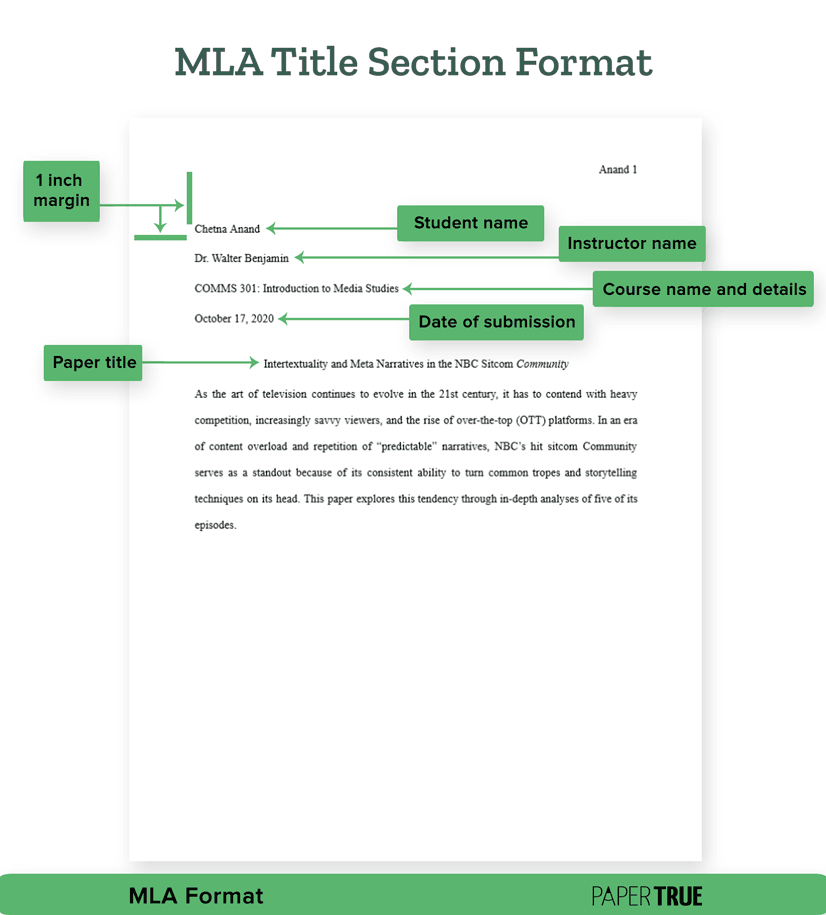
An MLA Style paper with labels indicating different formatting guidelines under the 9th edition.

On a new line, center-align the name of your paper. It should be in the title case, as seen in the example above. Do not underline or bold the title. Don’t enclose it in quotation marks or capitalize it entirely. Don’t italicize the title, except for words that will be italicized in the body text. 

Here are some examples of correct and incorrect MLA-style titles:

Shakespearean Theatre in the 21st Century.

SHAKESPEAREAN THEATRE IN THE 21ST CENTURY

Shakespearean Theatre in the 21st Century

A Critical Analysis of Sally Rooney’s Conversation with Friends

A Critical Analysis of Sally Rooney’s Conversation with Friends

A Critical Analysis of Sally Rooney’s Conversation with Friends

Once you add the title, begin writing the body text in the next double-spaced line. Start from the left margin and leave a half-inch indent, as shown in the infographic above. 

MLA cover page format

While including a cover page is not common practice in an MLA-style paper, you should include one if your instructor specifies it as part of their guidelines. You may also be required to add one if you’re working on a group project. 

In the case of a group project, give each author or contributor’s name its own line, followed by the remaining guidelines we detailed above. 
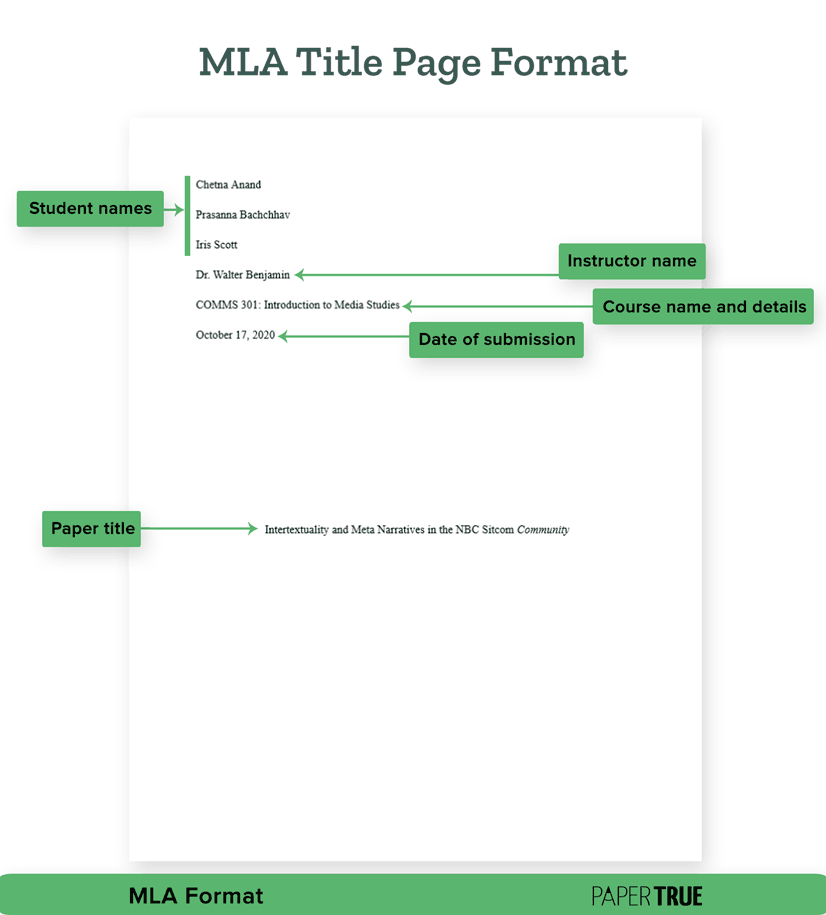
An MLA Style paper with labels indicating different formatting guidelines under the 9th edition.

Note: In some cases, you may also be asked to add your university’s name to the cover page. Check with your instructor about whether you have to do this. 

2. Running head and page numbers 

Each page of an MLA format paper has a header that includes the author’s last name and the corresponding page number. This is known as a “running head”. The MLA format header appears on the top-right corner of each page. 

To add an MLA format header, leave a one-inch margin from the top and add your last name followed by the page number. For example: 

Anand 9 

Bachchhav 14 

Do not add punctuation, text, or special characters between the name and the number. 

Note: If your project has multiple authors and you’re not able to fit all their names in the header, include only the page number. 
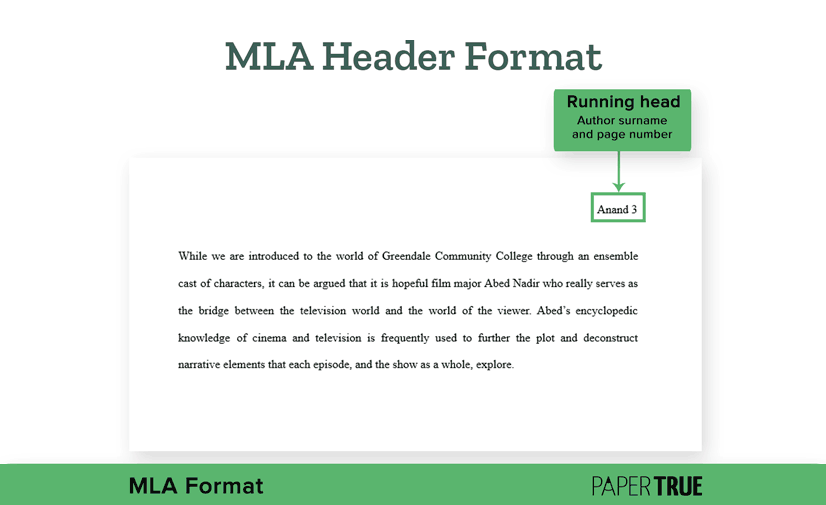
MLA header with a last name and page number included on the top right corner of the page.

Pro-tip: Your word processor usually has a function that will automatically include running heads on each page — this way you won’t have to do this manually! If you’re on Google Docs or MS Word, you can find it under the “Insert” tab. 

3. Internal headings and subheadings 

In an MLA-style paper, headings and subheadings allow you to present your research in a structured and organized manner. When used effectively, MLA format headings are also a great way to establish the hierarchy of ideas presented throughout the paper. 

The MLA formatting rules for headings and subheadings recommend that you should maintain consistency in the way you use them, but the Handbook doesn’t recommend a particular style. This means that the MLA heading format is likely to be contingent on what your instructor recommends. 

MLA heading format general guidelines: 

  • Maintain consistency in the heading/subheading format you’re adopting. This means uniformity in heading levels 1, 2, and so on. 
  • Follow the heading structure in the word processor you’re using (unless your professor gives you detailed instructions). 
  • Arrange headings in descending order of prominence. This means that the second level heading is subordinate to the first level heading, and so on. 
  • Use larger or bolder headings to indicate the first level. Use smaller or italicized font to indicate subordinate-level headings. 
  • Ensure there are two or more instances of each level of heading or subheading. 
  • Align all headings and subheadings with the left margin and not aligned to the center or right. 
  • Avoid using numbers or letters to indicate headings and subheadings unless your instructors specifically ask for them. 

4. MLA format of the works cited section 

Under the MLA 9 format, the list of works you have cited throughout your research should appear at the end of the document, after endnotes (if you’ve included them). 

Follow these instructions while formatting the “Works Cited” section: 

  • Start the works cited section on a new page. 
  • Center-align the heading “Works Cited” one inch from the top margin. 
  • Begin each entry on the left margin. 
  • Add a half-inch indent if the entry exceeds more than one line. 
  • Arrange the entries in alphabetical order by the first author’s last name. 
  • As you did for the rest of the paper, double-space the entire list. 

Each works cited entry should be organized according to MLA guidelines, ensuring proper punctuation and format for each element.

Here’s what an MLA 9 works cited page looks like:
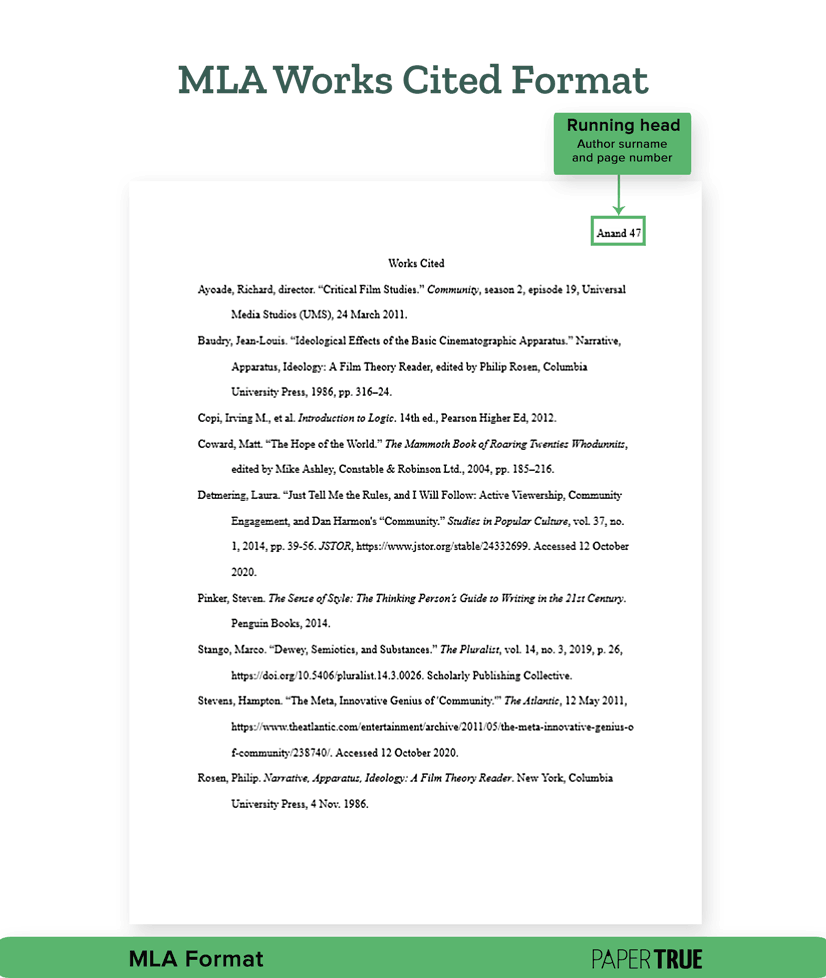
An MLA Works Cited page with a list of references.

5. Tables and illustrations 

Academic papers often include tables and illustrations to complement textual elements in the research. They can be quite effective in elaborating on or providing additional context about what you’ve said in prose. 

According to the MLA formatting rules, there are some general guidelines you should follow while incorporating tables and illustrations in your work. 

MLA format tables 

  • Place tables as close as possible to the text they complement.  
  • Above the table, add the title “Table” followed by an Arabic numeral. 
  • Below this, add the name of the table. 
  • Ensure both these elements are to the left margin and are in the title case. 
  • Ensure each column heading is in the title case. 
  • Double-space each row in the table, using dividers as and when needed. 
  • Add the source (and additional notes) directly below the table as a caption. 
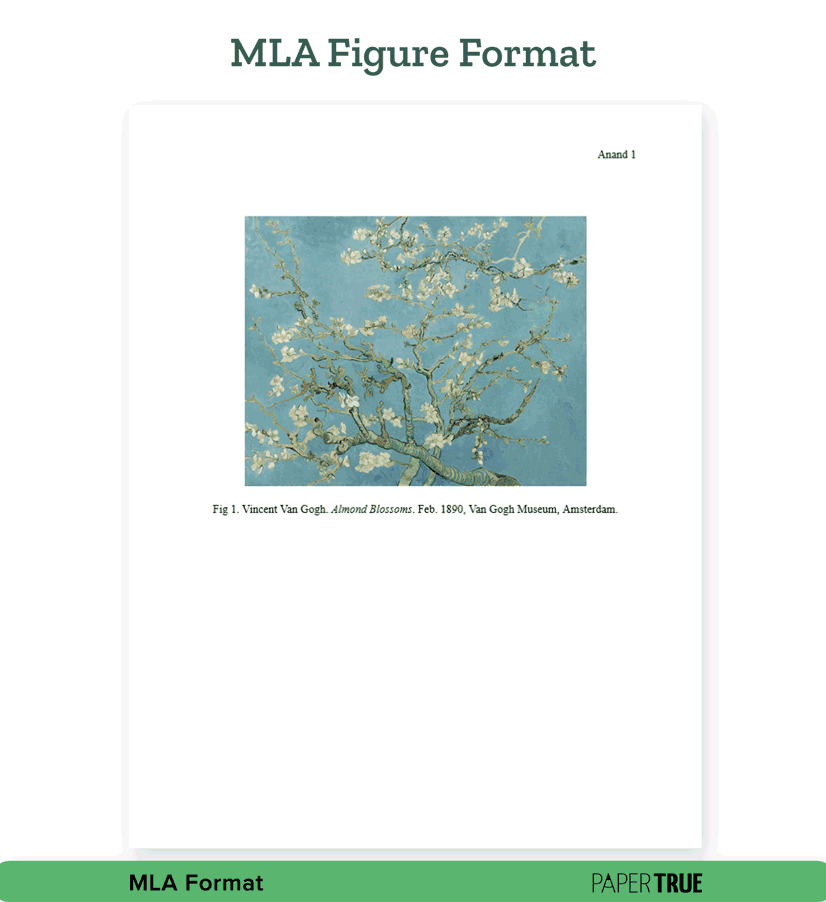
MLA image format for papers or other academic documents such as essays or dissertations.

Illustrations and other visual elements 

  • Use the label “Figure” (or its abbreviation “Fig.”) for visual elements such as photographs, maps, graphs, and charts, followed by the corresponding Arabic numeral. 
  • Follow the numeral with a caption containing complete information about the source of the image. 
  • When you’re providing bibliographic information in the caption, follow the format used in the Works Cited section (without inverting the name of the author/artist). 

6. Quotations in MLA 9 

MLA formatting rules vary for short and long quotes. Let’s take a brief look at both. 

Short quotations (less than four lines in prose or three lines in verse) can remain in paragraphs. Enclose the quoted text with double quotation marks (“”), followed by a parenthetical citation before any punctuation marks in the outer sentence. See below for an example: 

Literature serves its true purpose when an author’s prose provides profound insight, meaning, or significance for the reader. This begs us to question the centrality of the author’s intent and, instead, approach literature as “that composite, that oblique into which every subject escapes, the trap where all identity is lost” (Barthes 145). 

When you’re including longer quotations, place them as a separate block of text, as shown below. Insert the quoted text in a new line, with the entire block double-spaced and indented half an inch from the left margin. Omit quotation marks and add the parenthetical citation after the final punctuation mark in the text. 

When you are quoting verse, maintain line breaks as done in the original text. 

Here’s an example of MLA block quotation citation: 

While the episode itself makes no mention of the poem or its subject, the title alludes to it as an analogy to Heisenberg’s fall as a drug kingpin. Walter’s journey throughout this episode parallels the loss of legacy detailed in the poem: 

My name is Ozymandias, King of Kings;

Look on my Works, ye Mighty, and despair!

Nothing besides remains. Round the decay

Of that colossal Wreck, boundless and bare

The lone and level sands stretch far away. (Shelley 549)

The “colossal wreck” mirrors the crumbling losses in Walter’s life: his family, his empire, and any wealth he could claim his own. 

At PaperTrue, we not only ensure proper formatting but also provide expert editing and proofreading services. If you want to enhance your document to score high, you can consider taking our services. 

Want to keep reading? Here are the newest articles we’ve worked on:
How to Write a Poem: Step-by-Step Guide to Writing Poetry

Whether you’re writing poetry for a class or as a hobby, it can be difficult to get started. Precisely how do you write a poem, and how to write a good poem at that? Do poems have to rhyme? How to write a free verse poem? The questions are endless, but the process is more or less the same.

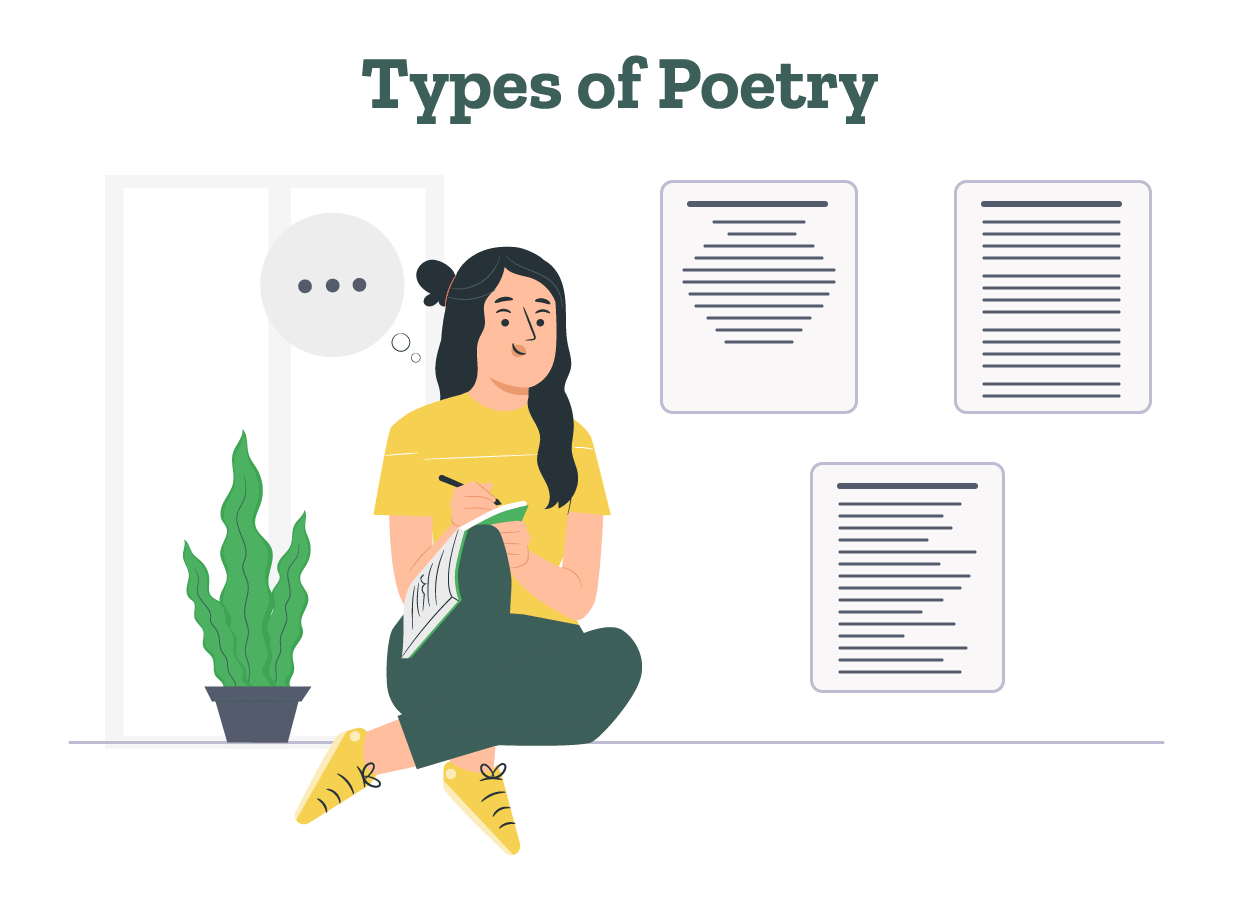
So, let’s unravel the art of poem-writing! We’ll tell you everything from how to start a poem to how to end one. But first, you’d probably want to go through our article on what a poem is, its elements, and its types. Now, let’s get started!

Enhance your poetry with an expert review!

Understanding Poetry

Poetry is a unique form of creative writing that uses language in a condensed and powerful way to evoke emotions, convey ideas, and create a sense of connection with the reader. Unlike prose, poetry often relies on the musicality of words, the rhythm of stressed and unstressed syllables, and the strategic use of literary devices such as metaphor, simile, and imagery. These elements help to create a rich and layered meaning that can be interpreted in various ways.

Here’s how to write a poem:

As you can see, this is a complete guide on how to write a poem for beginners. Let’s take an in-depth look.

1. Read at least ten other poems

All good poem writing comes from reading. If you want your poem to resonate with readers, you need to find out what resonates with you. Ideally, you should be a habitual reader of poetry. But if you’re writing a poem for class or tying it out as a hobby, try reading at least ten different types of poems

Each form offers its own unique way to explore and express ideas. For instance, blank verse poetry follows a specific meter, often iambic pentameter, but does not rhyme, while free verse poetry is unrestricted by conventional rules such as rhyme schemes and meter.

All good poem writing comes from reading. If you want your poem to resonate with readers, you need to find out what resonates with you. Ideally, you should be a habitual reader of poetry. But if you’re writing a poem for class or tying it out as a hobby, try reading at least ten different types of poems. 

Each form offers its own unique way to explore and express ideas. For instance, blank verse poetry follows a specific meter, often iambic pentameter, but does not rhyme, while free verse poetry is unrestricted by conventional rules such as rhyme schemes and meter.

Here are some poems you should read as a beginner:

  • The Sun Rising by John Donne (Metaphysical poem)
  • In Kyoto… by Matsuo Basho (Haiku)
  • Sonnet 18 by William Shakespeare (Sonnet)
  • I Wandered Lonely as a Cloud by William Wordsworth (Pastoral lyric)
  • Because I could not stop for Death by Emily Dickinson (Lyrical poem)
  • The Road Not Taken by Robert Frost (Narrative poem)
  • Jabberwocky by Lewis Carroll (Nonsense poem)
  • Howl by Allen Ginsberg (Free verse, “Beat epic”)
  • Tonight by Agha Shahid Ali (Ghazal)
  • Concrete Cat by Dorthi Charles (Concrete poetry)

Likely, you won’t understand many of these poems on the first read; most readers don’t. Read them three or four times, and once you get the gist, look up their explanations. That’ll clear things up and show you the possibilities in every type of poetry.

Poetry is not just about following rules; it’s about breaking them to create something new and meaningful, whether you choose to adhere to the same meter throughout or experiment with different rhythms.

2. List topics you feel passionate about

Do you want to know how to write good poetry? Know what you’re writing about. Your poem will ring hollow if you write from a shallow state of mind.

“Poetry is the spontaneous overflow of powerful feelings: it takes its origin from emotion recollected in tranquility.” —William Wordsworth

Now, emotion is quite important in poetry, but your poem doesn’t always have to come from an emotional place. You should, however, care deeply about your topic. You can write a good poem only if the topic matters to you.

Here’s how you can narrow down some topics:

  • Reflect on your life experiences, friendship, family, romance, joy, and heartbreak.
  • Think about philosophy: What are your big existential questions?
  • Observe plants, animals, and natural phenomena, and document how they make you feel.
  • Ponder upon the social issues around you.
  • Try freewriting and journaling.
  • If you want to challenge yourself, use poetry writing prompts.

3. Consider poetic form, but not too much

The type of poem you write can affect your poem-writing process. A haiku, for example, dwells on stark images, whereas a limerick is likely to be funny. If you really want to try your hand at a concrete poem, your theme, word choice, and tone will change accordingly. Plus, some forms like sonnets or ghazals are inherently trickier than a haiku or free verse.

So, you should consider the poetic form you’d be most comfortable with. Understanding different rhyme schemes can also help you decide how to structure your written poetry. Make sure not to get caught up in the rules, though. Everyone’s creative process is different. Some poets thrive under the limits of form, while others prefer the freedom of composition. Find what works for you and practice it a few times.

4. Start writing, prioritizing sound

Sound is incredibly important in a poem: It’s responsible for rhythm, which makes poetry pleasing to read. So when you begin to write, pay attention to how your words sound together. Try to create rhyming words, consonance, and assonance as you write. Pay attention to how your lines rhyme, as this can significantly impact the rhythm and flow of your poem. If you’re unsure about this, watch some poetry recitations online and compare them to written poems. This will help you “hear” the words as you write them down.

Consonance:

“Nary a grin grinned Rudolph Reed” —The Ballad of Rudolph Reed by Gwendolyn Brooks

Assonance:

“The lady is a sight

        a might

        a light” —Le sporting-club de Monte Carlo by James Baldwin

You’re probably wondering how to start a poem when you’ve never done it before. It’s simple, really: Just start! No one’s first attempt is Nobel-worthy, but that’s not the point. Simply focus on getting your words out as creatively as you can. If you happen to use a startling image or a tender metaphor while you’re at it, all the better!

It’s best to use pen and paper on your first try. It’s not only easier to organize your thoughts and cancel out lines, but also quicker. Plus, physical activity can help you focus better. 

Does poetry have to rhyme?
No, poetry does not have to rhyme. Many poems achieve a musical effect through assonance alone while many others don’t have a musical effect at all. It all depends on your taste and preference while writing poems!

5. Google synonyms, antonyms, and rhyming words for a rhyme scheme

As beginners, it’s difficult to find the right words for your poem. So it’s perfectly fine to use Google or other tools to look for rhyming words, synonyms, or homophones. Even seasoned poets sometimes have to Google synonyms while writing poems!

Make sure you’re not asking an AI to produce a poem for you, though. That would defeat the purpose of the exercise! (Not to mention, AI-written poems lack originality, nuance, and soul.) But AI tools can be extremely useful while hunting for that slippery word that’s just the right fit in your line.

6. Create original and striking imagery

Imagery is the art of painting a picture using words, and you’re likely to do this in your poem without even realizing it. So pay attention to the images you create and make sure they’re not typical. This is quite important when learning how to write poetry for beginners. Images like a rose, the moon, and the nightingale are so overdone in poetry that they can cheapen your poem.

Depending on the tone and theme of your poem, imagery can even be jarring and disturbing. Here’s an example of how to write such a poem:

“What a thrill –

My thumb instead of an onion.

The top quite gone

Except for a sort of hinge

Of skin,

A flap like a hat,

Dead white.

Then that red plush.” —Cut by Sylvia Plath

Observe how Plath creates the original and raw image of the cut thumb. She uses metaphor (hinge of skin), simile (a flap like a hat), and color (dead white, red plush). You can also describe the senses of sound, smell, taste, and touch to create unique images.

So, make sure that the images you use are vivid and striking. Also, check whether they’re appropriate for your poem: Your images shouldn’t stick out for the wrong reason!

7. Use literary devices

Remember consonance and assonance? Those are literary devices or tools that make your writing more interesting to read. There are more of these, and you should use them in your poem:

Simile: Comparing dissimilar objects using “as” or “like”.

“O my Luve is like a red, red rose” —A Red, Red Rose by Robert Burns

Metaphor: Comparing two objects by saying that one thing is another.

“‘Hope’ is the thing with feathers -” —“Hope” is the thing with feathers by Emily Dickinson

Personification: Giving human characteristics to non-human entities.

“The fog comes

on little cat feet.” —Fog by Carl Sandburg

Symbolism: Using symbols to depict ideas or qualities.

The raven in Edgar Allen Poe’s poem The Raven symbolizes the narrator’s descent into madness.

Oxymoron: Placing contradictory terms together.

“Parting is such sweet sorrow.” —Romeo and Juliet by William Shakespeare

Hyperbole: An exaggerated statement.

“Belinda smiled, and all the world was gay.” —The Rape of the Lock by Alexander Pope

Repetition: Repeating a word or phrase for impact.

“Break, break, break,

On thy cold gray stones, O Sea!” —Break, Break, Break by Alfred, Lord Tennyson

Juxtaposition: Placing two things together for a direct comparison.

“Some say the world will end in fire,

Some say in ice.” —Fire and Ice by Robert Frost

Of all the tips on how to write a poem, this can be the toughest for beginners. In the beginning, using these poetic devices may come off as crafty or put-upon, but you’ll get better at it with practice. When in doubt, think of proverbs and adages: You’ll find the best figures of speech used naturally!

8. Choose an appropriate title

A poem deserves a fitting title; it’s sort of a crowning moment while writing poetry! If you’ve got a strong first line in your poem, you can just use that as the title. Another method is to use the central image, symbol, or theme of your poem as the title. You can even use an interesting line connected to your poem, so your title starts the poem before your first line does.

Whatever route you choose, the title of your poem should be impactful and fitting for the poem. Here are some great examples:

  • Night Sky With Exit Wounds by Ocean Vuong
  • Wild nights – Wild nights! By Emily Dickinson
  • The Language of Dust by Asotto Saint
  • A Small Needful Fact by Ross Gay
  • [Didn’t Sappho say her guts clutched up like this?] by Marylyn Hacker

9. Edit and proofread your poem

The biggest rule of editing any document is to leave it alone for at least a week. This way, you can come back to your poem with a fresh, (slightly more) objective perspective. If you spend this time reading, you’ll have many examples of how to use literary devices in a poem. Enriched with this new knowledge, you can examine your poem and improve it further.

Here’s a poetry editing checklist for your poem:

  • Read your poem aloud. Can you improve its rhythm and sound?
  • If you’ve followed a meter, count the syllables and check the stress pattern.
  • Check line breaks and stanzas to see if the poem can be more impactful if it’s structured differently.
  • Examine your word choice and try out variations and synonyms where you’re unsure.
  • Check your images: Are they vivid? Are they appropriate?
  • Ensure you aren’t using any cliches.
  • Check if the third and fourth lines of your quatrains rhyme, as this can enhance the poem’s rhythm and coherence.
  • Remove all spelling, punctuation, and grammar errors.

The last step can be tricky for new poets since you have to balance poetic license with readability. This is precisely where poetry editing services can step in, helping you refine your poem with expert advice. If you can’t hire an editor, seek feedback on your poem from family, friends, or teachers.

That’s about everything you need to know about how to write a poem! Now, start reading poems so you can start writing one. You can begin brainstorming and listing down all ideas for poem writing. If you’d like some more writing tips, here are some resources that can help:

The 8 Parts of Speech | Types, Uses & Examples

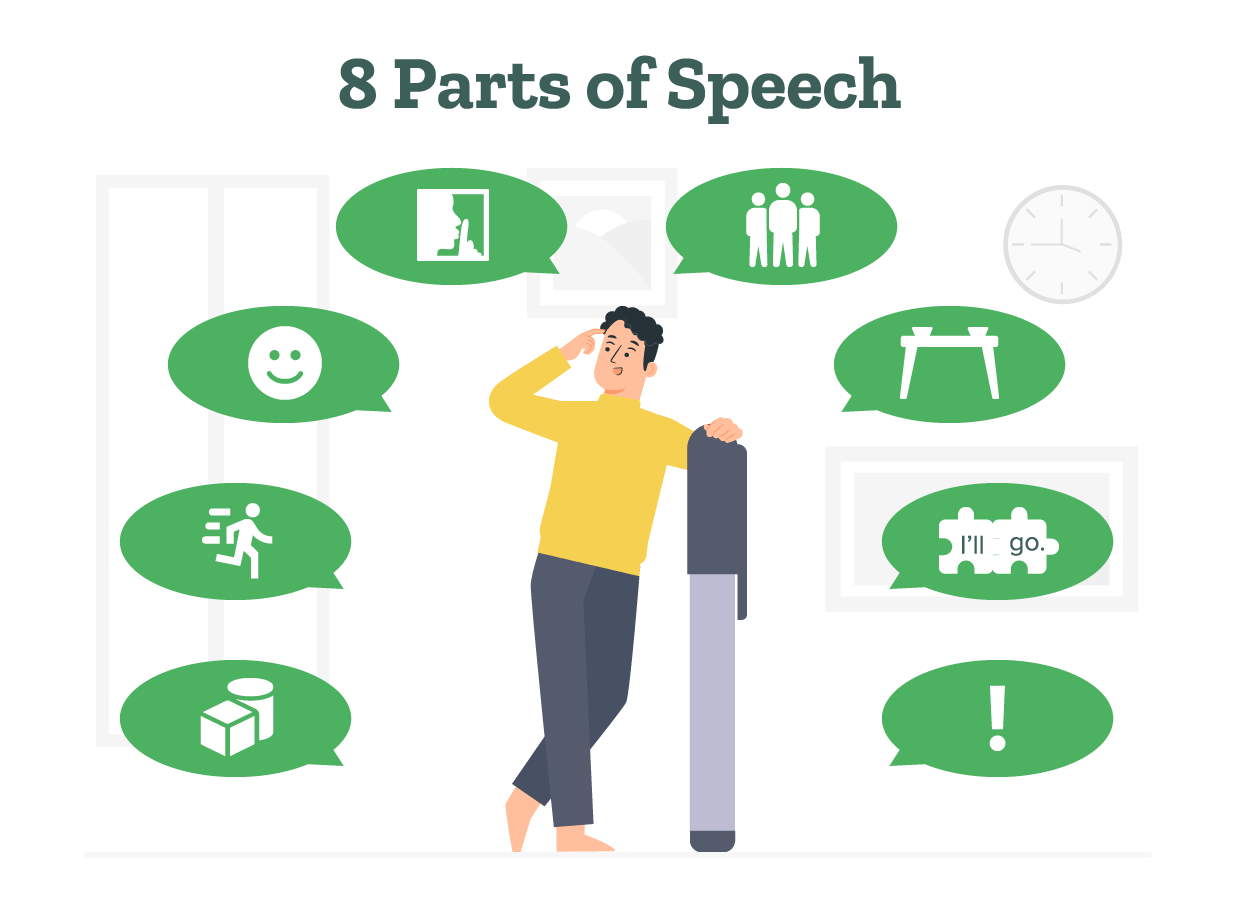
Did you know that every word in the English language can be classified into roughly eight categories? This means that around 170,000 words are sorted into eight simple categories, also known as parts of speech. 

However, this categorization isn’t always easy to decipher, and incorrect categorization leads to grammatical errors. To help you use these categories correctly,  we’ve explained what are the parts of speech with examples. Let’s start with a simple parts of speech definition. 

Do grammar mistakes haunt you? Let our editors help you write better.

What are the parts of speech?

Parts of speech are specific roles and functions of a word in the English language. You can also think of parts of speech as characters in plays, movies, and books, each one having its function. Although the number may vary, modern English classifies these words into the following eight categories: 

  • Nouns
  • Pronouns
  • Adjectives
  • Verbs
  • Adverbs
  • Conjunctions
  • Prepositions
  • Interjections

These parts of speech can further be classified into two categories: open and closed classes. Closed word classes, such as pronouns and prepositions, do not readily acquire new words, contrasting with open-class words that evolve over time.

Open classes

The word classes where new words can be easily added are known as open classes. These include nouns, adjectives, verbs, and adverbs. Open classes contain a greater number of words as compared to closed classes. 

Closed word classes

Parts of speech that are more resistant to change are known as closed classes. These include conjunctions, prepositions, and interjections. New words are rarely added to these classes. 

Eight parts of speech

Each word in the English language performs one of eight roles. These eight parts of speech can be better explained with the help of the following chart:

Let’s look at all these categories of parts of speech with examples:

1. Nouns

A name or title given to an object, person, group, or concept is known as a noun. It can either be the subject of a sentence (an individual who acts) or the object of the verb (receiver of the action). 

Nouns can be further divided into common nouns (A generic term used to refer to somebody or something) and proper nouns (A specific name used to refer to an individual, place, or concept). The first letter of proper nouns always has to be capitalized, whereas the first letter of common nouns is only capitalized at the beginning of a sentence. 

Other types of nouns include collective nouns, abstract nouns, and gerunds. Let’s look at the use of these nouns in a sentence.

  1. Collective noun: The team performed its best and won all the tournaments.
  2. Common noun: The inexperienced chef surprised everybody by creating a delectable dessert.
  3. Proper noun: Margot is vacationing in Normandy and Paris.
  4. Abstract noun: She finds happiness in traveling to different countries. 
  5. Gerund: Swimming always manages to calm me down.

2. Pronouns

To avoid repetition, pronouns are used as stand-ins for nouns. A pronoun is usually used to indicate a noun that has already been mentioned. It can refer to people, places, objects, or concepts.  Pronouns can further be divided into the following categories:

  • Personal pronouns (I, you, he, she, it, we, they)
  • Possessive pronouns (mine, yours, his, hers, its, ours, theirs)
  • Demonstrative pronouns (this, that, these, those)
  • Interrogative pronouns (who, whom, whose, what, which)
  • Reflexive pronouns (myself, yourself, himself, herself, itself, ourselves, yourselves, themselves)
  • Relative pronouns (who, whom, whose, which, that)

Let’s look at a few example sentences with these different types of pronouns:

  1. Personal pronouns: Maria is a party animal but values her alone time.
  2. Possessive pronouns: Lea is a voracious reader. The copy of The Death of Vivek Oji is hers
  3. Demonstrative pronouns: This is my cat, Milo. 
  4. Interrogative pronouns: Who do you think wrote the letter, and to whom was it addressed?
  5. Reflexive pronouns: After a long day at work, James treated himself to a relaxing spa session.
  6. Relative pronouns: The book that won the Pulitzer Prize is now a bestseller.

3. Adjectives

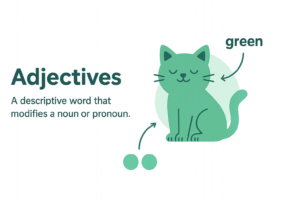
A descriptive word that modifies a noun or pronoun is known as an adjective. It elaborates on characteristics and provides descriptions of the subject they modify. This may include physical characteristics, qualities, or quantity of the subject. 

Adjectives can either be placed before or after nouns or pronouns. Adjectives are used to describe nouns, providing detailed descriptions of objects, emotions, and experiences. Here is an example:

My father gifted me a blue pen before my exams. It was a lovely pen with dark blue ink.


A cat is described as green in color using an adjective which is a part of speech.


4. Verbs

A word that indicates an action, an event, or a state of being is called a verb. It indicates the action the subject is performing by itself or on an object. A complete sentence must at least contain a subject and a verb. 

Verbs can be altered according to the subject, tense, and tone of voice. They can further be divided into two categories:

  • Regular verbs: Verbs whose simple past and past participle forms end with a d or ed.
  • Irregular verbs: Verbs whose simple past and past participles are constructed differently.

Let’s take a look at examples of both these verbs:

Tara walked towards me and embraced me. 

Jamil came to meet me. 

5. Adverbs

An adverb is a descriptive word that gives more information about a verb, adjective, or another adverb. A rule of thumb to turn an adjective into an adverb is to simply add ly at the end. However, not all adverbs follow this pattern, such as “fast” and “well.”

Adverbs can be further divided into the following types:

  • Adverb of manner: description of how something is done
  • Adverb of degree: description of the extent something is taken to
  • Adverb of place: description of where an event takes place

Here are a few examples of these adverbs in a sentence:

  1. Adverb of manner: Playing fast and loose will not always get you where you want.
  2. Adverb of degree: There is no normal; everyone is slightly deviant in their own way.
  3. Adverb of degree: Let’s get back inside, it’s raining cats and dogs.

6. Conjunctions

A conjunction is a word used to join two or more sentences, phrases, clauses, or words. There are three types of conjunctions:

  • Coordinating conjunctions: Used to connect two grammatically equal entities.
  • Subordinating conjunctions: Used to connect a dependent clause to an independent clause.
  • Correlative conjunctions: Used to connect two grammatically equal parts of sentences.

Here are a few example sentences with all three types of conjunctions:

Most animals have a fight-or-flight response to potentially dangerous situations. (Coordinating conjunction) 

Although it was snowing very heavily, the schools were still open. (Subordinating conjunction) 

Both Trixie and Katya like to indulge in psychological thrillers. (Correlative conjunctions) 

7. Prepositions

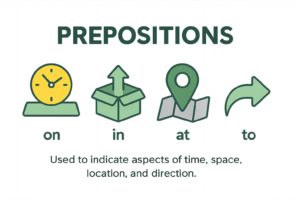
A preposition is a word or phrase that indicates the relationship of the noun or pronoun with the rest of the sentence. Prepositions can be used to indicate aspects of time, space, location, and direction. A prepositional phrase consists of a preposition followed by a noun or pronoun, and it serves to modify another word in a sentence. Here are a few example sentences with prepositions:

Sam is the head of the department.

Capybaras swim with their heads above the water.

Shall we meet by the river at 6 pm?


Prepositions like on, in, at, and to are shown as parts of speech.

8. Interjections

Interjections are exclamations that form a separate part of the sentence. They are used to indicate emotions such as awe, joy, pain, or hesitation. They can also be used as a command or a greeting. Here are some example sentences with interjections:

Wow! What a game.

Ouch! That hurt. 

Psst! Do you have an extra pencil?

Hey! How are you today?

Shush! The baby is sleeping. 

Other parts of speech

The following categories at one point were considered separate parts of speech, but are now more or less integrated with the other eight parts of speech. Let’s take a look.

Determiners

Determiners are words that describe the qualities of a noun, such as quantity, belonging as well as position. As per the traditional eight parts of speech, these are classified as adjectives or even pronouns. 

Here are a few example sentences:

That is my chair.

Few people believe in the power of positive reinforcement.

We met plenty of tourists in Bangkok, many of whom were from our city.

Articles

Articles are used to modify a noun to indicate if it is general or specific. There are two types of articles.

  • Definite articles (the): Used to indicate a specific version of a noun.
  • Indefinite articles (a, an): Used to indicate a generic version of a noun.

Here are some examples of these articles: 

A cow was lazily grazing in the meadow.

He noticed that an eye of the pigeon was red. 

Although articles can be classified as a separate part of speech, they are generally included under the category of determiners.

Words functioning as multiple parts of speech

Certain words can function as multiple parts of speech depending on the way they’re used. Let’s look at a few example sentences with these words:

1. Run

The word run can function as a verb, noun, as well as an adjective, depending on how it’s used. Here are a few example sentences with the word run used in different contexts.

Richard runs by the lake every morning. (Verb) 

We should start going for evening runs together. (Noun) 

Edgar scored the top grade but Violet certainly gave him a run for his money. (Adjective) 

2. Lead

The word lead can function as a noun as well as an adjective. Here’s how it’s used in both these cases:

She is the only lead we have. (Noun) 

The lead surgeon failed to show up for the operation. (Adjective) 

3. Work

Work can be used as a verb as well as a noun, depending on the circumstances. Here are a few example sentences of work in both contexts:

I usually leave work at 5:00 pm. (Noun) 

You must work tirelessly to achieve success. (Verb) 

These differences may seem trivial at first but are key to perfect writing. As editing and proofreading experts, we realize the importance of understanding grammar concepts for flawless writing. 

We’ve created a useful list of resources to help you minimize such errors. We hope they help bring out the best in your words!

15 Best ATS-Friendly ChatGPT Prompts for Resumes in 2025

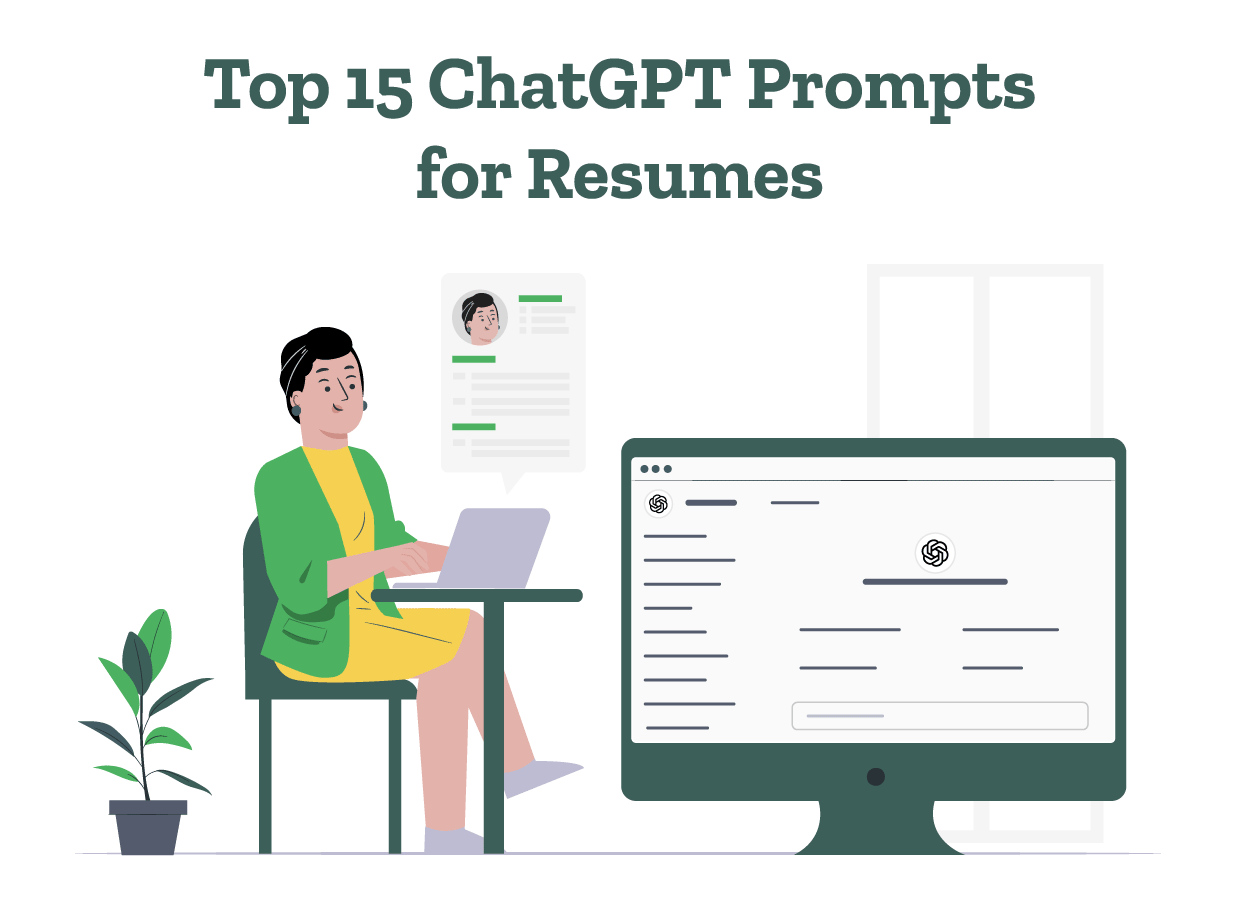
Creating a standout resume is a crucial step in landing your dream job. With the rise of artificial intelligence, tools like ChatGPT can significantly streamline this process. In this article, we’ll guide you through the 15 best ChatGPT prompts for resumes to harness the full potential of ChatGPT in generating, editing, refining, tailoring, and proofreading your resume.

These prompts are designed to leverage the power of ChatGPT to create a resume that not only stands out but also effectively communicates your skills and experiences. Let’s make your resume ATS-friendly with the best ChatGPT prompts for resume writing!

Get perfect editing and make your resume stand out!

What is ChatGPT, and how can it help with resumes?

ChatGPT is a powerful AI tool that leverages natural language processing (NLP) technology to generate human-like text responses. In the context of resume writing, ChatGPT can be a game-changer for job seekers in today’s competitive job market. By using ChatGPT, you can create a compelling resume that highlights your professional profile, tailors your resume to specific job descriptions and opportunities. Using ChatGPT can help you review and upgrade your resume, making it more effective in standing out to hiring managers and recruiters.

Without further ado, let’s see the best ChatGPT prompts for resume building:

1. ChatGPT prompts for resume creation

Prompt 1

This is one of the best ChatGPT prompts for resume creation:

Based on my background in [Industry/Field], draft a resume that highlights my [Number] years of experience, education from [University/College], and skills in [List of Skills]. Focus on illustrating achievements in [Specific Projects or Roles] and incorporate industry-relevant keywords for ATS optimization.

Prompt 2

This ChatGPT prompt for resume crafting is designed to highlight your journey:

I’ve worked in [Industry/Field] for [Number] years, specializing in [Specialization]. Using this information, create a resume that showcases my expertise, contributions to [Specific Projects or Initiatives], and my growth from [Entry-Level Position] to [Current Position]. Emphasize skills such as [List of Skills] and include any relevant certifications.

Prompt 3

Utilize this ChatGPT prompt for resume writing to ensure comprehensive coverage:

Generate a resume for someone with a background in [Field/Industry], detailing [Number] years of experience and education from [University/College], majoring in [Major]. Highlight leadership roles in [Clubs/Organizations], involvement in [Projects], and proficiency in [Skills]. Tailor the resume to appeal to employers looking for [Job Title], with a focus on ATS-friendly formatting and content.

What’s ATS?
The full form of ATS is “Applicant Tracking System”. It refers to a software application that enables the electronic handling of recruitment and hiring needs, streamlining the process by sorting and ranking candidates based on resume keywords and other criteria.

Using these ChatGPT resume prompts, you can create quick and editable resume templates for yourself. If you indeed want a quicker way to build your resume, you can always use AI resume builders to make this process easier.

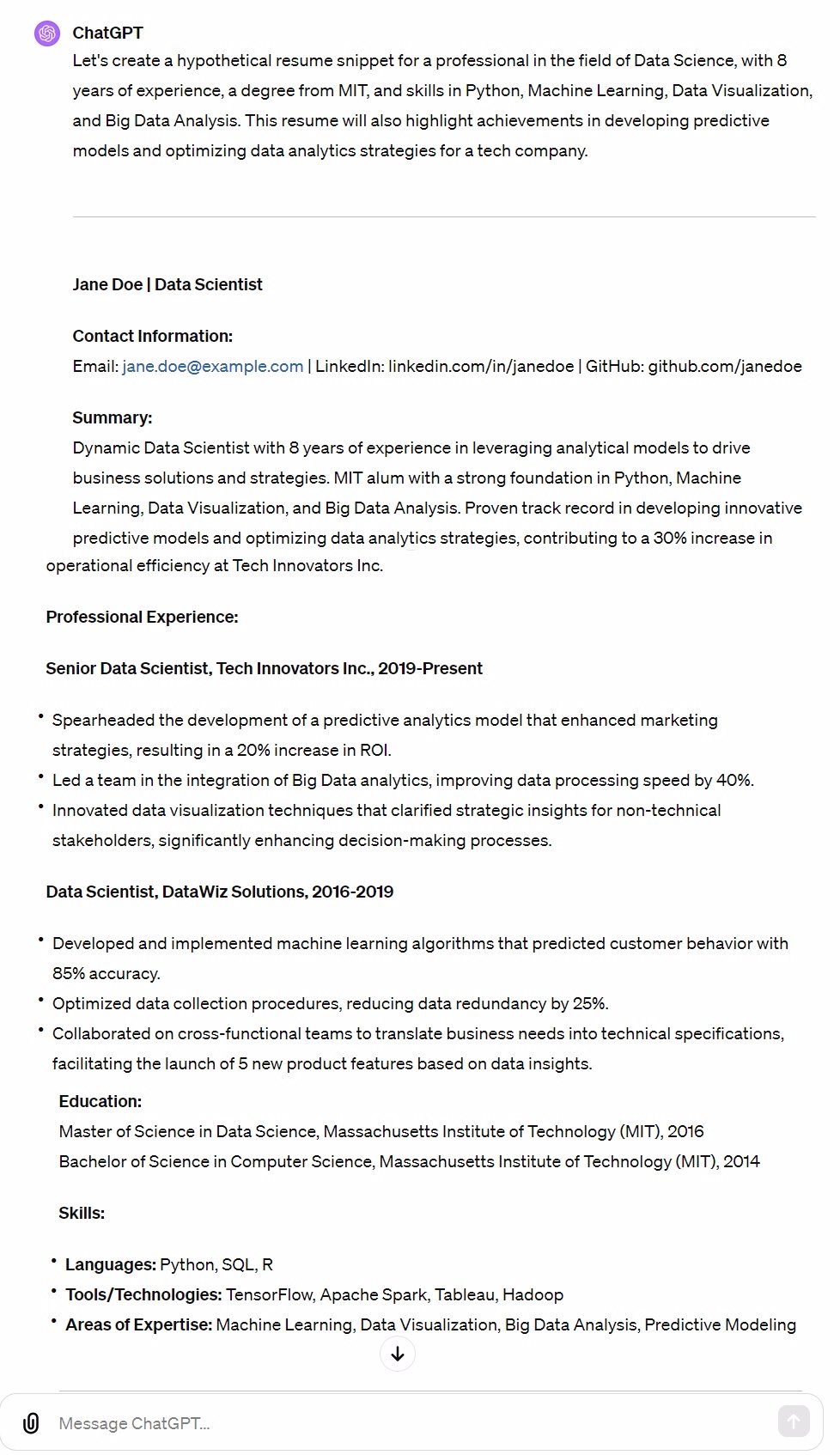
A result for ChatGPT prompt for resume.

2. ChatGPT prompts for resume editing

Prompt 4

Leverage this ChatGPT prompt for resume editing for a polished finish:

Review and edit my current resume, focusing on enhancing the clarity and impact of my experience in [Industry/Field]. Strengthen the language to better showcase my achievements, particularly in [Specific Roles or Projects], and ensure the layout is ATS-friendly. Adjust the skills section to better reflect the requirements of [Job Title].

Prompt 5

This is among the best resume prompts for ChatGPT:

Refine my resume by revising the summary to more accurately reflect my [Number] years of experience in [Industry/Field] and my key accomplishments, especially in [Key Projects]. Improve the readability and keyword alignment for [Job Title], ensuring that my skills and experiences are presented in a compelling way. 

Prompt 6

This prompt for ChatGPT resume editing is crucial for impact:

Take my existing resume and transform it into a more dynamic and engaging document. Pay special attention to rewording the experience section to highlight my contributions to [Company/Project] and my skill in [Skill]. Ensure the language is active and the achievements are quantified, aligning with the expectations for [Job Title].

Using ChatGPT prompts for resume editing is a free and easy way to edit your resume. But for a more professional resume, you can always opt for top resume editing services.

3. ChatGPT prompts for resume refinement

Prompt 7

Use this AI prompt for resume refinement to make your experiences stand out:

Enhance my resume by integrating powerful action verbs and quantifiable outcomes, especially relating to my time at [Company] where I led [Project/Initiative]. Emphasize skills that are crucial for [Job Title], and adjust the layout for better readability and ATS compatibility.

Prompt 8

This is an essential ChatGPT prompt for resume writing, tailored for precision:

Refine my resume’s skills and achievements sections to more effectively target [Job Title]. Include specific examples of how I successfully applied [Skill] in a professional setting, leading to [Result]. Ensure the language used matches the industry lingo for [Industry/Field]. 

Prompt 9

This prompt for ChatGPT for resume refinement is key for targeting:

Optimize my resume for [Job Title] by highlighting my most relevant experiences and skills. Focus on my role in [Project/Event] and my proficiency in [Skill], making sure to present this information in a way that’s engaging and ATS-friendly. Adjust the formatting to emphasize these sections.

4. Industry-specific ChatGPT prompts

Prompt 10

This ChatGPT prompt for resume building is perfect for industry veterans:

Create a resume tailored for the [Industry/Field], emphasizing my expertise in [Area of Expertise] and experience with [Technology/Methodology]. Highlight my achievements in [Project/Role] and how they’ve contributed to business outcomes. Use industry-specific terminology and ensure the format is suitable for ATS systems.

Prompt 11

This is a prime example of industry-specific AI prompts for resume crafting:

Draft a resume focused on [Industry/Field], detailing my journey from [Entry-Level Position] to [Senior Position]. Highlight specific technical skills, such as [Skill], and major projects, like [Project], that demonstrate my contributions to the field. Format the resume to appeal to key industry players and ATS.

Prompt 12

Utilize this ChatGPT prompt for resume writing to underscore industry expertise:

For a professional in [Industry/Field], generate a resume that showcases a strong background in [Area], including projects like [Project] and skills such as [Skill]. Emphasize any awards or recognitions received and ensure the document is polished, professional, and ATS-optimized.

You can also use ChatGPT prompts for a resume and cover letter to write a cover letter to go with your resume while applying for a job. A cover letter stating why you are interested in the position and why you might be a good candidate for the role can increase your chances of being considered for it.

5. ChatGPT prompts for resume proofreading

Prompt 13

This ChatGPT prompt for resume proofreading is essential for a flawless presentation.

Proofread my resume for mistakes in grammar, punctuation, and consistency. Focus on improving the flow and readability, ensuring that the language is appropriate for [Job Title] applications within [Industry/Field]. Verify that the format is ATS-friendly and that all information is accurately presented.

Prompt 14

This resume prompt for ChatGPT ensures precision and professionalism:

Conduct a thorough review of my resume, identifying and correcting any typos or formatting inconsistencies. Enhance the overall structure to better suit applications for [Job Title], paying special attention to the alignment of the skills and experiences sections with industry standards.

Prompt 15

This ChatGPT prompt for resume proofreading is the final step to perfection:

Examine my resume for clarity, coherence, and conciseness, with an eye toward applications in [Industry/Field]. Ensure that each section, from the summary to the education, is well-written and free of errors, and that the document meets the criteria for ATS systems and appeals to potential employers.

You can also get help from the top online proofreading services available, to ensure that your resume is crisp and perfect.

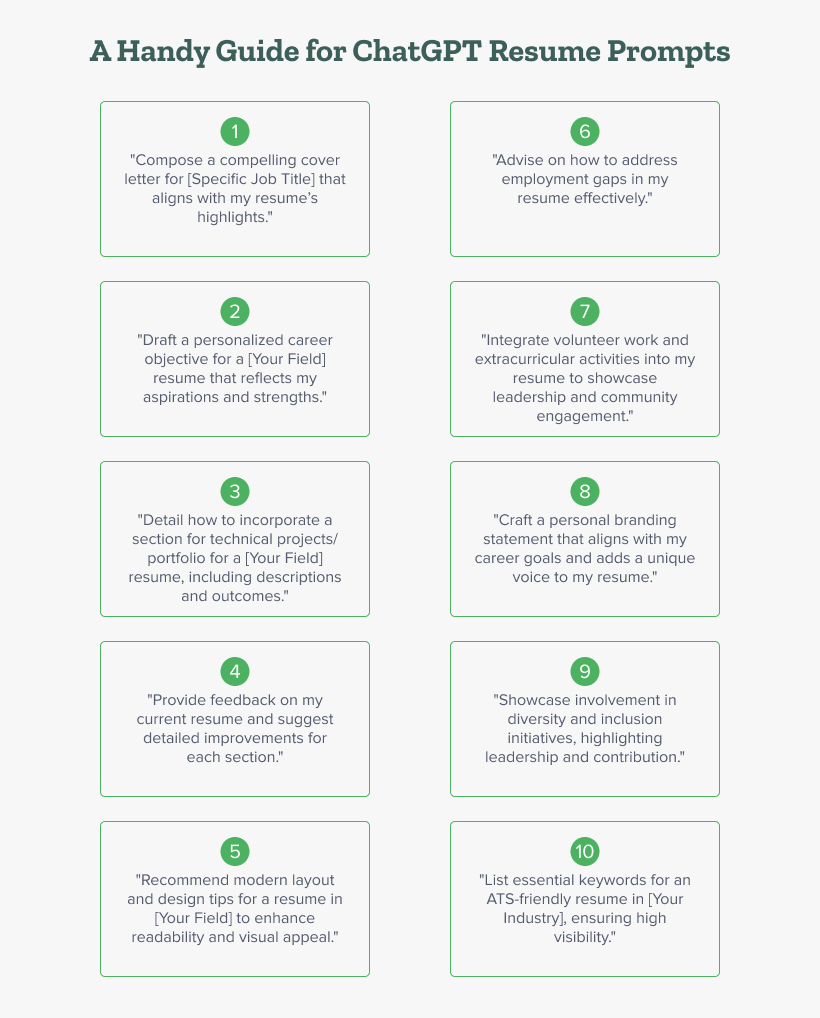
A handy guide on ChatGPT prompts for resume.

By utilizing these ChatGPT prompts for resume creation, editing, refinement, and proofreading, job seekers can craft various types of resumes easily. These resumes will not only pass ATS filters but also captivate the attention of hiring managers.

Tailoring Your Resume to a Job Description

Tailoring your resume to a job description is crucial in today’s competitive job market. ChatGPT can streamline this process by helping you customize your resume based on each job description. Simply paste the job description and your current resume into the chatbot and ask it to identify key skills and qualifications. ChatGPT can also suggest ways to adjust your resume to match the specific requirements of each job description. By using ChatGPT to tailor your resume, you can increase your chances of getting noticed by hiring managers and recruiters.

Creating Effective Resume Bullet Points with ChatGPT

Creating effective resume bullet points is essential for showcasing your achievements and skills to hiring managers and recruiters. ChatGPT can assist you in crafting impactful resume bullet points that highlight your accomplishments and experience. Ask ChatGPT to suggest action verbs and industry-specific language to make your resume bullet points more engaging. Additionally, ChatGPT can help simplify complex jargon, making your resume clear and accessible. By using ChatGPT to create effective resume bullet points, you can make your resume stand out in a crowded job market.

Enhancing Your Resume with AI

In addition to ChatGPT, there are other tools that can help enhance your resume. AI-powered resume builders can assist you in creating a professional-looking resume with a modern design, while AI-powered keyword optimization tools can help you identify relevant keywords and phrases to include in your resume. By combining ChatGPT with other AI tools, you can take your resume to the next level. Remember to always review and customize the AI-generated content to ensure it accurately represents you and meets the specific requirements of the jobs you’re applying for.

The goal of your resume is to showcase your skills, experiences, and achievements in a manner that is both compelling and relevant to your desired job title. As experts in resume editing and proofreading services, PaperTrue helps refine your resume to perfection and makes it stand out in today’s competitive job market!

If you’d like to keep reading, here are a few informative articles:

The Four Main Types of Essay | Quick Summary with Examples

An essay is a highly versatile, non-fictional piece of writing aimed at persuading, informing, or entertaining the reader. It can serve multiple functions, such as taking a stance on topics, disproving widely believed myths, and sharing interesting anecdotes. 

There are various styles and types of essay writing that can be used to serve specific functions. In this article, we’ll take a detailed look at the four main types of essays, along with the combinations and derivations of these types. Let us understand what are the different types of essays.

Upgrade your essay to perfection with our expert editing services today!

What are the four main types of essays?

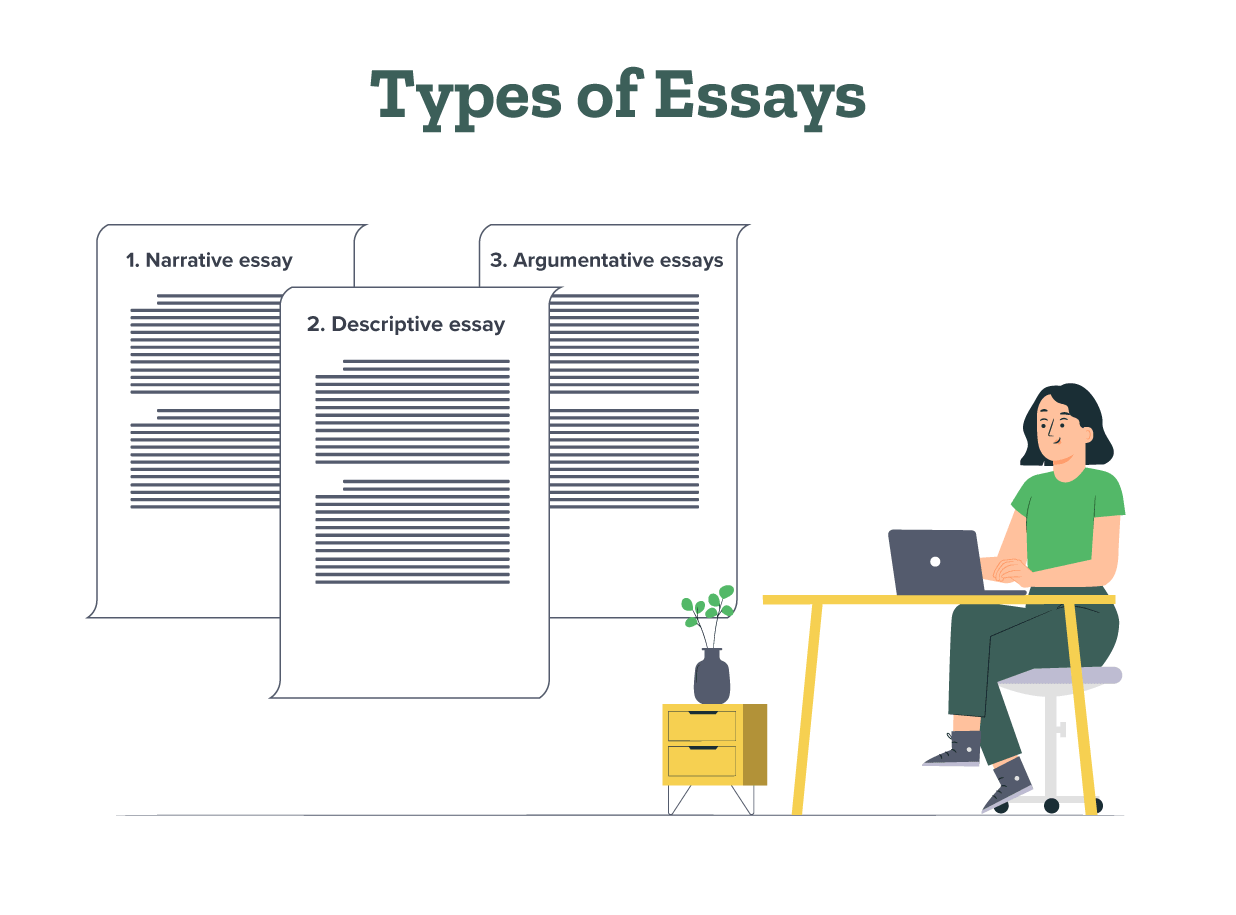
There are four types of essays you can write depending on the message you want to convey. They include narrative essays, descriptive essays, argumentative essays, and expository essays. 

Narrative and descriptive essays aim to tell a story or describe an immersive experience with the help of sensory descriptors. Expository and argumentative essays aim to educate and inform the reader on a particular topic. 

There are many more types of essay that are a combination or derivation of these four essay types. Here are the four main types of essays. To help you better understand these essay types, we’ve also constructed relevant example essays. 

1. Narrative essay 

A narrative essay is a type of writing that involves telling a story using either highly specific or open-ended prompts. It is a form of personal and creative nonfiction that tests your ability to build up your story in a well-structured format. The use of storytelling techniques such as similes, metaphors, alliteration, imagery, and dialogue is common in narrative essay writing.

It typically begins with the introduction of the settings and characters of the story. The body consists of the highlights of your life, often described with the help of vivid imagery. The conclusion includes reflections on the meaning or significance of the events, as well as any lessons learned or insights gained from experience.

A personal statement is one example of a narrative essay, where you tell a story about yourself in order to convince the reader of your suitability for a particular role or position.

Let’s understand the structure of a narrative essay better with the help of this example: 

My First Job as a Server

My first job as a server was a crash course in hard work, patience, and resilience. I was eager to work and earn my own money, but I had no idea what I had signed up for.

I soon discovered that this job was no walk in the park. I had to constantly be on my feet, multitasking and juggling multiple orders at once. But with the help of my manager and fellow servers, I was quickly able to learn the ropes.

One of the biggest challenges I faced was being patient with irate customers. Initially, their harsh words made me doubt my abilities. But, over time I developed a thick skin and became immune to their comments. 

These experiences taught me to be patient with myself as well as with others. I developed a sense of empathy, that I never would have otherwise and learned not to take things personally. Due to the fast-paced restaurant environment, I also learned how to multitask and manage my time efficiently.

Looking back, I can confidently say that these experiences shaped me into the person I am today.  These lessons have stayed with me throughout and continue to influence the way I approach challenges.

2. Descriptive essay

A descriptive essay aims to provide an immersive experience for the reader by using sensory descriptors. Unlike a narrative essay, which tells a story, a descriptive essay has a narrower scope and focuses on one particular subject or aspect of a story.

For example, a descriptive essay about a beach may describe the warmth of the sand underfoot, the sound of the waves crashing against the shore, the salty smell of the ocean breeze, and the taste of saltwater on the lips. These sensory details bring the reader into the experience and allow them to imagine themselves in the setting.

One key tip for a descriptive essay is to choose your words carefully, using language that is both specific and evocative. By doing so, you can create a strong emotional connection between the reader and the subject of the essay. The goal is to make the readers feel as though they are a part of the setting, experiencing it firsthand. You can always take the help of AI essay writers to get a blueprint for your essay.

Let’s understand this in more detail with the help of an example:

Cherry Blossoms in Japan

Japan’s cherry blossom season is a magical time of year when the country is covered in a sea of pink and white petals. The colors are striking and seem to change with the light and angle of the sun. 

The soft, delicate petals dance in the wind, filling the air with a sweet fragrance that can be smelled everywhere. The sound of the petals rustling and swaying in the breeze is soothing and calming. 

Families and friends gather beneath the trees, enjoying picnics and drinks, adding to the festive atmosphere. The taste of the cherry blossom is subtle but distinct, and many Japanese sweets and drinks are flavored with sakura. 

The essence of the cherry blossom is hope and renewal, reminding us of the fleeting nature of life and the importance of savoring each moment. It is a time when the entire country comes together to celebrate life’s beauty and the present moment. 

Witnessing the cherry blossom in Japan is a sensory feast that evokes feelings of joy, wonder, and gratitude. It is an unforgettable experience that should not be missed.

3. Argumentative essays

An argumentative essay is an extended argument that aims to persuade the reader to adopt a particular stance based on factual information and statistics. It is one of the most common forms of college essays.

The purpose of an argumentative essay is to present a well-reasoned and well-supported argument in favor of a particular position. You must provide relevant evidence, logical reasoning, and convincing arguments to support your stance. The goal is to convince the reader to accept your point of view.

To write an effective argumentative essay, you must conduct thorough research. This involves gathering reliable sources of information, analyzing it, and synthesizing it into a coherent argument. You should also consider counterarguments and address them in your essay to strengthen your position.

Let’s take a look at an example:

The Power of Positive Reinforcement

Positive reinforcement is a powerful tool for motivating individuals and increasing performance efficiency. It involves rewarding desired behavior, rather than punishing negative behavior. Research has shown that positive reinforcement can be highly effective in both school and workplace settings.

In a study conducted by the University of Melbourne, researchers found that students who received positive feedback from their teachers were more likely to be engaged and motivated. They were also more likely to participate in class and have better academic performance.

Similarly, in a corporate setting, positive reinforcement has been shown to improve employee morale and job satisfaction. A study by the Society for Human Resource Management found that 89% showed high levels of motivation when their achievements were recognized and appreciated. Additionally, 86% of employees showed increased job satisfaction.

Positive feedback, also helps individuals think creatively and develop strong problem-solving skills. A study conducted by the University of Illinois involved participants engaging in a brainstorming task, where some were provided with positive feedback and others were not. The results showed that those who received positive feedback demonstrated significantly greater creativity and better problem-solving abilities than those who did not.

Positive reinforcement is proven to be powerful tool that should be implemented in both academic and corporate settings. It not only improves academic and workplace achievements but also promotes creativity and problem-solving skills. 

4. Expository essays

An expository essay is a common format used in school and college exams to assess your understanding of a specific topic. The purpose of an expository essay is to present and explore a topic thoroughly without taking any particular stance or expressing personal opinions.

An expository essay does not require an original argument and requires less research as compared to an argumentative essay. However, you should be able to cover a topic from all angles and provide factual information to support your argument. You should also be able to structure your essay in a well-organized, logical format, with a clear introduction, body, and conclusion. 

The term “expository essay” is an umbrella term used to describe several different types of essays. They include classification essays, definition essays, compare and contrast essays, and cause and effect essays.

Let’s take a look at an example:

The Legacy of Thomas Edison 

Thomas Edison was one of the most important inventors in history, credited with over 1,000 patents during his lifetime. He was born in Ohio in 1847 and grew up in Michigan, where he received very little formal education. Despite this, Edison showed a strong interest in science and technology from an early age and began conducting experiments in his spare time.

In his early career, Edison worked as a telegraph operator and began to develop his own inventions, including an improved stock ticker and a quadruplex telegraph system. In 1877, he invented the phonograph, a device that could record and play back sound. This invention helped establish Edison as a leading inventor and made him a household name.

One of Edison’s most famous inventions was the incandescent light bulb, which he developed in the late 1870s. This invention revolutionized the way people lived, allowing them to work and live comfortably even after sunset. Edison’s work on the light bulb led to the development of the electrical power grid, which helped bring electricity to homes and businesses across the country.

Throughout his career, Edison remained committed to the idea of practical invention, focusing on creating devices that would have a real impact on people’s lives. He famously said, “Anything that won’t sell, I don’t want to invent. Its sale is proof of utility, and utility is success.”

Overall, Thomas Edison’s impact on the world of invention and innovation cannot be overstated. His inventions helped transform the world and set the stage for many of the technological advances that we enjoy today.

Other types of essays

Now that we’ve looked at the four main types of essays, let’s take a look at the combinations and derivations of these types.

These different types of essays include:  

1. Persuasive essays

These types of essays aim to convince the reader to adopt a particular viewpoint. They achieve this by using personal anecdotes and experiences, which are backed up by factual evidence. Although they share some similarities with argumentative essays, persuasive essays place greater emphasis on emotion and personal narratives, on top of providing factual evidence.

Persuasive essays follow three methods of persuasion: Ethos, pathos, and logos. These methods are utilized to effectively convince the reader to adopt a particular viewpoint. 

  • Ethos involves establishing the writer’s strong moral character, creating a sense of trustworthiness and reliability with the reader. 
  • Pathos aims to evoke an emotional response from the reader in order to sway them toward the writer’s viewpoint. 
  • Logos relies on providing the reader with hard facts, statistics, and evidence to convince them to adopt the writer’s standpoint.

Here’s an example: 

Importance of Mental Health Days in Corporate Settings

Employees need mental health days for their overall wellbeing and productivity. According to the World Health Organization, one in four people globally are affected by mental health disorders, which can lead to absenteeism, presenteeism, and decreased productivity in the workplace.

Taking a mental health day can provide a necessary break from work-related stress and allow employees to focus on their mental well-being. It can help prevent burnout and reduce the risk of developing serious issues such as depression or anxiety. Employees who feel supported in taking mental health days are more likely to return to work feeling refreshed and recharged, leading to increased productivity and creativity.

Furthermore, promoting mental health days in the workplace can foster a culture of transparency and support. When employees feel comfortable discussing their concerns with their employers and colleagues, it creates a sense of trust and understanding. This can lead to a more positive work environment and a higher level of employee morale.

In conclusion, mental health days are not a luxury, but a necessity for maintaining employees’ mental health and wellbeing. Employers who recognize the importance of mental health days and actively promote them in the workplace can create a more productive, positive, and healthy work environment for their employees.

2. Critical essays

A critical essay is not necessarily an evaluative piece of writing, but rather a thoughtful and analytical approach to interpreting a work of art. Through this process, you can provide valuable insights that enhance the reader’s appreciation and understanding of a piece.

These types of essays are common projects assigned to students in school or college. They involve the analysis and interpretation of a text or a visual medium. It goes beyond criticism despite the negative connotation of the term “critical”. It analyzes themes, characters, plots, and other crucial aspects to gain a deeper insight into the message or purpose of a literary or visual piece.

The critical essay-writing process involves actively reading or observing a piece of art or literature and forming a central idea or thesis statement on the basis of these observations. The body paragraphs consist of topic sentences that bolster the thesis statement, along with pieces of evidence proving these statements. The conclusion consists of the summary of the most impactful parts of your essay along with a powerful concluding statement.

While writing a critical essay or literary analysis essay, it is crucial to inspect every little aspect of a piece. For example, when writing a critical essay on a poem, it is essential to analyze its structure, the specific use of language, and the various literary devices used by the poet. By examining these elements, you can effectively explain its intended message.

Take a look at an example: 

The Surreal Narrative of Virginia Woolf’s A Haunted House

Virginia Woolf’s A Haunted House is a surreal narrative that explores the interplay of light and shadow, the instability of time, and the haunting silence of an old house. The narrator’s state of mind is between sleep and wakefulness, which is reflected in the hazy lighting of the setting. The events of the night are narrated in the present tense, while the narrator’s waking hours are narrated in the past tense, heightening the sense of eeriness. The story takes place inside the narrator’s mind, bearing an imprint of their unconscious.

The provocation that “nothing really happens in A Haunted House” is inappropriate because it assumes there is one absolute reality in which events naturally unfold. In Woolf’s essay Modern Fiction, she reflects on the essential thing one looks for in fiction, which is often lost due to stagnant literary conventions like plot. Woolf rejects the realistic mode of storytelling to find a better form for the essential thing, which she creates out of the consciousness of her narrator.

One may argue that the narrator’s consciousness imagines the disembodied selves of old writers as the ghostly couple and gives form to “the light in the heart” when the ghosts bury it inside the house. The act of giving form to “the light in the heart” connects the new writer to the ghostly selves of old writers. These are the things that happen in the story.

In conclusion, the surreal narrative of A Haunted House is an exploration of the interplay of light and shadow, the instability of time, and the haunting silence of an old house. Through her rejection of stagnant literary conventions and the creation of a new reality shaped by the consciousness of her narrator, Woolf gives form to “the essential thing” in fiction.

3. Reflective essays

These essays provide an opportunity for you to share your personal insights, opinions, and reflections on an experience. They are highly creative and typically employ the first-person point of view. 

Through this form of writing, you can take the time to reflect on the meaning and significance of certain life events and their impact on you. It also allows you to share your key takeaways or lessons you’ve learned from these events. 

Here’s an example:

A Trip to My Home Country

My trip to Kenya, my home country, was an eye-opening experience that left a lasting impact on me. As a Kenyan-American, I had grown up hearing stories about my parents’ home country, but nothing prepared me for the reality of it. The vibrant colors, the delicious smells, and the welcoming people all contributed to a truly inspiring trip.

One of the most memorable moments was visiting a rural village and meeting a group of young girls who were determined to receive an education. Despite facing significant obstacles, such as the societal pressure to prioritize marriage over education, these girls were highly committed to their goals. It was truly inspiring to see their resilience and made me reflect on my own privileges and opportunities in life.

The trip also made me realize the importance of preserving one’s cultural heritage. As a Kenyan American who was born and raised in the United States, I had never fully appreciated the richness and diversity of Kenyan culture. However, being immersed in it made me realize the importance of keeping these traditions alive.

Overall, my trip to Kenya inspired me to be more appreciative of my cultural heritage, to work towards social justice and equality, and to never take my privileges for granted. It was a truly life-changing experience that will stay with me forever.

The next step to creating a perfect essay is thorough editing. You can either choose to edit it yourself or make things easier for yourself by consulting a professional essay editing service. Which you all the best in your essay-writing journey!

Keep reading with more resources from your loyal editors and proofreaders:

Top 10 AI Humanizers of 2025 [Free & Paid Tools]

If you think AI has revolutionized writing, you’re not wrong. Professors are scrambling to find reliable AI content detectors while marketers and brands have embraced AI to varying degrees. So whether you’re a student, researcher, or content marketer, knowing how to humanize AI content has become crucial. 

That’s why we’ve compiled a list of the ten best AI humanizers out there. We’ve ranked them based on their accuracy, ease of use, and customizing potential. We’ve only listed AI humanizers with a free plan that everyone can benefit from. Simply click ‘Humanize’ to transform your AI-generated text into more human-like content. So, without wasting any time, let’s begin!

Eliminate all errors with specialized editing!

Definition and Purpose of AI Text Humanizer

An AI Text Humanizer is a powerful online tool designed to transform AI-generated content into human-like writing, making it more relatable, engaging, and authentic. The primary purpose of an AI Text Humanizer is to bypass AI detection tools and create content that resonates with readers while maintaining the original intent and message. By using advanced algorithms and natural language processing techniques, AI Text Humanizers can convert AI-generated text into human-written content that sounds natural and conversational.

The AI Text Humanizer is an essential tool for content creators, marketers, and academics who want to improve the quality and authenticity of their written content. It helps to humanize AI-generated drafts, making them more readable and engaging for the target audience. With the AI Text Humanizer, users can create high-quality content that is indistinguishable from content written by a human while saving time and effort.

Here are the ten best AI humanizers of 2025:

      • Undetectable AI
      • AISEO
      • StealthWriter
      • WriteHuman
      • Humanize AI
      • AIHumanize
      • Humbot
      • RewriterPro
      • AI Humanizer
      • AI Undetect

Now, let’s take a closer look at each of them. What makes each one special? Whether you’re looking for an AI essay humanizer or an SEO-focused tool, you’ll find the perfect one for you in this list.

#1 Undetectable AI

Undetectable AI stands out for its ability to render AI-generated content undetectable by tools like ZeroGPT and Crossplag. The AI humanizer tool lends your content a natural, engaging tone and lets it fly under the radar! Its user interface is quite straightforward and the free plan lets you humanize 250 words at a time.

Undetectable-AI-Humanizer

This AI writing humanizer:

          • Makes AI content feel more conversational and less robotic.
          • Helps content bypass AI detection tools, ensuring broader acceptance.
          • Simplifies the process of humanizing text, making it accessible even for beginners.
          • Creates human-like, keyword-rich content.
          • Is designed to handle text of up to 10,000 characters at a time. 

Pricing: $14.99 per month (15,000 words)

#2 AISEO

AISEO’s humanizer AI is designed to generate and turn dry, AI-driven text into engaging stories. It’s particularly adept at enhancing SEO in your content and assures a 90% chance of passing content as human-written. They offer a free trial, but you’ll have to get the paid tool if you want to use it regularly.

AISEO-AI-Humanizer

The AI text humanizer:

            • Increases reader engagement by making your content feel more personalized.
            • Offers various humanization modes such as “Simplify”, “Expand”, and “Improve Writing”.
            • Lets you adjust text according to your brand’s voice.
            • Provides various input and output languages such as Spanish, French, English, and Portuguese.

Pricing: $15 per month (50,000 words)

#3 StealthWriter

StealthWriter’s free AI humanizer excels in creating content that is not only human-like but also highly unique and SEO-friendly. It allows you to humanize 300 words at a time. But if you’re looking to bypass more advanced AI detectors like Originality AI, the paid version is much better.

StealthWriter-AI-Humanizer

This AI content humanizer:

            • Makes your humanized text unique, which is critical for SEO.
            • Provides options for expanding or shortening text without losing quality.
            • Lets you select a level of humanizing your text based on your requirements.
            • Ensures no grammar mistakes or odd vocabulary is present in your text.

Pricing: $20 per month (20,000 words)

#4 WriteHuman

WriteHuman is a fantastic AI humanizing tool for anyone who wants to make their AI-generated text feel more real and emotionally rich. It’s particularly effective for creative writing, narrative, and storytelling purposes. The AI humanizer’s free plan allows you to input 200 words, and they have three paid plans available.

WriteHuman-AI-Humanizer

WriteHuman’s AI humanizer tool:

            • Lets you input 3,000 words at a time with the “Ultra” plan.
            • Adds emotional undertones to content, enhancing reader connection.
            • Allows detailed customization to align with specific brand tones.
            • Leaves no trace online.
            • Contains a built-in free AI detector.

Pricing: $12 per month (basic plan) 

#5 Humanize AI

Humanize AI is simple and straightforward, specializing in humanizing large batches of AI text. It is ideal for businesses needing quick turnaround without sacrificing content quality. Its free plan, however, lets you convert a meager 475 characters at a time.

Humanize-AI-Humanizer

This text humanizer AI:

            • Quickly converts batches of AI text into human-like text.
            • Is suitable for both small tasks and large-scale content projects.
            • Maintains high accuracy in preserving the intended meaning.
            • Ensures that you get plagiarism-free content. 
            • Transforms AI-generated product descriptions into more appealing and relatable content.
            • Recognizes keywords that are required for SEO purposes and retains them.

Pricing: $8 for a one-time use (10,000 words)

#6 AIHumanize

AIHumanize transforms technical and sterile AI text into undetectable human-like content. It’s especially useful for industries where building trust and approachability are key. Its free plan lets you humanize 400 words at a time.

AIHumanize-AI-Humanizer

The AI content humanizer:

            • Makes your content more engaging and thus more trustworthy. 
            • Breaks down complex ideas into easily understandable text.
            • Tailors content to specific audiences for better engagement.
            • Has three writing models: “Falcon”, “Maestro”, and “Your Own Writing Style” (which you can customize).
            • Lets you upload documents to humanize your text.
            • Has a built-in AI detector tool.

Pricing: $12 per month (20,000 words)

#7 Humbot

Humbot’s AI Detector and Humanizer is well-known for consistently creating content that achieves a 100% human-written score. It has a simple interface and can produce great results within seconds. Its free plan allows you to work on 100 words at a time.

Humbot-AI-Humanizer

This AI writing humanizer:

            • Improves the overall readability of your content and makes it more accessible.
            • Offers dynamic adjustments for different content needs.
            • Provides three humanizing modes: “Quick”, “Enhanced”, and “Advanced”.
            • This tool produces humanized text that is free from any spelling or grammatical errors.

Pricing: $11.99 per month (3,000 words)

#8 RewriterPro

RewriterPro is a hassle-free tool that doesn’t need you to sign up in order to use it. It doesn’t engage in content-spinning, instead offering a sophisticated result that passes even manual AI checks. Its free version lets you humanize 300 words at a time. 

RewriterPro-AI-Humanizer

The RewriterPro AI content humanizer:

            • Provides tools for shaping your narrative style like “Rewriter” and “Checker”.
            • Adds depth to your content.
            • Has a simple and user-friendly interface. It features an input box where you can easily paste or drop your articles for processing.
            • Has two models: the Swift model which is faster and the Prometheus model which is more accurate.
            • Contains a built-in AI detector that gives a detection score.

Pricing: $9.95 per month (30,000 words)

#9 AI Humanizer

AI Humanizer converts AI-generated text into naturally flowing content that is suitable for blogs, reports, and social media. It has four modes that cater to specific groups of writers: Students, Bloggers, Business Professionals, and Writing Agencies. The AI text humanizer’s free version lets you work with 125 words at a time.

AI-Humanizer

This AI humanizer:

            • Enhances the flow and coherence of AI-generated text.
            • Adapts to different content types and formats. It can transform AI-generated social media posts into more engaging and conversational messages.
            • Offers quick turnaround times, which is crucial for meeting tight deadlines.
            • Allows various languages such as Italian, Japanese, Korean, and Serbian.
            • Accommodates SEO optimization techniques by including keywords.

Pricing: $19.99 per month (50,000 words)

#10 AI Undetect

AI Undetect provides a detailed AI detection report before and after the humanization process. You can choose three writing styles while humanizing text: Emotional, Formal, and Casual. The free AI humanizer lets you humanize 2,000 words at a time.

AI-Undetect-AI-Humanizer

The AI text humanizer tool:

            • Maintains the original message and integrity of your content.
            • Customizes AI-generated text to make it unique.
            • Is user-friendly and straightforward.
            • Supports various languages such as English, Chinese, and German.
            • Emphasizes the importance of a final review stage to ensure the output text aligns with the user’s brand tone and quality standards.
            • Has a built-in AI content detector.

Pricing: $12 per month (15,000 words)

So that’s our list of the ten best AI humanizer tools out there! We hope it helps you find the right one for you. AI content generators and humanizers are an ever-evolving industry, so we’ll edit this list as new and improved tools are launched. 

But if you’re looking for the best AI humanizers, there’s none better than human language experts! Try using PaperTrue’s expert editing and proofreading services to give your content that final touch of human expertise!

Want to keep reading? Here are some more resources on AI writing:

10 Best Book Writing Apps for Writers 2025: Free & Paid!

If you’re looking for the best book-writing apps, we’ve got you covered! Below are the best book-writing apps that go above and beyond, transforming your writing experience and empowering you to create compelling and impactful content. 

Browse through the pros and cons of every app to choose the best app for writing! We’ve included both free and paid apps in this list. 

Polish your book to perfection with expert editing!

What is a book-writing app?

Book-writing app is a comprehensive digital tool that supports writers in crafting, organizing, and editing their manuscripts. They have become an indispensable tool for writers. These applications are designed to assist in the creation and organization of books, offering a range of features that streamline the writing process. 

Irrespective of whether you are penning a novel, a non-fiction book, or a collection of short stories, apps for book writing can significantly enhance your productivity. By providing tools for everything from character development to plot management, these applications help writers focus on their craft without getting bogged down by technical details. Additionally, these tools often include research organization capabilities, enabling writers to store and easily access their research materials.

Features and pricing of apps for book writing

Book-writing app comes with a variety of features designed to support different aspects of the writing process. Common features include word-processing capabilities, distraction-free writing modes, plot management features, and collaboration tools.

When it comes to pricing, book-writing apps can range from completely free options to premium versions with advanced features. Free versions often provide basic functionalities, which can be sufficient for many writers. However, paid versions typically offer more comprehensive tools and support, such as advanced formatting options, cloud storage, and integration with other writing apps.

Here are the best book-writing apps of 2025: 

1. Scrivener

Scrivener is a renowned novel-writing software that helps writers create books, stories, novels, professional articles, etc. Out of all the other book-writing apps, Scrivener tops the charts as it offers enhanced features to elevate the writing experience.

Its USP lies in its unique distraction-free Composition Mode with a customizable background. It is widely used for book writing and script writing purposes. You can now update to the latest version of the app – Scrivener 3, which comes with an improved user interface, bookmarking, tracking, updated compile tool, easier formatting, metadata, and EPUB compatibility.

Scrivener-book-writing-app

Pros

  • Scrivener excels in editing, composing, and customizing. There are many customizable components in Scrivener, like the editor settings. In the Editor, you can set up Full-Screen mode or make changes according to your preferences for elements, such as hide/show ruler or format bar or turn on Page View. If you want to block out distractions as much as possible, choose Composition Mode, which always displays what you’re typing in the center of the screen. Most likely, you’ll want to experiment with different settings to find the ones that you prefer. 
  • The updated app comes with a user-friendly ‘Compiling’ option, which allows you to combine parts of your manuscript that are formatted differently, such as the title page, preface, table of contents, and chapters of a book.
  • Users can switch between different views, such as corkboard or outline mode, providing diverse perspectives on their writing project.

Cons

  • The interface may seem overwhelming for new users due to the numerous features.
  • Some users might face challenges with formatting academic, educational, or research work and writing. For example, the app is not as efficient as MS Word when handling tables. So, even if you use the copy/paste feature, it can result in broken formatting. 
  • Users need to purchase separate licenses for different platforms, which can be a consideration for those using multiple devices.

Pricing: Scrivener offers a 30-day free trial, which offers almost the same features and capabilities as the paid version. The base cost is $59.99 for Windows.

2. Plottr

Plottr is based on the outlining needs for independently published fiction books. Positioned as one of the premier free book-writing apps, it offers striking templates and a user-friendly interface. It also has a robust timeline view and layouts in various formats. Plottr is particularly useful for creative writing projects, offering tools to help organize and visualize your story.

Plottr-book-writing-app

Pros

  • One of its key features is the way it lets you easily arrange (and rearrange) your scenes, plot, and characters with no corkboard required. The app allows you to quickly outline your book with visual story cards and filter your timeline by characters, places, and tags.
  • Another striking feature of the app is that you can color-coordinate your storylines to keep them organized. You can also flip the timeline to view it vertically or horizontally.
  • It works on various device types like iPhone, iPad, and Android tablets – and online as a standalone online web app.

Cons

  • It has limited functionality and demands extra costs for various licenses.
  • There is just an annual or lifetime payment option; a monthly model is not offered.
  • The plot text fields do not come with an undo/redo option.

Pricing: Offering a variety of features and services for writers, this app comes with 3 lifetime subscription models – $139 for one device, $149 for three devices, and $299 for the Pro version.

3. FocusWriter

FocusWriter provides a clean, minimalist interface, helping writers focus solely on their writing without distractions. Its key features are:

Focuswriter-book-writing-app

Pros

  • FocusWriter utilizes a hide-away interface that you access by moving your mouse to the edges of the screen. It also features fully customizable themes, live statistics, and a portable mode
  • It’s available for Linux and Windows and has been translated into 20 different languages.
  • The app includes features for tracking writing progress, such as word count goals and session durations.

Cons

  • The app lacks advanced features present in more comprehensive writing tools. For instance, writers cannot save the previous versions, as once changes are made, the older version gets automatically deleted. Another feature that is missing in this app is that writers cannot collaborate or share content with others through the app. Additionally, writers cannot collaborate or share content with others through the app.
  • FocusWriter has limitations when it comes to advanced formatting.
  • This app is less suitable for complex document structuring.

Pricing: FocusWriter is a free book-writing app.

4. Ulysses

Ulysses uses Markdown for formatting, making it easy to write in a clean and structured manner without the distraction of complex formatting options. Here are its key features:

Ulysses-book-writing-app

Pros

  • Ulysses comes with a built-in proofreader and editing assistant, offering grammar and style checks that help you avoid mistakes and meet the right tone. Ulysses also offers writing advice to help you improve your manuscript.
  • This app is available in more than 20 languages. It offers suggestions for capitalization, punctuation, semantics, redundancy, style, etc.
  • Writers can seamlessly sync their work across multiple devices using iCloud, making it convenient for those who switch between a Mac, iPad, and iPhone.

Cons

  • Ulysses operates on a subscription model, which may not appeal to users who prefer one-time purchases.
  • While Ulysses is user-friendly, it may have a learning curve for users transitioning from simpler writing apps due to its feature-rich environment.
  • It’s only accessible to Apple users, while a massive number of non-Apple people cannot use Ulysses.

Pricing: Ulysses offers monthly and yearly subscription plans. The monthly subscription costs $5.99, while the annual subscription is for $39.99. They offer special discounts for students.

5. LivingWriter

LivingWriter is one of the best apps for book writing, with a clean and user-friendly interface. It has a professional organizational structure that comes with appropriate chapter and scene divisions.

LivingWriter-book-writing-app

Pros

  • There are plenty of formatting options, just like a normal word processor, and it is easy to insert images. Some of its key formatting features include changing default fonts, first-line auto-indent, adding global notes, and installing Grammarly for Chrome, Firefox, and Edge.
  • You can add characters, images, and objects, and you can add as many sections as you need to.
  • This app has a built-in Story Elements section, which helps writers keep track of story characters, locations, and general notes. 
  • LivingWriter also helps you set and track writing goals, ensuring you stay productive and on track with your project.

Cons

  • It doesn’t let writers select large chunks of text and apply new formatting.
  • Writers are unable to create their character templates.
  • Another feature that can be troublesome for writers is its bulk editing and formatting options, which can make it difficult for them to make large changes.

Pricing: There is no free version of LivingWriter, but they do offer a 14-day free trial. It is a great value at approximately $12 a month, $144 for a year. A lifetime one-time fee is also available for $699 once you are registered for your free trial.

6. Storyist

Storyist provides organizational tools like project view, outlining, and index cards, making it easier for writers to manage and structure their stories. 

Storyist-book-writing-app

Pros

  • The app includes outlining features, allowing writers to plan and organize their narrative structure seamlessly within the writing environment.
  • Storyist offers unique features for plot and character development. Using index cards, Storyist allows you to quickly draft a story and then edit it further using editable character, plot, and setting sheets. It aids authors in developing complex plots and fully realized characters.
  • Storyist provides a rich text editor, an aesthetic manuscript, and screenplay templates, so writers don’t have to worry about formatting.

Cons

  • Like many feature-rich apps for book writing, Storyist may have a learning curve, especially for writers transitioning from simpler tools.
  • It may not promote a distraction-free writing process as it doesn’t have a “Full Screen” or “Focus Mode” to keep the users focused.
  • The importing process is not very smooth, and users also find it a little more expensive than the other book-writing apps.

Pricing: You can access the editing features by purchasing the app. If you prefer not to start the trial immediately, you can do so anytime by returning to the Storyist home screen and selecting In-App Purchases from the More menu. The app sells for a one-time fee instead of a recurring subscription rate, and its cost is $59 on Mac. 

7. Lite Writer

This simple yet high-quality application is one of the best apps for writing a book and for drafting and editing text on your mobile phone. 

Lite-Writer-book-writing-app

Pros

  • The app allows you to track word and character counts and monitor word trends over the last one well. It also provides full support for Chinese, Japanese, and Korean characters.
  • This app has a robust Book Shelter and File Management system, which helps you personalize your book covers, streamline bulk operations, and conduct intelligent chapter number recognition and sorting.
  • Lite Writer automatically backs up your documents to the cloud storage or the internal storage of your mobile phone.

Cons

  • Although the app can be downloaded for free, paying for customizable options like a streaming service for writing abilities will be a tough choice for many writers.
  • You need an internet connection to use its cloud-based benefits, as these services aren’t available without internet connectivity.
  • It can be a little complicated to use, especially when classifying headers and other markups.

Pricing: Lite Writer can be downloaded for free.

8. yWriter

The yWriter app is one of the free apps for writing a book. It is designed to help writers organize their projects effectively. 

yWriter-book-writing-app

Pros

  • The app includes tools for managing characters, locations, and other story elements, aiding in creating a well-developed narrative.
  • The app focuses on scene-based writing, allowing writers to work on individual scenes and easily rearrange them to experiment with the story structure.
  • Writers can track their progress using features like word count goals and project statistics, helping them stay on target and motivated.

Cons

  • Some users may find a learning curve when getting used to yWriter’s interface and features.
  • The user interface might be considered less modern or intuitive compared to some other writing applications.
  • It is completely offline, and many users miss integrating online features like Google Docs while using this app.

Pricing: This is a free-to-download book-writing app; registering for services will cost you $24.95.

9. iA Writer

This app features a clean and minimalist design, providing a distraction-free writing environment focusing on the text. 

iA-writer-book-writing-app

Pros

  • The app includes a focus mode, highlighting the current sentence or paragraph to enhance concentration while writing.
  • This app utilizes Markdown for formatting, allowing writers to apply styles without using distracting buttons or menus.
  • The app is available on multiple platforms (Mac, Windows, iOS, Android), allowing for seamless syncing and accessibility across devices, and it supports various file export options, including PDF and Word, making it versatile for sharing or publishing documents.

Cons

  • This app’s minimalist approach might be a limitation for writers who require more advanced features for complex projects.
  • While it’s excellent for straightforward writing, iA Writer lacks a hierarchical organization system for managing complex projects.
  • This app has a difficult-to-access document library, especially when managing chapters if you’re writing anything long-form like a book. This is why it becomes difficult to differentiate chapters, articles, and notes from each other without using a proper tagging system.

Pricing: IA Writer for Android offers a 14-day free trial, followed by a one-time fee of $29.99 for Windows and Android. Alternatively, there’s a subscription option at $0.99 per month or $9.99 per year. For Mac, iPad, and iPhone, the one-time fee is $49.99.

10. Novelist

Novelist is one of the popular free book-writing apps. It’s a valuable tool for authors, novice writers, and screenwriters alike. With customizable templates it aids in structuring your story to suit your preferences. 

Novelist-book-writing-app

Pros

  • Novelist shows you what your book will look like before publishing it.
  • Your output is available in three different formats – EPUB, rich text format or RTF, and HTML.
  • Another great feature of this app is that it uses a board where you can plot the entire story. It has a simple interface that makes merging, reordering, deleting, and splitting items easy. 

Cons

  • Novelist helps transform an idea into a chapter outline; however, you cannot type the whole manuscript on it.
  • It doesn’t have a copy-and-paste feature, which makes it difficult for users to add several external features to their content.
  • Transferring extensive written content to the app isn’t possible, which requires users to manually input each word.

Pricing: This app is entirely free of charge.

Now that you know the best apps for writing a book, you can select an app for your next masterpiece. Remember, once you complete your book, opting for professional book editing services is essential. It helps you ensure your work reaches its full potential and achieves the highest standards of quality. 

At PaperTrue, we offer expert editing and proofreading services and would love to perfect your work. Here are some other articles you might find interesting: 

15 Different Types of Poems: Examples & Insight into Poetic Styles

Poetry is as old as human civilization, so there are innumerable types of poetry around the world. But what are the different types of poems that are well-known in English? That’s what we’ve listed here: From free verse and spoken word to the kinds of poems that have an almost mathematical structure!

In addition to traditional forms, contemporary poetry has introduced innovative styles that reflect modern themes and expressions.

We’ve arranged this list of the different types of poetry alphabetically since no other method would be nearly as clean! Here, you’ll find every type of poetry you’ve ever heard about and more. So, let’s dive into the different types of poems and examples.

Transform your poems into masterpieces!

What is Poetic Form?

The poetic form refers to the overall structure and organization of a poem. It encompasses elements such as rhyme schemes, meter, line length, and stanza structure, all of which contribute to the poem’s unique and expressive nature. Poetic form is not just about following rules; it’s about using these guidelines to enhance the poem’s meaning and emotional impact. By experimenting with different forms, poets can discover new ways to express their ideas and connect with their audience on a deeper level.

Here are the 15 types of poems you should know (and try to write in):

It’s time for a closer look at the different types of poetry. Let’s get started!

1. Acrostic

An acrostic poem is one in which the first letters of all its lines spell out a name or a phrase. This can be any word but is usually related to the poem’s theme and may even be the title. The lines don’t have to follow a specific meter or rhyme scheme. Acrostic poems are particularly popular among children as they provide a playful and engaging way to explore creativity, allowing each line to connect back to a central theme or emotion. Let’s try making one:

Pen to paper, the magic flows,

Opening gates for imagination,

Emotion and thought, well it knows

Transcending the older, frozen tradition.a

Rumbling and roaring in every heart

Yours to master, this sacred art.

Simple and creative, this is one of the ideal types of poems for kids. You’re free to experiment with this form. You can have the end letters of the lines form your message or organize your poem around the letters that do. If you are looking for inspiration and getting help to start, you may use the AI tools available online such as an acrostic poem generator that can be a fun and easy tool to create personalized acrostics for you. A popular example of acrostic poetry is John Keat’s Acrostic: Georgiana Augusta Keats, which spells out the name of Keats’ sister-in-law, Georgiana.

2. Ballad

A ballad is a form of narrative poetry that tells a story in simple and direct language. Since ballad is a traditional form of folk poetry, its composers are often unknown. It typically features bold themes such as love, tragedy, folklore, and historical events. 

Ballads often use quatrains with a refrain, making them easy to remember and pass down orally. They use dialogue to carry the story forward and are often emotionally charged. Here are some examples of ballads:

  • The Rime of the Ancient Mariner by S. T. Coleridge
  • The Ballad of John Henry
  • Lord Randall

3. Concrete poem

A concrete poem is one in which words are formatted to create a shape that is central to its meaning. The shape and the words create a visual impact, thus mixing poetry with the visual arts. Concrete poetry dates back to Alexandria and has evolved through the ages via religious texts.

how does one quite

accommodate

this spilling verse into a vase,

then fill it to the brim, a spill-short volume

of drenching rhyme. Impossible to gather close,

unthinkable to scatter, morose, only allowing

glimpse after glimpse of a quiet world within.

a subtle invitation then to descend, but

not a drop here spilled, only wild,

sweet flowers enchanting

the gray world above.

Here are some well-known examples of concrete poem:

  • Easter Wings by George Herbert
  • Sonnet in the Shape of a Potted Christmas Tree by George Starbuck
  • The Loophole of Retreat, or The Love Below, as Above by Alison C. Rollins

4. Elegy

An elegy is a serious poem that’s often mournful and expresses lament over death. This may be a person’s death, the end of something significant, or just death in general. The original Greek elegiac couplet was a poetic form used to talk about subjects like war, death, and love. Its evolution in English, however, has made it a death poem.

“I sometimes hold it half a sin

   To put in words the grief I feel;

   For words, like Nature, half reveal

And half conceal the Soul within.” —In Memoriam A. H. H. by Alfred, Lord Tennyson

The poem is long and written in a grand style as the poet mourns his close friend, Arthur Henry Hallam. Elegies in English, however, don’t have a specific form: They only have to be about death! Here are some popular examples of an elegy:

  • Dirge Without Music by Edna St. Vincent Millay
  • When Lilacs Last in the Dooryard Bloom’d by Walt Whitman
  • Lycidas by John Milton

5. Epic poem

An epic is a long narrative poem that tells the story of legendary heroes or mythological figures. One of the earliest forms of literature, epics are typically written in an elevated style. They explore themes of heroism, adventure, and the fate of nations.

Epic poems like Homer’s The Iliad and The Odyssey are renowned for their expansive themes, intricate narratives, and cultural significance, embodying the power of storytelling through structured verse.

An epic usually places its protagonist amid vast and changing settings as he goes on a hero’s journey. This adventure is often episodic and involves supernatural intervention. Epics usually begin with an invocation to the muse, where the poet calls upon the deity for inspiration

Here are some examples of epics:

  • The Iliad and The Odyssey by Homer
  • The Aeneid by Virgil
  • Paradise Lost by John Milton

6. Found poem

A found poem combines words and phrases from other sources by adding or removing text from the original pieces. These sources can range from other religious texts to emails, but the poet creates a new work out of them. It’s like making a collage with words!

Poets black out certain passages to reveal the poem within, or cut up lines and arrange them differently. A pure found poem consists only of found pieces and no text is added by the poet. It has evolved in the late 20th century, making it a modern poetic form.

Here are some examples of a found poem:

  • Cantos by Ezra Pound (not purely a found poem)
  • The Man in the Moon by Phil Rizzuto
  • The Unknown by Hart Seely

7. Free verse poetry

Free verse is one of the most popular types of poems that have no rhyme scheme or meter.  Free verse poetry allows poets to break free from traditional forms, offering a fluid and innovative way to express ideas without the constraints of set rhyme schemes and meter. This structure allows poets to experiment with language and rhythm, emphasizing natural speech patterns. The rise of free verse has allowed poems to become more introspective, which is often complemented with stunning imagery. This form has become a dominant style in contemporary poetry, celebrated for its conversational qualities and rhythmic flexibility.

Here are some examples of free-verse poems:

  • Song of Myself by Walt Whitman
  • The Waste Land by T.S. Eliot
  • Howl by Allen Ginsberg

8. Ghazal

A ghazal is a poem consisting of ten to fifteen couplets, often dealing with spiritual and romantic love. These themes are usually accompanied by the pain of separation or beauty among hardship. Originating in the 7th century, the ghazal was adapted from Arabic to Persian, and then to Urdu and other South Asian languages.

A ghazal usually has a rhyme scheme of AA BA CA DA EA, and so on. Every couplet ends with the same word, called radif, which appears twice in the first couplet. The meter set in the first couplet is followed in all others. The English ghazal, however, doesn’t always follow these rules. 

“Where are you now? Who lies beneath your spell tonight?

Whom else from rapture’s road will you expel tonight?

I beg for haven: Prisons, let open your gates—

A refugee from Belief seeks a cell tonight.” —Tonight by Agha Shahid Ali

Here are some other examples of a ghazal:

  • Ghazal: With Prayer by Zeina Hashem Beck
  • Points of Contact by Kyle Dargan
  • Ghazal for White Hen Pantry by Jamila Woods

9. Haiku

Haiku is a traditional Japanese form characterized by three lines with a 5-7-5 syllable count. Perhaps the shortest of the different kinds of poems in this list, it captures a moment in nature. A haiku conveys a sense of simplicity, beauty, and impermanence. The form rose in popularity in English literature during the early to mid-20th century and was embraced by the Imagist and Beat Generation poets.

“After the shower,

 among the drenched roses,

the bird thrashing in the bath” —Jack Kerouac

Note that English haiku may not always adhere to the 5-7-5 syllable structure. They do, however, capture the contemplative spirit and brevity of the traditional form.

Here are some examples of haiku:

  • The Old Pond by Matsuo Basho
  • In a Station of the Metro by Ezra Pound
  • Haiku [for you] by Sonia Sanchez

10. Limerick

A limerick is a short poem that’s often humorous, obscene, or nonsense. It has five lines, with a rhyme scheme of AABBA. It’s written in the anapestic trimeter (three feet per line, each with two unstressed syllables followed by a stressed one). In a limerick, the first, second, and fifth lines typically have a specific number of syllables, while the third and fourth lines are characterized by a shorter syllable range, creating a distinct rhythmic pattern. It emerged in 18th-century England and was popularized by Edward Lear in the 19th century.

“There was an Old Lady of Chertsey,

Who made a remarkable curtsey;

She twirled round and round,

Till she sunk underground,

Which distressed all the people of Chertsey.” —Edward Lear

Lear wrote about 212 limericks and published them with cartoons in A Book of Nonsense. The limerick isn’t widely used today and is more popular as one of the types of poems for kids!

11. Ode

An ode is a type of lyrical poetry characterized by its formal and ceremonious style. It is typically written in a serious tone and dedicated to a particular subject. Subjects for an ode are often grand, such as love, nature, or an idea. There are three major types of odes:

Pindaric ode:

  • Named after ancient Greek poet Pindar
  • Formal and elaborate, with specific meter and rhyme
  • Three-part structure: strophe, antistrophe, and epode
  • Celebrates heroic achievements or events

Horatian ode:

  • Named after Roman poet Horace
  • More relaxed and less formal than the Pindaric Ode
  • Varied stanza structure, often regular
  • Explores themes of love, friendship, or daily life 

Irregular or free ode:

  • Allows structural flexibility
  • Varied meter, rhyme, and stanza form
  • Emphasizes creativity and individual expression

Here are some more examples of an ode:

  • Olympian Ode 1 by Pindar
  • Maecenas atavis edite regibus by Horace
  • Ode to a Nightingale by John Keats.

12. Sestina

A sestina is an intricately structured poem with six sestets (six-line stanzas) and a three-line envoi (concluding stanza). It’s unrhymed and the end words of all six lines are repeated throughout the poem in a fixed pattern. Each stanza flips the structure of the previous stanza in a cyclical manner:

Sestina's stanza structure

You can observe that the first and last lines, second and second-last lines, and third and third-last lines are connected in this pattern. The end words for these lines flip around to precede the other. Needless to say, this is the most complex out of all the different types of poems listed here!

Here are some examples of a sestina:

  • Beautiful Poetry by Camille Guthrie
  • The Complaint of Lisa by Algernon Charles Swinburne
  • A sestina for a black girl who does not know how to braid hair by Taych Jackson

13. Sonnet

A sonnet is a 14-line poem often written in iambic pentameter. It traditionally explores themes of love, beauty, and nature. Shakespeare popularized the form by writing 154 sonnets, some addressing a grey lady and others, a fair youth. There are two types of sonnets.

Petrarchan sonnet:

  • An octave followed by a sestet
  • Rhyme schemes: ABBA ABBA CDCDCD or ABBA ABBA CDECDE
  • Popularized by the Italian poet Petrarch in the 14th century.

Elizabethan sonnet:

  • Three quatrains followed by a couplet
  • Rhyme scheme: ABAB CDCD EFEF GG
  • Most prominently used by Shakespeare in the 16th century

Here are some popular examples of the sonnet:

  • How Do I Love Thee? by Elizabeth Barrett Browning
  • On His Blindness by John Milton
  • Sonnet 18 by William Shakespeare.

14. Spoken word

A spoken word poem is written to be performed by the poet and uses rhythm and vocal expression to achieve its full effect. Spoken word is a broad umbrella ranging from poetry recitation to jazz, rap, and hip-hop. Some spoken word poems are published, but their key characteristic is vocal aesthetics.

Since they’re meant to be performed in a social setting, spoken word poems often engage in wordplay and satire. Their themes predominantly revolve around identity and social issues. Going back to the roots of poetry itself, spoken word is hugely popular around the world.

Here are some popular examples of a spoken word poem:

  • To This Day by Shane Koyczan
  • Accents by Denice Frohman
  • What Teachers Make by Taylor Mali

15. Villanelle

No, we’re not talking about the fictional character from Killing Eve! A villanelle is a highly structured 19-line poem with five tercets (three-line stanzas) and a final quatrain (four-line stanza). The rhyme scheme is ABA ABA ABA ABA ABA ABAA, with the first and third lines appearing as alternating refrains throughout the poem.

The repeating lines in a villanelle not only adhere to a strict rhyme scheme but also enhance the emotional intensity and lyrical quality of the poem, often reflecting themes of obsession and struggle. Confused? Take a look:

Do not go gentle into that good night,

Old age should burn and rave at the close of day;

Rage, rage against the dying of the light.


Though wise men at their end know dark is right,

Because their words had forked no lightning they

Do not go gentle into that good night.


Good men, the last wave by, crying how bright

Their frail deeds might have danced in a green bay,

Rage, rage against the dying of the light.” 

Do Not Go Gentle into That Good Night    by Dylan Thomas

Although the form originated in France, the majority of villanelles have been written in English. Here are some popular examples of a villanelle:

  • Mad Girl’s Love Song by Sylvia Plath
  • One Art by Elizabeth Bishop
  • The Waking by Theodore Roethke

Now that you know all about the major types of poetry, you’ll probably start writing your own poems soon. If you need a second opinion, make sure to use our poetry editing services!

If you’d like to keep reading, here are some more resources:

Top 10 Book Promotion Services for Authors (2025)

Want your book to reach the maximum readers? Explore the features of the top book promotion services in detail! 

We’ve also included the best book promotion companies that offer services like creating a book teaser, author bio, book trailer, and book blurb. Whether you want to increase sales through Amazon, use email marketing, or increase your online presence, we’ve included the perfect options. Discover the best value services that provide economical choices for authors. So, without further delay, let’s begin! 

Maximize book sales with expert book promotion services!

Book promotion essentials

Book promotion is a crucial aspect of an author’s marketing strategy. It involves marketing a book to potential readers, increasing visibility, and driving sales. To effectively promote your book, consider these essentials:

  • Identifying the target audience: Understanding who your readers are and what they enjoy is the first step. Tailor your marketing efforts to their preferences to maximize engagement.
  • Creating a compelling book description and author bio: A well-written book description and an engaging author bio can captivate potential readers and make them eager to read your book.
  • Designing an eye-catching book cover: Your book cover is the first thing readers see. Make sure it’s visually appealing and represents your book’s genre and theme.
  • Building an author platform: Use social media and email marketing to build a strong online presence. Engage with your audience through regular updates and interactive content.
  • Utilizing book promotion sites and services: Leverage platforms like Written Word Media and other book promotion sites to reach a wider audience and boost your book’s visibility.
  • Running price promotions and discounts: Offering your book at a discounted price or even for free for a limited time can attract new readers and increase sales.
  • Leveraging the author network: Connect with other authors and influencers in your genre. Their endorsements and reviews can significantly enhance your book’s credibility and reach.

By focusing on these essentials, you can create a robust book promotion strategy that drives sales and builds a loyal readership.

Here are the best book promotion services of 2025:

1. PaperTrue 

One of the most trusted self-publishing companies, PaperTrue offers a diverse range of book promotion services. From creating an exciting book teaser for social media to making an attractive promotional video, PaperTrue does it all. They also create promotional posts and press releases to market your book. 

With this, PaperTrue also helps in online distribution on various platforms like Amazon KDP, Kobo, and Barnes & Noble Press to promote your book. They can also help you create an eye-catching book cover design for your book. Their team also helps you create an engaging author profile and book blurb to market your book. PaperTrue’s book promotion services start at $200. 

2. Scribe Media 

Scribe Media is a top book promotion agency offering email marketing, social media marketing, and online advertising services. They optimize Amazon’s category search keywords to increase the chances of a bestseller status on Amazon. They also make stunning graphics and develop strategies to coordinate giveaways (free reader copies) to ensure a wider audience for your book. 

With this, Scribe Media also sets up a Goodreads account and plans for Goodreads giveaway promotions. They also create short and long-form content to post on social media, increasing your book’s reach. The costs for their marketing services start at $12,000. 

3. BookBaby

BookBaby is a popular book promotion company that optimizes your Amazon page and uses stronger keywords to increase visibility. They also evaluate your social media profile and give suggestions for engaging social media posts. With this, they also assist in creating targeted ads for promoting your book. If you are searching for eBook promotion services, they offer that as well. 

Once you select their services, you must fill out a questionnaire and highlight your publishing goals. A book marketing expert will then contact you and provide valuable feedback about how to promote your book. BookBaby offers 3 packages of Amazon retail listing, creating an extensive book marketing plan and social media promotion where every package costs $399. 

4. Written Word Media 

Established in 2011, Written Word Media is a reliable book promotion service. They help the book reach a mass audience through their targeted email marketing campaigns, often featuring heavily discounted promotional books. They can also schedule eBook promotions across the best book promotion sites simultaneously, saving you time and effort. 

With this, Written Word Media also creates ad campaigns on Facebook and Amazon to boost sales. Using Reader Reach ads, they help authors find new readers for their books. These ads are usually served from one of their pages like Free Booksy or Bargain Booksy. The ad campaigns can last 5-10 to 30 days, depending on the requirements. 

5. Greenleaf Book Group 

With more than 25 years of experience in publishing, Greenleaf Book Group is one of the best book promotion agencies. Their marketing strategies not only include targeted ads but also book club promotions. They focus on marketing your book to well-known retailers to maximize your book’s distribution. Want eBook promotion services for your book? Greenleaf Book Group can help you market your eBook effectively. 

Along with social media marketing, they also focus on podcast interviews and reaching out to influencers for book promotion. For non-fiction authors, they emphasize personal journeys and the knowledge being shared. With this, Greenleaf Book Group also provides Amazon advertising and author branding services. This also includes building an author website, logo, and video to promote your book. 

6. Elite Authors 

Elite Authors can optimize your Amazon page for Amazon’s search algorithm to improve your book’s visibility. They can also help you build an active online presence on free book promotion sites like Instagram, LinkedIn, Twitter, and Facebook. From creating a monthly content calendar to designing posts to attract more readers, Elite Authors does it all. 

Their expert team also develops a book trailer to promote the book across multiple online platforms. With this, they also get authentic book reviews from actual readers and post them on your book’s page. They also write a good book blurb and help you create a good author profile for book promotion. 

7. Bookishelf 

Bookishelf offers a wide range of promotion services, including creating an author website and social media marketing along with Google, Facebook, and YouTube advertising. They also comprehensively review your book and post their reviews on Amazon, Flipkart, Goodreads, and other eBook promotion sites. With this, they also create social media posts and help you manage various fan pages for your book. 

They also interview the author and post the interview on various social media platforms. Their expert team creates a comprehensive book marketing plan that covers all the services mentioned above, tailored to your book’s needs. You can opt for the whole plan or customize it, depending on your requirements. 

8. Ghost Book Writers 

One of the best book promotion companies, Ghost Book Writers offers expert email marketing and advertising and creates search-engine optimized content for book promotion. With this, Ghost Book Writers also draft a press release for your book. Their team creates a customized marketing plan as per your book requirements. They also plan your book launch and help you advertise in top newspapers and magazines. After your book launch, they also provide post-promotion services to ensure that your book reaches a wider audience. 

9. Smith Publicity 

Smith Publicity is a reliable book promotion company that helps authors with social media marketing. They also craft engaging press releases and create content for the author’s website. Their expert team will also help you plan book events like podcasts and interviews.

They also help to increase your book’s reach through media engagements on podcasts, radio, and television. With this, they also optimize your Amazon page, develop a list of media contacts, and pitch your book to the relevant editors. They also offer expert eBook promotion services. 

10. Friesen Press 

Friesen Press provides comprehensive promotion services that include creating a stunning book trailer, an author website and posting content on the best book promotion sites. They also help you get professional reviews from Kirkus Reviews and Clarion Book Review. 

With this, they also create promotional materials like catalogs, bookmarks, and business cards to market your book. If you are a part of any book promotional event, they can also design creative banners to market your book. They also provide coaching and access to a webinar to understand the basics of book marketing

Now that you know about the top book promotion services, you can choose the best one for your book. You can browse through these book promotion sites and compare them to select the perfect service. You can also research the best free book promotion sites to increase your book’s reach. As leaders in self-publishing services, we’d love to help you publish and market your book. 

Here are some other articles you might find useful: 

How to Copyright Your Book?

If you’ve thought about copyrighting your book, you’re on the right path.

Explore more