Newsletter Sign Up

What Is Self-Plagiarism? (+ 7 Prevention Strategies!)

Self-plagiarism can severely damage academic reputation and lead to loss of funding. This blog explains what it means and offers 6 strategies to prevent it. 

To help you understand this service, we’ve included both paid and free plagiarism checkers online. We’ve also added useful citation practices you can adopt. So let’s begin by examining what self-plagiarism means! 

Get your text checked for all types of plagiarism!

What is self-plagiarism? 

Self-plagiarism is reusing one’s own previously published work without citing and crediting the original source. There are different forms of self-plagiarism. 

      • Text recycling: This means copying and pasting chunks of your old work into a new paper without giving credit. 
      • Redundant publication: This occurs when an author presents the same research or writing in multiple platforms and magazines. For example, you publish the same article in two journals by rewording the abstract and changing the title. 
      • Data recycling: This is when you use the same research data again without explaining where it came from originally. 
      • Salami slicing: It involves publishing many small research articles about the same topic that are a part of the larger research. 
      • Translating without crediting the original source: if you’re translating your work into another language and not crediting the original source, this is also self-plagiarism. 

Here are some examples of self-plagiarism: 

        • Publishing a conference presentation as a journal article without crediting the original presentation. 
        • Reusing images and figures from a previous publication without crediting the original source. 
        • Submitting the same article for print publication which was published online without crediting the online source. 
        • Reusing content written for a book chapter to create a journal article without crediting the original book chapter. 

Now let’s explore why self-plagiarism is not acceptable. (If you already know this, skip this section and directly see the tools to avoid self-plagiarism.)

Why is self-plagiarism considered unethical? 

Self-plagiarism can mislead people about new research by researchers. Not only does it break the rules about copyright and publishing rights, but it also gives researchers an unfair edge when competing for funding. 

Furthermore, self-plagiarism can artificially boost citation counts, making work seem more influential than it really is. Also, reusing co-authored work without permission is unfair to your collaborators. 

Now let’s understand the features of 5 self-plagiarism checkers that can help! 

Five useful tools to prevent self-plagiarism

Here are the 5 of the best plagiarism checkers to avoid self-plagiarism: 

1. Turnitin

Turnitin similarity scans the text across more than 90 million pages for plagiarism. It provides a “Similarity Report” where plagiarism instances are highlighted using colors. 

Further, it also provides a side-by-side comparison and an overall similarity score for your text. With this, Turnitin can also identify text that has been tweaked to evade standard checks.

Additionally, Turnitin also identifies any occurrences of text spinning and contract cheating. 

2. iThenticate 

To use, iThenticate, you’ll need to create a free account. Then, you must purchase credits to submit files and compare their similarity with other texts. After this, you’ll be able to upload a file of not more than 25000 words to detect plagiarism. 

This tool also allows integration with manuscript tracking systems like eJournal Press, ScholarOne, and Open Journal System. Additionally, iThenticate also enables users to submit two documents for comparison. After scanning the text, iThenticate provides a “Similarity Report” that includes a percentage score for plagiarism. 

3. Grammarly 

Grammarly’s free plagiarism checker compares your writing to a vast database of online content. Then, it highlights any parts that might be similar. Further, it scores your text and provides links to the original sources.

The best part is that this plagiarism tool is integrated with Grammarly’s grammar and writing assistant. So, you can also correct any grammatical mistakes and enhance your sentence structures. Plus, Grammarly even gives suggestions to help you correct any incorrect citations! (for Premium users) 

Note: Only 10,000 words can be checked using the free version. 

4. QuillBot 

QuillBot allows you to scan text in 100+ languages, including English, French, Spanish, German, etc. You can check text up to 25,000 words with the Premium subscription. 

The tool accepts various file formats such as .txt, .pdf, .docx, and .html. Once you upload your text, QuillBot provides a report with the plagiarism score and links to similar sources. 

5. PlagiarismDetector.Net 

The free version of this tool can scan 1000 words at a time for plagiarism. Users who wish to scan larger texts can opt for the Premium version that allows checks for 25,000 words. 

This tool is ad-free and supports various languages like English, German, Arabic, Spanish, Portuguese, etc, Further, it also allows you to upload the page URL for a quick plagiarism check! 

How to avoid self-plagiarism (7 strategies)

1. Organize your sources

To organize your sources, create separate folders for each research topic. A simple strategy is to tag resources with relevant keywords. This makes it easy to search for sources. Some other practical strategies for organizing sources are: 

        • Use reference management software like Zotero or Mendeley.
        • Save PDFs of articles with clear file names (Author_Year_Title).
        • Use cloud storage to access your sources from anywhere. You can use Google Drive, Dropbox, and Microsoft OneDrive for cloud storage and file backup. 

2. Improve note-taking practices

        • Clearly mark direct quotes with quotation marks.
        • Include page numbers with all notes and quotes.
        • Use digital note-taking apps like Evernote, OneNote, Notion, Bear, Obsidian, and EditPad. 

3. Justify reuse in the new context

When reusing your old data, explain why you’re doing it and what’s new in your current work. Also, if you’re using different research methods, say so. 

Here are some sentence ideas to give you an idea about how to justify reuse: 

        • “While our previous study focused on X, this paper examines Y.” (highlighting new aspects). 
        • “Reexamining this dataset allows for longitudinal comparison.” (give a logical reason for reuse).
        • “Unlike our 2018 study, these results suggest a complete shift…” (use compare and contrast two studies) 
        • “By reanalyzing these results, we contribute to the ongoing debate about Z.” (link the research to a broader context). 
        • While some data overlap exists, this study provides unique insights by…” (address potential concerns and criticism) 

4. Practice paraphrasing

Rephrase the content from your source. Some ways of doing this are using synonyms and changing sentence structure. For example, if the original sentence starts with “These are the main findings”, avoid starting your sentence using the same words. 

Splitting large sentences in two, joining two related sentences using conjunctions, and adding your own perspective help to paraphrase. To ensure that your content isn’t exactly similar, you can also use unique examples you’ve crafted (wherever relevant). 

5. Be aware of citation practices

It’s crucial to learn the citation style specific to your field (APA, MLA, Chicago, etc.). Cite your own work objectively, including your name, publication date, title, and page number. Use both in-text citations and full references in your paper.  

Here are some important pointers to remember while citing sources: 

        • Clearly indicate when you’re citing your own work. For example, In the text, you might say “As I/we argued in a previous study (Author, Year)…”
        • Update citations when required. If you’ve earlier cited an unpublished work, but the work has been recently published, update the citation accordingly. 
        • Don’t repeat large portions of your previous work; summarize and cite instead. 

Note: Overuse of self-citation can be seen as self-promotion. 

Bonus tip: You can also use citation generators like Citation Machine, Zotero, and BiBMe to generate citations. 

6. Maintain transparency about reuse

Some strategies to cite data taken from your own works are: 

        • Give exact data of the content taken: For example, “Approximately 20% of the methods section is adapted from our previous publication Orange Persona.”
        • Obtain and acknowledge permissions from the publisher/ publication: For example, “Portions of the methods are reprinted with permission from Journal X.”
        • Create a dedicated paragraph explaining all instances of reuse. 
        • Add link for open source content: Use a sentence like, “Full dataset available at [original source link], enabling verification and reuse.” 
        • Use tables comparing old and new works and footnotes if relevant. 

7. Take feedback from colleagues

Ask your colleagues to review your work before you submit it. You can also use platforms like Google Docs and OverLeaf for collaborating with colleagues. By allowing them to comment and give suggestions, you can minimize self-plagiarism. 

Also, after you run your text through plagiarism checkers, take feedback from colleagues and share the plagiarism report with them. Some other useful strategies are: 

        • Create a self-plagiarism checklist and request colleagues to review if the checklist is being followed. 
        • Have colleagues review your work at both early and late stages to catch self-plagiarism at the writing stage. 
        • If working with co-authors, assign one person to specifically check for self-plagiarism.

You can use these practical strategies to prevent self-plagiarism. However, it’s possible to still accidentally plagiarize from various sources. 

If you want extra help, PaperTrue can check your text for plagiarism. We upload your paper to our reliable in-house software to scan for any plagiarism instances. Additionally, we also enhance formatting, cross-check references, and provide editing and proofreading services

Here are some useful resources for you: 
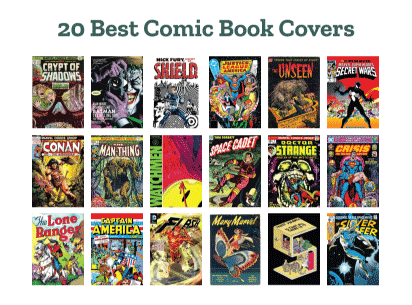
20 Best Comic Book Covers of All Time!

Comic book covers are the key to our treasure of nostalgia. As a kid, comics were the one thing every child wanted. The reason? Creative storylines, interactive images, and cool comic book covers! They’re more than just protective wrappings; they’re works of art that evoke powerful emotions and transport us back to simpler times.

In this article, we’ll take a nostalgic trip and explore some of the most iconic comic book covers ever created. From classic superheroes to beloved anti-heroes, these covers have captured the imaginations of readers young and old. So, let’s dive in and rediscover the magic of comic book covers!

Want a book cover for your comic? Check out our design services!

The twenty best comic book covers of all time

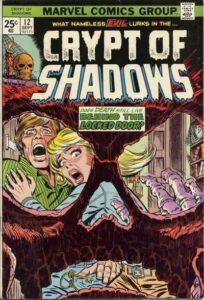
1. Crypt of Shadows #12

Crypt-of-Shadows-12-Behind-The-Locked-Door comic book cover


One of the lesser-known Marvel comic book covers is the Crypt of Shadows cover. Created by Ron Wilson and Mike Esposito, this issue was published in September 1974. The point of view of the evil is a unique perspective on the cover. The chilling skeleton and the scared protagonists take us on a mysterious ride.

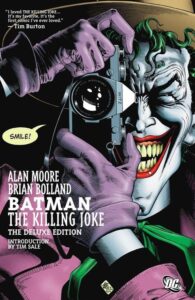
2. Batman: The Killing Joke


Batman: The Killing Joke comic book cover.

Cover artists Brian Bolland and Richard Bruning crafted one of the best Joker comic book covers. The comic was published on March 29, 1988. This amazing comic book cover features the maniacal Joker holding a camera, ready to capture Batman’s final moments. The cover art perfectly captures the dark tone of the story within.

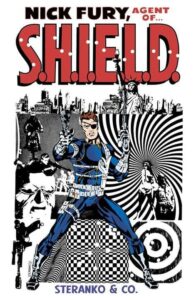
3. Nick Fury: Agent of S.H.I.E.L.D.


Nick Fury: Agent of S.H.I.E.L.D. comic book cover

This famous book cover shows the one-eyed, super-spy in all his glory, standing confidently against a chaotic backdrop filled with swirling patterns and silhouettes. Nick Fury, dressed in his signature blue uniform, looks ready to face any challenge that comes his way. His serious expression and clenched fists make it clear he’s all about business. The black and white design, accented with splashes of red, really gives off a classic spy thriller feel. This cover was created by artist Steranko.

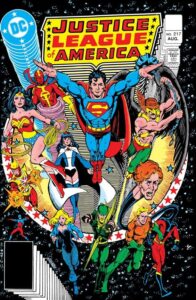
4. Justice League of America (1960-) #217

Justice League of America (1960-) #217 comic book cover.

One of the flashiest superhero comic book covers drawn by George Pérez, it’s like a super-powered explosion of colors, spandex, and heroic poses that’ll make your eyes pop. First off, can we talk about Superman, Batman, Aquaman, Wonder Woman, Flash, Hawkman, and Atom being together on one cover? Did you know that the Justice League first appeared way back in 1960? That’s right, these iconic heroes have been teaming up to fight evil for over six decades! Talk about a serious commitment to justice.

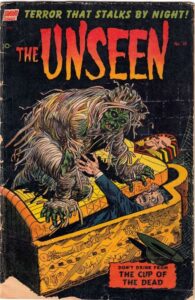
5. The Unseen (1952) #10


The Unseen comic book cover.

The cover was done by Jack Katz. The title practically screams, “Terror That Stalks by Night!” I mean, who wouldn’t want to read a comic with a tagline like that? The artwork on this cover is straight-up nightmare fuel. We’ve got a gnarly-looking creature with wild, flowing hair and green skin that looks like it’s been through a meat grinder. And check out those claws – they’re the size of steak knives! This monster is not messing around.

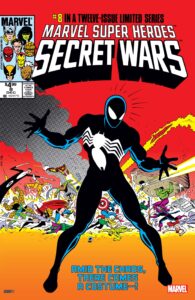
6. Marvel Super Heroes Secret Wars Vol.1 #8


Marvel Super Heroes Secret Wars Vol.1 #8 comic book cover.

“Marvel Super Heroes Secret Wars,” the epic crossover event that’s got more heroes than you can imagine. One of the coolest Spiderman comic book covers, your favorite characters bursting out of the page in a frenzy of action. The background is a trippy mix of fiery orange and cool blue, creating a sense of chaos and excitement that perfectly captures the spirit of this epic crossover. And that black-suited Spidey right in the center? He’s striking a pose that screams, “I’m here for some action!”

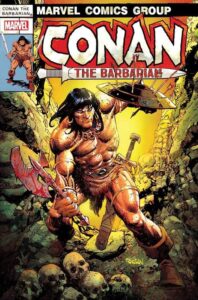
7. Conan the Barbarian Vol.3 #20


Conan the Barbarian Vol 3 20 comic book cover.

The cover shows Conan, ready to take on any challenge with his trusty sword and steely gaze. Dan Panosian designed this vintage comic book cover. The background is a chaotic mess of skulls, bones, and other assorted bits of carnage. From the meticulously rendered skulls to the tiny creatures lurking in the shadows, it’s clear that the artist put a ton of time and effort into creating this masterpiece.

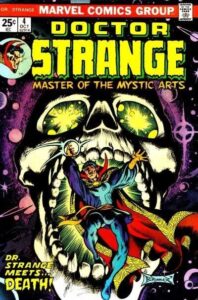
8. Doctor Strange Vol.2 #4


Doctor Strange Vol.2 #4 comic book cover.

This Marvel comic book cover is a psychedelic trip designed by Frank Brunner. The background is a mind-bending explosion of colors and shapes. We’ve got swirling vortexes, trippy starbursts, and of course, the big scary skull. In the center is Dr. Strange. His iconic red cape is billowing in the wind, and his funky blue tunic is adorned with golden amulets.

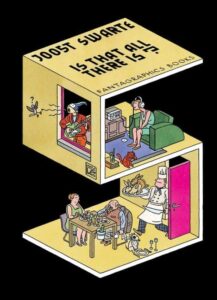
9. Is That All There Is


Is That All There Is comic book cover.

“Is That All There Is?” is a compilation of nearly every published comic by the Dutch cartoonist Joost Swarte. The book may not need an introduction—the art speaks for itself, loudly and clearly. The comics are not easy to digest, but that is their nature. Though Swarte’s crisply blocked grids of squeaky clean cartoons are as eminently readable as comics get, the multi-layered shaggy dog plots are an entirely different matter. This book encompasses fifty-three different stories. 

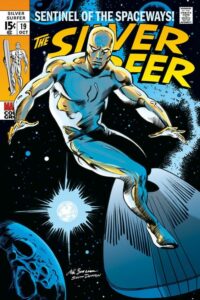
10. The Silver Surfer No. 19


The Silver Surfer No. 19 comic book cover.

This cover, masterfully crafted by the legendary duo of John Buscema and Scott Dutton, is a visual feast. The Silver Surfer exudes power, grace, and a touch of alien mystique. The artists have captured the very essence of the character and distilled it into one dynamic image. Did you know that the Silver Surfer first appeared in Fantastic Four #48 back in 1966 and was created by the legendary duo of Jack Kirby and Stan Lee?

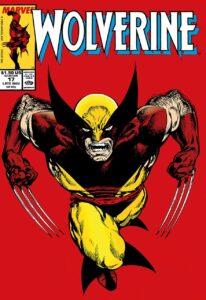
11. Wolverine (Vol. 2) #17


Wolverine (Vol. 2) #17 comic book cover

This Wolverine comic book cover was created by renowned comic artist John Byrne, known for his influential work on many Marvel titles. Wolverine is shown in his iconic yellow and blue costume, lunging forward with his adamantium claws extended. This cover is a classic example of the bold, eye-catching comic book art that was prevalent during this period of comic book publishing. 

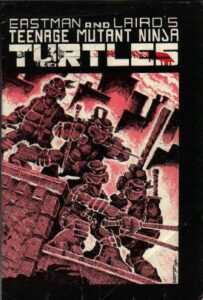
12. Mutant Ninja Turtles Vol. 1 #1


Mutant Ninja Turtles Vol. 1 #1 comic book cover.

The Teenage Mutant Ninja Turtles were initially conceived as a parody of popular comic book tropes, particularly the grim and gritty superhero comics of the 1980s. This cover is significant because it represents the Turtles in their original incarnation as created by Eastman and Laird. The artwork depicts all four Ninja Turtles in a dynamic, action-packed pose, wielding their signature weapons – you can see nunchucks, sai, and a bo staff clearly visible. The cover established the unique look that made these characters stand out in the crowded independent comics scene of the 1980s.

13. The Lone Ranger #1


The Lone Ranger #1 comic book cover.

This vibrant comic book cover for “The Lone Ranger” captures the essence of classic Western adventure. Clad in his signature blue pants, red shirt, white hat, and black mask, the Lone Ranger brandishes a gun, ready for action. The background bustles with other riders on horseback, while a figure in yellow fringed clothing, possibly Tonto, appears in the bottom right. The comic book was created by Thomas P. Gill.

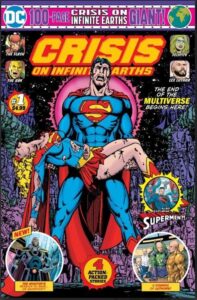
14. Crisis on Infinite Earths #7

Crisis on Infinite Earths #7 comic book cover

This Superman comic book cover inspired many other book covers with Superman’s iconic pose. Created by Tom Grummett, the vibrant cover shows the agonized hero holding the fallen heroine in his arms. The title “CRISIS” dominates the top in bold yellow letters, emphasizing the epic nature of the story. This cover encapsulates the grandeur and drama of one of DC’s best comic books of all time.

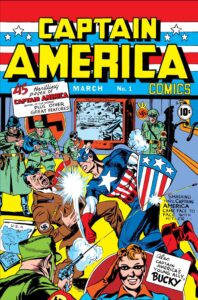
15. Captain America #1

Captain America #1 comic book cover.

Created by Jack Kerby and Joe Simon, the Captain America comic book cover was a powerful statement given that the United States had not yet entered World War II at the time of publication. The cover features Captain America in his classic red, white, and blue costume, prominently punching Adolf Hitler in the face. This inaugural issue not only launched Captain America but also reflected the growing anti-Nazi sentiment in America, making it a significant piece of both comic book and cultural history across the country.

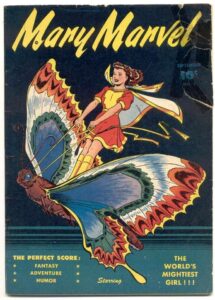
16. Mary Marvel

Mary Marvel comic book cover.

This vibrant cover of “Mary Marvel” comics, created by artist Jack Binder, showcases the heroine in a whimsical and fantastical scene. Mary Marvel, dressed in her iconic red and yellow costume with a flowing white cape, is depicted riding atop a giant, colorful butterfly. The image captures a sense of wonder and adventure, with Mary confidently steering the butterfly as if it were a magical steed. The background is a deep navy blue, making the brightly colored character and insect stand out dramatically.

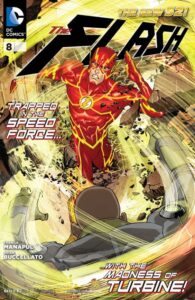
17. The Flash #8 

The Flash  #8 comic book cover.

This dynamic comic book cover is a striking example of Francis Manapul’s artistic prowess. The cover depicts the Flash trapped in a swirling vortex of yellow energy, with debris and mechanical parts flying around him. The hero’s determined expression and outstretched arms convey a sense of struggle against the forces surrounding him. Manapul’s use of color is particularly noteworthy, with the bright reds of the Flash’s costume contrasting against the golden hues of the speed force energy. The overall composition draws the eye in a circular motion, mimicking the very forces threatening to overwhelm the hero.

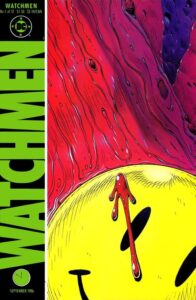
18. Watchmen #1

Watchmen #1 comic book cover.

Created by artist Dave Gibbons, it is a masterpiece of graphic design that encapsulates the series’ dark, complex themes. The image is dominated by a stark close-up of the infamous “smiley face” button, a recurring motif throughout the series. A bright splash of blood stains the yellow surface, immediately setting a tone of violence and moral ambiguity. This cover, first published in September 1986, has become one of the most recognizable and influential images in comic book history.

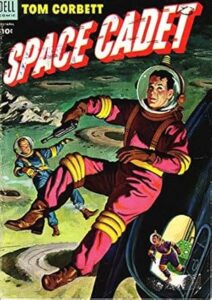
19. Tom Corbett, Space Cadet 9 – Version 1

Tom Corbett, Space Cadet 9 - Version 1 comic book cover.

This vibrant cover, illustrated by Al McWilliams, epitomizes the golden age of science fiction comics. The background showcases a stark, alien landscape with jagged mountains, creating a sense of otherworldly adventure. The hero is depicted in a dynamic pose, seemingly floating or leaping through space. Behind him, a female character in a blue suit adds depth to the scene. The Dell Comics logo and 10-cent price tag are visible, placing this issue fittingly in the context of mid-20th-century comic book publishing. 

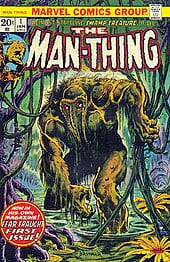
20. Man-Thing (1974) #1

Man-Thing (1974) #1 comic book cover.

The cover features the Man-Thing emerging from a murky, vegetation-choked swamp, its massive, grotesque form dominating the frame. The cover was created by artist Frank Brunner with colors by Glynis Wein. Brunner’s detailed linework brings out the creature’s plant-like texture and inhuman features, while Wein’s coloring – rich greens for the foliage and sickly yellows for Man-Thing’s body – enhances the supernatural atmosphere. This eerie cover was from 1974.

So, did you have a trip down memory lane with these comic book covers? The covers are not only vibrant but also enchanting, just pulling us in! If you liked this list of the best comic book covers of all time, you should check out our list of 50 timeless and unforgettable book covers of all time!

Creating such good comic book covers might be a task. If you want a thrilling comic book cover for your book, you can always take the help of PaperTrue’s self-publishing services.

Take a look at the below articles for more tips:

Top 10 AI Resume Checkers for Job Seekers (Free & Paid)

Want your resume to stand out in the competitive job market? This is where AI resume checkers can help! In this article, we’ll list the top 10 AI resume checkers. 

These AI resume checkers help to refine your resume’s grammar and punctuation. However, this is not all. Let’s quickly learn their additional features and how they work in the next section! 

Make your resume stand out with professional editing!

What is an AI resume checker? 

AI resume checkers are software tools that analyze and optimize resumes using artificial intelligence. They help create ATS-friendly resumes by comparing content to industry keywords and successful resume patterns.

Furthermore, these tools assign a score to your resume and suggest improvements in grammar, word choice, formatting, content relevance, and keyword usage. Several resume checkers also provide useful resume templates.  

Now let’s quickly see the benefits of AI resume checkers. (If you already know these, skip this and directly explore the top 10 resume checkers.) 

Why are AI resume checkers important? 

AI resume checkers are important for receiving unbiased feedback on the resume’s strengths and weaknesses. By providing suggestions to include industry-specific keywords and ensure consistency in formatting and style, they help applicants enhance their resumes. 

Following are the top 5 reasons why these tools  are important: 

  1. Error reduction: They catch grammatical and formatting mistakes that might otherwise be overlooked.
  2. Time-saving: They quickly identify areas for improvement, streamlining the resume-writing process.
  3. Industry insights: They offer guidance on current resume trends and best practices.
  4. Customization: They help to create resumes for specific job applications, improving relevance.
  5. ATS optimization: Enhances resume visibility to automated systems, increasing the likelihood of favorable recruiter evaluation and resume shortlisting.

Now let’s explore the top 10 AI resume checkers in detail! 

1. Resume Worded 

Resume Worded provides an overall score and a line-by-line score, offering 25+ free resume checks. It detects repetitions, weak verbs, lengthy text, and redundancies in content (e.g. unnecessary words). 

Pros 

      • Determines whether the text has the necessary keywords. 
      • Features “Magic Write” for AI-powered line rewrites.
      • Improves resume summary with targeted advice. 
      • Provides top-tier summary examples. 
      • Offers spell-check functionality and highlights unnecessary sections. 

Cons

        • Features such as spell check and resume examples are only available in the paid version. 
        • The option to analyze weak verbs and check verb tenses is only available in the pro version. 

Price: Resume Woded has both, a free and a paid version. The paid version package Coach Essential costs $99 per month and Coach Business costs $159 per month. 

2. Enhancv Resume Checker 

Enhancv provides 16 checks and 200+ free resume examples and templates. It scores your resume and provides suggestions for improvement. Plus, it also offers one of the best AI resume builders for crafting resumes from scratch. 

Pros 

        • A spelling and grammar check. 
        • Suggestions to improve resume length and file size.
        • Analyzes where achievements are quantifiable.  
        • A detailed report highlighting resume issues. 
        • Suggestions to improve style, formatting, and layout. 

Cons 

        • You can check only 15 sections of a resume using the free version. 
        • An ATS check is only included in the Pro version.

Price: This resume checker has both free and paid versions. The paid version costs $24.99 per month. 

3. Ladders 

Ladders not only checks the resume but also provides a useful application named Apply4me. Users can utilize this tool to apply for jobs on their behalf. Furthermore, it also offers LinkedIn profile optimization for job seekers. 

Pros 

        • Scans the text for any grammar, punctuation, typos, and capitalization issues. 
        • Checks for any over-use of the first person’s point-of-view (I). 
        • Analyzes whether jobs are listed in the required order. 
        • Gives recommendations to add keywords. 
        • An option to rewrite content using AI. 

Cons

      • Fewer features compared to resume checkers like Resume Reworded. 
      • Fewer template options and practical examples compared to other tools. 

Price: Ladders has both free and paid versions. The paid version costs $49.97 per month. 

4. Job Scan 

Job Scan analyzes various sections like education details, section headings, and date formatting. It also scans whether your resume has the necessary soft skills and hard skills. 

Features 

        • Gives suggestions to enhance formatting. 
        • Determines if achievements are measurable or vague. 
        • Gives pointers to improve the word count.
        • Scans your text for any cliches and buzzwords to avoid. 
        • Checks if the file type and file name are appropriate. 

Cons

        • The free version includes only 5 scans. 
        • ATS resume-friendly templates are not included in the free version. 

Price: This tool has both free and paid versions. The paid version costs $89.95 for every 3 months. 

5. Panna.ai 

Along with a comprehensive resume check, Panna.ai answers questions in real time about various job roles. Using this AI resume checker, users can also conduct interviews and Panna.ai will provide digital interview reports. 

Features 

        • Offers a comprehensive report highlighting strengths and areas for improvement. 
        • Identifies the use of action verbs
        • Determines whether your skills match your job role. 
        • Checks whether your resume has been recently updated. 
        • Analyzes the job summary length and content. 

Cons 

        • It might prioritize keyword matching over actual content quality.
        • It may not fully understand niche industries or roles.

Price: This tool includes both free and paid versions. To understand the pricing of the paid version, you’ll need to contact Panna.ai’s customer support team. 

6. Resume Genius 

To use Resume Genius’s resume checker, you need to upload your resume and create a free account. Resume Genius will then check your resume and provide practical examples for every feature (e.g., prewritten examples for problem-solving, excellent communication, etc). 

Pros 

        • Options to add sections like birth date, nationality, and LinkedIn and Twitter profile links. 
        • Analyzes if the resume’s introduction is engaging. 
        • Identifies any typos and grammatical mistakes
        • Determines if the resume has the necessary keywords. 
        • ATS-friendly templates to enhance your resume. 

Cons 

        • An AI rewriter to rewrite resume content is not included in the resume checker. 
        • Fewer suggestions for improvement as compared to other tools. 

Price: This is a free AI resume checker. 

7. ResumeGo 

To get a free resume scan, you need to upload your resume. This tool then scores your resume and checks the word choice, use of pronouns, keywords, and formatting. 

Pros 

        • Analyzes whether your file type, file size, and resume length are appropriate. 
        • Determines if your resume has the required word count.
        • Identifies if your resume has important details like the phone number, email, and LinkedIn URL. 
        • Checks if your resume has any missing sections. 
        • Determines if your resume contains soft skills, hard skills, and measurable achievements. 

Cons 

        • Fewer suggestions to improve your resume compared to other tools. 
        • Fewer examples compared to other tools. 

Price: This is a free AI resume checker. 

8. Rezi 

Rezi allows you to upload all types of resumes for free. It identifies any grammar mistakes, typos, filler words, and formatting errors in your resume. 

Features 

        • Analyze whether the accomplishments included are measurable. 
        • Helps to arrange all educational qualifications date-wise in reverse chronological order. 
        • A hiring expert to review your resume. 
        • Determines if the bullet points are punctuated and capitalized properly. 
        • Checks if the resume has the required keywords. 

Cons 

        • You can download only 3 PDF resumes using the free version. 
        • Various features such as resume template features in bold, modern, and compact formats are only a part of the paid version. 

Price: Rezi has a free version and a paid one. The paid version costs $29 per month. 

9. KickResume 

KickResume’s AI resume checker scans and grades your resume. It also allows you to compare your resume against successful resume templates. Furthermore, it also provides an advanced AI resume writer! 

Pros

        • A detailed report of all resume issues.
        • 1500+ resume examples and 20,000 pre-written phrases for reference. 
        • A GPT-4 analyzer to review the resume. 
        • Strong security and data protection.
        • Checks if there are any overused words.

Cons

        • Features such as priority email and chat support are not a part of the free version. 
        • Fewer resume templates are included in the free version. 

Price: KickResume’s resume checker has both free and paid versions. The paid version costs $7 per month. 

10. Live Career Resume Checker 

This resume analyzer accepts resume files in DOC, DOCX, PDF, HTML, RTF, and TXT formats. Once you upload your resume, this checker scores your resume and provides practical recommendations. 

Features 

        • Provides suggestions to enhance grammar and clarity. 
        • Gives suggestions to improve formatting. 
        • Enhances word choice. 
        • Determines if the results are measurable. 
        • Analyzes if the summary length is appropriate. 

Cons

        • Unlike Resume Worded, it doesn’t provide a line-by-line evaluation and score. 
        • Doesn’t provide suggestions to rewrite content using AI for CV editing and proofreading

Price: This is a free resume analyzer. 

Five practical tips to use resume checkers 

Here are some useful tips for using resume checkers: 

        • Job-specific input: Enter the target job description for effective optimization.
        • Keyword balance: Incorporate suggested keywords naturally, avoiding overuse or “keyword stuffing”.
        • Compatibility test: Use multiple resume checkers to cross-verify suggestions and ensure broad ATS compatibility.
        • Version tracking: Save different versions to compare changes and improvements over time.
        • Format check: Use the tool to verify your resume’s formatting remains consistent across different file types (e.g., .docx, .pdf).

Now, you can refine your resume using the best resume checkers. However, these tools might not provide completely accurate results. At PaperTrue, our trained team provides high-quality resume editing services. We not only eliminate all language errors but also enhance your resume’s formatting. 

Here are some other useful resources for you: 

What Is Accidental Plagiarism & 9 Prevention Strategies

Accidental plagiarism, while unintentional, can have serious consequences in academic and professional settings. It occurs when you present someone’s work unknowingly as your own. 

In this article, we’ll explain the reasons for accidental plagiarism and 9 practical strategies to prevent it. We’ve also included useful accidental plagiarism examples. 

Get your text checked for plagiarism today!

So to begin with, let’s understand why accidental plagiarism occurs. 

What are the causes of accidental plagiarism? 

Not organizing your research sources can lead to accidental plagiarism. Another reason can be language barriers where the student is unfamiliar with the language. The following are some other common causes of accidental plagiarism: 

1. Improper paraphrasing 

Improper paraphrasing occurs when a writer attempts to restate an author’s ideas in their own words. However, they retain the original sentence structure and don’t modify the text enough. Here is an example: 

Original: “The effects of climate change are far-reaching and complex.”

Plagiarized: “The impacts of climate change are wide-ranging and complicated.”

2. Forget to cite sources 

This occurs when a writer forgets to cite the source in the text or in the reference list. For example: 

Original: A recent study by the  Ocean Conservancy found that over 8 million metric tons of plastic enter the ocean each year. : 

Plagiarized: Original: Over 8 million metric tons of plastic enter the ocean each year, posing a serious threat to marine life.

Also, if you forget to mention one author of a text written by multiple authors, this is also considered accidental plagiarism.

3. Misquoting or misattributing information 

Misquoting involves incorrectly rephrasing a direct quote by changing words, punctuations, or omitting parts. In contrast, misattribution occurs when a writer correctly quotes or paraphrases information but gives credit to the wrong source. 

Here is an example: 

Original quote: “To be or not to be, that is the question.”

Misquoted: “To be or not to be, this is the question.”

Five additional reasons for accidental plagiarism

The following reasons can also cause accidental plagiarism: 

      • Unfamiliarity with citation rules can lead to accidental plagiarism.
      • Failing to properly attribute sources during note-taking can lead to confusion and accidental plagiarism when writing.
      • Students under pressure to meet deadlines may plagiarize without careful consideration.
      • Cultural differences in academic writing norms can lead to unintentional plagiarism, as what might be considered acceptable in one culture may be considered plagiarism in another. 
      • Distractions while writing or researching can lead to unintentional copying of material without proper attribution.

Now let’s understand 9 strategies to avoid accidental plagiarism! 

Nine strategies to avoid accidental plagiarism 

Following are 9 practical strategies to avoid plagiarism: 

1. Develop strong paraphrasing skills 

Following are some common paraphrasing strategies: 

        • Split long, complex sentences into two short sentences (wherever relevant).
        • Combine two short sentences about the same idea using conjunctions (wherever required). 
        • Use synonyms and similar phrases. Take the help of online dictionaries like Merriam-Webster. 
        • Change the sentence structure by:
           1) Ensuring that your sentences don’t begin with the same words as the original sentence.
          2) Shifting the position of nouns and other parts of speech wherever possible.

To understand in detail, you can read the article “How to paraphrase a text”. 

2. Give your own, unique opinions 

Some ways to state your point of view  are: 

        • Provide examples based on your personal experiences and observations (wherever relevant). 
        • Discuss how theories might be applied in real-world situations.
        • Create comparisons between two ideas to explain complex ideas in your own way.
        • State whether you agree or disagree and give facts to support your views. 
        • Create “what if” situations to explore potential outcomes or implications.
        • Connect ideas based on your knowledge to give unique insights. 

3. Improve note-taking techniques 

Some strategies to improve note-taking techniques are: 

        • Use color coding to distinguish between direct quotes, paraphrases, and your own ideas.
        • Always note the source information alongside your notes (author, title, page number). 
        • Use digital note-taking tools like Evernote or OneNote to organize and tag information.
        • Create summary sheets for each source, including key points and your own thoughts.

4. Understand the required citation style 

To understand the style guide, keep reading about how to cite sources in the chosen style guide (APA, MLA, Chicago, or other). Here are some articles that can help: 

Bonus tip: You can also use citation generators like Citation Machine, Zotero, SciSpace APA Citation Generator, and BibMe. 

5. Time management and planning 

For proper time management, create a schedule and break large projects into small, manageable tasks. Create a checklist and set personal deadlines for completing every task. You can also use tools like Trello and Asana to organize your writing projects. 

6. Keep records of sources used 

Organize and save records of all sources you’ve used in folders. Some strategies for keeping records are: 

        • Use a spreadsheet (MS Excel or Google Sheets) or a dedicated note-taking app to record all sources.
        • Include columns for the date accessed, full citation, summary of key points, and relevant quotes.
        • Use browser bookmarks or tools like Pocket to save web pages.
        • Take screenshots of online sources or tools that might disappear. 

7. Understand the types of plagiarism

While direct plagiarism involves copying the exact same words, mosaic plagiarism means combining ideas from multiple sources without crediting them. 

In contrast, self-plagiarism means copying from your previously published work without giving it due credit. If you’re knowingly using someone’s ideas without giving them credit, this is known as intentional plagiarism. Understanding the types of plagiarism can help to prevent it. 

8. Use plagiarism checkers 

You can use online plagiarism checkers provided by Grammarly, QuillBot, PlagiarismDetector.Net, Scribbr, etc. Turnitin, Copyscape, UniCheck, and Duplichecker are some other tools you can use. Upload your document or paste text in these accidental plagiarism checkers to detect any plagiarism. 

Here are some strategies for using these plagiarism tools: 

        • Upload your entire document rather than checking small sections at a time.
        • Use more than one plagiarism checker and compare reports. 
        • If available, use features that allow you to exclude quoted text or bibliography to reduce false positives.

9. Take feedback from experts 

Reach out to your instructor to seek overall feedback, including citation rules and expectations. Furthermore, you can also consult any writing center tutors you know for guidance. 

Note: When in doubt about whether to cite something or not, cite the source. 

What are the consequences of accidental plagiarism? 

Following are some of the consequences of accidental plagiarism: 

        • Academic penalties: These include reduced or zero grades on assignments, failing the course, and mandatory resubmission of work. 
        • Disciplinary action: Formal warnings, academic probation, and notation on academic records can be initiated against students. 
        • Reputational damage: This can lead to loss of trust from instructors and colleagues and potential impact on academic and professional preferences. 
        • Impact on graduation: Some potential consequences are delays in completing degree requirements, suspension, or expulsion.
        • Loss of funding: This can mean possible revocation of scholarships or grants in serious cases.

You can use the 9 practical strategies mentioned in this guide to prevent any negative consequences related to plagiarism. For future reference, bookmark this article containing examples of accidental plagiarism and plagiarism tools! However, these tools may not provide results that are as accurate as PaperTrue’s plagiarism detection services. 

At PaperTrue, we run your document through our trusted in-house plagiarism-checking software to ensure that your work isn’t plagiarized. With this, we also provide high-quality editing and proofreading services

We’re dedicated to providing excellent services! Contact us if you have any questions. 

Here are some resources for you: 

Book Cover Design Basics: Tips & Best Book Cover Ideas

‘Don’t judge a book by its cover’. This popular saying does not apply to books while publishing. The reason is that a good book cover is the thin line between buying the book and not buying the book.  To help you design an attractive cover, this blog includes useful book cover design tips.

We’ve also explained all the basic elements of a book cover. To help authors brainstorm ideas for book covers, we’ve given simple tips. We’ve also explained how to select the perfect book cover design service. So let’s begin by understanding the important elements of a book cover design

Make your book stand out with a professionally designed cover!

Anatomy of a book cover design

If you think that your book cover is only all about the graphics, think again! These elements go into making one:

  1. Title: Your title should be the core of your book. Try to keep it short and simple, instead of aiming for a clever title, because remember, you’re thinking like a reader and not an author. 
  2. Subtitle: Add a subtitle only if necessary. Most romance or thriller novels have subtitles that span two lines, a pinch of vague, and enough to intrigue the reader about the book. 
  3. Author’s name: Very obvious. And if it’s your first book, a matter of pride. But it should not overpower the title in font and size. 
  4. Front cover: Your front cover is the main hook of the book cover design. Along with the title, it includes the author’s name and artwork. The publisher’s logo, a positive review, a subtitle, a tagline, and any awards or bestseller status are optional elements. 
  5. Back cover: The back cover contains a summary of the book, the author’s name, ISBN, barcode, and the publisher’s name and location. It also consists of an author bio and photo, copyright information, price, social media handles, author website, other books by the author, and awards and accolades.
  6. Spine: The spine is the narrow side of the book cover that you see when books are on a shelf. It usually shows the book’s title, author’s name, and publisher’s logo.

Quick tips for designing a book cover 

To design a book cover, it’s crucial to research and be aware if the conventions of your genre. It’s also important to use high-quality images that look professional.

Here are some other important tips for designing a book cover: 

1. Book title

Ensure that your book title stands out. Some strategies you can use to do this are: use colors that contrast strongly with the background, use bold, heavy-weight fonts, and place the title within a frame or shape to make it stand out.  

2. Subtitle 

While adding a subtitle, ensure that it’s smaller than the title, place it near the main title. You can use a lighter shade near the title for the subtitle. You can also italicize, use different fonts, capitalize letters, or remove all capitalization to create an impact. 

3. Author’s name 

You can place the author’s name below the title or at the bottom of the cover. Another strategy you can use is to choose the same font as the title but a different font size. Leave some space around the author’s name so it doesn’t look crowded. Furthermore, you can consider using a different color from the title to create separation. 

Bonus tip: For new authors, prioritize the title over the author’s name. For bestselling authors, make the name more prominent. 

4. Front cover 

To create a front cover, select images that accurately reflect your book’s content. You can use shadows or overlays to create a good impression. You can also try to show movements by using design elements like lines. For print books, you can explore options like embossing, debossing, or foil stamping. 

5. Back cover 

You can use lines and borders to separate sections of the back cover. This ensures clarity while reading. If you’re using review quotes, make them stand out using larger fonts. It’s also important to use readable fonts like sans serif for books. 

To know more about fonts, consider reading the article “An Easy Guide to the Best Fonts and Font Sizes for Your Book”. 

6. Spine 

While creating a spine, use colors and fonts that complement the front and back cover. If your book has a thin spine, you can consider using vertical text. You can also use a background color different from the front and back cover for impact. Furthermore, you can create a visual hierarchy. This means that the title should be the largest, followed by the author’s name, and publisher. 

Book imagery, typography, and colors 

Here are some basic tips for the following elements: 

    • Choose colors that match your book’s mood and genre – warm colors for energy (red, yellow, orange), cool colors for calm (blue, green). 
    • Pick one strong, relevant image that represents your story and looks good even as a thumbnail. 
    • For text, use easy-to-read fonts (no more than 2-3 different ones) that fit your book’s style.

Crucial pre-design steps for your book cover 

To have a clear idea of your book cover, jot down any ideas you have about the design. You can also use free AI image generators provided by Canva, Gemini, and GenCraft for brainstorming. Here are some useful strategies for coming up with good cover ideas:

  1. Thoroughly understand what your book is about. Try and make a short summary of the book to get a clearer idea. Another thing that might work for you is listing down words that immediately remind you of your book, which indirectly means that you want the reader to feel the same way. For example, the cover design for A Girl on the Train’ immediately invokes thrill and mystery, along with the subtitle.
  2. Finalize the title and the subtitle (if there is one). The title is the identity of your book for a reader who is going to pick it up for the first time. Make sure you discuss with experts in this field, take criticism and feedback from your editors and closest friends, and carefully contemplate what exactly will the title be.
  3. Define your target audience. Determine the age range, interests, educational level, areas of expertise, and geographical interests of your readers. 
  4. Study your genre. Analyze bestsellers in your category for good book cover ideas. This will help you identify common design elements and trends.
  5. Decide a budget. Cover design depends on the level of complexity and at a later stage, on the material to be used for the book cover. If you want to be a little flexible to ensure a stunning cover, decide on a price bracket instead of a fixed budget. 

Why do you need a good book cover?

Think of your book cover as a movie’s trailer. If the trailer is good, packs a punch, and tells what to expect without revealing what the whole movie is, bingo! You have yourself an exciting wait. The same applies to book cover design. A good book cover catches the eye of the reader almost immediately, igniting curiosity about the book.

Sometimes, a good cover design becomes the identity of your book and can remain the same for multiple editions as opposed to a new cover for an anniversary edition, or 10th edition.

Book cover design ideas 

Following are popular book cover design ideas for popular genres: 

      • Romance: Soft colors, romantic imagery (silhouettes, flowers, couples), elegant fonts (e.g. Garamond, Playfair Display), and a sense of longing or anticipation.
      • Thriller/Mystery: Darker colors, suspenseful imagery (shadows, weapons, obscured faces), bold fonts (e.g. Impact, Benbas Neue), a sense of danger or intrigue.
      • Fantasy: Rich colors, fantastical imagery (mythical creatures, landscapes, magic), ornate fonts (e.g. Brush Script, Pacifico), and a sense of wonder or adventure.
      • Science fiction: Futuristic imagery (technology, space, robots), bold colors, geometric shapes, a sense of innovation or mystery.
      • Historical fiction: Vintage imagery (clothing, architecture, objects), muted colors, elegant fonts (e.g. Godoni, Boudi Old Style), a sense of timelessness or nostalgia.

For more book cover ideas, you can browse through the following document! 

Book cover design ideas

Professional book cover designers for self-publishers are crucial to creating captivating covers. The next section explores the advantages of hiring professional book cover design services.

Benefits of hiring a professional book cover design service  

When you hire a professional book cover design service, you don’t need to worry about design skills or technical details – the experts handle it all for you. They’ll create a cover that fits your book’s genre and appeals to your target readers.

Another important factor is the insight that a creative mind brings to the desk. When you approach a professional book cover designer, they will dedicate their entire time to your cover, give you a variety of options, and also provide another perspective if you already know what you want your design to be.

They are more skilled and trained in identifying how the visual really works for the story and the audience. Hence, you’ll save time and avoid stress, which lets you focus on other tasks like marketing and promotion.

If you think that you will be wasting money by hiring a professional cover designer, think again; think of it as an investment in a good book. It’s a golden opportunity to immortalize your book in the eyes of your readers. Moreover, money is always secondary in this case. 

How to hire book designers for your book? 

To hire a book designer, start by researching portfolios of designers specializing in your genre. Next, reach out to a few designers you like, discuss your project, timeline, and budget, and ask for quotes. Finally, choose the designer whose work, communication style, and pricing best fit your needs. Make sure to clearly outline expectations and deliverables in a contract before starting the project.

Why should you choose PaperTrue for cover design?

PaperTrue offers professional book cover design services for eBooks, paperbacks, and hardbacks. This includes typesetting and creating graphics for book covers.

When you choose PaperTrue for your book cover design, you get:

      1. Three sample options that are professionally designed, keeping your specific requirements in mind. 
      2. Fast and timely delivery; we work weekends too!
      3. Free design revision (if required). 

We can also design a dust jacket for your book. Furthermore, we also adjust the size according to the book’s format (eBook/paperback/hardcover). Our pricing for a book cover is $348. 

In conclusion, book cover design is a crucial element of your publishing journey. To create an appealing book cover, you can approach PaperTrue. Our cover designers can provide high-quality book cover design services. Along with these services, we also provide high-quality editing and proofreading services

Here are some useful resources for you: 
A Simple Proofreading Checklist to Catch Every Mistake

New to proofreading? Relax, we’ll explain everything that you need to check! This article includes a simple proofreading checklist to help you correct all errors. 

A proofreading checklist is a set of pointers that help identify and rectify any errors in written content. It typically includes items such as spelling, grammar, punctuation, formatting, capitalization, and consistency checks. 

We’ve added useful tools and basic grammar rules to help you proofread. Plus, you’ll learn how to remove any unnecessary words to polish your text! If you wish to enhance your text’s formatting, we’ve included a checklist for that as well. 

Let’s start by understanding the essential elements of this checklist!  

Get professional proofreading services for your text!

Six crucial elements you need to proofread 

The six elements listed below help to enhance clarity, improve your writing style, and polish your text. These elements are spelling, grammar, punctuation, capitalization, word choice, and formatting. Browse through a simple proofreading checklist for each element! 

1. Spelling 

This includes checking the spelling of all parts of speech including: 

Tip: Use spell-checkers provided by Grammarly, QuillBot, Reverso, Ginger, and Corrector.co. 

2. Grammar 

This contains a quick overview of: 

        • Verb tenses (Are all tenses consistent?) 
        • Subject-verb agreement (Rule explained in a special section after elements) 
        • Pronoun usage (Are pronouns placed correctly?) 
        • Preposition usage (Are prepositions used correctly?) 
        • Conjunctions (Are conjunctions placed correctly?) 
        • Infinitives (Are infinitives with to+main verb correctly used?) 
        • Active and passive voice (Are both these types appropriately used? ) 
        • Conditional sentences (Are sentences indicating a condition correctly written?) For example: If it rains, I’ll stay at home. 
Bonus tip: To check the grammar of your text, consider using the best online grammar checkers provided by Scribbr, ZeroGPT, Dupli Checker, etc. 

3. Punctuation 

This includes checking the use of brackets (), dashes, slashes, and ellipses. Some other aspects that are reviewed are: 

        • Fullstops (.) (Are fullstops correctly used at the end of sentences and in abbreviations?) 
        • Question marks (?) (Are question marks placed at the end of direct questions?) 
        • Exclamation marks (!) (Are interjections used sparingly, where relevant or overused?) 
        • Colon (:)  (Are colons used correctly before lists, explanations, or elaborations?)
        • Apostrophes () (Are apostrophes used correctly to show contractions (e.g., didn’t) and possession (e.g., it’s)) 

You also need to check the usage of other punctuation marks like parentheses, semicolons, hyphens, and quotation marks. To understand the usage of all punctuation marks for better proofreading, read the article “14 Punctuation Marks: Examples & Free Guide on How to Use”.

Bonus tip: Use punctuation checkers provided by Hix.AI, ProWritingAid, QuillBot, etc. 

4. Capitalization 

        • The first letter of the first word of the sentence 
        • Proper nouns (e.g. Amy) 
        • Acronyms (e.g. WHO) 
        • Brand names (e.g. PUMA) 
        • Historical Events (World War 1) 
        • Capitalization of words in titles (The Truth of the Matter) 
Bonus tip: For in-depth information about capitalization, read the article “Capitalization Rules”.

5. Redundancies and typos 

You can remove the following types of words: 

          • Commonly confused words: Words with similar spellings or pronunciations but different meanings, like “affect” and “effect,” can lead to errors 
          • Unnecessarily repeated words: Two or more words to explain the same idea can seem repetitive (e.g., writing “your own” when the meaning is already conveyed by “your”. 
          • Clichés and overused phrases: Overused expressions (e.g., needless to say) can make writing feel stale and unoriginal, reducing its impact on readers. 
          • Weak verbs: Weak verbs are common, vague words like “is,” “was,” “have,” “do,” “get,” and “make” that don’t give clear details about actions.
          • Filler words: Words like “basically” or “actually” often add no real meaning and can make writing feel less professional and should be removed.
          • Unnecessary intensifiers: Overuse of words like “really” or “very” can reduce the impact of words and must be eliminated.
          • Double negatives: Using two negative words in the same clause can create confusion and sometimes unintentionally reverse the intended meaning. For example, I didn’t see nobody. 

6. Formatting 

This involves analyzing whether the margin size is consistent. Plus, consistency in font type and font size are also reviewed at this stage. Some other aspects you need to check for formatting are: 

        • Spacing 
        • Paragraphs (Alignment) 
        • Indent 
        • Tables and figures 
        • Lists 
        • Page numbers 
        • Italicization 
        • Page layout (Portrait/landscape) 
        • Headings and subheadings 
        • Referencing style guidelines for formatting (APA, MLA, Chicago, or other)) 
        • Page breaks
        • Table of Contents 
        • Footnotes 
        • Hyperlinks 
        • Headers and footers
        • Running heads  (if applicable 
        • Hyperlinks (for digital documents) 
        • Appendices 
        • File format (e.g., PDF) 
        • Columns 
        • Section breaks 

After seeing this proofreading checklist for students and other authors, let’s see some useful grammar rules! 

Five basic grammar rules for proofreading 

Understanding the basic grammar rules for verbs, nouns, pronouns, and other parts of speech is crucial. Given below are important rules to follow while proofreading: 

1. Subject-verb agreement

Ensure subjects and verbs agree in number (singular/plural)

This means that either both, the subject and verb are singular, or both, the subject and verb are plural. For example: 

John ate a fruit (John- Singular, fruit- Singular) 

The group members are arriving soon. (group members- Plural, are- Plural) 

2. Noun-pronoun agreement

The pronoun used must correctly indicate the number conveyed by the noun (singular or plural). For example: 

The student raised his hand. (student – singular, his – singular)

All participants must bring their own materials. (participants – plural, their – plural)

3. Modifier placement 

The modifier must be placed close to the word they describe to avoid confusion. For example: 

Correct: The runner, walking quickly, passed by the trees.

Incorrect: Walking quickly, the trees passed by the runner. 

In the above sentence starting with ‘walking’, the word ‘quickly’ is placed far from the runner. This creates confusion about who is walking quickly. 

4. Use proper punctuation to connect clauses 

Use punctuation marks such as commas, semil colons, and dashes to connect clauses. Also, use conjunctions wherever relevant to connect clauses. For example: 

Correct: The sun was setting, so we decided to go home.

Incorrect: The sun was setting we decided to go home. 

5. Pronouns must refer to the nouns they intend to describe 

This means that the pronoun used must clearly refer to the noun mentioned earlier in the sentence. Also, the pronouns must not sound ambiguous. For example, 

Correct: John told Mike, ‘You have won the lottery’. 

Incorrect: John told Mike that he had won the lottery. 

In the above sentence, the pronoun ‘he’ is ambiguous and doesn’t indicate whether Jorn or Mike has won the lottery. Hence, the pronoun usage isn’t correct. 

Six quick strategies for proofreading

The following are 6 useful strategies for proofreading: 

      1. Proofread right to left: Instead of reading left to right, adopting this practice can eliminate any errors. 
      2. Proofread for specific elements: Instead of trying to catch everything at once, focus on one specific element at a time (e.g., spelling, punctuation, grammar).
      3. Use AI proofreaders: Use AI proofreading tools provided by QuillBot, Grammarly, Semrush, EasyBib, ProWritingAid, etc. These can also be used as essay proofreaders. 
      4. Read it on a different device: Switch from your computer to a tablet or phone. The change in font and screen size can help you spot errors you might have missed before.
      5. Review punctuation separately: Focus on proofreading punctuation marks like commas, full stops, etc., separately.

Why is proofreading important? 

Proofreading is crucial to elevate the quality and impact of your writing. By catching and correcting errors, you ensure your message is clear, professional, and credible. 

This process helps to prevent misunderstandings about the content. Furthermore, it allows your audience to focus on your content without being distracted by errors. Whether you’re crafting an email, report, or academic paper, thorough proofreading demonstrates your attention to detail and enhances your reputation as a writer.

What is the difference between proofreading and editing? 

Proofreading is the final check for errors before a document is submitted or published. In contrast, editing is performed before proofreading, when the first draft is ready. Editing is an in-depth process that improves sentence structure and flow. 

Additionally, editing also involves fact-checking, ensuring logical connection between ideas, and smooth transitions along with enhancing tone, and writing style. Alternatively, proofreading reviews the text for typos, spelling, grammar, capitalization, and formatting mistakes. 

We hope this article has cleared your doubts about editing and proofreading. Now, you can create your own academic/professional proofreading checklist! This can help you refine your text and polish its presentation. 

After completing proofreading, take feedback from experts. This is crucial, especially for texts that will be published and read by a wider audience. Another reason for this is that proofreading tools can also have limitations. 

If you require expert feedback about your text, PaperTrue can help! We offer in-depth feedback to enhance your text along with high-quality editing and proofreading services. Our trained team of professional proofreaders and editors can eliminate all errors. 

For those who require academic proofreading and editing, we’ve got you covered! Additionally, we offer to edit and proofread other document types like theses, essays, dissertations, research papers, business reports, resumes, CVs, books, etc.  

Need editing as soon as possible? We can edit and proofread your text in an hour! 

Contact us to learn more about our editing and proofreading services! 

Here are some useful resources for you: 
How to Write an Engaging Author Bio: Tips and Examples

Imagine sitting down with a book and flipping it over to find no information whatsoever about the book’s author. For many readers, this can be off-putting—a jarring omission—which is why authors give a brief but engaging summary of their personal and professional journeys to their readers. 

Author bios make the author and the story they wish to share relatable and persuasive. In this article, we explore the meaning and purpose of an author bio, share some author bio examples, and understand why it is important to have an awe-inspiring author bio for your book cover.

Thinking about how to make your author bio impressive? Talk to us.

What is an author bio?

An author bio is a summary of an author’s background, including relevant details about their personal life and career journey, printed on the back of a book or published on online platforms. It introduces readers to the author’s interests, writing style, and genre. It is an important aspect of writing a book

A well-written author bio can get readers excited about the book and understand the author’s motivations for writing the story. The purpose of an author bio is to give readers insight into the author’s personality and expertise. 

An author bio offers a quick yet interesting overview of an author’s accomplishments, education, notable publications, and awards (if any). Often found on a book’s back cover, e-commerce platform, website, or online profile, these write-ups share key information in a way that builds both curiosity and connection. 

Since readers often want to know more about who wrote the novel or book they are reading or planning to purchase, an author bio gives insights into an author’s life and provides context. It helps improve the reading experience. If you are a first-time author, you can consider using author bio templates to write your bio. 

Key components of a strong author bio

A strong author bio must communicate things that seem interesting and compelling enough to persuade readers to buy a book and follow an author’s works. 

Here are some important components of a strong author bio:

      • Professional introduction: A brief introduction to an author’s professional title and a few details about their personal life are needed to let readers know who the author is in real life.
      • Relevant expertise: Highlighting the author’s background, experience, and expertise in their field or genre is recommended.
      • Achievements: Include awards or recognitions the author has received to create an impact on the readers. Telling readers about the author’s best-selling books or featured publications can make a world of difference to reader perspectives.
      • Personal flavor: Adding hobbies, interests, or some facts about the author makes the reading experience more memorable than otherwise.
      • Prospects: Including an author’s upcoming projects, short stories, or books can keep readers interested for a significant period.
      • Social media and other links: A good author bio typically includes links to the author’s website, social media, or other works so that readers can explore further or engage with them in different ways. Also, adding a strong call to action is recommended.

Even when you are self-publishing on Amazon, an effective, relevant, and engaging author bio is crucial. 

How to write a captivating author bio: A step-by-step guide

Writing a short bio requires an in-depth understanding of what an author offers their readers. If you plan on writing your author’s bio, consider following the steps listed below to create one for yourself. Alternatively, you could ask a bio writer to help you do this. 

1. Start with your name and credentials

      • Begin with your full name
      • Include relevant credentials or achievements

2. Highlight your writing experience

      • Your author bio is a powerful marketing tool. Make it engaging, authentic, and reflective of your unique voice as a writer.
      • If you are new to writing author bios, consider using an author bio template like the one below until you get the hang of it. 

3. Share your background

      • Add interesting personal details
      • Include information about your location or origin

4. Describe your writing style or genre

      • Explain what you write and why and state your unique perspective or approach
      • Mention your target audience

5. Add a personal touch

      • Share a hobby or interest
      • Include a quirky fact about yourself

6. Include a call to action

      • Direct readers to your website or social media
      • Encourage them to check out your latest work

7. Proofread and edit

      • Check for grammar and spelling errors
      • Ensure clarity and coherence

8. Update regularly

      • Keep your bio current with new achievements
      • Adjust for different platforms or audiences

Your author bio is a powerful marketing tool. Make it engaging, authentic, and reflective of your unique voice as a writer.

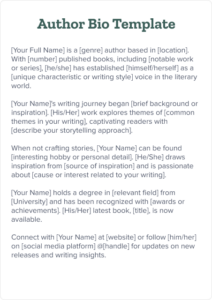
If you are new to writing author bios, consider using an author bio template like the one below until you get the hang of it.

This image shows an author bio template.


Examples of author bios

First-time authors may find it slightly challenging to write their bios. In author bios for new writers, the key is to include what drives you and what you hope to achieve. 

Here are some author bio examples for first-time authors:

                                        • Fiction author bio example

Emma Clarke is a debut novelist and former journalist who loves exploring human emotions through storytelling. Her first novel, Beneath the Willow Tree, delves into themes of love, loss, and resilience. When not writing, Emma enjoys gardening and visiting local bookstores. Follow her journey on Instagram @EmmaClarkeWrites.

                                        • Non-fiction author bio example

Michael Rivers is an entrepreneur and first-time author of The Art of Mindful Leadership, inspired by his years in corporate management. He aims to help others lead with authenticity and compassion. Michael enjoys hiking with his family and sharing insights on leadership. Connect with him at www.MichaelRiversAuthor.com.

Studying author bios of well-known authors can give you useful insights into how you can write your own. Here are a few good examples of author bios of popular authors in the world of literature:

                                        • J.K. Rowling

J.K. Rowling is the author of the seven Harry Potter books, which have sold over 500 million copies, been translated into over 80 languages, and made into eight blockbuster films. She has also written three companion volumes for charity: Fantastic Beasts and Where to Find Them, Quidditch Through the Ages, and The Tales of Beedle the Bard. In addition to the Harry Potter series, she writes novels for adults under the pseudonym Robert Galbraith. J.K. Rowling supports a wide range of charitable causes through her charitable trust, Volant, and is the founder of the international children’s charity Lumos. She lives in Scotland with her family.

                                        • Margaret Atwood

Margaret Atwood, whose work has been published in more than forty-five countries, is the author of more than fifty books of fiction, poetry, and critical essays. Her novels include Cat’s Eye, The Robber Bride, Alias Grace, The Blind Assassin, and the MaddAddam trilogy. Her 1985 classic The Handmaid’s Tale became a Hulu series, won the Booker Prize in 2019, and inspired the sequel The Testaments. A fellow of the Royal Society of Canada, she has received numerous awards, including the Peace Prize of the German Book Trade and the Franz Kafka Prize. She lives in Toronto.

Why is an author bio important?

An author bio is a powerful way to connect with the readers and build a personal brand. It also helps authors share their work and writing experience with their readers. 

In this section, let us see some other key reasons why it is important to have a well-written bio. 

                                        • Author branding: The bio is an essential branding tool for every author, particularly newbies writing in any genre. It is a platform to highlight achievements, previous publications, and qualities that distinguish an author from others in the field.
                                        • Audience engagement: By sharing some personal background, interests, or writing style, authors can make readers feel more engaged and inclined to buy a book.
                                        • Credibility: An author bio establishes the author’s credibility and helps readers understand why the author is qualified to write on a particular topic.
                                        • Marketing support: It is all about marketing strategy! A compelling author bio can attract opportunities like speaking engagements, collaborations, or podcast invitations. 

Tips for writing an effective author bio 

While giving interesting information is recommended, eliminating unnecessary details from your author bio is a good idea. Also, if the tone of the author’s bio matches the author’s brand or writing style, it is easier for readers to connect with the author. 

Listed below are some quick tips (and a recap) on how you can write an engaging author bio. You can also check out author bio samples online to see what normally works.

                                        • Keep it concise and engaging
                                        • Write in the third person
                                        • Use strong verbs and active voice
                                        • Show, don’t tell
                                        • Proofread carefully

Crafting an effective author bio is an essential skill for any writer, new or seasoned. It is a chance to make a lasting impression on potential readers. By following the steps we have shared in this article, you can create a cogent narrative.

Once you create a short bio for yourself, get in touch with us for editing and proofreading it. Alternatively, we could write a short bio for you. Editors at PaperTrue will ensure you have a crisp yet informative bio ready for publishing in time for your book launch. 

Here are some other articles you might want to read:

How to Paraphrase a Text (Examples + 10 Strategies!)

Paraphrasing is more than just replacing words with synonyms. It involves rewriting the text without copy-pasting from the original source. In this article, discover what paraphrasing involves and 10  simple strategies to paraphrase your text. 

We’ve also listed advanced paraphrasing tools and given useful examples to help you. Whether you want to paraphrase definitions, surveys, or any other text, this article will help! So without prolonging, let’s quickly see the meaning of paraphrasing. 

Get error-free text with in-depth editing and feedback!

What is paraphrasing? 

Paraphrasing is rephrasing a text in your own words while preserving its original meaning. It often involves changing entire sentence structures to rewrite the text. To paraphrase a text, it’s essential to identify key ideas and understand the text’s meaning. 

Now let’s see 2 short paraphrasing examples to understand better! 

Example 1: 

Original sentence: The cat sat on the mat, basking in the warm sunlight. 

Paraphrased sentence: Bathed in the inviting warmth of the sun’s rays, the cat rested on the mat. 

Example 2: 

Original sentence: The city’s skyline was a breathtaking sight, with towering skyscrapers reaching towards the heavens. 

Paraphrased sentence: Soaring majestically into the sky, the tall skyscrapers formed a stunning view that took one’s breath away

While these examples show how to paraphrase without plagiarizing, there are more advantages. Let’s quickly see 3 other benefits of paraphrasing in the next section! (If you don’t want to read this section, you can directly skip it and move to the next heading.)

Why paraphrasing is important?  

Following are the top 3 reasons you must paraphrase the original content: 

1. You can break down complex ideas and present them in a better manner.

2. You can provide an overview of a text’s main ideas without mentioning unnecessary details. 

3. By using your own writing style, you can display your vocabulary, sentence structure, and overall writing prowess. 

Now let’s understand when to use paraphrasing. 

When to use paraphrasing? 

Following are the scenarios when to use paraphrasing: 

      • To compare and contrast different sources.
      • To add information from a source without changing your writing style.
      • To briefly mention the main points of an article or book chapter.
      • To provide background information on a topic using various sources.
      • To avoid copying exact words and give credit to the original source. 
      • To explain a technical term or jargon in simpler language.

Now let us understand how to paraphrase a text. 

How to paraphrase a text (10 strategies!) 

1. Change the word order or sentence structure 

Following are the ways to do this: 

a. Move the phrases starting with prepositions to a different position in the sentence. For example, 

Original sentence: The artist painted the mural on the wall. (On-preposition) 

Paraphrased sentence: On the wall, the artist painted the mural. 

Now let’s see how to paraphrase a paragraph/sentence by splitting it. 

b. You can split long sentences when the sentence expresses more than one idea. Identify phrases separated by punctuation marks like commas, colons, etc to split sentences. Here is an example: 

Original sentence: The conference, which was attended by experts from various fields, provided a platform for discussing emerging technologies. 

Paraphrased sentence: Experts from various fields attended the conference. It provided a platform for discussing emerging technologies. 

c. Employ transitional words or phrases (e.g., “furthermore,” “moreover,” “however”) to connect sentences logically.

Original sentence: Renewable energy sources are becoming more popular due to their lower environmental impact, and many governments are investing heavily in solar and wind power. 

Paraphrased sentence: Renewable energy sources are becoming more popular due to their lower environmental impact. Furthermore, many governments are investing heavily in solar and wind power.

2. Use similar phrases or words 

You can apply the following strategies to paraphrase meanings and other primary and secondary sources: 

a. Use a thesaurus or online dictionaries to find synonyms for words. Merriam-Webster, Oxford English Dictionary, and Cambridge Dictionary are available online. 

b. Replace phrasal verbs (having two or more verbs) with single-word verbs or vice versa. For example, “give up” can be replaced by “surrender”. 

c. Substitute idioms with simpler language. For example, 

Original sentence: After the project failed, John decided it was time to throw in the towel.

Paraphrased sentence: After the project failed, John decided it was time to cease his efforts. 

3. Use AI paraphrasing tools 

You can use AI paraphrasing tools like QuillBot, Paraphrase.io, WordAI, SpinBot, and Jasper to rephrase your text. These tools can help to change sentence structures, shorten, expand, or creatively paraphrase your content. 

You can also paraphrase content in various dialects like British English, and Canadian English and multiple languages other than English using these tools. 

4. Shorten the text to paraphrase 

Following are some ways to do this: 

        • Identify and remove redundant or repetitive information to paraphrase paragraphs or single sentences. For example: 

Original text: The meeting is scheduled to begin at 9 AM in the morning. During the meeting, we will discuss the upcoming project plans and strategies. 

Paraphrased text: The meeting is scheduled to begin at 9 AM. We will discuss the upcoming project plans and strategies. 

The following tip explains how to paraphrase a sentence by altering its form. 

5. Change the sentence’s form 

This involves changing a question into a statement, or a statement into a question. This strategy can be used in creative writing to paraphrase the content. For example: 

Original sentence: There was a doubt about whether the meeting would start at 10 am sharp. 

Paraphrased sentence: Will the meeting begin at 10 am sharp? 

Now let’s see how to rephrase a paragraph by expanding the content! 

6. Expand the text to paraphrase 

You can use this strategy to paraphrase examples, important contributions by researchers, etc. Some ways to do this are: 

a. Join two or more simple sentences that are related to each other using conjunctions like “and,” “but,” “or,” or “so”. For example, 

Original sentence: “The sun was setting. The sky turned a beautiful shade of orange.”

Paraphrased sentence: The sun was setting, and the sky turned a beautiful shade of orange

b. Add relevant examples or anecdotes to illustrate key points and make the content more relatable. For example, 

Original sentence: Practicing mindfulness can help improve concentration and reduce stress. 

Paraphrased sentence with an example: Incorporating meditation practices can enhance focus and decrease stress. For example, Sarah started meditating for just ten minutes each morning. After a few weeks, she noticed that she could focus better at work and felt less anxious. 

c. Provide brief definitions or explanations for technical terms or complex concepts. For example: 

Algorithm: A step-by-step procedure or formula for solving a problem or performing a task.

7. Add your own interpretation 

a. Identify the underlying themes, implications, or significance of the topic and mention it. For example, suppose the original content is about a tool that helps in time management. In that case, you can mention the importance of time management and your interpretation of how the tool can be effectively used. 

b. Relate the content to current events, personal experiences, or other relevant concepts to make it more meaningful and engaging

Now let’s see how to rephrase a sentence by using active voice! 

8. Use active voice whenever possible 

It’s essential to identify all instances of active and passive voice in the text. While passive voice involves the object being mentioned first in the sentence, active involves speaking of the subject first. 

a. Emphasize the subject performing the action rather than the object receiving it.

Original sentence in passive voice: The new policy was implemented by the manager. 

The rephrased sentence in active voice: The manager implemented the new policy. 

b. Use strong, direct verbs to make the writing more engaging and easier to understand. For example, 

Original Sentence: The report was written by the committee to highlight the issues.

Rephrased sentence: The committee drafted a report to highlight the issues.

In the above sentence, drafted is the verb. 

9. Change the writing style used 

Following are some strategies to change the writing style: 

a. Identify the original text’s writing style (e.g., formal, casual, persuasive) and adapt it to suit your purpose and audience. 

b. Adjust the tone (e.g., serious, humorous, satirical) to match your intended message and engage your readers.

You can change the writing style to paraphrase examples using these strategies.

10. Use transition words 

Employ transitional words or phrases (e.g., “furthermore,” “moreover,” “however”) to connect sentences logically. You can also use words like “following”, “nevertheless, “ultimately”, “additionally”, “also”, “not only but also”, “as well as”, “similarly”, “although”, etc. 

Here’s how to paraphrase an article/other content using transition words: 

a. Use transition words to show sequence or chronology. 

The following is an example of this point: 

The participants were initially chosen according to specific criteria. Subsequently, they were separated into two groups, namely control and experimental. Following this division, both groups were subjected to a battery of tests. Ultimately, the researchers analyzed and compared the results. 

b. Use transition words to show contrast or comparison

The following is an example of this point: 

Although several studies show the advantages of a vegetarian diet, other research has pointed out the risk of nutrient deficiencies. On the other hand, an omnivorous diet that is well-balanced can offer all the necessary nutrients. Nevertheless, it is crucial to recognize that either diet can be nutritious with appropriate planning.

c. Use transition words to show cause and effect 

Some transition words you can use to show cause and effect are “consequently”, “as a result”, “hence”, “thus”, “therefore”, “because”, “since”, “due to”, “as a consequence”, accordingly”. 

The following is an example of this: 

Original sentences: “He didn’t set an alarm. He overslept.”

Paraphrased sentence: He didn’t set an alarm; as a result, he overslept.”

After understanding how to paraphrase a text, you can effectively paraphrase definitions or any other content. However, the paraphrased text may contain word choice and grammatical errors. As trusted experts in editing and proofreading services, PaperTrue can help you eliminate all textual errors. 

Here are some other useful resources for you: 
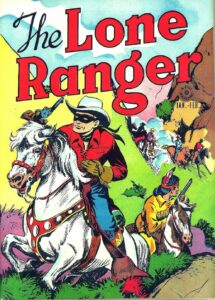
College Essay Review: A Step-by-Step Guide (With Examples)

When you write an essay, do you read and reread it to ensure your content is impressive before finally submitting it for grading? What this means is that you prefer to review your college essays thoroughly before your teacher or instructor peruses them. 

However, this task may become overwhelming at times. Don’t worry. We have a solution that will streamline essay reviewing for you. 

In this article, we will discuss how to review your college essay step by step and ensure that you do not miss verifying the effectiveness of any aspect of your essay. So, let’s begin! 

Need help with essay reviews? Explore our essay editing services.

How to review a college essay: A step-by-step guide

College essay reviews can be simple to execute if a defined process is followed. A structured process ensures that the output is superior in terms of relevance, information, and overall quality. 

By evaluating your work in advance, you can identify and correct mistakes that could potentially harm your essay score. Editing and proofreading your essays will help polish them to a great extent, bringing them closer to perfection in that instance. 

Here are the points you can follow to edit, proofread, and review your college essays:

1. Understand the essay prompts and requirements

The prompt that your college or teacher has asked you to work with must be carefully studied and understood. Take the key objectives and expectations into account before finalizing the essay outline. Also, ensure that you keep the essay writing and submission requirements in view. 

2. Check the essay outline

Precisely interpreting the meaning of the topic is key to generating an essay outline. This outline should guide you in organizing your points logically, ensuring that the content flows smoothly and remains relevant throughout.

3. Evaluate the essay structure and flow

If the essay outline seems apt, checking whether the final structure upon adding content is effective goes a long way in making your essay interesting and informative. Assess whether the information is presented logically and whether the transitions between paragraphs are smooth. A well-structured essay keeps the reader engaged and makes your arguments more compelling.

4. Run content checks

Read the content to catch errors and verify the factual accuracy of your essay. Ensure that your arguments are logically sound and well-supported by evidence. This step is crucial in making your essay both informative and persuasive.

5. Check grammar, spelling, and punctuation

Incorrect grammar can make your content difficult to understand, and spelling mistakes are simply exhausting. Grammar and spelling play a key role in ensuring that readers remain focused on your message.

6. Revisit the tone and style

Examine the tone and writing style to ensure they are appropriate for the audience and purpose of your essay. Additionally, verify that the formatting style adheres to your university’s guidelines. Consistency in tone and style helps convey your ideas more effectively.

7. Ensure clarity and coherence

Analyze your essay to check whether your ideas are clearly expressed and logically connected. Each paragraph should build upon the previous one, making for a cohesive argument throughout. Avoid ambiguity and ensure that your essay communicates your message effectively.

8. Analyze the content for originality and depth

You can use free plagiarism checkers available online to check if your content gets flagged for plagiarism. This step helps you avoid any potential plagiarism issues before submission. Additionally, review your essay for depth, making sure that your analysis and arguments are insightful and contribute meaningfully to the topic.

Why reviewing a college essay is crucial?

A college essay that undergoes a detailed review has a higher chance of being graded better than one that has not been evaluated a second time. A thoroughly reviewed college essay directly impacts the quality of your submission. 

Such an essay goes beyond just meeting your college or teacher’s essay writing requirements. It ensures your content is clear and coherent. It also increases the effectiveness of your essay and makes it sound more compelling. 

Through reviews, you can identify and correct errors, refine your arguments, and enhance your essay’s overall structure and flow. This process helps you present ideas more effectively. 

Moreover, you can assess whether your work is original. Unintentional plagiarism is a possibility, and reviewing college essays allows you to double-check whether your work offers fresh insights. An in-depth review converts a good essay into an exceptional one. 

If you are worried about reviewing important essays, particularly college admissions essays, seeking college essay editing services might prove to be a good decision. 

Common mistakes to avoid during essay review

While reviewing the content of a college essay, you might inadvertently overlook certain mistakes that can negatively impact your grade. That is why free online essay checkers and grammar checkers come in handy during a college essay review.

To simplify the college essay review process, we have outlined some common mistakes you should try (as far as possible) to avoid during college essay reviews:

  • Undertaking speedy reviews: You must allow yourself adequate time to review your work. Taking a break from the essay content and returning with fresh eyes is important.
  • Ignoring thesis or topic checks: Verify the clarity and strength of your topic sentence or thesis statement to ensure the content is relevant. A clear and specific statement or prompt gives the right direction to the rest of the content.
  • Missing sentence structure checks: Complex, lengthy, or awkward sentence structures can confuse readers, introduce redundancies, and make your message unintelligible. To strengthen your arguments, sentence structure checks are unavoidable.
  • Disregarding aspects other than grammar and spelling: Grammar and spelling must be taken care of, there is no doubt about it. However, ignoring the soundness of arguments or the coherence of the ideas in your essay can prove to be detrimental.
  • Failing to fact-check: If you do not verify the accuracy of facts or statistics and corroborate them with the right sources, your teacher will end up doing it for you during essay grading. Inaccurate information can result in a low grade.
  • Dismissing tone and style issues: Tone and writing style are important aspects of any writing endeavor. Check whether they match the essay’s purpose and audience. Inconsistent tone and/or style can impact your standing as a student.
  • Leaving transitions unchecked: If you want the content to flow smoothly, checking transitions between paragraphs and sentences is crucial. They help maintain the flow. An unconnected or irrelevant thought or idea can make your essay difficult to follow.
  • Brushing aside plagiarism checks: We cannot stress the importance of using plagiarism detection tools to ensure your content is original and properly cited. This is a non-negotiable step!
  • Not seeking feedback: Conducting a review but not asking peers or mentors to read your work might lead to a biased assessment. Hence, you should seek feedback from others to identify if any areas need improvement.

Some examples of college essays 

Here are some college essay examples for your reference. Note that these can be further reviewed and edited if needed. 

Example 1: Reflect on a time when you challenged a belief or idea. What prompted you to act? Would you make the same decision again?

In my sophomore year, I was part of a debate team where we discussed the merits of mandatory volunteerism. I initially believed that forcing people to volunteer was counterproductive. However, after conducting research and hearing opposing views, I found myself questioning my stance. 

During the debate, I decided to argue in favor of mandatory volunteerism, emphasizing the long-term benefits it could bring to society. This experience taught me the importance of being open to changing my perspective when presented with new evidence.

Example 2: Describe an extracurricular activity that has been meaningful to you.

As the president of the Robotics Club, I had the opportunity to lead a team of passionate students in designing and building robots for regional competitions. This experience has not only honed my technical skills but also taught me the value of teamwork, problem-solving, and perseverance. 

One of our proudest achievements was winning the Innovation Award at the state championship, a moment that validated our countless hours of hard work. Being part of this club has solidified my desire to pursue a career in engineering.

Utilize tools and resources for college essay reviews

Before you begin writing a college essay, using essay outline generators can help create relevant points for your essay. Once your essay is ready, reviews are essential. Let us discuss this further.

Essay checkers and essay graders are useful tools for essay reviews. Similarly, grammar checkers and spell checkers are also important. Additionally, you can look for college essay editing and essay proofreading services for essays that can make or break your academic journey. 

Here are some tools and resources for college essay reviews:

  • Essay checkers: Using essay checkers like Grammarly, QuillBot, PaperRater, etc., can help you understand how effective your essay is and correct it before submission. 
  • Essay graders: Several free and paid essay graders are available today. You can look for a suitable essay grader and secure feedback for essay revision. Some popular ones include Perfect Essay Writer, Essay-Grader AI, My Essay Writer, etc. 
  • Grammar checkers: They help you correct grammar mistakes and fix sentences wherever required. Popular grammar checkers include Grammar Check, Reverso, etc. 
  • Spell checkers: Many grammar checkers have integrated spell checks in their tools. However, a separate spell check is always recommended. You can use tools like Grammarly, LanguageTool, etc. 
  • College essay editing services: Hiring college essay editing services like PaperTrue is advisable if your essay is the deciding factor in what happens next in your academics. 
  • College essay proofreading services: These services provide similar support in terms of correction and feedback as college essay editing services. PaperTrue, a renowned name in the editing industry, offers both essay editing and proofreading
  • Books and essay writing guides: Books are timeless! You can always rely on books and essay editing guides, both online and in print, to write a good essay and verify its relevance and effectiveness. 

College essay reviews can only enhance your essay and polish it, making it an interesting read. It is an essential step that you should not ignore or avoid. By following a structured review process that also includes relying on tools and resources to get the best results, you will likely earn a high score. 

Professional college essay editing services can further streamline the college essay review process and help you achieve your academic goals. A well-reviewed essay not only meets academic requirements but also showcases your ability to communicate skillfully. 

For more articles on essays, grammar, and sentence structure, refer to the links below: 

How to Copyright Your Book?

If you’ve thought about copyrighting your book, you’re on the right path.

Explore more