Newsletter Sign Up

Preposition: Definition, Meaning, Types, Examples, and List

Imagine you are looking for something and your friend tells you that it’s “here”. 

Here? But where is “here”? 

“Right in front of you,” your friend says. 

Communication would be so difficult if not for prepositions! In front, behind, against, and many more prepositions are there to help us. This article will decode the meaning of prepositions, their types, and examples. We will also explore common prepositions, their types, and how they are used in sentences.

Plus, there’s also a prepositions list, tips on how to use them, and fun quizzes and exercises to make your understanding of prepositions concrete! So, let’s start by understanding what is a preposition.

Achieve error-free text with our top-notch editing!

Here’s an easy preposition definition to begin with:

What is a preposition?

Prepositions provide context to words, often indicating when, where, or how something happens. They show connections related to time, location, or direction. Prepositions are important because they give essential details that clarify different parts of speech

It usually comes before a noun (like a person, place, animal, or thing) or a pronoun (like he, she, it), or a noun phrase to show their relationship in terms of time, place, or other details. 

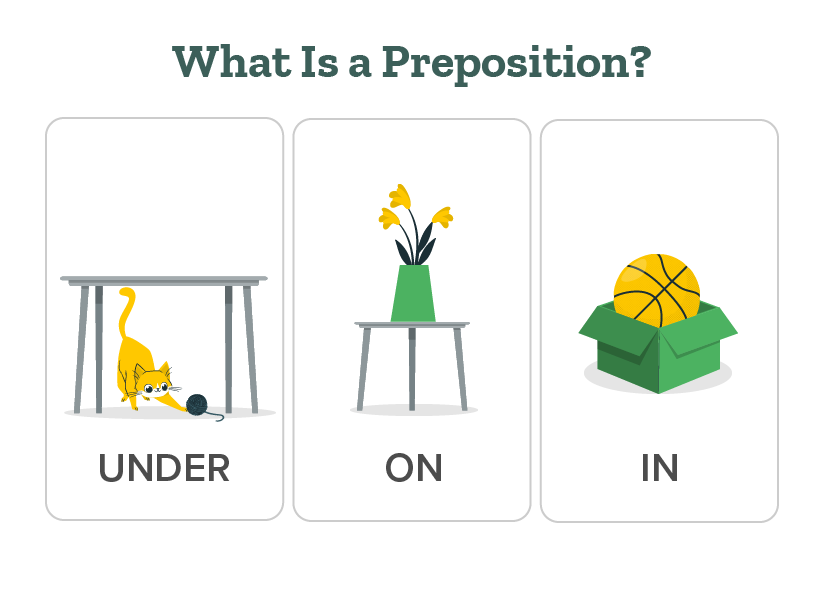
For example, in the sentence “The book is on the table,” the word “on” is a preposition that tells us where the book is in relation to the table. Similarly, in “We will meet at 12 PM,” the preposition “at” tells us the time of the meeting.

Without prepositions, sentences would lack clarity and direction, making them vague and confusing. To know in-depth, what a preposition means, take a look at a few preposition examples:

Time: In

Place: Under

Direction: From

What are parts of speech? 

Parts of speech are specific roles and functions of a word in the English language. Noun, verb, adjective, adverb, pronoun, preposition, conjunction, and interjection are the eight parts of speech. 

You will get a better grasp on things once we look at the different types of prepositions: 

Types of prepositions
Types of Prepositions like time, place, and direction.

1. Prepositions of time

Prepositions of time help us specify when something occurs. They indicate when events happen, whether in the past, present, or future. They are crucial for discussing past, present, and future events. To identify prepositions of time in a sentence, look for words that answer the question “When?”.

For instance, we use ‘in’ to refer to centuries, such as ‘in the 21st century’.

Examples of prepositions of time

Here are some time examples to illustrate the usage of prepositions of time:

  • At” is used for precise time.

Meet me at 3 pm. 

It rained at 10 o’clock yesterday.

At 6 in the morning, the rally will start.

  • On” is used for days and dates

We will go shopping on Friday. 

Their wedding is on 12 March.

On Wednesday, the hotel will be closed.

  • In” is used for months, years, seasons, and parts of the day.

It snows in December. 

The trees look red in autumn.

In the afternoon, the classes will begin.

  • Since” is used to indicate the start of a period.

She has been here since morning. 

He has not eaten since yesterday.

Since 1999, computers have been used more often.

  • By” is used to indicate deadlines.

Please finish this report by tomorrow.

You have to come home by 10 PM.

By Friday, I’ll complete my project.

2. Prepositions of place

Prepositions of place are used to describe the location or position of nouns. They help us understand the spatial relationship between objects. They help us understand where something is situated. To identify prepositions of place in a sentence, look for words that answer the question “Where?”.

Examples of prepositions of place

Examples of prepositions of place include:

  • “At” indicates a specific point or location.

Meet me at the fountain in the park.

She left her keys at the front desk before heading out.

The dog likes to nap at the foot of the bed during the afternoon.

  • “In” is used for enclosed spaces, areas, or large geographical locations.

She lives in Germany.

The cat is sleeping in the sunny spot by the window.

He found his favorite book in the top drawer of the desk.

  • “On” refers to a surface or a position along a surface.

The pen is on the desk.

The keys are on the kitchen counter next to the coffee machine.

There is a beautiful vase on the shelf above the fireplace.

  • “Above” indicates a higher position relative to a point of reference, without physical contact.

Hang the picture above the sofa.

The clock hanging above the mantelpiece is almost a century old.

A flock of birds soared above the lake.

  • “Below” indicates a lower position relative to a point of reference.

The fish swim below the surface of the water.

The storage room is located below the main floor of the house.

They noticed a bright coral reef just below the surface of the water.

  • “Under” is similar to below but often implies that something is directly beneath another thing, possibly covered by it.

The boy hid under the bed during the thunderstorm.

She keeps all her board games stored under the staircase.

The picnic area is located under the large oak tree at the park.

  • “Over” indicates that something is positioned directly above something else, and can also imply covering or moving across.

There is a bridge over the river.

A colorful banner stretched over the entrance.

She threw her clothes all over the bed.

  • “Beside” indicates next to or at the side of something.

Park your bike beside mine.

She sat beside her friend at the café.

The lamp is placed beside the sofa in the living room.

  • “Between” indicates in the middle of two or more points.

The coffee shop is situated between the bookstore and the bakery.

The small cottage is nestled between two towering mountains.

She found her lost earring between the couch cushions.

  • “Among” indicates surrounded by; in the middle of a group or collection.

She was sitting among a group of students.

The ancient ruins were hidden among dense forests.

She distributed the snacks among the children at the party.

  • “Across” indicates from one side to the other, implying a crossing over.

The zebra crossing goes across the busy street.

She lives just across the street from the library.

The bridge stretches across the river connecting the two towns.

  • “Around” indicates in a circular direction or position; surrounding something.

We gathered around the fire to keep warm.

The path winds around the lake leading to the hilltop.

He looked around the room, searching for his bag.

  • “Near” indicates close to; not far away in distance.

There is a nice park near my house.

The parking lot is near the entrance of the museum.

There is a bakery near the corner of the street.

  • “Against” shows in contact with something, typically in a way that provides support or resistance.

He leaned against the wall.

The waves crashed against the rocky shore.

She rested the painting against the back of the chair.

  • “Within” indicates inside or not further than an area or period of time.

You should receive a reply within 24 hours.

The café is within walking distance of her office.

He found the solution within the first chapter of the book.

However, is “in” a preposition of time or place? Similarly, is “on” a preposition of time or place? The answer is that “in” and “on” can be used as both, prepositions of time and prepositions of place. What makes them different is the context they are being used in. 

3. Prepositions of direction

These prepositions tell us about the direction in which something or someone moves. They are essential for describing movement and location in sentences. They are dynamic, indicating movement. To identify prepositions of place in a sentence, look for words that answer the question “From Where” or “To Where”.

Examples of prepositions of direction

In the following sentences, we will see examples of prepositions of direction:

  • To indicates movement towards a specific destination.

She is going to the office.

He sent a letter to his friend in Canada.

The children ran to the playground.

  • “From” indicates the starting point of a movement.

He travels from Chicago to New York often.

This gift is from all of us at the office.

She learned the recipe from her grandmother.

  • “Into” indicates movement towards the inside of a place.

She walked into the room.

The cat jumped into the empty box on the floor.

Pour the water into the glass slowly.

  • “Out of” indicates movement from inside to outside.

He ran out of the house.

She took the book out of the bag

The magician pulled a rabbit out of his hat.

  • “Through” indicates moving from one side to the other within something.

They drove through the tunnel.

The tour group walked through the ancient ruins.

She read through the document before signing it.

  • “Across” indicates movement from one side to the other over a surface.

She swam across the lake.

The chicken ran across the road.

She glanced across the room.

Preposition examples

To understand different prepositions better, let’s look at some more preposition examples and how they are used in a sentence. These examples will show how prepositions indicate when and where events happened!

It rains a lot in April. (In indicates a specific time.)

The cat is sleeping under the bed. (Under indicates a specific space.)

I will meet you at the entrance. (At indicates a specific location.)

She travels from New York to London often. (From indicates a specific direction.)

But, there’s a trap here! In the phrase “from New York to London”, if  “from” tells you the direction then so does “to” right? So, is “to” a preposition?

Yes. “To” is also a preposition that indicates a direction. 

Some prepositions can create confusion, especially for second language learners, due to their multiple meanings.

Now that we’ve seen so many preposition examples, let’s have a small fun quiz to test your learning:

  • Is “with” a preposition?

Ans: Yes

  • Is “of” a preposition?

Ans: Yes

  • Is “for” a preposition?

Ans: Yes

Don’t worry if you got some answers wrong. Here’s the most commonly used prepositions list for you. As a bonus, we’ve also got an uncommon prepositions list:
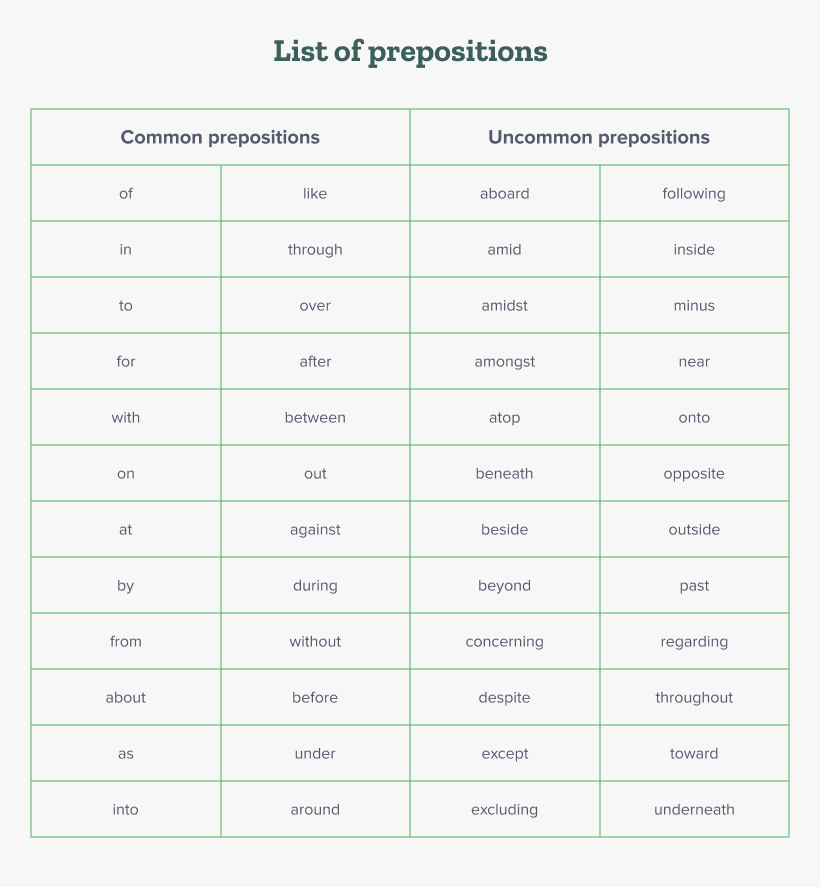
List of common and uncommon prepositions.

Verbs followed by prepositions

In English, many verbs are commonly followed by specific prepositions. These pairings are crucial because the prepositions can alter the meaning of the verb or make it whole.

Some common examples are:

  • She agrees with you on that. (The verb “agrees” is followed by the preposition “with”)
  • She asked for a glass of water. (The verb “asked” is followed by the preposition “for”)
  • The test consists of two parts. (The verb “consists” is followed by the preposition “of”)
  • The team focused on winning. (The verb “focused” is followed by the preposition “on”)
  • You can rely on me to help you. (The verb “rely” is followed by the preposition “on”)

It is important to note that different verbs can share the same preposition, which is crucial for effective usage.

Adjectives followed by prepositions

Just like verbs, many adjectives in English are commonly paired with specific prepositions. These combinations are key for pinpointing relationships and can shift the meaning or context of your description.

Some common examples are:

  • She is afraid of spiders. (The adjective “afraid” is followed by the preposition “of”)
  • He was angry at the news. (The adjective “angry” is followed by the preposition “at”)
  • He is very fond of his parents. (The adjective “fond” is followed by the preposition “of”)
  • I’m tired of all the noise. (The adjective “tired” is followed by the preposition “of”)
  • He’s keen on playing chess. (The adjective “keen” is followed by the preposition “on”)

These combinations of adjectives and prepositions form phrases that are essential for clear communication.

Ending a sentence with a preposition

Ending a sentence with a preposition is something that often happens in spoken and written English, even though traditional grammar rules used to frown upon it.  When we speak casually, it’s common and perfectly natural to end sentences with prepositions.

For example:

What are you thinking about? (the preposition “about” ends the sentence.)

This is more conversational and easier to use than the more formally correct “About what are you thinking?”

Who did you go with? (the preposition “with” ends the sentence.)

The idea that ending sentences with prepositions is incorrect is actually a myth.

Ending sentences with prepositions can make speech sound more natural and less forced, which is why it’s commonly accepted in everyday English. Here are more examples where sentences naturally end with prepositions:

  • Where did you come from?
  • What are you looking for?
  • That’s the company I work for.
  • Which university did she graduate from?
  • What movie are you interested in?
  • Who were you talking to?
  • What chair should I sit on?
  • That’s something I haven’t thought about.
  • Which team are you rooting for?
  • What is the remote control for?

Rules for using prepositions

  1. Ensure that the preposition essential for meaning is not dropped.

She is married to him (not just “She is married him”).

  1. Avoid inserting prepositions where they are not needed.

Let’s meet next Monday (not “Let’s meet on next Monday”).

  1. Phrasal verbs often pair verbs with specific prepositions or adverbs, creating meanings that are not predictable from the individual elements.

Look up the information (not “look at” the information).

  1. Some expressions use prepositions in ways that are fixed and might not follow normal rules. These should be learned as complete phrases.

At odds with, in favor of, on behalf of.

  1. Keep them close to what they modify: To avoid confusion, place prepositional phrases close to the nouns or verbs they modify.

The cake with whipped cream was delicious (not “The cake was delicious with whipped cream”).

To solidify your knowledge of prepositions, the last thing you can do is solve this prepositions exercise. 

We’ve specially crafted this exercise for you, which you can solve with the help of extensive preposition examples, a list of prepositions, and the meaning of prepositions that we’ve learned before!

Exercise Instructions

Read the sentences below and fill in the blanks with the correct prepositions.

  1. She has been studying hard ___ the library since morning.
  2. We will meet ___ the coffee shop ___ 3 PM.
  3. The cat is hiding ___ the sofa.
  4. They traveled ___ car ___ the two cities.
  5. The meeting continued ___ lunch.

Mastering the use of prepositions can enhance your language skills. Whether you’re writing a business proposal, crafting a professional email, or preparing an academic paper, understanding these combinations is crucial. It is important to proofread your documents and make sure they do not have any grammar mistakes.

If you’re looking to perfect your writing even further, consider PaperTrue’s expert editing and proofreading services. Our team of professionals can help refine your document, ensuring every preposition is perfectly placed for maximum clarity and impact!

Here are some more grammar articles for you:
How to Write a Dissertation & Thesis Conclusion (+ Examples)

Want to create a strong, impactful conclusion? Explore how to create a dissertation and thesis conclusion in 5 simple steps! To help you understand better, we’ve also included useful dissertation and thesis conclusion examples! 

Whether you want to write a conclusion for an empirical or humanities paper, this article will help. So, without delay, let’s understand how to create the best conclusion! 

Achieve academic excellence with exceptional editing services!

Introduction to writing a conclusion

Writing a conclusion is a crucial part of the research process, as it provides a final opportunity to summarize the main findings, reiterate the thesis statement, and leave a lasting impression on the reader. A strong conclusion should be concise yet comprehensive and provide a broader context for the research. It is essential to avoid simply repeating the introduction or main body of the dissertation and, instead, focus on presenting the key takeaways of the research. In this section, we will explore the importance of writing a great conclusion and provide guidance on how to structure it effectively.

Firstly, let’s know more about the appropriate length of a dissertation and thesis conclusion. 

What is the length of a conclusion? 

Depending on the complexity of your research and document length, the length will differ. The thesis or dissertation conclusion should be 5-7% of your paper’s overall word count. For example, if your thesis is 30,000 words, the conclusion can be 1,500-2100 words. 

The conclusion for empirical or scientific theses or dissertations is often brief. It summarizes the main findings, interprets the research, and discusses the main implications in a few words. In contrast, the thesis or dissertation conclusion for humanities subjects is longer and more reflective. 

Understanding the research question

The research question is the foundation of any research project, and it is essential to understand its significance and relevance to the field of study. A well-crafted research question should be specific, measurable, achievable, relevant, and time-bound (SMART), and it should guide the entire research process. In the conclusion chapter, it is essential to revisit the research question and provide a clear answer to it based on the research findings. This will help to demonstrate the contribution of the research to the existing body of knowledge and provide a sense of closure for the reader. Further research can also be suggested to explore the topic in more depth.

Structuring the conclusion chapter

The conclusion chapter should have a typical structure that includes a brief recap of the research problem, a summary of the main findings, and an explanation of the implications of the research. It is essential to use concise language and avoid unnecessary details, as the conclusion should be around 5-10% of the overall word count. The conclusion chapter should also provide a broader perspective on the research and its contribution to the field, and it should be written in a way that is engaging and memorable. The key points to be covered in the conclusion chapter include the research findings, the implications of the research, and the suggestions for future research.

Now, let’s see how to write a conclusion for a thesis/ dissertation in 5 steps! 

How to write a dissertation and thesis conclusion 

1. Remind readers of the research purpose 

For an empirical paper, start your conclusion by revisiting your research question or hypotheses stated earlier in your research. This reminds readers of your study’s main focus and sets the stage for findings. The following is an example: 

“This study aimed to investigate the relationship between employee job satisfaction and organizational commitment in the healthcare industry.” 

In comparison, while writing the conclusion for a humanities paper, reflect on the research journey. You can also consider the key themes, ideas, arguments, and questions that have guided your research. Here is an example: 

“Throughout this thesis, the concept of identity formation in postcolonial literature has been explored, focusing on the works of Chinua Achebe and Chimamanda Ngozi Adichie. The central argument claimed that these authors utilize their narratives to challenge Western hegemonic discourses and assert the agency of African identities.” 

2. Summarize main insights 

For an empirical paper, summarize your main results and findings concisely. This section should highlight the most significant research outcomes and how they relate to your research questions, hypotheses or research methodology. Here is an example: 

“The results of this study demonstrated a significant positive correlation between employee job satisfaction and organizational commitment (r = 0.78, p < 0.001). Multiple regression analysis revealed that job satisfaction, along with factors such as work-life balance and leadership support, accounted for 65% of the variance in organizational commitment scores.” 

On the other hand, if it’s a humanities paper, you can summarize any evidence or examples that support your claims about the research in your conclusion. Here is an example: 

“The analysis of Achebe’s ‘Things Fall Apart’ and Adichie’s ‘Purple Hibiscus’ reveals a common thread of resistance against colonial oppression and the assertion of African identity. Both authors employ narrative techniques that subvert Western stereotypes and provide a nuanced portrayal of African experiences. Through their characters’ journeys, Achebe and Adichie challenge the notion of a singular African identity and highlight the complexities of postcolonial life.”

3. Suggest practical applications, future recommendations, and limitations 

Mention how your research can be practically applied (if relevant) and make suggestions for future research. Explain the broader significance of your findings while writing a dissertation conclusion/thesis conclusion. If there are any limitations, you can add them to this part. Here is an example: 

“The findings have implications for healthcare organizations aiming to improve employee retention and well-being, with potential benefits for patient care and organizational performance. However, the study’s limitations, such as its specific sample size and setting make it difficult to generalize these findings. Further research is needed to explore the effectiveness of interventions targeting these factors across diverse healthcare contexts and to investigate additional variables that may impact organizational commitment.” 

In contrast, here is another conclusion example for an empirical paper: 

“The comparative analysis of Achebe and Adichie’s works has significant implications for the study of postcolonial literature. By highlighting the diversity of African experiences and the importance of cultural identity, these authors challenge the notion of a monolithic African narrative. This research also raises important questions about the role of literature in shaping cultural perceptions and the impact of colonialism on contemporary African societies.”

Browse through the next step of how to write a conclusion for a dissertation/thesis! This step demonstrates your research’s importance in a broader context. 

4. Highlight your research’s significance

In this part, write about how your research has contributed new knowledge to your field. You can briefly explain how the research conducted has filled a gap in your field of study. By using relevant academic research resources like Google Scholar, you can understand the research already conducted and use relevant references in your conclusion. 

If your research proves or disproves a certain theory or assumption, you can mention that. Also, if you’ve mentioned the gap in the literature review, you can remind readers about this. 

Here is an example of how to highlight your research’s significance for an empirical paper: 

“This study contributes to the growing body of research on the impact of social media on adolescent mental health. By utilizing a longitudinal design and a large, diverse sample, this study provides robust evidence for the relationship between social media usage and negative mental health outcomes. The findings also highlight the importance of considering the role of specific social media platforms and usage patterns in shaping mental health, which has been overlooked in previous research.” 

In contrast, in a humanities paper, you should focus on how your insights contribute to the broader discourse in your field and any new perspectives or interpretations.

The following is an example: 

“This comparative analysis of Achebe and Adichie’s works contributes to the growing body of postcolonial literary criticism by highlighting the importance of considering the diversity of African experiences and the ongoing impact of colonialism on contemporary African societies. By focusing on the theme of cultural identity and the use of narrative techniques that subvert Western stereotypes, this research offers a new lens through which to interpret these authors’ works and their significance within the canon of African literature.” 

Now, let’s understand the last step of how to write a dissertation conclusion/thesis conclusion! 

5. Strongly conclude your thesis or dissertation 

End with an impactful statement that summarizes a key takeaway or highlights your work’s broader significance. 

Here is an example of an empirical paper conclusion: 

“By investing in evidence-based strategies to promote mental health in the workplace, we can foster a more resilient and productive workforce for the future.” 

In contrast, the following is an example of the final statement for a humanities paper: 

“In the final analysis, the enduring legacy of these writers lies in their ability to touch the depths of the human soul, awakening us to the transformative power of language, story, and imagination.” 

After concluding your thesis, to enhance your thesis further, you can take the help of online thesis editing and proofreading services

Literature Review Reflection

The literature review is an essential part of any research project as it provides a comprehensive overview of the existing body of knowledge on the topic. In the conclusion chapter, it is essential to reflect on the literature review and provide an analysis of the key findings and implications. This will help to demonstrate the significance of the research and its contribution to the existing body of knowledge. The literature review reflection should also provide a critical evaluation of the existing theory and its limitations, and it should suggest areas for further exploration. The conclusion chapter should also provide a sense of closure and finality, and it should leave the reader with a lasting impression of the research.

Emphasizing Contributions to the Field

The conclusion chapter should emphasize the contributions of the research to the field of study, and it should provide a clear explanation of the implications of the research. The contributions can be theoretical, practical, or empirical, and they should be based on the research findings. The conclusion chapter should also provide suggestions for future research and recommendations for practitioners or policymakers. The key arguments and findings of the research should be summarized, and the conclusion chapter should provide a final opportunity to present the key takeaways and implications of the research. The conclusion chapter should be written in a way that is engaging and memorable, and it should leave the reader with a lasting impression of the research and its contribution to the field.

Now, let us see the dos and don’ts to follow while writing a thesis conclusion! 

Dos and don’ts while writing a conclusion 

Suggested sentence structures for framing the conclusion 

Depending on whether you’re writing an empirical or humanities paper, you can use and customize these sentence structures for your thesis or dissertation conclusion. 

  1. This study aimed to investigate the… 
  2. The results of this study demonstrate that…
  3. The analysis of the data revealed that… 
  4. The findings of this study have significant implications for…
  5. The insights gained from this research have important implications for…
  6. The key findings of this research indicate… 
  7. Further research is needed to explore….
  8. By investigating [write the research purpose], this study found out [write the main findings]. 
  9. This study makes a notable contribution to the field of…[field name] by [write the contribution] 
  10. While this study demonstrates the potential for [practical application], further research is required to explore…
  11. To conclude, the insights gained from this research…
  12. This dissertation fills a crucial gap in the literature by…
  13. This study offers valuable insights that can…
  14. In summary, this study…
  15. In closing, this dissertation…

This concludes our guide about how to write a thesis conclusion and dissertation conclusion. You can bookmark this article to revisit any thesis and dissertation conclusion examples. Once you write the conclusion and complete your paper, you’ll need to edit and proofread your thesis or dissertation. As experts in editing and proofreading services, we’d love to help you perfect your paper! 

Here are some other articles you might find interesting: 

The Top 10 Literary Devices: Definitions & Examples

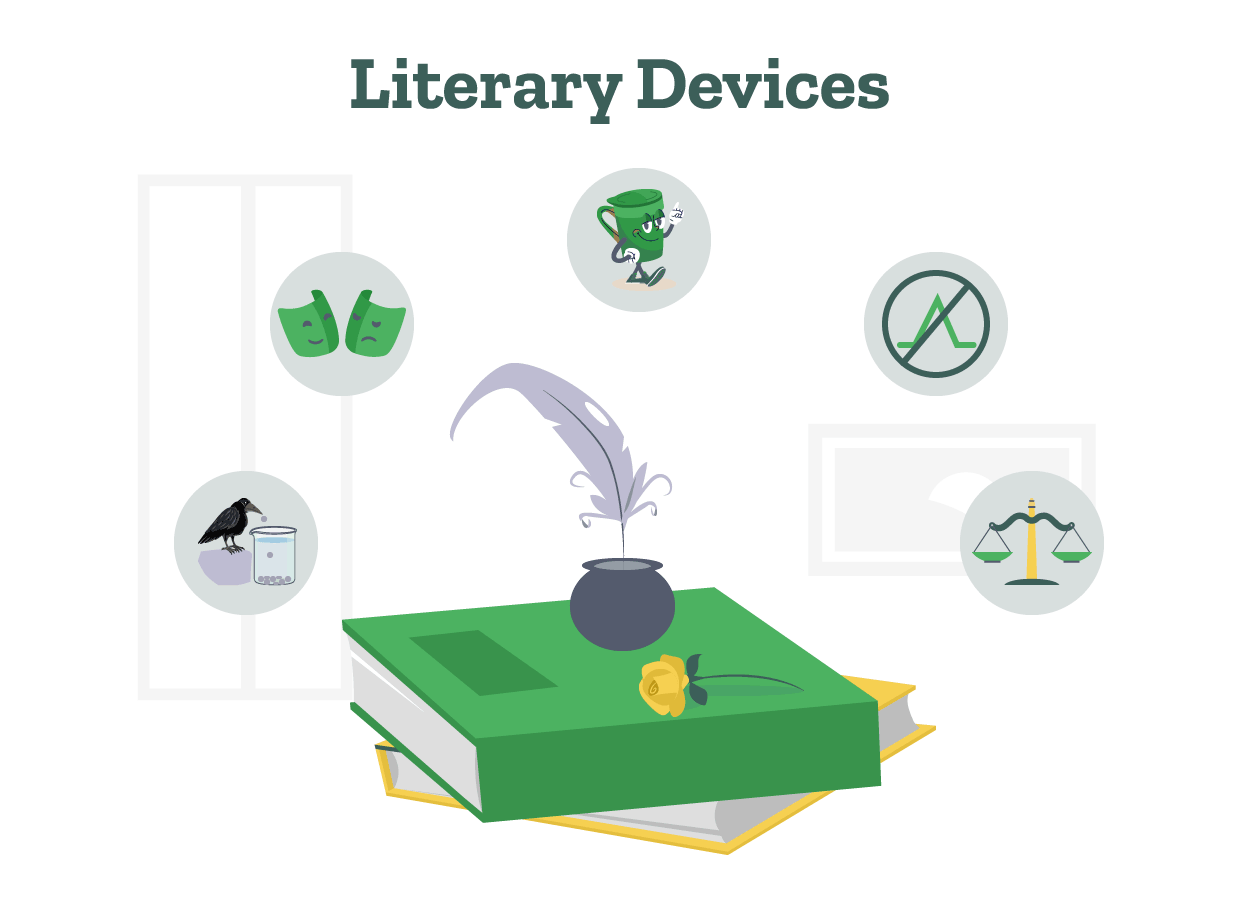
If you want to understand literary devices better, this article is for you! This list of literary devices can help you take your creativity to the next level. You can use these 10 literary devices to describe emotions and highlight themes while writing. Understanding the most common literary devices can significantly enhance one’s writing skills.

This article will cover various common literary devices. We have also provided practical examples of all literary devices to help you understand their usage. So, let’s get started!

Elevate your writing with expert editing and proofreading! Get started

What are literary devices?

Literary devices are techniques and strategies authors use to enrich their writing and take it beyond the literal meaning of words. They serve various purposes and can operate at the sentence level or even permeate an entire literary work. Understanding literary devices is crucial to appreciating the depth and complexity of a text. Literary devices refer to the creative tools writers use to elevate their works above ordinary writing. When used effectively, literary devices add depth, beauty, and emotional resonance to literary works. Writers typically employ several devices simultaneously. Some literary devices are more common in certain forms of writing, such as assonance or alliteration in poetry.

Here are the top ten literary devices:

  • Allegory 
  • Anticlimax 
  • Allusion 
  • Dramatic Irony 
  • Anthropomorphism 
  • Paradox 
  • Chiasmus 
  • Juxtaposition 
  • Motif 
  • Analogy 

Let’s understand each of these literary techniques in further detail.

#1 Allegory 

An allegory is one of the commonly used literary techniques where words, symbols, and pictures represent a deeper, hidden meaning. This meaning can be moral or political and can refer to occurrences. From children’s stories to mythology, allegories are everywhere! Allegories often represent significant historical events to convey deeper meanings.

Using allegories helps you explain complex ideas in simple terms. Various other literary devices such as metaphor (comparing different concepts) and Personification (giving non-living entities human qualities) are used to create allegories. Allegories often have an underlying meaning that reflects broader societal or moral themes.

Example: The Lord of the Flies by William Golding

Every character in the novel represents a bigger idea. Ralph represents democratic ideals, Jack symbolizes autocracy and barbarianism, while Piggy portrays scientific thinking and rationalism. The novel is a moral and political allegory portraying a struggle between good and evil, democracy, and a dictatorial mindset. 

#2 Anticlimax 

Anticlimax refers to a sudden shift from a significant or intense moment to a less important or trivial one. This shift can create a sense of disappointment, contrast, or even humor after a tense moment. Authors also sometimes resolve the conflict easily in the novel, resulting in an anticlimax for the readers. This literary device subverts the audience’s expectations by including unexpected developments or consequences in the plot. Anticlimax can evoke emotion by subverting expectations and create tension by leading readers to anticipate a different outcome.

Example: The Catcher in the Rye by J.D. Salinger 

Readers expect a definite resolution at the end of the novel. However, the ending is left ambiguous by the author. While Holden expresses happiness on seeing his sister Phoebe, he later says that he misses everyone. Towards the novel’s end, Holden confesses how he still doesn’t understand what he is feeling and why. Through Holden’s words, Salinger subverts the readers’ expectations of a definite resolution about Holden. 

#3 Allusion 

An allusion is a reference to a person, literary piece, artwork, or event outside a given story. This reference is usually indirect and subtle. Writers use this device to situate a work in a literary tradition or build connections outside the text into another text that came before. 

There are various types of allusions, such as literary allusions, mythological allusions, historical allusions, religious allusions, and pop culture allusions. Authors use allusions to provide context to the reader and add more depth to the story. 

Example: The Love Song of Alfred J. Prufrock by T.S Eliot 

In this popular poem, there is a line: “No! I am not Prince Hamlet, nor was meant to be.” Here, Hamlet is a reference to Shakespeare’s play Hamlet. Other biblical, historical, cultural, literary, and mythological allusions are also used in this poem. 

#4 Dramatic Irony 

Dramatic irony is a device in which the audience has information that the characters don’t.  This makes the audience understand the characters’ point of view and the motivations behind their actions. The use of dramatic irony can provide comic relief, create empathy, or make the readers anxious while reading a literary piece. 

Example: Pride and Prejudice by Jane Austen

In this novel, dramatic irony can be seen at two levels. While the audience realizes that Darcy is attracted to Elizabeth, Elizabeth doesn’t realize this until much later in the novel. Also, Elizabeth and Darcy (along with the audience) are aware of how Wickham wronged Darcy’s sister Georgiana, but Elizabeth’s sister Lydia is unaware of this fact. 

Now it’s time to learn the literary technique that made our childhoods magical and memorable. If you’ve read fairy tales and watched cartoons, you know it already! 

#5 Anthropomorphism

Anthropomorphism is a literary device where plants, animals, and inanimate objects are given human characteristics. Out of all literary techniques, anthropomorphism is the most commonly used. Authors use anthropomorphism to make the story more exciting and to create interesting, memorable characters.

Anthropomorphism is more frequently used in children’s literature, where animals, birds, the sun, and the moon are given human qualities. It helps children learn about morals and good behavior through engaging stories. 

Example: Animal Farm by George Orwell 

In this novel, all animals are given human characteristics, for example, the pigs Snowball, Squealer, and Napoleon.

#6 Paradox

A paradox is a self-contradictory statement. Paradox is the most complex device out of all literary devices. Writers use this literary device to engage the readers and make them reflect more deeply on the characters’ choices and lives. It also helps the readers gain a different, unique perspective on the characters’ lives. 

There are three types of paradoxes: 

  • Falsidical paradox: A falsidical paradox is a contradictory statement/ question that seems correct initially but is false. For example, Zeno’s paradox that a fast runner can’t reach close to a tortoise despite being initially ahead in the race is a falsidical paradox. 
  • Veridical paradox:  A veridical paradox is a contradictory statement/question that is true. For example, the fact mentioned in the comic opera The Pirates of Penzance that a 21-year-old will only have five birthdays if his birthday is on a leap day is an example of veridical paradox. 
  • Antimony: Antimony is a contradictory statement/question where there are two sides of an argument/ perspective. Both sides/perspectives are completely true and justified. For example, “This statement is false” is an example of antimony. If this statement is indeed false, then what it’s saying is true, but it can’t be both true and false at the same time!

These examples of literary devices clearly show how different types of paradoxes can be used to intrigue the readers. Now let us move on to the next literary device that writers use to create memorable phrases and strongly emphasize a specific theme. 

#7 Chiasmus 

Chiasmus is a literary device where there is a repetition of the same idea using a slightly different grammatical structure to create emphasis. Parallel phrases that have a similar meaning or grammatical structure can also be used to create a chiasmus. Chiasmus is used to create a strong effect on readers and also create a sense of rhythm.  

Example: Song of Myself, 15 by Walt Whitman

The line “And these tend inward to me, and I tend outward to them”, is an example of chiasmus. Here, the words “inward” and “outward” situated in a parallel grammatical structure create a good contrast. 

#8 Juxtaposition 

Juxtaposition is a figure of speech where two different ideas or concepts are placed together to create an effect. By placing contrasting ideas side by side, writers highlight their differences and create tension, encouraging readers to reflect on the complexities of the narrative. Writers use this literary device to show the resemblance or dissimilarity between two different concepts. Many times, juxtaposition is also used in dialogues to engage readers effectively. 

Foil characters, antithesis, and oxymoron are used to place different concepts together. Let us understand these literary devices with examples. 

  • Foil characters:  A foil character refers to a character whose traits are completely different from another character. The characters of Sydney Carton and Charles Darnay in A Tale of Two Cities are good examples of foil as both have similarities in terms of physical appearance, but their traits are completely different. 
  • Antithesis: Antithesis is where two different concepts are mentioned in the same sentence. In Shakespeare’s play Romeo and Juliet, the line, “My only love sprung from my only hate” is an example of antithesis as love and hate are opposite ideas.  
  • Oxymoron: Oxymoron is a literary device where two different ideas can be written together as one phrase. “Bittersweet” and “impossible solutions” are some examples of oxymorons. 

#9 Motif 

A motif is an idea, symbol, concept, or object that is repeatedly used in the novel. Authors use motifs to help readers understand the character’s perspective or highlight the novel’s themes. They can also be used to depict and set the moods in the novel. Motifs are commonly used in fictional novels to help readers understand the larger perspective and to highlight important themes, reinforcing the narrative’s central ideas.

Example: The Scarlet Letter by Nathaniel Hawthorne 

In this novel, the scarlet letter “A” that is imprinted on Hester is considered a symbol of adultery and sin. However, as time passes, the letter “A” is seen as meaning “able”, referring to the ability to do something and make a difference. The letter “A” keeps recurring throughout the novel and encourages Dimmesdale to confess the truth. 

Now, let’s understand the last element in this list of literary devices. 

#10 Analogy 

An analogy is a comparison between two concepts that have similarities. Authors use analogies to help their readers understand complex topics in simple terms. Analogies often follow a common analogy structure, such as ‘A is as B’ or ‘A is to B as C is to D’, to draw comparisons between different concepts.

An analogy also includes extra information and provides context and clarity to the reader. Analogies help a reader to imagine the characters and setting vividly and make the work more relatable and significant. 

Example: Forrest Gump (1994)

The line “Life was like a box of chocolates. You never know what you’re gonna get” is an example of an analogy. Here, a similarity is drawn between life and chocolates to explain the unpredictability of life. 

Literary devices in poetry

Poetry is a genre that heavily relies on literary devices to convey meaning and create a specific atmosphere. Literary devices in poetry can include metaphor, simile, personification, and symbolism. For example, in a poem, a poet may use a metaphor to compare two unlike things, creating a vivid and powerful image in the reader’s mind. Literary devices in poetry can also be used to create a musical quality, with devices such as alliteration and assonance adding to the overall rhythm and sound of the poem. Understanding literary devices in poetry can help readers to uncover deeper meanings and appreciate the artistry of the poet.

Literary devices in prose

Literary devices are also used in prose writing, including novels, short stories, and essays. In prose, literary devices can be used to create a specific tone or mood, convey complex ideas or themes, and add depth and complexity to the narrative. For example, an author may use foreshadowing to hint at future events, creating suspense and tension in the reader. Literary devices in prose can also be used to create vivid imagery, with devices such as descriptive language and figurative language helping to bring the story to life. Understanding literary devices in prose can help readers to appreciate the author’s craft and to gain a deeper understanding of the narrative.

We hope these literary devices with examples will help you use them appropriately. As experts who provide novel editing services, we understand how writing creatively without errors is important for you. Here are some resources to help you avoid common grammar and word choice errors: 

How Much Does It Cost to Self-Publish a Book in 2025?

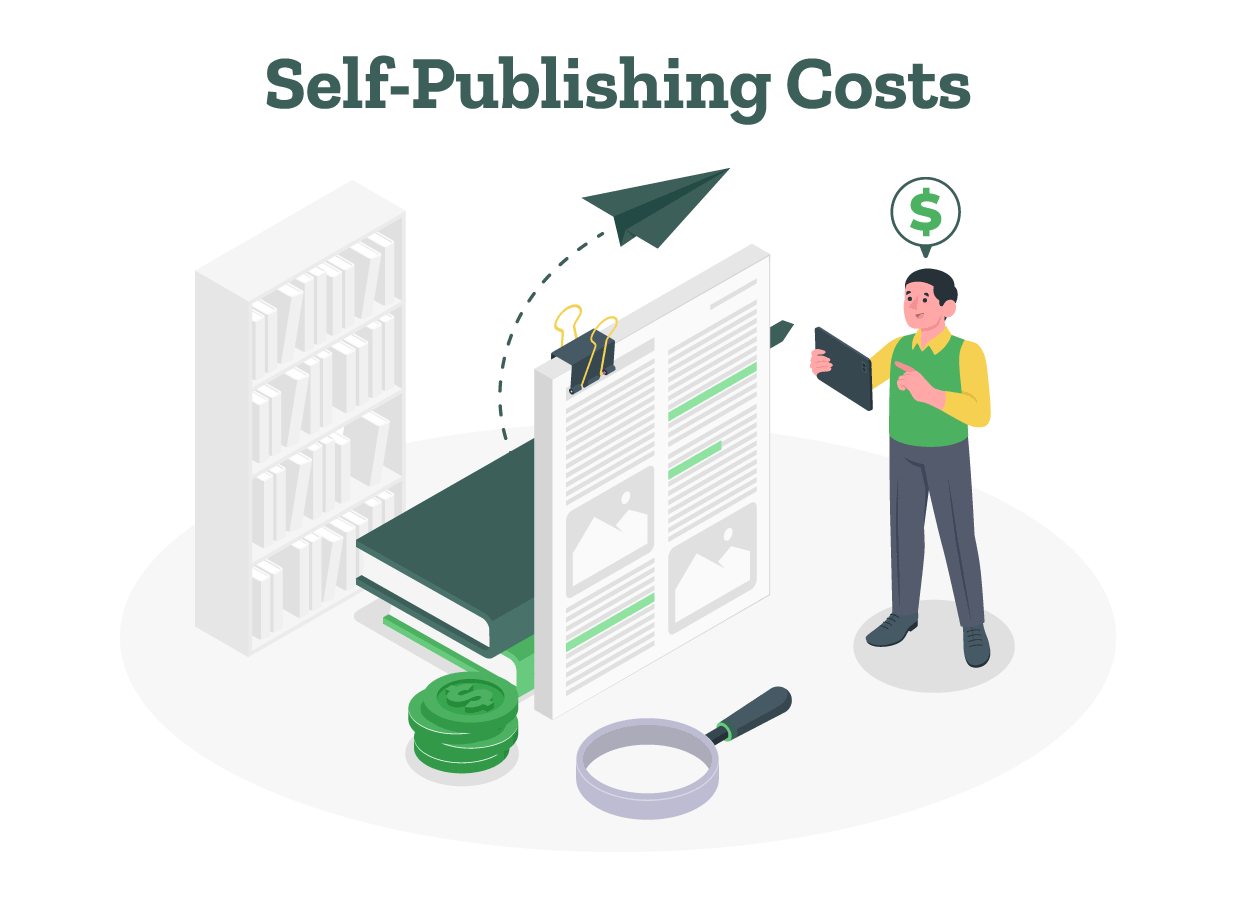
Begin your self-publishing journey by understanding all the costs involved! From editing to formatting costs, we’ve included everything you need to know. We’ve also added the costs to create an ISBN and book cover design for your book. 

For those wondering about the total cost of self-publishing, we’ve given a specific estimate. The average costs can vary significantly based on factors like genre and word count, with services such as editing and marketing ranging widely in price. We’ve also mentioned how you can save costs while self-publishing. So, without wasting time, let’s get started! 

Fast-track your book to self-publication!

Introduction to self-publishing

Self-publishing has revolutionized the publishing industry, offering authors unprecedented control over their work and the potential for higher royalties. Unlike traditional publishing, where literary agents and publishers make most of the decisions, self-publishing allows authors to retain creative control from start to finish. This means you can self-publish a book that truly reflects your vision.

The self-publishing process involves several key steps: editing, cover design, formatting, and marketing. Each step is crucial to producing a professional-quality book that can compete with traditionally published titles. Self-publishing companies offer a range of services to assist authors through this journey, from developmental editing to final cover design.

How much does it cost to self-publish a book? 

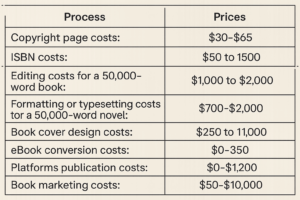
The cost of self-publishing a book ranges from $2500-$5000, depending on how much you are willing to spend for your book. This includes the price of creating a copyright page and the ISBN costs. 

  • Copyright page costs- $30-$65. 
  • ISBN costs- $50 to $150. 

To understand how much does self-publishing cost, here is a breakdown of the pricing: 

1. Editing costs 

The cost of editing a 50,000-word book ranges from $1000 to $2,000. This includes the pricing of developmental editing, line editing, copy editing, and proofreading. While developmental editing includes enhancing the story’s plot, characters, and pacing, line editing includes a line-by-line check of your novel. Editing costs also include copyediting (your novel’s spelling, grammar, and spelling check) and proofreading (rectifying any pending errors). 

For independent authors, financial considerations are crucial during the self-publishing process. It’s important to manage your budget effectively and explore affordable self-publishing platforms that cater specifically to indie authors.

You can also research the costs of top editing and proofreading services like PaperTrue and ProofreadingPal in detail. 

2. Formatting costs 

The cost of formatting or typesetting a 50,000-word novel ranges from $700 to $2000. This cost depends on the novel’s word count. It also depends on whether you want book formatting for a paperback or an eBook. The cost of formatting an eBook is generally less than the cost of a paperback. 

The design process, including interior design and book cover design, is crucial in creating a professionally published book. Essential aspects such as typesetting for readability and the visual elements of book covers should be considered, ensuring both uniqueness and genre consistency.

You can approach companies like PaperTrue, BookBaby, and Elite Authors to format your book. Several book formatting companies also provide additional services like optimizing your book for self-publishing on Amazon KDP, Barnes & Noble Press, Lulu, Smashwords, and Kobo at additional costs. 

3. Book design costs 

The cost to design the front and back cover of the book ranges from $250 to $1000. The exact cost depends on the customization required, quality, and the experience of the book designer. It’s also based on whether you want a book cover for a print book or an eBook. The cost to design a print book cover is more than the cost of an eBook cover. 

The book cover design price includes the costs for concept development and spine design (consisting of the book title, author’s name, and publisher’s name). You can hire professional book cover design services to get an attractive book cover. PaperTrue, BookBaby, and Ebook Launch are some of the top book cover design companies. Several companies also offer multiple revisions at extra costs. You can explore the costs of book cover design services to better understand. 

These are front and back covers of a book and how much it costs to self-publish them.

4. Costs to convert a book into an eBook 

The price to convert your eBook can range from $0-$350. Several eBook creator tools like Draft2Digital, Apple Pages, and Kindle Create help to convert and export eBooks in EPUB and PDF formats for free. FlipHTML5 and Adobe InDesign are some other eBook creator tools you can use. 

The costs can vary, depending on the book length, images and graphics, layout complexity, and special formatting requirements (hyperlinks, multimedia). You can also approach self-publishing companies like PaperTrue to convert your book into an eBook. 

5. Costs to publish on self-publishing platforms 

The price to self-publish on popular platforms ranges from $0-$1200. Amazon KDP, Lulu, Apple Books, Bookbaby, Kobo Writing Life, and Barnes & Noble Press are some of the popular self-publishing platforms. It is free to upload your books on platforms like Amazon KDP, Barnes and Noble Press, Kobo Writing Life, and Apple Books. However, several platforms, like BookBaby and Lulu, charge additional costs for printing your book. Also, several self-publishing companies charge extra to optimize your book as per the guidelines of popular self-publishing platforms. 

Print on demand is a modern self-publishing solution that allows authors to print books only when they receive orders, eliminating the need for substantial upfront investments.

Blurb, BookBaby, and Lulu also offer additional services like book cover design, formatting, and marketing. You can compare the costs of all top self-publishing platforms to decide the best one for your book. 

6. Marketing and promotion costs 

It costs $50-$10,000 to market and promote a book. The cost depends on how much you spend for paid advertising, creating a professional website, hosting events at bookstores, distributing press releases, email marketing, and social media marketing. It’s also based on whether you employ services to create a book trailer, blurb, author profile, and writing reviews to market your book. Hiring a professional PR firm for your book can also significantly increase costs. Following is a breakdown of how much these marketing strategies cost. 

  • Creating a book trailer- $300-$1000 
  • Blurb writing- $75-$260 
  • Author profile- $125-$300 
  • Using LinkedIn, Instagram, Facebook, and Twitter- $0-$1000 
  • Email marketing- $100-$1200 
  • Press releases- $50-$1000
  • Creating a professional website- $200-$3000  
  • Hiring a professional PR firm- $1000-$5000
  • Amazon advertising- $0.05-$10 per click for pay-per-click  (PPC) campaigns 
  • Paid advertising on Google and Facebook- $5-$100 or more per month

Calculating total costs

Calculating the costs of self-publishing a book can seem overwhelming, but breaking it down into manageable parts can help. On average, self-publishing a book can cost between $2,000 and $5,000, depending on the services you choose. Editing costs, for instance, can range from $1,000 to $2,000, covering everything from developmental editing to proofreading. Cover design costs can vary from $250 to $1,000, depending on the complexity and quality of the design.

Marketing costs are another significant factor. Paid ads, book reviewers, and promotional campaigns can add up, with expenses ranging from $50 to $10,000. The type of book you’re publishing also affects costs. For example, historical fiction often requires extensive research and meticulous editing, while children’s books may need professional illustrations, increasing the overall budget. By using online tools and resources, you can estimate these costs and create a realistic budget for your self-publishing project.

Cost-of-self-publishing

Working with Professionals

Working with professionals is a cornerstone of the self-publishing process. Hiring experienced editors, cover designers, and formatters can make a significant difference in the quality of your final product. Developmental editors can help refine your story’s structure and ensure its commercial viability, while copy editors focus on correcting inconsistencies and polishing the text.

Cover designers play a crucial role in creating eye-catching front and back covers that attract potential readers. A well-designed cover can make your book stand out in a crowded market. You can find these professionals through self-publishing companies, online marketplaces, or by seeking referrals from other authors. It’s essential to research and interview potential candidates to ensure they have the right experience and skills to meet your needs.

After understanding what is the cost of self-publishing a book, let’s see how we can cut down on expenses. 

How to save costs while self-publishing your book 

Following are the top 5 strategies to reduce the cost to self-publish a book: 

1. Utilize free promotion tools 

You can use free promotion tools on Amazon KDP, Barnes & Noble Press, Lulu, Smashwords, Apple Books, and other self-publishing platforms. This will help you to reduce marketing costs. Here are some free promotional strategies you can implement: 

  • Create a free author page on Amazon KDP, Smashwords, and Barnes & Noble Press and link it to your website to promote your book. 
  • Use the free preview feature of self-publishing platforms like Amazon KDP, Kobo, Apple Books, and Kobo to allow readers to view sample chapters from your book. 
  • Access Apple Books 250 free promo codes to create the best offers to promote your book.
  • Engage with local bookstores by organizing events like bookstore readings and distributing flyers. These community spaces can help connect you with potential readers, enhancing your visibility and sales.

2. Cut costs on a professional author website 

The following are 3 ways to reduce the costs of creating a professional website: 

  • Employ a freelancer to create a professional author website. 
  • You can save the cost of developing a professional website by using DIY website builders like WIX and Squarespace. 
  • You can also use free content management systems like WordPress for website development. 

3. Use DIY formatting tools and software

The best formatting tools and software you can use for book formatting are Reedsy Book Editor, Sigil, Kindle Create, and Calibre. These tools will help you structure your chapters, add scene breaks, images, and endnotes, and create your book’s Table of Contents (TOC). You’ll also be able to adjust the margins, font size, font space, indents, and spacing of the title page and chapters and add hyperlinks if required. However, using DIY formatting tools and software can be more time-consuming and less reliable than using book formatting companies. 

4. Take feedback from beta readers 

Getting feedback from beta readers about the plot, character development, and writing style can help save editing costs. Beta readers can help you enhance your manuscript before it reaches the professional editor. You can find beta readers through online writing communities, asking your friends and family for reviews, and through websites like BetaBooks, Critique Circle, etc. 

5. Reduce costs on ISBN 

Several self-publishing platforms like Amazon KDP, Smashwords, Draft2Digital, Lulu, Barnes & Noble Press, and Blurb offer free ISBNs for books self-published using their platform. A con is that if you wish to self-publish on another platform, you can’t use the same ISBN. Also, the ISBN will be registered in the name of the self-publishing platform. This can create limitations in distribution, as some bookstores, retailers, and wholesalers might be hesitant to stock books where the ISBN is listed in the publishing platform’s name. 

Purchasing your own ISBN instead of using a free one offered by self-publishing platforms grants you greater control over your book’s distribution and discoverability in bookstores and online retailers.

In conclusion, self-publishing a book requires careful planning, budgeting, and execution. From editing and cover design to formatting and marketing, each step is vital to creating a high-quality book. Working with professionals can help you achieve your publishing goals and produce a book that appeals to your target audience. With the right resources and support, self-publishing can be a cost-effective and rewarding way to publish your book and reach potential readers.

We hope this article has answered your question: “How much does it cost to self-publish a book?” To make your publishing journey easier, you can also create a self-publishing checklist. As experts in self-publishing services, we’d love to help you accomplish your publishing dream. 

Here are some other articles you might find interesting: 

100+ Amazing Short Story Ideas to Craft Unforgettable Stories

Looking for inspiration for your next short story? Explore 100+ amazing ideas and select the best one! No matter which genre you prefer, these short story plot ideas have got you covered! 

With this, we’ve added an interesting category: short stories with a twist. We’ve also included the top 3 short story idea generators in a special section. This article covers various genres of short story ideas, providing a diverse collection to enhance your creativity. Additionally, it offers specific points of inspiration for writers. So, without further delay, let’s take a closer look at what this article covers! 

  1. Short story ideas with a twist
  2. Romance short story ideas 
  3. Fantasy short story ideas
  4. Funny short story ideas 
  5. Mystery short story ideas 
  6. Science fiction short story ideas 
  7. Short horror story ideas 
  8. Fairy tale ideas 
  9. Thriller and adventure ideas 
  10. Short story ideas for students 
  11. Short story ideas for kids 
  12. Top 3 short story generators 

Get professional editing for your short story!

1. Short story ideas with a twist 

1) A girl falls in love with a young man she met on a train. Twist: The man is actually a woman disguised as a man to fulfill a secret mission. 

2) A couple discovers a hidden room in their house. Twist: The room opens to an alternate portal where each human has two heads. An unexpected happening in this alternate world changes the course of their lives.

3) A new neighbor moves into a posh society and does everything perfectly. Twist: The neighbor is an alien studying human behavior. 

4) A man buys an old clock from an antique shop. Twist: The clock can turn back time, but only by taking years from the owner’s life.

5) A famous influencer sees someone who looks exactly like her. Twist: She is an assassin sent to eliminate the influencer and take her place. 

6) A family moves to a town where everyone is rich. Twist: The town performs a strange ritual where one person is sacrificed every month. 

7) A teenager makes a close friend online. Twist: The friend is an AI bot developed by their parents to help the teenager.

8) A woman relives the same day over and over, trying to fix small mistakes. Twist: Each change causes unintended consequences in the lives of others, leading to a disaster she must prevent.

9) Old friends gather for a high school reunion, remembering the past. Twist: One of them has been replaced by an imposter with a hidden agenda, and the others must uncover the truth before it’s too late.

10) A man inherits a mansion from a distant relative he never knew. Twist: The mansion is filled with traps designed to test his worthiness for a hidden fortune.

2. Romance short story ideas 

11) A young girl falls in love with a man who can transform into a dragon. 

12) Two people meet on a busy street, discover they have a shocking connection, and have a long-distance romance. 

13) A pianist falls in love with a video gamer despite their differences. 

14) Despite a language barrier, two individuals find themselves drawn to one another.

15) A scientist develops feelings for a female alien from space. 

16) A popular social media icon suddenly receives a message from his ex-girlfriend. The message reads, “I need to see you,” and he decides to visit her. 

17) A teenager feels a strong connection with a 30-year-old marine biologist. 

18) A well-known stamp collector falls in love with a female stamp collector and is impressed by her knowledge. 

19) The director of a well-known museum falls in love with a secret agent. What happens next?  

20) Two people meet to participate in a unique experiment and start bonding over common hobbies. 

3. Fantasy short story ideas 

21) An archaeologist discovers the last living witch on earth. Angry, the witch transports him to the Ghostland. 

22) A child releases a cursed fairy trapped for 100 years in a wooden box. The fairy plans to take revenge on those who trapped her. 

23) A girl discovers a world beneath the sea and is trapped there. What happens next? 

24) A boy finds a key to a land of endless possibilities where anything he thinks takes place. 

25) A musician plays an ancient, magical harp that transports him to a land of immortals. 

26) Write a short story about an enchanted paintbrush that can bring paintings to life. Using this brush, a boy creates a magical, fictional world. 

27) Pen a story about a drama teacher who discovers an old map of the land where anyone can choose a superpower. 

28) Craft a story of how an elf and a fairy create a secret land for themselves. 

29) A woman meets a rare child who can change his form at will. The child opens a door to a magical portal where ancient creatures of superhuman strength reside. The child also has the ability to read minds.

30) A wizard cunningly transports a world to the Shadowland, where shadows come to life at night. 

4. Funny short story ideas 

31) A man who always lies is confronted by an angel with magical powers. Whenever the man lies, the angel tells a funny and true incident at the wrong moment, making the situation both hilarious and awkward.

32) An enchanter does magic on the plants and vegetables in a famous public garden, making them talk. This causes confusion when normal human beings enter the garden. 

33) A boy discovers a genie that promises to grant five wishes. The genie’s wishes come with a comical twist, always backfiring in hilariously unexpected ways.

34) A person finds a cursed pair of socks that make him dance uncontrollably at the most inappropriate times.

35) A girl finds a powder that can make people invisible. She sprays it on herself and plays pranks on her friends. 

36) Craft a short story about how retired superheroes transfer their powers to a brave, courageous boy. Unfortunately, this backfires, and whenever the boy uses his powers, he attracts all animals and pests.  

37) Write a story about a woman who can talk with non-living objects. The non-living objects make funny comments at the wrong time. 

38) Pen a story about a woman who gets a haunted horse as a gift that takes her on a crazy ride in a rainforest. 

39) A group of campers finds the most amusing, mischievous parrot in the forest that gives advice in a comical way. 

40) A man uses his power of reading minds to get what he wants, but it backfires on him in a funny way. 

Now, let us browse through good short story ideas to create engaging mystery stories! 

5. Mystery short story ideas 

41) A detective must solve the mystery of the deaths of five scientists on the same day. 

42) A time traveler sees the murder of a woman take place in the past and decides to find out the real reason behind that crime. 

43) After a millionaire buys an ancient vase, surprising deaths start taking place in the family. The London police must solve this mystery before the entire family is wiped out. 

44) A private investigator is hired to find a missing celebrity and find out why she disappeared. 

45) A journalist decides to solve the mystery of a shocking trade deal between two rival countries. 

46) A boy decides to find out the reason why his dog was shot without reason and discovers a shocking truth. 

47) A woman wakes up with no memory of the previous night and must piece together the events to clear her name in a murder investigation.

48) A man finds an old box that has clues leading to a hidden treasure and a dark family secret. 

49) A spy decides to solve the mystery of his friend’s sudden death. 

50) A group of strangers stumbles across a letter that is an important clue to solving the mystery of an actor’s murder. 

6. Science fiction short story ideas 

51)  A scientist designs a unique machine for space travel and has an unforgettable adventure. 

52) A test-tube baby is created in a laboratory, and something goes terribly wrong. 

53) A group of astronauts discovers an alien planet where the skin of its inhabitants is green. 

54) A person uses science to overthrow the government. He uses advanced artificial intelligence to hack into the government’s private data, exposing trails of black money. 

55) An unknown, dangerous virus is released to kill people, and scientists must find its cure before thousands of people die. 

56) A war has broken out between aliens and humans and humans must discover a secret code to stop the war. 

57) A genius creates a machine to stop time, and his life falls in danger. 

58) A person creates an AI bot to steal money from bank accounts. What happens next?

59) A man discovers a portal to the land of amazing machines. He tries to bring one to earth, resulting in chaos. 

60) A group of scientists meets a tribal man who knows how to make an amazing fuel that can solve the global energy crisis. 

7. Short horror story ideas 

61) A person stumbles across a body while walking and realizes that it is half-human, half-animal. 

62) A group of urban explorers venture into an abandoned hospital, only to discover that the patients never left and became ghosts. 

63) A man inherits a mysterious puzzle box that, once solved, summons a demon that will stop at nothing to claim his soul.

64) A man wakes up in a coffin with no memory of how he got there and must escape before he runs out of air.

65) A woman’s scary dreams start coming true, and she must find a way to stop them or she’ll die. 

66) A town is engulfed by a mysterious fog that causes people to disappear, leaving behind only their nightmares.

67) Playing a game of chess turns into horror as a supernatural force makes people reveal their worst truths and kill each other. 

68) A person discovers an enchanted jacket. Whenever he checks the jacket’s pocket, he finds a note about a person who’ll die soon and this actually happens. 

69) There are unexplainable suicides in a village where a strange symbol lies on the scene of every suicide. 

70) A person marries a woman and later realizes that she is a banshee. 

8. Fairy tale ideas 

71) A boy realizes that he has the power to control the weather. 

72) A young man falls in love with a charming girl without realizing that she’s actually a mermaid. 

73) A wizard brings a metallic figure of a woman to life. 

74) A boy finds an enchanted music box. Whoever plays the music box can hypnotize people. 

75) A group of birds decides to save the last princess from an evil sorcerer. 

76) Toys come to life due to a spell cast by a young wizard. What happens next? 

77) A girl calls all the cats and dogs by loudly whistling and saves an old woman’s life. This leads to chaos when she accidentally whistles during a fancy dinner party, unleashing a furry avalanche of neighborhood pets.

78) An enchanted book’s author rewards those who love the book and punishes those who criticize or treat the book badly. 

79) An evil troll takes over the world with the help of a magical red stone that gives it powers. What happens next?

80) A lady finds a magical fan. Whenever she waves it, a handsome prince appears. 

Now, let’s look at some intriguing fiction short story ideas that can keep readers hooked! 

9. Thriller and adventure ideas 

81) A killer posts footage of a kidnapped politician. Now, cops race against time to save him. 

82) A train is taken over by terrorists. What happens next? 

83) A tourist is stranded on a deserted island and must escape before a dragon living on the island kills him. 

84) A journalist stumbles on a big secret of the President and must escape to save his life. 

85) A girl is forced to board a train that takes her to Paris. She must save herself from her kidnappers. 

86) A man wakes up in a different city and doesn’t remember how he got there. 

87) An explorer finds a cave where a Yeti lives. She must save her life and hide the friendly Yeti from being discovered. 

88) A man realizes that the volcano is going to erupt and has only an hour to save the village. 

89) A tourist discovers a mysterious caravan hidden among the trees and finds a diary that has clues to an ancient treasure. 

90) A girl who knows multiple languages must decode a secret code to stop multiple bomb blasts in the city. 

Now, let’s explore some fictional short story ideas for students! 

10. Short story ideas for students 

91) Write a story about an art competition that turns out to be a disaster. 

92) Pen a story about a student who writes for the school newspaper and discovers a corruption scandal that involves the principal. 

93) Craft a story about how a unique machine a student made is stolen before a prestigious science exhibition. 

94) A debate team cheats to win the competition. The losing team decides to take revenge. 

95) A boy is locked in a room during a school trip to a hotel. What happens next? 

96) A teenager who is criticized for playing video games suddenly gets a job to play and try out newly launched video games.

97) A coach takes up the challenge to train young cricketers and faces a test when an important match is announced. 

98) A student wishes upon a feather to go 20 years back in time, and his wish comes true. 

99) A group of students form a secret club to solve mysteries and stop kids from being bullied by other kids. 

100) A new student rebels against the school’s strict laws. What happens next? 

11. Short story ideas for kids 

101) A child makes a friend whom nobody else can and who mysteriously assists him in overcoming every challenge he faces at school. 

102) A girl finds a friendly cat hidden in her old shed and decides to secretly take care of her. 

103) A kid keeps a book under his pillow. He dreams of the book and is transported to the magical land the book talks about. 

104) A girl visits a scary house and takes a doll from the house. The doll starts talking. 

105) A boy finds a key that can open any door in the world. What does he do? 

106) A group of friends find a tree house and realize that a criminal is living in that tree house. 

107) A man opens a door to a secret library of a thousand books. Each book can transport the person to a new, magical land. 

108) A fruit seller and a magician become friends and decide to host a grand show for kids. What happens? 

109) An old woman is given 5 tasks of helping people randomly. Will she fulfill those 5 tasks? 

110) A group of children decides to organize a birthday party for their neighbor. However, they do not have enough money. What do they do? 

Want more ideas for a short story? Discover the 3 best random short story idea generators and get any number of ideas! 

12. Short story idea generators 

a. Plot-Generator.org

This generator allows you to: 

      • Input the number of ideas you wish to generate 
      • Select the ending: happy, sad, twist, any
      • Browse 20+ generators for ideas to craft memes, fairy tales, picture books, opening lines, headlines, twists, horror, mystery, dystopian, vampire, etc

b. Story Shack 

This has 500+ generators and is one of the best tools for generating unique names. Its important features are: 

        • Various generators to craft unique names for superheroes, elves, dragons, demons, islands, countries, etc. 
        • Additional tools like a plot generator, story title generator, random date generator, random movie generator, etc. 
        • A huge collection of visual writing prompts where you need to write a story based on an image. 

c. Seventh Sanctum 

The best features of the short story idea generator are: 

          • Character generators: Authors can use them to generate unique character descriptions of deities, vampires, villains, magical knights, mascot generators, etc. 
          • Setting generators: Writers can generate settings of lost civilizations, tavern names, currencies, magical phenomena, space phenomena, rooms, locations, etc. 
          • Name generators: Using the “Names and meaning generator,” writers can generate weird names, dark elf names, vampire names, goblin names, evil names, pirate ship names, etc. 

You can use these ideas and generate prompts with the help of short story idea generators. Once you finish writing, the next step is editing your story. As experts in editing and proofreading services, we’d love to help you perfect your story! 

Here are some useful resources for you: 

Who vs. Whom: When to Use Which [& Why It’s Important]

The words who vs. whom are often mixed up when it comes to colloquial English. So much so that even native speakers use who where whom should be present. Such minor indiscretions do not cause much harm when it comes to day-to-day language. Some may even argue that the whom and who debate is unnecessary and comes across as pedantic. 

However, when it comes to formal or academic writing every little error counts, and they only detract from the quality of your work. Therefore, it may be helpful to understand the correct application of these words. Generally, knowing the rules can help you avoid common mistakes.

In this article, we will guide you through just that. Let’s start from the beginning: What exactly is the difference between who and whom?

Are you facing vocabulary errors? Let our editors help you write better!

What is the difference between who and whom?

Who in a sentence represents the doer or performer of a particular action. On the other hand, whom is the receiver of the action. This means that who is the subject of the sentence, whereas, whom is the object. 

The following example can better explain the difference between the two:

Who is coming to the party, and to whom should I address the invitation?

In the above sentence, who is a pronoun used to address the doer of an action, that is “coming to the party”. On the other hand, whom is someone who is the receiver of the action “addressing the custom invitation to”

A helpful trick to understanding the difference between the two is to replace both these words with corresponding pronouns. For instance, who can be replaced by subject pronouns such as I, he, she, they, and we. Similarly, whom can be replaced by object pronouns such as me, him, her, them, and us

The above question “Who is coming to the party” can be answered by “She is coming to the party”. On the other hand, “whom should I address the invitation to?” can be answered using “I should address the invitation to her”. 

Now that we’ve understood the basic difference between the two, let us understand when to use whom or who. A useful method is substituting subject pronouns and object pronouns to see which fits best.

When to use who vs. whom?

Wondering whether to use who or whom? The use of who is pretty straightforward since it acts as a subject in a sentence or clause, referring to the person performing the action. Who can be used as a relative pronoun that is used to introduce a subordinate clause. It can also function as an interrogative pronoun, usually placed at the beginning of a question.  

Here are a few example sentences:

The student who aced the exam received a special award.

That girl, who lives across from my apartment, is my sister.

Who won the singing competition?

When to use whom vs. who?

The use of whom is slightly more complicated as compared to that of who. Whom functions as an object in sentences and clauses, making it the correct objective form, and is sometimes used with prepositions such as to, from, with, and by.  However, there is no significant difference between whom and whom when it comes to meaning.

Here are a few example sentences:

Whom did they invite to the party?

The letter is from a friend whom I met last summer.

I would like to know with whom I will be working.

Who vs. whom examples

The question of when to use who or whom is further complicated by phrases. A good test to determine the correct usage is to assess the function of each word in the sentence. In order to properly understand when to use whom or who, we need to understand how each of these words function in multiple example phrases. 

Let’s take a look at a few whom vs. who example phrases:

To who or whom?

The correct phrase here is to whom. Although to who is used more often in spoken English, the grammatically correct version is to whom. This highlights the correct use of the pronoun ‘whom’ in formal contexts.

This is because whom functions as an object for the preposition to. So when choosing between to whom or to who, when it comes to formal language, always go for to whom

Here are a few example sentences:

To whom it may concern, I am writing to express my interest in the job opening.

Kindly address the payment to the supplier to whom we owe the outstanding amount.

Please direct your questions to the customer service representative to whom you spoke earlier.

With who or with whom

The correct usage is with whom. Whom functions as an object for the preposition with in the phrase with whom

So, when deciding between with whom or with who, the answer is with whom. However, when it comes to informal settings who can be used to replace whom. In formal writing, it is essential to maintain the proper grammatical use of ‘whom’.

Here are a few whom vs. who examples: 

She collaborated with a talented designer with whom she had worked before.

I am pleased to introduce John, with whom I have had the pleasure of working closely.

Please meet our new team member, with whom you will be collaborating on upcoming projects.

Whom I love or who I love

The correct phrase is whom I love, which is a noun phrase. When it comes to the following phrase, it’s relatively easier to pick out the correct word. Simply make note of the subject, verb, and object. In the case of whom / who I love:

Here are a few examples using the phrase whom I love:

I owe much of my success to my mentors, whom I love and respect for their guidance.

The people in my neighborhood, whom I love, have created a warm and welcoming environment.

I have a fantastic team at work, whom I love working with because of their dedication and talent.

Those whom or who

Both of these phrases are correct. Relative pronouns, such as who and whom, play a crucial role in these phrases. Who is a pronoun that is directly used to address those. Hence, it functions as the subject of the phrase. However, this changes when certain prepositions such as of are introduced to the phrase. In this case, the phrase changes to those of whom, since whom functions as an object for the preposition of

Let’s look at a few examples of both these phrases.

Example phrases using those who:

Those who work hard will reap the rewards.

In times of crisis, it’s those who remain calm and composed who lead the way.

The winners are always those who put in their best effort.

Example phrases using those of/for/with whom:

Among the candidates interviewed for the position, there were a few exceptional individuals, those of whom the hiring manager was particularly interested in.

The organization values employees’ feedback, especially those with whom we have regular meetings.

The scholarship program is designed to support exceptional students, particularly those for whom financial constraints might hinder higher education.

Many of whom or many of who

The correct usage here is many of whom. The preposition of is present in the phrase many of whom, whom functions as an object for this preposition. 

Here’s how this phrase can be used: 

Our team consists of thirty members, many of whom are highly experienced professionals.

In the survey, over 80% of the respondents expressed positive feedback, many of whom praised the customer service.

The university has a diverse student population, with students from various countries, many of whom are pursuing advanced degrees.

Now that you’ve understood the use of whom vs. who you’re one step closer to perfect grammar.

How to Write an Essay Introduction | 4 Examples & Steps

Staring at a blank page, not knowing how to start your essay introduction, can certainly be daunting! You may spend hours pondering over the introduction of your essay while the deadline draws closer each day. However, the formula for a great introductory paragraph is not that complex.

Different types of essays use different forms of introductions. But a good introduction should grab the reader’s attention from the get-go! It should also equip the reader with essential background information and acquaint them with the main idea of your essay.

Start by presenting the topic in a broad, general sense to provide context before narrowing it down to your specific thesis or argument. An effective way to engage your reader is by starting with an intriguing question that piques their curiosity about the essay’s theme.

In this article, we’ll guide you on how to start off an essay with a bang. We’ll also brief you on a few essay introduction examples. Let’s start by understanding how to write an introduction for an essay.

Optimize your essay with our expert essay editing services!

What is an Essay Introduction?

An essay introduction is the first paragraph of an academic essay that serves multiple purposes. It aims to capture the reader’s attention, provide necessary background information, and clearly state the main point or argument of the essay. A well-written introduction sets the tone for the rest of the essay and engages the reader from the outset. By presenting the key idea and context, the introduction helps the reader understand the significance of the topic and prepares them for the arguments that will follow.

How to start an essay

In order to understand how to start an essay, we need to first take a look at its different components. The introduction to an essay should outline the main points that will be discussed in the essay. It consists of three main parts:

1. Hook: Attractive opening line that draws the reader’s attention

2. Background information: Relevant information that revolves around the thesis statement

3. Thesis statement: The main argument or idea of your essay

You can also provide an overview, which gives the reader a glimpse of what is to come. But make sure that this structure is very brief. 

There are several ways to start an essay. But, any changes to the content of your essay may lead to significant revisions in your introduction. 

We suggest that you simply develop a rough thesis statement and save the essay introduction paragraph for the end. Once you have completed the rest of your work, you can use the following steps to understand how to start an essay introduction:

1. Begin with an attractive hook

In order to understand how to start an introduction in an essay, we must first focus on the hook. An effective opening statement, or a “hook”, aims to intrigue the reader. The first sentence sets the tone for the entire essay, making it crucial to craft an engaging hook. The second sentence should enhance interest by making a bold claim or providing specific context to engage the reader more effectively. An effective opening statement, or a “hook”, aims to intrigue the reader.

An attractive opening statement essentially hooks the reader to your essay. It should be fairly concise but should still provide insight into the main point of your essay. Although the goal of the opening statement is the same for all essay types, different essays use different types of hooks. Since essay types are highly diverse, an opening statement that works for one type of essay may not always work for the other. Hence, it’s crucial to refer to different types of opening statements. 

Let’s understand this with the help of the following opening statements:

A. Interesting fact or statistic

Begin your essay with a shocking, seemingly unbelievable fact that makes the reader want to delve further into your essay. This type of opener is especially useful for persuasive and expository essays

A key thing to consider while using this opener is to make sure it ties to the rest of your introduction. Relevancy is key to an effective opener. 

Let’s take a look at a few examples:

The richest 1% of the world’s population owns more wealth than the remaining 99% combined. As the gap between the ultra-rich and the rest of society continues to widen, questions about fairness, social mobility, and the sustainability of such a system become increasingly critical to address.

Approximately 450 million people worldwide are currently living with mental health disorders, yet stigma and discrimination persist, preventing many from seeking the help they desperately need.

The universe is estimated to contain more than 2 trillion galaxies, each harboring billions of stars. With such mind-boggling vastness, the question arises: Are we alone?

B. Question

Wondering how to start an introduction in an essay using a unique format? Just ask a question! Starting off your essay with a question makes your essay more interactive, as it directly addresses the reader. It adds an element of interest to your essay making it much more engaging as compared to a passive, boring statement. 

It also encourages the reader to form their own opinion on a particular topic. This type of opener is best suited for persuasive and argumentative essays

Here are a few examples: 

Are we playing with nature’s blueprint while unlocking unprecedented medical breakthroughs? Delving into the ethical considerations surrounding genetic engineering opens up a Pandora’s box of questions about the balance between scientific progress, ethical boundaries, and the long-term consequences for humanity.

Is personal privacy a casualty of the digital age, or can we strike a balance between technological convenience and safeguarding our personal information? Examining the implications of surveillance, data collection, and cybersecurity challenges us to reassess the boundaries of privacy in an interconnected world.

Can machines truly possess intelligence and consciousness? Exploring the ethical and philosophical implications of AI raises fundamental questions about the nature of humanity and the boundaries of technological advancement.

C. Dramatized opening

We’ve already taken a look at how to start an essay introduction for different types of academic essays. Hence, we must also figure out how to start a paragraph in an essay when it comes to creative writing. 

Framing significant life events as compelling stories is crucial in creative essay types. These stories often include a turning point that reshapes perspectives and impacts one’s journey. Innovative and dramatic opening statements are key factors in creative essay types. These openings are used to create a scene that the reader can step into. 

This type of opening is commonly used in personal essays, narrative essays, and descriptive essays. However, they can also be used in persuasive essays to put across your point. 

Let’s take a look:

In the depths of a moonlit forest, a lone figure emerged, carrying the weight of a secret that would unravel the very fabric of their existence.

Nestled amidst emerald green hills, a quaint village exuded an old-world charm. Its cobblestone streets were lined with charming cottages adorned with cascading flowers.

The ancient ruins stand stoic and weathered, their crumbling stone walls echoing the whispers of history. For centuries, this city has invited visitors to step back in time and unravel their enigmatic stories.

D. Impactful quote

Another key technique to kick off your opening statement is to impart knowledge from experts. This can be done with the help of a powerful quote that foreshadows the theme and topic of your essay. 

This technique is highly versatile and can be used for all essay types. However, it is key to take into account that your opening quote is relevant to the rest of your essay. An unrelated quote may have the opposite effect and may confuse the reader!

Here are a few impactful opening quotes:

According to Winston Churchill “The Industrial Revolution was a revolution of profound consequences, an age of wonders that turned the wheels of progress and forever changed the course of human history.” According to the recent evidence, this statement seems to ring true.

“The pain of mental illness knows no boundaries of age, and in the battle against depression, it is our duty to lend a helping hand and provide a ray of hope to the young souls navigating through the darkness.” A profound statement quoted by first lady, Michelle Obama. Mental health disorders affect millions of people worldwide, and the World Health Organization (WHO) has recognized the global burden of mental health as a significant public health challenge. However, many people do not receive the necessary mental health care they need due to various social, and economic barriers.

As famous anthropologist Jane Goodall correctly pointed out, “Genetic modification holds the key to unlocking the mysteries of life, but we must tread cautiously, for with great power comes great responsibility.” While genetic modification holds tremendous potential to improve agriculture, healthcare, and overall human well-being, we can’t turn a  blind eye to the potential dangers and ethical concerns associated with this practice.

E. Main idea

Some essays require no beating around the bush and should get straight to the point. The goal is to be as clear, concise, and succinct as possible.

In such cases, it is a good idea to simply begin your essay with the main idea. This sort of opening statement is especially useful for analytical and argumentative essays as it immediately conveys your stance on an argument. 

Here are a few succinct opening statements:

Smoking should be universally prohibited due to its severe health risks for both smokers and involuntary bystanders, its strain on public healthcare systems, and its negative impact on societal well-being.

Subsidized college education is crucial to the development of society. It enhances accessibility, promotes social mobility, reduces disparities, and empowers individuals to contribute to the economy.

Dismissing emotional support animals as a scam overlooks their well-documented therapeutic benefits of providing genuine support to individuals with mental health issues.

Now that we’ve understood how to start a paragraph in an essay with the help of a hook, let’s move on to providing the necessary context.

2. Provide essential background information

The introduction to an essay consists of more than just a hook and the main idea. In order to learn how to start an introduction for an essay, it is crucial to understand what background information needs to be included in your introduction. The goal is to acquaint the reader with the background of your topic or argument without getting into the specifics. The background information explains the context of your thesis statement and may include:

  • Historical and social background
  • Geographical facts
  • Past research or theories on a particular argument
  • Definition of terminologies in case of a highly technical essay

Although the background information provides context to your thesis statement, it should be highly generalized. It is a good idea to save the more detailed bits for the body paragraphs. The length and scope of your background information depend on the complexity of your essay. But keep it fairly broad and do not delve into the specifics. 

Let’s take a look at a few examples of background information:

The following example provides background information for the topic “Why Domestication of Wild Animals Should Be Prohibited”.

Wild animals play critical roles in maintaining ecological balance within their natural habitats. Removing them from their natural environments disrupts the delicate balance of ecosystems, leading to potential negative impacts on biodiversity and ecosystem health.

Here’s an essay introduction example on the topic “Experiencing the Beauty of Hana Matsuri in Japan”:

Hana Matsuri, also known as the “Flower Festival” or “Buddha’s Birthday,” is a significant annual festival celebrated in Japan to commemorate the birth of Siddhartha Gautama, who later became known as Buddha. The festival takes place on April 8th or the nearest Sunday, depending on the region.

The final example is based on the topic ”Changes in the Post-Covid Work Culture”.

Pre-pandemic, many organizations had a traditional office-based work culture, where employees would commute to a physical workspace and work regular hours. This allowed for face-to-face interactions, team collaboration, and a sense of community among coworkers.

3. Present your main idea or thesis statement

In order to construct an impactful introductory paragraph, its foundation must be strong. It is crucial to construct a rough idea of your thesis statement even before writing an introducton paragraph. A good thesis statement should be broad enough to be elaborated on. But you need to make sure that it’s not too broad since an overabundance of information will make the essay tedious to work upon.

The thesis statement is the most important part of your essay. It is the premise or argument upon which the entire essay is based. A good thesis statement summarizes the main argument of your essay in just a few sentences.

Let’s take a look at a few impactful thesis statements:

The following thesis statement is based on the topic “Harvesting the Rain”.

Rainwater harvesting represents a sustainable and effective solution to combat water scarcity by capturing and utilizing rainfall, thereby alleviating the pressures on traditional water sources, promoting self-sufficiency, and fostering long-term environmental and societal resilience.

Here’s an example of a thesis statement for the topic “Unveiling the Mysteries of the Medieval World”:

The medieval period, characterized by its rich tapestry of cultural, social, and political developments, shaped the course of history through its influence on governance, religion, arts, and the emergence of a distinct feudal system.

Here’s one on the topic “Tracing the Journey of Canine Domestication”:

The domestication of dogs, a complex process spanning thousands of years, not only transformed wolves into loyal companions but also had profound impacts on human society.

4. Provide a general overview  

Although this step is optional, it is a good idea to provide a general overview of your essay in the introduction paragraph. This is especially beneficial for longer essays. It gives the reader a gist of what is to be expected and the points that you will be covering.

Let’s take a look at a few examples: 

The following overview is for the topic “Life in the Victorian Era”.

The essay begins with a discussion of social segregation and class division in the Victorian era. It then highlights the impact of the industrial revolution on Victorian society. Finally, it discusses the influence of Victorian morals, values, and art on modern society.  

Now that we’ve figured out how to write introductions for essays let’s take a look at a few introduction examples for essays.   

Essay introduction examples

To guide you in your essay writing journey, we’ve also provided a few good introductions for essays. Since different essay types have different types of introduction paragraphs, we’ve provided examples of how to start an essay for the four main essay types (narrative, descriptive, argumentative, and expository essay).

Narrative essay introduction example

The following narrative essay introduction example revolves around the everyday struggles faced by a person of color living as an immigrant in a foreign nation.

  1. Hook
  2.  Background information
  3.  Thesis statement

As the sun rose on a seemingly ordinary day, little did I know that it would mark the beginning of a journey that would shape my identity, challenge my perceptions, and lead me to discover the profound significance of being a person of color. In a world that prides itself on diversity and equality, the lived experiences of individuals from marginalized communities often remain obscured, untold, and overshadowed by dominant narratives. However, I am unafraid to delve into the depths of my personal journey. Through the exploration of pivotal moments, encounters, and self-reflection, I will unveil the complexities and nuances of my life, shedding light on the triumphs, struggles, and transformative experiences that have shaped my understanding of self, others, and the world around me.

Descriptive essay introduction example

The following descriptive essay introduction highlights the beauty of a leisurely walk through the park.

  1. Hook
  2.  Background information
  3.  Thesis statement

In the hustle and bustle of modern life, where time slips through our fingers like grains of sand, there exists a tranquil refuge—a haven where the frenetic pace slows and the soul finds solace. This refuge is none other than a park—a sanctuary of greenery, a tapestry of serenity nestled within the heart of urban landscapes. It is a place where nature’s gentle symphony mingles with the whispers of the wind, where vibrant hues dance on the canvas of the sky, and where the weary spirit finds respite in the embrace of tranquility. Through the lens of this leisurely stroll, we can unravel the secrets of nature’s embrace, illuminating how a simple walk in the park can rejuvenate our senses, soothe our souls, and reconnect us with the innate beauty of the natural world.

Argumentative essay introduction example

The following argumentative essay introduction revolves around the age-old debate of nature vs. nurture.

  1. Hook
  2.  Background information
  3.  Thesis statement

The eternal question of whether our genes or our environment shape us as individuals has sparked a timeless debate—the battle between nature and nurture. The nature versus nurture debate revolves around the influence of our genetic inheritance (nature) and the impact of our environment (nurture) on our development, behavior, and essence. The nature perspective argues for the predominance of our innate characteristics determined by our genes, while the nurture perspective emphasizes the crucial role of external factors such as upbringing, social interactions, and cultural influences in shaping our identities. However, a deeper exploration reveals a dynamic interplay between genetic predispositions and environmental factors in human development. The integration of both nature and nurture is essential for comprehending the complexities of individual growth, transcending the boundaries of a simplistic dichotomy.

Expository essay introduction example

The following expository essay introduction describes the world before the advent of the internet and other digital devices.

  1. Hook
  2. Background information
  3.  Thesis statement

Picture a world without smartphones, social media, or instant connectivity—a time when information was sought from physical encyclopedias, conversations happened face-to-face, and the written word carried a tangible weight. Before the digital age emerged communication, information retrieval, and daily life unfolded through traditional means. Printed books, landline telephones, handwritten letters, and physical newspapers formed the foundation of knowledge dissemination and interpersonal connections. During this analog era, people relied on physical maps for navigation, shopping in brick-and-mortar stores, and cherished personal photo albums to safeguard memories. It was an era that demanded patience and perseverance to acquire information and establish connections. The pre-digital age offered a distinctive combination of challenges and opportunities, providing a glimpse into a simpler, more deliberate way of life. Through an exploration of its defining characteristics, we can gain deeper insights into the impact of the digital revolution on society.

Common Mistakes to Avoid in an Essay Introduction

  1. Starting with a dictionary definition: Avoid starting with a dictionary definition of the topic, as it can be boring and unengaging for the reader.
  2. Using a weak thesis statement: A weak thesis statement can make the rest of the essay seem unclear and unfocused, so ensure your thesis is strong and specific.
  3. Providing too much background information: Too much background information can overwhelm the reader and make the introduction seem too long. Keep it relevant and concise.
  4. Using clichés: Avoid using clichéd phrases or sentences that don’t add any value to the introduction. Originality is key to engaging the reader.
  5. Not revising the introduction: Failing to revise the introduction can result in a poorly written and unengaging start. Always review and refine your introduction to ensure it effectively sets the stage for your essay.

By following these tips and avoiding common mistakes, you can write an effective essay introduction that captures the reader’s attention and sets the tone for the rest of the essay.

Now that you’ve discovered how to write an essay introduction, you can use this information to create an engaging introduction. After you create your introduction and write the rest of the essay, you’ll also need to edit your essay. Since we provide essay editing services, we’d love to make your work easier. 

We’ve also created many resources to help you write high-quality essays and resolve any confusion you may have. Bookmark the resources given below to write the best essay!

10 Best Book Cover Design Services of 2025: Price & Ratings

If you’re looking for the best book cover design services, your search ends here! A book cover design company must be helpful, accessible, and above all, worth the money. So, we’ve considered online reviews, pricing details, and level of technical polish while ranking these services. 

After all, your cover design is not only a beautiful display that envelops your book but also an important marketing tool. It signals your reader about your book’s genre, quality, and style. So the book cover design agency you work with must understand the market trends in 2024, informing your decisions accordingly. Our design team collaborates closely with authors to create professional designs that reflect their vision and attract readers. Let’s see which companies fit the bill!

Make your book stand out with our expert book cover design services!

book-covers-best-book-cover-design-services

These are the ten best book cover design services of 2025:

1. PaperTrue

PaperTrue is an end-to-end author service that helps authors refine and publish their manuscripts. They employ designers skilled in various genres and have extensive experience in creating covers that stand out and effectively represent the story. Their team collaborates with you to create two cover designs from which you can choose one.

The creative process involves close collaboration with authors, ensuring the final product aligns with their vision. PaperTrue also offers unlimited free revisions to ensure you’re satisfied with the final product. Since 2014, they’ve designed over 1,250 covers ranging from edgy sci-fi to heart-touching memoirs. Their professional book cover design services have been rated 4.7/5 on Trustpilot, with clients being extremely pleased with the results.

Pricing: PaperTrue’s basic package for a book cover starts from $348.  

Free revisions: Unlimited for book covers 

2. BookBaby 

Like PaperTrue, BookBaby is also an end-to-end author service company but is slightly pricier. They offer cover design services for print books, eBooks, and audiobooks. While working with BookBaby, you’ll be asked to generate a quote based on your requirements. 

Once a quote has been generated, you’ll fill in a design questionnaire and provide some rough images as references. The process of creating a cover design is highly collaborative, involving both the designers and the authors to ensure the final product effectively represents the author’s vision. Based on the two, BookBaby’s team will create a cover design for your book. Writers have rated them 4.6/5 on Trustpilot.

Pricing: $399 (eBook cover), $599 (print cover)

Free revisions: Two

3. Kirkus Reviews  

Primarily a book review magazine, Kirkus Reviews also helps writers self-publish their books. They’re certainly on the pricier side of things, but the end product is unparalleled. You get three concepts as well as editing and proofreading for all content on the front and back covers.

Kirkus Reviews guarantees technical integrity and doesn’t charge any licensing fees for the images included. For those who can afford their services, Kirkus Reviews offers clean, polished, and ethically sourced cover designs. The project involves collaboration with the design team to ensure the client’s vision is met. Their services are rated 4.3/5 on Trustpilot.

Pricing: $699 (eBook cover), $999 (print cover)

Free revisions: Three 

4. Ebook Launch 

A relatively lesser-known author service, Ebook Launch boasts a diverse portfolio of polished designs. They offer two packages based on your book format, and you can also order add-ons such as marketing material. This includes social media banners, poster-size files, and custom bookmarks. A key part of their marketing materials is the cover reveal image, which is crucial for creating a visually appealing and effective promotional strategy.

Along with custom cover design, Ebook Launch also offers a gallery of pre-made covers you can choose from. Such a cover runs the risk of being generic, but it’s a good choice for writers working on a tight budget. Clients appreciate the timely manner in which Ebook Launch delivers its services, ensuring prompt and consistent communication throughout the design process. Ebook Launch has been rated 3.9/5 on Trustpilot.

Pricing: $497 (eBook cover), $595 (print cover)

Free revisions: Unlimited

5. MiblArt

Primarily a book cover design service, MiblArt helps you brainstorm a refined version of your original idea. They offer unlimited revisions, and all revisions within the first month of delivery are completely free. A unique aspect of their work is that they don’t ask for upfront payment. MiblArt provides tailored design services for custom eBook covers, ensuring high-resolution images and compatibility with platforms like ACX/Audible and Kindle Vella.

MiblArt offers a variety of packages to authors, such as a book trilogy bundle, an author brand bundle, and a social media bundle. They incorporate licensed fonts in their design packages to create visually appealing and unique covers that adhere to industry standards. You can choose to order promotional materials alongside your book cover by paying an additional $100. Writers have rated MiblArt 4.9/5 on Trustpilot.

Pricing: $220 (eBook cover),  $270 (ebook and print cover design)

Free revisions: Unlimited

6. Damonza

Damonza is an interior formatting and book cover design agency that boasts 35 years of experience. They offer four packages, ranging from $175 to $1,645. The base package is for authors who have the visuals prepared and only need typography for the text on the cover.

Choosing the right designer is crucial, and many authors have found that working with a different designer can make all the difference in achieving a distinct artistic style for their book covers. The other three packages offer various perks according to the cost but may be too expensive for most writers. The standard package, for example, offering two first draft options, costs almost twice as much as most other companies. If you do have the coin, though, the premium package ($1,645) offers four draft options within ten days!

Professional design is essential for creating book covers that make a strong first impression on readers. Damonza’s team ensures that authors benefit from expert design services while contributing their vision to the final product.

Pricing: $395 (one draft option), 645 (two draft options)

Free revisions: Two, three, or unlimited, depending on the package chosen

7. JD&J Book Cover Design 

Although lesser known than some other book cover design agencies listed here, JD&J Design offers great price packages to self-publishing authors. Even their most basic package comes with 3D promo mockups and a free barcode! Other packages offer various social media banners and promotional links from the company.

Although JD & J offers great package deals, their cover design portfolio is a little less polished. If you choose to work with them, make sure you thoroughly understand the seven parts of book cover design. Give them a very specific brief with plenty of references so your design turns out perfect! Their creative process involves close collaboration with authors, ensuring the final product aligns with the author’s vision.

Pricing: $350 (two draft options), $650 (four draft options)

Free revisions: Four or unlimited, depending on the package chosen

8. AIA Publishing 

AIA Publishing is an author service company that offers typesetting and book cover design services as a bundle. You can have them design only the cover for you, but their website isn’t clear on the pricing for this. We estimate it to be around $300–$450 based on the package listed on the website.

A standout feature of AIA Publishing is that it also takes care of book illustrations. So if you’re publishing children’s stories or photobooks, you can have them work on both tasks, incorporating your own images to ensure a personalized and engaging design. Be warned that while some covers in their portfolio look polished, others seem slightly generic. Creating a book cover is a collaborative process, so weigh your options and consider working closely with their designers to bring your vision to life before making the call!

Pricing: $999 (print and eBook cover and interior formatting)

Free revisions: Two

9. Luminare Press

Luminare Press is an end-to-end self-publishing company that offers book cover design as part of its “à la carte design services”. While they have great reviews online, their portfolio favors nonfiction books more than other genres. So if you’re looking for a vibrant and eye-catching cover, we’re afraid this isn’t the place to get one.

One downside of working with Luminare Press is that you only get three rounds of review with only minor corrections. However, if you’re passionate about supporting a small, woman-led business, you can get in touch with them. The project involves collaboration with their design team to ensure your vision is met. They have an outstanding rating of 5/5 on Google. 

Pricing: $600 (print and eBook cover)

Free revisions: Three 

10. MindStir Media

Of all the book cover design companies on this list, MindStir Media offers the most extensive marketing and PR services. They offer only one plan, with which you get an eBook and print book cover. If you’re lucky, they might also throw in some 3D promo images!

A great aspect of working with MindStir Media is that they schedule a direct call with you to understand your creative vision. This collaborative approach is crucial in creating original, eye-catching designs that effectively represent the author’s vision. The samples on their website indicate proficiency in nonfiction and children’s books, but not much familiarity with horror, sci-fi, or fantasy. They do, however, boast a rating of 4.9/5 on Google!

Pricing: $675 (print and eBook cover)

Free revisions: Unlimited 

We hope one of these best book cover design companies is the partner you’ve been looking for. Planning for your next book is essential, and having a reliable design partner can make a significant difference. If you want to edit and self-publish your work, you can consider taking our editing and self-publishing services

If you’d like to keep learning about the self-publishing industry, here are some articles that can help:

Top 10 Online Dissertation Editing Services of 2025

As a doctoral student, you understand the importance of producing a high-quality dissertation that meets the academic standards of your institution. However, writing a dissertation can be a daunting task, and it’s easy to overlook errors and inconsistencies in your work. That’s where dissertation editing services come in! By leveraging professional editing services, you can transform your dissertation into a polished, coherent, and academically rigorous document that stands out.

Are you ready to elevate your dissertation to its full potential? Explore all the features of the best dissertation editing services online! Compare their pros and cons to choose the best service for your dissertation. 

Our academic editors, with their extensive training and experience in editing complex academic documents like PhD dissertations, ensure high-quality editing. Additionally, our academic services provide a range of support for scholarly work, including dissertation editing, while maintaining confidentiality and security.

Make your dissertation error-free now!

What is dissertation editing?

Dissertation editing is the process of meticulously reviewing and revising your dissertation to ensure it meets the stringent academic standards of your institution. A professional dissertation editing service can help you improve the clarity, coherence, and overall quality of your writing. These services focus on eliminating language errors, inconsistencies, and formatting issues, ensuring your dissertation is polished and professional.

Benefits of dissertation editing services

There are several benefits to using a dissertation editing service. Here are some of the most significant advantages:

  1. Improved Writing Quality: A professional dissertation editing service can help you refine your writing, ensuring that it is clear, concise, and free of errors. This results in a more readable and impactful dissertation.
  2. Enhanced Academic Integrity: A dissertation editing service can help you ensure that your work is original and free of plagiarism, which is essential for maintaining academic integrity. This is crucial for upholding the ethical standards of academic writing.
  3. Increased Confidence: By using a dissertation editing service, you can feel confident that your work is of the highest quality, which can help reduce stress and anxiety. Knowing that your dissertation has been thoroughly reviewed by experts can provide peace of mind.
  4. Better Grades: A well-edited dissertation can help you achieve better grades, which can be essential for your academic and professional career. High-quality dissertations are more likely to impress your advisors and examiners, leading to better evaluations.

We’ve also included the pricing for all dissertation proofreading services. So, without wasting time, let’s dive in!

1. PaperTrue

PaperTrue provides professional dissertation editing services to ensure your academic documents have clarity, coherence, and a good flow. They also ensure that the dissertation has proper formatting, along with reviewing the dissertation’s content for plagiarism and checking citations. Additionally, they guarantee the timely delivery of the edited document, which meets academic standards.

PaperTrue’s academic experts check whether the document follows the referencing style guidelines (APA, MLA, Chicago, Harvard, etc). They also remove any spelling mistakes, typographical errors, and grammatical errors. With this, they also identify any literature review gaps and help to substantiate arguments and ideas in dissertations. 

View PaperTrue’s sample edits and get your free one here.

PaperTrue online dissertation editing services.

Pricing: Proofreading and editing for a 1000-word document start from $29. 

2. Scribbr

Scribbr is a well-known academic editing company that offers expert Ph.D. editing and dissertation proofreading services. They have a team of more than 200 native English editors to edit dissertations. Along with correcting any spelling and grammar errors, they also check the document’s formatting, clarity, citations, and structure. 

If your document has more than 20,000 words, they also provide you with a sample edit of 2,000 words. They edit documents in American English, British English, or Australian English, depending on the requirements.

Scribbr home service page.

Pricing: It costs $61 to edit and proofread a 1000-word document.

3. Scribendi 

Scribendi provides expert dissertation editing, proposal editing, and thesis editing services. They correct any misspellings, or typographical errors and briefly summarize the work done, along with listing down major concerns. These professionals enhance the quality of academic work by addressing style, grammar, and adherence to specific formatting guidelines.

With this, they also ensure that the dissertation’s word count is as per the requirements. Scribendi enables you to track revisions in your document and gives you a summary of the changes done in your document. They also have secure, encrypted systems to ensure the complete confidentiality of your document.

Scribendi home service page.

Pricing: A 24-hour proofread of a 1000-word academic text will cost you about US $44.69

4. Editage 

Editage is one of the best dissertation proofreader services, especially for doctoral students who face numerous challenges during the dissertation writing process. They edit dissertations in American English or British English, as per the requirements.

They offer various packages for editing like advanced editing, scientific editing, and premium editing for your dissertation. Their premium and scientific editing packages include unlimited rounds of free re-editing. However, their dissertation copyediting services do not include rephrasing the content and verifying the dissertation’s references.

Editage home service page.

Pricing: You can have your papers checked with Editage for $68 per 1000 words.

5. Enago 

Enago is a global academic editing company that offers high-quality dissertation and thesis proofreading services. They offer two packages: Thesis Essentials and Thesis Pro. Both packages include the standard spelling, grammar, academic style review, and plagiarism check. However, the Thesis Pro includes extra features like a clarity check, structure check, and advanced recommendations. They also offer features like formatting references and one round of revision, free in the Pro package, which you’ll have to pay for if you choose the Essentials package. 

Along with these services, Enago also offers additional services like an Editing certificate, thesis expert summary report, plagiarism check, and expert ratings for your dissertation report. 

Enago home service page.

Pricing: The cost for substantive editing of a 1000-word document is $173.

6.  ServiceScape

Offering a personalized and tailored editing experience, ServiceScape is a premier option for dissertation editing services. The platform allows you to handpick your editor from a pool of highly qualified professionals, many of whom have been rated and reviewed by hundreds of past clients. This ensures your dissertation receives expert attention from someone who truly understands your academic field and research objectives. Many ServiceScape editors hold advanced degrees, including Ph.Ds and Master’s, and bring decades of academic editing experience to the table. With expertise spanning diverse disciplines, finding an editor who matches your specific area of study is straightforward. Whether your dissertation requires technical precision, stylistic refinement, or contextual relevance, ServiceScape guarantees that your work meets the highest academic standards.

The platform also facilitates seamless interaction with your chosen editor via messaging or teleconferencing, ensuring that your unique voice and perspective shine through in the final draft. This collaborative approach fosters a deep understanding of your academic goals, resulting in a dissertation that is both polished and aligned with your intention

ServiceScape-online-dissertation-editing-service-home-page

Pricing: It costs around $40 to edit a 1,000-word document (depending on the editor hired).

7. Capstone Editing 

Capstone Editing is a trusted company offering dissertation editing services for students, universities, and academics. They are one of the few companies that offer an after-pay service. They ensure that the dissertation’s formatting, referencing, and academic style are as per the guidelines. 

They edit the document in British or US English as per the requirements. With this, their expert editors also strengthen your dissertation’s arguments. They also check your in-text citations and edit and format your appendices to ensure consistency.

Capstone editing service home page.

Pricing: The price to edit and proofread a 1000-word document in 48 hours is $295.05. 

8. Wordvice 

Wordvice has a team of more than 500 native-English editors to edit dissertations. They rephrase any complex sentences, also improving the document’s logical flow and readability. With this, they also correct any improper use of symbols and abbreviations. 

Their editors are comfortable with editing your document as per the required referencing style (APA, MLA, Chicago, etc). They also offer extensive feedback and suggestions to enhance your dissertation.

Wordvice home service page.

Pricing: It costs $88 to edit a 1000-word document in 24 hours. 

9. EliteEditing 

Australia’s most trusted academic editing company has world-class, PhD-qualified editors to provide you with dissertation editing services. Along with reviewing the document’s spelling and grammar, they also fact-check the graphs and data representations. 

Their editors are native English speakers, many of whom have degrees from top-tier US universities. They also ensure the complete confidentiality of your document. The editors return each piece of reviewed work with a comprehensive letter that explains all the changes made to your document and advice on how to improve it further.

EliteEditing home service page.

Pricing: You will have to shell out $27.80 for basic editing of a 1000-word document with a turnaround time of 24 hours.

10. Proofed 

Proofed has a dedicated team of professional editors to enhance your dissertation. They offer 24/7 support, and your document is proofread by at least 2 editors. With this, they also give customers the option of creating a corporate account. Once your account is created, you can directly get updates via email. 

For any queries, they also offer efficient customer service from Monday-Friday, 9 am to 5 pm. With this, they also provide fast turnaround times if you want to submit documents within tight deadlines.

Proofed home service page.

Pricing: It costs $30 to edit and proofread a 1000-word document. 

Each of these services offers a range of editing services, including developmental editing, thesis editing, and proofreading. They also have experienced editors who are qualified to edit dissertations in various fields of study. 

Choosing the right dissertation editing service

With so many dissertation editing services available, it can be difficult to choose the right one. Here are some factors to consider when selecting a dissertation editing service:

  • Experience: Look for a service that has experience in editing dissertations in your field of study. Experienced editors are more likely to understand the specific requirements and nuances of your discipline.
  • Qualifications: Ensure that the editors have the necessary qualifications and expertise to edit your dissertation. Qualified editors with advanced degrees and relevant experience can provide more insightful and accurate feedback.
  • Reviews: Check online reviews from previous clients to get an idea of the service’s quality and reliability. Positive reviews and testimonials can indicate a reputable and trustworthy service.
  • Pricing: Compare prices from different services to ensure that you get the best value for your money. While cost is an important factor, it should be balanced with the quality of the editing service provided.

Now that you know the top online thesis and dissertation editing services, you can choose the best. As a leader in dissertation editing services, we’d love to help you perfect your dissertation. 

Here are some other articles that you might find useful: 

How to Copyright Your Book?

If you’ve thought about copyrighting your book, you’re on the right path.

Explore more