- A List of Writing Contests in 2022 | Exciting Prizes!
- Em Dash vs. En Dash vs. Hyphen: When to Use Which
- Book Proofreading 101: The Beginner’s Guide
- Screenplay Editing: Importance, Cost, & Self-Editing Tips
- Screenplay Proofreading: Importance, Process, & Cost
- Script Proofreading: Rates, Process, & Proofreading Tips
- Manuscript Proofreading | Definition, Process & Standard Rates
- Tips to Write Better if English Is Your Second Language
- Novel Proofreading | Definition, Significance & Standard Rates
- Top 10 Must-Try Writing Prompt Generators in 2024
- 100+ Creative Writing Prompts for Masterful Storytelling
- Top 10 eBook Creator Tools in 2024: Free & Paid
- 50 Timeless and Unforgettable Book Covers of All Time
- What Is Flash Fiction? Definition, Examples & Types
- 80 Enchanting Christmas Writing Prompts for Your Next Story
- Top 10 Book Review Clubs of 2025 to Share Literary Insights
- 2024’s Top 10 Self-Help Books for Better Living
- Writing Contests 2023: Cash Prizes, Free Entries, & More!
- What Is a Book Teaser and How to Write It: Tips and Examples
- Audiobook vs. EBook vs. Paperback in 2024: (Pros & Cons)
- How to Get a Literary Agent in 2024: The Complete Guide
- Alpha Readers: Where to Find Them and Alpha vs. Beta Readers
- Author Branding 101: How to Build a Powerful Author Brand
- A Guide on How to Write a Book Synopsis: Steps and Examples
- How to Write a Book Review (Meaning, Tips & Examples)
- 50 Best Literary Agents in the USA for Authors in 2024
- Building an Author Website: The Ultimate Guide with Examples
- Top 10 Paraphrasing Tools for All (Free & Paid)
- Top 10 Book Editing Software in 2024 (Free & Paid)
- What Are Large Language Models and How They Work: Explained!
- Top 10 Hardcover Book Printing Services [Best of 2024]
- 2024’s Top 10 Setting Generators to Create Unique Settings
- Different Types of Characters in Stories That Steal the Show
- Top 10 Screenplay & Scriptwriting Software (Free & Paid)
- 10 Best AI Text Generators of 2024: Pros, Cons, and Prices
- Top 10 Must-Try Character Name Generators in 2024
- 10 Best AI Text Summarizers in 2024 (Free & Paid)
- 11 Best Story Structures for Writers (+ Examples!)
- How to Write a Book with AI in 2024 (Free & Paid Tools)
- Writing Contests 2024: Cash Prizes & Free Entries!
- Patchwork Plagiarism: Definition, Types, & Examples
- Simple Resume Formats for Maximum Impact With Samples
- What Is a Complement in a Sentence? (Meaning, Types & Examples)
- What are Clauses? Definition, Meaning, Types, and Examples
- Persuasive Writing Guide: Techniques & Examples
- How to Paraphrase a Text (Examples + 10 Strategies!)
- A Simple Proofreading Checklist to Catch Every Mistake
- Top 10 AI Resume Checkers for Job Seekers (Free & Paid)
- 20 Best Comic Book Covers of All Time!
- How to Edit a Book: A Practical Guide with 7 Easy Steps
- How to Write an Autobiography (7 Amazing Strategies!)
- How to Publish a Comic Book: Nine Steps & Publishing Costs
- Passive and Active Voice (Meaning, Examples & Uses)
- How to Publish a Short Story & Best Publishing Platforms
- What Is Expository Writing? Types, Examples, & 10 Tips
- 10 Best Introduction Generators (Includes Free AI Tools!)
- Creative Writing: A Beginner’s Guide to Get Started
- How to Sell Books Online (Steps, Best Platforms & Tools)
- Top 10 Book Promotion Services for Authors (2025)
- 15 Different Types of Poems: Examples & Insight into Poetic Styles
- 10 Best Book Writing Apps for Writers 2025: Free & Paid!
- Top 10 AI Humanizers of 2025 [Free & Paid Tools]
- How to Write a Poem: Step-by-Step Guide to Writing Poetry
- 100+ Amazing Short Story Ideas to Craft Unforgettable Stories
- The Top 10 Literary Devices: Definitions & Examples
- Top 10 AI Translators for High-Quality Translation in 2025
- Top 10 AI Tools for Research in 2025 (Fast & Efficient!)
- 50 Best Essay Prompts for College Students in 2025
- Top 10 Book Distribution Services for Authors in 2025
- Top 10 Book Title Generators of 2025
- Best Fonts and Sizes for Books: A Complete Guide
- What Is an Adjective? Definition, Usage & Examples
- How to Track Changes in Google Docs: A 7-Step Guide
- Best Book Review Sites of 2025: Top 10 Picks
- Parts of a Book: A Practical, Easy-to-Understand Guide
- What Is an Anthology? Meaning, Types, & Anthology Examples
- How to Write a Book Report | Steps, Examples & Free Template
- 10 Best Plot Generators for Engaging Storytelling in 2025
- 30 Powerful Poems About Life to Inspire and Uplift You
- What Is a Poem? Poetry Definition, Elements, & Examples
- Metonymy: Definition, Examples, and How to Use It In Writing
- How to Write a CV with AI in 9 Steps (+ AI CV Builders)
- What Is an Adverb? Definition, Types, & Practical Examples
- How to Create the Perfect Book Trailer for Free
- 14 Punctuation Marks: A Guide on How to Use with Examples!
- Translation Services: Top 10 Professional Translators (2025)
- 10 Best Free Online Grammar Checkers: Features and Ratings
- 30 Popular Children’s Books Teachers Recommend in 2025
- 10 Best Photobook Makers of 2025 We Tested This Year
- Top 10 Book Marketing Services of 2025: Features and Costs
- Top 10 Book Printing Services for Authors in 2025
- 10 Best AI Detector Tools in 2025
- Audiobook Marketing Guide: Best Strategies, Tools & Ideas
- 10 Best AI Writing Assistants of 2025 (Features + Pricing)
- How to Write a Book Press Release that Grabs Attention
- 15 Powerful Writing Techniques for Authors in 2025
- Generative AI: Types, Impact, Advantages, Disadvantages
- Top 101 Bone-Chilling Horror Writing Prompts
- 25 Figures of Speech Simplified: Definitions and Examples
- Best EBook Cover Design Services of 2025 for Authors
- Writing Contests 2025: Cash Prizes, Free Entries, and More!
- National Novel Writing Month (NaNoWriMo)
- Best Horror Books of All Time (Must-Read List)
- Best Book Trailer Services
- Your Guide to the Best eBook Readers in 2026
- 10 Best Punctuation Checkers for Error-Free Text (2026)
- Master Circumlocution: Definition, Examples & Literary Uses
- Best Historical Fiction Books: 30 Must-Read Novels
- Best 101 Greatest Fictional Characters of All Time
- Writing Contests 2026: Free Entries and Cash Prizes!
- Top 10 Book Writing Software, Websites, and Tools in 2026
- Top 10 AI Rewriters for Perfect Text in 2026 (Free & Paid)
- Top 10 Book Publishing Companies in the World (2026)
- What is a Book Copyright Page?
- Final Checklist: Is My Article Ready for Submitting to Journals?
- 8 Pre-Publishing Steps to Self-Publish Your Book
- 7 Essential Elements of a Book Cover Design
- How to Copyright Your Book in the US, UK, & India
- Beta Readers: Why You Should Know About Them in 2024
- How to Publish a Book in 2024: Essential Tips for Beginners
- Book Cover Design Basics: Tips & Best Book Cover Ideas
- Why and How to Use an Author Pen Name: Guide for Authors
- How to Format a Book in 2025: 7 Tips for Book Formatting
- What is Manuscript Critique? Benefits, Process, & Cost
- 10 Best Ghostwriting Services for Authors in 2025
- Best Manuscript Editing Services of 2025
- Best Manuscript Critique Services (2026): Top 10 Picks
- How To Format a Book in Google Docs (Step-by-Step)
- ISBN Guide: What Is an ISBN and How to Get an ISBN
- How to Hire a Book Editor in 5 Practical Steps
- Self-Publishing Options for Writers
- How to Promote Your Book Using a Goodreads Author Page
- 7 Essential Elements of a Book Cover Design
- What Makes Typesetting a Pre-Publishing Essential for Every Author?
- 4 Online Publishing Platforms To Boost Your Readership
- Typesetting: An Introduction
- Quick Guide to Novel Editing (with a Self-Editing Checklist)
- Self-Publishing vs. Traditional Publishing: 2024 Guide
- How to Publish a Book in 2024: Essential Tips for Beginners
- How to Publish a Book on Amazon: 8 Easy Steps [2024 Update]
- What are Print-on-Demand Books? Cost and Process in 2024
- What Are the Standard Book Sizes for Publishing Your Book?
- How to Market Your Book on Amazon to Maximize Sales in 2024
- Top 10 Hardcover Book Printing Services [Best of 2024]
- How to Find an Editor for Your Book in 8 Steps (+ Costs!)
- What Is Amazon Self-Publishing? Pros, Cons & Key Insights
- Manuscript Editing in 2024: Elevating Your Writing for Success
- Know Everything About How to Make an Audiobook
- A Simple 14-Point Self-Publishing Checklist for Authors
- How to Write an Engaging Author Bio: Tips and Examples
- Book Cover Design Basics: Tips & Best Book Cover Ideas
- How to Publish a Comic Book: Nine Steps & Publishing Costs
- Why and How to Use an Author Pen Name: Guide for Authors
- How to Sell Books Online (Steps, Best Platforms & Tools)
- A Simple Guide to Select the Best Self-Publishing Websites
- 10 Best Book Cover Design Services of 2025: Price & Ratings
- How Much Does It Cost to Self-Publish a Book in 2025?
- Quick Guide to Book Editing [Complete Process & Standard Rates]
- How to Distinguish Between Genuine and Fake Literary Agents
- What is Self-Publishing? Everything You Need to Know
- How to Copyright a Book in 2025 (Costs + Free Template)
- The Best eBook Conversion Services of 2025: Top 10 Picks
- 10 Best Self-Publishing Companies of 2025: Price & Royalties
- 10 Best Photobook Makers of 2025 We Tested This Year
- Book Cover Types: Formats, Bindings & Styles
- A Beginner’s Guide on How to Self Publish a Book (2025)
- Index in a Book: Definition, Purpose, and How to Use It
- How to Publish a Novel: Easy Step-By-Step Guide
- How to Design a Book Cover: From Concept to Covers That Sell
- ISBN Guide: What Is an ISBN and How to Get an ISBN
- 8 Tips To Write Appealing Query Letters
- Self-Publishing vs. Traditional Publishing: 2024 Guide
- How to Publish a Book in 2024: Essential Tips for Beginners
- What are Print-on-Demand Books? Cost and Process in 2024
- How to Write a Query Letter (Examples + Free Template)
- Third-person Point of View: Definition, Types, Examples
- How to Write an Engaging Author Bio: Tips and Examples
- How to Publish a Comic Book: Nine Steps & Publishing Costs
- 10 Best Photobook Makers of 2025 We Tested This Year
- Book Cover Types: Formats, Bindings & Styles
- Index in a Book: Definition, Purpose, and How to Use It
- How to Publish a Novel: Easy Step-By-Step Guide
- How to start your own online publishing company?
- How to Design a Book Cover: From Concept to Covers That Sell
- ISBN Guide: What Is an ISBN and How to Get an ISBN
- Top 10 Book Publishing Companies in the World (2026)
- How to Create Depth in Characters
- Starting Your Book With a Bang: Ways to Catch Readers’ Attention
- Research for Fiction Writers: A Complete Guide
- Short stories: Do’s and don’ts
- How to Write Dialogue: 7 Rules, 5 Tips & 65 Examples
- What Are Foil and Stock Characters? Easy Examples from Harry Potter
- How To Write Better Letters In Your Novel
- On Being Tense About Tense: What Verb Tense To Write Your Novel In
- How To Create A Stellar Plot Outline
- How to Punctuate Dialogue in Fiction
- On Being Tense about Tense: Present Tense Narratives in Novels
- The Essential Guide to Worldbuilding [from Book Editors]
- What Is Point of View? Definition, Types, & Examples in Writing
- How to Create Powerful Conflict in Your Story | Useful Examples
- How to Write a Book: A Step-by-Step Guide
- How to Write a Short Story in 6 Simple Steps
- How to Write a Novel: 8 Steps to Help You Start Writing
- What Is a Stock Character? 150 Examples from 5 Genres
- Joseph Campbell’s Hero’s Journey: Worksheet & Examples
- Novel Outline: A Proven Blueprint [+ Free Template!]
- Character Development: 7-Step Guide for Writers
- What Is NaNoWriMo? Top 7 Tips to Ace the Writing Marathon
- What Is the Setting of a Story? Meaning + 7 Expert Tips
- What Is a Blurb? Meaning, Examples & 10 Expert Tips
- What Is Show, Don’t Tell? (Meaning, Examples & 6 Tips)
- How to Write a Book Summary: Example, Tips, & Bonus Section
- How to Write a Book Description (Examples + Free Template)
- 10 Best Free AI Resume Builders to Create the Perfect CV
- A Complete Guide on How to Use ChatGPT to Write a Resume
- 10 Best AI Writer Tools Every Writer Should Know About
- How to Write a Book Title (15 Expert Tips + Examples)
- 100 Novel and Book Ideas to Start Your Book Writing Journey
- Exploring Writing Styles: Meaning, Types, and Examples
- Mastering Professional Email Writing: Steps, Tips & Examples
- How to Write a Screenplay: Expert Tips, Steps, and Examples
- Business Proposal Guide: How to Write, Examples and Template
- Different Types of Resumes: Explained with Tips and Examples
- How to Create a Memorable Protagonist (7 Expert Tips)
- How to Write an Antagonist (Examples & 7 Expert Tips)
- Writing for the Web: 7 Expert Tips for Web Content Writing
- 10 Best AI Text Generators of 2024: Pros, Cons, and Prices
- What are the Parts of a Sentence? An Easy-to-Learn Guide
- What Is Climax Of A Story & How To Craft A Gripping Climax
- What Is a Subject of a Sentence? Meaning, Examples & Types
- Object of a Sentence: Your Comprehensive Guide
- What Is First-Person Point of View? Tips & Practical Examples
- Second-person Point of View: What Is It and Examples
- 10 Best AI Essay Outline Generators of 2024
- Third-person Point of View: Definition, Types, Examples
- The Importance of Proofreading: A Comprehensive Overview
- Patchwork Plagiarism: Definition, Types, & Examples
- Simple Resume Formats for Maximum Impact With Samples
- The Ultimate Guide to Phrases In English – Types & Examples
- Modifiers: Definition, Meaning, Types, and Examples
- What are Clauses? Definition, Meaning, Types, and Examples
- Persuasive Writing Guide: Techniques & Examples
- What Is a Simile? Meaning, Examples & How to Use Similes
- Mastering Metaphors: Definition, Types, and Examples
- How to Publish a Comic Book: Nine Steps & Publishing Costs
- Essential Grammar Rules: Master Basic & Advanced Writing Skills
- Benefits of Using an AI Writing Generator for Editing
- Hyperbole in Writing: Definition and Examples
- 15 Best ATS-Friendly ChatGPT Prompts for Resumes in 2025
- How to Write a Novel in Past Tense? 3 Steps & Examples
- 10 Best Spell Checkers of 2025: Features, Accuracy & Ranking
- Foil Character: Definition, History, & Examples
- How to Write a Children’s Book: An Easy Step-by-Step Guide
- How To Write a Murder Mystery Story
- What Is an Adjective? Definition, Usage & Examples
- Metonymy: Definition, Examples, and How to Use It In Writing
- Fourth-Person Point of View: A Unique Narrative Guide
- How to Write a CV with AI in 9 Steps (+ AI CV Builders)
- What Is an Adverb? Definition, Types, & Practical Examples
- How to Write A Legal Document in 6 Easy Steps
- 10 Best AI Story Generators in 2025: Write Captivating Tales
- How to Introduce a Character Effectively
- What is Rhetoric and How to Use It in Your Writing
- How to Write a Powerful Plot in 12 Steps
- How to Make Money as a Writer: Your First $1,000 Guide
- How to Write SEO Content: Tips for SEO-Optimized Content
- Types of Introductions and Examples
- What is a Cliffhanger? Definition, Examples, & Writing Tips
- How to Write Cliffhangers that Keep Readers Hooked!
- How to Write a Romance Novel: Step-by-Step Guide
- Top 10 Writing Tips from Famous Authors
- 10 Best Ghostwriting Services for Authors in 2025
- What is Ghostwriting? Meaning and Examples
- How to Become a Ghostwriter: Complete Career Guide
- How to Write a Speech that Inspires (With Examples)
- Theme of a Story | Meaning, Common Themes & Examples
- 10 Best AI Writing Assistants of 2025 (Features + Pricing)
- Generative AI: Types, Impact, Advantages, Disadvantages
- Worldbuilding Questions and Templates (Free)
- How to Avoid Plagiarism in 2025 (10 Effective Strategies!)
- How to Create Marketing Material
- What Is Worldbuilding? Steps, Tips, and Examples
- What is Syntax in Writing: Definition and Examples
- What is a Subplot? Meaning, Examples & Types
- Writing Challenges Every Writer Should Take
- What Is a Memoir? Definition, Examples, and Tips
- What Is Fiction? Definition, Types & Examples
- What Is Science Fiction? Meaning, Examples, and Types
- 50 Character Stereotypes: The Ultimate List!
- 50 Novel Writing Prompts (Categorized by Genre)
- 50 Haiku Writing Prompts For Your Inner Poet
- Direct Characterization: Definition, Examples & Comparison
- Indirect Characterization: Meaning, Examples & Writing Tips
- Direct vs Indirect Characterization: What’s the Difference
- How to Write Epic Fantasy
- 50 Non-fiction Writing Prompts For Your Inner Writer
- Master Circumlocution: Definition, Examples & Literary Uses
- How to Write a Good Villain (With Examples)
- How to Avoid AI Detection in 2026 (6 Proven Techniques!)
- How to Write a Cookbook: Step-by-Step Guide
- 5 Key Elements of a Short Story: Essential Tips for Writers
Still have questions? Leave a comment
Checklist: Dissertation Proposal
Enter your email id to get the downloadable right in your inbox!
[contact-form-7 id="12425" title="Checklist: Dissertation Proposal"]
Examples: Edited Papers
Enter your email id to get the downloadable right in your inbox!
[contact-form-7 id="12426" title="Examples: Edited Papers"]Looking
to self-publish
your book?
What Is Fiction? Definition, Types & Examples
 Dec 15, 2025
 7
min read
7
min read
- Tags: Fiction, Fiction Research, Fiction Writing
If you’ve ever picked up a novel, lost yourself in a movie, or binge-watched a series with characters who feel almost real, you’ve already stepped into the world of fiction. But what exactly is fiction? And why does it play such a big role in our lives, cultures, and imaginations?
This simple guide breaks down the meaning of fiction, its types, examples, and why it continues to be one of humanity’s favourite forms of storytelling.
Got A Fiction Manuscript You Want Published? Ask The Experts. Learn More
What Is Fiction?
Fiction is an imaginative narrative that tells a story with invented characters, events, or settings. Fiction is a form of storytelling created from imagination rather than from factual, real-life events.
It includes made-up characters, settings, plots, and worlds, though it can be inspired by real situations. Unlike non-fiction, which presents facts and real events, fiction explores what could happen or what we imagine happening.
Why Is Fiction Important?
We read stories for entertainment, but fiction does much more:
- Helps us understand human emotions
- Allows us to explore different cultures, experiences, and perspectives
- Encourages creativity and imagination
- Provides escape and comfort
- Teaches lessons through metaphor and storytelling
Fiction connects us to what’s deeply human.
Main Features of Fiction
Fiction usually has:
1. Imaginary elements (characters, worlds, events)
Fiction is built on imagination. The people, places, and events do not need to be real, even if they feel realistic.
Examples:
- Characters: A young wizard like Harry Potter, or a talking animal like Stuart Little.
- Worlds: The magical land of Narnia, futuristic cities in sci-fi stories, or an invented village that doesn’t exist in real life.
- Events: Time travel, mythical battles, or a love story between two characters who never existed.
Imaginary elements let writers explore anything they want, from everyday life to completely new universes.
2. A plot (beginning, middle, end)
A plot is simply the sequence of events in a story. It’s the “what happens.”
Most plots follow a structure:
- Beginning: We meet the characters and learn about their world.
- Middle: A problem or challenge appears.
- End: The problem is solved, or the story reaches a conclusion.
Example:
Imagine a story about a girl named Tara who wants to win a painting competition:
- Beginning: Tara loves painting but is shy about showing her work.
- Middle: She decides to enter a competition, practices hard, and faces self-doubt.
- End: She finally participates, learns confidence, and either wins or discovers that courage matters more than winning.
The plot helps the story flow in a meaningful way.
3. Conflict (internal or external)
Conflict is the challenge or problem the characters face. Without conflict, the story feels flat.
There are two types:
Internal Conflict (inside the character)
This is when a character struggles with emotions, fears, or decisions.
Examples:
- A boy is scared of performing on stage but wants to make his parents proud.
- A woman is unsure if she should leave a stable job to follow her passion.
- A student torn between being honest and cheating on an exam.
External Conflict (outside the character)
This is when the character faces obstacles from the world around them.
Examples:
- A hero fighting a villain.
- A family trying to survive during a storm.
- Two friends are arguing and drifting apart.
Conflict gives the story tension and makes the character grow.
4. Themes (love, loss, adventure, identity)
A theme is the deeper message or idea that the story explores. It’s what the story is really about beneath the plot.
Examples of themes:
- Love: A story about two strangers finding connection in unexpected ways.
- Loss: A tale about someone coping with the death of a loved one.
- Adventure: A group of friends going on a quest to find hidden treasure.
- Identity: A teenager trying to understand who they are and where they fit in.
Themes help readers relate to the story and reflect on life.
5. A narrative voice (first-person, third-person, etc.)
The narrative voice is how the story is told. It affects how close we feel to the characters.
a) First-person (“I”)
In the first-person point of view, the character tells the story directly.
Example:
“I walked into the room and instantly knew something was wrong.”
b) Second-person (“you”) (less common)
In the second-person point of view, the narrator speaks directly to the reader.
Example:
“You open the door and step into a world you’ve never seen before.”
c) Third-person (“he,” “she,” “they”)
In the third-person point of view, a narrator tells the story from the outside.
Example:
“Mira looked at the old photo and wondered where time had gone.”
These elements help shape a story that feels meaningful and engaging even when it isn’t real.
Types of Fiction
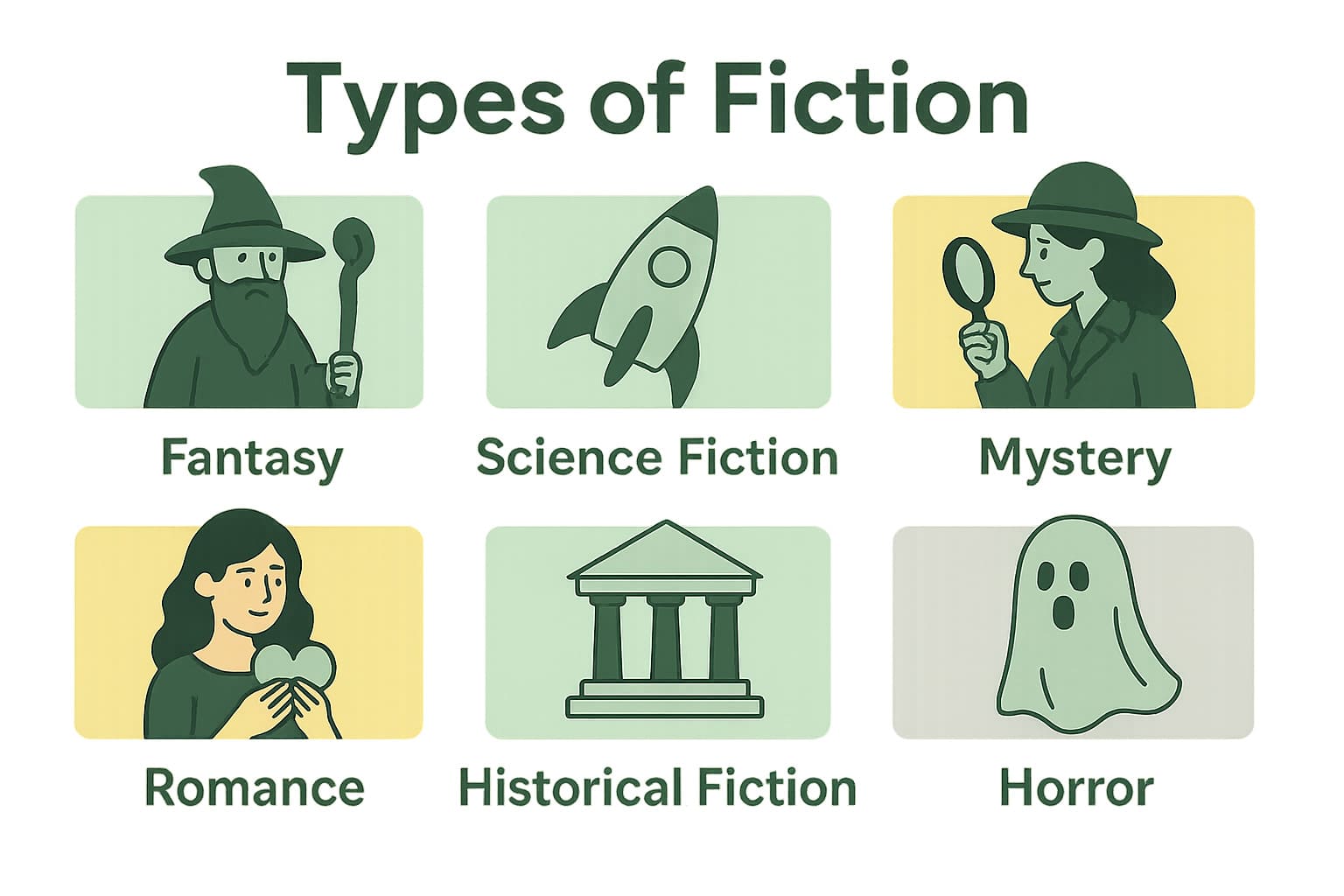
Fiction covers a huge range of genres. Here are the most popular types:
1. What is Science Fiction?
Science fiction (sci-fi) explores futuristic ideas, advanced technology, space, time travel, or scientific possibilities.
Example: A story about humans living on Mars or robots developing emotions.
2. What is Historical Fiction?
Historical fiction is set in a real time period from the past, but the characters or events can be partly or fully imagined.
Example: A fictional love story set during the Mughal era or World War II.
3. What is Realistic Fiction?
Realistic fiction includes stories that could happen in real life. The characters, settings, and events feel normal and believable.
Example: A novel about a teenage girl dealing with school, friendships, and anxiety.
4. What is Speculative Fiction?
Speculative fiction asks “What if?” and explores worlds or situations that don’t exist in our reality. It includes fantasy, sci-fi, dystopian, and supernatural stories.
Example: What if humans could read each other’s thoughts?
5. What is Literary Fiction?
Literary fiction focuses on deep themes, character growth, and emotional or philosophical meaning rather than fast-paced plots.
Example: A story exploring grief, identity, or relationships in a thoughtful way.
6. What is Pulp Fiction?
Pulp fiction refers to fast, entertaining, dramatic stories, usually crime, mystery, adventure, or horror, originally printed on cheap “pulp” paper.
Example: Detective stories with bold heroes, gangsters, or shocking twists.
7. What is Flash Fiction?
Flash fiction is a very short story, often under 1,000 words, that still has a complete moment or message.
Example: A 300-word story about someone meeting their childhood friend unexpectedly.
8. What is Fan Fiction?
Fan fiction is written by fans using characters or worlds from existing books, movies, or games.
Example: A story where Hermione and Draco from Harry Potter become friends.
9. What is Dystopian Fiction?
Dystopian fiction shows a society that has gone wrong, often controlled, unfair, or futuristic.
Example: A world where every citizen is watched by the government 24/7.
10. What is Contemporary Fiction?
Contemporary fiction is set in the present day and reflects modern life, culture, and issues.
Example: A story about influencers, online dating, or workplace challenges.
11. What is Upmarket Fiction?
Upmarket fiction sits between literary and commercial fiction. It has meaningful themes like literary fiction, but is also engaging and plot-driven like commercial fiction.
Example: The Kite Runner – emotional, deep, but easy to read.
12. What is Gothic Fiction?
Gothic fiction mixes mystery, dark atmosphere, fear, and sometimes supernatural elements.
Example: A haunted mansion, a family curse, or a lonely castle with secrets.
13. What is Fiction in Literature?
Fiction in literature simply means stories created from imagination rather than real events. It includes novels, short stories, and novellas.
Example: Alice in Wonderland, The Alchemist, The Hobbit.
14. What is Commercial Fiction?
Commercial fiction is written for wide mainstream appeal. It’s fast-paced, easy to read, and often genre-based (romance, thriller, mystery, fantasy).
Example: A page-turning thriller about a missing person.
15. What is Split Fiction?
Split fiction usually refers to stories told through two or more alternating timelines, narrators, or perspectives.
Example: A novel where one chapter follows a woman in 2025 and the next chapter follows her grandmother in the 1970s, and their stories connect.
Examples of Fiction
To understand fiction better, here are simple examples:
1. Harry Potter – Fantasy fiction
Harry Potter is a fantasy fiction because it takes place in a magical world that doesn’t exist in real life. The story has wizards, spells, magical creatures, and a school called Hogwarts. None of these things is real, but they feel believable within the story. Fantasy fiction lets readers escape into an imaginative world full of wonder and adventure.
2. Sherlock Holmes – Detective fiction
The Sherlock Holmes stories follow a brilliant detective who solves tricky mysteries using logic, clues, and sharp observation. Detective fiction focuses on crime, secrets, and uncovering the truth. We follow Sherlock and his friend Dr. Watson as they investigate unusual cases. The excitement comes from guessing “who did it” and how the mystery will be solved.
3. Pride and Prejudice – Romantic fiction
Pride and Prejudice is a classic romance story about love, misunderstandings, and relationships. It follows Elizabeth Bennet and Mr. Darcy as they gradually overcome their pride, assumptions, and differences. Romantic fiction focuses on emotions, attraction, and how two people come together despite obstacles. It’s relatable because it deals with real feelings and human behavior.
4. 1984 – Dystopian fiction
1984 is dystopian fiction because it shows a dark, controlled, and frightening version of the future. In the story, the government watches everyone, controls information, and limits freedom. Dystopian fiction warns us about what can go wrong in society if power is misused. These stories make us think about freedom, truth, and human rights.
5. The Avengers – Superhero fiction
The Avengers is superhero fiction because it features characters with special powers, extraordinary abilities, or advanced technology. These heroes work together to fight threats and save the world. Superhero fiction blends action, adventure, and imagination. It’s exciting because it mixes human emotions with larger-than-life battles and heroic moments.
All of them are invented worlds, but they resonate because they explore real emotions.
Fiction vs Non-Fiction (Key Differences)
| Fiction | Non-Fiction |
| Imaginary, created from imagination | Based on real events, facts, or information |
| Uses invented characters and settings | Uses real people, places, and events |
| Focuses on storytelling and creativity | Focuses on accuracy and factual detail |
Both are valuable, but they serve different purposes.
Fiction is the art of storytelling built on imagination.
It spans genres, cultures, and eras, serving as both entertainment and emotional insight. Be it a novel or a movie, fiction is a gateway into worlds that help you better understand your own.
If you’re a writer and have written your own piece of fiction, PaperTrue is here to help you. Our expert self-publishing services will help you publish your fiction and make your writing shine!
Read for more useful tips: